Forward thinking
What’s next for AI
March 2017
bit.ly/ibm-ai-future
2
Thinking beyond today
In the past few years, we have seen significant strides in analytics,
machine learning and artificial intelligence techniques. While we’re
only beginning to scratch the surface of what AI can help us do,
many are already working on what’s next.
We interviewed 30 AI experts to get their take on what advances
in AI technology and applications we can expect in the next decade.
© IBM, 2017
Necessity is the mother of innovation
“Faced with a constant onslaught of data, we
needed a new type of system that learns and
adapts, and we now have that with AI. What
was deemed impossible a few years ago is not
only becoming possible, it’s very quickly
becoming necessary and expected.”
— Arvind Krishna, Senior Vice President
of Hybrid Cloud and Director of IBM Research
© IBM, 20173
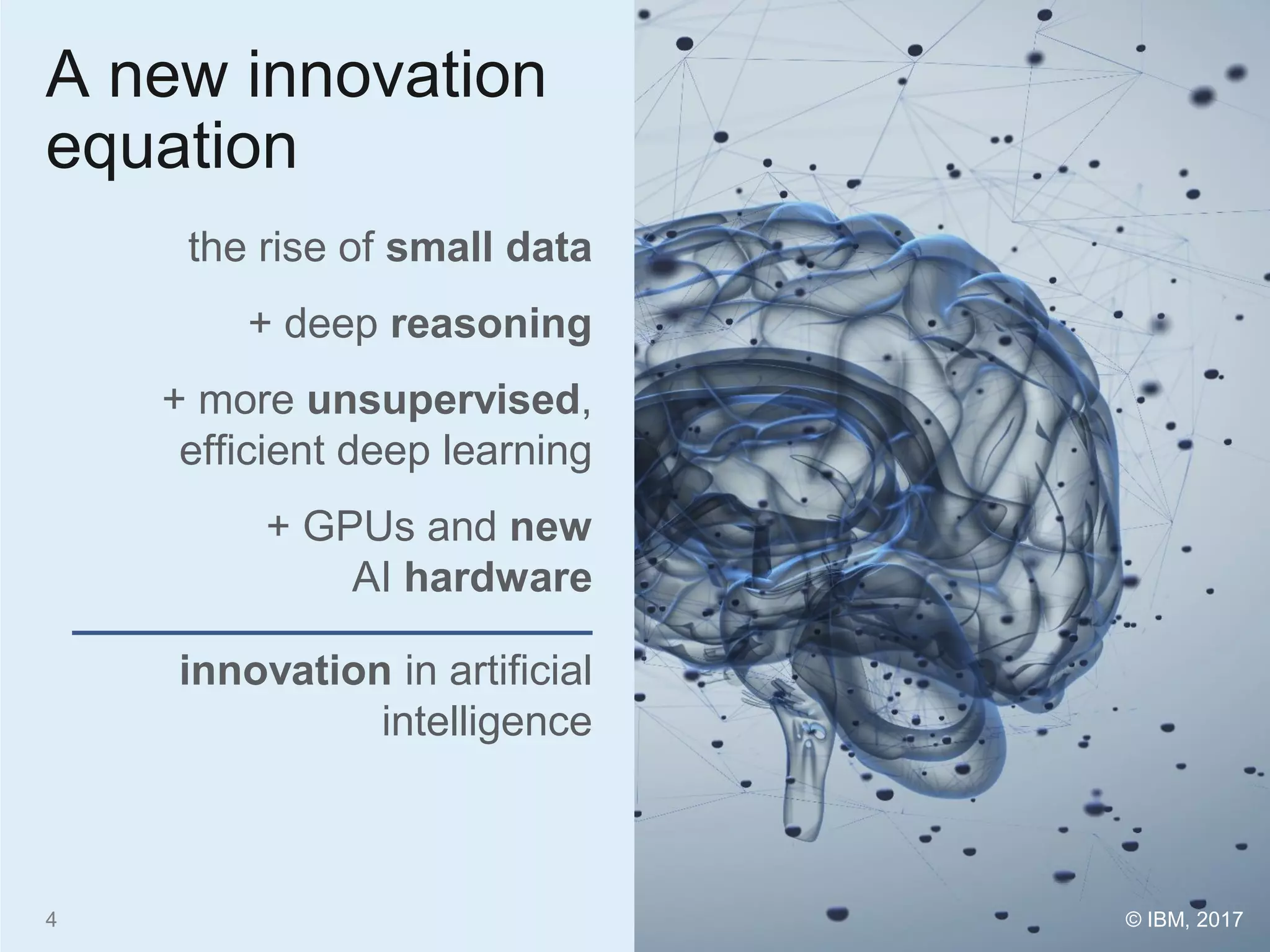
A new innovation
equation
the rise of small data
+ deep reasoning
+ more unsupervised,
efficient deep learning
+ GPUs and new
AI hardware
innovation in artificial
intelligence
4 © IBM, 2017
5
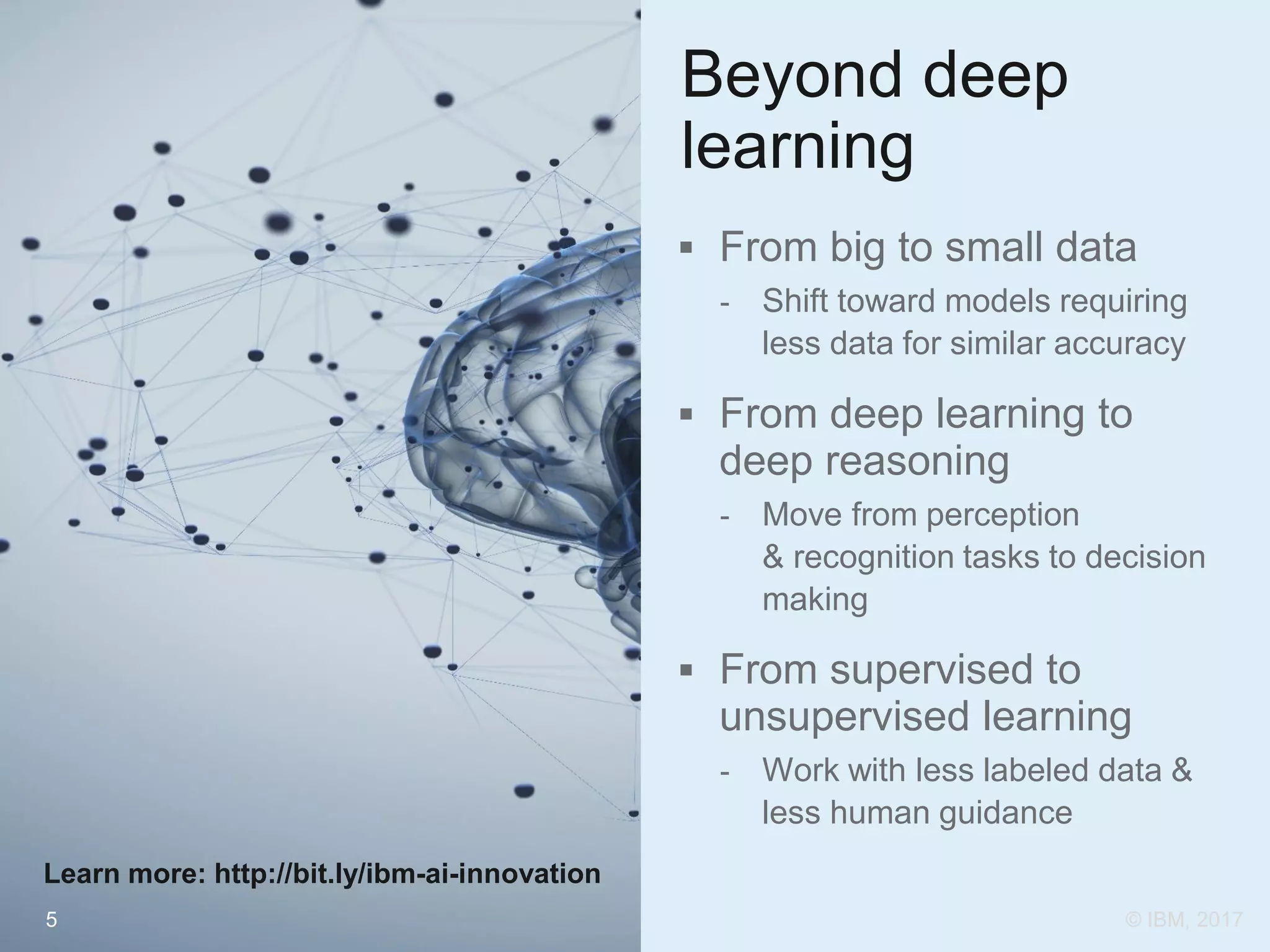
Beyond deep
learning
 From big to small data
- Shift toward models requiring
less data for similar accuracy
 From deep learning to
deep reasoning
- Move from perception
& recognition tasks to decision
making
 From supervised to
unsupervised learning
- Work with less labeled data &
less human guidance
Learn more: http://bit.ly/ibm-ai-innovation
© IBM, 2017
Breaking the language barrier
“Language is a very tough nut to crack because
it allows us in a succinct way, without using a
whole lot of symbols, to say an extraordinarily
diverse set of things. It’s a significantly more
complex problem than perception, recognizing
objects or moving from speech to text.”
— Vijay Saraswat, Chief Scientist
for IBM Compliance Solutions
6 © IBM, 2017
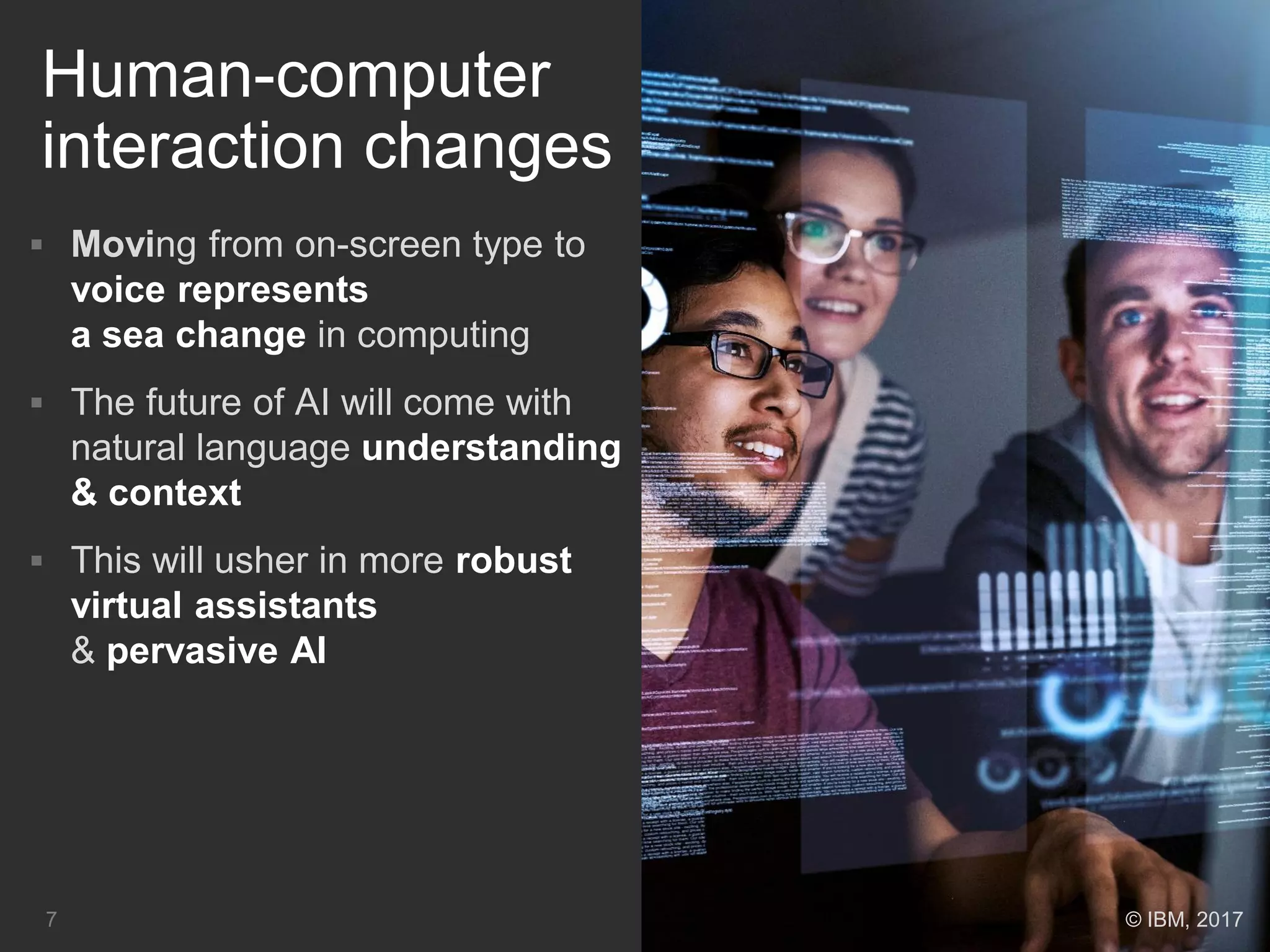
Human-computer
interaction changes
 Moving from on-screen type to
voice represents
a sea change in computing
 The future of AI will come with
natural language understanding
& context
 This will usher in more robust
virtual assistants
& pervasive AI
7 © IBM, 2017
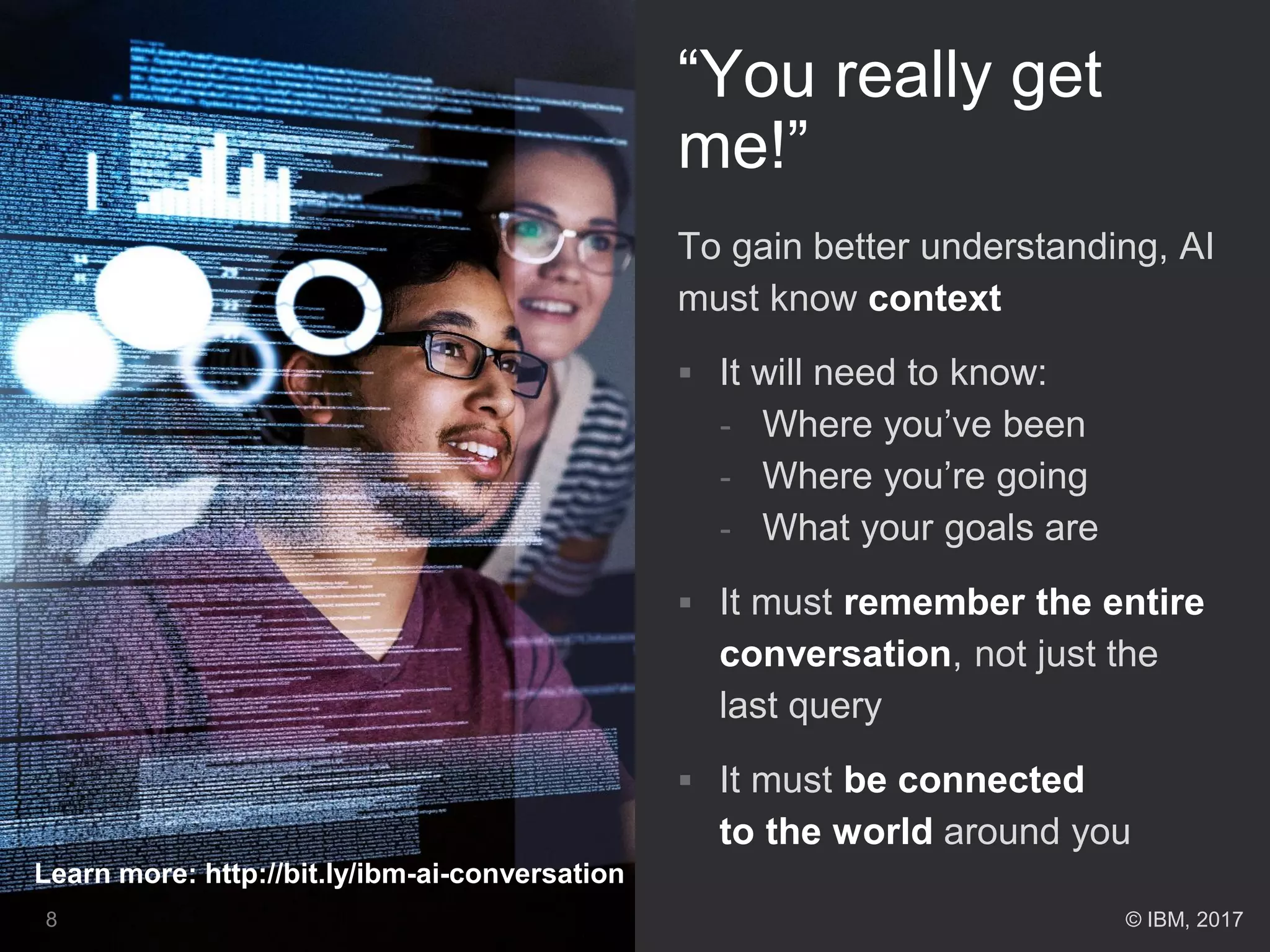
“You really get
me!”
To gain better understanding, AI
must know context
 It will need to know:
- Where you’ve been
- Where you’re going
- What your goals are
 It must remember the entire
conversation, not just the
last query
 It must be connected
to the world around you
8
Learn more: http://bit.ly/ibm-ai-conversation
© IBM, 2017
Creativity is in the eye of the beholder
“We still have to define what creativity means.
We know some attributes like something that
is novel and unexpected, yet useful. It’s easy
for AI to come up with something novel just
randomly. But it’s very hard for it to come up
with something that is novel and unexpected
and useful.”
— John Smith, Manager of
Multimedia and Vision at IBM Research
9 © IBM, 2017
The quest for AI
creativity
 AI does well as a creative
“mimic”
 It can reduce the mundane
execution tasks in creative
work
 AI can also serve as
inspiration for human
creativity.
 But can it — or should it — be
taught to be innately creative?
10 © IBM, 2017
Where does AI
fit?
 Teaching computers to be
creative is different from the
way humans learn to create.
 How can computers learn the
subjective idea of beauty?
By studying pixels? Color
palettes?
 In the end, AI will most likely
remain a creative partner.
Learn more: http://bit.ly/ibm-ai-creativity
11 © IBM, 2017
Keeping watch
“AI can be used for social good. It can be used
for business purposes. But it can also be used
for other types of social impact in which one
man's good is another man's evil. We must
remain aware of that.”
— James Hendler, Director of the Institute for
Data Exploration and Applications,
Rensselaer Polytechnic Institute
12 © IBM, 2017
Building trust in AI
There is a wealth of potential for
artificial intelligence if we foster it
properly. To do this, we need:
 Constant transparency into AI
systems & explanations for
their recommendations
 General education on AI
 Common standards for
interoperability & integration
 High ethical standards for
AI-driven decisions
 Continued collaboration
between scientists, academics,
industry, & government
13 © IBM, 2017
Whose values?
 Instilling human values in AI is
challenging, but possible
 First, we must determine
whose values to use
 Should computers be held to a
different set of values than
humans?
 We must vigilantly prevent bias
from entering AI systems
 And accept that computers
might be imperfect ethical
actors because they will not
feel emotion & consequences
like humans do
Learn more: http://bit.ly/ibm-ai-trust
14 © IBM, 2017
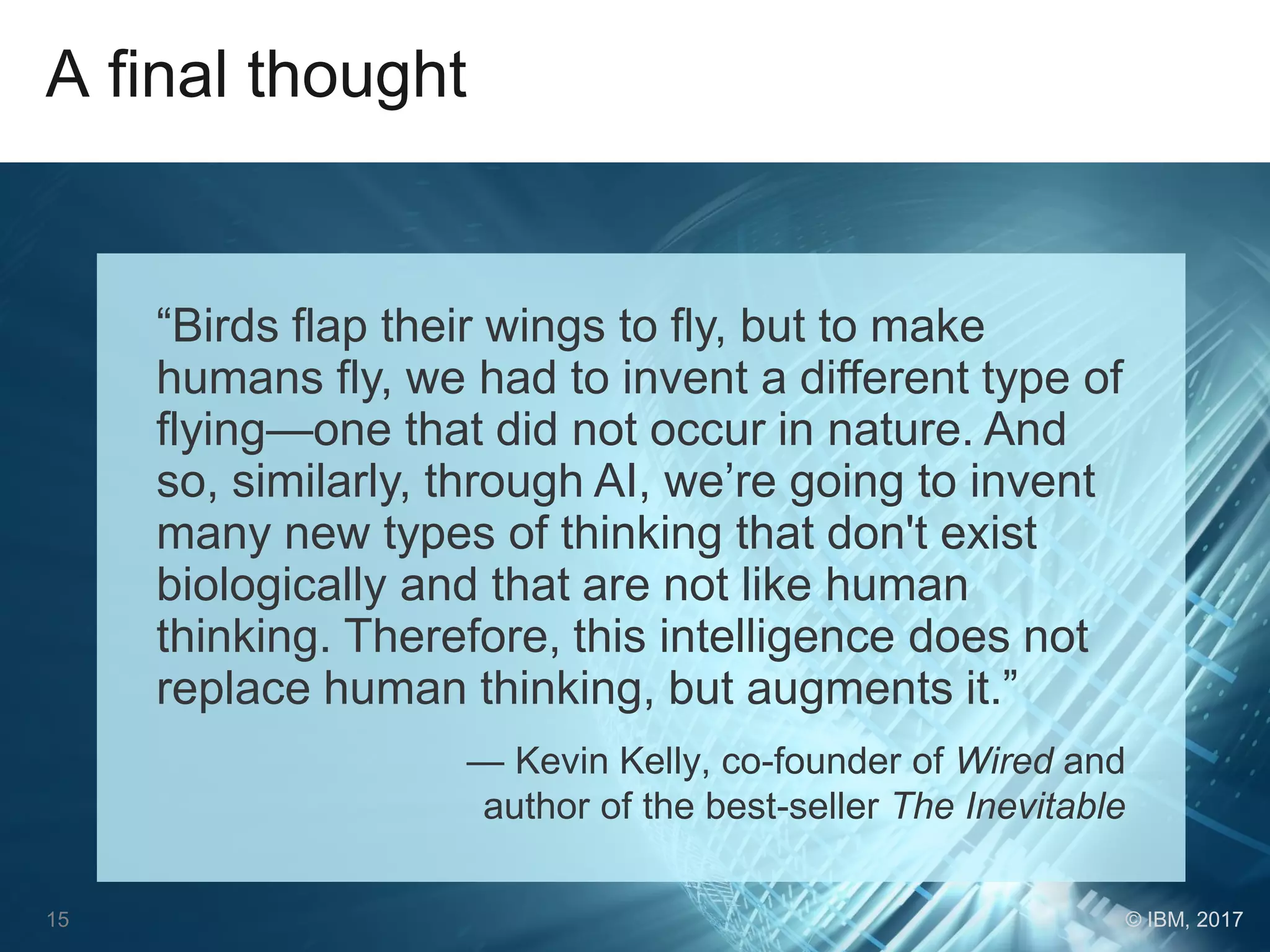
A final thought
“Birds flap their wings to fly, but to make
humans fly, we had to invent a different type of
flying—one that did not occur in nature. And
so, similarly, through AI, we’re going to invent
many new types of thinking that don't exist
biologically and that are not like human
thinking. Therefore, this intelligence does not
replace human thinking, but augments it.”
— Kevin Kelly, co-founder of Wired and
author of the best-seller The Inevitable
15 © IBM, 2017
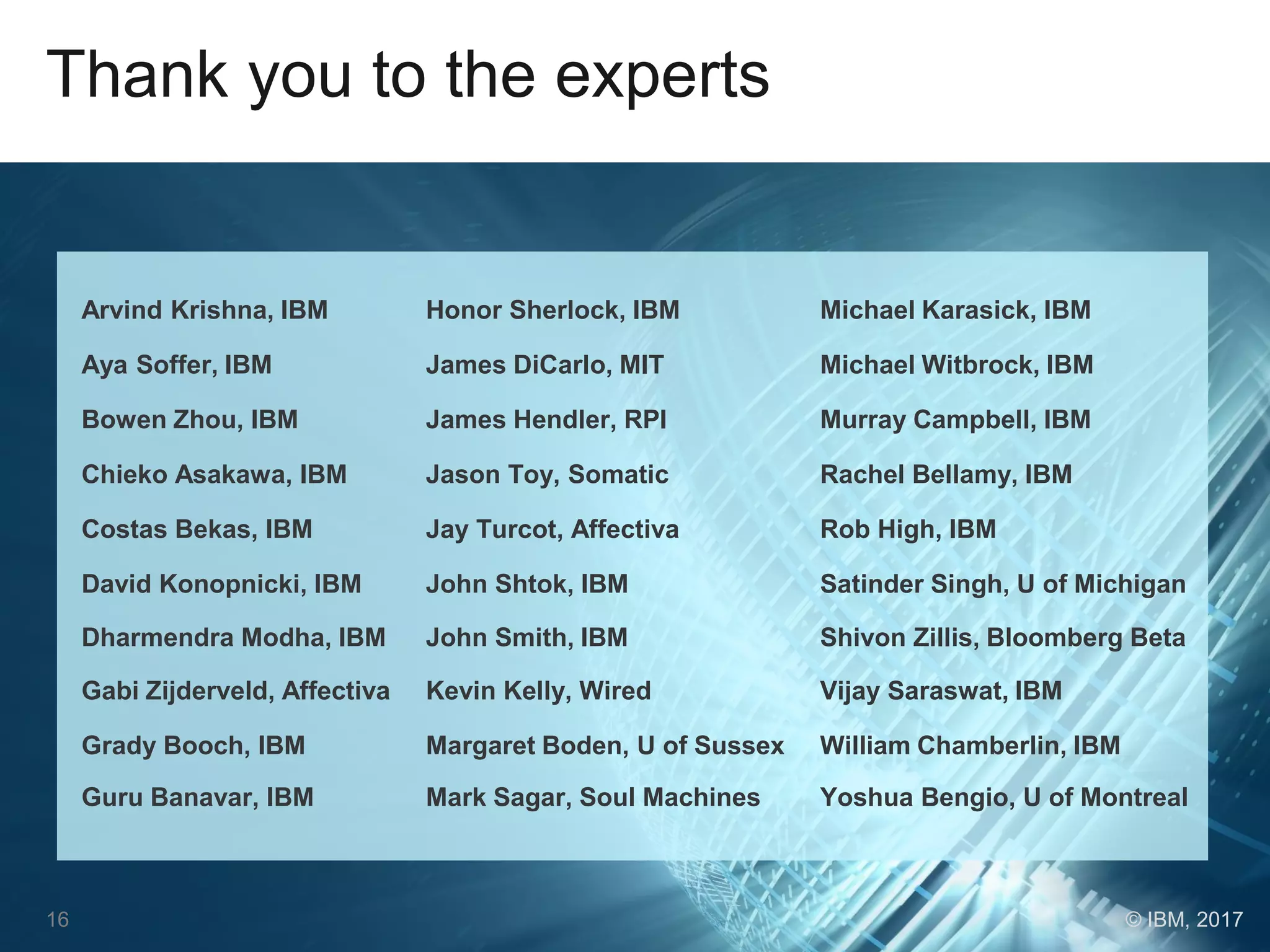
Thank you to the experts
Arvind Krishna, IBM Honor Sherlock, IBM Michael Karasick, IBM
Aya Soffer, IBM James DiCarlo, MIT Michael Witbrock, IBM
Bowen Zhou, IBM James Hendler, RPI Murray Campbell, IBM
Chieko Asakawa, IBM Jason Toy, Somatic Rachel Bellamy, IBM
Costas Bekas, IBM Jay Turcot, Affectiva Rob High, IBM
David Konopnicki, IBM John Shtok, IBM Satinder Singh, U of Michigan
Dharmendra Modha, IBM John Smith, IBM Shivon Zillis, Bloomberg Beta
Gabi Zijderveld, Affectiva Kevin Kelly, Wired Vijay Saraswat, IBM
Grady Booch, IBM Margaret Boden, U of Sussex William Chamberlin, IBM
Guru Banavar, IBM Mark Sagar, Soul Machines Yoshua Bengio, U of Montreal
16 © IBM, 2017
Author: Laura DeLallo,
Senior Editor, IBM
Contact: lauradelallo@us.ibm.com
@ldelall0
Report: bit.ly/ibm-ai-future
IBM Research: research.ibm.com
© Copyright IBM Corporation 2017
IBM Corporation
New Orchard Road
Armonk, NY 10504
Produced in the United States of America
March 2017
IBM, the IBM logo and ibm.com are trademarks of International
Business Machines Corporation in the United States, other countries
or both. If these and other IBM trademarked terms are marked on
their first occurrence in this information with a trademark symbol (®
or TM), these symbols indicate U.S. registered or common law
trademarks owned by IBM at the time this information was
published. Such trademarks may also be registered or common law
trademarks in other countries. Other product, company or service
names may be trademarks or service marks of others. A current list
of IBM trademarks is available on the web at “Copyright and
trademark information” at ibm.com/legal/copytrade.shtml
This document is current as of the initial date of publication and may
be changed by IBM at any time. Not all offerings are available in
every country in which IBM operates.
THE INFORMATION IN THIS DOCUMENT IS PROVIDED “AS IS”
WITHOUT ANY WARRANTY, EXPRESS OR IMPLIED, INCLUDING
WITHOUT ANY WARRANTIES OF MERCHANTABILITY, FITNESS
FOR A PARTICULAR PURPOSE AND ANY WARRANTY OR
CONDITION OF NON-INFRINGEMENT. IBM products are
warranted according to the terms and conditions of the agreements
under which they are provided.
17

Forward thinking: What's next for AI

  • 1.
    Forward thinking What’s nextfor AI March 2017 bit.ly/ibm-ai-future
  • 2.
    2 Thinking beyond today Inthe past few years, we have seen significant strides in analytics, machine learning and artificial intelligence techniques. While we’re only beginning to scratch the surface of what AI can help us do, many are already working on what’s next. We interviewed 30 AI experts to get their take on what advances in AI technology and applications we can expect in the next decade. © IBM, 2017
  • 3.
    Necessity is themother of innovation “Faced with a constant onslaught of data, we needed a new type of system that learns and adapts, and we now have that with AI. What was deemed impossible a few years ago is not only becoming possible, it’s very quickly becoming necessary and expected.” — Arvind Krishna, Senior Vice President of Hybrid Cloud and Director of IBM Research © IBM, 20173
  • 4.
    A new innovation equation therise of small data + deep reasoning + more unsupervised, efficient deep learning + GPUs and new AI hardware innovation in artificial intelligence 4 © IBM, 2017
  • 5.
    5 Beyond deep learning  Frombig to small data - Shift toward models requiring less data for similar accuracy  From deep learning to deep reasoning - Move from perception & recognition tasks to decision making  From supervised to unsupervised learning - Work with less labeled data & less human guidance Learn more: http://bit.ly/ibm-ai-innovation © IBM, 2017
  • 6.
    Breaking the languagebarrier “Language is a very tough nut to crack because it allows us in a succinct way, without using a whole lot of symbols, to say an extraordinarily diverse set of things. It’s a significantly more complex problem than perception, recognizing objects or moving from speech to text.” — Vijay Saraswat, Chief Scientist for IBM Compliance Solutions 6 © IBM, 2017
  • 7.
    Human-computer interaction changes  Movingfrom on-screen type to voice represents a sea change in computing  The future of AI will come with natural language understanding & context  This will usher in more robust virtual assistants & pervasive AI 7 © IBM, 2017
  • 8.
    “You really get me!” Togain better understanding, AI must know context  It will need to know: - Where you’ve been - Where you’re going - What your goals are  It must remember the entire conversation, not just the last query  It must be connected to the world around you 8 Learn more: http://bit.ly/ibm-ai-conversation © IBM, 2017
  • 9.
    Creativity is inthe eye of the beholder “We still have to define what creativity means. We know some attributes like something that is novel and unexpected, yet useful. It’s easy for AI to come up with something novel just randomly. But it’s very hard for it to come up with something that is novel and unexpected and useful.” — John Smith, Manager of Multimedia and Vision at IBM Research 9 © IBM, 2017
  • 10.
    The quest forAI creativity  AI does well as a creative “mimic”  It can reduce the mundane execution tasks in creative work  AI can also serve as inspiration for human creativity.  But can it — or should it — be taught to be innately creative? 10 © IBM, 2017
  • 11.
    Where does AI fit? Teaching computers to be creative is different from the way humans learn to create.  How can computers learn the subjective idea of beauty? By studying pixels? Color palettes?  In the end, AI will most likely remain a creative partner. Learn more: http://bit.ly/ibm-ai-creativity 11 © IBM, 2017
  • 12.
    Keeping watch “AI canbe used for social good. It can be used for business purposes. But it can also be used for other types of social impact in which one man's good is another man's evil. We must remain aware of that.” — James Hendler, Director of the Institute for Data Exploration and Applications, Rensselaer Polytechnic Institute 12 © IBM, 2017
  • 13.
    Building trust inAI There is a wealth of potential for artificial intelligence if we foster it properly. To do this, we need:  Constant transparency into AI systems & explanations for their recommendations  General education on AI  Common standards for interoperability & integration  High ethical standards for AI-driven decisions  Continued collaboration between scientists, academics, industry, & government 13 © IBM, 2017
  • 14.
    Whose values?  Instillinghuman values in AI is challenging, but possible  First, we must determine whose values to use  Should computers be held to a different set of values than humans?  We must vigilantly prevent bias from entering AI systems  And accept that computers might be imperfect ethical actors because they will not feel emotion & consequences like humans do Learn more: http://bit.ly/ibm-ai-trust 14 © IBM, 2017
  • 15.
    A final thought “Birdsflap their wings to fly, but to make humans fly, we had to invent a different type of flying—one that did not occur in nature. And so, similarly, through AI, we’re going to invent many new types of thinking that don't exist biologically and that are not like human thinking. Therefore, this intelligence does not replace human thinking, but augments it.” — Kevin Kelly, co-founder of Wired and author of the best-seller The Inevitable 15 © IBM, 2017
  • 16.
    Thank you tothe experts Arvind Krishna, IBM Honor Sherlock, IBM Michael Karasick, IBM Aya Soffer, IBM James DiCarlo, MIT Michael Witbrock, IBM Bowen Zhou, IBM James Hendler, RPI Murray Campbell, IBM Chieko Asakawa, IBM Jason Toy, Somatic Rachel Bellamy, IBM Costas Bekas, IBM Jay Turcot, Affectiva Rob High, IBM David Konopnicki, IBM John Shtok, IBM Satinder Singh, U of Michigan Dharmendra Modha, IBM John Smith, IBM Shivon Zillis, Bloomberg Beta Gabi Zijderveld, Affectiva Kevin Kelly, Wired Vijay Saraswat, IBM Grady Booch, IBM Margaret Boden, U of Sussex William Chamberlin, IBM Guru Banavar, IBM Mark Sagar, Soul Machines Yoshua Bengio, U of Montreal 16 © IBM, 2017
  • 17.
    Author: Laura DeLallo, SeniorEditor, IBM Contact: lauradelallo@us.ibm.com @ldelall0 Report: bit.ly/ibm-ai-future IBM Research: research.ibm.com © Copyright IBM Corporation 2017 IBM Corporation New Orchard Road Armonk, NY 10504 Produced in the United States of America March 2017 IBM, the IBM logo and ibm.com are trademarks of International Business Machines Corporation in the United States, other countries or both. If these and other IBM trademarked terms are marked on their first occurrence in this information with a trademark symbol (® or TM), these symbols indicate U.S. registered or common law trademarks owned by IBM at the time this information was published. Such trademarks may also be registered or common law trademarks in other countries. Other product, company or service names may be trademarks or service marks of others. A current list of IBM trademarks is available on the web at “Copyright and trademark information” at ibm.com/legal/copytrade.shtml This document is current as of the initial date of publication and may be changed by IBM at any time. Not all offerings are available in every country in which IBM operates. THE INFORMATION IN THIS DOCUMENT IS PROVIDED “AS IS” WITHOUT ANY WARRANTY, EXPRESS OR IMPLIED, INCLUDING WITHOUT ANY WARRANTIES OF MERCHANTABILITY, FITNESS FOR A PARTICULAR PURPOSE AND ANY WARRANTY OR CONDITION OF NON-INFRINGEMENT. IBM products are warranted according to the terms and conditions of the agreements under which they are provided. 17