TechCon 2020
IBM MQ and Kafka, what is the difference?
David Ware
IBM MQ Chief Architect
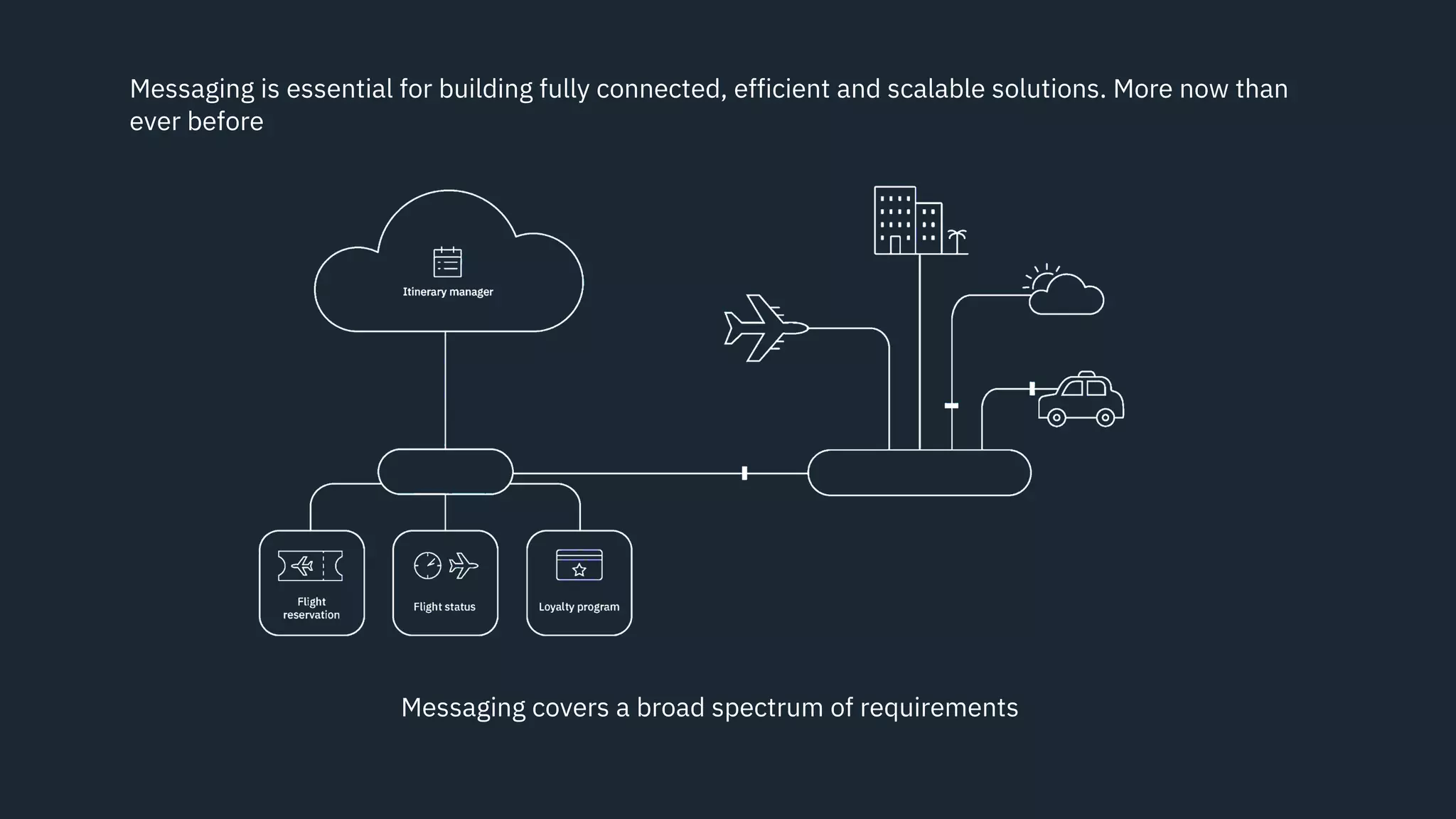
Messaging is essential for building fully connected, efficient and scalable solutions. More now than
ever before
Messaging covers a broad spectrum of requirements
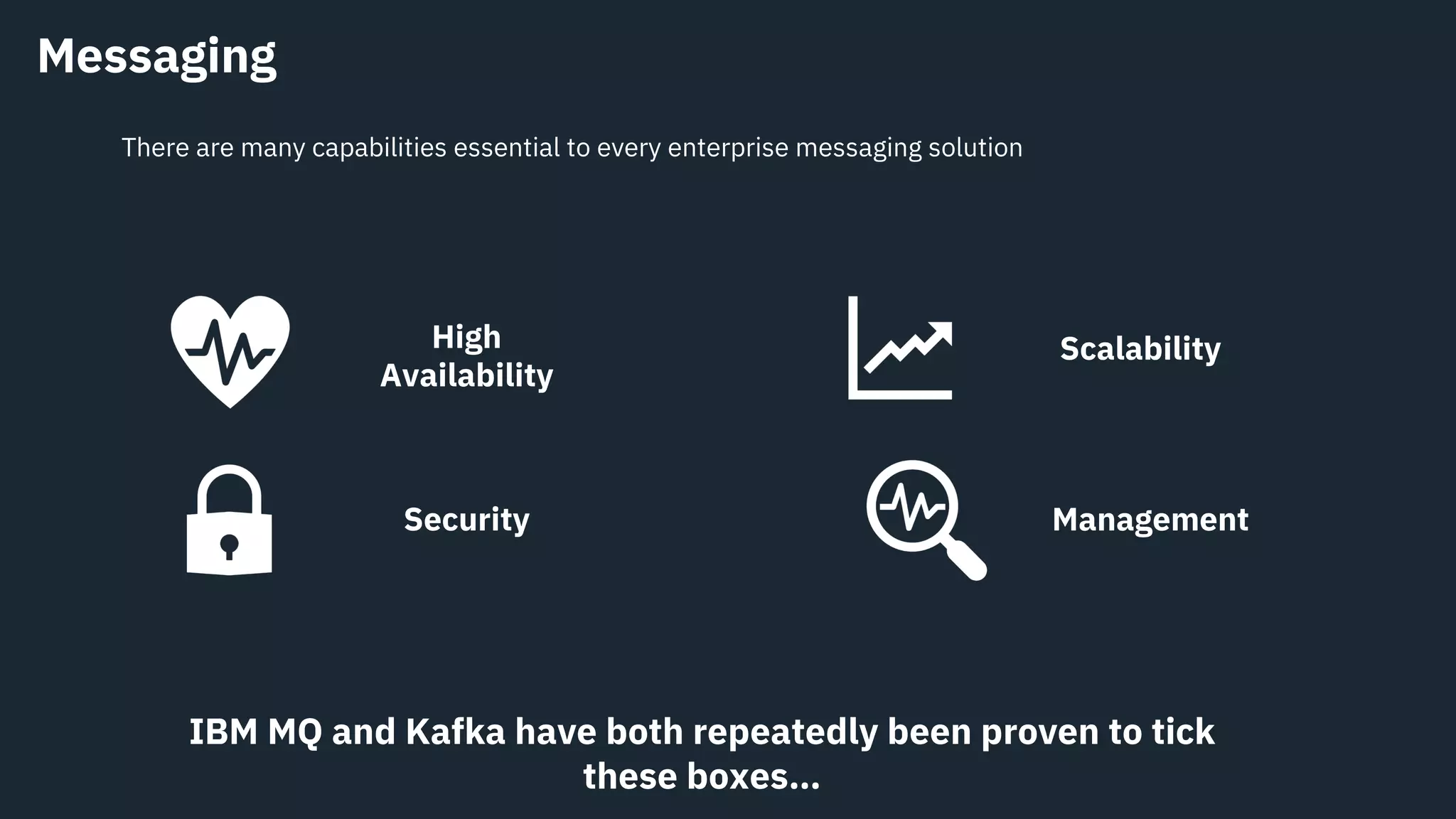
Messaging
Scalability
Security Management
High
Availability
There are many capabilities essential to every enterprise messaging solution
IBM MQ and Kafka have both repeatedly been proven to tick
these boxes…
© 2020 IBM Corporation
So just pick one and move on?
© 2020 IBM Corporation
So just pick one and move on?
Perhaps, if you think
everything looks like a nail
© 2020 IBM Corporation
So just pick one and move on?
Perhaps, if you think
everything looks like a nail
Otherwise, let’s focus on what
you’re trying to achieve…
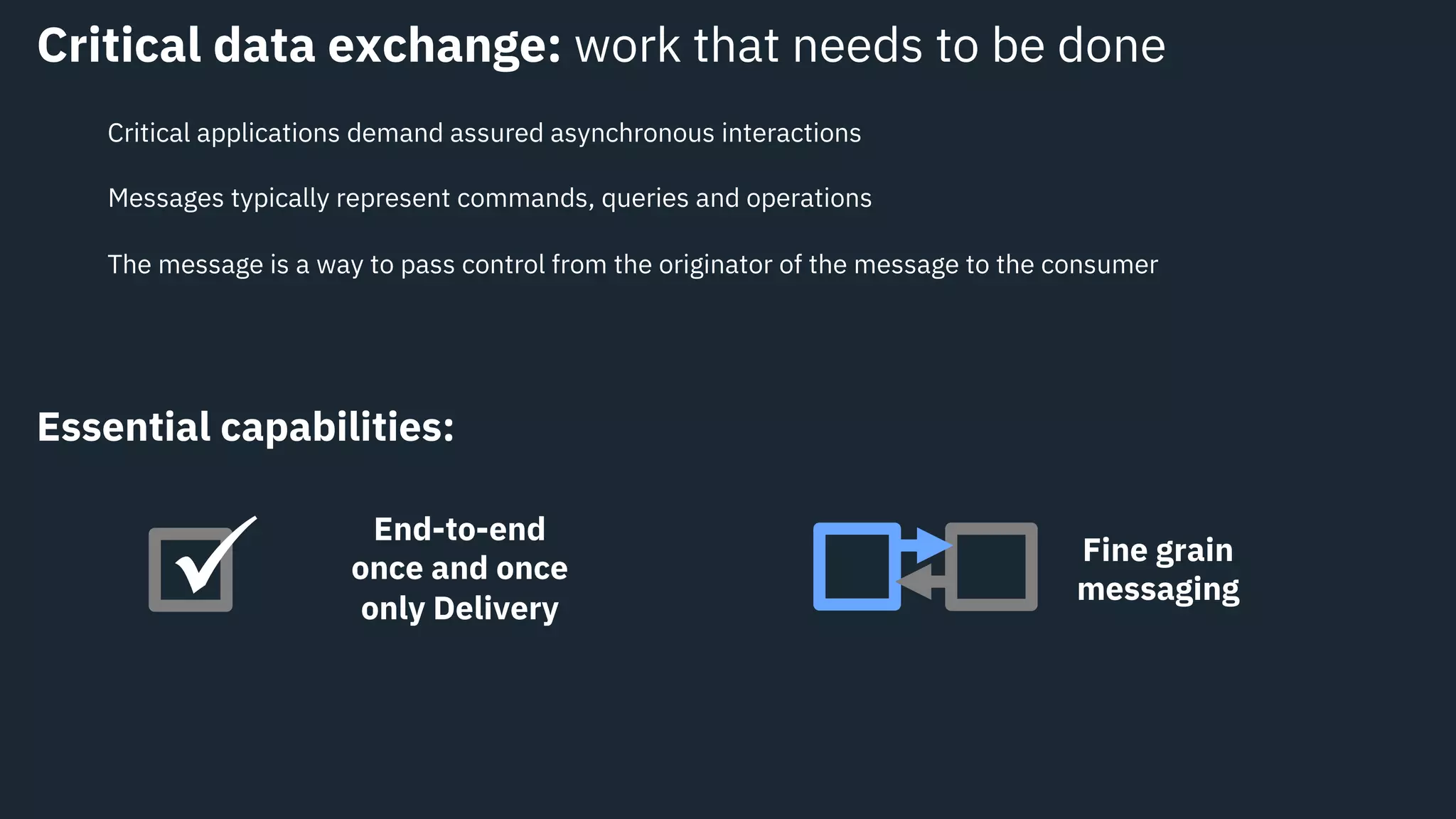
Critical data exchange: work that needs to be done
Critical applications demand assured asynchronous interactions
Essential capabilities:
End-to-end
once and once
only Deliveryü Fine grain
messaging
Messages typically represent commands, queries and operations
The message is a way to pass control from the originator of the message to the consumer
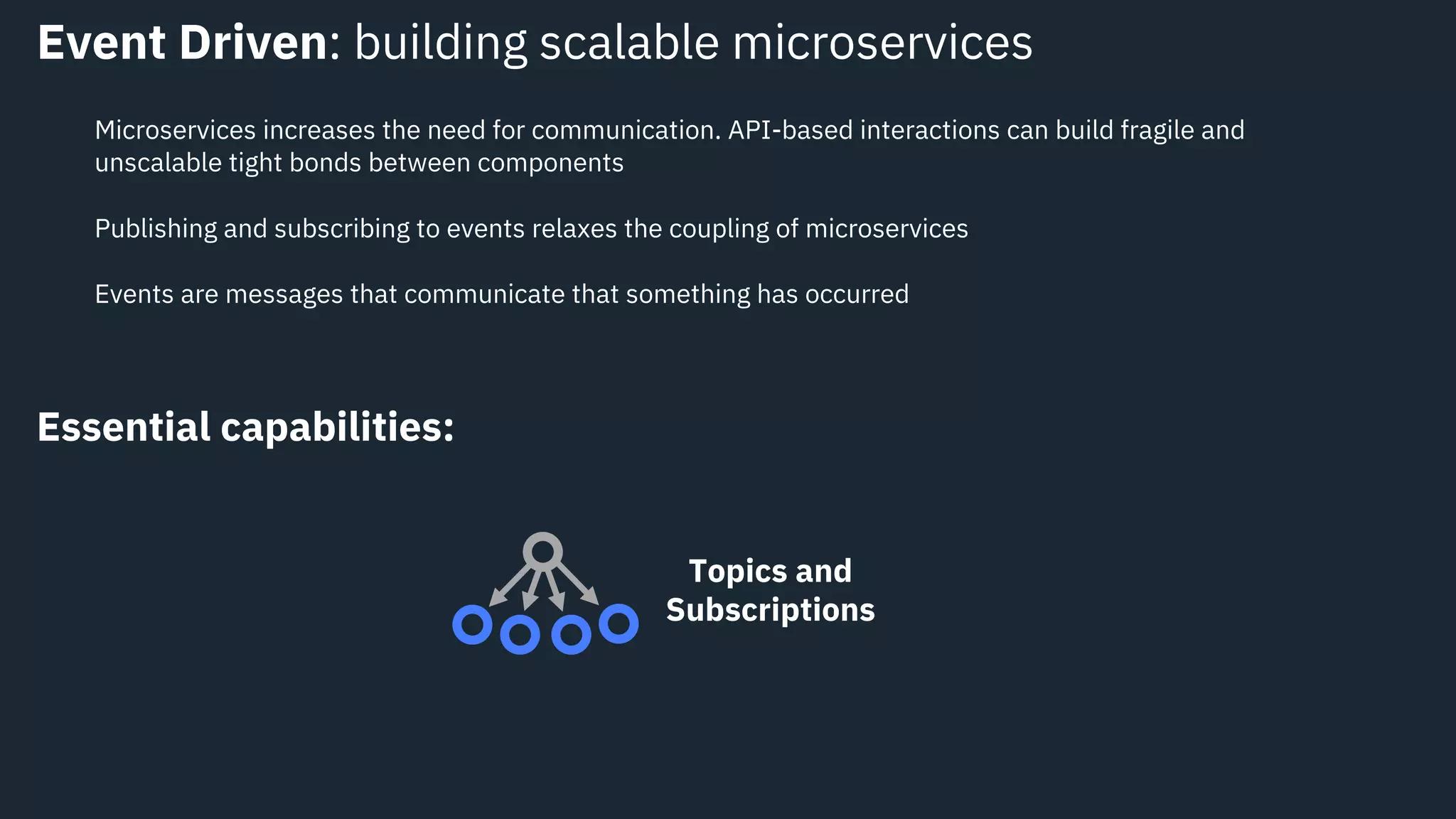
Event Driven: building scalable microservices
Microservices increases the need for communication. API-based interactions can build fragile and
unscalable tight bonds between components
Topics and
Subscriptions
Publishing and subscribing to events relaxes the coupling of microservices
Events are messages that communicate that something has occurred
Essential capabilities:
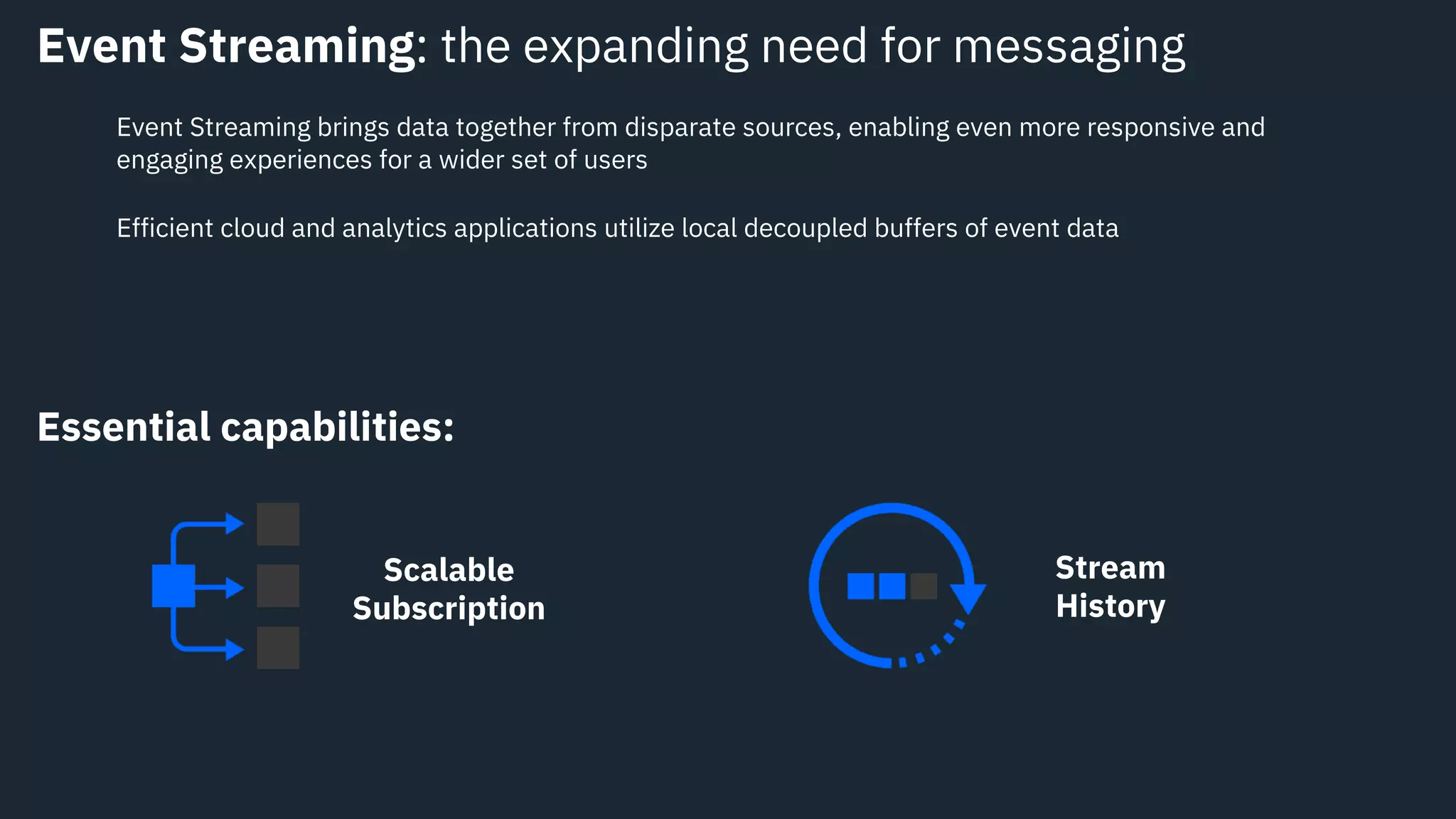
Event Streaming: the expanding need for messaging
Event Streaming brings data together from disparate sources, enabling even more responsive and
engaging experiences for a wider set of users
Scalable
Subscription
Stream
History
Efficient cloud and analytics applications utilize local decoupled buffers of event data
Essential capabilities:
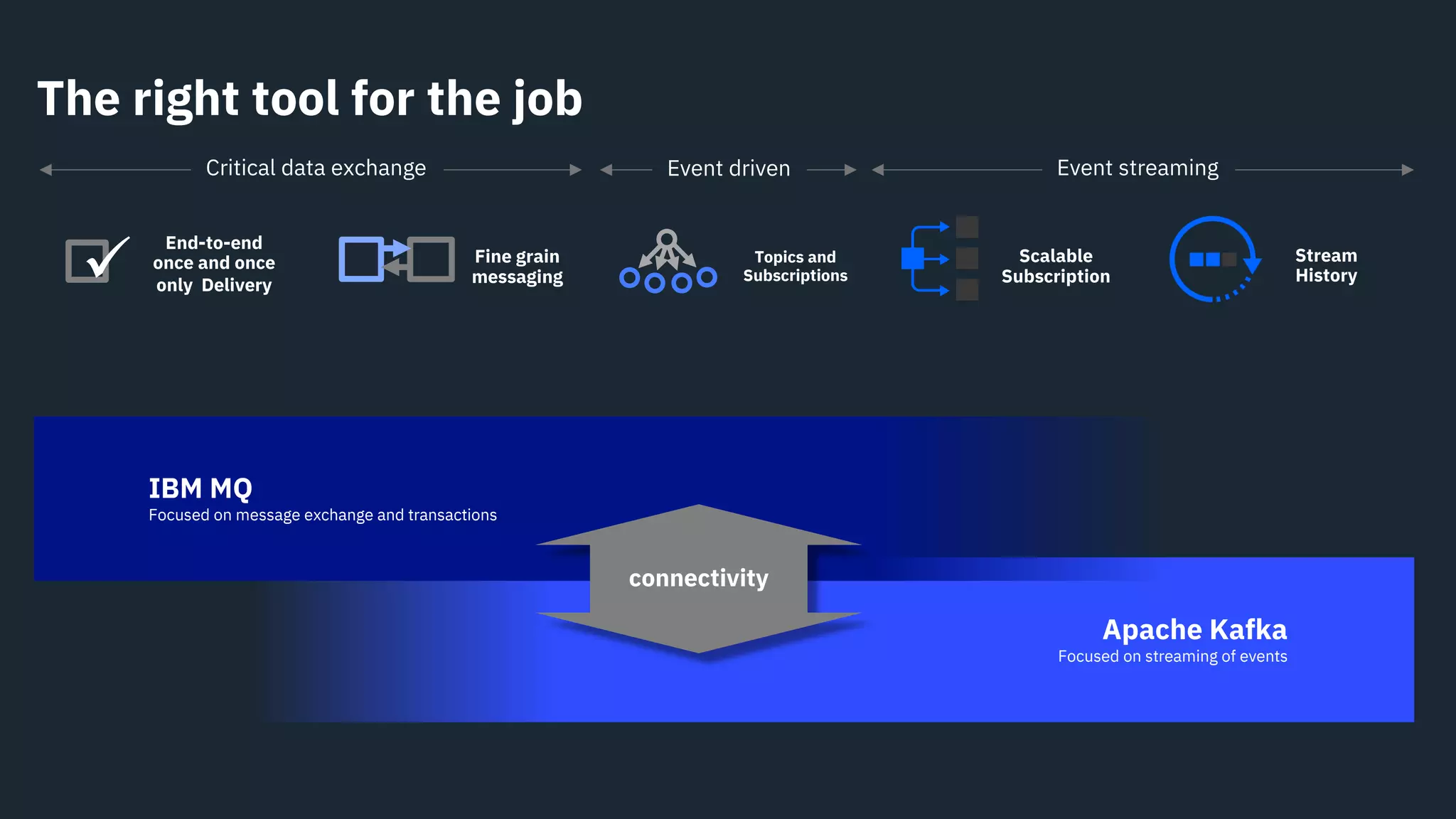
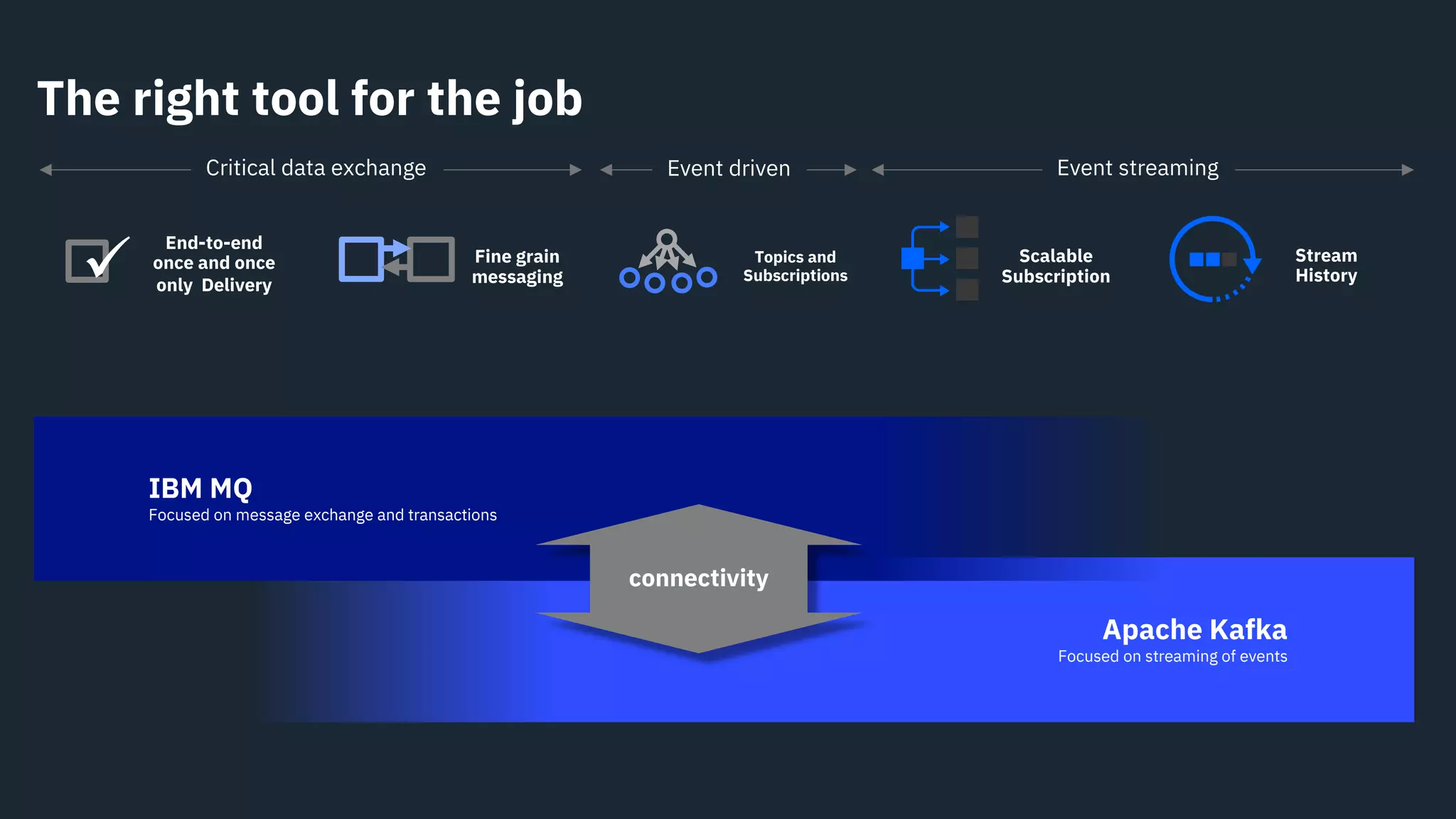
The right tool for the job
Fine grain
messaging
End-to-end
once and once
only Deliveryü Topics and
Subscriptions
Critical data exchange Event driven Event streaming
Apache Kafka
Focused on streaming of events
IBM MQ
Focused on message exchange and transactions
connectivity
Scalable
Subscription
Stream
History
© 2020 IBM Corporation
To choose the right tool
you’re probably going to
need to go to the next level…
© 2020 IBM Corporation
Message consumption
© 2019 IBM Corporation
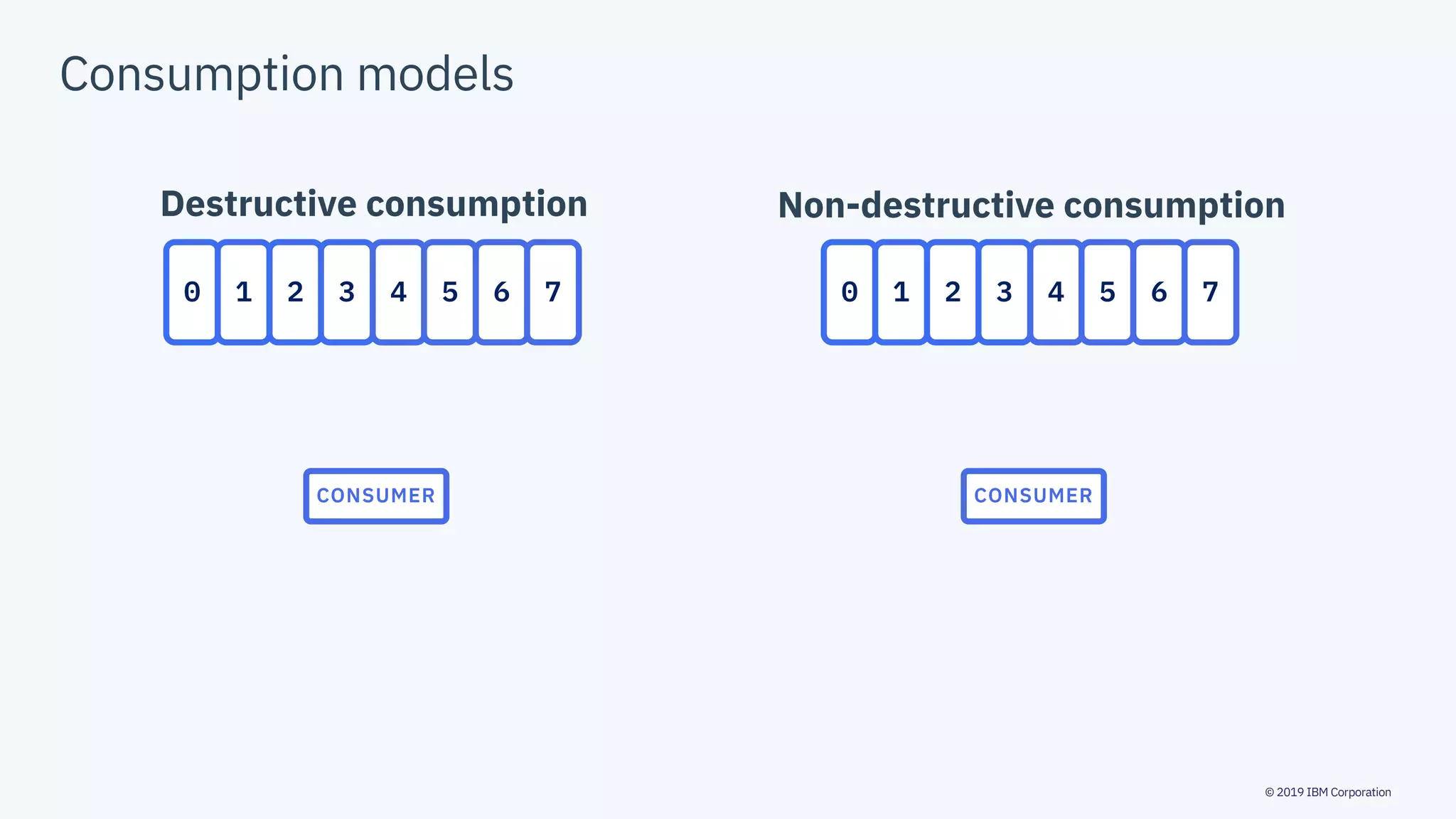
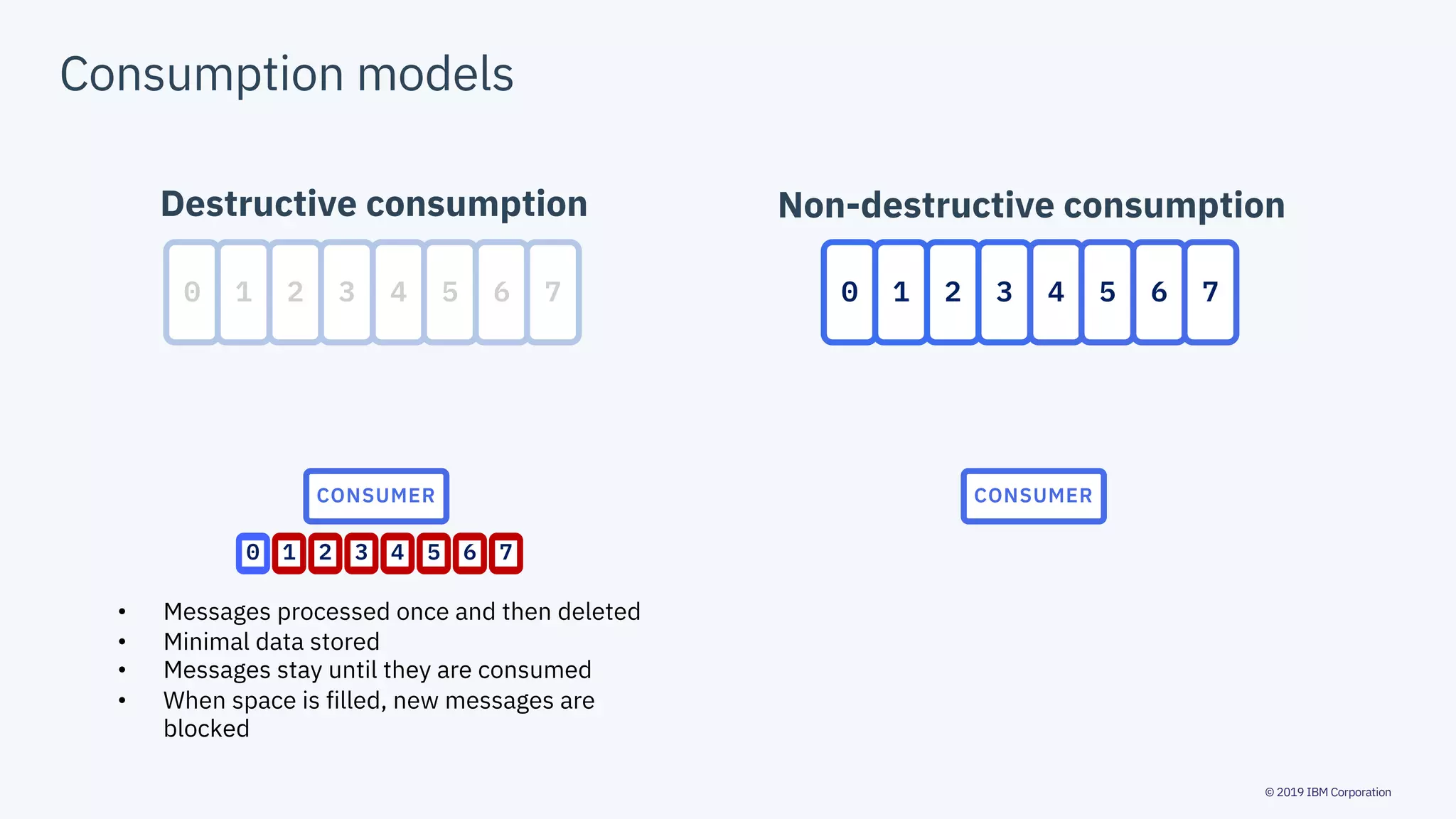
Consumption models
0 1 2 3 4 5 6 7
CONSUMER
0 1 2 3 4 5 6 7
CONSUMER
Destructive consumption Non-destructive consumption
© 2019 IBM Corporation
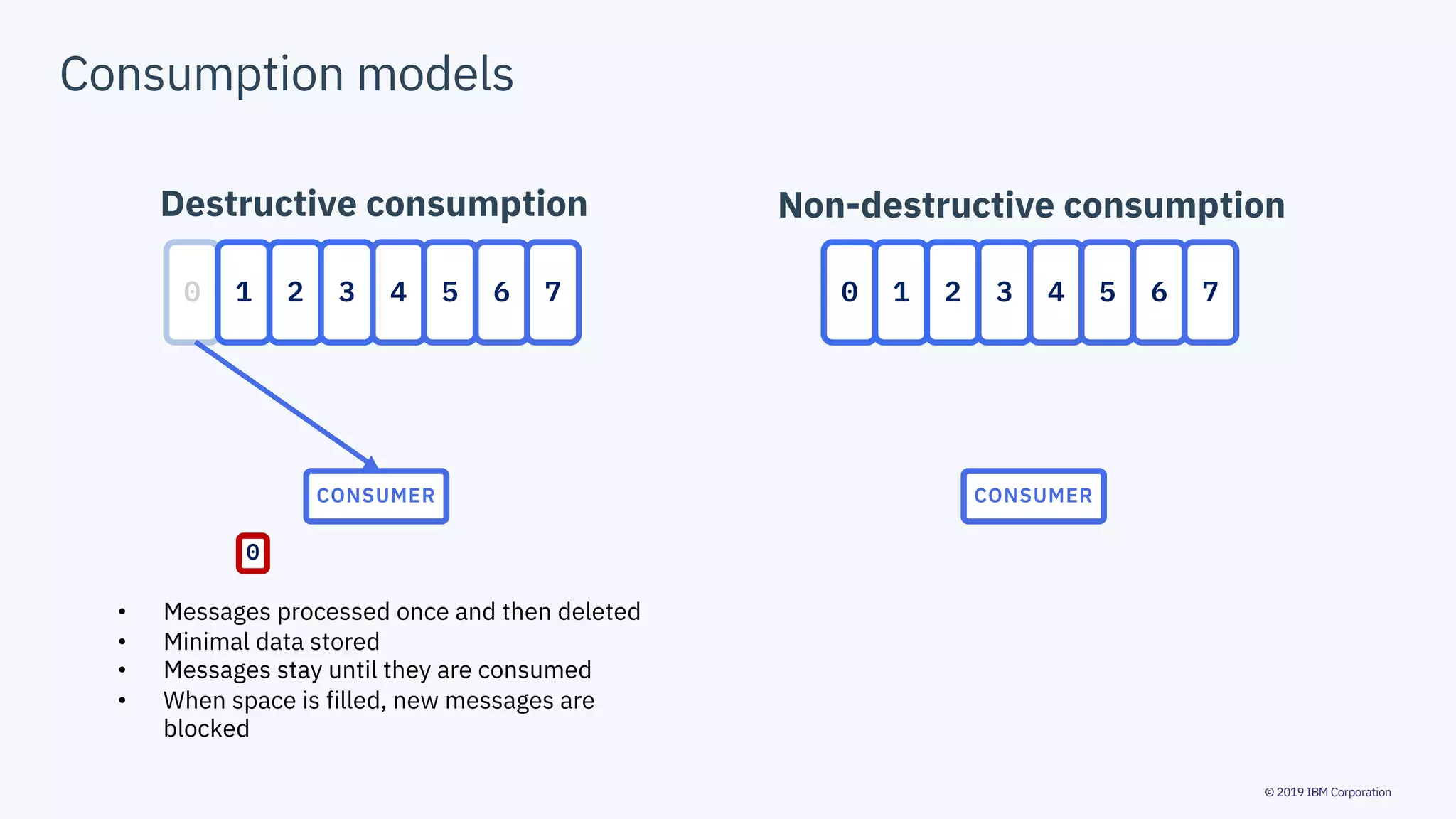
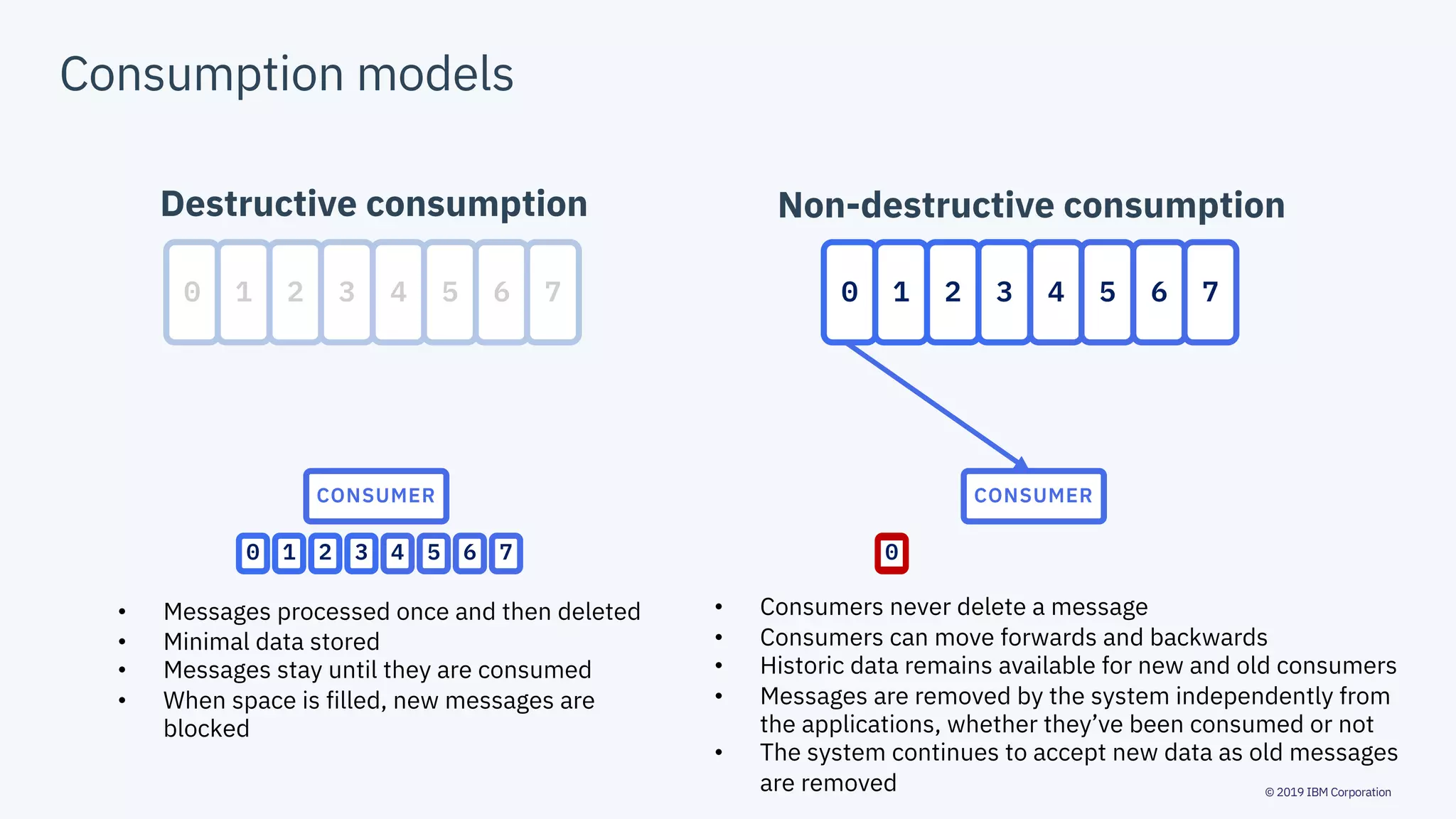
Consumption models
0 1 2 3 4 5 6 7
CONSUMER
0
0 1 2 3 4 5 6 7
CONSUMER
Destructive consumption Non-destructive consumption
• Messages processed once and then deleted
• Minimal data stored
• Messages stay until they are consumed
• When space is filled, new messages are
blocked
© 2019 IBM Corporation
Consumption models
0 1 2 3 4 5 6 7
CONSUMER
• Messages processed once and then deleted
• Minimal data stored
• Messages stay until they are consumed
• When space is filled, new messages are
blocked
0
0 1 2 3 4 5 6 7
CONSUMER
Destructive consumption Non-destructive consumption
1 2 3 4 5 6 7
© 2019 IBM Corporation
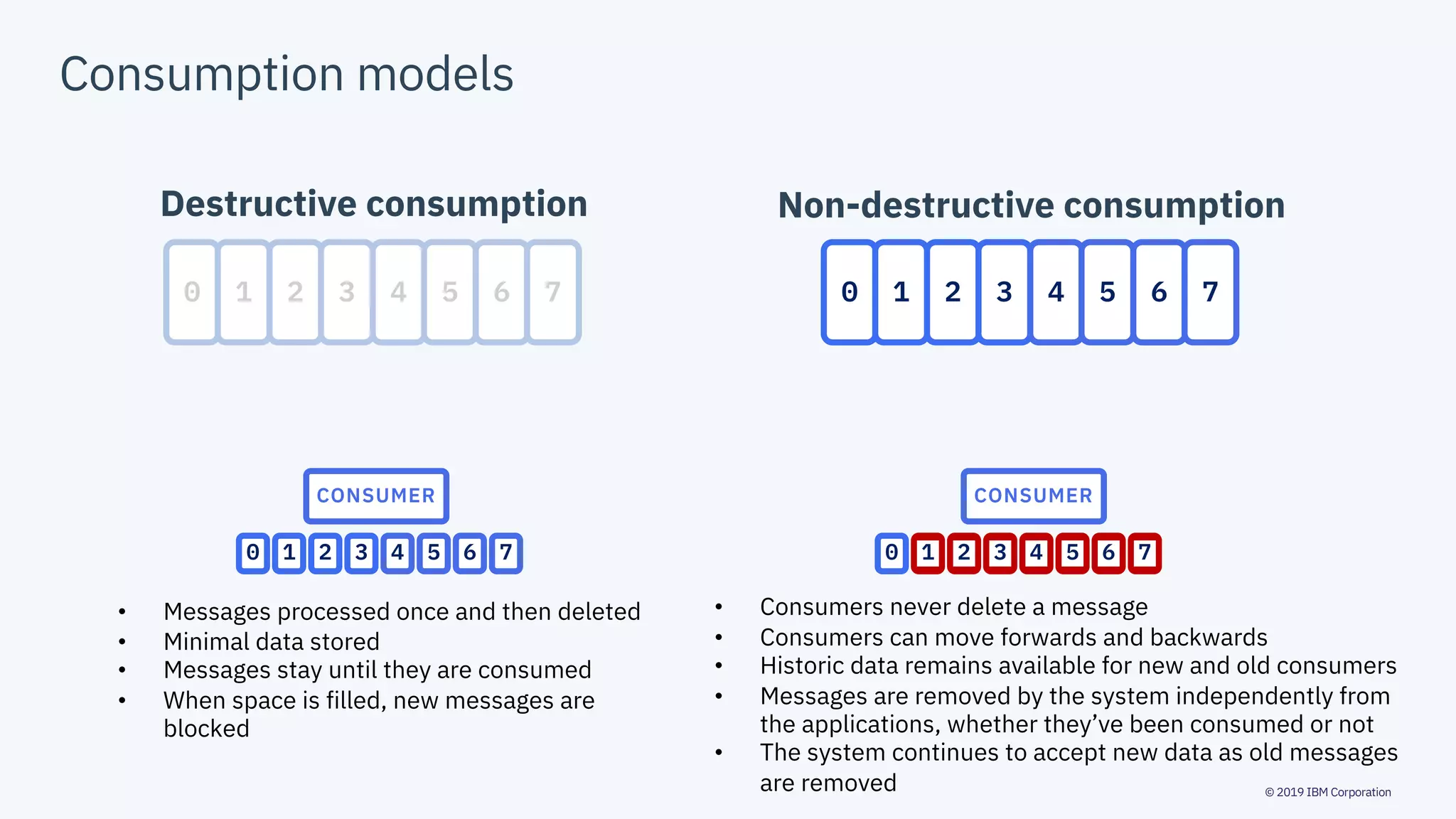
Consumption models
0 1 2 3 4 5 6 7
CONSUMER
0
0 1 2 3 4 5 6 7
CONSUMER
Destructive consumption Non-destructive consumption
1 2 3 4 5 6 7 0
• Consumers never delete a message
• Consumers can move forwards and backwards
• Historic data remains available for new and old consumers
• Messages are removed by the system independently from
the applications, whether they’ve been consumed or not
• The system continues to accept new data as old messages
are removed
• Messages processed once and then deleted
• Minimal data stored
• Messages stay until they are consumed
• When space is filled, new messages are
blocked
© 2019 IBM Corporation
Consumption models
0 1 2 3 4 5 6 7
CONSUMER
0
0 1 2 3 4 5 6 7
CONSUMER
Destructive consumption Non-destructive consumption
1 2 3 4 5 6 7 0 1 2 3 4 5 6 7
• Consumers never delete a message
• Consumers can move forwards and backwards
• Historic data remains available for new and old consumers
• Messages are removed by the system independently from
the applications, whether they’ve been consumed or not
• The system continues to accept new data as old messages
are removed
• Messages processed once and then deleted
• Minimal data stored
• Messages stay until they are consumed
• When space is filled, new messages are
blocked
© 2019 IBM Corporation
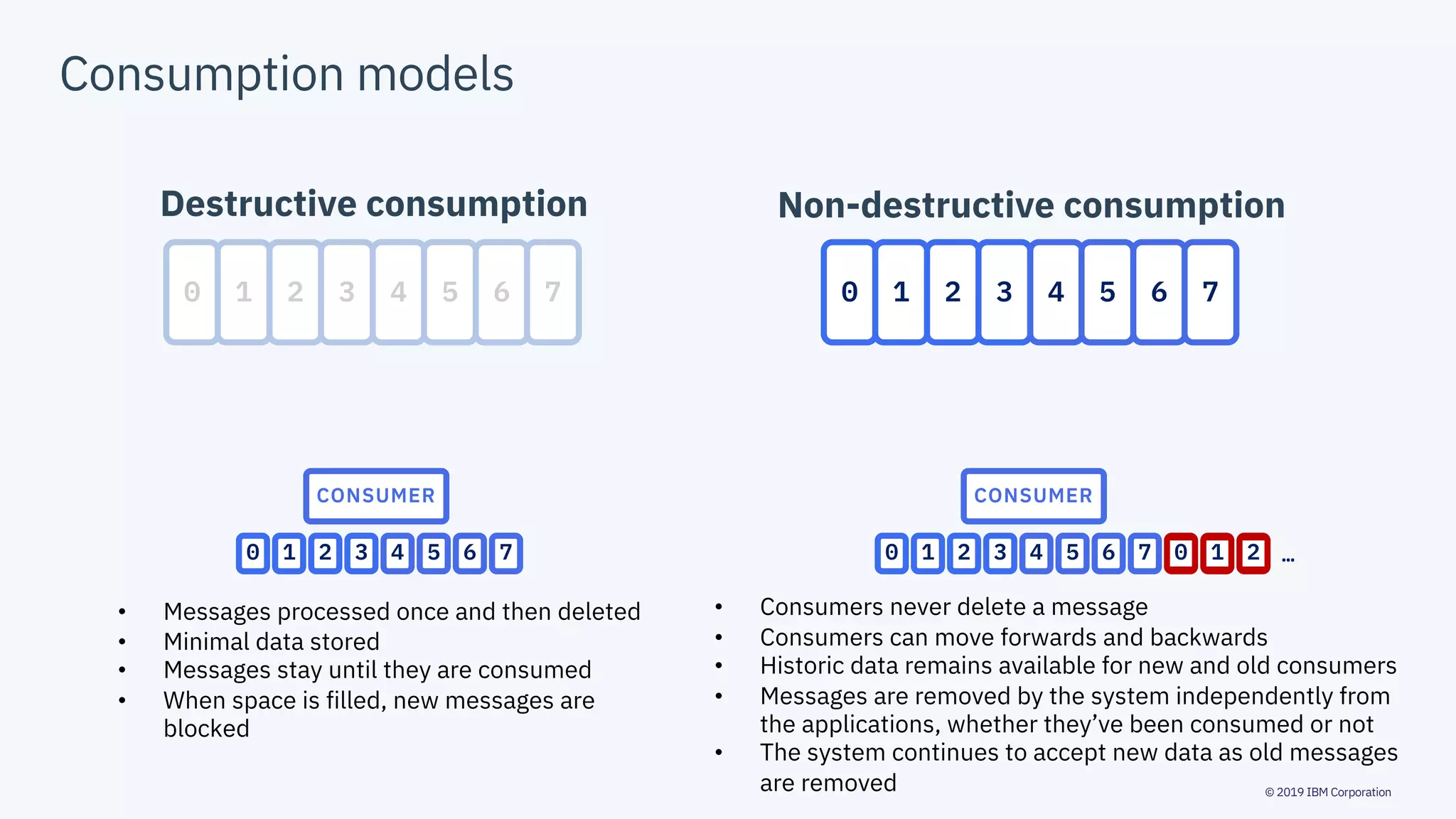
Consumption models
0 1 2 3 4 5 6 7
CONSUMER
0
0 1 2 3 4 5 6 7
CONSUMER
• Consumers never delete a message
• Consumers can move forwards and backwards
• Historic data remains available for new and old consumers
• Messages are removed by the system independently from
the applications, whether they’ve been consumed or not
• The system continues to accept new data as old messages
are removed
Destructive consumption Non-destructive consumption
1 2 3 4 5 6 7 0 1 2 3 4 5 6 7 0 1 2 …
• Messages processed once and then deleted
• Minimal data stored
• Messages stay until they are consumed
• When space is filled, new messages are
blocked
© 2019 IBM Corporation
Consumption models
0 1 2 3 4 5 6 7
CONSUMER
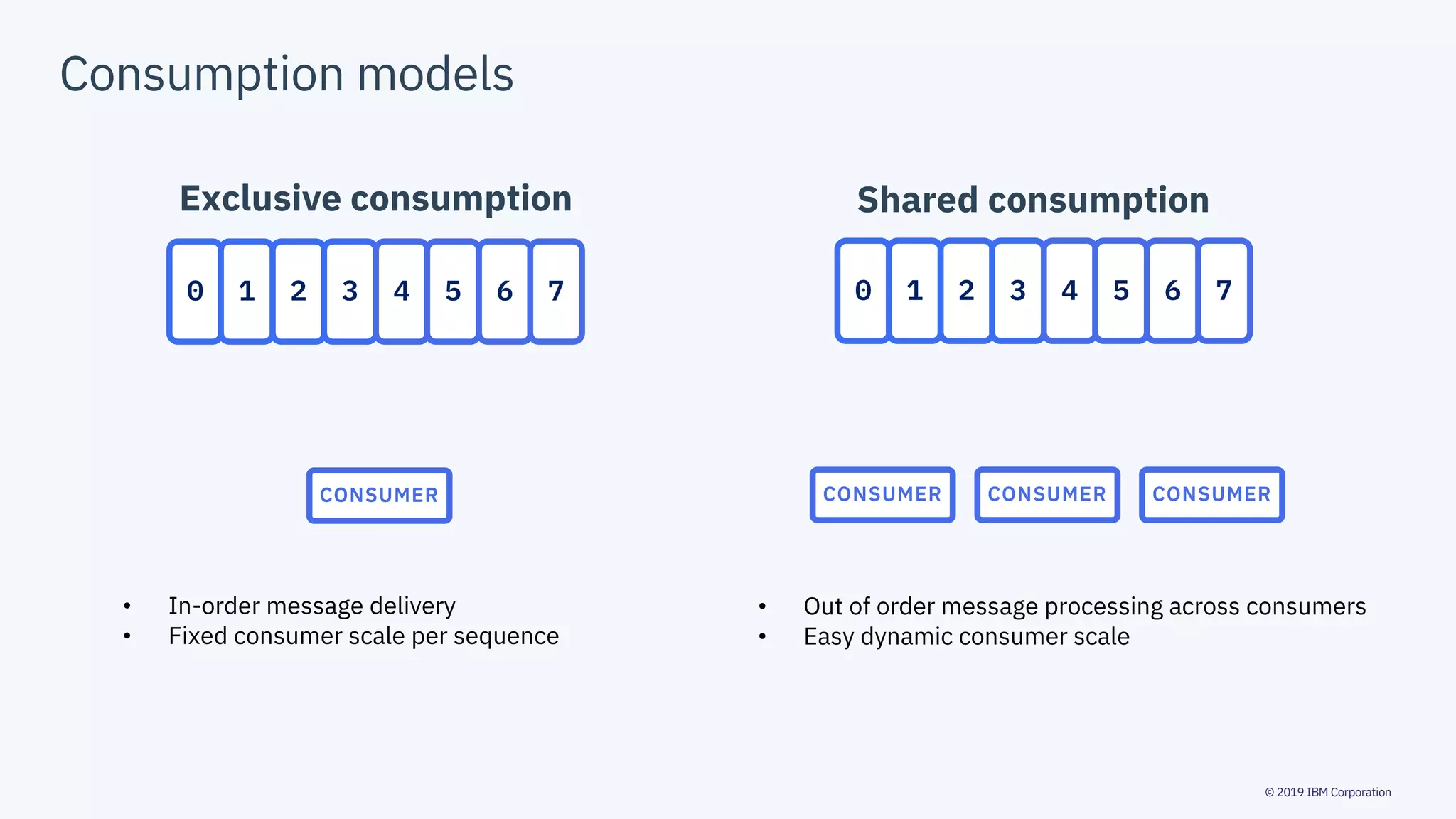
• In-order message delivery
• Fixed consumer scale per sequence
• Out of order message processing across consumers
• Easy dynamic consumer scale
Exclusive consumption Shared consumption
0 1 2 3 4 5 6 7
CONSUMER CONSUMER CONSUMER
© 2019 IBM Corporation
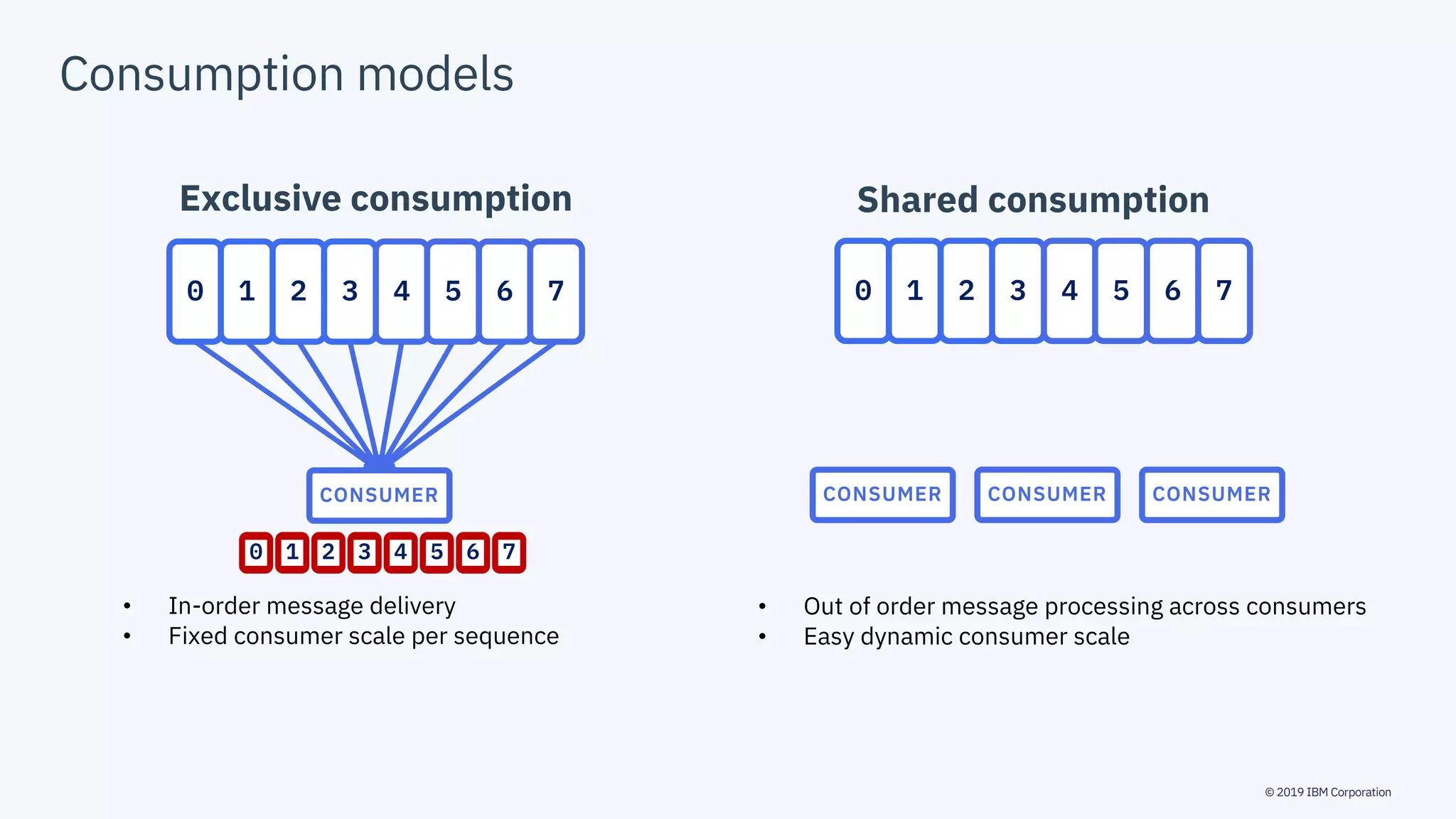
Consumption models
0 1 2 3 4 5 6 7
CONSUMER
• In-order message delivery
• Fixed consumer scale per sequence
0 1 2 3 4 5 6 7
• Out of order message processing across consumers
• Easy dynamic consumer scale
Exclusive consumption Shared consumption
0 1 2 3 4 5 6 7
CONSUMER CONSUMER CONSUMER
© 2019 IBM Corporation
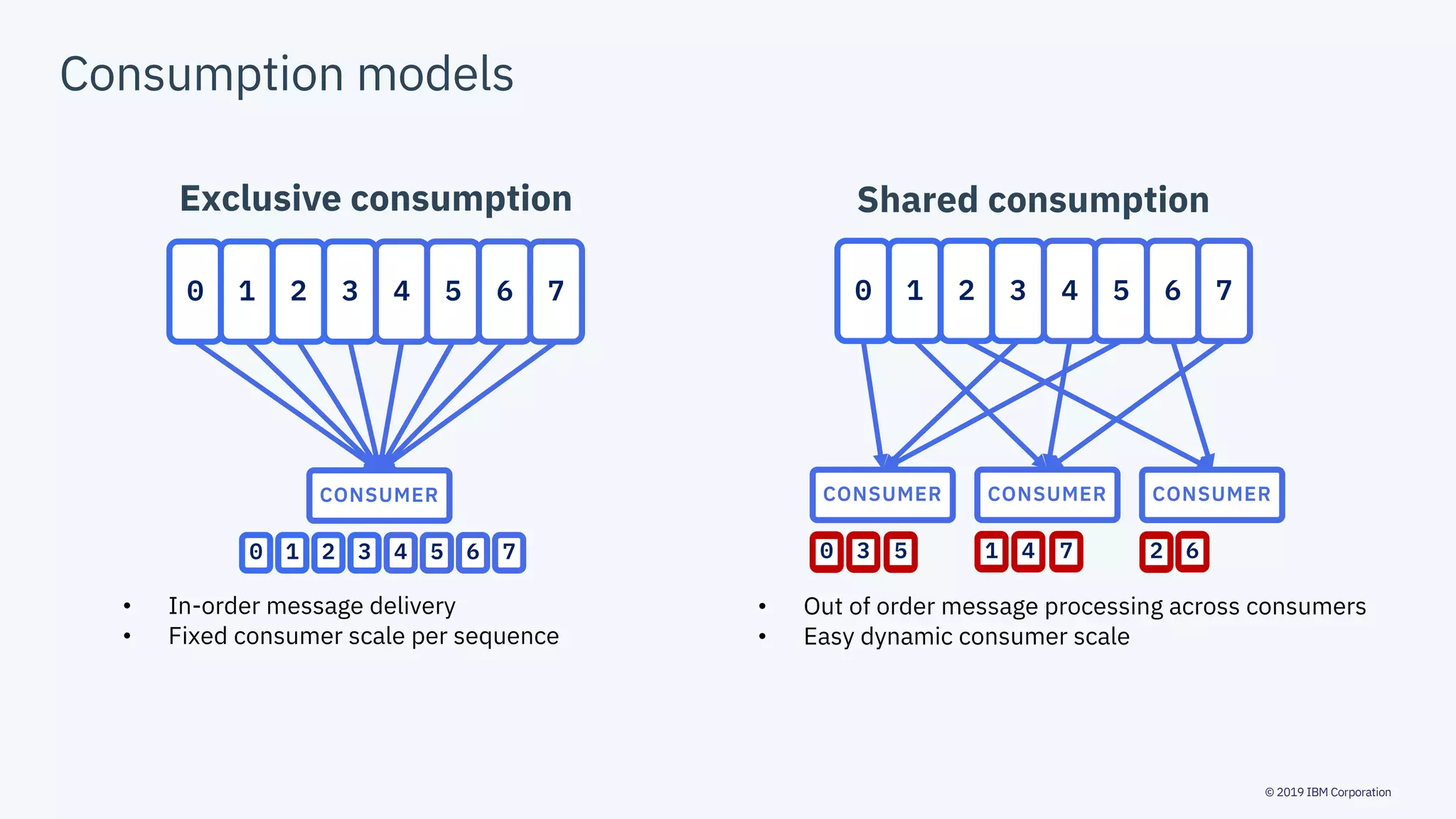
Consumption models
0 1 2 3 4 5 6 7
CONSUMER
• In-order message delivery
• Fixed consumer scale per sequence
0 1 2 3 4 5 6 7
• Out of order message processing across consumers
• Easy dynamic consumer scale
Exclusive consumption Shared consumption
0 1 2 3 4 5 6 7
CONSUMER CONSUMER CONSUMER
0 1 23 45 67
© 2019 IBM Corporation
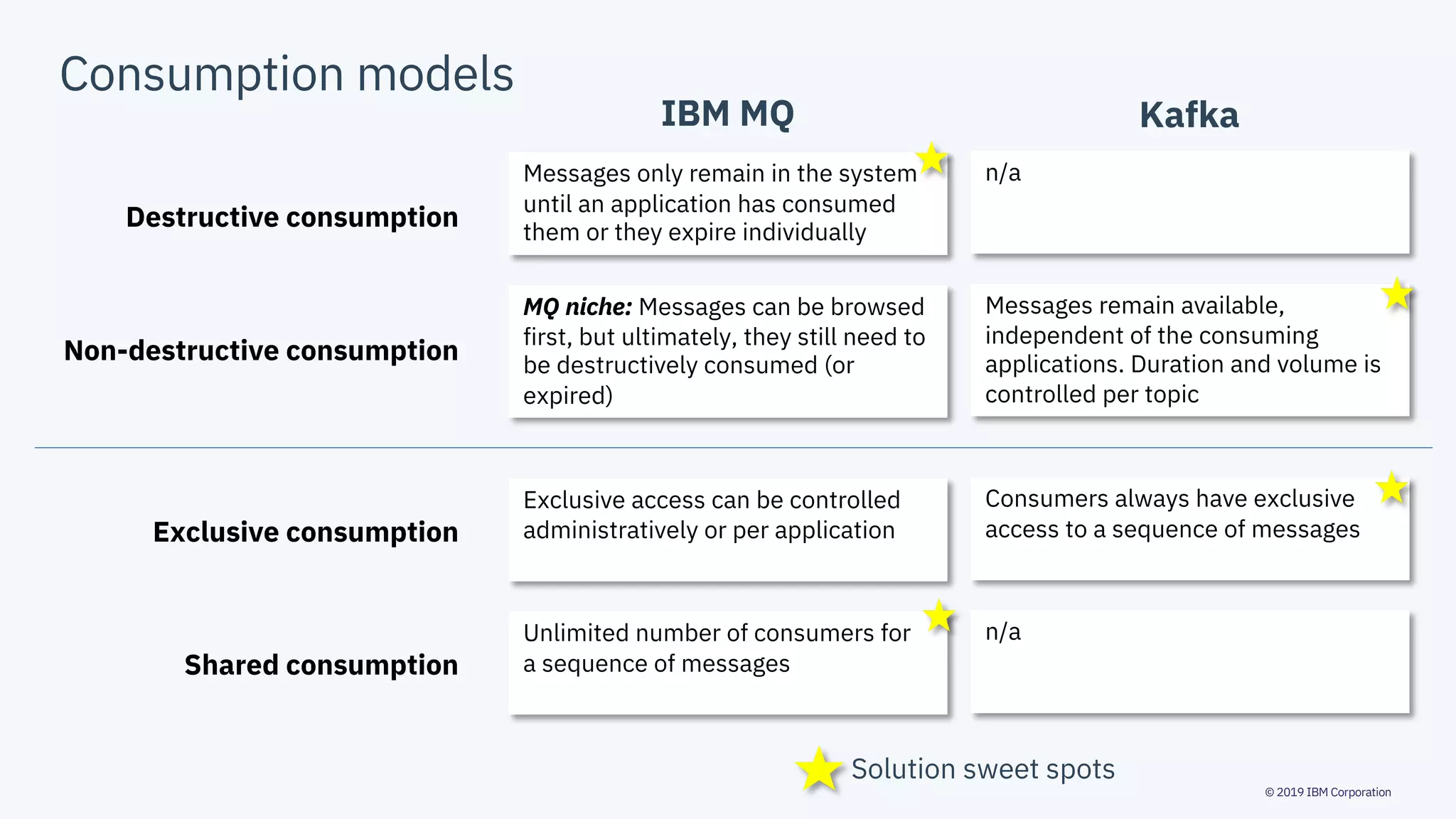
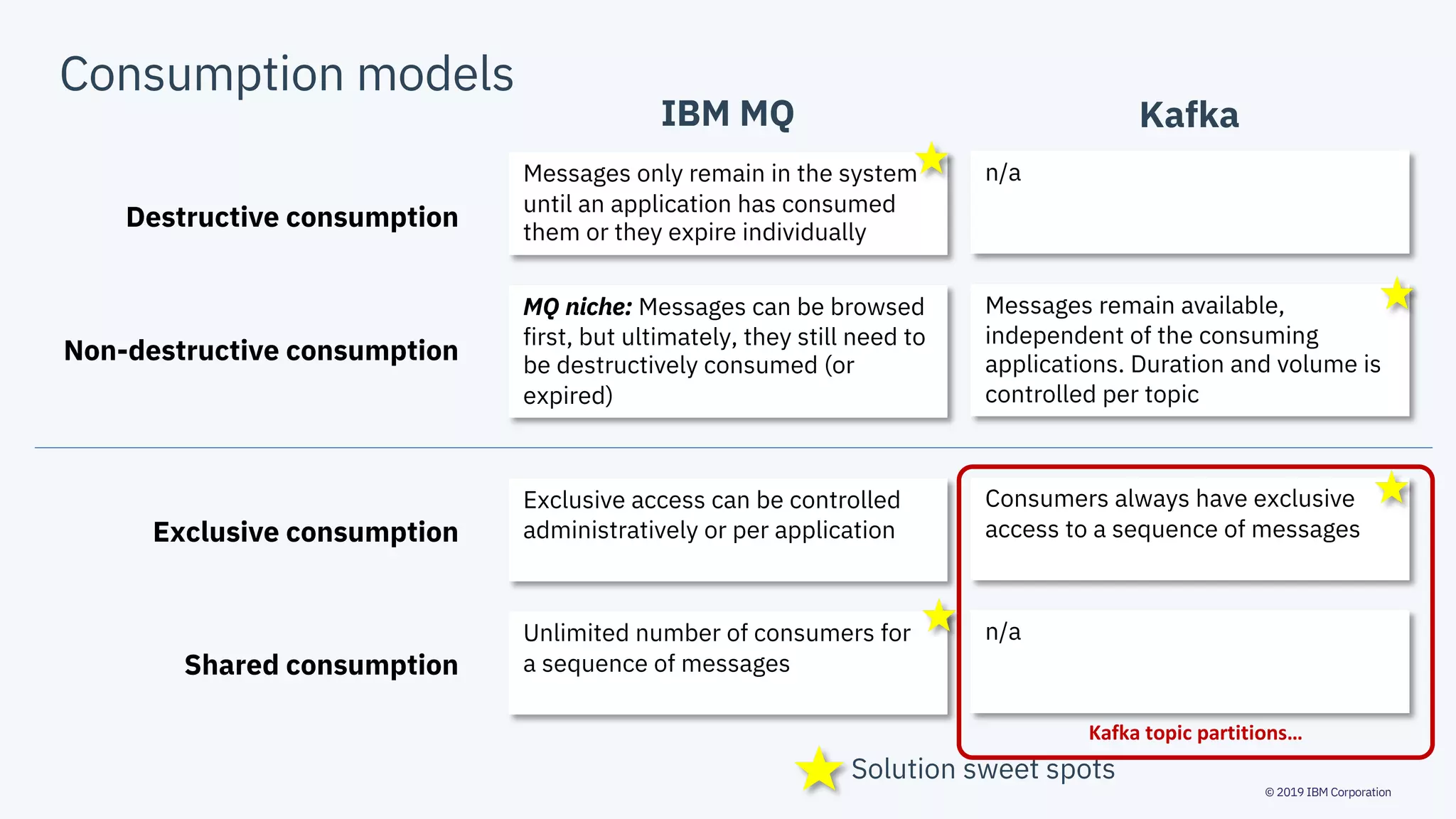
Consumption models
IBM MQ Kafka
Destructive consumption
Messages only remain in the system
until an application has consumed
them or they expire individually
n/a
Non-destructive consumption
MQ niche: Messages can be browsed
first, but ultimately, they still need to
be destructively consumed (or
expired)
Messages remain available,
independent of the consuming
applications. Duration and volume is
controlled per topic
Exclusive consumption
Exclusive access can be controlled
administratively or per application
Consumers always have exclusive
access to a sequence of messages
Shared consumption
Unlimited number of consumers for
a sequence of messages
n/a
Solution sweet spots
© 2019 IBM Corporation
Consumption models
IBM MQ Kafka
Destructive consumption
Messages only remain in the system
until an application has consumed
them or they expire individually
n/a
Non-destructive consumption
MQ niche: Messages can be browsed
first, but ultimately, they still need to
be destructively consumed (or
expired)
Messages remain available,
independent of the consuming
applications. Duration and volume is
controlled per topic
Exclusive consumption
Exclusive access can be controlled
administratively or per application
Consumers always have exclusive
access to a sequence of messages
Shared consumption
Unlimited number of consumers for
a sequence of messages
n/a
Solution sweet spots
Kafka topic partitions…
© 2020 IBM Corporation
Queues and topics
© 2019 IBM Corporation
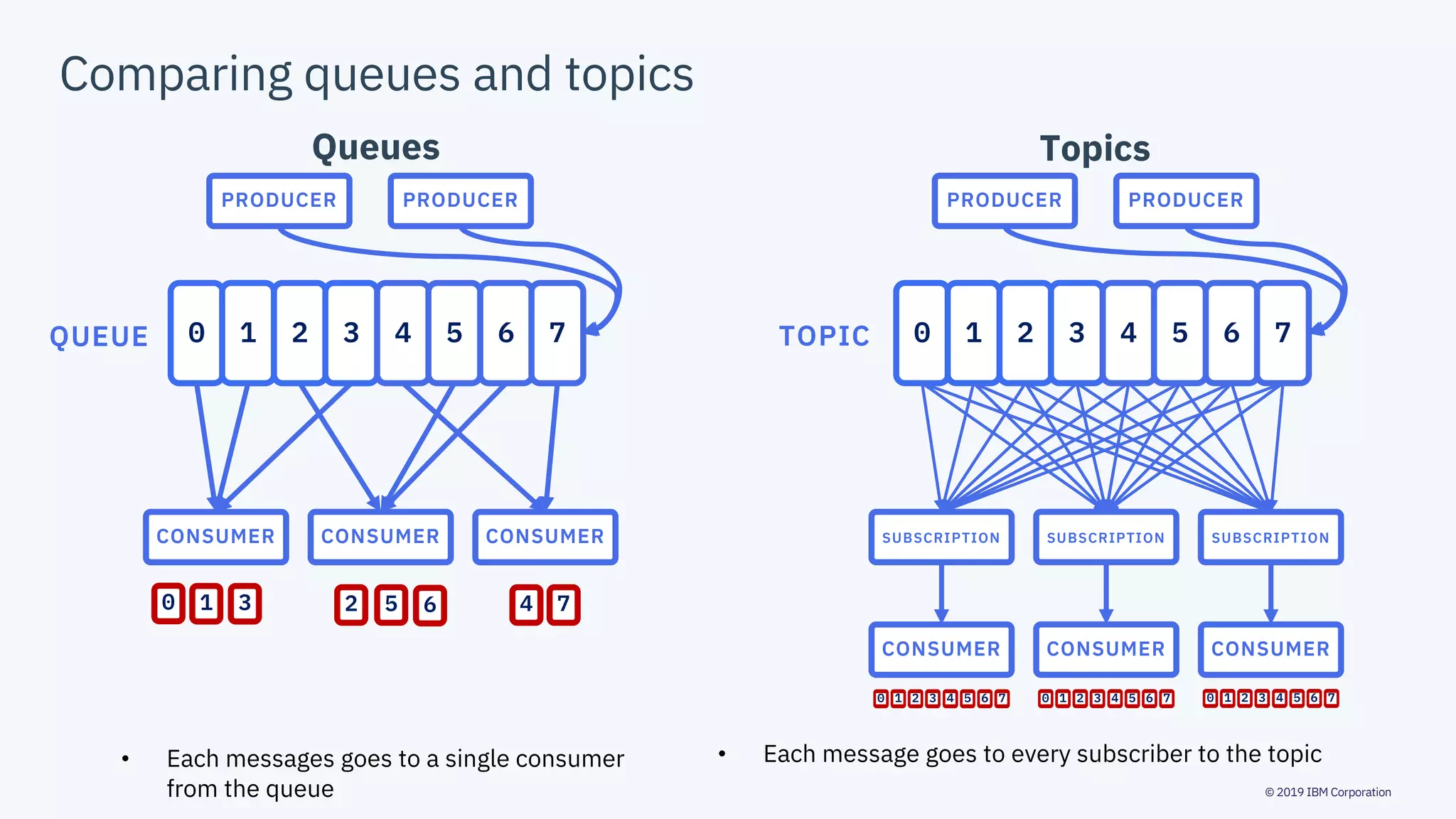
Comparing queues and topics
QUEUE 0 1 2 3 4 5 6 7
CONSUMER CONSUMER CONSUMER
PRODUCER PRODUCER
0 1 23 45 6 7
TOPIC 0 1 2 3 4 5 6 7
SUBSCRIPTION SUBSCRIPTION SUBSCRIPTION
PRODUCER PRODUCER
CONSUMER CONSUMER CONSUMER
0 1 2 3 4 5 6 7 0 1 2 3 4 5 6 7 0 1 2 3 4 5 6 7
Queues Topics
• Each messages goes to a single consumer
from the queue
• Each message goes to every subscriber to the topic
© 2019 IBM Corporation
CONSUMERCONSUMER
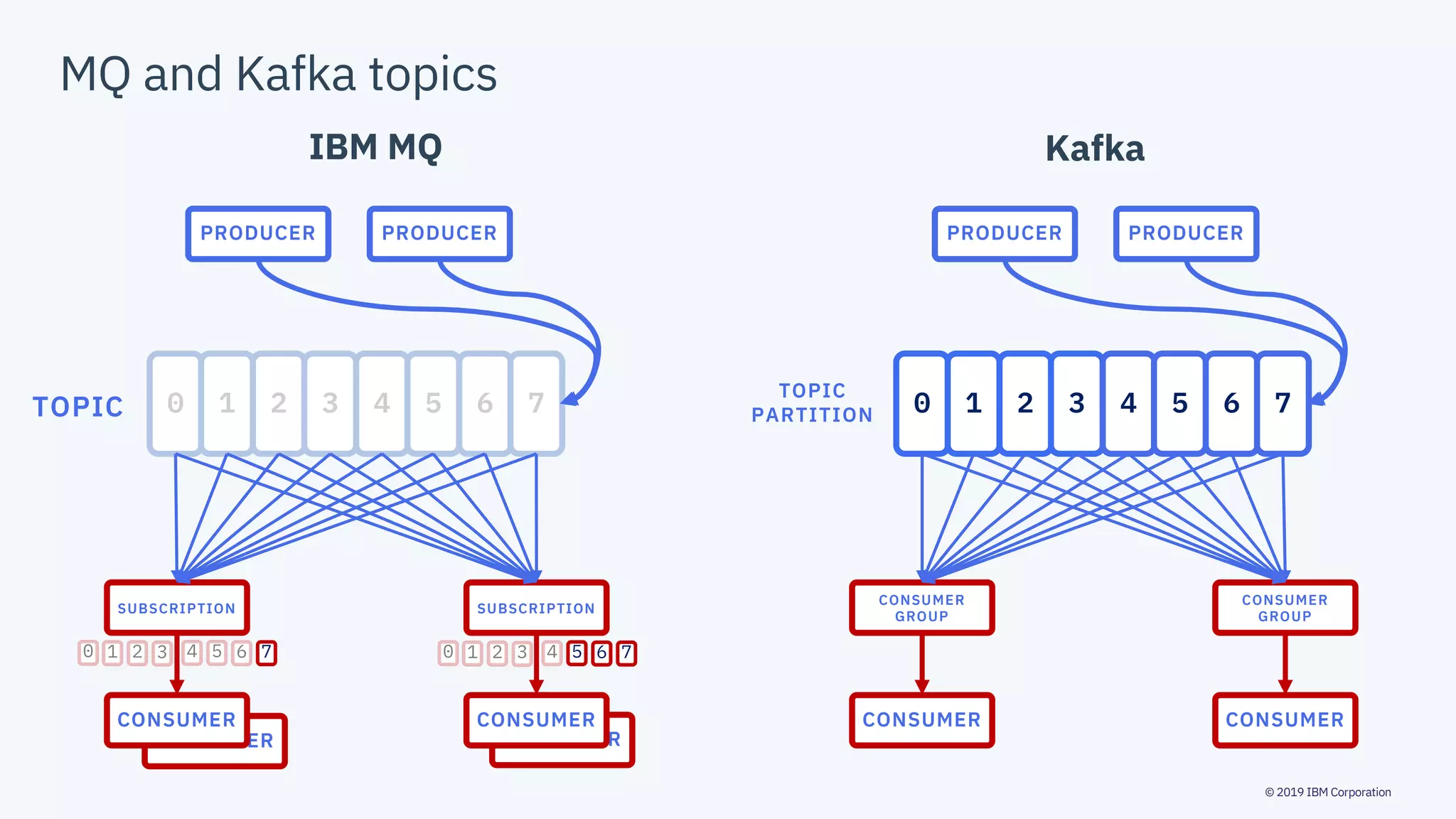
MQ and Kafka topics
TOPIC
PARTITION 0 1 2 3 4 5 6 7
CONSUMER
GROUP
CONSUMER
GROUP
PRODUCER PRODUCER
CONSUMER CONSUMER
TOPIC 0 1 2 3 4 5 6 7
SUBSCRIPTION SUBSCRIPTION
PRODUCER PRODUCER
CONSUMER CONSUMER
1 2 3 4 5 6 70 1 2 3 4 5 6 70
IBM MQ Kafka
© 2019 IBM Corporation
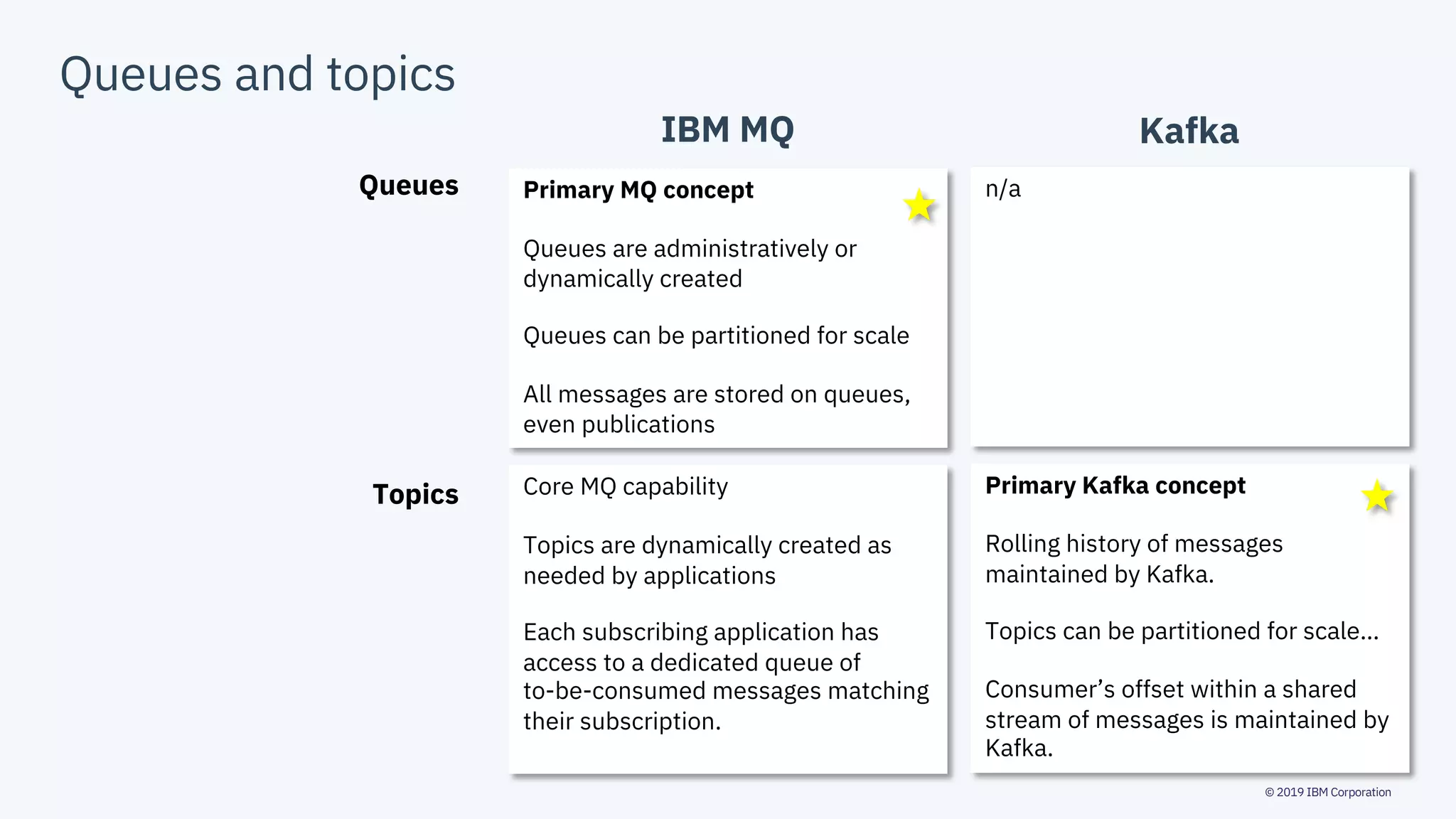
Queues and topics
IBM MQ Kafka
Queues Primary MQ concept
Queues are administratively or
dynamically created
Queues can be partitioned for scale
All messages are stored on queues,
even publications
n/a
Topics Core MQ capability
Topics are dynamically created as
needed by applications
Each subscribing application has
access to a dedicated queue of
to-be-consumed messages matching
their subscription.
Primary Kafka concept
Rolling history of messages
maintained by Kafka.
Topics can be partitioned for scale…
Consumer’s offset within a shared
stream of messages is maintained by
Kafka.
© 2020 IBM Corporation
Scaling
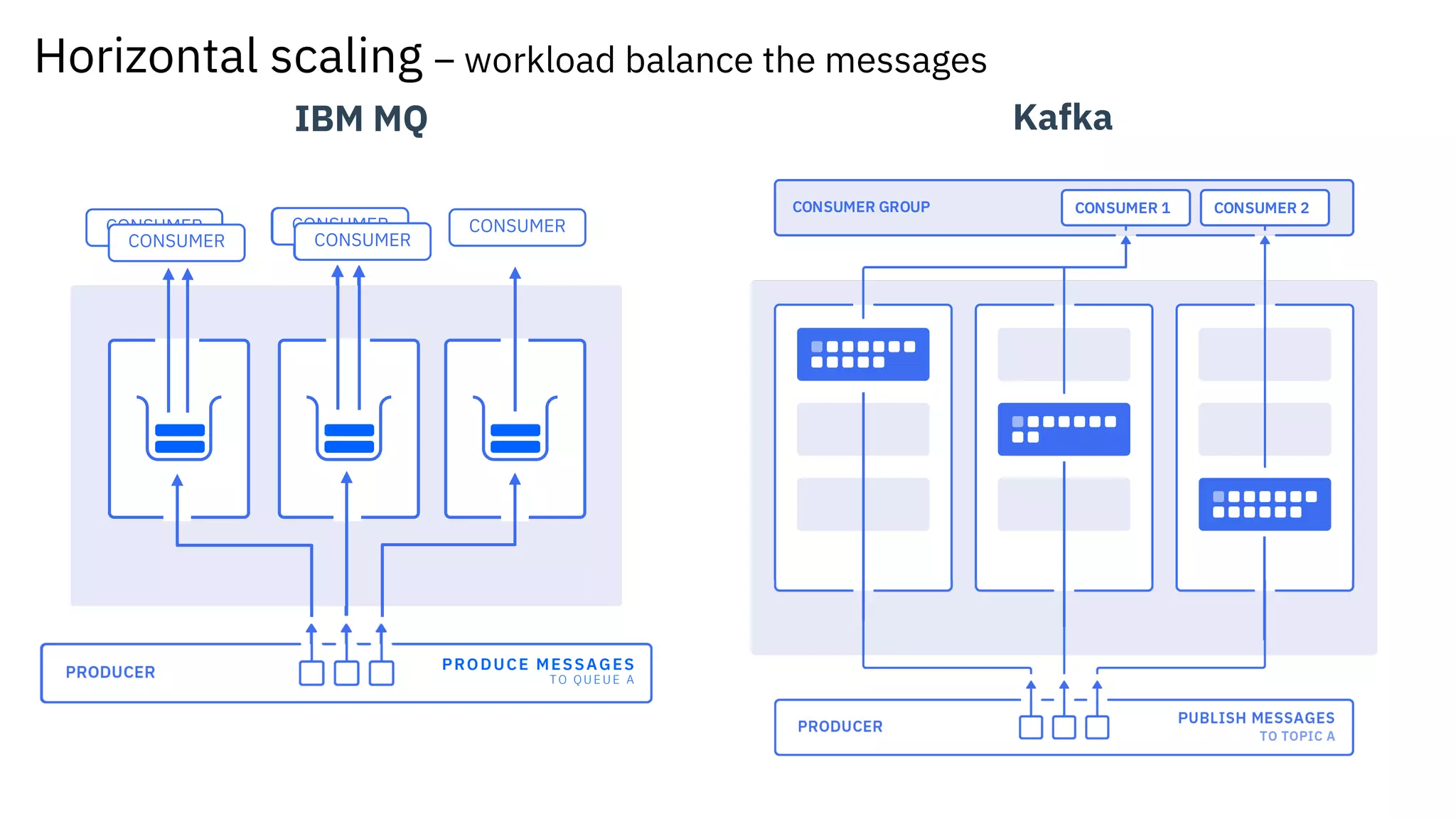
Horizontal scaling – workload balance the messages
PRODUCE MESSAGES
T O Q U E U E A
CONSUMER
CONSUMER
IBM MQ Kafka
PRODUCE MESSAGES
T O Q U E U E A
CONSUMER
CONSUMER
CONSUMER
CONSUMER
CONSUMER
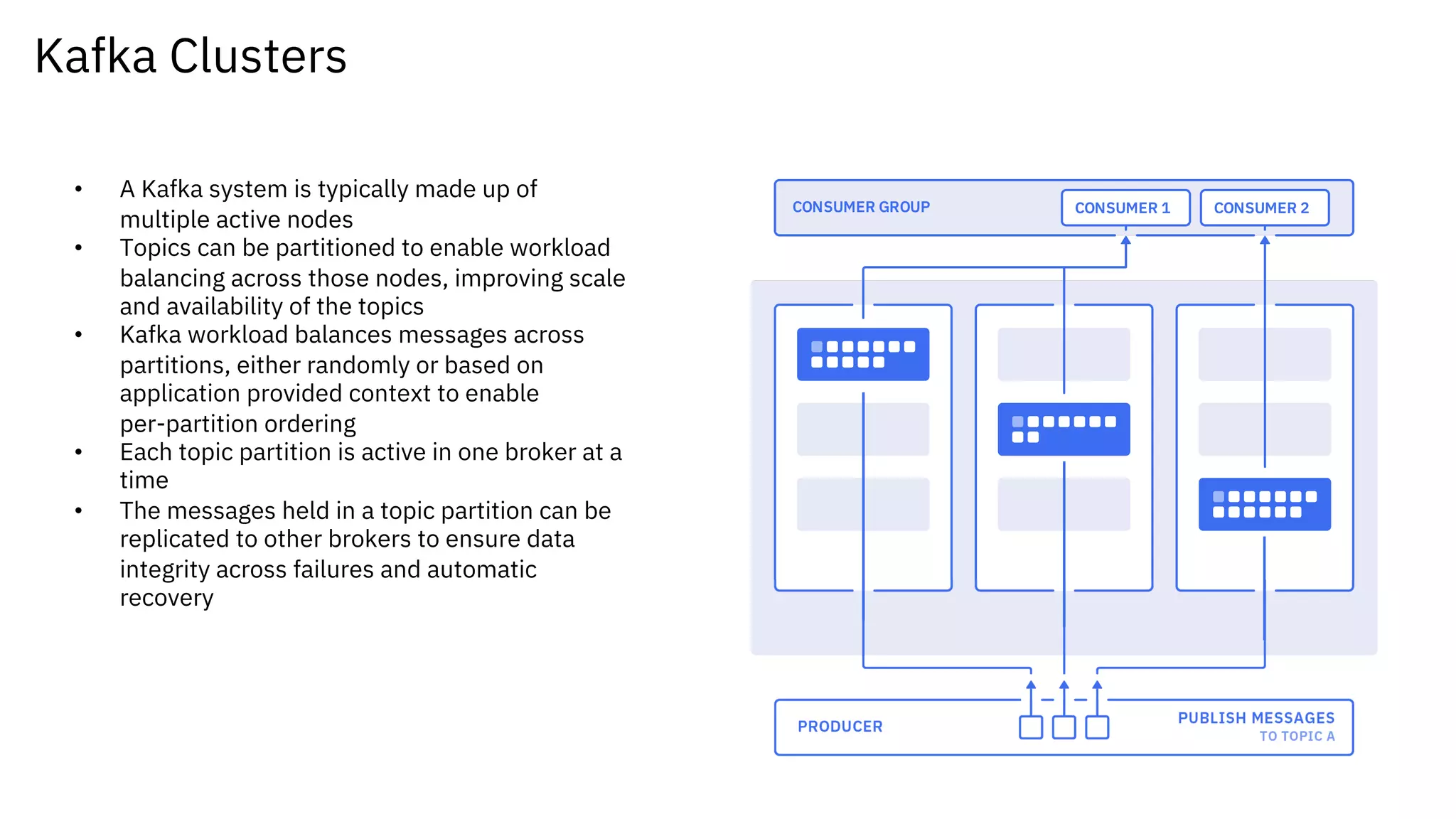
Kafka Clusters
• A Kafka system is typically made up of
multiple active nodes
• Topics can be partitioned to enable workload
balancing across those nodes, improving scale
and availability of the topics
• Kafka workload balances messages across
partitions, either randomly or based on
application provided context to enable
per-partition ordering
• Each topic partition is active in one broker at a
time
• The messages held in a topic partition can be
replicated to other brokers to ensure data
integrity across failures and automatic
recovery
© 2019 IBM Corporation
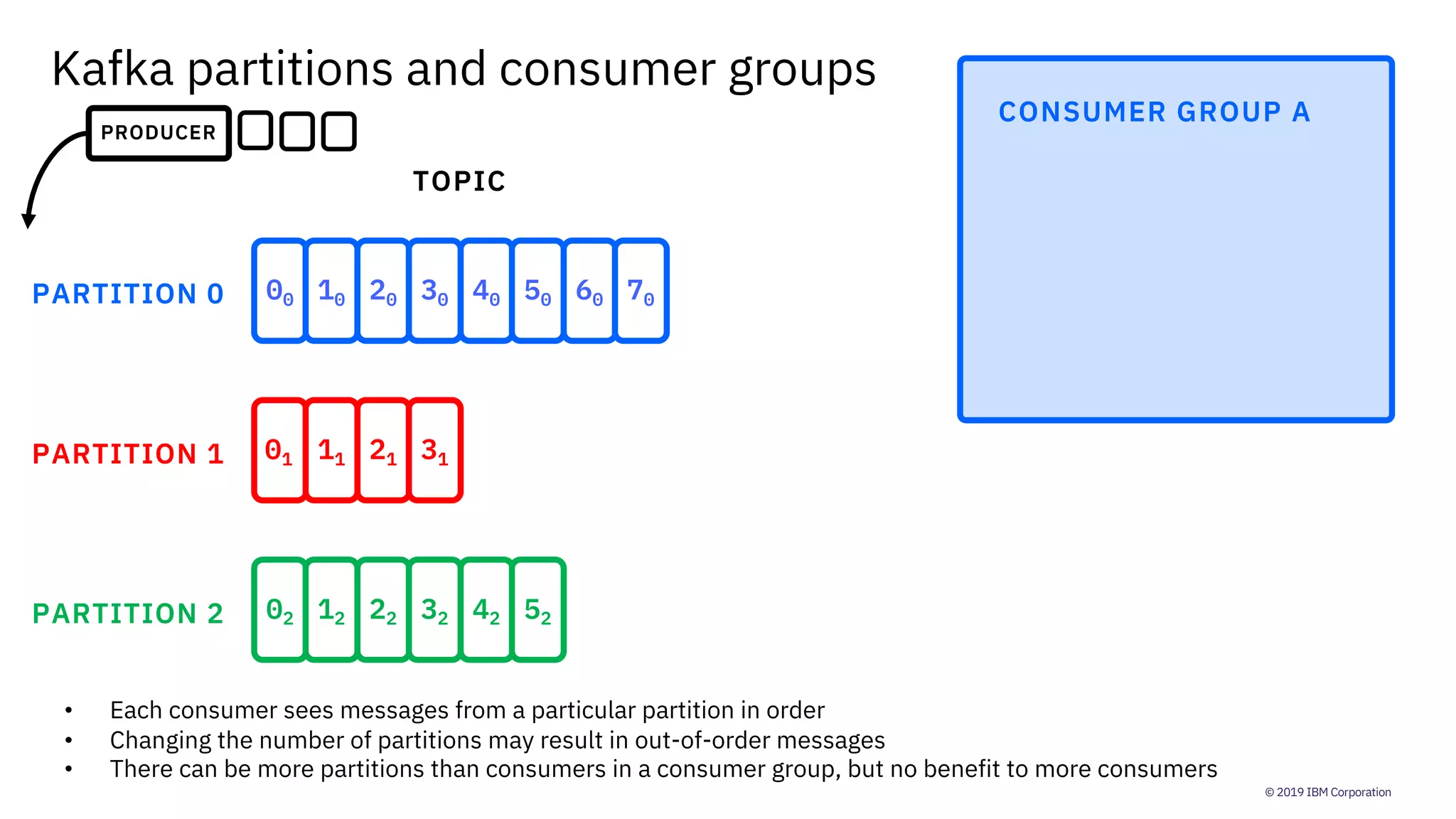
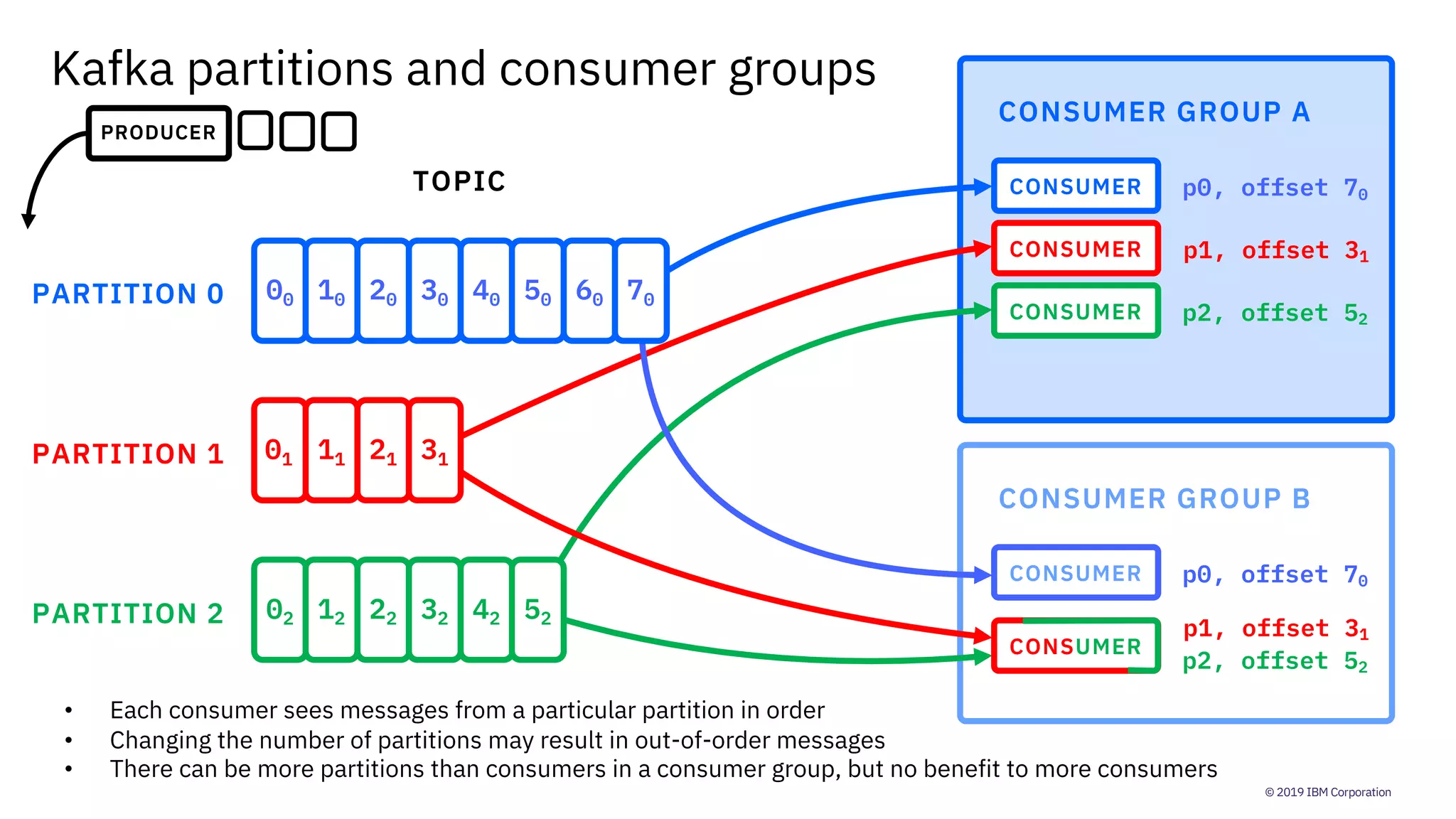
CONSUMER GROUP A
TOPIC
PARTITION 0
PARTITION 1
PARTITION 2
Kafka partitions and consumer groups
01 11 21 31
02 12 22 32 42 52
00 10 20 30 40 50 60 70
PRODUCER
• Each consumer sees messages from a particular partition in order
• Changing the number of partitions may result in out-of-order messages
• There can be more partitions than consumers in a consumer group, but no benefit to more consumers
© 2019 IBM Corporation
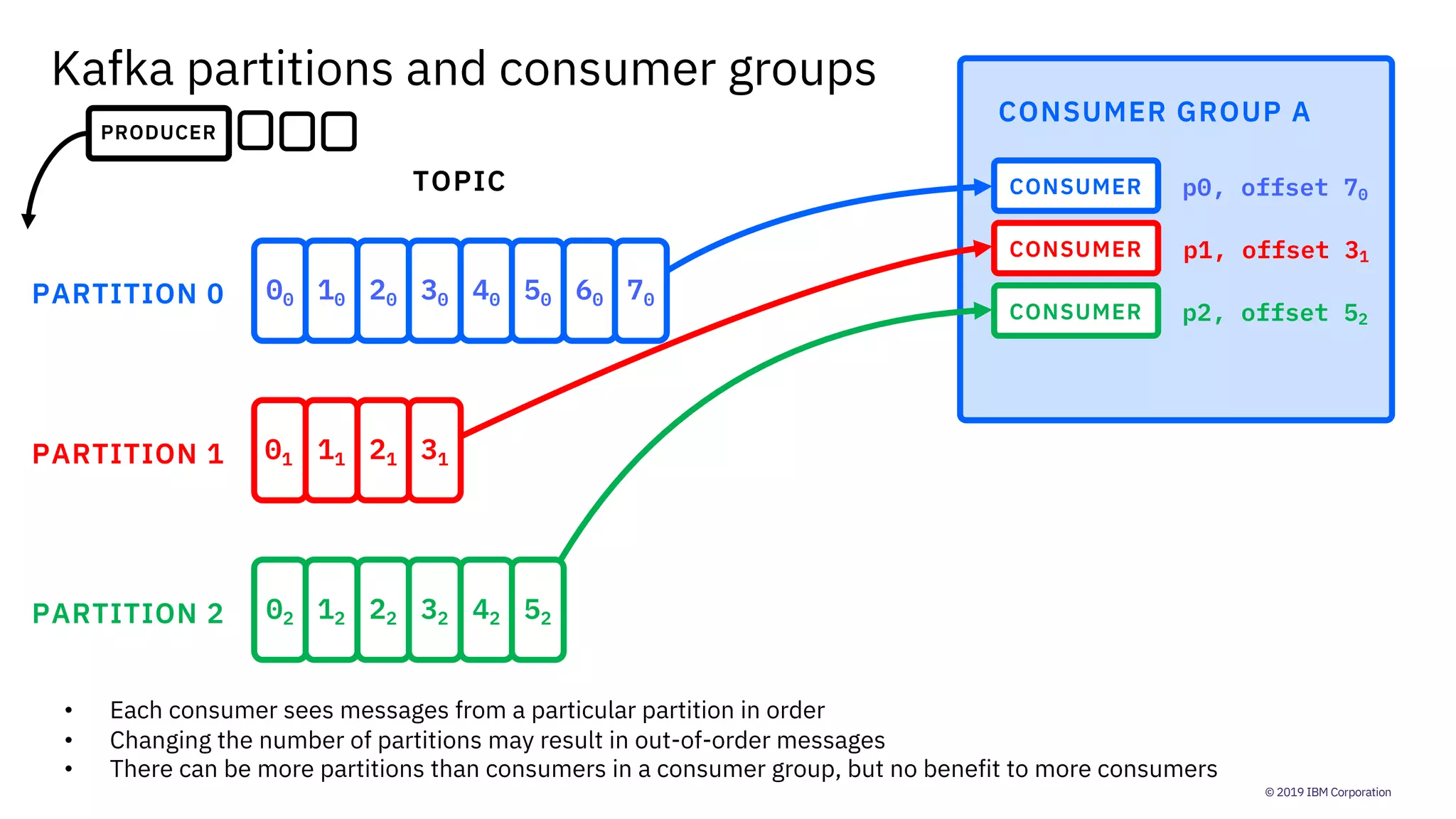
CONSUMER GROUP A
TOPIC
PARTITION 0
PARTITION 1
PARTITION 2
CONSUMER
CONSUMER
CONSUMER
Kafka partitions and consumer groups
p0, offset 70
p1, offset 31
p2, offset 52
01 11 21 31
02 12 22 32 42 52
00 10 20 30 40 50 60 70
PRODUCER
• Each consumer sees messages from a particular partition in order
• Changing the number of partitions may result in out-of-order messages
• There can be more partitions than consumers in a consumer group, but no benefit to more consumers
© 2019 IBM Corporation
CONSUMER GROUP A
TOPIC
PARTITION 0
PARTITION 1
PARTITION 2
CONSUMER
CONSUMER
CONSUMER
CONSUMER GROUP B
CONSUMER
CONSUMER
Kafka partitions and consumer groups
p0, offset 70
p1, offset 31
p2, offset 52
p0, offset 70
p1, offset 31
p2, offset 52
01 11 21 31
02 12 22 32 42 52
00 10 20 30 40 50 60 70
PRODUCER
• Each consumer sees messages from a particular partition in order
• Changing the number of partitions may result in out-of-order messages
• There can be more partitions than consumers in a consumer group, but no benefit to more consumers
© 2019 IBM Corporation
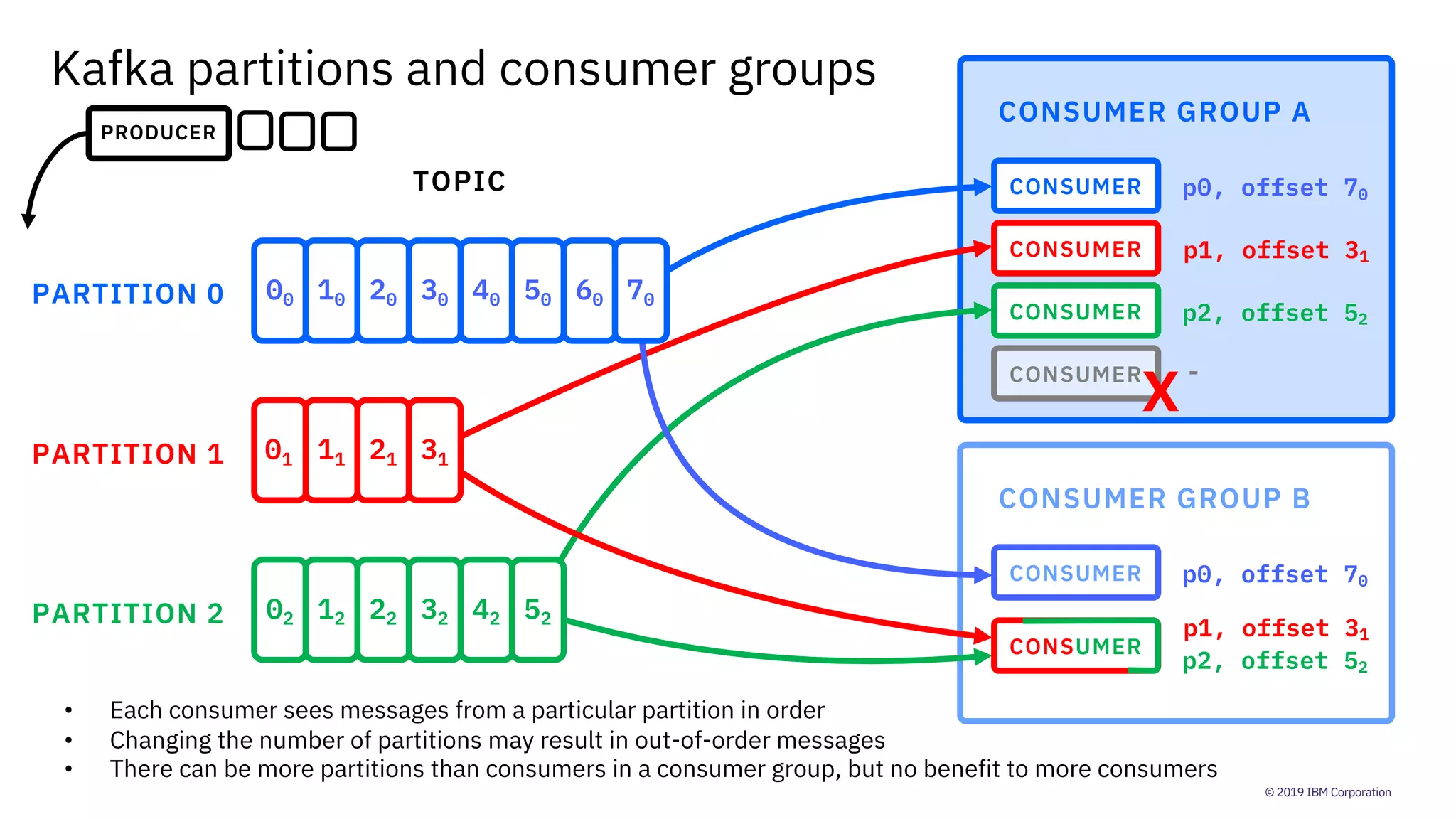
CONSUMER GROUP A
TOPIC
PARTITION 0
PARTITION 1
PARTITION 2
CONSUMER
CONSUMER
CONSUMER
CONSUMER
CONSUMER GROUP B
CONSUMER
CONSUMER
Kafka partitions and consumer groups
-
p0, offset 70
p1, offset 31
p2, offset 52
p0, offset 70
p1, offset 31
p2, offset 52
01 11 21 31
02 12 22 32 42 52
00 10 20 30 40 50 60 70
PRODUCER
• Each consumer sees messages from a particular partition in order
• Changing the number of partitions may result in out-of-order messages
• There can be more partitions than consumers in a consumer group, but no benefit to more consumers
X
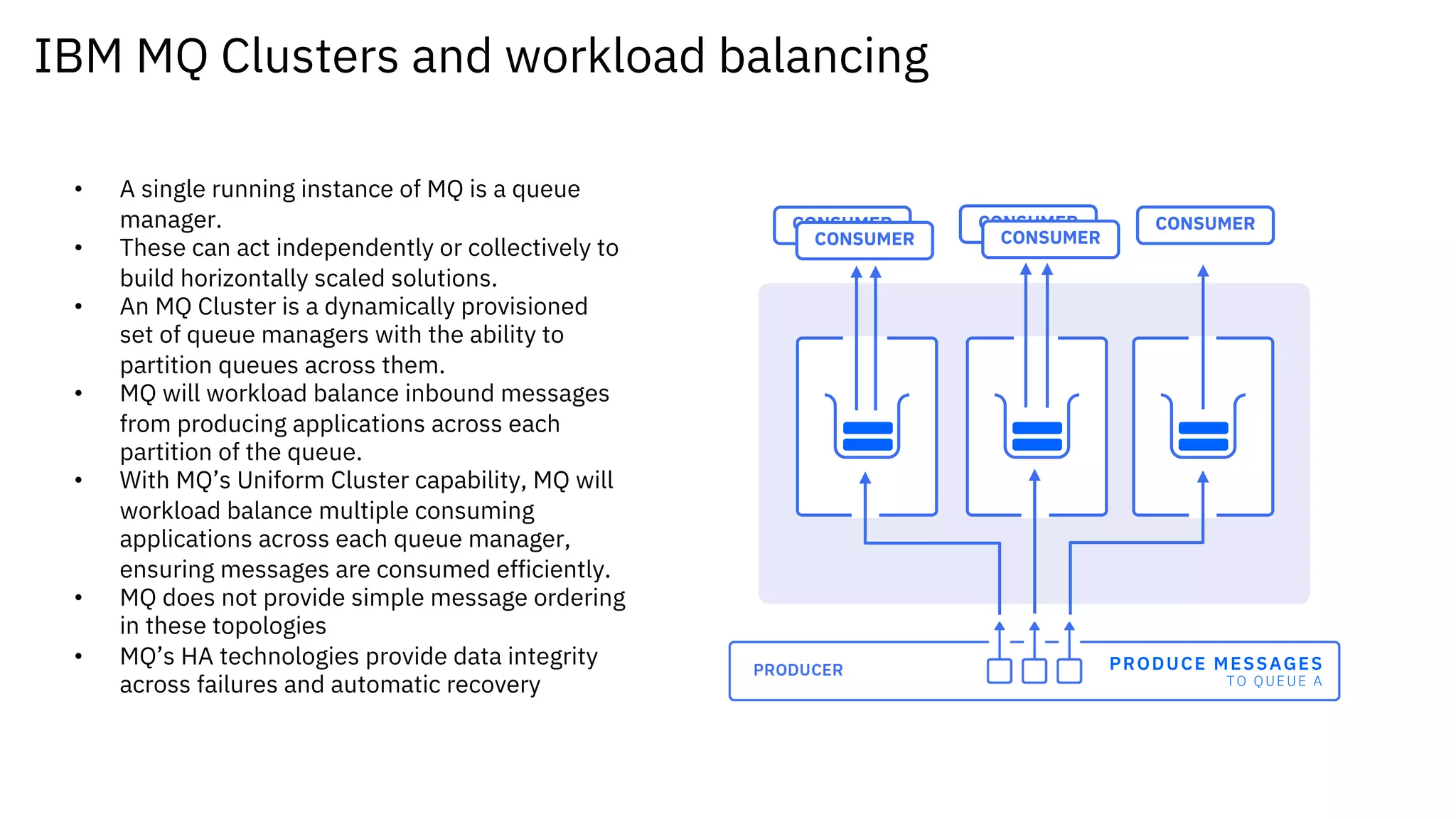
IBM MQ Clusters and workload balancing
PRODUCE MESSAGES
TO QUEUE A
CONSUMER
CONSUMER
CONSUMER
CONSUMER
CONSUMER
• A single running instance of MQ is a queue
manager.
• These can act independently or collectively to
build horizontally scaled solutions.
• An MQ Cluster is a dynamically provisioned
set of queue managers with the ability to
partition queues across them.
• MQ will workload balance inbound messages
from producing applications across each
partition of the queue.
• With MQ’s Uniform Cluster capability, MQ will
workload balance multiple consuming
applications across each queue manager,
ensuring messages are consumed efficiently.
• MQ does not provide simple message ordering
in these topologies
• MQ’s HA technologies provide data integrity
across failures and automatic recovery
© 2019 IBM Corporation
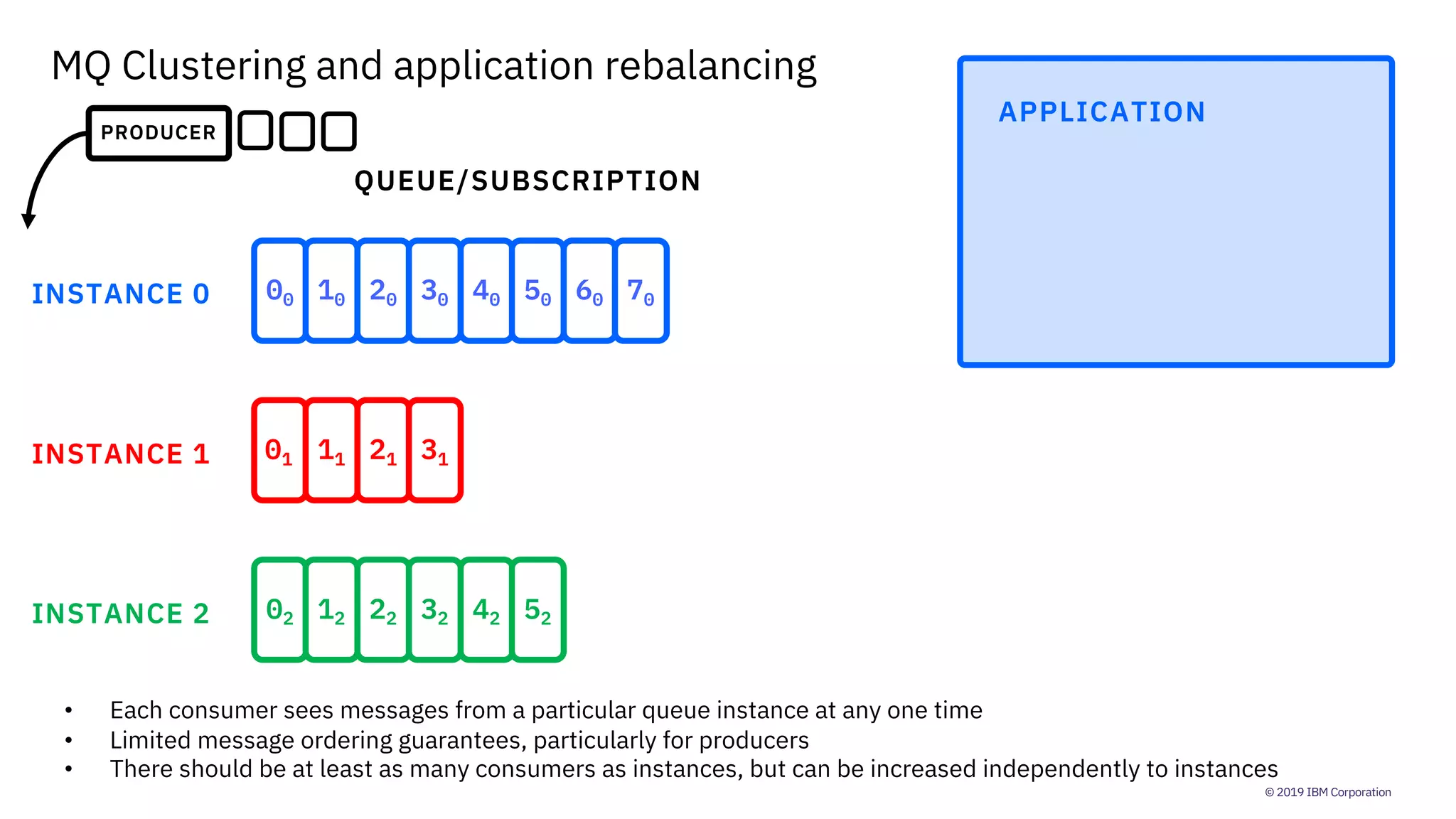
MQ Clustering and application rebalancing
APPLICATION
QUEUE/SUBSCRIPTION
INSTANCE 0
INSTANCE 1
INSTANCE 2
01 11 21 31
02 12 22 32 42 52
00 10 20 30 40 50 60 70
PRODUCER
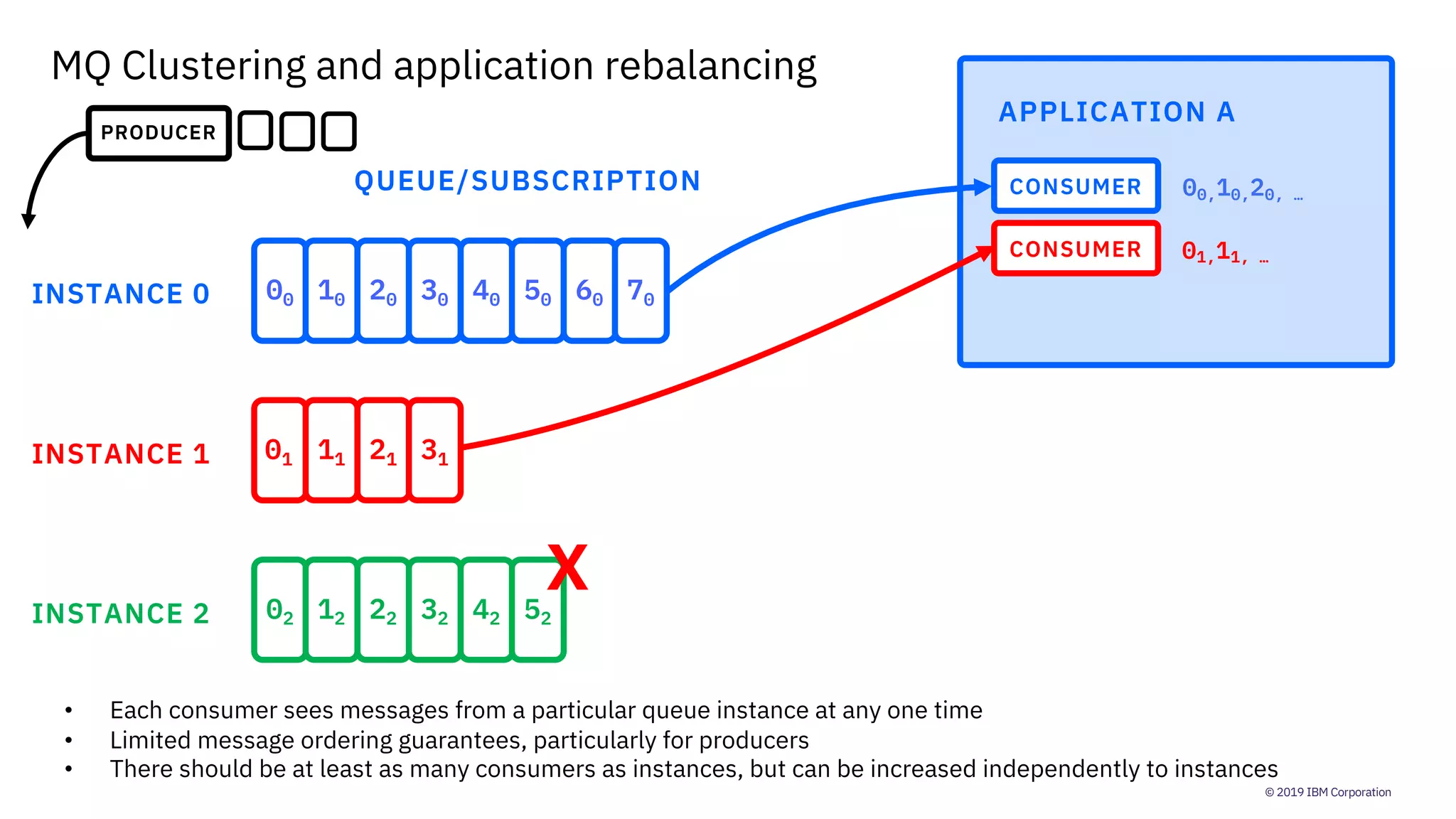
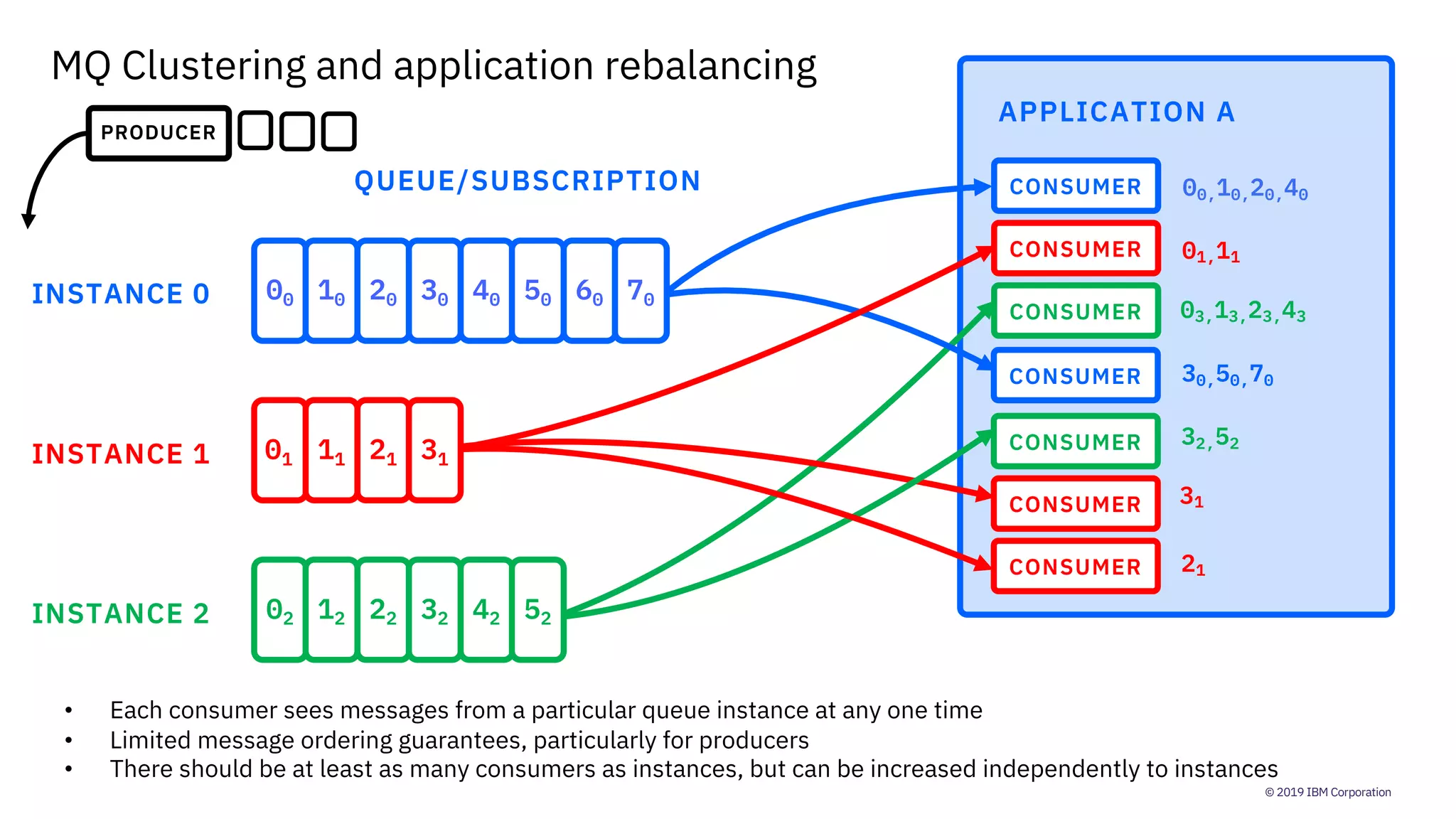
• Each consumer sees messages from a particular queue instance at any one time
• Limited message ordering guarantees, particularly for producers
• There should be at least as many consumers as instances, but can be increased independently to instances
© 2019 IBM Corporation
MQ Clustering and application rebalancing
APPLICATION A
QUEUE/SUBSCRIPTION
INSTANCE 0
INSTANCE 1
INSTANCE 2
CONSUMER
CONSUMER
01 11 21 31
02 12 22 32 42 52
00 10 20 30 40 50 60 70
PRODUCER
• Each consumer sees messages from a particular queue instance at any one time
• Limited message ordering guarantees, particularly for producers
• There should be at least as many consumers as instances, but can be increased independently to instances
00,10,20, …
01,11, …
X
© 2019 IBM Corporation
MQ Clustering and application rebalancing
APPLICATION A
QUEUE/SUBSCRIPTION
INSTANCE 0
INSTANCE 1
INSTANCE 2
CONSUMER
CONSUMER
CONSUMER
01 11 21 31
02 12 22 32 42 52
00 10 20 30 40 50 60 70
PRODUCER
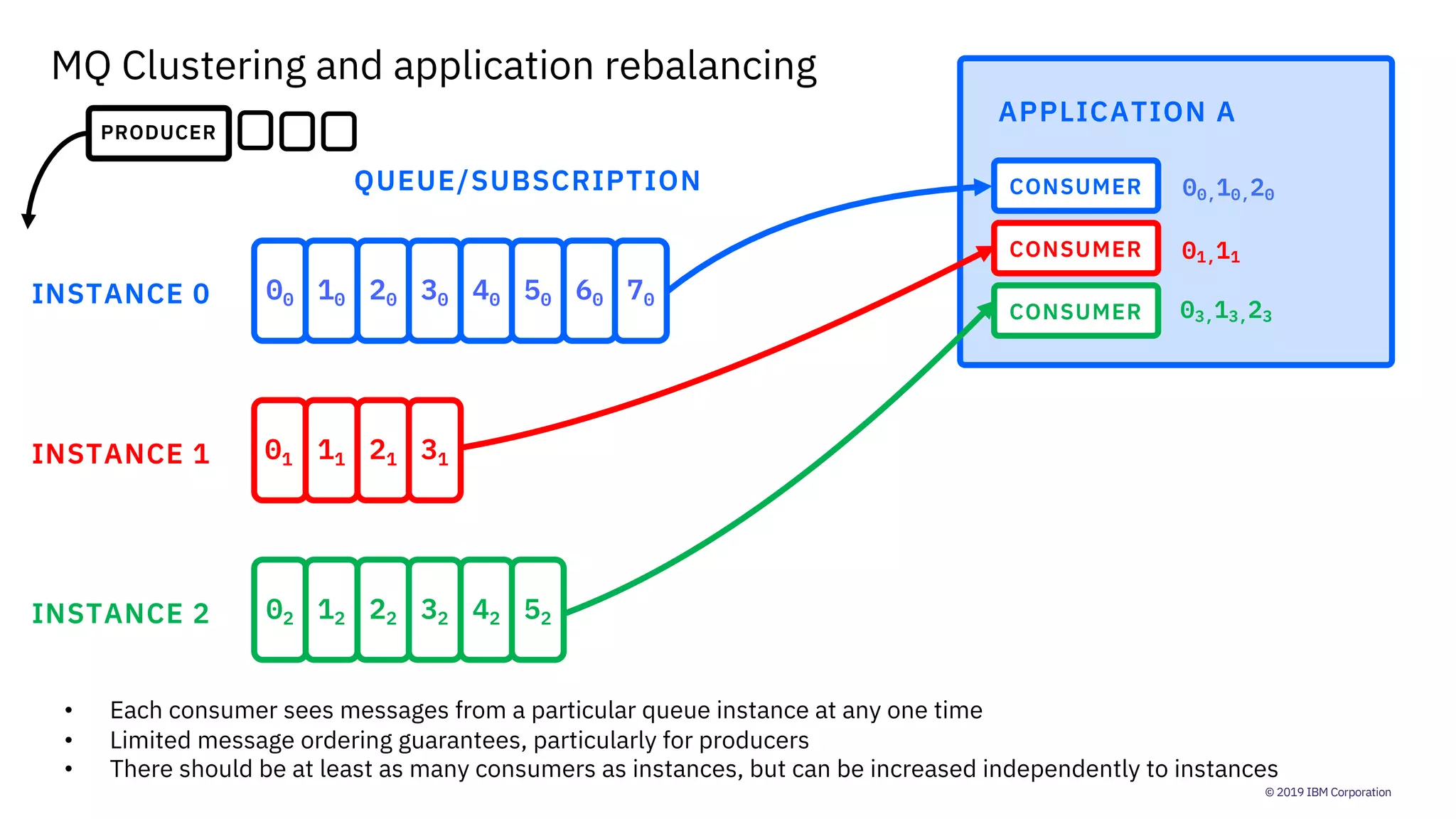
• Each consumer sees messages from a particular queue instance at any one time
• Limited message ordering guarantees, particularly for producers
• There should be at least as many consumers as instances, but can be increased independently to instances
00,10,20
01,11
03,13,23
© 2019 IBM Corporation
MQ Clustering and application rebalancing
APPLICATION A
QUEUE/SUBSCRIPTION
INSTANCE 0
INSTANCE 1
INSTANCE 2
CONSUMER
CONSUMER
CONSUMER
01 11 21 31
02 12 22 32 42 52
00 10 20 30 40 50 60 70
PRODUCER
• Each consumer sees messages from a particular queue instance at any one time
• Limited message ordering guarantees, particularly for producers
• There should be at least as many consumers as instances, but can be increased independently to instances
00,10,20,40
01,11
03,13,23,43
CONSUMER
CONSUMER
CONSUMER
CONSUMER 30,50,70
32,52
31
21
© 2019 IBM Corporation
Scaling IBM MQ Kafka
Consuming application is the bottleneck
Scale out the consuming application
Messaging system is the bottleneck
Scale out the messaging system
Increase the number of
consuming applications
from the existing
queue/subscription.
Increase the number of
topic partitions to support a
greater number of
consuming applications in a
consumer group.
Increase the number of
queue managers deployed
and workload balance
messages and consumers
across them.
Increase the number of
Kafka broker nodes
deployed and redistribute
the topic partitions across
them.
†Good practice is to capacity plan for highest load and pre-define
multiple topic partitions to support more consumers than you
currently require, enabling more dynamic consumer scaling
https://www.confluent.io/blog/how-choose-number-topics-partitions-kafka-cluster/
†
† † Unlike MQ, where new queue managers do not require copies of the
existing messages, Kafka requires event histories to be copied to a
new broker before it can be effective, slowing down dynamic scaling
https://www.infoq.com/presentations/cloud-native-kafka-netflix/
††
© 2020 IBM Corporation
Conversational
messaging
© 2019 IBM Corporation
ConversationConversation ConversationConversation
Fine grain communication?
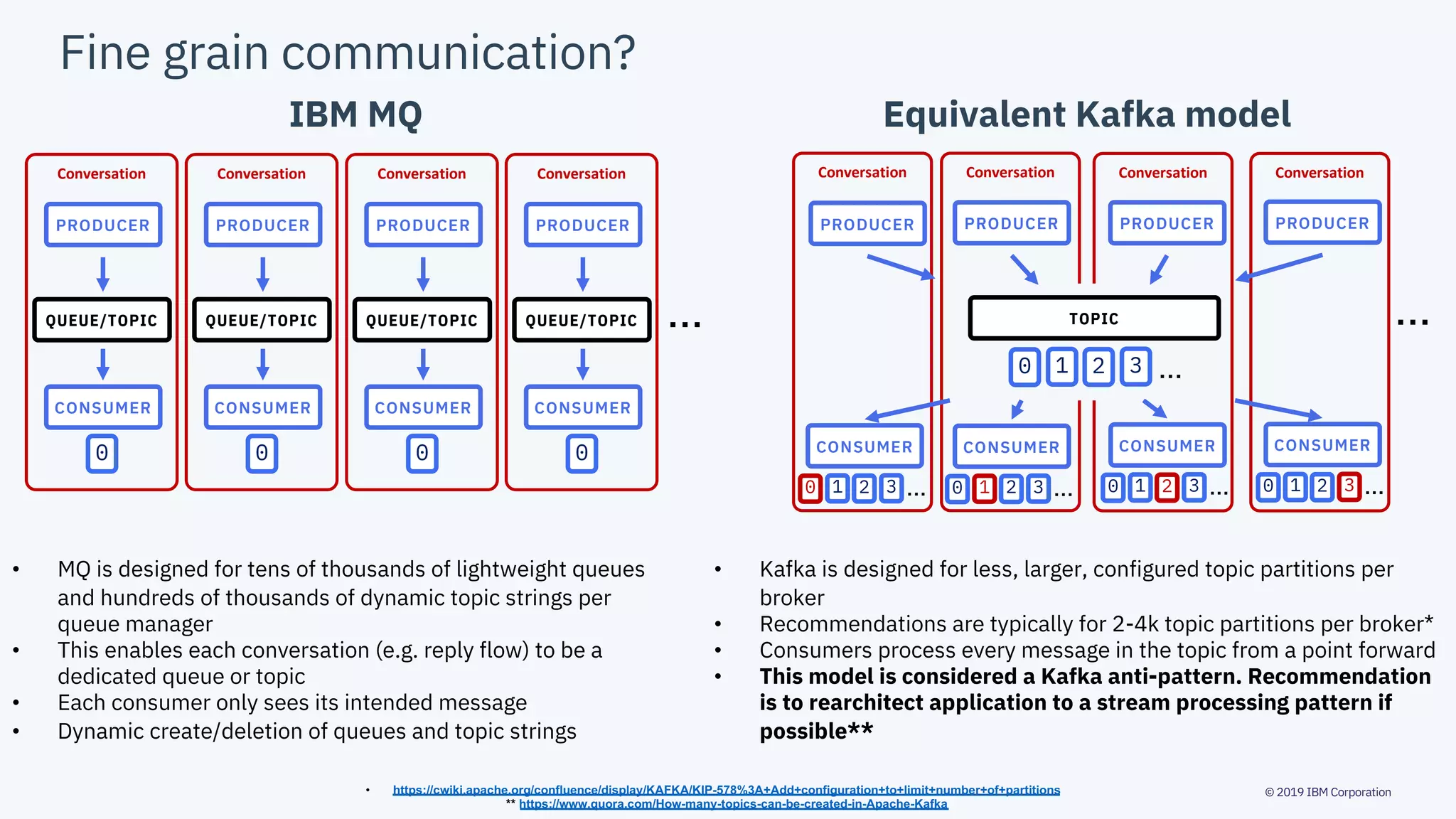
• MQ is designed for tens of thousands of lightweight queues
and hundreds of thousands of dynamic topic strings per
queue manager
• This enables each conversation (e.g. reply flow) to be a
dedicated queue or topic
• Each consumer only sees its intended message
• Dynamic create/deletion of queues and topic strings
IBM MQ Equivalent Kafka model
…
• Kafka is designed for less, larger, configured topic partitions per
broker
• Recommendations are typically for 2-4k topic partitions per broker*
• Consumers process every message in the topic from a point forward
• This model is considered a Kafka anti-pattern. Recommendation
is to rearchitect application to a stream processing pattern if
possible**
• https://cwiki.apache.org/confluence/display/KAFKA/KIP-578%3A+Add+configuration+to+limit+number+of+partitions
** https://www.quora.com/How-many-topics-can-be-created-in-Apache-Kafka
PRODUCERPRODUCER PRODUCERPRODUCER
CONSUMER
0
PRODUCER
QUEUE/TOPIC
Conversation
CONSUMER
0
PRODUCER
QUEUE/TOPIC
Conversation
CONSUMER
0
PRODUCER
QUEUE/TOPIC
Conversation
CONSUMER
0
PRODUCER
QUEUE/TOPIC
Conversation
CONSUMER
2 30 1 …
CONSUMER
2 30 1 …
CONSUMER
2 30 1 …
CONSUMER
2 30 1 …
TOPIC
2 30 1 …
…
© 2020 IBM Corporation
Message delivery
© 2019 IBM Corporation
Message delivery
TRANSACTIONALLY
COORDINATED
EXACTLY ONCE
AT LEAST ONCE
AT MOST ONCE 1 2 3 4 8 9
1 2 3 4 5 6 7
1 2 3 4 5 6 7 8 9
1 2 3 4 5 6 7 8 9
4 5 6 7 8 9
1 2 3 4 5 6 7 8 9
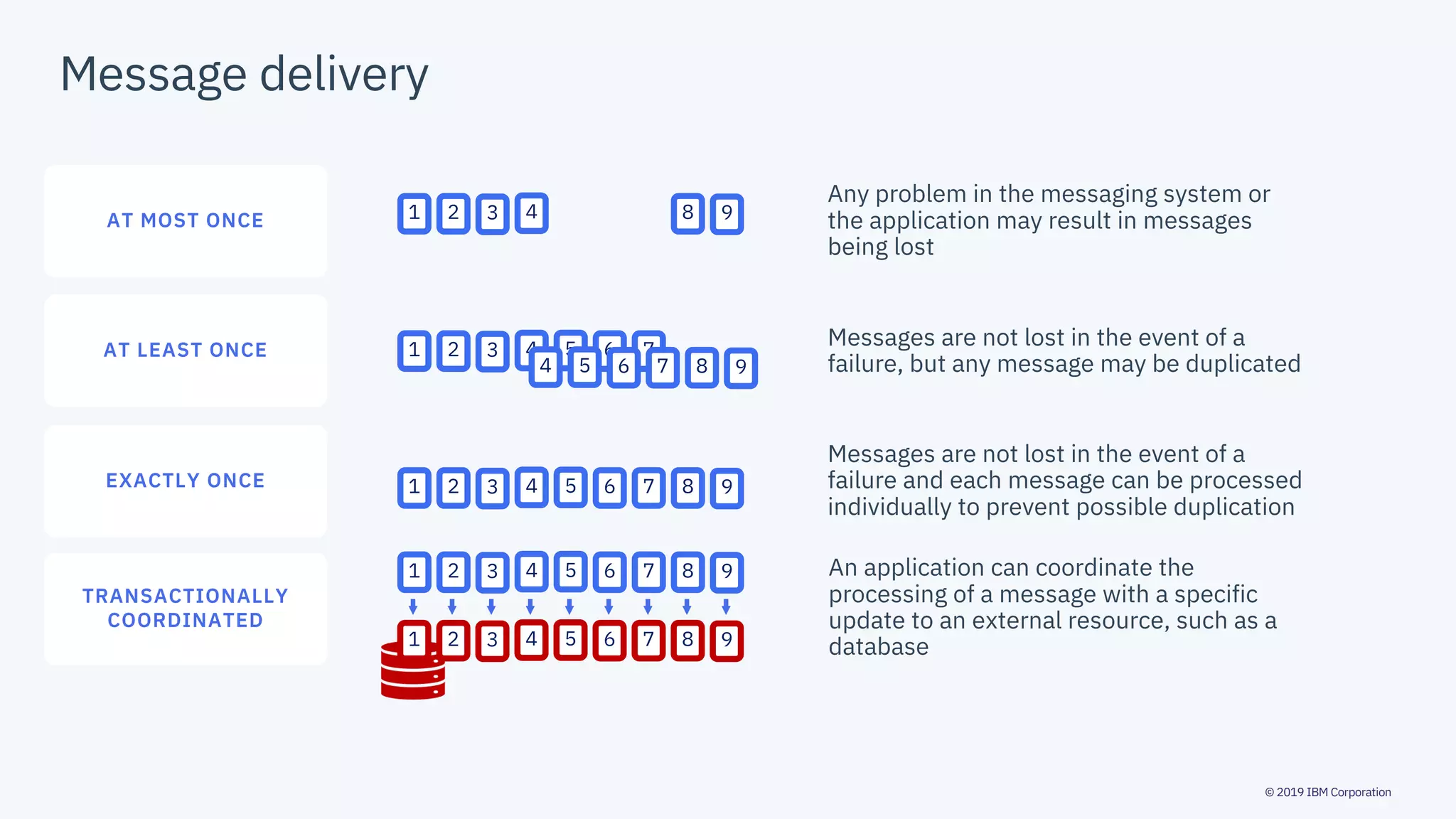
Any problem in the messaging system or
the application may result in messages
being lost
Messages are not lost in the event of a
failure, but any message may be duplicated
Messages are not lost in the event of a
failure and each message can be processed
individually to prevent possible duplication
An application can coordinate the
processing of a message with a specific
update to an external resource, such as a
database
© 2019 IBM Corporation
Message delivery
TRANSACTIONALLY
COORDINATED
EXACTLY ONCE
AT LEAST ONCE
AT MOST ONCE 1 2 3 4 8 9
1 2 3 4 5 6 7
1 2 3 4 5 6 7 8 9
1 2 3 4 5 6 7 8 9
4 5 6 7 8 9
1 2 3 4 5 6 7 8 9
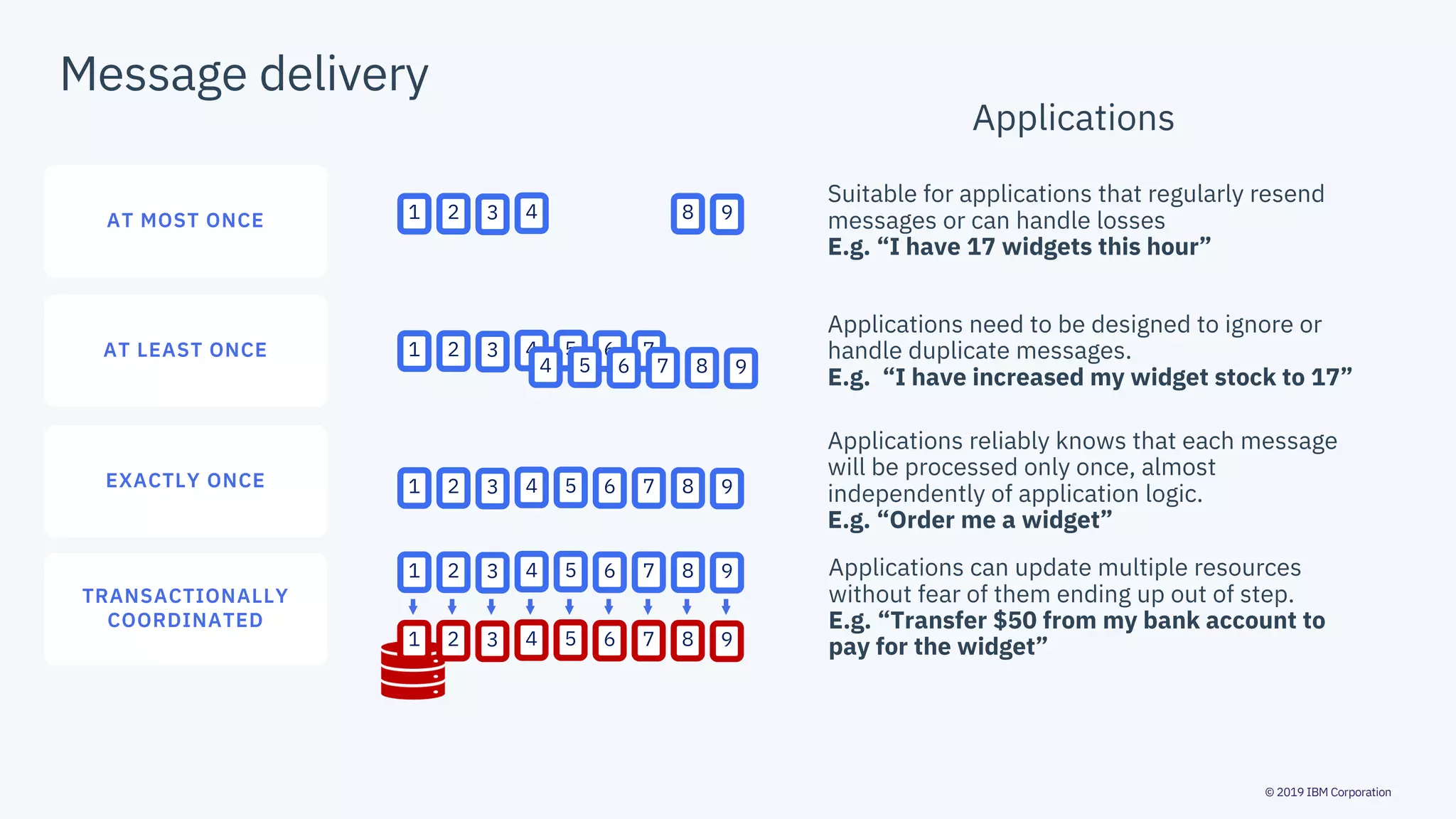
Suitable for applications that regularly resend
messages or can handle losses
E.g. “I have 17 widgets this hour”
Applications need to be designed to ignore or
handle duplicate messages.
E.g. “I have increased my widget stock to 17”
Applications reliably knows that each message
will be processed only once, almost
independently of application logic.
E.g. “Order me a widget”
Applications can update multiple resources
without fear of them ending up out of step.
E.g. “Transfer $50 from my bank account to
pay for the widget”
Applications
© 2019 IBM Corporation
Message delivery
TRANSACTIONALLY
COORDINATED
EXACTLY ONCE
AT LEAST ONCE
AT MOST ONCE 1 2 3 4 8 9
1 2 3 4 5 6 7
1 2 3 4 5 6 7 8 9
1 2 3 4 5 6 7 8 9
4 5 6 7 8 9
1 2 3 4 5 6 7 8 9
Suitable for applications that regularly resend
messages or can handle losses
E.g. “I have 17 widgets this hour”
Applications need to be designed to ignore or
handle duplicate messages.
E.g. “I have increased my widget stock to 17”
Applications reliably knows that each message
will be processed only once, almost
independently of application logic.
E.g. “Order me a widget”
Applications can update multiple resources
without fear of them ending up out of step.
E.g. “Transfer $50 from my bank account to
pay for the widget”
Applications
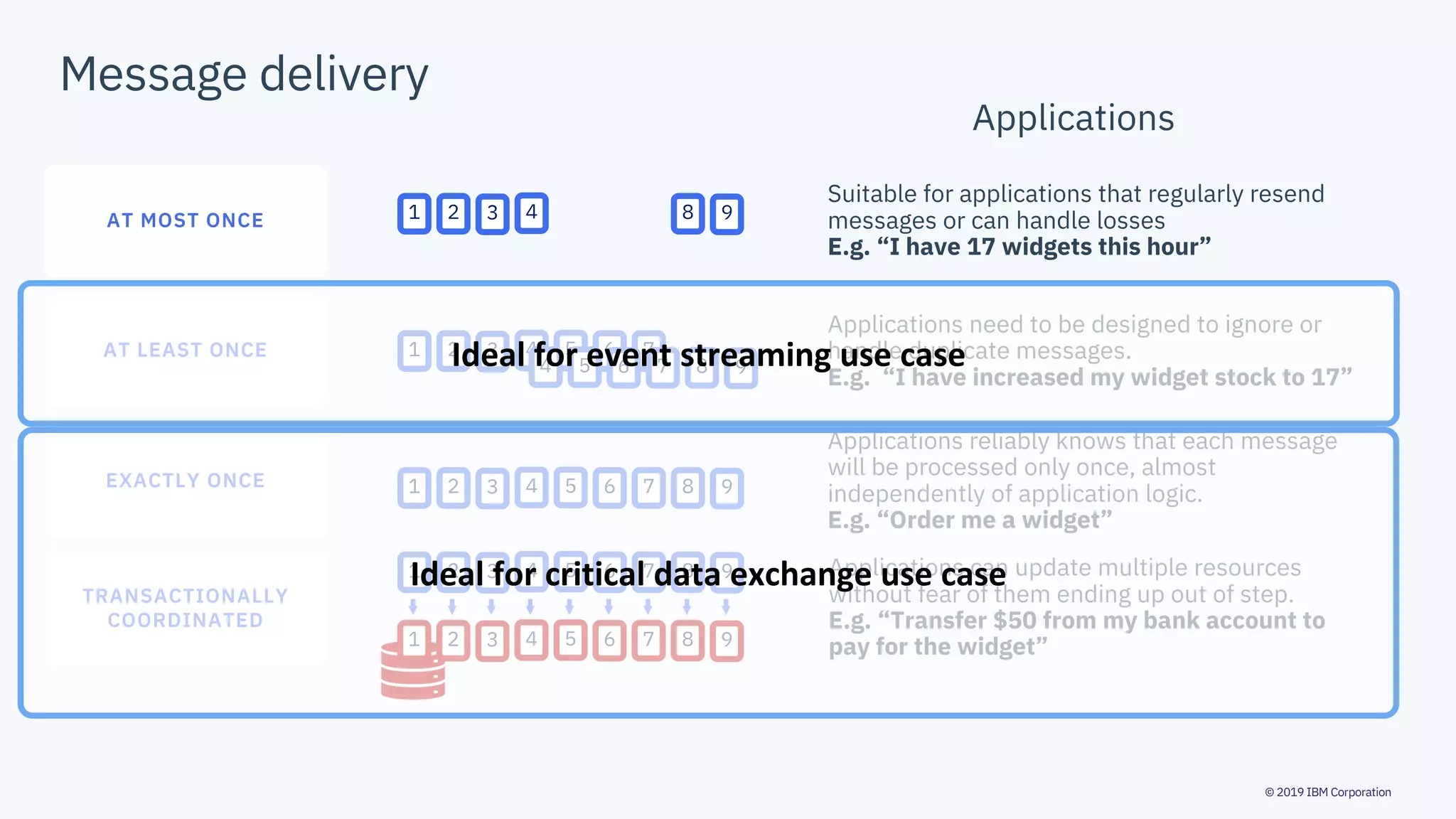
Ideal for event streaming use case
Ideal for critical data exchange use case
© 2019 IBM Corporation
Message delivery
TRANSACTIONALLY
COORDINATED
EXACTLY ONCE
AT LEAST ONCE
AT MOST ONCE 1 2 3 4 8 9
1 2 3 4 5 6 7
1 2 3 4 5 6 7 8 9
1 2 3 4 5 6 7 8 9
4 5 6 7 8 9
1 2 3 4 5 6 7 8 9
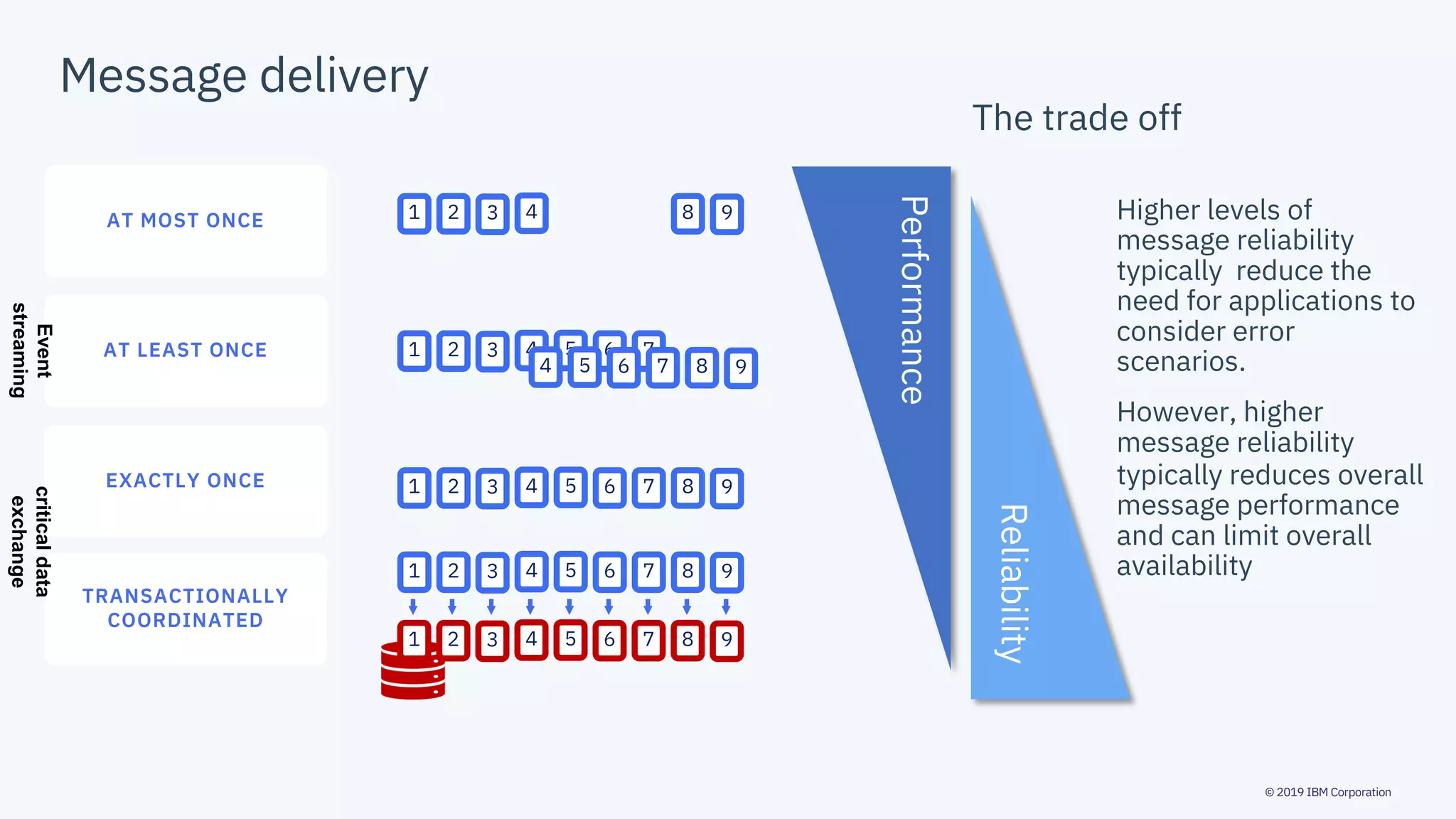
Higher levels of
message reliability
typically reduce the
need for applications to
consider error
scenarios.
However, higher
message reliability
typically reduces overall
message performance
and can limit overall
availability
The trade off
Event
streaming
criticaldata
exchange
Reliability
Performance
© 2019 IBM Corporation
Message delivery
TRANSACTIONALLY
COORDINATED
EXACTLY ONCE
AT LEAST ONCE
AT MOST ONCE 1 2 3 4 8 9
1 2 3 4 5 6 7
1 2 3 4 5 6 7 8 9
1 2 3 4 5 6 7 8 9
4 5 6 7 8 9
1 2 3 4 5 6 7 8 9
Kafka IBM MQ
https://medium.com/@andrew_schofield/does-apache-kafka-do-acid-transactions-647b207f3d0e
Sweet spots
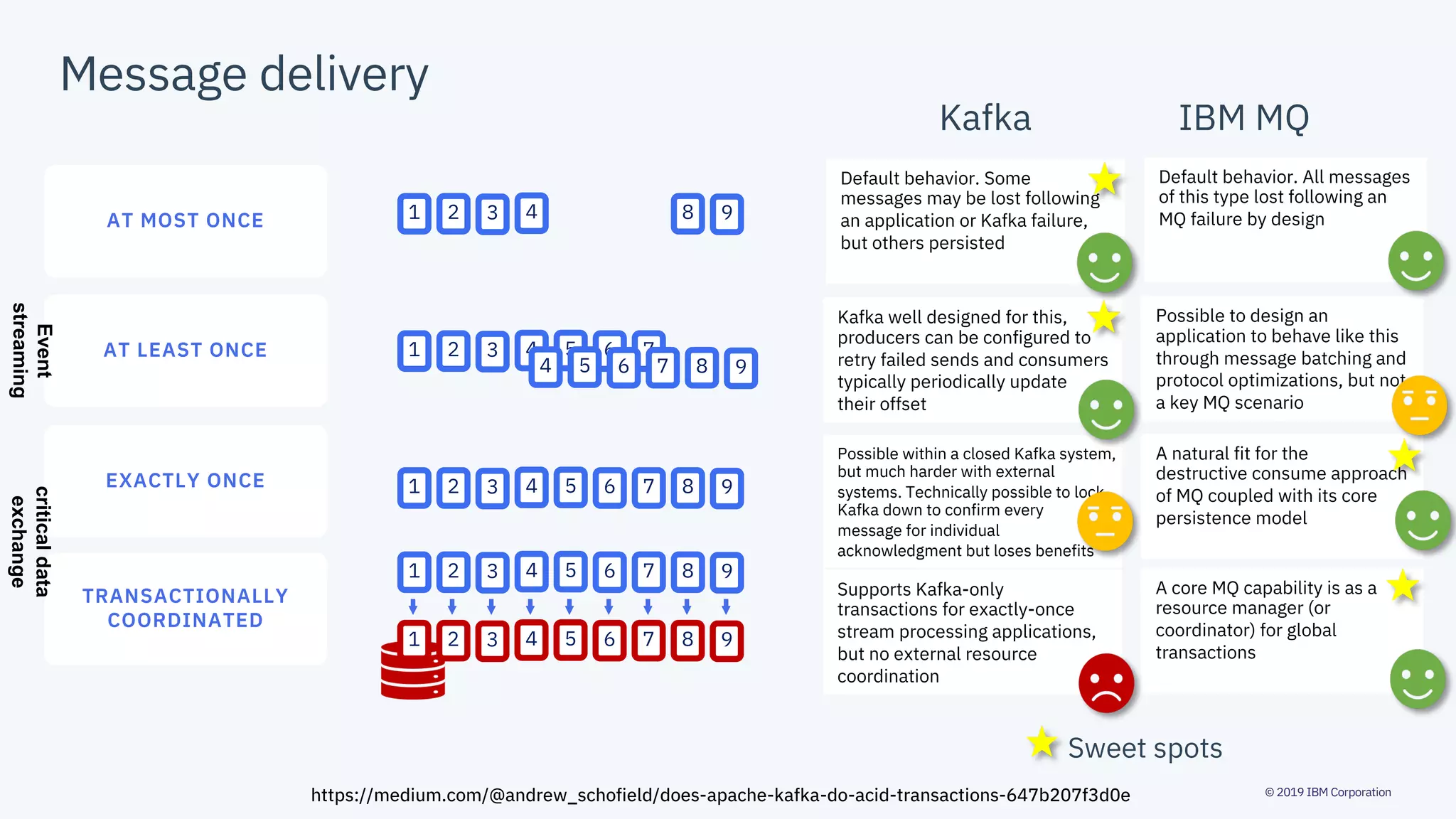
Default behavior. Some
messages may be lost following
an application or Kafka failure,
but others persisted
Default behavior. All messages
of this type lost following an
MQ failure by design
Kafka well designed for this,
producers can be configured to
retry failed sends and consumers
typically periodically update
their offset
Possible to design an
application to behave like this
through message batching and
protocol optimizations, but not
a key MQ scenario
Possible within a closed Kafka system,
but much harder with external
systems. Technically possible to lock
Kafka down to confirm every
message for individual
acknowledgment but loses benefits
A natural fit for the
destructive consume approach
of MQ coupled with its core
persistence model
Supports Kafka-only
transactions for exactly-once
stream processing applications,
but no external resource
coordination
A core MQ capability is as a
resource manager (or
coordinator) for global
transactions
Event
streaming
criticaldata
exchange
© 2020 IBM Corporation
Message availability
© 2019 IBM Corporation
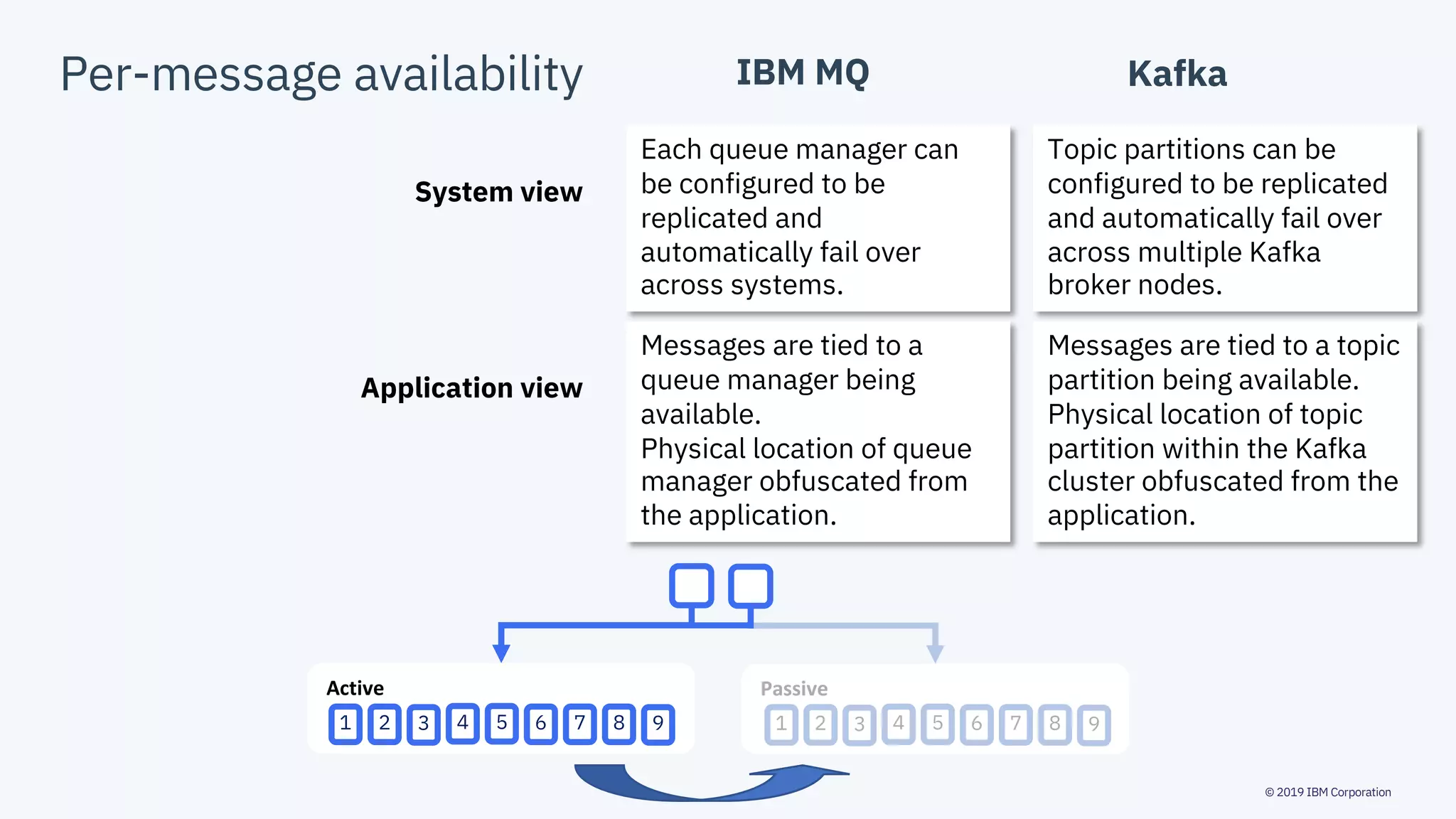
Per-message availability IBM MQ Kafka
Application view
System view
Messages are tied to a
queue manager being
available.
Physical location of queue
manager obfuscated from
the application.
Messages are tied to a topic
partition being available.
Physical location of topic
partition within the Kafka
cluster obfuscated from the
application.
Each queue manager can
be configured to be
replicated and
automatically fail over
across systems.
Topic partitions can be
configured to be replicated
and automatically fail over
across multiple Kafka
broker nodes.
PassiveActive
1 2 3 4 5 6 7 8 9 1 2 3 4 5 6 7 8 9
© 2019 IBM Corporation
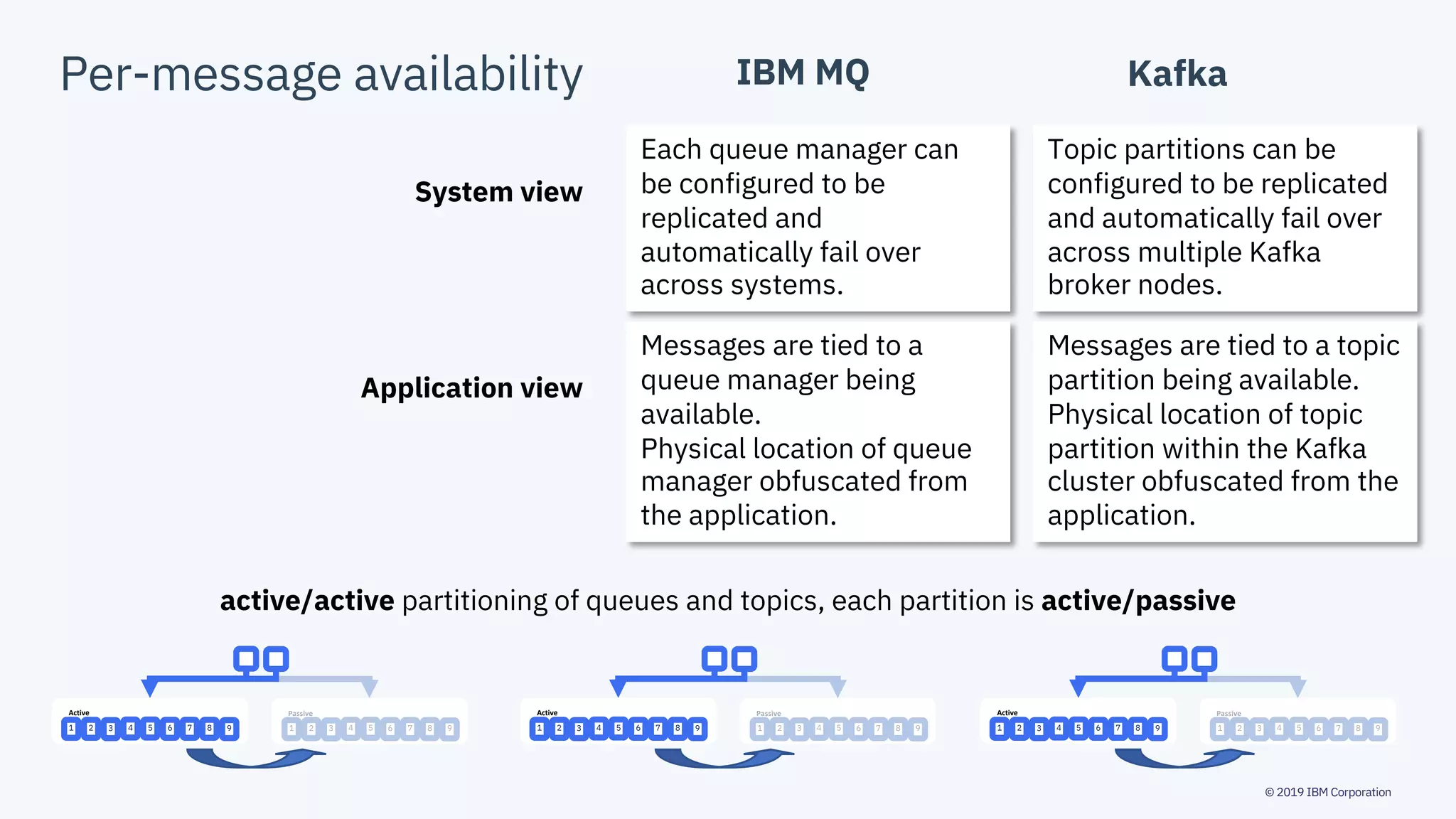
Per-message availability IBM MQ Kafka
PassiveActive
1 2 3 4 5 6 7 8 9 1 2 3 4 5 6 7 8 9
PassiveActive
1 2 3 4 5 6 7 8 9 1 2 3 4 5 6 7 8 9
PassiveActive
1 2 3 4 5 6 7 8 9 1 2 3 4 5 6 7 8 9
active/active partitioning of queues and topics, each partition is active/passive
Application view
System view
Messages are tied to a
queue manager being
available.
Physical location of queue
manager obfuscated from
the application.
Messages are tied to a topic
partition being available.
Physical location of topic
partition within the Kafka
cluster obfuscated from the
application.
Each queue manager can
be configured to be
replicated and
automatically fail over
across systems.
Topic partitions can be
configured to be replicated
and automatically fail over
across multiple Kafka
broker nodes.
© 2020 IBM Corporation
Summary
© 2020 IBM Corporation
If you want to build the best
solution, you’re probably
going to need more than a
hammer
The right tool for the job
Fine grain
messaging
End-to-end
once and once
only Deliveryü Topics and
Subscriptions
Critical data exchange Event driven Event streaming
Apache Kafka
Focused on streaming of events
IBM MQ
Focused on message exchange and transactions
connectivity
Scalable
Subscription
Stream
History
Thank you
David Ware
IBM MQ Chief Architect
—
www.linkedin.com/in/dware1
© Copyright IBM Corporation 2020. All rights reserved. The information contained in these materials is provided for informational purposes only, and is provided AS IS without warranty of
any kind, express or implied. Any statement of direction represents IBM’s current intent, is subject to change or withdrawal, and represent only goals and objectives. IBM, the IBM logo, and
ibm.com are trademarks of IBM Corp., registered in many jurisdictions worldwide. Other product and service names might be trademarks of IBM or other companies. A current list of IBM
trademarks is available at Copyright and trademark information.
57TechCon 2020 © 2020 IBM Corporation
TechCon 2020 / © 2020 IBM Corporation 58

IBM MQ and Kafka, what is the difference?

  • 1.
    TechCon 2020 IBM MQand Kafka, what is the difference? David Ware IBM MQ Chief Architect
  • 2.
    Messaging is essentialfor building fully connected, efficient and scalable solutions. More now than ever before Messaging covers a broad spectrum of requirements
  • 3.
    Messaging Scalability Security Management High Availability There aremany capabilities essential to every enterprise messaging solution IBM MQ and Kafka have both repeatedly been proven to tick these boxes…
  • 4.
    © 2020 IBMCorporation So just pick one and move on?
  • 5.
    © 2020 IBMCorporation So just pick one and move on? Perhaps, if you think everything looks like a nail
  • 6.
    © 2020 IBMCorporation So just pick one and move on? Perhaps, if you think everything looks like a nail Otherwise, let’s focus on what you’re trying to achieve…
  • 7.
    Critical data exchange:work that needs to be done Critical applications demand assured asynchronous interactions Essential capabilities: End-to-end once and once only Deliveryü Fine grain messaging Messages typically represent commands, queries and operations The message is a way to pass control from the originator of the message to the consumer
  • 8.
    Event Driven: buildingscalable microservices Microservices increases the need for communication. API-based interactions can build fragile and unscalable tight bonds between components Topics and Subscriptions Publishing and subscribing to events relaxes the coupling of microservices Events are messages that communicate that something has occurred Essential capabilities:
  • 9.
    Event Streaming: theexpanding need for messaging Event Streaming brings data together from disparate sources, enabling even more responsive and engaging experiences for a wider set of users Scalable Subscription Stream History Efficient cloud and analytics applications utilize local decoupled buffers of event data Essential capabilities:
  • 10.
    The right toolfor the job Fine grain messaging End-to-end once and once only Deliveryü Topics and Subscriptions Critical data exchange Event driven Event streaming Apache Kafka Focused on streaming of events IBM MQ Focused on message exchange and transactions connectivity Scalable Subscription Stream History
  • 11.
    © 2020 IBMCorporation To choose the right tool you’re probably going to need to go to the next level…
  • 12.
    © 2020 IBMCorporation Message consumption
  • 13.
    © 2019 IBMCorporation Consumption models 0 1 2 3 4 5 6 7 CONSUMER 0 1 2 3 4 5 6 7 CONSUMER Destructive consumption Non-destructive consumption
  • 14.
    © 2019 IBMCorporation Consumption models 0 1 2 3 4 5 6 7 CONSUMER 0 0 1 2 3 4 5 6 7 CONSUMER Destructive consumption Non-destructive consumption • Messages processed once and then deleted • Minimal data stored • Messages stay until they are consumed • When space is filled, new messages are blocked
  • 15.
    © 2019 IBMCorporation Consumption models 0 1 2 3 4 5 6 7 CONSUMER • Messages processed once and then deleted • Minimal data stored • Messages stay until they are consumed • When space is filled, new messages are blocked 0 0 1 2 3 4 5 6 7 CONSUMER Destructive consumption Non-destructive consumption 1 2 3 4 5 6 7
  • 16.
    © 2019 IBMCorporation Consumption models 0 1 2 3 4 5 6 7 CONSUMER 0 0 1 2 3 4 5 6 7 CONSUMER Destructive consumption Non-destructive consumption 1 2 3 4 5 6 7 0 • Consumers never delete a message • Consumers can move forwards and backwards • Historic data remains available for new and old consumers • Messages are removed by the system independently from the applications, whether they’ve been consumed or not • The system continues to accept new data as old messages are removed • Messages processed once and then deleted • Minimal data stored • Messages stay until they are consumed • When space is filled, new messages are blocked
  • 17.
    © 2019 IBMCorporation Consumption models 0 1 2 3 4 5 6 7 CONSUMER 0 0 1 2 3 4 5 6 7 CONSUMER Destructive consumption Non-destructive consumption 1 2 3 4 5 6 7 0 1 2 3 4 5 6 7 • Consumers never delete a message • Consumers can move forwards and backwards • Historic data remains available for new and old consumers • Messages are removed by the system independently from the applications, whether they’ve been consumed or not • The system continues to accept new data as old messages are removed • Messages processed once and then deleted • Minimal data stored • Messages stay until they are consumed • When space is filled, new messages are blocked
  • 18.
    © 2019 IBMCorporation Consumption models 0 1 2 3 4 5 6 7 CONSUMER 0 0 1 2 3 4 5 6 7 CONSUMER • Consumers never delete a message • Consumers can move forwards and backwards • Historic data remains available for new and old consumers • Messages are removed by the system independently from the applications, whether they’ve been consumed or not • The system continues to accept new data as old messages are removed Destructive consumption Non-destructive consumption 1 2 3 4 5 6 7 0 1 2 3 4 5 6 7 0 1 2 … • Messages processed once and then deleted • Minimal data stored • Messages stay until they are consumed • When space is filled, new messages are blocked
  • 19.
    © 2019 IBMCorporation Consumption models 0 1 2 3 4 5 6 7 CONSUMER • In-order message delivery • Fixed consumer scale per sequence • Out of order message processing across consumers • Easy dynamic consumer scale Exclusive consumption Shared consumption 0 1 2 3 4 5 6 7 CONSUMER CONSUMER CONSUMER
  • 20.
    © 2019 IBMCorporation Consumption models 0 1 2 3 4 5 6 7 CONSUMER • In-order message delivery • Fixed consumer scale per sequence 0 1 2 3 4 5 6 7 • Out of order message processing across consumers • Easy dynamic consumer scale Exclusive consumption Shared consumption 0 1 2 3 4 5 6 7 CONSUMER CONSUMER CONSUMER
  • 21.
    © 2019 IBMCorporation Consumption models 0 1 2 3 4 5 6 7 CONSUMER • In-order message delivery • Fixed consumer scale per sequence 0 1 2 3 4 5 6 7 • Out of order message processing across consumers • Easy dynamic consumer scale Exclusive consumption Shared consumption 0 1 2 3 4 5 6 7 CONSUMER CONSUMER CONSUMER 0 1 23 45 67
  • 22.
    © 2019 IBMCorporation Consumption models IBM MQ Kafka Destructive consumption Messages only remain in the system until an application has consumed them or they expire individually n/a Non-destructive consumption MQ niche: Messages can be browsed first, but ultimately, they still need to be destructively consumed (or expired) Messages remain available, independent of the consuming applications. Duration and volume is controlled per topic Exclusive consumption Exclusive access can be controlled administratively or per application Consumers always have exclusive access to a sequence of messages Shared consumption Unlimited number of consumers for a sequence of messages n/a Solution sweet spots
  • 23.
    © 2019 IBMCorporation Consumption models IBM MQ Kafka Destructive consumption Messages only remain in the system until an application has consumed them or they expire individually n/a Non-destructive consumption MQ niche: Messages can be browsed first, but ultimately, they still need to be destructively consumed (or expired) Messages remain available, independent of the consuming applications. Duration and volume is controlled per topic Exclusive consumption Exclusive access can be controlled administratively or per application Consumers always have exclusive access to a sequence of messages Shared consumption Unlimited number of consumers for a sequence of messages n/a Solution sweet spots Kafka topic partitions…
  • 24.
    © 2020 IBMCorporation Queues and topics
  • 25.
    © 2019 IBMCorporation Comparing queues and topics QUEUE 0 1 2 3 4 5 6 7 CONSUMER CONSUMER CONSUMER PRODUCER PRODUCER 0 1 23 45 6 7 TOPIC 0 1 2 3 4 5 6 7 SUBSCRIPTION SUBSCRIPTION SUBSCRIPTION PRODUCER PRODUCER CONSUMER CONSUMER CONSUMER 0 1 2 3 4 5 6 7 0 1 2 3 4 5 6 7 0 1 2 3 4 5 6 7 Queues Topics • Each messages goes to a single consumer from the queue • Each message goes to every subscriber to the topic
  • 26.
    © 2019 IBMCorporation CONSUMERCONSUMER MQ and Kafka topics TOPIC PARTITION 0 1 2 3 4 5 6 7 CONSUMER GROUP CONSUMER GROUP PRODUCER PRODUCER CONSUMER CONSUMER TOPIC 0 1 2 3 4 5 6 7 SUBSCRIPTION SUBSCRIPTION PRODUCER PRODUCER CONSUMER CONSUMER 1 2 3 4 5 6 70 1 2 3 4 5 6 70 IBM MQ Kafka
  • 27.
    © 2019 IBMCorporation Queues and topics IBM MQ Kafka Queues Primary MQ concept Queues are administratively or dynamically created Queues can be partitioned for scale All messages are stored on queues, even publications n/a Topics Core MQ capability Topics are dynamically created as needed by applications Each subscribing application has access to a dedicated queue of to-be-consumed messages matching their subscription. Primary Kafka concept Rolling history of messages maintained by Kafka. Topics can be partitioned for scale… Consumer’s offset within a shared stream of messages is maintained by Kafka.
  • 28.
    © 2020 IBMCorporation Scaling
  • 29.
    Horizontal scaling –workload balance the messages PRODUCE MESSAGES T O Q U E U E A CONSUMER CONSUMER IBM MQ Kafka PRODUCE MESSAGES T O Q U E U E A CONSUMER CONSUMER CONSUMER CONSUMER CONSUMER
  • 30.
    Kafka Clusters • AKafka system is typically made up of multiple active nodes • Topics can be partitioned to enable workload balancing across those nodes, improving scale and availability of the topics • Kafka workload balances messages across partitions, either randomly or based on application provided context to enable per-partition ordering • Each topic partition is active in one broker at a time • The messages held in a topic partition can be replicated to other brokers to ensure data integrity across failures and automatic recovery
  • 31.
    © 2019 IBMCorporation CONSUMER GROUP A TOPIC PARTITION 0 PARTITION 1 PARTITION 2 Kafka partitions and consumer groups 01 11 21 31 02 12 22 32 42 52 00 10 20 30 40 50 60 70 PRODUCER • Each consumer sees messages from a particular partition in order • Changing the number of partitions may result in out-of-order messages • There can be more partitions than consumers in a consumer group, but no benefit to more consumers
  • 32.
    © 2019 IBMCorporation CONSUMER GROUP A TOPIC PARTITION 0 PARTITION 1 PARTITION 2 CONSUMER CONSUMER CONSUMER Kafka partitions and consumer groups p0, offset 70 p1, offset 31 p2, offset 52 01 11 21 31 02 12 22 32 42 52 00 10 20 30 40 50 60 70 PRODUCER • Each consumer sees messages from a particular partition in order • Changing the number of partitions may result in out-of-order messages • There can be more partitions than consumers in a consumer group, but no benefit to more consumers
  • 33.
    © 2019 IBMCorporation CONSUMER GROUP A TOPIC PARTITION 0 PARTITION 1 PARTITION 2 CONSUMER CONSUMER CONSUMER CONSUMER GROUP B CONSUMER CONSUMER Kafka partitions and consumer groups p0, offset 70 p1, offset 31 p2, offset 52 p0, offset 70 p1, offset 31 p2, offset 52 01 11 21 31 02 12 22 32 42 52 00 10 20 30 40 50 60 70 PRODUCER • Each consumer sees messages from a particular partition in order • Changing the number of partitions may result in out-of-order messages • There can be more partitions than consumers in a consumer group, but no benefit to more consumers
  • 34.
    © 2019 IBMCorporation CONSUMER GROUP A TOPIC PARTITION 0 PARTITION 1 PARTITION 2 CONSUMER CONSUMER CONSUMER CONSUMER CONSUMER GROUP B CONSUMER CONSUMER Kafka partitions and consumer groups - p0, offset 70 p1, offset 31 p2, offset 52 p0, offset 70 p1, offset 31 p2, offset 52 01 11 21 31 02 12 22 32 42 52 00 10 20 30 40 50 60 70 PRODUCER • Each consumer sees messages from a particular partition in order • Changing the number of partitions may result in out-of-order messages • There can be more partitions than consumers in a consumer group, but no benefit to more consumers X
  • 35.
    IBM MQ Clustersand workload balancing PRODUCE MESSAGES TO QUEUE A CONSUMER CONSUMER CONSUMER CONSUMER CONSUMER • A single running instance of MQ is a queue manager. • These can act independently or collectively to build horizontally scaled solutions. • An MQ Cluster is a dynamically provisioned set of queue managers with the ability to partition queues across them. • MQ will workload balance inbound messages from producing applications across each partition of the queue. • With MQ’s Uniform Cluster capability, MQ will workload balance multiple consuming applications across each queue manager, ensuring messages are consumed efficiently. • MQ does not provide simple message ordering in these topologies • MQ’s HA technologies provide data integrity across failures and automatic recovery
  • 36.
    © 2019 IBMCorporation MQ Clustering and application rebalancing APPLICATION QUEUE/SUBSCRIPTION INSTANCE 0 INSTANCE 1 INSTANCE 2 01 11 21 31 02 12 22 32 42 52 00 10 20 30 40 50 60 70 PRODUCER • Each consumer sees messages from a particular queue instance at any one time • Limited message ordering guarantees, particularly for producers • There should be at least as many consumers as instances, but can be increased independently to instances
  • 37.
    © 2019 IBMCorporation MQ Clustering and application rebalancing APPLICATION A QUEUE/SUBSCRIPTION INSTANCE 0 INSTANCE 1 INSTANCE 2 CONSUMER CONSUMER 01 11 21 31 02 12 22 32 42 52 00 10 20 30 40 50 60 70 PRODUCER • Each consumer sees messages from a particular queue instance at any one time • Limited message ordering guarantees, particularly for producers • There should be at least as many consumers as instances, but can be increased independently to instances 00,10,20, … 01,11, … X
  • 38.
    © 2019 IBMCorporation MQ Clustering and application rebalancing APPLICATION A QUEUE/SUBSCRIPTION INSTANCE 0 INSTANCE 1 INSTANCE 2 CONSUMER CONSUMER CONSUMER 01 11 21 31 02 12 22 32 42 52 00 10 20 30 40 50 60 70 PRODUCER • Each consumer sees messages from a particular queue instance at any one time • Limited message ordering guarantees, particularly for producers • There should be at least as many consumers as instances, but can be increased independently to instances 00,10,20 01,11 03,13,23
  • 39.
    © 2019 IBMCorporation MQ Clustering and application rebalancing APPLICATION A QUEUE/SUBSCRIPTION INSTANCE 0 INSTANCE 1 INSTANCE 2 CONSUMER CONSUMER CONSUMER 01 11 21 31 02 12 22 32 42 52 00 10 20 30 40 50 60 70 PRODUCER • Each consumer sees messages from a particular queue instance at any one time • Limited message ordering guarantees, particularly for producers • There should be at least as many consumers as instances, but can be increased independently to instances 00,10,20,40 01,11 03,13,23,43 CONSUMER CONSUMER CONSUMER CONSUMER 30,50,70 32,52 31 21
  • 40.
    © 2019 IBMCorporation Scaling IBM MQ Kafka Consuming application is the bottleneck Scale out the consuming application Messaging system is the bottleneck Scale out the messaging system Increase the number of consuming applications from the existing queue/subscription. Increase the number of topic partitions to support a greater number of consuming applications in a consumer group. Increase the number of queue managers deployed and workload balance messages and consumers across them. Increase the number of Kafka broker nodes deployed and redistribute the topic partitions across them. †Good practice is to capacity plan for highest load and pre-define multiple topic partitions to support more consumers than you currently require, enabling more dynamic consumer scaling https://www.confluent.io/blog/how-choose-number-topics-partitions-kafka-cluster/ † † † Unlike MQ, where new queue managers do not require copies of the existing messages, Kafka requires event histories to be copied to a new broker before it can be effective, slowing down dynamic scaling https://www.infoq.com/presentations/cloud-native-kafka-netflix/ ††
  • 41.
    © 2020 IBMCorporation Conversational messaging
  • 42.
    © 2019 IBMCorporation ConversationConversation ConversationConversation Fine grain communication? • MQ is designed for tens of thousands of lightweight queues and hundreds of thousands of dynamic topic strings per queue manager • This enables each conversation (e.g. reply flow) to be a dedicated queue or topic • Each consumer only sees its intended message • Dynamic create/deletion of queues and topic strings IBM MQ Equivalent Kafka model … • Kafka is designed for less, larger, configured topic partitions per broker • Recommendations are typically for 2-4k topic partitions per broker* • Consumers process every message in the topic from a point forward • This model is considered a Kafka anti-pattern. Recommendation is to rearchitect application to a stream processing pattern if possible** • https://cwiki.apache.org/confluence/display/KAFKA/KIP-578%3A+Add+configuration+to+limit+number+of+partitions ** https://www.quora.com/How-many-topics-can-be-created-in-Apache-Kafka PRODUCERPRODUCER PRODUCERPRODUCER CONSUMER 0 PRODUCER QUEUE/TOPIC Conversation CONSUMER 0 PRODUCER QUEUE/TOPIC Conversation CONSUMER 0 PRODUCER QUEUE/TOPIC Conversation CONSUMER 0 PRODUCER QUEUE/TOPIC Conversation CONSUMER 2 30 1 … CONSUMER 2 30 1 … CONSUMER 2 30 1 … CONSUMER 2 30 1 … TOPIC 2 30 1 … …
  • 43.
    © 2020 IBMCorporation Message delivery
  • 44.
    © 2019 IBMCorporation Message delivery TRANSACTIONALLY COORDINATED EXACTLY ONCE AT LEAST ONCE AT MOST ONCE 1 2 3 4 8 9 1 2 3 4 5 6 7 1 2 3 4 5 6 7 8 9 1 2 3 4 5 6 7 8 9 4 5 6 7 8 9 1 2 3 4 5 6 7 8 9 Any problem in the messaging system or the application may result in messages being lost Messages are not lost in the event of a failure, but any message may be duplicated Messages are not lost in the event of a failure and each message can be processed individually to prevent possible duplication An application can coordinate the processing of a message with a specific update to an external resource, such as a database
  • 45.
    © 2019 IBMCorporation Message delivery TRANSACTIONALLY COORDINATED EXACTLY ONCE AT LEAST ONCE AT MOST ONCE 1 2 3 4 8 9 1 2 3 4 5 6 7 1 2 3 4 5 6 7 8 9 1 2 3 4 5 6 7 8 9 4 5 6 7 8 9 1 2 3 4 5 6 7 8 9 Suitable for applications that regularly resend messages or can handle losses E.g. “I have 17 widgets this hour” Applications need to be designed to ignore or handle duplicate messages. E.g. “I have increased my widget stock to 17” Applications reliably knows that each message will be processed only once, almost independently of application logic. E.g. “Order me a widget” Applications can update multiple resources without fear of them ending up out of step. E.g. “Transfer $50 from my bank account to pay for the widget” Applications
  • 46.
    © 2019 IBMCorporation Message delivery TRANSACTIONALLY COORDINATED EXACTLY ONCE AT LEAST ONCE AT MOST ONCE 1 2 3 4 8 9 1 2 3 4 5 6 7 1 2 3 4 5 6 7 8 9 1 2 3 4 5 6 7 8 9 4 5 6 7 8 9 1 2 3 4 5 6 7 8 9 Suitable for applications that regularly resend messages or can handle losses E.g. “I have 17 widgets this hour” Applications need to be designed to ignore or handle duplicate messages. E.g. “I have increased my widget stock to 17” Applications reliably knows that each message will be processed only once, almost independently of application logic. E.g. “Order me a widget” Applications can update multiple resources without fear of them ending up out of step. E.g. “Transfer $50 from my bank account to pay for the widget” Applications Ideal for event streaming use case Ideal for critical data exchange use case
  • 47.
    © 2019 IBMCorporation Message delivery TRANSACTIONALLY COORDINATED EXACTLY ONCE AT LEAST ONCE AT MOST ONCE 1 2 3 4 8 9 1 2 3 4 5 6 7 1 2 3 4 5 6 7 8 9 1 2 3 4 5 6 7 8 9 4 5 6 7 8 9 1 2 3 4 5 6 7 8 9 Higher levels of message reliability typically reduce the need for applications to consider error scenarios. However, higher message reliability typically reduces overall message performance and can limit overall availability The trade off Event streaming criticaldata exchange Reliability Performance
  • 48.
    © 2019 IBMCorporation Message delivery TRANSACTIONALLY COORDINATED EXACTLY ONCE AT LEAST ONCE AT MOST ONCE 1 2 3 4 8 9 1 2 3 4 5 6 7 1 2 3 4 5 6 7 8 9 1 2 3 4 5 6 7 8 9 4 5 6 7 8 9 1 2 3 4 5 6 7 8 9 Kafka IBM MQ https://medium.com/@andrew_schofield/does-apache-kafka-do-acid-transactions-647b207f3d0e Sweet spots Default behavior. Some messages may be lost following an application or Kafka failure, but others persisted Default behavior. All messages of this type lost following an MQ failure by design Kafka well designed for this, producers can be configured to retry failed sends and consumers typically periodically update their offset Possible to design an application to behave like this through message batching and protocol optimizations, but not a key MQ scenario Possible within a closed Kafka system, but much harder with external systems. Technically possible to lock Kafka down to confirm every message for individual acknowledgment but loses benefits A natural fit for the destructive consume approach of MQ coupled with its core persistence model Supports Kafka-only transactions for exactly-once stream processing applications, but no external resource coordination A core MQ capability is as a resource manager (or coordinator) for global transactions Event streaming criticaldata exchange
  • 49.
    © 2020 IBMCorporation Message availability
  • 50.
    © 2019 IBMCorporation Per-message availability IBM MQ Kafka Application view System view Messages are tied to a queue manager being available. Physical location of queue manager obfuscated from the application. Messages are tied to a topic partition being available. Physical location of topic partition within the Kafka cluster obfuscated from the application. Each queue manager can be configured to be replicated and automatically fail over across systems. Topic partitions can be configured to be replicated and automatically fail over across multiple Kafka broker nodes. PassiveActive 1 2 3 4 5 6 7 8 9 1 2 3 4 5 6 7 8 9
  • 51.
    © 2019 IBMCorporation Per-message availability IBM MQ Kafka PassiveActive 1 2 3 4 5 6 7 8 9 1 2 3 4 5 6 7 8 9 PassiveActive 1 2 3 4 5 6 7 8 9 1 2 3 4 5 6 7 8 9 PassiveActive 1 2 3 4 5 6 7 8 9 1 2 3 4 5 6 7 8 9 active/active partitioning of queues and topics, each partition is active/passive Application view System view Messages are tied to a queue manager being available. Physical location of queue manager obfuscated from the application. Messages are tied to a topic partition being available. Physical location of topic partition within the Kafka cluster obfuscated from the application. Each queue manager can be configured to be replicated and automatically fail over across systems. Topic partitions can be configured to be replicated and automatically fail over across multiple Kafka broker nodes.
  • 52.
    © 2020 IBMCorporation Summary
  • 53.
    © 2020 IBMCorporation If you want to build the best solution, you’re probably going to need more than a hammer
  • 54.
    The right toolfor the job Fine grain messaging End-to-end once and once only Deliveryü Topics and Subscriptions Critical data exchange Event driven Event streaming Apache Kafka Focused on streaming of events IBM MQ Focused on message exchange and transactions connectivity Scalable Subscription Stream History
  • 55.
    Thank you David Ware IBMMQ Chief Architect — www.linkedin.com/in/dware1 © Copyright IBM Corporation 2020. All rights reserved. The information contained in these materials is provided for informational purposes only, and is provided AS IS without warranty of any kind, express or implied. Any statement of direction represents IBM’s current intent, is subject to change or withdrawal, and represent only goals and objectives. IBM, the IBM logo, and ibm.com are trademarks of IBM Corp., registered in many jurisdictions worldwide. Other product and service names might be trademarks of IBM or other companies. A current list of IBM trademarks is available at Copyright and trademark information. 57TechCon 2020 © 2020 IBM Corporation
  • 56.
    TechCon 2020 /© 2020 IBM Corporation 58