WSO2	
  Message	
  Broker	


<Presenter	
  Name>	
  
<Designa*on>	
  
WSO2	
  Message	
  Broker	


  Unique	
  distributable,	
  fault	
  tolerant	
  and	
  scalable	
  enterprise	
  
message	
  broker	
  to	
  connect,	
  persist	
  and	
  reliably	
  distribute	
  
data,	
  event	
  informa9on	
  generated	
  from	
  mul9ple	
  systems,	
  
applica9ons	
  and	
  IoT	
  devices.	


Advantages	
  
•  Integrate	
  easily	
  with	
  exis9ng	
  IT	
  Infrastructure	
  .	
  
•  Select	
  storage	
  based	
  on	
  messaging	
  demands	
  .	
  
•  Provides	
  op9on	
  between	
  strict	
  and	
  best	
  effort	
  message	
  delivery.	
  
•  Low	
  maintenance	
  through	
  minimum	
  deployment	
  effort.	
  
•  Highly	
  interoperable	
  with	
  AMQP	
  clients.	
  
•  Effortlessly	
  handle	
  large	
  message	
  transfer.	
  
•  Seamless	
  feature	
  integra9on	
  with	
  WSO2	
  ESB.	


3	
  
Supported	
  Protocols	
  &	
  SpecificaAons	
  
•  Implements	
  and	
  supports	
  JMS	
  API	
  using	
  AMQP	
  
•  JMS	
  (Java	
  Message	
  Service)	
  
•  A	
  Standard	
  Java	
  API	
  for	
  programmers	
  to	
  handle	
  messaging	
  by	
  interac9ng	
  
with	
  a	
  message	
  broker	
  
•  AMQP	
  (Advanced	
  Message	
  Queuing	
  Protocol)	
  
•  Open	
  Standard	
  for	
  passing	
  business	
  messages	
  between	
  applica9ons	
  or	
  
organiza9ons	
  
•  MQTT	
  (Message	
  Queuing	
  Telemetry	
  Transport)	


4	
  
AMQP-­‐Interoperability	


•  Implements	
  and	
  supports	
  JMS	
  API	
  using	
  AMQP.	
  
•  Interoperability	
  with	
  many	
  languages	
  /	
  plaSorms	
  via	
  AMQP	
  
clients	
  for	
  	
  
•  Java,	
  
•  Net,	
  
•  	
  C,	
  C++,	
  PHP,	
  Ruby	
  and	
  more.	
  
•  Advanced	
  Message	
  Queuing	
  Protocol,	
  the	
  only	
  industry	
  standard	
  
protocol	
  for	
  interoperable	
  reliable	
  messaging.	
  
•  Support	
  for	
  JMS	
  v1.0	
  and	
  v1.1	
  API	
  .	


5	
  
MQTT	
  Support	
  
●  Lightweight	
  pub/sub	
  protocol	
  implemented	
  on	
  top	
  of	
  TCP/IP	
  to	
  
facilitate	
  machine-­‐to-­‐machine	
  (M2M)	
  and	
  Internet-­‐of-­‐Things	
  
(IoT)	
  integra9ons	
  
●  Hierarchical	
  topic	
  structures	
  and	
  wildcard	
  subscrip9ons	
  
●  All	
  quality	
  of	
  service	
  levels	
  and	
  retained	
  messages	
  
●  At	
  most	
  once(0)	
  
●  At	
  least	
  once(1)	
  
●  Exactly	
  one(2)	
  
●  Distributed	
  MQTT	
  topics	
  (Publish	
  to	
  any	
  node	
  and	
  receive	
  from	
  
another)	


6	
  
Architecture	
  
7	
  
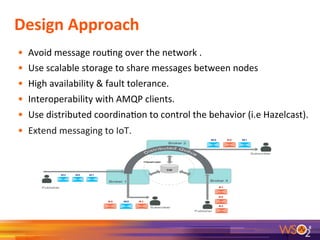
Design	
  Approach	
  
•  Avoid	
  message	
  rou9ng	
  over	
  the	
  network	
  .	
  
•  Use	
  scalable	
  storage	
  to	
  share	
  messages	
  between	
  nodes	
  
•  High	
  availability	
  &	
  fault	
  tolerance.	
  
•  Interoperability	
  with	
  AMQP	
  clients.	
  
•  Use	
  distributed	
  coordina9on	
  to	
  control	
  the	
  behavior	
  (i.e	
  Hazelcast).	
  
•  Extend	
  messaging	
  to	
  IoT.	


8	
  
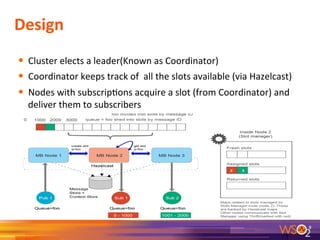
Design	


•  Cluster	
  elects	
  a	
  leader(Known	
  as	
  Coordinator)	
  
•  Coordinator	
  keeps	
  track	
  of	
  	
  all	
  the	
  slots	
  available	
  (via	
  Hazelcast)	
  
•  Nodes	
  with	
  subscrip9ons	
  acquire	
  a	
  slot	
  (from	
  Coordinator)	
  and	
  
deliver	
  them	
  to	
  subscribers	


9	
  
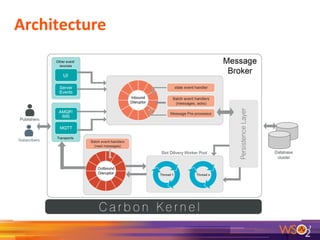
Performance	
  
•  Based	
  on	
  a	
  disruptor	
  based	
  model	
  
•  Inbound	
  Disruptor	
  
•  All	
  incoming	
  events	
  are	
  ordered	
  by	
  inser9ng	
  into	
  a	
  ring	
  buffer.	
  
•  Mul9ple	
  handlers	
  operate	
  on	
  ring	
  buffer	
  in	
  parallel.	
  
•  Stores/Deletes	
  data	
  through	
  persistence	
  layer	
  (	
  extensible	
  to	
  more	
  data	
  
store	
  types).	
  
•  Slot	
  Delivery	
  Worker	
  Pool:	
  
•  	
  	
  Reads	
  messages	
  from	
  Database	
  from	
  MB	
  nodes	
  based	
  on	
  the	
  
subscribers.	
  
•  Keeps	
  track	
  of	
  messages	
  (re-­‐)	
  delivered,	
  subscribers	
  
•  Passes	
  messages	
  to	
  outbound	
  Disruptor	
  
•  Outbound	
  Disruptor:	
  
•  Reads	
  messages	
  from	
  database	
  in	
  parallel	
  	
  
•  Handover	
  messages	
  to	
  transport	
  for	
  delivery	


   10	
  
Features	
  
11	
  
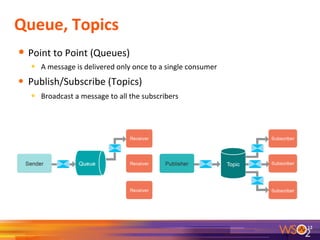
Queue,	
  Topics	
  
• Point	
  to	
  Point	
  (Queues)	
  
•  A	
  message	
  is	
  delivered	
  only	
  once	
  to	
  a	
  single	
  consumer	
  
•  Publish/Subscribe	
  (Topics)	
  
•  Broadcast	
  a	
  message	
  to	
  all	
  the	
  subscribers	


12	
  
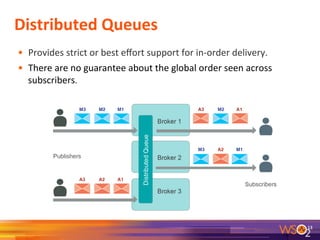
Distributed	
  Queues	
  
•  Provides	
  strict	
  or	
  best	
  effort	
  support	
  for	
  in-­‐order	
  delivery.	
  
•  There	
  are	
  no	
  guarantee	
  about	
  the	
  global	
  order	
  seen	
  across	
  
subscribers.	


13	
  
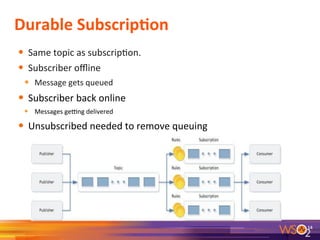
Durable	
  SubscripAon	
  
•  Same	
  topic	
  as	
  subscrip9on.	
  
•  Subscriber	
  offline	
  
•  Message	
  gets	
  queued	
  
•  Subscriber	
  back	
  online	
  	
  
•  Messages	
  geang	
  delivered	
  
•  Unsubscribed	
  needed	
  to	
  remove	
  queuing	


14	
  
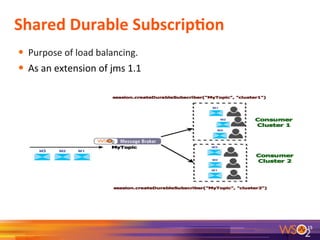
Shared	
  Durable	
  SubscripAon	
  
•  Purpose	
  of	
  load	
  balancing.	
  
•  As	
  an	
  extension	
  of	
  jms	
  1.1	


15	
  
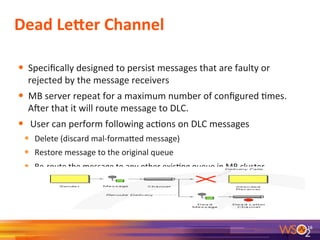
Dead	
  LeVer	
  Channel	


•  Specifically	
  designed	
  to	
  persist	
  messages	
  that	
  are	
  faulty	
  or	
  
rejected	
  by	
  the	
  message	
  receivers	
  
•  MB	
  server	
  repeat	
  for	
  a	
  maximum	
  number	
  of	
  configured	
  9mes.	
  
Ader	
  that	
  it	
  will	
  route	
  message	
  to	
  DLC.	
  
•  	
  User	
  can	
  perform	
  following	
  ac9ons	
  on	
  DLC	
  messages	
  
•  Delete	
  (discard	
  mal-­‐formaeed	
  message)	
  
•  Restore	
  message	
  to	
  the	
  original	
  queue	
  	
  
•  Re-­‐route	
  the	
  message	
  to	
  any	
  other	
  exis9ng	
  queue	
  in	
  MB	
  cluster	


16	
  
Flow	
  Control(Back	
  Pressure)	
  
•  Safeguards	
  server	
  from	
  sudden	
  bursts	
  of	
  message	
  loads.	
  
•  Ensures	
  that	
  the	
  rate	
  at	
  which	
  messages	
  are	
  transmieed	
  from	
  the	
  
publisher	
  to	
  the	
  receiver	
  is	
  controlled.	
  
•  Back-­‐pressure	
  is	
  exerted	
  when	
  the	
  defined	
  global	
  memory	
  threshold	
  or	
  
message	
  count	
  threshold	
  per	
  connec9on	
  is	
  exceeded.	
  
•  Message	
  acceptance	
  is	
  blocked	
  un9l	
  the	
  sender	
  is	
  no9fied	
  of	
  memory	
  
recovery.	
  
•  If	
  the	
  memory	
  is	
  not	
  recovered	
  within	
  a	
  specified	
  9me	
  interval	
  	
  all	
  
currently	
  publishing	
  clients	
  will	
  be	
  disconnected.	
  
•  Flow	
  control	
  mechanisms.	
  
•  Throeling	
  based	
  on	
  global	
  memory	
  threshold	
  
•  Throeling	
  based	
  on	
  message	
  count	
  per	
  connec9on	


17	
  
VisualizaAon	
  
•  View	
  ac9ve	
  queue	
  subscrip9ons	
  in	
  whole	
  MB	
  cluster.	
  
•  View	
  ac9ve	
  topic	
  subscrip9ons	
  in	
  whole	
  MB	
  cluster.	
  
•  View	
  inac9ve	
  durable	
  topic	
  subscrip9ons	
  specifically.	
  
•  Ability	
  to	
  unsubscribe	
  inac9ve	
  durable	
  topic	
  subscrip9ons	
  with	
  
UI.	
  	
  
•  Ability	
  to	
  deal	
  with	
  messages	
  at	
  Dead	
  Leeer	
  Channel.	
  	
  
18	
  
Other	
  Features	
  
•  Real-­‐9me	
  sta9s9cs	
  
•  Database	
  read/write	
  latencies	
  
•  Inbound/Outbound	
  event	
  rates.	
  
•  Number	
  of	
  connec9ons/channels	
  etc.	
  
•  Queue/Topic	
  Permission	
  Model	
  
•  Admin	
  can	
  explicitly	
  set	
  the	
  each	
  permissions.	
  
•  Dynamic	
  Queue	
  Crea9on	
  
•  	
  Publisher	
  client	
  ini9ates	
  the	
  queue	
  is	
  created	
  in	
  the	
  broker,	
  even	
  if	
  there	
  
are	
  no	
  consumers	
  
19	
  
Use	
  Cases	
  
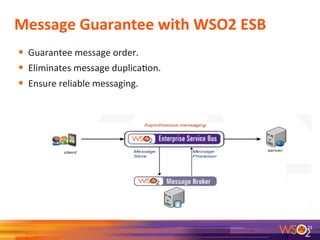
Message	
  Guarantee	
  with	
  WSO2	
  ESB	
  
•  Guarantee	
  message	
  order.	
  
•  Eliminates	
  message	
  duplica9on.	
  
•  Ensure	
  reliable	
  messaging.	


21	
  
Rate	
  Limits	
  
•  Some	
  services	
  only	
  process	
  messages	
  at	
  a	
  specific	
  rate	
  
•  Clients	
  may	
  send	
  messages	
  at	
  an	
  arbitrary	
  rate	
  
•  Provides	
  a	
  virtualized	
  service	
  interface	
  that	
  stores	
  all	
  messages	
  in	
  
a	
  queue	
  
•  Services	
  can	
  consume	
  messages	
  from	
  the	
  queue	
  at	
  their	
  own	
  pace	
  
•  Or	
  the	
  broker	
  can	
  forward	
  the	
  stored	
  messages	
  to	
  the	
  actual	
  service	
  at	
  a	
  
controlled	
  rate	


22	
  
Messaging	
  for	
  Audit/Logging	
  
•  Some9mes	
  messages	
  should	
  be	
  processed	
  through	
  expensive	
  
audit/logging	
  rou9nes	


•  To	
  avoid	
  high	
  response	
  9mes,	
  messages	
  can	
  be	
  cloned	
  and	
  
stored	
  in	
  a	
  queue	
  	
  
•  Audit/logging	
  systems	
  consume	
  the	
  messages	
  off	
  the	
  queues	


23	
  
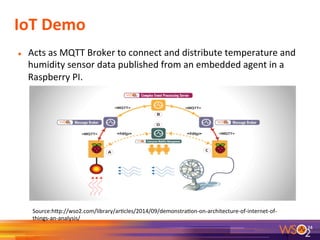
IoT	
  Demo	
  
●  Acts	
  as	
  MQTT	
  Broker	
  to	
  connect	
  and	
  distribute	
  temperature	
  and	
  
humidity	
  sensor	
  data	
  published	
  from	
  an	
  embedded	
  agent	
  in	
  a	
  
Raspberry	
  PI.	


24	
  
Source:hep://wso2.com/library/ar9cles/2014/09/demonstra9on-­‐on-­‐architecture-­‐of-­‐internet-­‐of-­‐
things-­‐an-­‐analysis/	
  
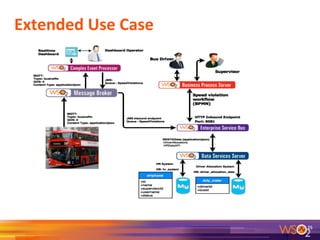
Extended	
  Use	
  Case	


25	
  
Thank	
  You

WSO2 Message Broker - Product Overview

  • 1.
      WSO2  Message  Broker           <Presenter  Name>   <Designa*on>  
  • 2.
    WSO2  Message  Broker      Unique  distributable,  fault  tolerant  and  scalable  enterprise   message  broker  to  connect,  persist  and  reliably  distribute   data,  event  informa9on  generated  from  mul9ple  systems,   applica9ons  and  IoT  devices.    
  • 3.
    Advantages   •  Integrate  easily  with  exis9ng  IT  Infrastructure  .   •  Select  storage  based  on  messaging  demands  .   •  Provides  op9on  between  strict  and  best  effort  message  delivery.   •  Low  maintenance  through  minimum  deployment  effort.   •  Highly  interoperable  with  AMQP  clients.   •  Effortlessly  handle  large  message  transfer.   •  Seamless  feature  integra9on  with  WSO2  ESB.     3  
  • 4.
    Supported  Protocols  &  SpecificaAons   •  Implements  and  supports  JMS  API  using  AMQP   •  JMS  (Java  Message  Service)   •  A  Standard  Java  API  for  programmers  to  handle  messaging  by  interac9ng   with  a  message  broker   •  AMQP  (Advanced  Message  Queuing  Protocol)   •  Open  Standard  for  passing  business  messages  between  applica9ons  or   organiza9ons   •  MQTT  (Message  Queuing  Telemetry  Transport)     4  
  • 5.
    AMQP-­‐Interoperability     • Implements  and  supports  JMS  API  using  AMQP.   •  Interoperability  with  many  languages  /  plaSorms  via  AMQP   clients  for     •  Java,   •  Net,   •   C,  C++,  PHP,  Ruby  and  more.   •  Advanced  Message  Queuing  Protocol,  the  only  industry  standard   protocol  for  interoperable  reliable  messaging.   •  Support  for  JMS  v1.0  and  v1.1  API  .       5  
  • 6.
    MQTT  Support   ● Lightweight  pub/sub  protocol  implemented  on  top  of  TCP/IP  to   facilitate  machine-­‐to-­‐machine  (M2M)  and  Internet-­‐of-­‐Things   (IoT)  integra9ons   ●  Hierarchical  topic  structures  and  wildcard  subscrip9ons   ●  All  quality  of  service  levels  and  retained  messages   ●  At  most  once(0)   ●  At  least  once(1)   ●  Exactly  one(2)   ●  Distributed  MQTT  topics  (Publish  to  any  node  and  receive  from   another)     6  
  • 7.
  • 8.
    Design  Approach   • Avoid  message  rou9ng  over  the  network  .   •  Use  scalable  storage  to  share  messages  between  nodes   •  High  availability  &  fault  tolerance.   •  Interoperability  with  AMQP  clients.   •  Use  distributed  coordina9on  to  control  the  behavior  (i.e  Hazelcast).   •  Extend  messaging  to  IoT.         8  
  • 9.
    Design     • Cluster  elects  a  leader(Known  as  Coordinator)   •  Coordinator  keeps  track  of    all  the  slots  available  (via  Hazelcast)   •  Nodes  with  subscrip9ons  acquire  a  slot  (from  Coordinator)  and   deliver  them  to  subscribers       9  
  • 10.
    Performance   •  Based  on  a  disruptor  based  model   •  Inbound  Disruptor   •  All  incoming  events  are  ordered  by  inser9ng  into  a  ring  buffer.   •  Mul9ple  handlers  operate  on  ring  buffer  in  parallel.   •  Stores/Deletes  data  through  persistence  layer  (  extensible  to  more  data   store  types).   •  Slot  Delivery  Worker  Pool:   •     Reads  messages  from  Database  from  MB  nodes  based  on  the   subscribers.   •  Keeps  track  of  messages  (re-­‐)  delivered,  subscribers   •  Passes  messages  to  outbound  Disruptor   •  Outbound  Disruptor:   •  Reads  messages  from  database  in  parallel     •  Handover  messages  to  transport  for  delivery       10  
  • 11.
  • 12.
    Queue,  Topics   • Point  to  Point  (Queues)   •  A  message  is  delivered  only  once  to  a  single  consumer   •  Publish/Subscribe  (Topics)   •  Broadcast  a  message  to  all  the  subscribers     12  
  • 13.
    Distributed  Queues   • Provides  strict  or  best  effort  support  for  in-­‐order  delivery.   •  There  are  no  guarantee  about  the  global  order  seen  across   subscribers.       13  
  • 14.
    Durable  SubscripAon   • Same  topic  as  subscrip9on.   •  Subscriber  offline   •  Message  gets  queued   •  Subscriber  back  online     •  Messages  geang  delivered   •  Unsubscribed  needed  to  remove  queuing           14  
  • 15.
    Shared  Durable  SubscripAon   •  Purpose  of  load  balancing.   •  As  an  extension  of  jms  1.1           15  
  • 16.
    Dead  LeVer  Channel     •  Specifically  designed  to  persist  messages  that  are  faulty  or   rejected  by  the  message  receivers   •  MB  server  repeat  for  a  maximum  number  of  configured  9mes.   Ader  that  it  will  route  message  to  DLC.   •   User  can  perform  following  ac9ons  on  DLC  messages   •  Delete  (discard  mal-­‐formaeed  message)   •  Restore  message  to  the  original  queue     •  Re-­‐route  the  message  to  any  other  exis9ng  queue  in  MB  cluster       16  
  • 17.
    Flow  Control(Back  Pressure)   •  Safeguards  server  from  sudden  bursts  of  message  loads.   •  Ensures  that  the  rate  at  which  messages  are  transmieed  from  the   publisher  to  the  receiver  is  controlled.   •  Back-­‐pressure  is  exerted  when  the  defined  global  memory  threshold  or   message  count  threshold  per  connec9on  is  exceeded.   •  Message  acceptance  is  blocked  un9l  the  sender  is  no9fied  of  memory   recovery.   •  If  the  memory  is  not  recovered  within  a  specified  9me  interval    all   currently  publishing  clients  will  be  disconnected.   •  Flow  control  mechanisms.   •  Throeling  based  on  global  memory  threshold   •  Throeling  based  on  message  count  per  connec9on       17  
  • 18.
    VisualizaAon   •  View  ac9ve  queue  subscrip9ons  in  whole  MB  cluster.   •  View  ac9ve  topic  subscrip9ons  in  whole  MB  cluster.   •  View  inac9ve  durable  topic  subscrip9ons  specifically.   •  Ability  to  unsubscribe  inac9ve  durable  topic  subscrip9ons  with   UI.     •  Ability  to  deal  with  messages  at  Dead  Leeer  Channel.     18  
  • 19.
    Other  Features   • Real-­‐9me  sta9s9cs   •  Database  read/write  latencies   •  Inbound/Outbound  event  rates.   •  Number  of  connec9ons/channels  etc.   •  Queue/Topic  Permission  Model   •  Admin  can  explicitly  set  the  each  permissions.   •  Dynamic  Queue  Crea9on   •   Publisher  client  ini9ates  the  queue  is  created  in  the  broker,  even  if  there   are  no  consumers   19  
  • 20.
  • 21.
    Message  Guarantee  with  WSO2  ESB   •  Guarantee  message  order.   •  Eliminates  message  duplica9on.   •  Ensure  reliable  messaging.     21  
  • 22.
    Rate  Limits   • Some  services  only  process  messages  at  a  specific  rate   •  Clients  may  send  messages  at  an  arbitrary  rate   •  Provides  a  virtualized  service  interface  that  stores  all  messages  in   a  queue   •  Services  can  consume  messages  from  the  queue  at  their  own  pace   •  Or  the  broker  can  forward  the  stored  messages  to  the  actual  service  at  a   controlled  rate     22  
  • 23.
    Messaging  for  Audit/Logging   •  Some9mes  messages  should  be  processed  through  expensive   audit/logging  rou9nes     •  To  avoid  high  response  9mes,  messages  can  be  cloned  and   stored  in  a  queue     •  Audit/logging  systems  consume  the  messages  off  the  queues     23  
  • 24.
    IoT  Demo   ● Acts  as  MQTT  Broker  to  connect  and  distribute  temperature  and   humidity  sensor  data  published  from  an  embedded  agent  in  a   Raspberry  PI.     24   Source:hep://wso2.com/library/ar9cles/2014/09/demonstra9on-­‐on-­‐architecture-­‐of-­‐internet-­‐of-­‐ things-­‐an-­‐analysis/  
  • 25.
  • 26.