Henry Yan
3-Jan-2022
2
• Executive Summary
• Introduction
• Methodology
• Results
• Conclusion
• Appendix
Outline
3
• Summary of methodologies
• Data collection
• Data wrangling
• EDA with data visualization
• EDA with SQL
• Building an interactive map with Folium
• Building a Dashboard with Plotly Dash
• Predictive analysis (Classification)
• Summary of all results
• EDA results
• Interactive analytics
• Predictive analysis
Executive Summary
4
Introduction
• Project background and context
• SpaceX advertises Falcon 9 rocket launches on its website, with a cost of 62 million dollars;

other providers cost upward of 165 million dollars each, much of the savings is because
SpaceX can reuse the first stage.
• Problems you want to find answers
• The project task is to predicting if the first stage of the SpaceX Falcon 9 rocket will land
successfully
5
6
Executive Summary
• Data collection methodology:
• SpaceX Rest API
• Web Scrapping from Wikipedia
• Perform data wrangling
• One Hot Encoding data fields for Machine Learning and data cleaning of null values and irrelevant
columns
• Perform exploratory data analysis (EDA) using visualization and SQL
• Perform interactive visual analytics using Folium and Plotly Dash
• Perform predictive analysis using classification models
• LR, KNN, SVM, DT models have been built and evaluated for the best classifier
Methodology
7
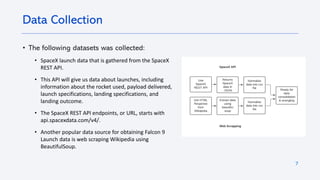
• The following datasets was collected:
• SpaceX launch data that is gathered from the SpaceX
REST API.
• This API will give us data about launches, including
information about the rocket used, payload delivered,
launch specifications, landing specifications, and
landing outcome.
• The SpaceX REST API endpoints, or URL, starts with
api.spacexdata.com/v4/.
• Another popular data source for obtaining Falcon 9
Launch data is web scraping Wikipedia using
BeautifulSoup.
Data Collection
8
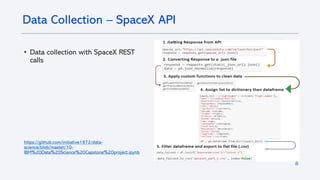
• Data collection with SpaceX REST
calls
https://github.com/initiative1972/data-
science/blob/master/10-
IBM%20Data%20Science%20Capstone%20project.ipynb
Data Collection – SpaceX API
9
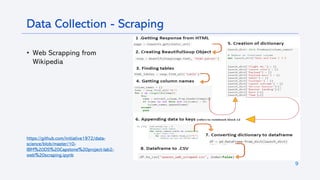
• Web Scrapping from
Wikipedia
https://github.com/initiative1972/data-
science/blob/master/10-
IBM%20DS%20Capstone%20project-lab2-
web%20scraping.ipynb
Data Collection - Scraping
Place your flowchart of web scraping here
10
https://github.com/initiative1972/data-science/blob/master/10-IBM%20DS%20Capstone%20project-lab3-EDA.ipynb
Data Wrangling
11
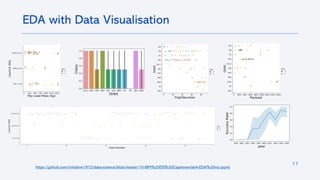
https://github.com/initiative1972/data-science/blob/master/10-IBM%20DS%20Capstone-lab4-EDA%20viz.ipynb
EDA with Data Visualisation
12
• SQL queries performed include:
• Displaying the names of the unique launch sites in the space mission
• Displaying 5 records where launch sites begin with the string 'KSC’
• Displaying the total payload mass carried by boosters launched by NASA (CRS)
• Displaying average payload mass carried by booster version F9 v1.1
• Listing the date where the successful landing outcome in drone ship was achieved.
• Listing the names of the boosters which have success in ground pad and have payload mass greater than 4000
but less than 6000
• Listing the total number of successful and failure mission outcomes
• Listing the names of the booster_versions which have carried the maximum payload mass.
• Listing the records which will display the month names, successful landing_outcomes in ground pad ,booster
• versions, launch_site for the months in year 2017
• Ranking the count of successful landing_outcomes between the date 2010 06 04 and 2017 03 20 in
descendingorder.
https://github.com/initiative1972/data-science/blob/master/10-IBM-DS%20Capstone%20project-SQL.ipynb
EDA with SQL
13
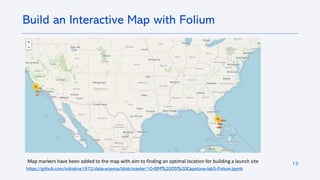
https://github.com/initiative1972/data-science/blob/master/10-IBM%20DS%20Capstone-lab5-Folium.ipynb
Build an Interactive Map with Folium
Map markers have been added to the map with aim to finding an optimal location for building a launch site
14
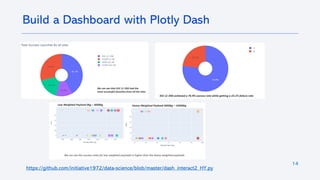
https://github.com/initiative1972/data-science/blob/master/dash_interact2_HY.py
Build a Dashboard with Plotly Dash
15
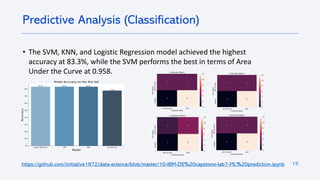
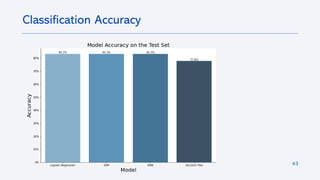
• The SVM, KNN, and Logistic Regression model achieved the highest
accuracy at 83.3%, while the SVM performs the best in terms of Area
Under the Curve at 0.958.
Predictive Analysis (Classification)
https://github.com/initiative1972/data-science/blob/master/10-IBM-DS%20capstone-lab7-ML%20prediction.ipynb
• The SVM, KNN, and Logistic Regression models are the best in terms of
prediction accuracy for this dataset.
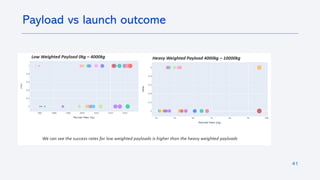
• Low weighted payloads perform better than the heavier payloads.
• The success rates for SpaceX launches is directly proportional time in years they
will eventually perfect the launches.
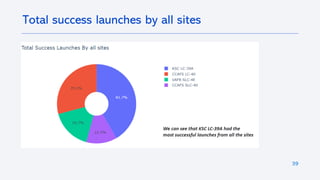
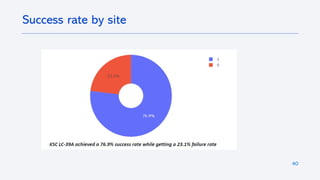
• KSC LC 39A had the most successful launches from all the sites.
• Orbit GEO,HEO,SSO,ES L1 has the best Success Rate.
16
Results
18
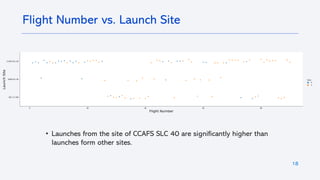
• Launches from the site of CCAFS SLC 40 are significantly higher than
launches form other sites.
Flight Number vs. Launch Site
19
Payload vs. Launch Site
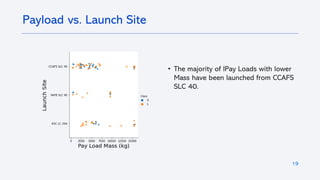
• The majority of lPay Loads with lower
Mass have been launched from CCAFS
SLC 40.
20
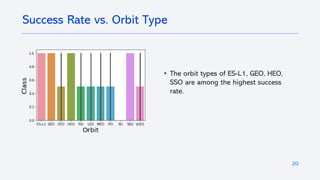
Success Rate vs. Orbit Type
• The orbit types of ES-L1, GEO, HEO,
SSO are among the highest success
rate.
21
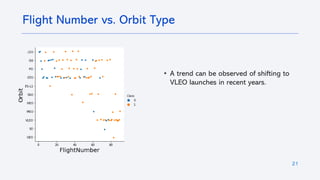
Flight Number vs. Orbit Type
• A trend can be observed of shifting to
VLEO launches in recent years.
22
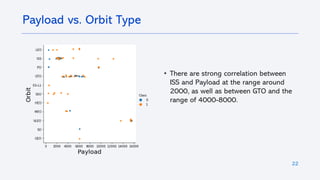
Payload vs. Orbit Type
• There are strong correlation between
ISS and Payload at the range around
2000, as well as between GTO and the
range of 4000-8000.
23
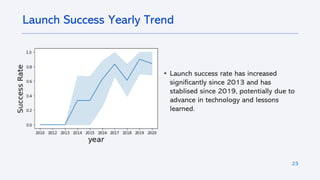
Launch Success Yearly Trend
• Launch success rate has increased
significantly since 2013 and has
stablised since 2019, potentially due to
advance in technology and lessons
learned.
24
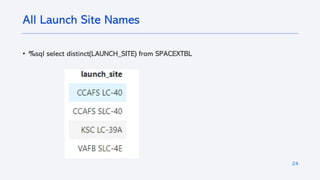
• %sql select distinct(LAUNCH_SITE) from SPACEXTBL
All Launch Site Names
25
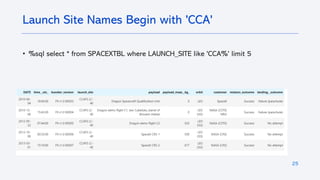
• %sql select * from SPACEXTBL where LAUNCH_SITE like 'CCA%' limit 5
Launch Site Names Begin with 'CCA'
26
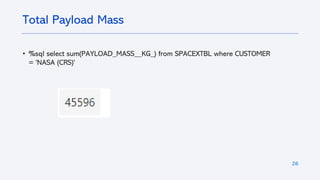
• %sql select sum(PAYLOAD_MASS__KG_) from SPACEXTBL where CUSTOMER
= 'NASA (CRS)'
Total Payload Mass
27
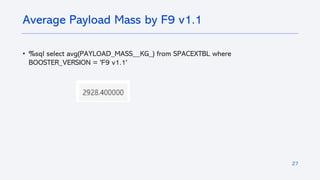
• %sql select avg(PAYLOAD_MASS__KG_) from SPACEXTBL where
BOOSTER_VERSION = 'F9 v1.1'
Average Payload Mass by F9 v1.1
28
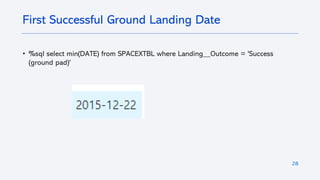
• %sql select min(DATE) from SPACEXTBL where Landing__Outcome = 'Success
(ground pad)'
First Successful Ground Landing Date
29
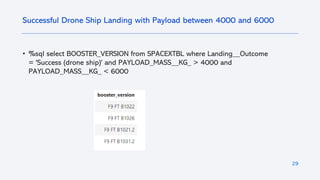
• %sql select BOOSTER_VERSION from SPACEXTBL where Landing__Outcome
= 'Success (drone ship)' and PAYLOAD_MASS__KG_ > 4000 and
PAYLOAD_MASS__KG_ < 6000
Successful Drone Ship Landing with Payload between 4000 and 6000
30
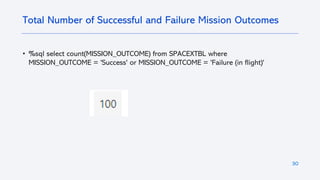
• %sql select count(MISSION_OUTCOME) from SPACEXTBL where
MISSION_OUTCOME = 'Success' or MISSION_OUTCOME = 'Failure (in flight)'
Total Number of Successful and Failure Mission Outcomes
31
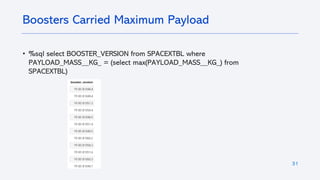
• %sql select BOOSTER_VERSION from SPACEXTBL where
PAYLOAD_MASS__KG_ = (select max(PAYLOAD_MASS__KG_) from
SPACEXTBL)
Boosters Carried Maximum Payload
32
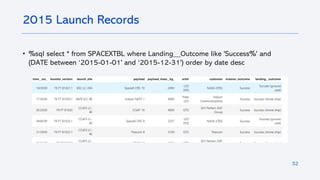
• %sql select * from SPACEXTBL where Landing__Outcome like 'Success%' and
(DATE between ‘2015-01-01' and ‘2015-12-31') order by date desc
2015 Launch Records
33
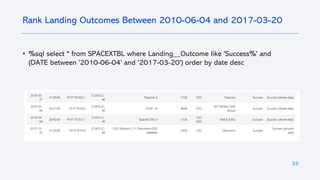
• %sql select * from SPACEXTBL where Landing__Outcome like 'Success%' and
(DATE between '2010-06-04' and '2017-03-20') order by date desc
Rank Landing Outcomes Between 2010-06-04 and 2017-03-20
35
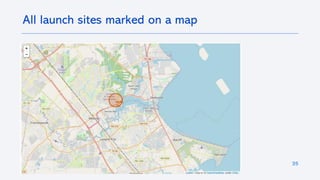
All launch sites marked on a map
36
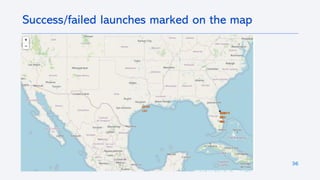
Success/failed launches marked on the map
37
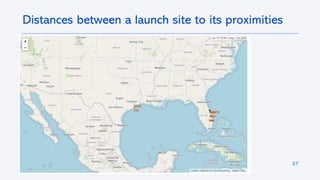
Distances between a launch site to its proximities
39
Total success launches by all sites
40
Success rate by site
41
Payload vs launch outcome
43
Classification Accuracy
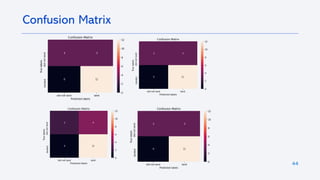
44
Confusion Matrix
45
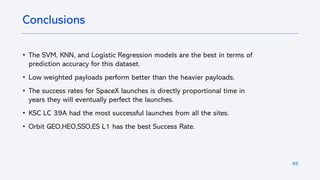
• The SVM, KNN, and Logistic Regression models are the best in terms of
prediction accuracy for this dataset.
• Low weighted payloads perform better than the heavier payloads.
• The success rates for SpaceX launches is directly proportional time in
years they will eventually perfect the launches.
• KSC LC 39A had the most successful launches from all the sites.
• Orbit GEO,HEO,SSO,ES L1 has the best Success Rate.
Conclusions
Ibm data science capstone project-SpaceX launch analysis

Ibm data science capstone project-SpaceX launch analysis

  • 1.
  • 2.
    2 • Executive Summary •Introduction • Methodology • Results • Conclusion • Appendix Outline
  • 3.
    3 • Summary ofmethodologies • Data collection • Data wrangling • EDA with data visualization • EDA with SQL • Building an interactive map with Folium • Building a Dashboard with Plotly Dash • Predictive analysis (Classification) • Summary of all results • EDA results • Interactive analytics • Predictive analysis Executive Summary
  • 4.
    4 Introduction • Project backgroundand context • SpaceX advertises Falcon 9 rocket launches on its website, with a cost of 62 million dollars; other providers cost upward of 165 million dollars each, much of the savings is because SpaceX can reuse the first stage. • Problems you want to find answers • The project task is to predicting if the first stage of the SpaceX Falcon 9 rocket will land successfully
  • 5.
  • 6.
    6 Executive Summary • Datacollection methodology: • SpaceX Rest API • Web Scrapping from Wikipedia • Perform data wrangling • One Hot Encoding data fields for Machine Learning and data cleaning of null values and irrelevant columns • Perform exploratory data analysis (EDA) using visualization and SQL • Perform interactive visual analytics using Folium and Plotly Dash • Perform predictive analysis using classification models • LR, KNN, SVM, DT models have been built and evaluated for the best classifier Methodology
  • 7.
    7 • The followingdatasets was collected: • SpaceX launch data that is gathered from the SpaceX REST API. • This API will give us data about launches, including information about the rocket used, payload delivered, launch specifications, landing specifications, and landing outcome. • The SpaceX REST API endpoints, or URL, starts with api.spacexdata.com/v4/. • Another popular data source for obtaining Falcon 9 Launch data is web scraping Wikipedia using BeautifulSoup. Data Collection
  • 8.
    8 • Data collectionwith SpaceX REST calls https://github.com/initiative1972/data- science/blob/master/10- IBM%20Data%20Science%20Capstone%20project.ipynb Data Collection – SpaceX API
  • 9.
    9 • Web Scrappingfrom Wikipedia https://github.com/initiative1972/data- science/blob/master/10- IBM%20DS%20Capstone%20project-lab2- web%20scraping.ipynb Data Collection - Scraping Place your flowchart of web scraping here
  • 10.
  • 11.
  • 12.
    12 • SQL queriesperformed include: • Displaying the names of the unique launch sites in the space mission • Displaying 5 records where launch sites begin with the string 'KSC’ • Displaying the total payload mass carried by boosters launched by NASA (CRS) • Displaying average payload mass carried by booster version F9 v1.1 • Listing the date where the successful landing outcome in drone ship was achieved. • Listing the names of the boosters which have success in ground pad and have payload mass greater than 4000 but less than 6000 • Listing the total number of successful and failure mission outcomes • Listing the names of the booster_versions which have carried the maximum payload mass. • Listing the records which will display the month names, successful landing_outcomes in ground pad ,booster • versions, launch_site for the months in year 2017 • Ranking the count of successful landing_outcomes between the date 2010 06 04 and 2017 03 20 in descendingorder. https://github.com/initiative1972/data-science/blob/master/10-IBM-DS%20Capstone%20project-SQL.ipynb EDA with SQL
  • 13.
    13 https://github.com/initiative1972/data-science/blob/master/10-IBM%20DS%20Capstone-lab5-Folium.ipynb Build an InteractiveMap with Folium Map markers have been added to the map with aim to finding an optimal location for building a launch site
  • 14.
  • 15.
    15 • The SVM,KNN, and Logistic Regression model achieved the highest accuracy at 83.3%, while the SVM performs the best in terms of Area Under the Curve at 0.958. Predictive Analysis (Classification) https://github.com/initiative1972/data-science/blob/master/10-IBM-DS%20capstone-lab7-ML%20prediction.ipynb
  • 16.
    • The SVM,KNN, and Logistic Regression models are the best in terms of prediction accuracy for this dataset. • Low weighted payloads perform better than the heavier payloads. • The success rates for SpaceX launches is directly proportional time in years they will eventually perfect the launches. • KSC LC 39A had the most successful launches from all the sites. • Orbit GEO,HEO,SSO,ES L1 has the best Success Rate. 16 Results
  • 18.
    18 • Launches fromthe site of CCAFS SLC 40 are significantly higher than launches form other sites. Flight Number vs. Launch Site
  • 19.
    19 Payload vs. LaunchSite • The majority of lPay Loads with lower Mass have been launched from CCAFS SLC 40.
  • 20.
    20 Success Rate vs.Orbit Type • The orbit types of ES-L1, GEO, HEO, SSO are among the highest success rate.
  • 21.
    21 Flight Number vs.Orbit Type • A trend can be observed of shifting to VLEO launches in recent years.
  • 22.
    22 Payload vs. OrbitType • There are strong correlation between ISS and Payload at the range around 2000, as well as between GTO and the range of 4000-8000.
  • 23.
    23 Launch Success YearlyTrend • Launch success rate has increased significantly since 2013 and has stablised since 2019, potentially due to advance in technology and lessons learned.
  • 24.
    24 • %sql selectdistinct(LAUNCH_SITE) from SPACEXTBL All Launch Site Names
  • 25.
    25 • %sql select* from SPACEXTBL where LAUNCH_SITE like 'CCA%' limit 5 Launch Site Names Begin with 'CCA'
  • 26.
    26 • %sql selectsum(PAYLOAD_MASS__KG_) from SPACEXTBL where CUSTOMER = 'NASA (CRS)' Total Payload Mass
  • 27.
    27 • %sql selectavg(PAYLOAD_MASS__KG_) from SPACEXTBL where BOOSTER_VERSION = 'F9 v1.1' Average Payload Mass by F9 v1.1
  • 28.
    28 • %sql selectmin(DATE) from SPACEXTBL where Landing__Outcome = 'Success (ground pad)' First Successful Ground Landing Date
  • 29.
    29 • %sql selectBOOSTER_VERSION from SPACEXTBL where Landing__Outcome = 'Success (drone ship)' and PAYLOAD_MASS__KG_ > 4000 and PAYLOAD_MASS__KG_ < 6000 Successful Drone Ship Landing with Payload between 4000 and 6000
  • 30.
    30 • %sql selectcount(MISSION_OUTCOME) from SPACEXTBL where MISSION_OUTCOME = 'Success' or MISSION_OUTCOME = 'Failure (in flight)' Total Number of Successful and Failure Mission Outcomes
  • 31.
    31 • %sql selectBOOSTER_VERSION from SPACEXTBL where PAYLOAD_MASS__KG_ = (select max(PAYLOAD_MASS__KG_) from SPACEXTBL) Boosters Carried Maximum Payload
  • 32.
    32 • %sql select* from SPACEXTBL where Landing__Outcome like 'Success%' and (DATE between ‘2015-01-01' and ‘2015-12-31') order by date desc 2015 Launch Records
  • 33.
    33 • %sql select* from SPACEXTBL where Landing__Outcome like 'Success%' and (DATE between '2010-06-04' and '2017-03-20') order by date desc Rank Landing Outcomes Between 2010-06-04 and 2017-03-20
  • 35.
    35 All launch sitesmarked on a map
  • 36.
  • 37.
    37 Distances between alaunch site to its proximities
  • 39.
  • 40.
  • 41.
  • 43.
  • 44.
  • 45.
    45 • The SVM,KNN, and Logistic Regression models are the best in terms of prediction accuracy for this dataset. • Low weighted payloads perform better than the heavier payloads. • The success rates for SpaceX launches is directly proportional time in years they will eventually perfect the launches. • KSC LC 39A had the most successful launches from all the sites. • Orbit GEO,HEO,SSO,ES L1 has the best Success Rate. Conclusions