2
• Executive Summary
• Introduction
• Methodology
• Results
• Conclusion
• Appendix
Outline
3
• The following methodologies were used to analyze data:
• Data Collection using web scraping and SpaceX API;
• Exploratory Data Analysis (EDA), including data wrangling, data visualization and interactive
visual analytics;
• Machine Learning Prediction.

• Summary of all results
• It was possible to collected valuable data from public sources;
• EDA allowed to identify which features are the best to predict success of launchings;
• Machine Learning Prediction showed the best model to predict which characteristics are
important to drive this opportunity by the best way, using all collected data.
Executive Summary
4
Introduction
• The objective is to evaluate the viability of the new company Space Y to compete
with Space X.
• Desirable answers:
• The best way to estimate the total cost for launches, by predicting successful landings of the
first stage of rockets;
• Where is the best place to make launches.
5
6
Executive Summary
• Data collection methodology:
• Data from Space X was obtained from 2 sources:
• Space X API (https://api.spacexdata.com/v4/rockets/)
• WebScraping
(https://en.wikipedia.org/wiki/List_of_Falcon/_9/_and_Falcon_Heavy_launches)
• Perform data wrangling
• Collected data was enriched by creating a landing outcome label based on outcome data
after summarizing and analyzing features
• Perform exploratory data analysis (EDA) using visualization and SQL
Methodology
7
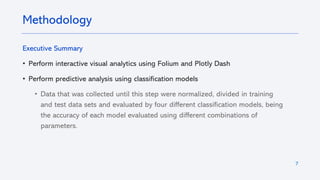
Executive Summary
• Perform interactive visual analytics using Folium and Plotly Dash
• Perform predictive analysis using classification models
• Data that was collected until this step were normalized, divided in training
and test data sets and evaluated by four different classification models, being
the accuracy of each model evaluated using different combinations of
parameters.
Methodology
8
• Data sets were collected from Space X API (https://api.spacexdata.com/v4/rockets/)
and from Wikipedia
(https://en.wikipedia.org/wiki/List_of_Falcon/_9/_and_Falcon_Heavy_launches),
using web scraping technics.
Data Collection
9
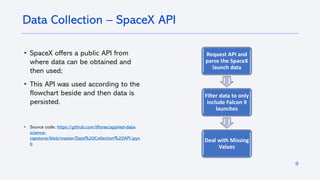
• SpaceX offers a public API from
where data can be obtained and
then used;
• This API was used according to the
flowchart beside and then data is
persisted.
• Source code: https://github.com/tflores/applied-data-
science-
capstone/blob/master/Data%20Collection%20API.ipyn
b
Data Collection – SpaceX API
Request API and
parse the SpaceX
launch data
Filter data to only
include Falcon 9
launches
Deal with Missing
Values
10
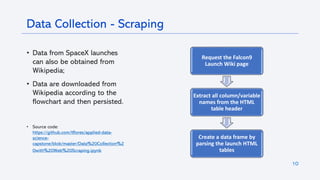
• Data from SpaceX launches
can also be obtained from
Wikipedia;
• Data are downloaded from
Wikipedia according to the
flowchart and then persisted.
• Source code:
https://github.com/tflores/applied-data-
science-
capstone/blob/master/Data%20Collection%2
0with%20Web%20Scraping.ipynb
Data Collection - Scraping
Request the Falcon9
Launch Wiki page
Extract all column/variable
names from the HTML
table header
Create a data frame by
parsing the launch HTML
tables
11
• Initially some Exploratory Data Analysis (EDA) was performed on the
dataset.
• Then the summaries launches per site, occurrences of each orbit and
occurrences of mission outcome per orbit type were calculated.
• Finally, the landing outcome label was created from Outcome column.
• Source code: https://github.com/tflores/applied-data-science-capstone/blob/master/Data%20Wrangling.ipynb
Data Wrangling
EDA Summarizations
Creation of
Landing
Outcome Label
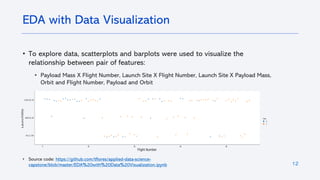
• To explore data, scatterplots and barplots were used to visualize the
relationship between pair of features:
• Payload Mass X Flight Number, Launch Site X Flight Number, Launch Site X Payload Mass,
Orbit and Flight Number, Payload and Orbit
• Source code: https://github.com/tflores/applied-data-science-
capstone/blob/master/EDA%20with%20Data%20Visualization.ipynb 12
EDA with Data Visualization
13
• The following SQL queries were performed:
• Names of the unique launch sites in the space mission;
• Top 5 launch sites whose name begin with the string 'CCA’;
• Total payload mass carried by boosters launched by NASA (CRS);
• Average payload mass carried by booster version F9 v1.1;
• Date when the first successful landing outcome in ground pad was achieved;
• Names of the boosters which have success in drone ship and have payload mass between
4000 and 6000 kg;
• Total number of successful and failure mission outcomes;
• Names of the booster versions which have carried the maximum payload mass;
• Failed landing outcomes in drone ship, their booster versions, and launch site names for in
year 2015; and
• Rank of the count of landing outcomes (such as Failure (drone ship) or Success (ground
pad)) between the date 2010-06-04 and 2017-03-20.
• Source code: https://github.com/tflores/applied-data-science-capstone/blob/master/EDA.ipynb
EDA with SQL
14
• Markers, circles, lines and marker clusters were used with Folium Maps
• Markers indicate points like launch sites;
• Circles indicate highlighted areas around specific coordinates, like NASA Johnson Space
Center;
• Marker clusters indicates groups of events in each coordinate, like launches in a launch site;
and
• Lines are used to indicate distances between two coordinates.
• Source code: https://github.com/tflores/applied-data-science-
capstone/blob/d232d76932163635b072952f121a8d70286e0d84/Interactive%20Visual%20Analytics%20with%20Folium%20l
ab.ipynb
Build an Interactive Map with Folium
15
• The following graphs and plots were used to visualize data
• Percentage of launches by site
• Payload range
• This combination allowed to quickly analyze the relation between payloads
and launch sites, helping to identify where is best place to launch according
to payloads.
• Source code: https://github.com/tflores/applied-data-science-
capstone/blob/d232d76932163635b072952f121a8d70286e0d84/spacex_dash_app.py
Build a Dashboard with Plotly Dash
16
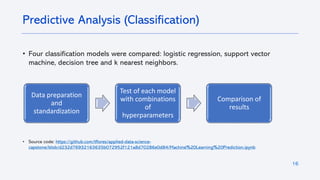
• Four classification models were compared: logistic regression, support vector
machine, decision tree and k nearest neighbors.
• Source code: https://github.com/tflores/applied-data-science-
capstone/blob/d232d76932163635b072952f121a8d70286e0d84/Machine%20Learning%20Prediction.ipynb
Predictive Analysis (Classification)
Data preparation
and
standardization
Test of each model
with combinations
of
hyperparameters
Comparison of
results
• Exploratory data analysis results:
• Space X uses 4 different launch sites;
• The first launches were done to Space X itself and NASA;
• The average payload of F9 v1.1 booster is 2,928 kg;
• The first success landing outcome happened in 2015 fiver year after the first launch;
• Many Falcon 9 booster versions were successful at landing in drone ships having payload above the average;
• Almost 100% of mission outcomes were successful;
• Two booster versions failed at landing in drone ships in 2015: F9 v1.1 B1012 and F9 v1.1 B1015;
• The number of landing outcomes became as better as years passed.
17
Results
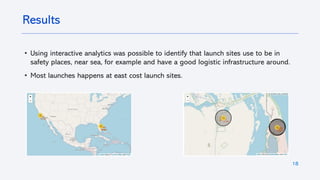
• Using interactive analytics was possible to identify that launch sites use to be in
safety places, near sea, for example and have a good logistic infrastructure around.
• Most launches happens at east cost launch sites.
18
Results
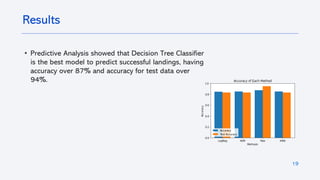
• Predictive Analysis showed that Decision Tree Classifier
is the best model to predict successful landings, having
accuracy over 87% and accuracy for test data over
94%.
19
Results
21
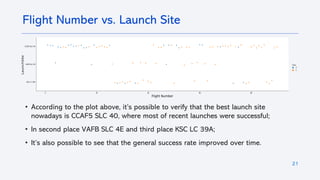
• According to the plot above, it’s possible to verify that the best launch site
nowadays is CCAF5 SLC 40, where most of recent launches were successful;
• In second place VAFB SLC 4E and third place KSC LC 39A;
• It’s also possible to see that the general success rate improved over time.
Flight Number vs. Launch Site
22
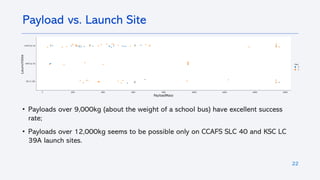
• Payloads over 9,000kg (about the weight of a school bus) have excellent success
rate;
• Payloads over 12,000kg seems to be possible only on CCAFS SLC 40 and KSC LC
39A launch sites.
Payload vs. Launch Site
23
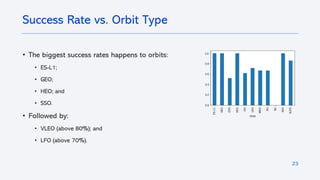
• The biggest success rates happens to orbits:
• ES-L1;
• GEO;
• HEO; and
• SSO.
• Followed by:
• VLEO (above 80%); and
• LFO (above 70%).
Success Rate vs. Orbit Type
24
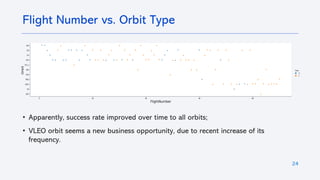
• Apparently, success rate improved over time to all orbits;
• VLEO orbit seems a new business opportunity, due to recent increase of its
frequency.
Flight Number vs. Orbit Type
25
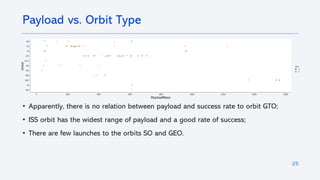
• Apparently, there is no relation between payload and success rate to orbit GTO;
• ISS orbit has the widest range of payload and a good rate of success;
• There are few launches to the orbits SO and GEO.
Payload vs. Orbit Type
26
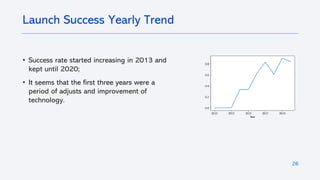
• Success rate started increasing in 2013 and
kept until 2020;
• It seems that the first three years were a
period of adjusts and improvement of
technology.
Launch Success Yearly Trend
27
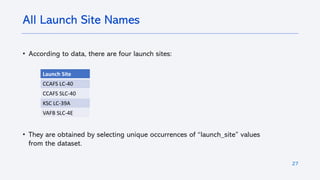
• According to data, there are four launch sites:
• They are obtained by selecting unique occurrences of “launch_site” values
from the dataset.
All Launch Site Names
Launch Site
CCAFS LC-40
CCAFS SLC-40
KSC LC-39A
VAFB SLC-4E
28
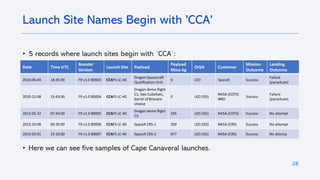
• 5 records where launch sites begin with `CCA`:
• Here we can see five samples of Cape Canaveral launches.
Launch Site Names Begin with 'CCA'
Date Time UTC
Booster
Version
Launch Site Payload
Payload
Mass kg
Orbit Customer
Mission
Outcome
Landing
Outcome
2010-06-04 18:45:00 F9 v1.0 B0003 CCAFS LC-40
Dragon Spacecraft
Qualification Unit
0 LEO SpaceX Success
Failure
(parachute)
2010-12-08 15:43:00 F9 v1.0 B0004 CCAFS LC-40
Dragon demo flight
C1, two CubeSats,
barrel of Brouere
cheese
0 LEO (ISS)
NASA (COTS)
NRO
Success
Failure
(parachute)
2012-05-22 07:44:00 F9 v1.0 B0005 CCAFS LC-40
Dragon demo flight
C2
525 LEO (ISS) NASA (COTS) Success No attempt
2012-10-08 00:35:00 F9 v1.0 B0006 CCAFS LC-40 SpaceX CRS-1 500 LEO (ISS) NASA (CRS) Success No attempt
2013-03-01 15:10:00 F9 v1.0 B0007 CCAFS LC-40 SpaceX CRS-2 677 LEO (ISS) NASA (CRS) Success No attemp
29
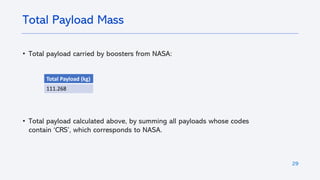
• Total payload carried by boosters from NASA:
• Total payload calculated above, by summing all payloads whose codes
contain ‘CRS’, which corresponds to NASA.
Total Payload Mass
Total Payload (kg)
111.268
30
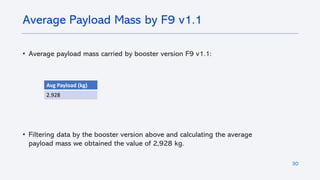
• Average payload mass carried by booster version F9 v1.1:
• Filtering data by the booster version above and calculating the average
payload mass we obtained the value of 2,928 kg.
Average Payload Mass by F9 v1.1
Avg Payload (kg)
2.928
31
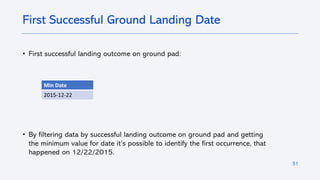
• First successful landing outcome on ground pad:
• By filtering data by successful landing outcome on ground pad and getting
the minimum value for date it’s possible to identify the first occurrence, that
happened on 12/22/2015.
First Successful Ground Landing Date
Min Date
2015-12-22
32
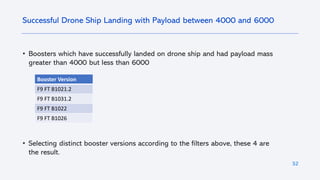
• Boosters which have successfully landed on drone ship and had payload mass
greater than 4000 but less than 6000
• Selecting distinct booster versions according to the filters above, these 4 are
the result.
Successful Drone Ship Landing with Payload between 4000 and 6000
Booster Version
F9 FT B1021.2
F9 FT B1031.2
F9 FT B1022
F9 FT B1026
33
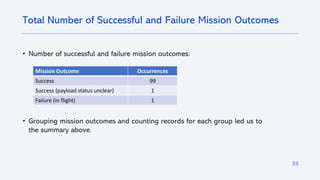
• Number of successful and failure mission outcomes:
• Grouping mission outcomes and counting records for each group led us to
the summary above.
Total Number of Successful and Failure Mission Outcomes
Mission Outcome Occurrences
Success 99
Success (payload status unclear) 1
Failure (in flight) 1
34
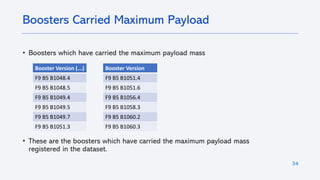
• Boosters which have carried the maximum payload mass
• These are the boosters which have carried the maximum payload mass
registered in the dataset.
Boosters Carried Maximum Payload
Booster Version (...)
F9 B5 B1048.4
F9 B5 B1048.5
F9 B5 B1049.4
F9 B5 B1049.5
F9 B5 B1049.7
F9 B5 B1051.3
Booster Version
F9 B5 B1051.4
F9 B5 B1051.6
F9 B5 B1056.4
F9 B5 B1058.3
F9 B5 B1060.2
F9 B5 B1060.3
35
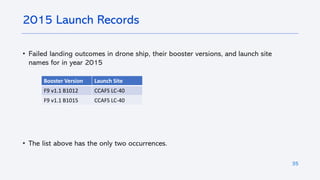
• Failed landing outcomes in drone ship, their booster versions, and launch site
names for in year 2015
• The list above has the only two occurrences.
2015 Launch Records
Booster Version Launch Site
F9 v1.1 B1012 CCAFS LC-40
F9 v1.1 B1015 CCAFS LC-40
36
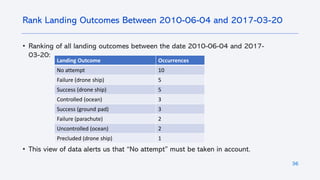
• Ranking of all landing outcomes between the date 2010-06-04 and 2017-
03-20:
• This view of data alerts us that “No attempt” must be taken in account.
Rank Landing Outcomes Between 2010-06-04 and 2017-03-20
Landing Outcome Occurrences
No attempt 10
Failure (drone ship) 5
Success (drone ship) 5
Controlled (ocean) 3
Success (ground pad) 3
Failure (parachute) 2
Uncontrolled (ocean) 2
Precluded (drone ship) 1
38
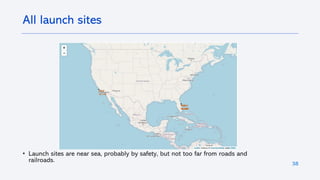
• Launch sites are near sea, probably by safety, but not too far from roads and
railroads.
All launch sites
39
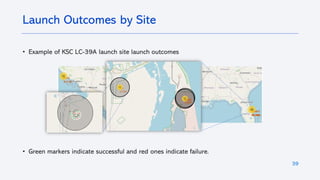
• Example of KSC LC-39A launch site launch outcomes
• Green markers indicate successful and red ones indicate failure.
Launch Outcomes by Site
40
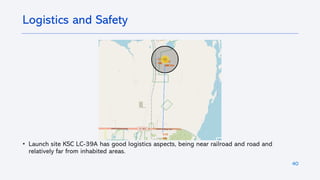
• Launch site KSC LC-39A has good logistics aspects, being near railroad and road and
relatively far from inhabited areas.
Logistics and Safety
42
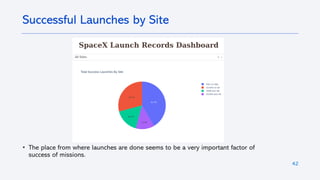
• The place from where launches are done seems to be a very important factor of
success of missions.
Successful Launches by Site
43
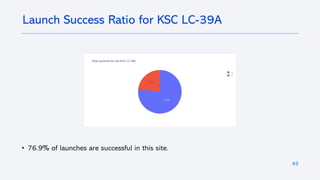
• 76.9% of launches are successful in this site.
Launch Success Ratio for KSC LC-39A
44
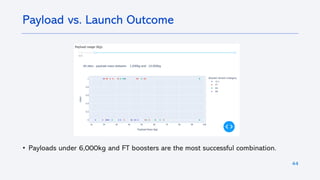
• Payloads under 6,000kg and FT boosters are the most successful combination.
Payload vs. Launch Outcome
45
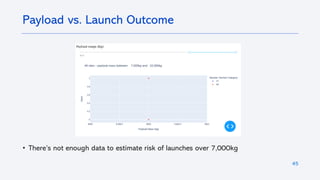
• There’s not enough data to estimate risk of launches over 7,000kg
Payload vs. Launch Outcome
47
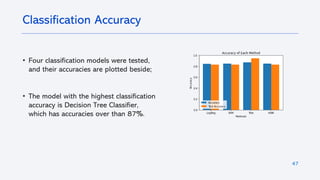
• Four classification models were tested,
and their accuracies are plotted beside;
• The model with the highest classification
accuracy is Decision Tree Classifier,
which has accuracies over than 87%.
Classification Accuracy
48
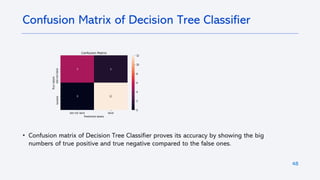
• Confusion matrix of Decision Tree Classifier proves its accuracy by showing the big
numbers of true positive and true negative compared to the false ones.
Confusion Matrix of Decision Tree Classifier
49
• Different data sources were analyzed, refining conclusions along the
process;
• The best launch site is KSC LC-39A;
• Launches above 7,000kg are less risky;
• Although most of mission outcomes are successful, successful landing
outcomes seem to improve over time, according the evolution of
processes and rockets;
• Decision Tree Classifier can be used to predict successful landings and
increase profits.
Conclusions
50
• As an improvement for model tests, it’s important to set a value to
np.random.seed variable;
• Folium didn’t show maps on Github, so I took screenshots.
Appendix
Analytical Report

Analytical Report

  • 2.
    2 • Executive Summary •Introduction • Methodology • Results • Conclusion • Appendix Outline
  • 3.
    3 • The followingmethodologies were used to analyze data: • Data Collection using web scraping and SpaceX API; • Exploratory Data Analysis (EDA), including data wrangling, data visualization and interactive visual analytics; • Machine Learning Prediction. • Summary of all results • It was possible to collected valuable data from public sources; • EDA allowed to identify which features are the best to predict success of launchings; • Machine Learning Prediction showed the best model to predict which characteristics are important to drive this opportunity by the best way, using all collected data. Executive Summary
  • 4.
    4 Introduction • The objectiveis to evaluate the viability of the new company Space Y to compete with Space X. • Desirable answers: • The best way to estimate the total cost for launches, by predicting successful landings of the first stage of rockets; • Where is the best place to make launches.
  • 5.
  • 6.
    6 Executive Summary • Datacollection methodology: • Data from Space X was obtained from 2 sources: • Space X API (https://api.spacexdata.com/v4/rockets/) • WebScraping (https://en.wikipedia.org/wiki/List_of_Falcon/_9/_and_Falcon_Heavy_launches) • Perform data wrangling • Collected data was enriched by creating a landing outcome label based on outcome data after summarizing and analyzing features • Perform exploratory data analysis (EDA) using visualization and SQL Methodology
  • 7.
    7 Executive Summary • Performinteractive visual analytics using Folium and Plotly Dash • Perform predictive analysis using classification models • Data that was collected until this step were normalized, divided in training and test data sets and evaluated by four different classification models, being the accuracy of each model evaluated using different combinations of parameters. Methodology
  • 8.
    8 • Data setswere collected from Space X API (https://api.spacexdata.com/v4/rockets/) and from Wikipedia (https://en.wikipedia.org/wiki/List_of_Falcon/_9/_and_Falcon_Heavy_launches), using web scraping technics. Data Collection
  • 9.
    9 • SpaceX offersa public API from where data can be obtained and then used; • This API was used according to the flowchart beside and then data is persisted. • Source code: https://github.com/tflores/applied-data- science- capstone/blob/master/Data%20Collection%20API.ipyn b Data Collection – SpaceX API Request API and parse the SpaceX launch data Filter data to only include Falcon 9 launches Deal with Missing Values
  • 10.
    10 • Data fromSpaceX launches can also be obtained from Wikipedia; • Data are downloaded from Wikipedia according to the flowchart and then persisted. • Source code: https://github.com/tflores/applied-data- science- capstone/blob/master/Data%20Collection%2 0with%20Web%20Scraping.ipynb Data Collection - Scraping Request the Falcon9 Launch Wiki page Extract all column/variable names from the HTML table header Create a data frame by parsing the launch HTML tables
  • 11.
    11 • Initially someExploratory Data Analysis (EDA) was performed on the dataset. • Then the summaries launches per site, occurrences of each orbit and occurrences of mission outcome per orbit type were calculated. • Finally, the landing outcome label was created from Outcome column. • Source code: https://github.com/tflores/applied-data-science-capstone/blob/master/Data%20Wrangling.ipynb Data Wrangling EDA Summarizations Creation of Landing Outcome Label
  • 12.
    • To exploredata, scatterplots and barplots were used to visualize the relationship between pair of features: • Payload Mass X Flight Number, Launch Site X Flight Number, Launch Site X Payload Mass, Orbit and Flight Number, Payload and Orbit • Source code: https://github.com/tflores/applied-data-science- capstone/blob/master/EDA%20with%20Data%20Visualization.ipynb 12 EDA with Data Visualization
  • 13.
    13 • The followingSQL queries were performed: • Names of the unique launch sites in the space mission; • Top 5 launch sites whose name begin with the string 'CCA’; • Total payload mass carried by boosters launched by NASA (CRS); • Average payload mass carried by booster version F9 v1.1; • Date when the first successful landing outcome in ground pad was achieved; • Names of the boosters which have success in drone ship and have payload mass between 4000 and 6000 kg; • Total number of successful and failure mission outcomes; • Names of the booster versions which have carried the maximum payload mass; • Failed landing outcomes in drone ship, their booster versions, and launch site names for in year 2015; and • Rank of the count of landing outcomes (such as Failure (drone ship) or Success (ground pad)) between the date 2010-06-04 and 2017-03-20. • Source code: https://github.com/tflores/applied-data-science-capstone/blob/master/EDA.ipynb EDA with SQL
  • 14.
    14 • Markers, circles,lines and marker clusters were used with Folium Maps • Markers indicate points like launch sites; • Circles indicate highlighted areas around specific coordinates, like NASA Johnson Space Center; • Marker clusters indicates groups of events in each coordinate, like launches in a launch site; and • Lines are used to indicate distances between two coordinates. • Source code: https://github.com/tflores/applied-data-science- capstone/blob/d232d76932163635b072952f121a8d70286e0d84/Interactive%20Visual%20Analytics%20with%20Folium%20l ab.ipynb Build an Interactive Map with Folium
  • 15.
    15 • The followinggraphs and plots were used to visualize data • Percentage of launches by site • Payload range • This combination allowed to quickly analyze the relation between payloads and launch sites, helping to identify where is best place to launch according to payloads. • Source code: https://github.com/tflores/applied-data-science- capstone/blob/d232d76932163635b072952f121a8d70286e0d84/spacex_dash_app.py Build a Dashboard with Plotly Dash
  • 16.
    16 • Four classificationmodels were compared: logistic regression, support vector machine, decision tree and k nearest neighbors. • Source code: https://github.com/tflores/applied-data-science- capstone/blob/d232d76932163635b072952f121a8d70286e0d84/Machine%20Learning%20Prediction.ipynb Predictive Analysis (Classification) Data preparation and standardization Test of each model with combinations of hyperparameters Comparison of results
  • 17.
    • Exploratory dataanalysis results: • Space X uses 4 different launch sites; • The first launches were done to Space X itself and NASA; • The average payload of F9 v1.1 booster is 2,928 kg; • The first success landing outcome happened in 2015 fiver year after the first launch; • Many Falcon 9 booster versions were successful at landing in drone ships having payload above the average; • Almost 100% of mission outcomes were successful; • Two booster versions failed at landing in drone ships in 2015: F9 v1.1 B1012 and F9 v1.1 B1015; • The number of landing outcomes became as better as years passed. 17 Results
  • 18.
    • Using interactiveanalytics was possible to identify that launch sites use to be in safety places, near sea, for example and have a good logistic infrastructure around. • Most launches happens at east cost launch sites. 18 Results
  • 19.
    • Predictive Analysisshowed that Decision Tree Classifier is the best model to predict successful landings, having accuracy over 87% and accuracy for test data over 94%. 19 Results
  • 21.
    21 • According tothe plot above, it’s possible to verify that the best launch site nowadays is CCAF5 SLC 40, where most of recent launches were successful; • In second place VAFB SLC 4E and third place KSC LC 39A; • It’s also possible to see that the general success rate improved over time. Flight Number vs. Launch Site
  • 22.
    22 • Payloads over9,000kg (about the weight of a school bus) have excellent success rate; • Payloads over 12,000kg seems to be possible only on CCAFS SLC 40 and KSC LC 39A launch sites. Payload vs. Launch Site
  • 23.
    23 • The biggestsuccess rates happens to orbits: • ES-L1; • GEO; • HEO; and • SSO. • Followed by: • VLEO (above 80%); and • LFO (above 70%). Success Rate vs. Orbit Type
  • 24.
    24 • Apparently, successrate improved over time to all orbits; • VLEO orbit seems a new business opportunity, due to recent increase of its frequency. Flight Number vs. Orbit Type
  • 25.
    25 • Apparently, thereis no relation between payload and success rate to orbit GTO; • ISS orbit has the widest range of payload and a good rate of success; • There are few launches to the orbits SO and GEO. Payload vs. Orbit Type
  • 26.
    26 • Success ratestarted increasing in 2013 and kept until 2020; • It seems that the first three years were a period of adjusts and improvement of technology. Launch Success Yearly Trend
  • 27.
    27 • According todata, there are four launch sites: • They are obtained by selecting unique occurrences of “launch_site” values from the dataset. All Launch Site Names Launch Site CCAFS LC-40 CCAFS SLC-40 KSC LC-39A VAFB SLC-4E
  • 28.
    28 • 5 recordswhere launch sites begin with `CCA`: • Here we can see five samples of Cape Canaveral launches. Launch Site Names Begin with 'CCA' Date Time UTC Booster Version Launch Site Payload Payload Mass kg Orbit Customer Mission Outcome Landing Outcome 2010-06-04 18:45:00 F9 v1.0 B0003 CCAFS LC-40 Dragon Spacecraft Qualification Unit 0 LEO SpaceX Success Failure (parachute) 2010-12-08 15:43:00 F9 v1.0 B0004 CCAFS LC-40 Dragon demo flight C1, two CubeSats, barrel of Brouere cheese 0 LEO (ISS) NASA (COTS) NRO Success Failure (parachute) 2012-05-22 07:44:00 F9 v1.0 B0005 CCAFS LC-40 Dragon demo flight C2 525 LEO (ISS) NASA (COTS) Success No attempt 2012-10-08 00:35:00 F9 v1.0 B0006 CCAFS LC-40 SpaceX CRS-1 500 LEO (ISS) NASA (CRS) Success No attempt 2013-03-01 15:10:00 F9 v1.0 B0007 CCAFS LC-40 SpaceX CRS-2 677 LEO (ISS) NASA (CRS) Success No attemp
  • 29.
    29 • Total payloadcarried by boosters from NASA: • Total payload calculated above, by summing all payloads whose codes contain ‘CRS’, which corresponds to NASA. Total Payload Mass Total Payload (kg) 111.268
  • 30.
    30 • Average payloadmass carried by booster version F9 v1.1: • Filtering data by the booster version above and calculating the average payload mass we obtained the value of 2,928 kg. Average Payload Mass by F9 v1.1 Avg Payload (kg) 2.928
  • 31.
    31 • First successfullanding outcome on ground pad: • By filtering data by successful landing outcome on ground pad and getting the minimum value for date it’s possible to identify the first occurrence, that happened on 12/22/2015. First Successful Ground Landing Date Min Date 2015-12-22
  • 32.
    32 • Boosters whichhave successfully landed on drone ship and had payload mass greater than 4000 but less than 6000 • Selecting distinct booster versions according to the filters above, these 4 are the result. Successful Drone Ship Landing with Payload between 4000 and 6000 Booster Version F9 FT B1021.2 F9 FT B1031.2 F9 FT B1022 F9 FT B1026
  • 33.
    33 • Number ofsuccessful and failure mission outcomes: • Grouping mission outcomes and counting records for each group led us to the summary above. Total Number of Successful and Failure Mission Outcomes Mission Outcome Occurrences Success 99 Success (payload status unclear) 1 Failure (in flight) 1
  • 34.
    34 • Boosters whichhave carried the maximum payload mass • These are the boosters which have carried the maximum payload mass registered in the dataset. Boosters Carried Maximum Payload Booster Version (...) F9 B5 B1048.4 F9 B5 B1048.5 F9 B5 B1049.4 F9 B5 B1049.5 F9 B5 B1049.7 F9 B5 B1051.3 Booster Version F9 B5 B1051.4 F9 B5 B1051.6 F9 B5 B1056.4 F9 B5 B1058.3 F9 B5 B1060.2 F9 B5 B1060.3
  • 35.
    35 • Failed landingoutcomes in drone ship, their booster versions, and launch site names for in year 2015 • The list above has the only two occurrences. 2015 Launch Records Booster Version Launch Site F9 v1.1 B1012 CCAFS LC-40 F9 v1.1 B1015 CCAFS LC-40
  • 36.
    36 • Ranking ofall landing outcomes between the date 2010-06-04 and 2017- 03-20: • This view of data alerts us that “No attempt” must be taken in account. Rank Landing Outcomes Between 2010-06-04 and 2017-03-20 Landing Outcome Occurrences No attempt 10 Failure (drone ship) 5 Success (drone ship) 5 Controlled (ocean) 3 Success (ground pad) 3 Failure (parachute) 2 Uncontrolled (ocean) 2 Precluded (drone ship) 1
  • 38.
    38 • Launch sitesare near sea, probably by safety, but not too far from roads and railroads. All launch sites
  • 39.
    39 • Example ofKSC LC-39A launch site launch outcomes • Green markers indicate successful and red ones indicate failure. Launch Outcomes by Site
  • 40.
    40 • Launch siteKSC LC-39A has good logistics aspects, being near railroad and road and relatively far from inhabited areas. Logistics and Safety
  • 42.
    42 • The placefrom where launches are done seems to be a very important factor of success of missions. Successful Launches by Site
  • 43.
    43 • 76.9% oflaunches are successful in this site. Launch Success Ratio for KSC LC-39A
  • 44.
    44 • Payloads under6,000kg and FT boosters are the most successful combination. Payload vs. Launch Outcome
  • 45.
    45 • There’s notenough data to estimate risk of launches over 7,000kg Payload vs. Launch Outcome
  • 47.
    47 • Four classificationmodels were tested, and their accuracies are plotted beside; • The model with the highest classification accuracy is Decision Tree Classifier, which has accuracies over than 87%. Classification Accuracy
  • 48.
    48 • Confusion matrixof Decision Tree Classifier proves its accuracy by showing the big numbers of true positive and true negative compared to the false ones. Confusion Matrix of Decision Tree Classifier
  • 49.
    49 • Different datasources were analyzed, refining conclusions along the process; • The best launch site is KSC LC-39A; • Launches above 7,000kg are less risky; • Although most of mission outcomes are successful, successful landing outcomes seem to improve over time, according the evolution of processes and rockets; • Decision Tree Classifier can be used to predict successful landings and increase profits. Conclusions
  • 50.
    50 • As animprovement for model tests, it’s important to set a value to np.random.seed variable; • Folium didn’t show maps on Github, so I took screenshots. Appendix