Cultural Context
---Continued
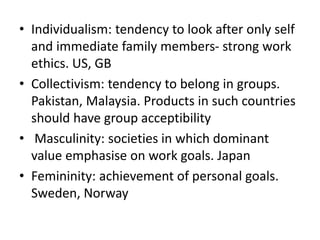
• Individualism: tendency to look after only self
and immediate family members- strong work
ethics. US, GB
• Collectivism: tendency to belong in groups.
Pakistan, Malaysia. Products in such countries
should have group acceptibility
• Masculinity: societies in which dominant
value emphasise on work goals. Japan
• Femininity: achievement of personal goals.
Sweden, Norway
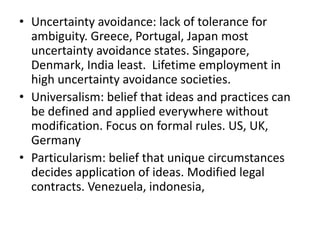
• Uncertainty avoidance: lack of tolerance for
ambiguity. Greece, Portugal, Japan most
uncertainty avoidance states. Singapore,
Denmark, India least. Lifetime employment in
high uncertainty avoidance societies.
• Universalism: belief that ideas and practices can
be defined and applied everywhere without
modification. Focus on formal rules. US, UK,
Germany
• Particularism: belief that unique circumstances
decides application of ideas. Modified legal
contracts. Venezuela, indonesia,
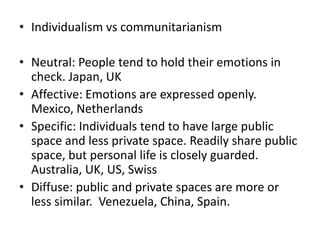
• Individualism vs communitarianism
• Neutral: People tend to hold their emotions in
check. Japan, UK
• Affective: Emotions are expressed openly.
Mexico, Netherlands
• Specific: Individuals tend to have large public
space and less private space. Readily share public
space, but personal life is closely guarded.
Australia, UK, US, Swiss
• Diffuse: public and private spaces are more or
less similar. Venezuela, China, Spain.
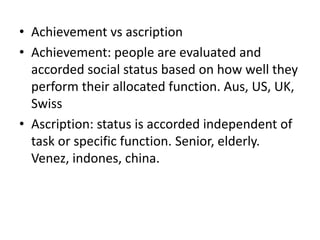
• Achievement vs ascription
• Achievement: people are evaluated and
accorded social status based on how well they
perform their allocated function. Aus, US, UK,
Swiss
• Ascription: status is accorded independent of
task or specific function. Senior, elderly.
Venez, indones, china.
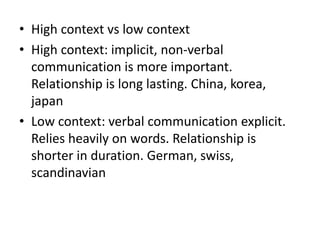
• High context vs low context
• High context: implicit, non-verbal
communication is more important.
Relationship is long lasting. China, korea,
japan
• Low context: verbal communication explicit.
Relies heavily on words. Relationship is
shorter in duration. German, swiss,
scandinavian
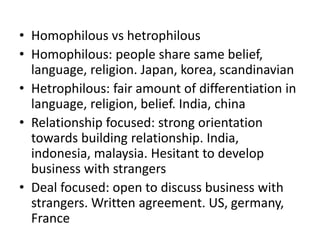
• Homophilous vs hetrophilous
• Homophilous: people share same belief,
language, religion. Japan, korea, scandinavian
• Hetrophilous: fair amount of differentiation in
language, religion, belief. India, china
• Relationship focused: strong orientation
towards building relationship. India,
indonesia, malaysia. Hesitant to develop
business with strangers
• Deal focused: open to discuss business with
strangers. Written agreement. US, germany,
France
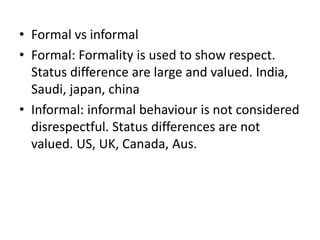
• Formal vs informal
• Formal: Formality is used to show respect.
Status difference are large and valued. India,
Saudi, japan, china
• Informal: informal behaviour is not considered
disrespectful. Status differences are not
valued. US, UK, Canada, Aus.
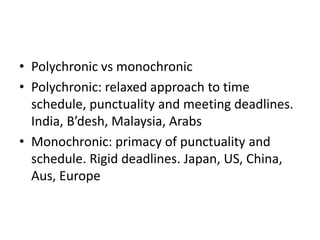
• Polychronic vs monochronic
• Polychronic: relaxed approach to time
schedule, punctuality and meeting deadlines.
India, B’desh, Malaysia, Arabs
• Monochronic: primacy of punctuality and
schedule. Rigid deadlines. Japan, US, China,
Aus, Europe
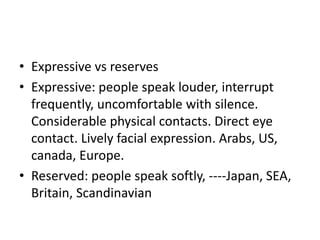
• Expressive vs reserves
• Expressive: people speak louder, interrupt
frequently, uncomfortable with silence.
Considerable physical contacts. Direct eye
contact. Lively facial expression. Arabs, US,
canada, Europe.
• Reserved: people speak softly, ----Japan, SEA,
Britain, Scandinavian
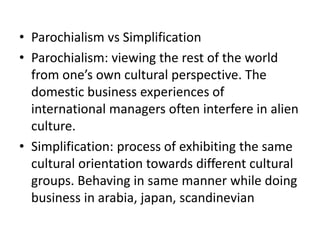
• Parochialism vs Simplification
• Parochialism: viewing the rest of the world
from one’s own cultural perspective. The
domestic business experiences of
international managers often interfere in alien
culture.
• Simplification: process of exhibiting the same
cultural orientation towards different cultural
groups. Behaving in same manner while doing
business in arabia, japan, scandinevian
EPRG Approach
• Ethnocentric orientation: Belief that own
culture is superior to other cultures. Minimum
effort to adopt to the needs of the foreign
countries. Selling idli mix in US
• Polycentric: Belief that substantial differences
exist among various culture. Recognising
cultural differences in the host countries.
Market oriented. A single business strategy
can not work across the world.
• Regiocentric: Treating region as a uniform
cultural segment and adopting a similar
business strategy within the region. Mc
Donald- muslim countries, beef.
• Geocentric: Considering whole world a single
market and formulating integrated business
strategies. Harry Potter series.
EMIC vs ETIC Approach
• EMIC: Attitude, interest and behavior are
unique to a culture and best understood in
their own terms. Studying business research
problems in each country’s specific context.
• ETIC: Identifying and assessing universal
attitudinal and behavioral concept and
developing ‘pan-cultural measures.

Ib culture- 3(1)

  • 1.
  • 2.
    • Individualism: tendencyto look after only self and immediate family members- strong work ethics. US, GB • Collectivism: tendency to belong in groups. Pakistan, Malaysia. Products in such countries should have group acceptibility • Masculinity: societies in which dominant value emphasise on work goals. Japan • Femininity: achievement of personal goals. Sweden, Norway
  • 3.
    • Uncertainty avoidance:lack of tolerance for ambiguity. Greece, Portugal, Japan most uncertainty avoidance states. Singapore, Denmark, India least. Lifetime employment in high uncertainty avoidance societies. • Universalism: belief that ideas and practices can be defined and applied everywhere without modification. Focus on formal rules. US, UK, Germany • Particularism: belief that unique circumstances decides application of ideas. Modified legal contracts. Venezuela, indonesia,
  • 4.
    • Individualism vscommunitarianism • Neutral: People tend to hold their emotions in check. Japan, UK • Affective: Emotions are expressed openly. Mexico, Netherlands • Specific: Individuals tend to have large public space and less private space. Readily share public space, but personal life is closely guarded. Australia, UK, US, Swiss • Diffuse: public and private spaces are more or less similar. Venezuela, China, Spain.
  • 5.
    • Achievement vsascription • Achievement: people are evaluated and accorded social status based on how well they perform their allocated function. Aus, US, UK, Swiss • Ascription: status is accorded independent of task or specific function. Senior, elderly. Venez, indones, china.
  • 6.
    • High contextvs low context • High context: implicit, non-verbal communication is more important. Relationship is long lasting. China, korea, japan • Low context: verbal communication explicit. Relies heavily on words. Relationship is shorter in duration. German, swiss, scandinavian
  • 7.
    • Homophilous vshetrophilous • Homophilous: people share same belief, language, religion. Japan, korea, scandinavian • Hetrophilous: fair amount of differentiation in language, religion, belief. India, china • Relationship focused: strong orientation towards building relationship. India, indonesia, malaysia. Hesitant to develop business with strangers • Deal focused: open to discuss business with strangers. Written agreement. US, germany, France
  • 8.
    • Formal vsinformal • Formal: Formality is used to show respect. Status difference are large and valued. India, Saudi, japan, china • Informal: informal behaviour is not considered disrespectful. Status differences are not valued. US, UK, Canada, Aus.
  • 9.
    • Polychronic vsmonochronic • Polychronic: relaxed approach to time schedule, punctuality and meeting deadlines. India, B’desh, Malaysia, Arabs • Monochronic: primacy of punctuality and schedule. Rigid deadlines. Japan, US, China, Aus, Europe
  • 10.
    • Expressive vsreserves • Expressive: people speak louder, interrupt frequently, uncomfortable with silence. Considerable physical contacts. Direct eye contact. Lively facial expression. Arabs, US, canada, Europe. • Reserved: people speak softly, ----Japan, SEA, Britain, Scandinavian
  • 11.
    • Parochialism vsSimplification • Parochialism: viewing the rest of the world from one’s own cultural perspective. The domestic business experiences of international managers often interfere in alien culture. • Simplification: process of exhibiting the same cultural orientation towards different cultural groups. Behaving in same manner while doing business in arabia, japan, scandinevian
  • 12.
    EPRG Approach • Ethnocentricorientation: Belief that own culture is superior to other cultures. Minimum effort to adopt to the needs of the foreign countries. Selling idli mix in US • Polycentric: Belief that substantial differences exist among various culture. Recognising cultural differences in the host countries. Market oriented. A single business strategy can not work across the world.
  • 13.
    • Regiocentric: Treatingregion as a uniform cultural segment and adopting a similar business strategy within the region. Mc Donald- muslim countries, beef. • Geocentric: Considering whole world a single market and formulating integrated business strategies. Harry Potter series.
  • 14.
    EMIC vs ETICApproach • EMIC: Attitude, interest and behavior are unique to a culture and best understood in their own terms. Studying business research problems in each country’s specific context. • ETIC: Identifying and assessing universal attitudinal and behavioral concept and developing ‘pan-cultural measures.