1
The Future of Legacy
How to leverage legacy and on-prem assets in your digital
transformation with Digital-Driven Integration
Zeev Avidan
Chief Product Officer
2
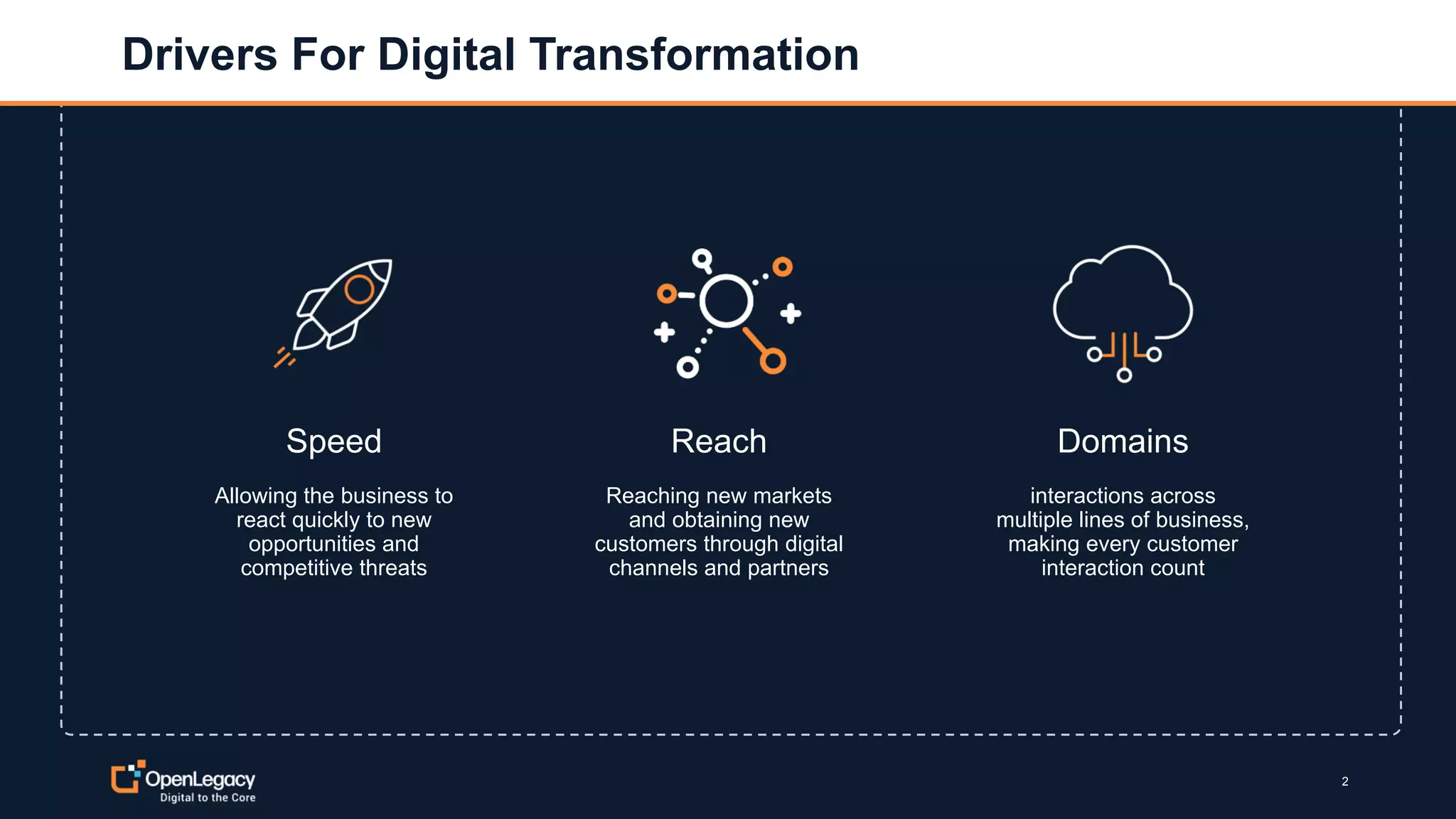
Reach
Reaching new markets
and obtaining new
customers through digital
channels and partners
Speed
Allowing the business to
react quickly to new
opportunities and
competitive threats
Domains
interactions across
multiple lines of business,
making every customer
interaction count
2
Drivers For Digital Transformation
3
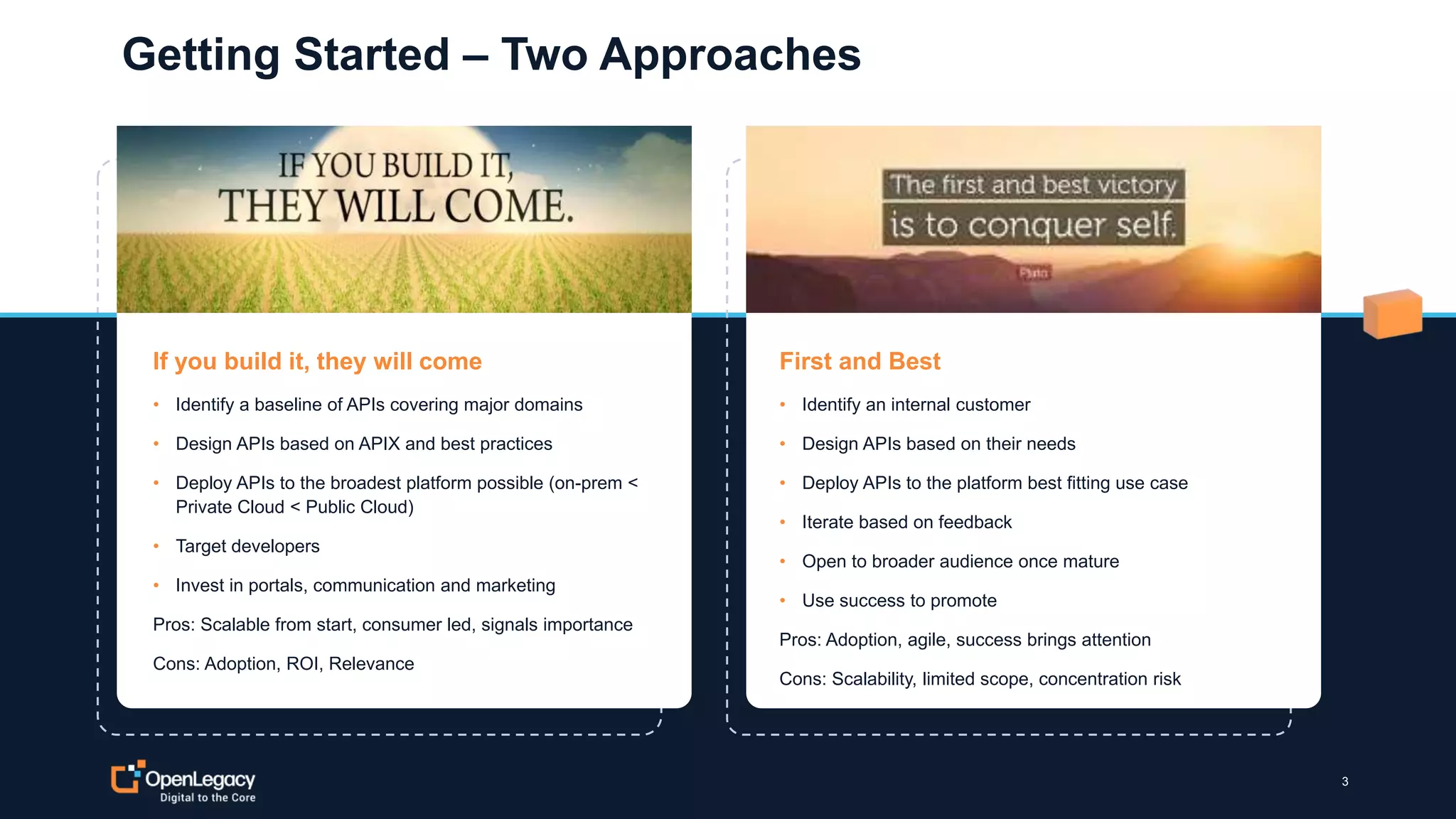
Getting Started – Two Approaches
3
If you build it, they will come
• Identify a baseline of APIs covering major domains
• Design APIs based on APIX and best practices
• Deploy APIs to the broadest platform possible (on-prem <
Private Cloud < Public Cloud)
• Target developers
• Invest in portals, communication and marketing
Pros: Scalable from start, consumer led, signals importance
Cons: Adoption, ROI, Relevance
First and Best
• Identify an internal customer
• Design APIs based on their needs
• Deploy APIs to the platform best fitting use case
• Iterate based on feedback
• Open to broader audience once mature
• Use success to promote
Pros: Adoption, agile, success brings attention
Cons: Scalability, limited scope, concentration risk
4
Identifying API Opportunities
4
Internal Developers
• What data and transactions would your
own mobile apps need?
• Does generic data exist that is the same
for all app users, such as business
locations, rates and so on?
• Is there data specific to existing
customers that should be accessible
through your app, such as account
balance or open account status?
Partners
• What data and transactions do you share
among your current partners?
• Is partner onboarding a long, difficult
process?
• Would self-registration of partners be of
value.
increasing the number of partners and
broadening geographic coverage, for
example?
Public
• What apps might others write that could
use your data and transactions?
• What information are you currently making
available on your website?
• What other industries or processes might
also use your products? One example
might be a car purchase that needs a bank
loan.
• Think mashups: What other APIs might
make sense with yours? Mapping? Social?
Social
• How do your systems interact with social
media? Can you spot trends in social
media and raise alerts or act?
• Can you gain insight on your brand and
your competition through social media?
• Can you do real-time analytics combining
current customer status, behavior and
history with social interactions?
Devices
• What features of the device might be
useful in conjunction with your APIs?
(GPS, camera)
• What scenarios can apply to the device?
For example, needing repair/supplies,
needing to send status information,
controlling device behavior or enabling
interaction between the device and
enterprise systems.
• How are you positioned to integrate the
next UI technology, such as wearables
like smart clothing or augmented reality
glasses?
Data
• What data do you collect about your
clients? Would this data be of value to a
larger audience inside the enterprise?
• Can your data identify market segments
that would be of interest to a non-related
industry? For example, can it identify a
high volume of expensive credit card
purchases in a region of the city? Or can
it identify a high percentage of wealth
management investments being moved to
low-risk funds for retirement planning in
certain times of the year?
5
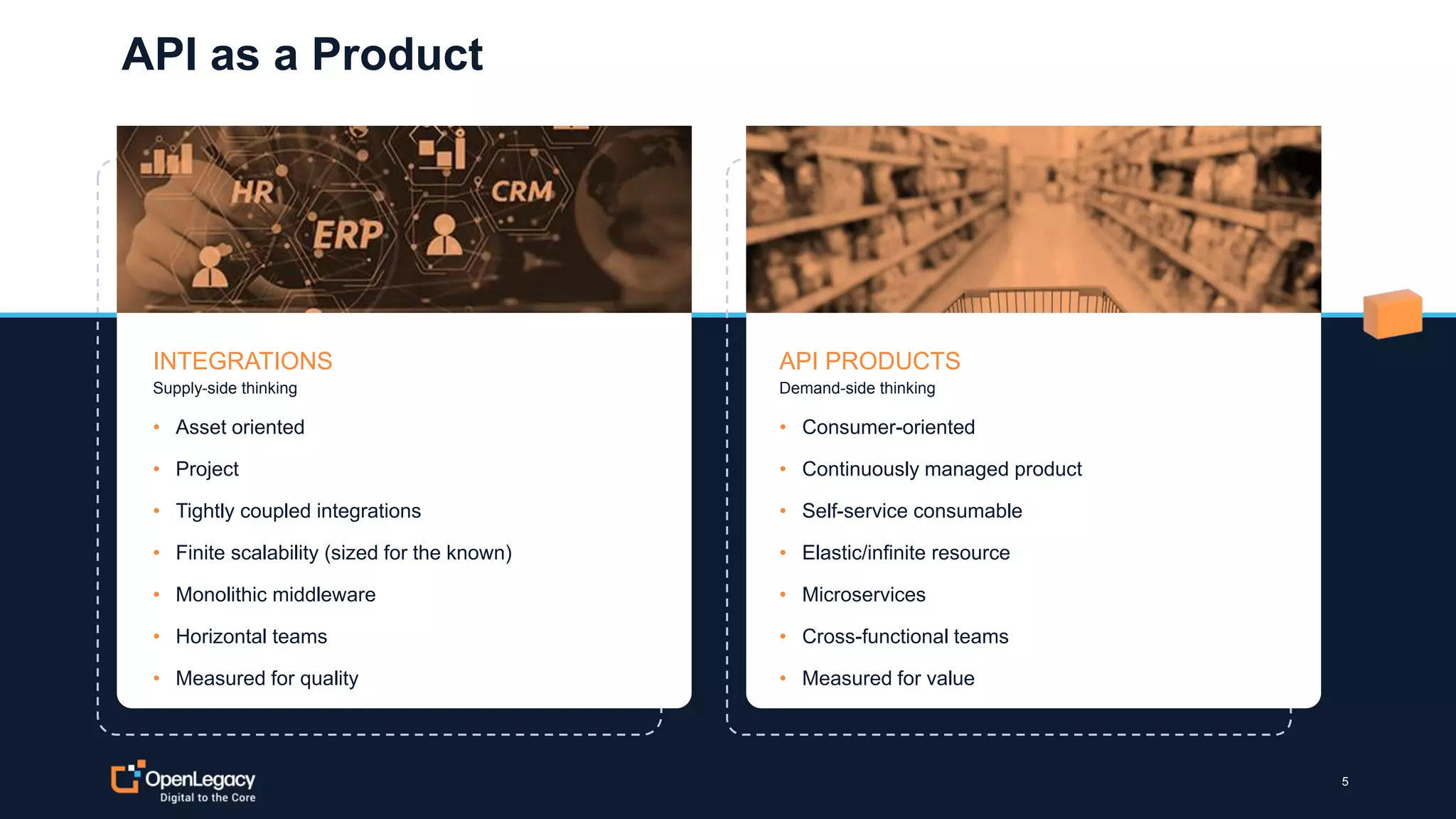
API as a Product
5
INTEGRATIONS
Supply-side thinking
• Asset oriented
• Project
• Tightly coupled integrations
• Finite scalability (sized for the known)
• Monolithic middleware
• Horizontal teams
• Measured for quality
API PRODUCTS
Demand-side thinking
• Consumer-oriented
• Continuously managed product
• Self-service consumable
• Elastic/infinite resource
• Microservices
• Cross-functional teams
• Measured for value
6
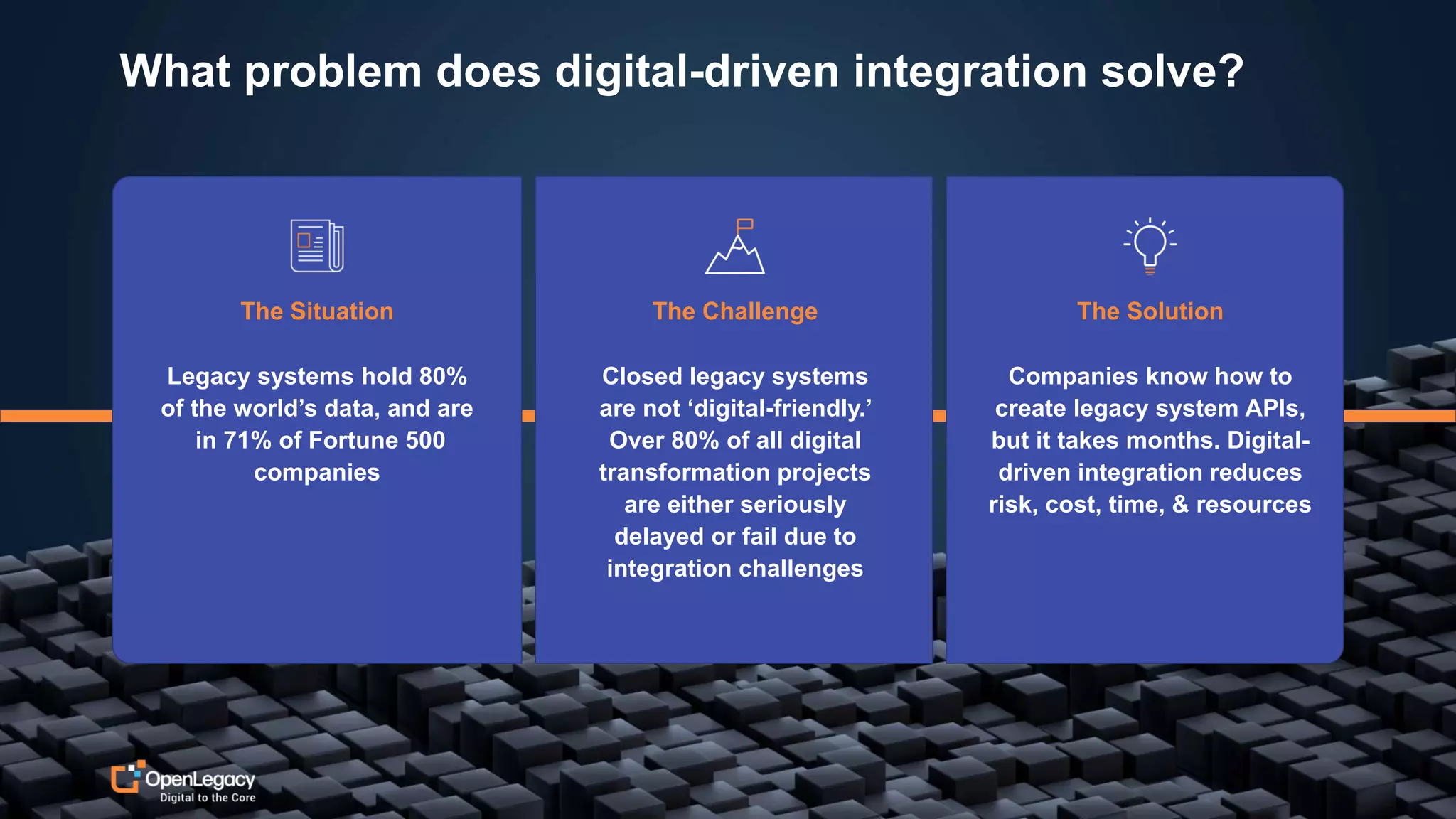
What problem does digital-driven integration solve?
Legacy systems hold 80%
of the world’s data, and are
in 71% of Fortune 500
companies
Companies know how to
create legacy system APIs,
but it takes months. Digital-
driven integration reduces
risk, cost, time, & resources
Closed legacy systems
are not ‘digital-friendly.’
Over 80% of all digital
transformation projects
are either seriously
delayed or fail due to
integration challenges
The Situation The Challenge The Solution
7
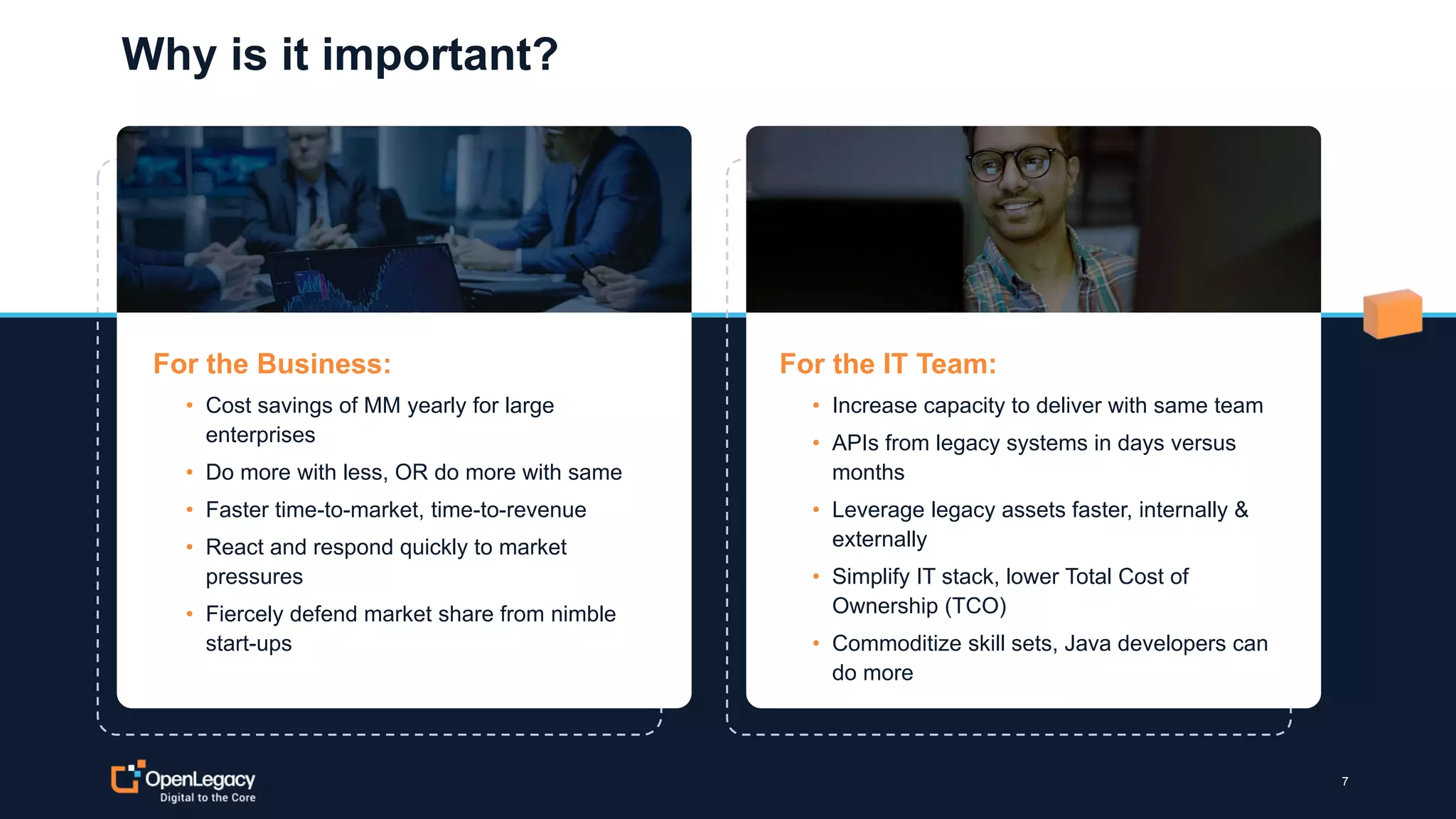
Why is it important?
7
For the Business:
• Cost savings of MM yearly for large
enterprises
• Do more with less, OR do more with same
• Faster time-to-market, time-to-revenue
• React and respond quickly to market
pressures
• Fiercely defend market share from nimble
start-ups
For the IT Team:
• Increase capacity to deliver with same team
• APIs from legacy systems in days versus
months
• Leverage legacy assets faster, internally &
externally
• Simplify IT stack, lower Total Cost of
Ownership (TCO)
• Commoditize skill sets, Java developers can
do more
8
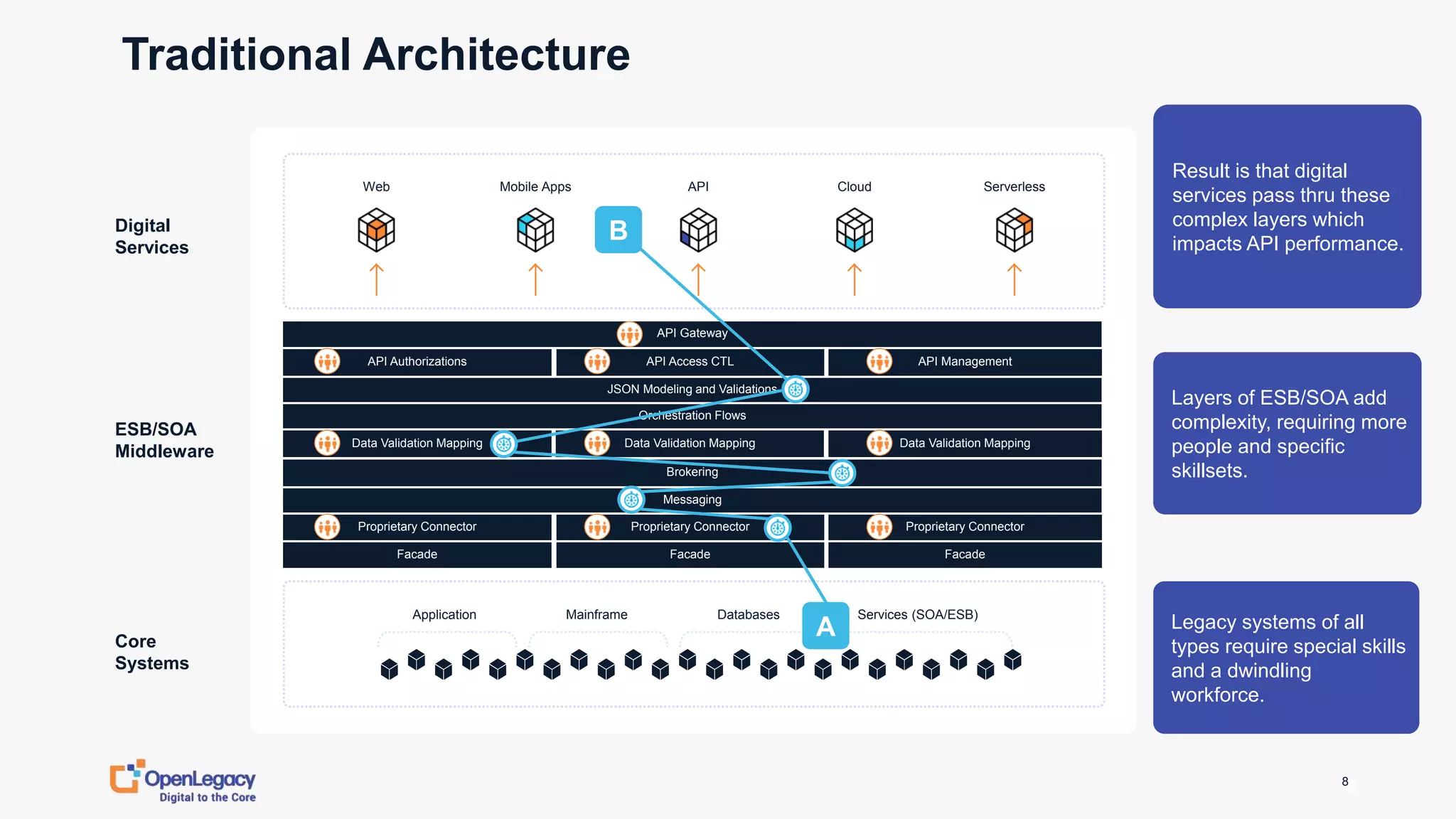
Traditional Architecture
8
Result is that digital
services pass thru these
complex layers which
impacts API performance.
Layers of ESB/SOA add
complexity, requiring more
people and specific
skillsets.
Legacy systems of all
types require special skills
and a dwindling
workforce.
Application Mainframe Databases Services (SOA/ESB)
Web Mobile Apps API Cloud Serverless
Messaging
Orchestration Flows
Brokering
Data Validation Mapping Data Validation Mapping Data Validation Mapping
JSON Modeling and Validations
API Authorizations API Access CTL API Management
API Gateway
Proprietary Connector Proprietary Connector Proprietary Connector
Facade Facade Facade
Digital
Services
ESB/SOA
Middleware
Core
Systems
B
A
9
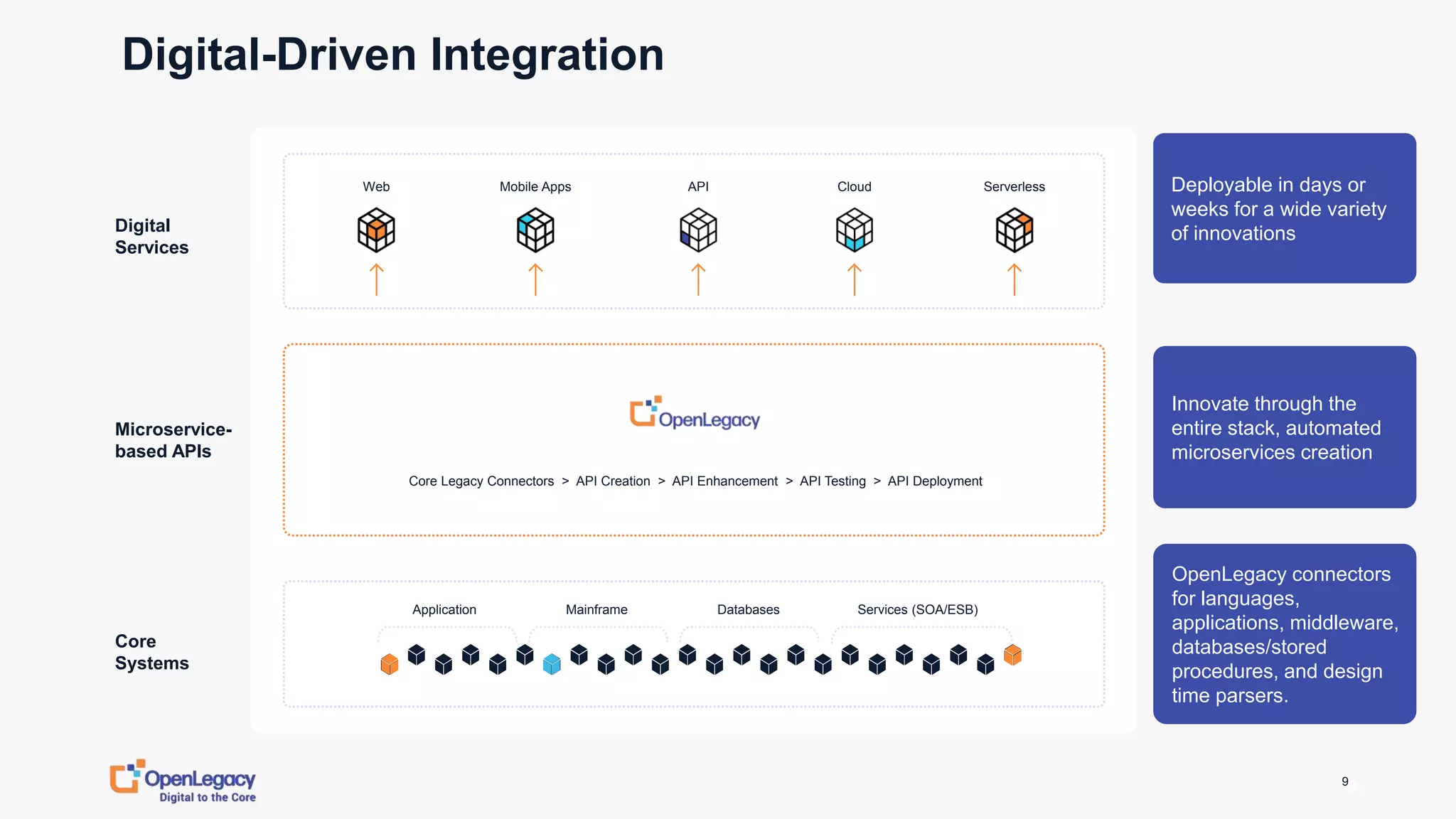
Digital-Driven Integration
Application Mainframe Databases Services (SOA/ESB)
Web API Cloud
Core Legacy Connectors > API Creation > API Enhancement > API Testing > API Deployment
Mobile Apps Serverless
9
Deployable in days or
weeks for a wide variety
of innovations
Innovate through the
entire stack, automated
microservices creation
OpenLegacy connectors
for languages,
applications, middleware,
databases/stored
procedures, and design
time parsers.
Digital
Services
Microservice-
based APIs
Core
Systems
10
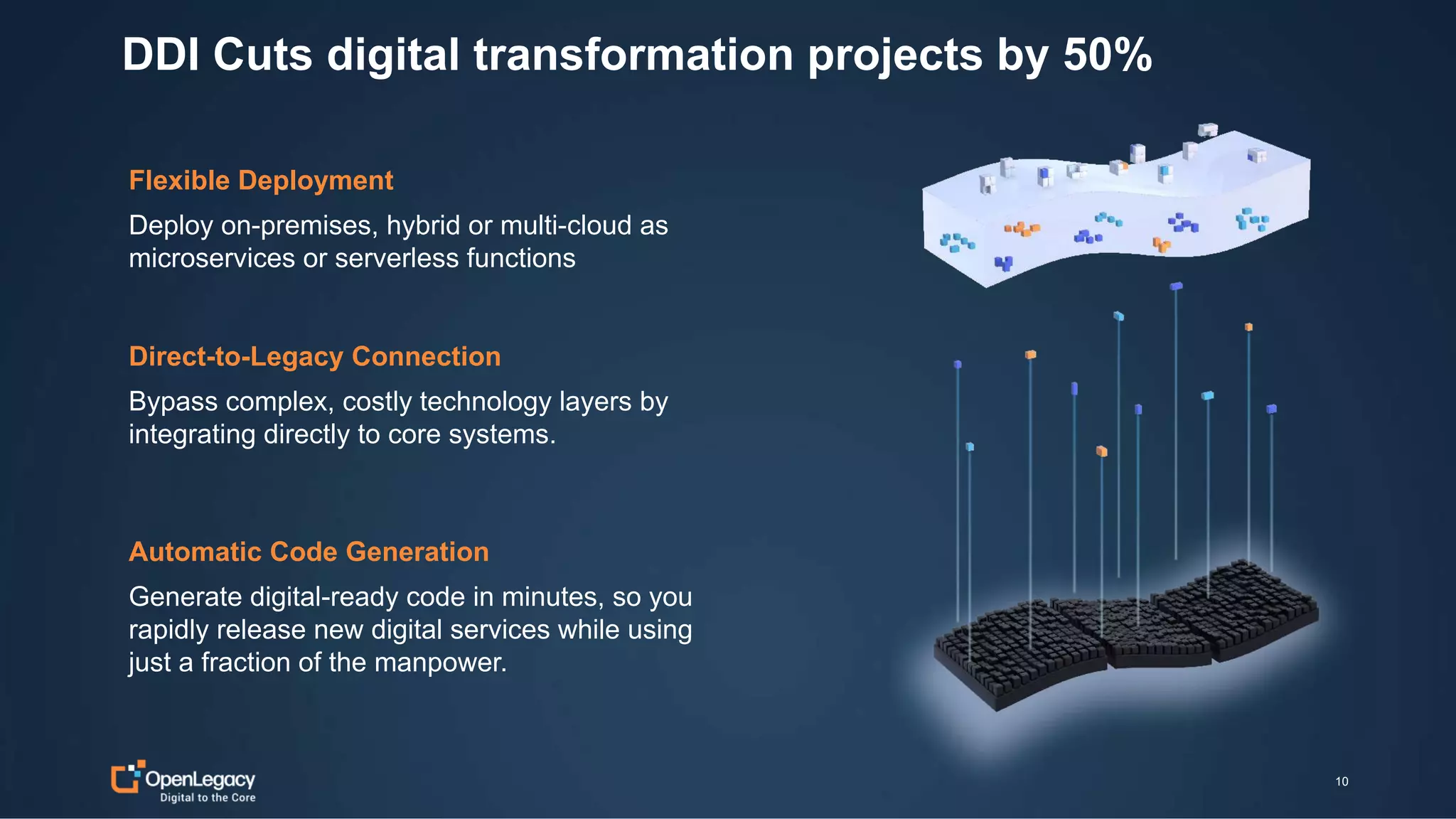
DDI Cuts digital transformation projects by 50%
10
Flexible Deployment
Deploy on-premises, hybrid or multi-cloud as
microservices or serverless functions
Automatic Code Generation
Generate digital-ready code in minutes, so you
rapidly release new digital services while using
just a fraction of the manpower.
Direct-to-Legacy Connection
Bypass complex, costly technology layers by
integrating directly to core systems.
11
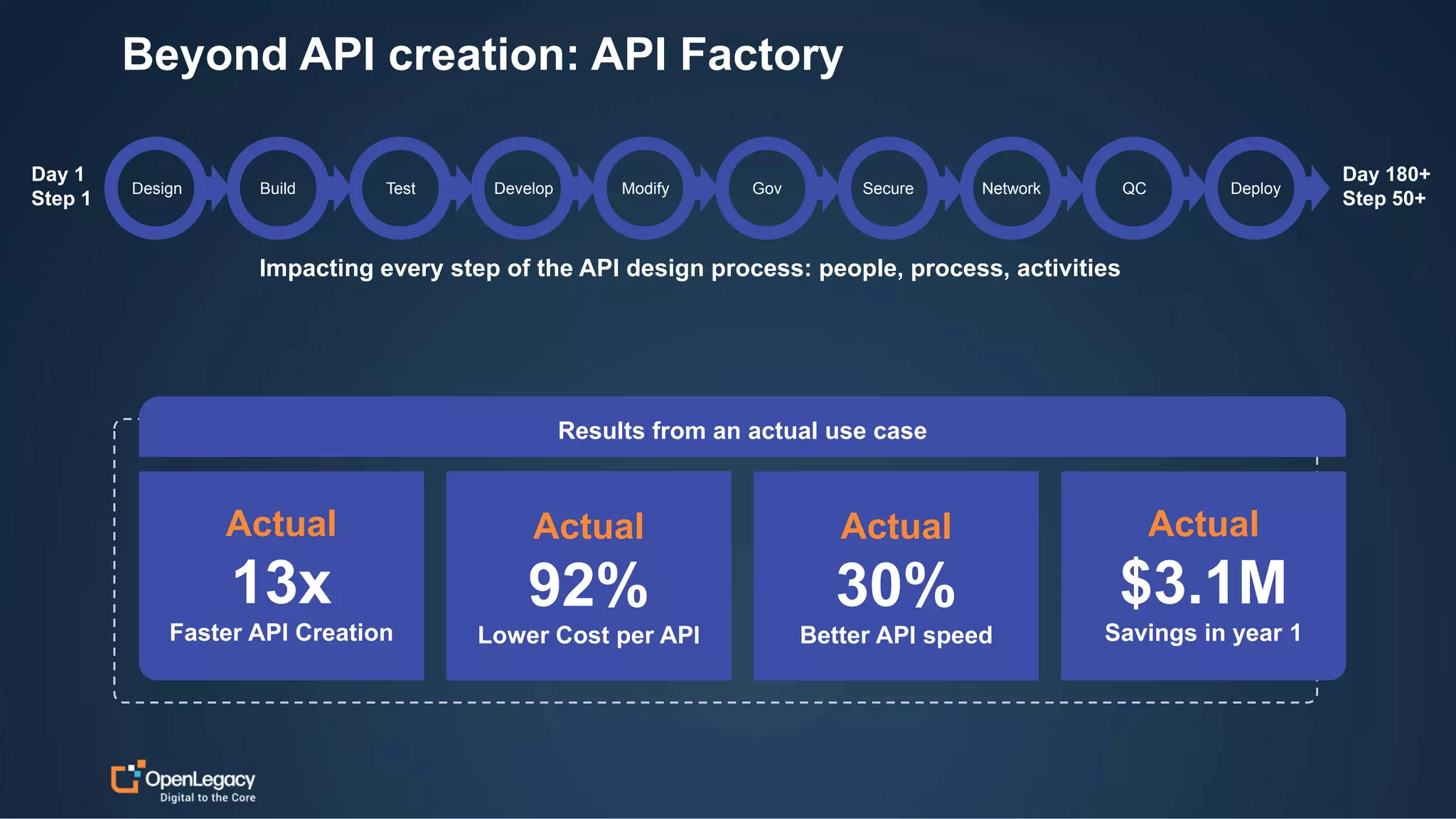
Beyond API creation: API Factory
Impacting every step of the API design process: people, process, activities
Day 1
Step 1
Day 180+
Step 50+
Design Build Test Develop Modify Gov Secure Network QC Deploy
Actual
13x
Faster API Creation
Actual
92%
Lower Cost per API
Actual
30%
Better API speed
Actual
$3.1M
Savings in year 1
Results from an actual use case
1212
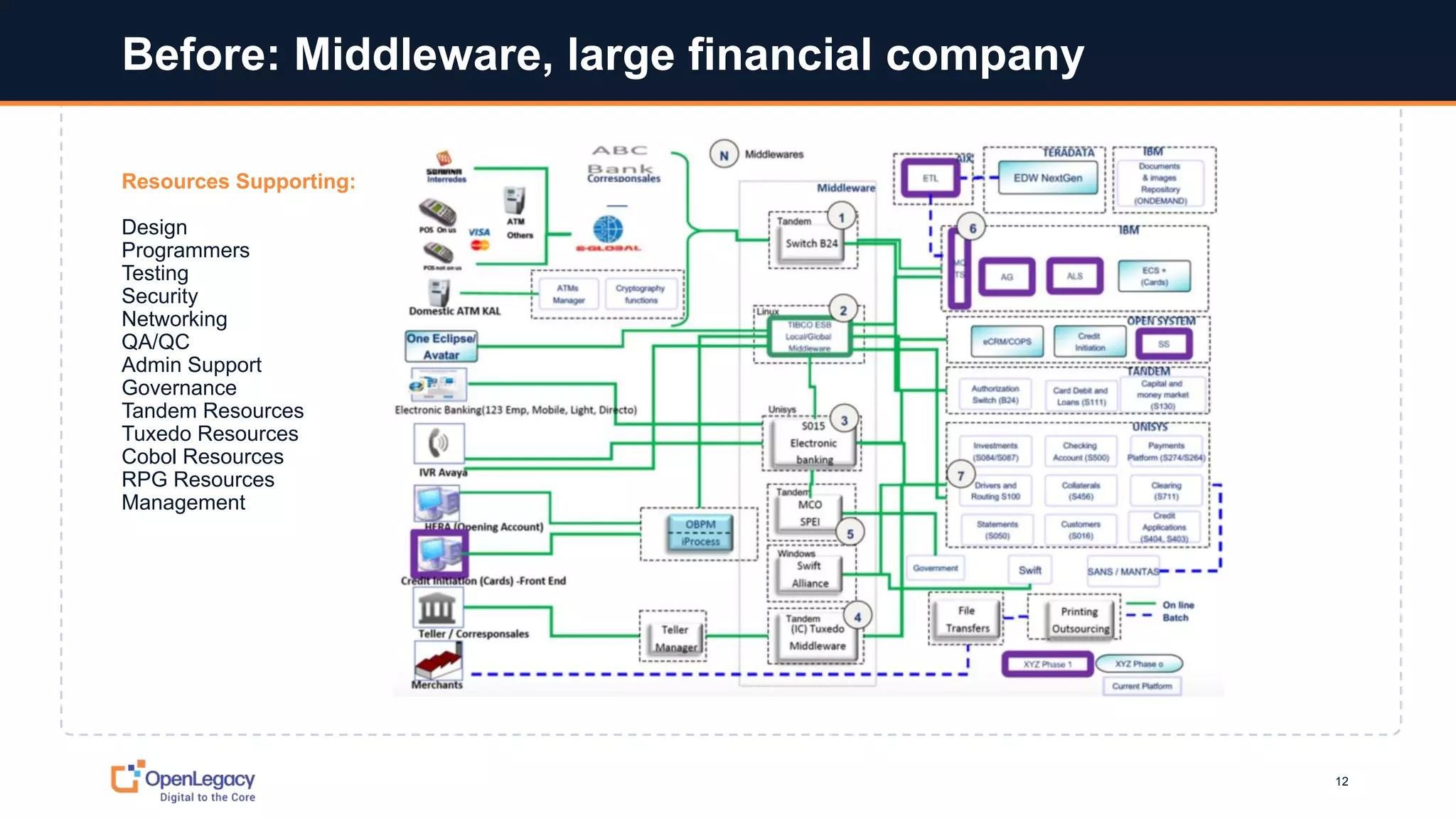
Before: Middleware, large financial company
Resources Supporting:
Design
Programmers
Testing
Security
Networking
QA/QC
Admin Support
Governance
Tandem Resources
Tuxedo Resources
Cobol Resources
RPG Resources
Management………
1313
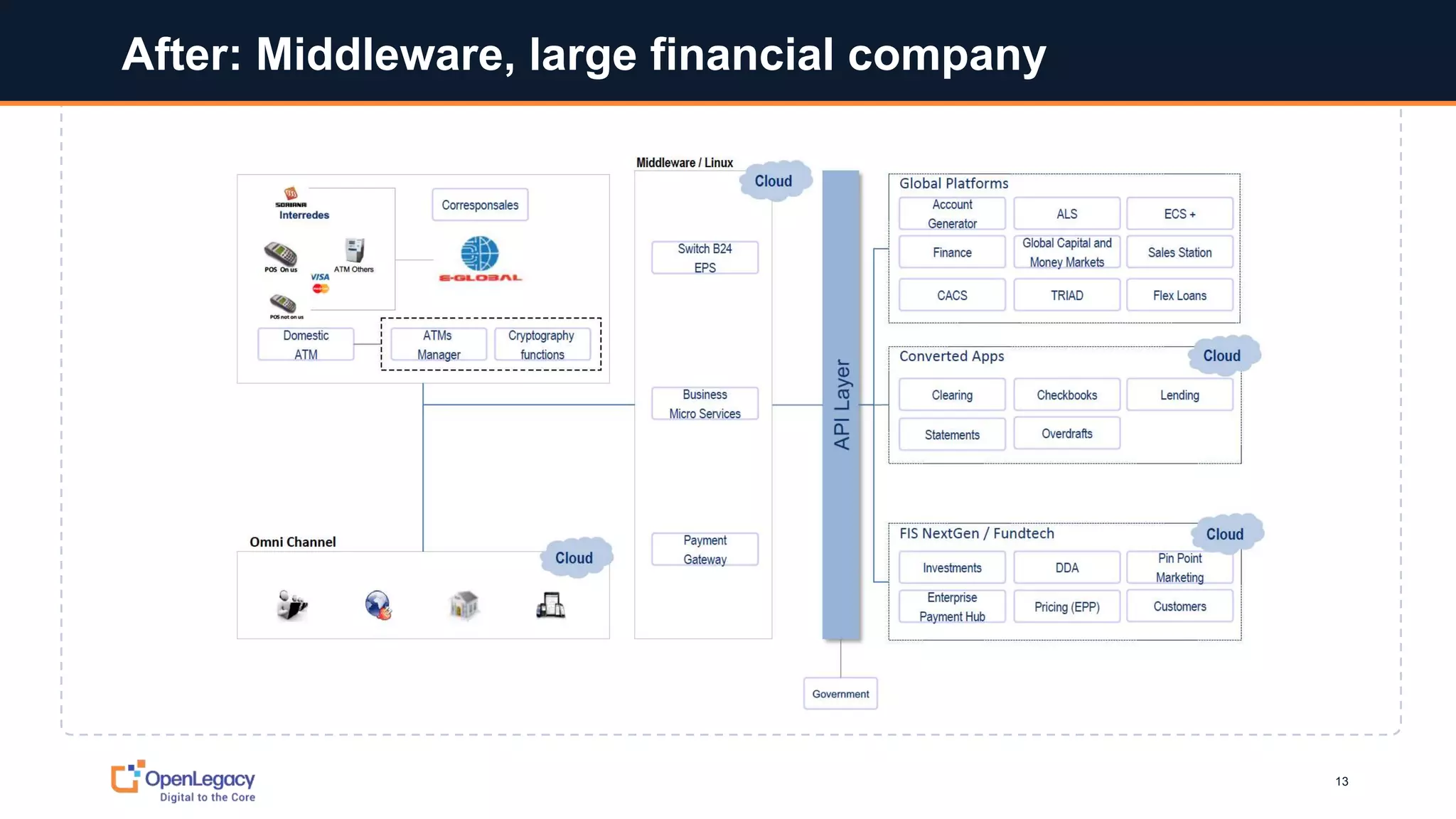
After: Middleware, large financial company
1414
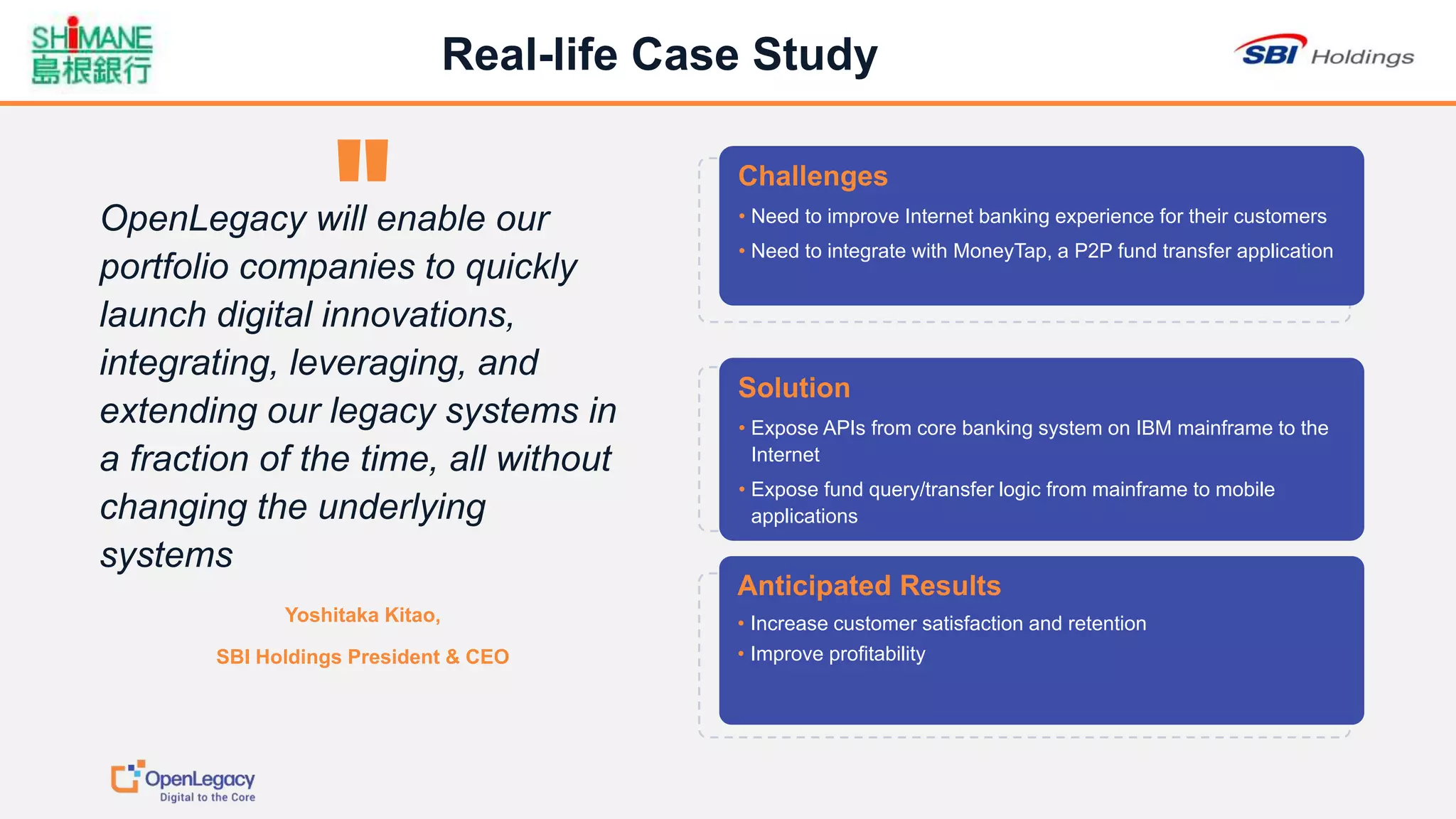
Real-life Case Study
Challenges
• Need to improve Internet banking experience for their customers
• Need to integrate with MoneyTap, a P2P fund transfer application
Solution
• Expose APIs from core banking system on IBM mainframe to the
Internet
• Expose fund query/transfer logic from mainframe to mobile
applications
Anticipated Results
• Increase customer satisfaction and retention
• Improve profitability
Yoshitaka Kitao,
SBI Holdings President & CEO
OpenLegacy will enable our
portfolio companies to quickly
launch digital innovations,
integrating, leveraging, and
extending our legacy systems in
a fraction of the time, all without
changing the underlying
systems
15
Thank you
15
info@openlegacy.com

apidays LIVE Hong Kong - The Future of Legacy - How to leverage legacy and on-prem assets in your digital transformation by Zeev Avidan

  • 1.
    1 The Future ofLegacy How to leverage legacy and on-prem assets in your digital transformation with Digital-Driven Integration Zeev Avidan Chief Product Officer
  • 2.
    2 Reach Reaching new markets andobtaining new customers through digital channels and partners Speed Allowing the business to react quickly to new opportunities and competitive threats Domains interactions across multiple lines of business, making every customer interaction count 2 Drivers For Digital Transformation
  • 3.
    3 Getting Started –Two Approaches 3 If you build it, they will come • Identify a baseline of APIs covering major domains • Design APIs based on APIX and best practices • Deploy APIs to the broadest platform possible (on-prem < Private Cloud < Public Cloud) • Target developers • Invest in portals, communication and marketing Pros: Scalable from start, consumer led, signals importance Cons: Adoption, ROI, Relevance First and Best • Identify an internal customer • Design APIs based on their needs • Deploy APIs to the platform best fitting use case • Iterate based on feedback • Open to broader audience once mature • Use success to promote Pros: Adoption, agile, success brings attention Cons: Scalability, limited scope, concentration risk
  • 4.
    4 Identifying API Opportunities 4 InternalDevelopers • What data and transactions would your own mobile apps need? • Does generic data exist that is the same for all app users, such as business locations, rates and so on? • Is there data specific to existing customers that should be accessible through your app, such as account balance or open account status? Partners • What data and transactions do you share among your current partners? • Is partner onboarding a long, difficult process? • Would self-registration of partners be of value. increasing the number of partners and broadening geographic coverage, for example? Public • What apps might others write that could use your data and transactions? • What information are you currently making available on your website? • What other industries or processes might also use your products? One example might be a car purchase that needs a bank loan. • Think mashups: What other APIs might make sense with yours? Mapping? Social? Social • How do your systems interact with social media? Can you spot trends in social media and raise alerts or act? • Can you gain insight on your brand and your competition through social media? • Can you do real-time analytics combining current customer status, behavior and history with social interactions? Devices • What features of the device might be useful in conjunction with your APIs? (GPS, camera) • What scenarios can apply to the device? For example, needing repair/supplies, needing to send status information, controlling device behavior or enabling interaction between the device and enterprise systems. • How are you positioned to integrate the next UI technology, such as wearables like smart clothing or augmented reality glasses? Data • What data do you collect about your clients? Would this data be of value to a larger audience inside the enterprise? • Can your data identify market segments that would be of interest to a non-related industry? For example, can it identify a high volume of expensive credit card purchases in a region of the city? Or can it identify a high percentage of wealth management investments being moved to low-risk funds for retirement planning in certain times of the year?
  • 5.
    5 API as aProduct 5 INTEGRATIONS Supply-side thinking • Asset oriented • Project • Tightly coupled integrations • Finite scalability (sized for the known) • Monolithic middleware • Horizontal teams • Measured for quality API PRODUCTS Demand-side thinking • Consumer-oriented • Continuously managed product • Self-service consumable • Elastic/infinite resource • Microservices • Cross-functional teams • Measured for value
  • 6.
    6 What problem doesdigital-driven integration solve? Legacy systems hold 80% of the world’s data, and are in 71% of Fortune 500 companies Companies know how to create legacy system APIs, but it takes months. Digital- driven integration reduces risk, cost, time, & resources Closed legacy systems are not ‘digital-friendly.’ Over 80% of all digital transformation projects are either seriously delayed or fail due to integration challenges The Situation The Challenge The Solution
  • 7.
    7 Why is itimportant? 7 For the Business: • Cost savings of MM yearly for large enterprises • Do more with less, OR do more with same • Faster time-to-market, time-to-revenue • React and respond quickly to market pressures • Fiercely defend market share from nimble start-ups For the IT Team: • Increase capacity to deliver with same team • APIs from legacy systems in days versus months • Leverage legacy assets faster, internally & externally • Simplify IT stack, lower Total Cost of Ownership (TCO) • Commoditize skill sets, Java developers can do more
  • 8.
    8 Traditional Architecture 8 Result isthat digital services pass thru these complex layers which impacts API performance. Layers of ESB/SOA add complexity, requiring more people and specific skillsets. Legacy systems of all types require special skills and a dwindling workforce. Application Mainframe Databases Services (SOA/ESB) Web Mobile Apps API Cloud Serverless Messaging Orchestration Flows Brokering Data Validation Mapping Data Validation Mapping Data Validation Mapping JSON Modeling and Validations API Authorizations API Access CTL API Management API Gateway Proprietary Connector Proprietary Connector Proprietary Connector Facade Facade Facade Digital Services ESB/SOA Middleware Core Systems B A
  • 9.
    9 Digital-Driven Integration Application MainframeDatabases Services (SOA/ESB) Web API Cloud Core Legacy Connectors > API Creation > API Enhancement > API Testing > API Deployment Mobile Apps Serverless 9 Deployable in days or weeks for a wide variety of innovations Innovate through the entire stack, automated microservices creation OpenLegacy connectors for languages, applications, middleware, databases/stored procedures, and design time parsers. Digital Services Microservice- based APIs Core Systems
  • 10.
    10 DDI Cuts digitaltransformation projects by 50% 10 Flexible Deployment Deploy on-premises, hybrid or multi-cloud as microservices or serverless functions Automatic Code Generation Generate digital-ready code in minutes, so you rapidly release new digital services while using just a fraction of the manpower. Direct-to-Legacy Connection Bypass complex, costly technology layers by integrating directly to core systems.
  • 11.
    11 Beyond API creation:API Factory Impacting every step of the API design process: people, process, activities Day 1 Step 1 Day 180+ Step 50+ Design Build Test Develop Modify Gov Secure Network QC Deploy Actual 13x Faster API Creation Actual 92% Lower Cost per API Actual 30% Better API speed Actual $3.1M Savings in year 1 Results from an actual use case
  • 12.
    1212 Before: Middleware, largefinancial company Resources Supporting: Design Programmers Testing Security Networking QA/QC Admin Support Governance Tandem Resources Tuxedo Resources Cobol Resources RPG Resources Management………
  • 13.
  • 14.
    1414 Real-life Case Study Challenges •Need to improve Internet banking experience for their customers • Need to integrate with MoneyTap, a P2P fund transfer application Solution • Expose APIs from core banking system on IBM mainframe to the Internet • Expose fund query/transfer logic from mainframe to mobile applications Anticipated Results • Increase customer satisfaction and retention • Improve profitability Yoshitaka Kitao, SBI Holdings President & CEO OpenLegacy will enable our portfolio companies to quickly launch digital innovations, integrating, leveraging, and extending our legacy systems in a fraction of the time, all without changing the underlying systems
  • 15.