



IAS 37
Provisions, Contingent Liabilities and
Contingent Assets
By:- Yohannes Negatu
(ACCA,DipIFR,Cert IPSAS,Cert BV)
Overview
 Objective
 Scope
 Definitions
 Recognition
 Measurement
 Application
 Disclosure
 Exercises & Discussions
Objectives:-
Ensure that appropriate recognition
criteria and measurement bases are
applied.
 Disclose sufficient information in the
notes to enable users to understand
their nature, timing and amount
Scope
Covers all provisions, contingent
liabilities and assets except those
covered by another standard
eg. IAS 11,12,19,21
eg. IFRS 4,9,15
1. Provisions
1.1 Definition:-
Liability:- Present obligation arising from
past events, the settlement of which is
expected to result in an out flow from the
entity of resources embodying economic
benefits.
continued
Provision:- Liability of
uncertain timing or amount.
eg. Provision for restructuring
cost, decommissioning and
environmental cost.
Present Obligation
Present obligation (Legal or Constructive)
Legal obligation derives from
 A contract
 Legislation
 Other operations of law eg.
 Warranties given by manufacturer
 Legislation enacted to require past
Environmental damage to be put right
continued
Constructive obligations arise from
 By an established pattern of past practice
 Published policies
 By Sufficiently specified current
statement eg.
 Restructuring program
 Retailers refund policy
 Environmental policy
Past Events
Obligating Event :- Event that creates legal or
constructive obligation that result in an entity
having no realistic alternatives to settling that
obligation. eg.Sale of goods for warranty liability
Contamination of land for environmental
obligation
 Construction of power station for
decommissioning liability
Probable out flow to Settle
Probable in this context defined
as ‘more likely than not’
 If probability not more than 50%,
must not provide disclose a
contingent liability.
continued
Under IAS 37, if there was 40%
probability no provision would be
recognized
Under proposal in the ED A provision
would be recognized and the degree of
probability would be reflected in
measuring the amount to be recognized
1.2 Recognition
Recognition Criteria:-
A provision shall be recognized when:
(a)Present obligation (Legal orConstructive)
exists as a result of past event;
(b) Probable that an out flow of resources
required to settle the obligation; and
(c)Amount of obligation can be estimated
reliably.
1.3 Measurement
 Measure at ‘best estimate’
• Single obligation = Most likely
outcome
• Large population = Expected value
 Risk and Uncertainties are take
into account in reaching best estimate.
continued
If time value of money is
material, measure the provision at
Present value.
 Review provisions at reporting
date and adjust to reflect best
estimate eg. Change in discount rate
continued
 Judgment by preparers:- similar
transaction, use expert, industry
model
 Consider Reimbursement
1.4 Application
Do not recognize Provision for
future operating losses
 Recognize onerous contract as a
provision
 Recognize provision when
general recognition
continued
criteria are met for Restructuring
eg.
 The sale or termination of line of
business
 Closure/relocation of business
 Changes in management
structure
continued
To conclude that there is present
obligation (legal or constructive) at the
ending of the reporting period for
Restructure:-
1. An entity must have a detailed formal
Plan
2. It must have raised a valid expectation in
those affected.
continued
Restructuring cost= only direct
expenditure i.e. does not include
Retraining or relocating continuing
staff;
 Marketing;
 Investment in new systems and
distribution networks
1.5 Disclosures
 For each class of provision, disclose
Carrying amount of the beginning and
end of period
 Additional provisions made in the
period
 Amounts used during the period
 Un used amounts reversed during the
period
continued
Adjustment
 Description of obligation
 Amount of any expected
reimbursement
Note:- Do not have to disclose changes
for comparative period --- explicitly
stated in IAS 37
2 Contingent Liabilities
2.1 Definition
Contingent liabilities:- Possible
obligation that arises from past event
whose existence will only be confirmed
by uncertain future events not wholly
within entity's control ; or
continued
Present obligation that arise from
past event but is not recognized
because:-
• Economic outflow is not
probable; or
• Amount cannot be reliably
measured
2.2 Recognition
 Do not recognize
 Disclose unless possibility of
outflow is remote
2.3 Disclosures
disclose
A brief description of the nature
of the contingent liability
 An estimate of its financial effect
 The possibility of reimbursement
3 Contingent Assets
3.1 Definition
Contingent Assets:- Possible Asset that
arises from past event whose existence
will only be confirmed by uncertain
future events not wholly within entity's
control
eg. Insurance claims, legal actions
3.2 Recognition
 Do not recognize
 An asset can only be recognized
where realization is ‘Virtually
certain’
 Disclose where inflow is probable
3.3 Disclosures
Disclose
 A brief description of the nature
of contingent asset
 An estimate of its financial effect
For all Disclosure
 If any information not disclosed
because of impracticable, disclose that
fact
 In extremely rare case need not disclose
the information but should disclose general
nature of disputes, together with the fact
that, and reason, why the information has
not been disclosed
Thank You
Questions and Discussion
Exercises and Discussions
1. Identify whether each of the following would be a
Liability, a Provision or a Contingent liability or none
of the above in the financial statement of the
company A at its reporting date of 30 June 2010.
Assume that company A’s financial statements are
authorized for issue on 24 August 2010.
A= An amount of Birr 35,000 owing to company Z for
services rendered during May 2010
continued
B= Long service leave, estimated to be Birr 500,000
owing to employees in respect of past service
continued
C= Cost of Birr 26,000 estimated to be incurred for
relocating employee D from company A’s head office
location to another city. The staff will physically
relocate during July 2010
continued
D= provisions of birr 50,000 for the overhaul of a
machine. The overhaul is needed every 5 years and
the machine was five years old as at 30 June 2010
continued
E= Damages awarded against company A resulting
from a court case decided on 26 June 2010. The judge
has announced that the amount of damages will be
set at a future date, expected to be in September
2010.
Company A has received advice from its lawyers that
the amount of damages could be anything between
Birr 20,000 and birr7million
continued
2. Determine the amount of provision to recognize.
Identify the considerations you used in arriving at the
‘best estimate’ of outflow of economic benefits.
continued
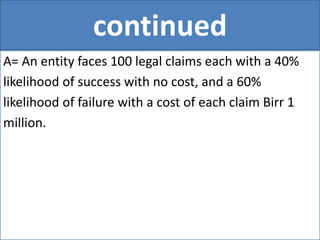
A= An entity faces 100 legal claims each with a 40%
likelihood of success with no cost, and a 60%
likelihood of failure with a cost of each claim Birr 1
million.
continued
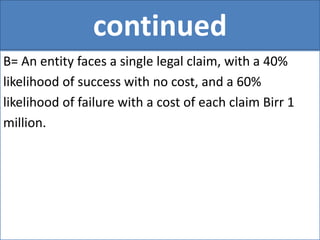
B= An entity faces a single legal claim, with a 40%
likelihood of success with no cost, and a 60%
likelihood of failure with a cost of each claim Birr 1
million.
continued
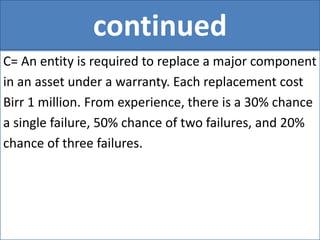
C= An entity is required to replace a major component
in an asset under a warranty. Each replacement cost
Birr 1 million. From experience, there is a 30% chance
a single failure, 50% chance of two failures, and 20%
chance of three failures.
continued
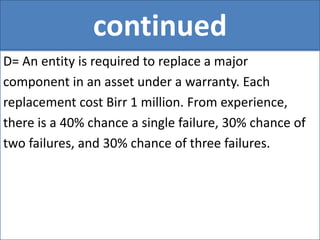
D= An entity is required to replace a major
component in an asset under a warranty. Each
replacement cost Birr 1 million. From experience,
there is a 40% chance a single failure, 30% chance of
two failures, and 30% chance of three failures.
continued
3. Provisions
All entities A to F below have reporting dates of 31
December. Assume that reliable estimates can be
made of the obligations. Determine for each situation
whether a provision should be recognized.
continued
A = warranties
A manufacturer gives warranties at the time of sale to
purchasers of its product. Under the terms of the sale
contract the manufacturer undertakes to make good,
by repair or replacement, manufacturing defects that
may become apparent with in three years of sale.
On past experience, its probable that there will be
some claims under warranty.
continued
B= Refund Policy
A retail store has a policy of refunding purchases by
dissatisfied customers, even though its under no legal
obligation to do so. Its refund policy is generally
known.
continued
C = Closure of division
On 12 December the board of directors decided to
close down a division of the entity. Before the
reporting date (31 December) the decision was not
communicated to any of those affected and no other
steps were taken to implement the decision.
continued
C = Closure of division
On 12 December the board of directors decided to
close down a division of the entity. On 20 December a
detailed plan for closing down the division was agreed
by the board of directors .
Letters were sent to customers warning them to seek
an alternative source of supply and redundancy
notice were sent to the staff affected.
continued
D= Onerous contract
An entity operates profitably from property leased
under operating lease. During December the entity
relocates its operations to new premises. The lease on
the old property has four years to run from the end of
December and is non-cancellable.
continued
E= Court case
Customers have begun legal proceedings against the
entity and are seeking damages. Up to date of
authorization of the financial statement for 2010 for
issue, the entity’s lawyers advise that its probable that
the entity will not be found liable. How ever when the
entity prepares its financial statement for the 2011 , the
lawyers advice has changed; they believe that
developments in the case in 2011 are likely to result in
the case being decided against the entity.
What accounting treatment are required for 2010 and
2011 financial statement?
continued
F = Cost of major overhaul
An airline is required by law to overhaul its aircraft
once every three years. At 31 December two years
remained before the next overhaul was due.
Thank You
Questions and Discussion

Ias 37

  • 1.
    IAS 37 Provisions, ContingentLiabilities and Contingent Assets By:- Yohannes Negatu (ACCA,DipIFR,Cert IPSAS,Cert BV)
  • 2.
    Overview  Objective  Scope Definitions  Recognition  Measurement  Application  Disclosure  Exercises & Discussions
  • 3.
    Objectives:- Ensure that appropriaterecognition criteria and measurement bases are applied.  Disclose sufficient information in the notes to enable users to understand their nature, timing and amount
  • 4.
    Scope Covers all provisions,contingent liabilities and assets except those covered by another standard eg. IAS 11,12,19,21 eg. IFRS 4,9,15
  • 5.
    1. Provisions 1.1 Definition:- Liability:-Present obligation arising from past events, the settlement of which is expected to result in an out flow from the entity of resources embodying economic benefits.
  • 6.
    continued Provision:- Liability of uncertaintiming or amount. eg. Provision for restructuring cost, decommissioning and environmental cost.
  • 7.
    Present Obligation Present obligation(Legal or Constructive) Legal obligation derives from  A contract  Legislation  Other operations of law eg.  Warranties given by manufacturer  Legislation enacted to require past Environmental damage to be put right
  • 8.
    continued Constructive obligations arisefrom  By an established pattern of past practice  Published policies  By Sufficiently specified current statement eg.  Restructuring program  Retailers refund policy  Environmental policy
  • 9.
    Past Events Obligating Event:- Event that creates legal or constructive obligation that result in an entity having no realistic alternatives to settling that obligation. eg.Sale of goods for warranty liability Contamination of land for environmental obligation  Construction of power station for decommissioning liability
  • 10.
    Probable out flowto Settle Probable in this context defined as ‘more likely than not’  If probability not more than 50%, must not provide disclose a contingent liability.
  • 11.
    continued Under IAS 37,if there was 40% probability no provision would be recognized Under proposal in the ED A provision would be recognized and the degree of probability would be reflected in measuring the amount to be recognized
  • 12.
    1.2 Recognition Recognition Criteria:- Aprovision shall be recognized when: (a)Present obligation (Legal orConstructive) exists as a result of past event; (b) Probable that an out flow of resources required to settle the obligation; and (c)Amount of obligation can be estimated reliably.
  • 13.
    1.3 Measurement  Measureat ‘best estimate’ • Single obligation = Most likely outcome • Large population = Expected value  Risk and Uncertainties are take into account in reaching best estimate.
  • 14.
    continued If time valueof money is material, measure the provision at Present value.  Review provisions at reporting date and adjust to reflect best estimate eg. Change in discount rate
  • 15.
    continued  Judgment bypreparers:- similar transaction, use expert, industry model  Consider Reimbursement
  • 16.
    1.4 Application Do notrecognize Provision for future operating losses  Recognize onerous contract as a provision  Recognize provision when general recognition
  • 17.
    continued criteria are metfor Restructuring eg.  The sale or termination of line of business  Closure/relocation of business  Changes in management structure
  • 18.
    continued To conclude thatthere is present obligation (legal or constructive) at the ending of the reporting period for Restructure:- 1. An entity must have a detailed formal Plan 2. It must have raised a valid expectation in those affected.
  • 19.
    continued Restructuring cost= onlydirect expenditure i.e. does not include Retraining or relocating continuing staff;  Marketing;  Investment in new systems and distribution networks
  • 20.
    1.5 Disclosures  Foreach class of provision, disclose Carrying amount of the beginning and end of period  Additional provisions made in the period  Amounts used during the period  Un used amounts reversed during the period
  • 21.
    continued Adjustment  Description ofobligation  Amount of any expected reimbursement Note:- Do not have to disclose changes for comparative period --- explicitly stated in IAS 37
  • 22.
    2 Contingent Liabilities 2.1Definition Contingent liabilities:- Possible obligation that arises from past event whose existence will only be confirmed by uncertain future events not wholly within entity's control ; or
  • 23.
    continued Present obligation thatarise from past event but is not recognized because:- • Economic outflow is not probable; or • Amount cannot be reliably measured
  • 24.
    2.2 Recognition  Donot recognize  Disclose unless possibility of outflow is remote
  • 25.
    2.3 Disclosures disclose A briefdescription of the nature of the contingent liability  An estimate of its financial effect  The possibility of reimbursement
  • 26.
    3 Contingent Assets 3.1Definition Contingent Assets:- Possible Asset that arises from past event whose existence will only be confirmed by uncertain future events not wholly within entity's control eg. Insurance claims, legal actions
  • 27.
    3.2 Recognition  Donot recognize  An asset can only be recognized where realization is ‘Virtually certain’  Disclose where inflow is probable
  • 28.
    3.3 Disclosures Disclose  Abrief description of the nature of contingent asset  An estimate of its financial effect
  • 29.
    For all Disclosure If any information not disclosed because of impracticable, disclose that fact  In extremely rare case need not disclose the information but should disclose general nature of disputes, together with the fact that, and reason, why the information has not been disclosed
  • 31.
  • 32.
  • 33.
    Exercises and Discussions 1.Identify whether each of the following would be a Liability, a Provision or a Contingent liability or none of the above in the financial statement of the company A at its reporting date of 30 June 2010. Assume that company A’s financial statements are authorized for issue on 24 August 2010. A= An amount of Birr 35,000 owing to company Z for services rendered during May 2010
  • 34.
    continued B= Long serviceleave, estimated to be Birr 500,000 owing to employees in respect of past service
  • 35.
    continued C= Cost ofBirr 26,000 estimated to be incurred for relocating employee D from company A’s head office location to another city. The staff will physically relocate during July 2010
  • 36.
    continued D= provisions ofbirr 50,000 for the overhaul of a machine. The overhaul is needed every 5 years and the machine was five years old as at 30 June 2010
  • 37.
    continued E= Damages awardedagainst company A resulting from a court case decided on 26 June 2010. The judge has announced that the amount of damages will be set at a future date, expected to be in September 2010. Company A has received advice from its lawyers that the amount of damages could be anything between Birr 20,000 and birr7million
  • 38.
    continued 2. Determine theamount of provision to recognize. Identify the considerations you used in arriving at the ‘best estimate’ of outflow of economic benefits.
  • 39.
    continued A= An entityfaces 100 legal claims each with a 40% likelihood of success with no cost, and a 60% likelihood of failure with a cost of each claim Birr 1 million.
  • 40.
    continued B= An entityfaces a single legal claim, with a 40% likelihood of success with no cost, and a 60% likelihood of failure with a cost of each claim Birr 1 million.
  • 41.
    continued C= An entityis required to replace a major component in an asset under a warranty. Each replacement cost Birr 1 million. From experience, there is a 30% chance a single failure, 50% chance of two failures, and 20% chance of three failures.
  • 42.
    continued D= An entityis required to replace a major component in an asset under a warranty. Each replacement cost Birr 1 million. From experience, there is a 40% chance a single failure, 30% chance of two failures, and 30% chance of three failures.
  • 43.
    continued 3. Provisions All entitiesA to F below have reporting dates of 31 December. Assume that reliable estimates can be made of the obligations. Determine for each situation whether a provision should be recognized.
  • 44.
    continued A = warranties Amanufacturer gives warranties at the time of sale to purchasers of its product. Under the terms of the sale contract the manufacturer undertakes to make good, by repair or replacement, manufacturing defects that may become apparent with in three years of sale. On past experience, its probable that there will be some claims under warranty.
  • 45.
    continued B= Refund Policy Aretail store has a policy of refunding purchases by dissatisfied customers, even though its under no legal obligation to do so. Its refund policy is generally known.
  • 46.
    continued C = Closureof division On 12 December the board of directors decided to close down a division of the entity. Before the reporting date (31 December) the decision was not communicated to any of those affected and no other steps were taken to implement the decision.
  • 47.
    continued C = Closureof division On 12 December the board of directors decided to close down a division of the entity. On 20 December a detailed plan for closing down the division was agreed by the board of directors . Letters were sent to customers warning them to seek an alternative source of supply and redundancy notice were sent to the staff affected.
  • 48.
    continued D= Onerous contract Anentity operates profitably from property leased under operating lease. During December the entity relocates its operations to new premises. The lease on the old property has four years to run from the end of December and is non-cancellable.
  • 49.
    continued E= Court case Customershave begun legal proceedings against the entity and are seeking damages. Up to date of authorization of the financial statement for 2010 for issue, the entity’s lawyers advise that its probable that the entity will not be found liable. How ever when the entity prepares its financial statement for the 2011 , the lawyers advice has changed; they believe that developments in the case in 2011 are likely to result in the case being decided against the entity. What accounting treatment are required for 2010 and 2011 financial statement?
  • 50.
    continued F = Costof major overhaul An airline is required by law to overhaul its aircraft once every three years. At 31 December two years remained before the next overhaul was due.
  • 51.
  • 52.