IPSAS 3
Accounting Policies, Changes in Accounting Estimates and
Errors
Presentation by:
CPA Anthony M. Njiru
November 2019
Uphold public interest
1
Effective date
Annual periods beginning on or after January 1,
2008.
2
Scope
IPSAS 3 applies to all public organizations
3
Scope
❑The standard does not cover the tax effects of
corrections of prior period errors and
❑Retrospective adjustments made to apply
changes in accounting policies are as they are not
relevant for many public sector organization
4
Objective
To prescribe the criteria for:
• Selection and application of accounting policies
• Changes in accounting policies
• Errors
5
Accounting policies
Specific principles, bases, conventions, rules and
practices applied by an entity in preparing and
presenting financial statements.
6
Selection and Application of Accounting
Policies
In selection and application of accounting policies
• An entity shall apply the relevant IPSAS
• If no specific IPSAS the management shall use its
discretion in coming up with policies
7
In the absence of a Standard or an
Interpretation that specifically applies to a
transaction, other event or condition -
Management must use its judgment in
developing and applying an accounting policy
that results in information that is relevant and
reliable.
8
Reliable, in that the financial statements:
• Represent faithfully the financial position, financial
performance, and cash flows of the entity
• Reflect the economic substance of transactions,
other events and conditions, and not merely the
legal form
•Are neutral, i.e., free from bias
• Are prudent
• Are complete in all material aspects 9
Managerial Considerations In
Selection Of Policies
• Requirements and guidance in IPSAS dealing with
similar and related issues;
• Definitions, recognition, and measurement criteria for
assets, liabilities, revenue, and expenses described in
other IPSASs.
• Management may also consider the most recent
pronouncements of other standard-setting bodies and
accepted public and private sector practices. 10
Consistency of accounting
policies
An entity shall select and apply its accounting
policies consistently for similar transactions,
other events and conditions, unless a Standard
or an Interpretation specifically requires or
permits categorization of items for which
different policies may be appropriate
11
If a Standard or an Interpretation requires or
permits categorization, an appropriate
accounting policy shall be selected and applied
consistently to each category
12
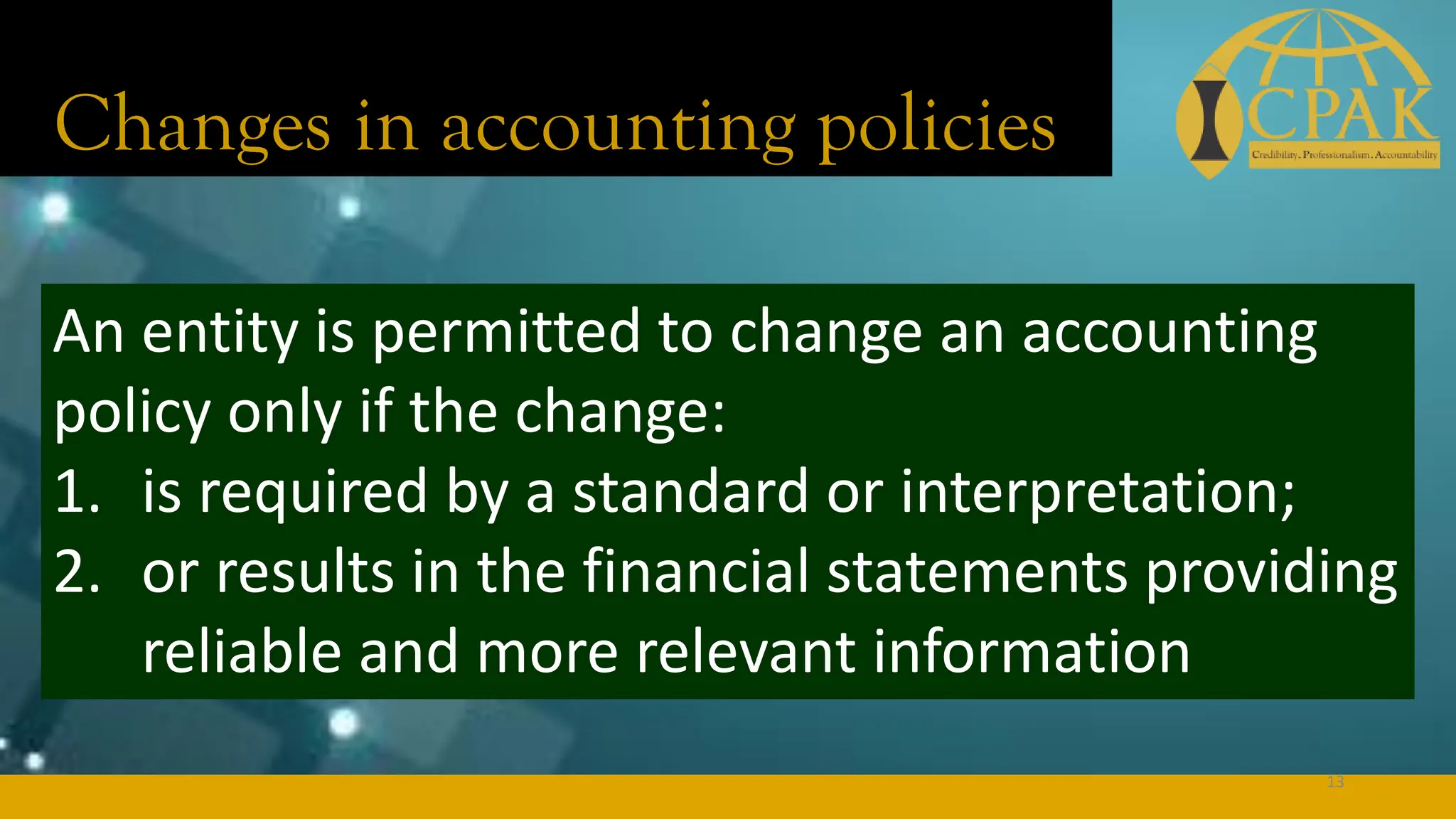
Changes in accounting policies
An entity is permitted to change an accounting
policy only if the change:
1. is required by a standard or interpretation;
2. or results in the financial statements providing
reliable and more relevant information
13
Exclusions
• Transaction or event that did not occur
previously
• or were immaterial
14
Treatment of Change In
Accounting Policies
• If a change in accounting policy is required by a
new standard or interpretation- as per that
standard
• If the new pronouncement does not include
specific transition provisions, then the change
in accounting policy is applied retrospectively.
15
Disclosures relating to changes in
accounting policies
oTitle of the standard or interpretation causing the
change
oThe nature of the change in accounting policy
oDescription of the transitional provisions
oTo the extent practicable, the amount of the
adjustment: for each financial statement line item
affected
16
Disclosures relating to changes in
accounting policies
o If retrospective application is impracticable, an
explanation and description of how the change
in accounting policy was applied.
Financial statements of subsequent periods need
not repeat these disclosures.
17
Disclosures For Voluntary
Changes In Policies
❑Nature
❑Amount
❑Description
If an entity has not applied a new standard or
interpretation that has been issued but is not yet
effective, the entity must disclose that fact
18
Changes in accounting estimates
Adjustment of the carrying amount of an asset or
liability, or related expense, resulting from
reassessing the expected future benefits and
obligations associated with that asset or liability
19
Treatment of Change In
Accounting Estimate
Prospectively by including it in profit or loss in:
❖The period of the change, if the change affects
that period only,
❖ or the period of the change and future
periods, if the change affects both.
20
Disclosures On Change In
Accounting Estimate
➢Nature and amount of a change in an
accounting estimate
➢If the amount of the effect in future periods is
not disclosed because estimating it is
impracticable, an entity shall disclose that fact
21
Prior Period Errors
Omissions from, and misstatements in, an entity's
financial statements for one or more prior periods
arising from a failure to use, or misuse of, reliable
information that was available and could
reasonably be expected to have been obtained
and taken into account in preparing those
statements.
22
Causes Of Errors
Errors result from mathematical mistakes,
mistakes in applying accounting policies,
oversights or misinterpretations of facts, and fraud
Mainly errors emanate from non system based
accounting
23
Causes Of Errors
Errors result from mathematical mistakes, mistakes
in applying accounting policies, oversights or
misinterpretations of facts, and fraud
Mainly errors emanate from non system based
accounting
24
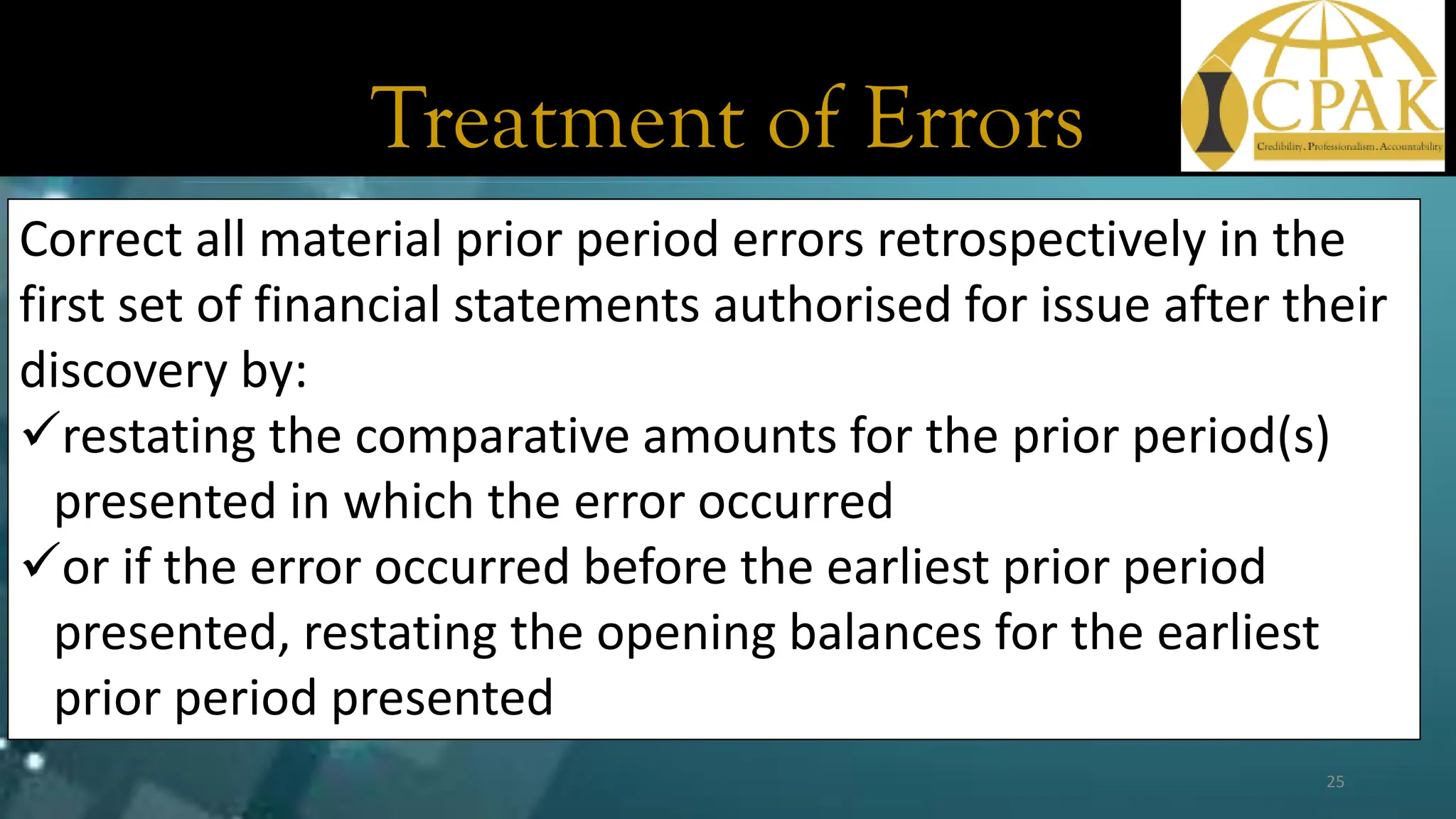
Treatment of Errors
Correct all material prior period errors retrospectively in the
first set of financial statements authorised for issue after their
discovery by:
✓restating the comparative amounts for the prior period(s)
presented in which the error occurred
✓or if the error occurred before the earliest prior period
presented, restating the opening balances for the earliest
prior period presented
25
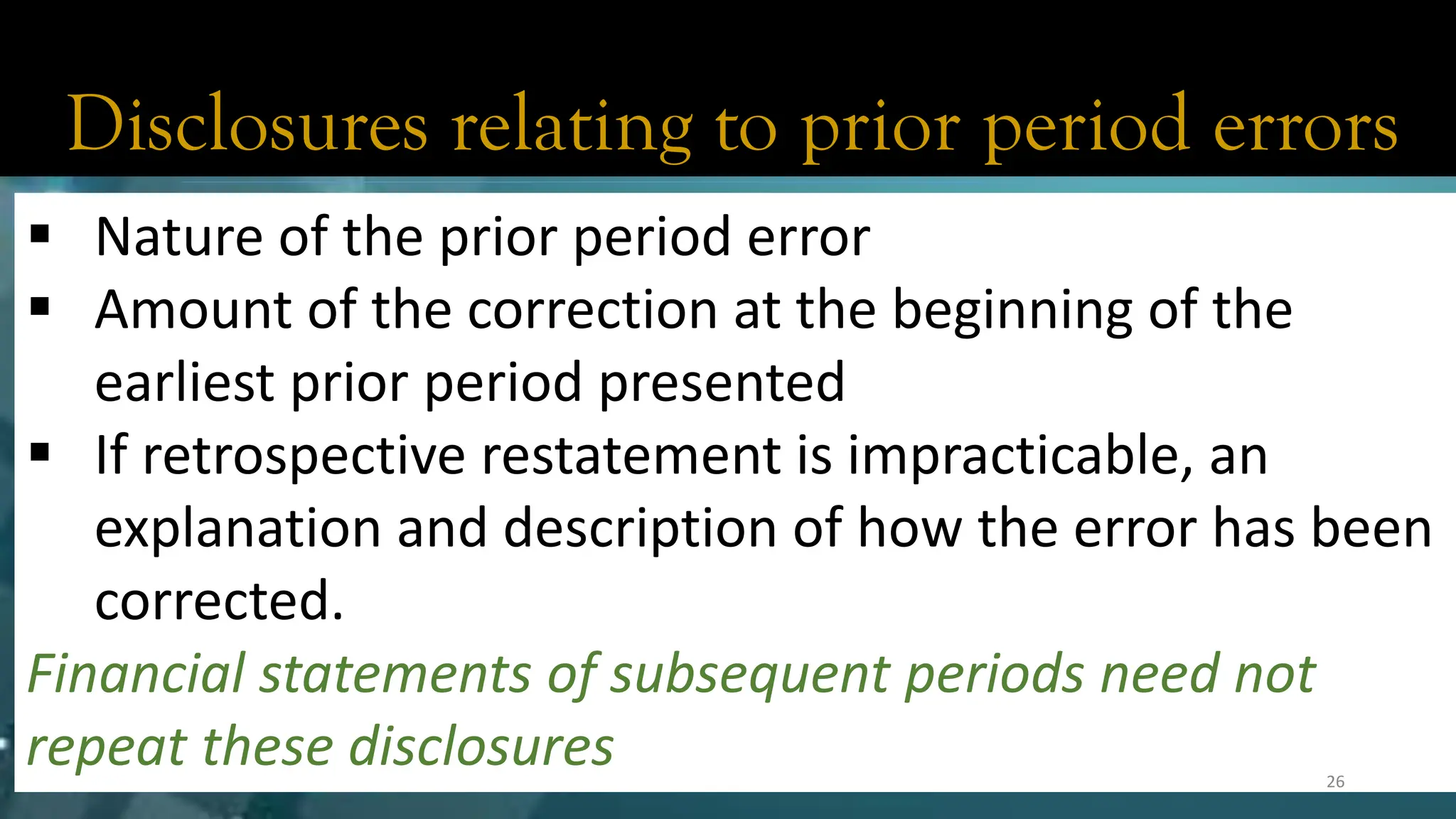
Disclosures relating to prior period errors
▪ Nature of the prior period error
▪ Amount of the correction at the beginning of the
earliest prior period presented
▪ If retrospective restatement is impracticable, an
explanation and description of how the error has been
corrected.

Financial statements of subsequent periods need not
repeat these disclosures 26
IPSAS 14 Events After the Reporting
Date
27
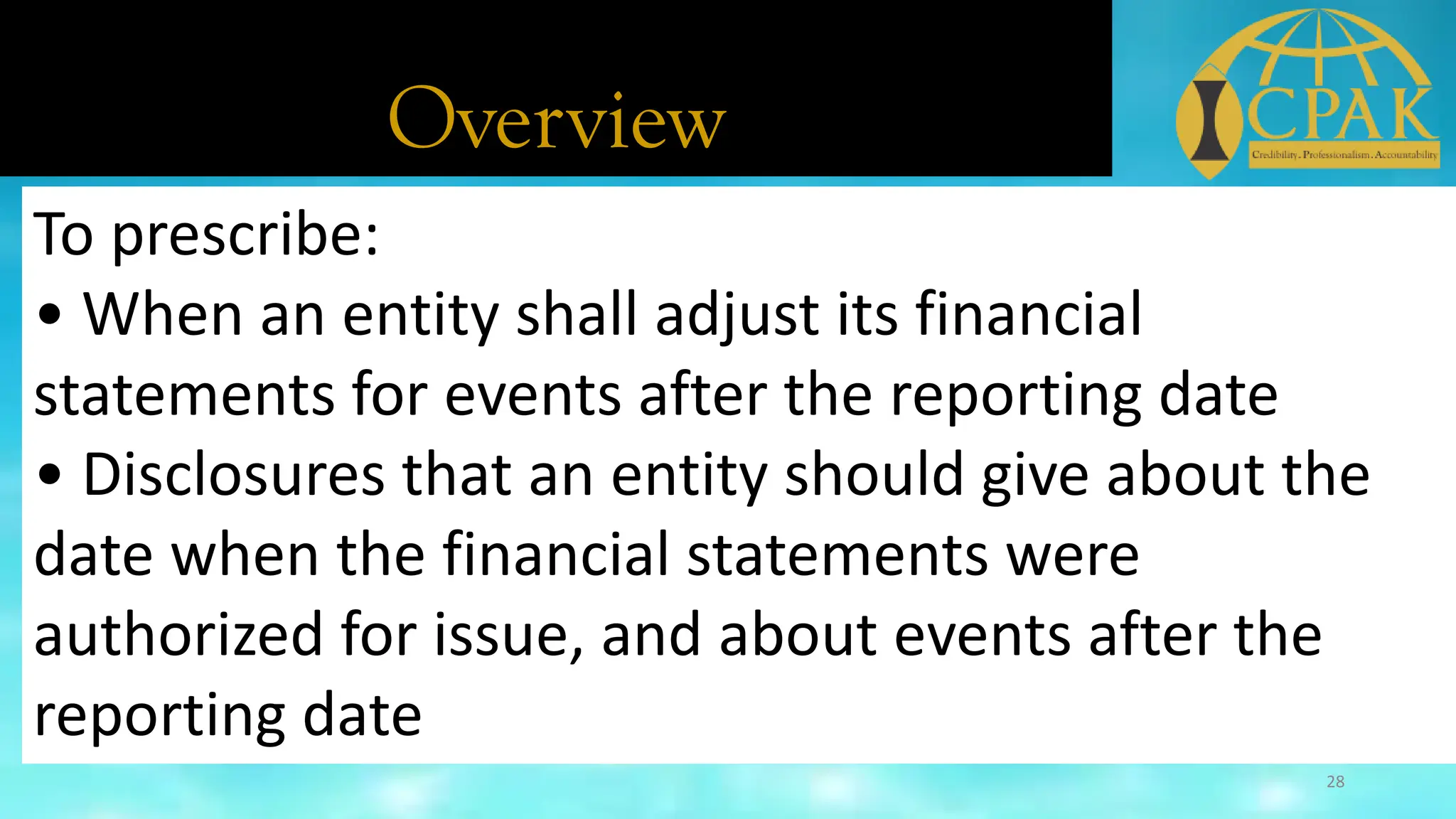
Overview
To prescribe:
• When an entity shall adjust its financial
statements for events after the reporting date
• Disclosures that an entity should give about the
date when the financial statements were
authorized for issue, and about events after the
reporting date
28
Event after the reporting period
An event, which could be favourable or
unfavourable, that occurs between the end of the
reporting period and the date that the financial
statements are authorised for issue
29
Adjusting event
An event after the reporting period that provides
further evidence of conditions that existed at the
end of the reporting period, including an event
that indicates that the going concern assumption
in relation to the whole or part of the enterprise is
not appropriate.
30
Eg. settlement of a court case after the reporting
date, that confirms that the entity had an
obligation at the reporting date.
31
Non-adjusting event
An event after the reporting period that is
indicative of a condition that arose after the
end of the reporting period.
32
e.g a decline in the fair value of property
after year end, which does not change the
valuation of the property at the reporting
date
33
Accounting Treatment
Adjust financial statements for adjusting events
Do not adjust for non-adjusting events - events or
conditions that arose after the end of the reporting
period.
If an entity declares dividends after the reporting
period, the entity shall not recognise those dividends as
a liability at the end of the reporting period. That is a
non-adjusting event – disclosure is required 34
Going concern issues arising after
end of the reporting period
An entity shall not prepare its financial
statements on a going concern basis if
management determines after the end of the
reporting period either that it intends to
liquidate the entity or to cease trading, or that it
has no realistic alternative but to do so.
35
Disclosure
Disclosure
Non-adjusting events should be disclosed if they are of such
importance that non-disclosure would affect the ability of
users to make proper evaluations and decisions.
The required disclosure is
(a) the nature of the event and
(b) an estimate of its financial effect or a statement that a
reasonable estimate of the effect cannot be made
36
Disclosure
A company should update disclosures that relate to conditions
that existed at the end of the reporting period to reflect any
new information that it receives after the reporting period
about those conditions.
Companies must disclose the date when the financial
statements were authorised for issue and who gave that
authorisation. If the enterprise's owners or others have the
power to amend the financial statements after issuance, the
enterprise must disclose that fact. 37
IPSASB - Recommended
Practice Guideline
38
Recommended Practice Guidance (RPGs) are
developed and approved by the International
Public Sector Accounting Standards Board.
(IPSASB).
IPSAS and RPGs are for use by all public sector
entities including national, regional and local
governments and related agencies.
While IPSAS guide the preparations of financial
statements, RPGs provide best practice guidance
in preparation of general purpose financial report. 39
RPG 1long-term sustainability of a public
sector entity’s finances
40
•Provides guidance on reporting on the long-term
•sustainability of a public sector entity’s finances.
Applicable to entities which:
➢Have significant tax and/or other revenue
raising powers;
➢Have powers to incur significant debt; or
➢Have the power and ability to determine the
nature, level and method of service delivery
including the introduction of new services.
41
▪ long-term fiscal sustainability information will
usually include the following components:
Projections of future inflows and outflows, displayed in
tables/graphs and narratives explaining the projections.
Discussions on the dimensions of long-term
sustainability ( revenue; service; debt…etc.)
Discussion on the principles, assumptions and
methodology underlying the projections.
42
Adequate information should be provided to users to
enable them assess the long-term sustainability of the
entity’s finances: Key disclosures include:
➢Name of the entity
➢The financial statements referred to
➢Date of projections
➢Reference to sources of all information obtained
from other entities
43
➢Sources of revenue inflows from taxation and
other sources
➢Sources of significant outflows including capital
expenditure
➢Explanations of changes in projections at the
reporting date
➢Time horizon used in the projections
➢Sensitivity analysis on all key indicators
44
RPG 2 : Financial Statements Discussion &
Analysis
45
46
Components should include:
▪Explanation of the entity’s operations and the environment
in which it operates;
▪Information about the entity’s objectives and strategies;
▪Analysis of the entity’s financial statements; changes and
trends in an entity’s financial position, financial
performance and cash flows;
▪Description of the entity’s principal risks and uncertainties;
strategies for bearing or mitigating those risks and
uncertainties.
RPG 3 : Reporting Public Service Information
47
The guidance in RPG 3 aligns with the
IPSASB's view that public sector financial
reporting has a greater scope than financial
statements alone.
48
Service information includes explanations on the
services that an entity provides; its objectives in
relation to service performance and the extent to
which the objectives have been achieved.
Service information assist users assess the
entity’s efficiency and effectiveness.
49
Service information to display includes the
below:
➢Service performance objectives – e.g.
reducing inputs/ increasing output
➢Performance indicators – Intended
outcomes and actual outcomes
➢Total cost of services 50
End
GOD BLESS YOU ALL
0722241005
Njiru@ffifinance.com
51

IPSAS-3-IPSAS-14-Recommended-Practice-Guidelines-1.pdf

  • 1.
    IPSAS 3 Accounting Policies,Changes in Accounting Estimates and Errors Presentation by: CPA Anthony M. Njiru November 2019 Uphold public interest 1
  • 2.
    Effective date Annual periodsbeginning on or after January 1, 2008. 2
  • 3.
    Scope IPSAS 3 appliesto all public organizations 3
  • 4.
    Scope ❑The standard doesnot cover the tax effects of corrections of prior period errors and ❑Retrospective adjustments made to apply changes in accounting policies are as they are not relevant for many public sector organization 4
  • 5.
    Objective To prescribe thecriteria for: • Selection and application of accounting policies • Changes in accounting policies • Errors 5
  • 6.
    Accounting policies Specific principles,bases, conventions, rules and practices applied by an entity in preparing and presenting financial statements. 6
  • 7.
    Selection and Applicationof Accounting Policies In selection and application of accounting policies • An entity shall apply the relevant IPSAS • If no specific IPSAS the management shall use its discretion in coming up with policies 7
  • 8.
    In the absenceof a Standard or an Interpretation that specifically applies to a transaction, other event or condition - Management must use its judgment in developing and applying an accounting policy that results in information that is relevant and reliable. 8
  • 9.
    Reliable, in thatthe financial statements: • Represent faithfully the financial position, financial performance, and cash flows of the entity • Reflect the economic substance of transactions, other events and conditions, and not merely the legal form •Are neutral, i.e., free from bias • Are prudent • Are complete in all material aspects 9
  • 10.
    Managerial Considerations In SelectionOf Policies • Requirements and guidance in IPSAS dealing with similar and related issues; • Definitions, recognition, and measurement criteria for assets, liabilities, revenue, and expenses described in other IPSASs. • Management may also consider the most recent pronouncements of other standard-setting bodies and accepted public and private sector practices. 10
  • 11.
    Consistency of accounting policies Anentity shall select and apply its accounting policies consistently for similar transactions, other events and conditions, unless a Standard or an Interpretation specifically requires or permits categorization of items for which different policies may be appropriate 11
  • 12.
    If a Standardor an Interpretation requires or permits categorization, an appropriate accounting policy shall be selected and applied consistently to each category 12
  • 13.
    Changes in accountingpolicies An entity is permitted to change an accounting policy only if the change: 1. is required by a standard or interpretation; 2. or results in the financial statements providing reliable and more relevant information 13
  • 14.
    Exclusions • Transaction orevent that did not occur previously • or were immaterial 14
  • 15.
    Treatment of ChangeIn Accounting Policies • If a change in accounting policy is required by a new standard or interpretation- as per that standard • If the new pronouncement does not include specific transition provisions, then the change in accounting policy is applied retrospectively. 15
  • 16.
    Disclosures relating tochanges in accounting policies oTitle of the standard or interpretation causing the change oThe nature of the change in accounting policy oDescription of the transitional provisions oTo the extent practicable, the amount of the adjustment: for each financial statement line item affected 16
  • 17.
    Disclosures relating tochanges in accounting policies o If retrospective application is impracticable, an explanation and description of how the change in accounting policy was applied. Financial statements of subsequent periods need not repeat these disclosures. 17
  • 18.
    Disclosures For Voluntary ChangesIn Policies ❑Nature ❑Amount ❑Description If an entity has not applied a new standard or interpretation that has been issued but is not yet effective, the entity must disclose that fact 18
  • 19.
    Changes in accountingestimates Adjustment of the carrying amount of an asset or liability, or related expense, resulting from reassessing the expected future benefits and obligations associated with that asset or liability 19
  • 20.
    Treatment of ChangeIn Accounting Estimate Prospectively by including it in profit or loss in: ❖The period of the change, if the change affects that period only, ❖ or the period of the change and future periods, if the change affects both. 20
  • 21.
    Disclosures On ChangeIn Accounting Estimate ➢Nature and amount of a change in an accounting estimate ➢If the amount of the effect in future periods is not disclosed because estimating it is impracticable, an entity shall disclose that fact 21
  • 22.
    Prior Period Errors Omissionsfrom, and misstatements in, an entity's financial statements for one or more prior periods arising from a failure to use, or misuse of, reliable information that was available and could reasonably be expected to have been obtained and taken into account in preparing those statements. 22
  • 23.
    Causes Of Errors Errorsresult from mathematical mistakes, mistakes in applying accounting policies, oversights or misinterpretations of facts, and fraud Mainly errors emanate from non system based accounting 23
  • 24.
    Causes Of Errors Errorsresult from mathematical mistakes, mistakes in applying accounting policies, oversights or misinterpretations of facts, and fraud Mainly errors emanate from non system based accounting 24
  • 25.
    Treatment of Errors Correctall material prior period errors retrospectively in the first set of financial statements authorised for issue after their discovery by: ✓restating the comparative amounts for the prior period(s) presented in which the error occurred ✓or if the error occurred before the earliest prior period presented, restating the opening balances for the earliest prior period presented 25
  • 26.
    Disclosures relating toprior period errors ▪ Nature of the prior period error ▪ Amount of the correction at the beginning of the earliest prior period presented ▪ If retrospective restatement is impracticable, an explanation and description of how the error has been corrected. Financial statements of subsequent periods need not repeat these disclosures 26
  • 27.
    IPSAS 14 EventsAfter the Reporting Date 27
  • 28.
    Overview To prescribe: • Whenan entity shall adjust its financial statements for events after the reporting date • Disclosures that an entity should give about the date when the financial statements were authorized for issue, and about events after the reporting date 28
  • 29.
    Event after thereporting period An event, which could be favourable or unfavourable, that occurs between the end of the reporting period and the date that the financial statements are authorised for issue 29
  • 30.
    Adjusting event An eventafter the reporting period that provides further evidence of conditions that existed at the end of the reporting period, including an event that indicates that the going concern assumption in relation to the whole or part of the enterprise is not appropriate. 30
  • 31.
    Eg. settlement ofa court case after the reporting date, that confirms that the entity had an obligation at the reporting date. 31
  • 32.
    Non-adjusting event An eventafter the reporting period that is indicative of a condition that arose after the end of the reporting period. 32
  • 33.
    e.g a declinein the fair value of property after year end, which does not change the valuation of the property at the reporting date 33
  • 34.
    Accounting Treatment Adjust financialstatements for adjusting events Do not adjust for non-adjusting events - events or conditions that arose after the end of the reporting period. If an entity declares dividends after the reporting period, the entity shall not recognise those dividends as a liability at the end of the reporting period. That is a non-adjusting event – disclosure is required 34
  • 35.
    Going concern issuesarising after end of the reporting period An entity shall not prepare its financial statements on a going concern basis if management determines after the end of the reporting period either that it intends to liquidate the entity or to cease trading, or that it has no realistic alternative but to do so. 35
  • 36.
    Disclosure Disclosure Non-adjusting events shouldbe disclosed if they are of such importance that non-disclosure would affect the ability of users to make proper evaluations and decisions. The required disclosure is (a) the nature of the event and (b) an estimate of its financial effect or a statement that a reasonable estimate of the effect cannot be made 36
  • 37.
    Disclosure A company shouldupdate disclosures that relate to conditions that existed at the end of the reporting period to reflect any new information that it receives after the reporting period about those conditions. Companies must disclose the date when the financial statements were authorised for issue and who gave that authorisation. If the enterprise's owners or others have the power to amend the financial statements after issuance, the enterprise must disclose that fact. 37
  • 38.
  • 39.
    Recommended Practice Guidance(RPGs) are developed and approved by the International Public Sector Accounting Standards Board. (IPSASB). IPSAS and RPGs are for use by all public sector entities including national, regional and local governments and related agencies. While IPSAS guide the preparations of financial statements, RPGs provide best practice guidance in preparation of general purpose financial report. 39
  • 40.
    RPG 1long-term sustainabilityof a public sector entity’s finances 40 •Provides guidance on reporting on the long-term •sustainability of a public sector entity’s finances.
  • 41.
    Applicable to entitieswhich: ➢Have significant tax and/or other revenue raising powers; ➢Have powers to incur significant debt; or ➢Have the power and ability to determine the nature, level and method of service delivery including the introduction of new services. 41
  • 42.
    ▪ long-term fiscalsustainability information will usually include the following components: Projections of future inflows and outflows, displayed in tables/graphs and narratives explaining the projections. Discussions on the dimensions of long-term sustainability ( revenue; service; debt…etc.) Discussion on the principles, assumptions and methodology underlying the projections. 42
  • 43.
    Adequate information shouldbe provided to users to enable them assess the long-term sustainability of the entity’s finances: Key disclosures include: ➢Name of the entity ➢The financial statements referred to ➢Date of projections ➢Reference to sources of all information obtained from other entities 43
  • 44.
    ➢Sources of revenueinflows from taxation and other sources ➢Sources of significant outflows including capital expenditure ➢Explanations of changes in projections at the reporting date ➢Time horizon used in the projections ➢Sensitivity analysis on all key indicators 44
  • 45.
    RPG 2 :Financial Statements Discussion & Analysis 45
  • 46.
    46 Components should include: ▪Explanationof the entity’s operations and the environment in which it operates; ▪Information about the entity’s objectives and strategies; ▪Analysis of the entity’s financial statements; changes and trends in an entity’s financial position, financial performance and cash flows; ▪Description of the entity’s principal risks and uncertainties; strategies for bearing or mitigating those risks and uncertainties.
  • 47.
    RPG 3 :Reporting Public Service Information 47
  • 48.
    The guidance inRPG 3 aligns with the IPSASB's view that public sector financial reporting has a greater scope than financial statements alone. 48
  • 49.
    Service information includesexplanations on the services that an entity provides; its objectives in relation to service performance and the extent to which the objectives have been achieved. Service information assist users assess the entity’s efficiency and effectiveness. 49
  • 50.
    Service information todisplay includes the below: ➢Service performance objectives – e.g. reducing inputs/ increasing output ➢Performance indicators – Intended outcomes and actual outcomes ➢Total cost of services 50
  • 51.
    End GOD BLESS YOUALL 0722241005 Njiru@ffifinance.com 51