Maiko Yoshida


GOLD MEDAL HEIGHTS
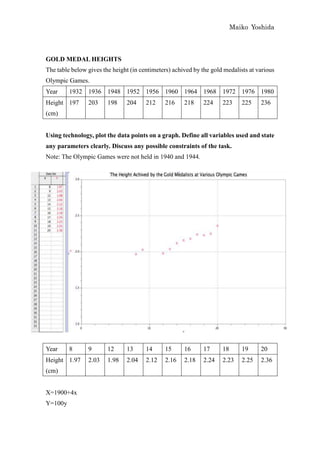
The table below gives the height (in centimeters) achived by the gold medalists at various
Olympic Games.
Year     1932 1936 1948 1952 1956 1960 1964 1968 1972 1976 1980
Height 197      203     198    204     212    216     218     224    223     225    236
(cm)


Using technology, plot the data points on a graph. Define all variables used and state
any parameters clearly. Discuss any possible constraints of the task.
Note: The Olympic Games were not held in 1940 and 1944.


Year     8      9       12     13      14     15      16      17     18      19     20
Height 1.97     2.03    1.98   2.04    2.12   2.16    2.18    2.24   2.23    2.25   2.36
(cm)


X=1900+4x
Y=100y
Maiko Yoshida


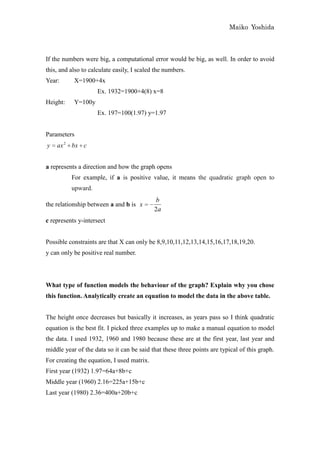
If the numbers were big, a computational error would be big, as well. In order to avoid
this, and also to calculate easily, I scaled the numbers.
Year:      X=1900+4x
                     Ex. 1932=1900+4(8) x=8
Height:    Y=100y
                     Ex. 197=100(1.97) y=1.97


Parameters
y   ax 2 bx c


a represents a direction and how the graph opens
          For example, if a is positive value, it means the quadratic graph open to
          upward.
                                            b
the relationship between a and b is x
                                            2a
c represents y-intersect


Possible constraints are that X can only be 8,9,10,11,12,13,14,15,16,17,18,19,20.
y can only be positive real number.


What type of function models the behaviour of the graph? Explain why you chose
this function. Analytically create an equation to model the data in the above table.


The height once decreases but basically it increases, as years pass so I think quadratic
equation is the best fit. I picked three examples up to make a manual equation to model
the data. I used 1932, 1960 and 1980 because these are at the first year, last year and
middle year of the data so it can be said that these three points are typical of this graph.
For creating the equation, I used matrix.
First year (1932) 1.97=64a+8b+c
Middle year (1960) 2.16=225a+15b+c
Last year (1980) 2.36=400a+20b+c
Maiko Yoshida


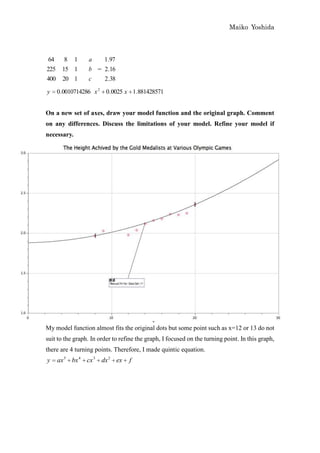
 64     8    1   a      1.97
225    15 1      b = 2.16
400    20 1      c   2.38

y     0.0010714286 x 2 0.0025 x 1.881428571


On a new set of axes, draw your model function and the original graph. Comment
on any differences. Discuss the limitations of your model. Refine your model if
necessary.


My model function almost fits the original dots but some point such as x=12 or 13 do not
suit to the graph. In order to refine the graph, I focused on the turning point. In this graph,
there are 4 turning points. Therefore, I made quintic equation.
y     ax 5 bx 4 cx 3 dx 2 ex      f
Maiko Yoshida


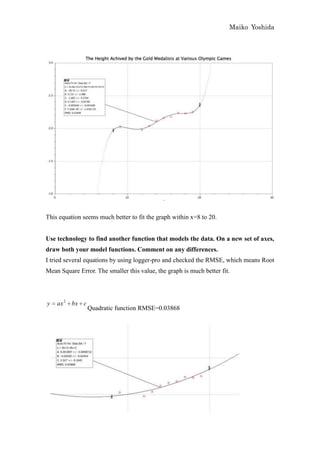
This equation seems much better to fit the graph within x=8 to 20.


Use technology to find another function that models the data. On a new set of axes,
draw both your model functions. Comment on any differences.
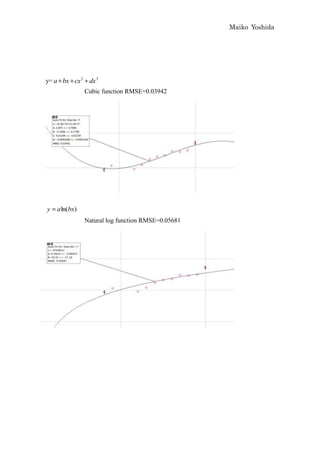
I tried several equations by using logger-pro and checked the RMSE, which means Root
Mean Square Error. The smaller this value, the graph is much better fit.


y   ax 2 bx c
                Quadratic function RMSE=0.03868
Maiko Yoshida


y= a bx cx 2 dx 3
              Cubic function RMSE=0.03942


y   aln(bx)
              Natural log function RMSE=0.05681
Maiko Yoshida


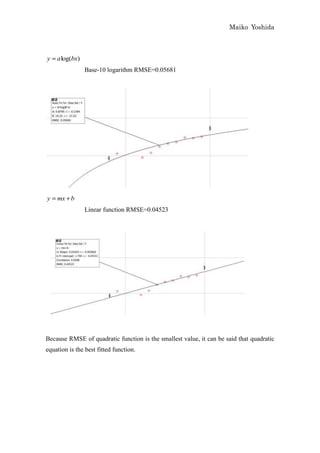
y   alog(bx)
               Base-10 logarithm RMSE=0.05681


y   mx b
                Linear function RMSE=0.04523


Because RMSE of quadratic function is the smallest value, it can be said that quadratic
equation is the best fitted function.
Maiko Yoshida


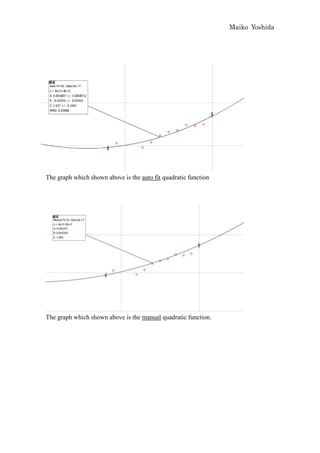
The graph which shown above is the auto fit quadratic function


The graph which shown above is the manual quadratic function.
Maiko Yoshida


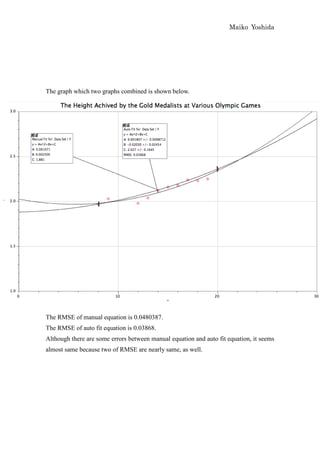
The graph which two graphs combined is shown below.


The RMSE of manual equation is 0.0480387.
The RMSE of auto fit equation is 0.03868.
Although there are some errors between manual equation and auto fit equation, it seems
almost same because two of RMSE are nearly same, as well.
Maiko Yoshida


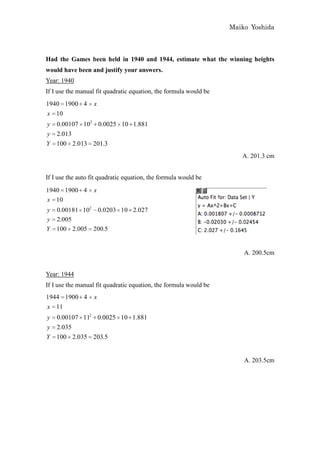
Had the Games been held in 1940 and 1944, estimate what the winning heights
would have been and justify your answers.
Year: 1940
If I use the manual fit quadratic equation, the formula would be
1940 1900 4        x
x 10
y   0.00107 102 0.0025 10 1.881
y   2.013
Y   100 2.013 201.3
                                                                      A. 201.3 cm


If I use the auto fit quadratic equation, the formula would be
1940 1900 4        x
x 10
y   0.00181 102 0.0203 10 2.027
y   2.005
Y   100 2.005 200.5


                                                                       A. 200.5cm


Year: 1944
If I use the manual fit quadratic equation, the formula would be
1944 1900 4        x
x 11
y 0.00107 112 0.0025 10 1.881
y 2.035
Y 100 2.035 203.5


                                                                       A. 203.5cm
Maiko Yoshida


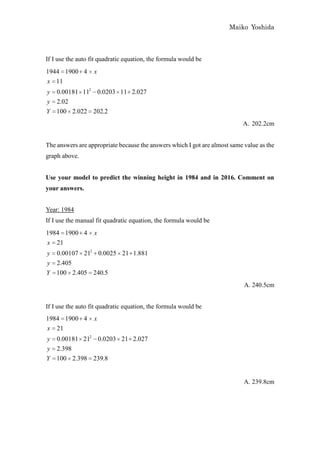
If I use the auto fit quadratic equation, the formula would be
1944 1900 4        x
x 11
y   0.00181 112 0.0203 11 2.027
y   2.02
Y   100 2.022 202.2
                                                                           A. 202.2cm


The answers are appropriate because the answers which I got are almost same value as the
graph above.


Use your model to predict the winning height in 1984 and in 2016. Comment on
your answers.


Year: 1984
If I use the manual fit quadratic equation, the formula would be
1984 1900 4        x
x 21
y   0.00107 212 0.0025 21 1.881
y   2.405
Y   100 2.405 240.5
                                                                            A. 240.5cm


If I use the auto fit quadratic equation, the formula would be
1984 1900 4        x
x 21
y 0.00181 212 0.0203 21 2.027
y 2.398
Y 100 2.398 239.8


                                                                            A. 239.8cm
Maiko Yoshida


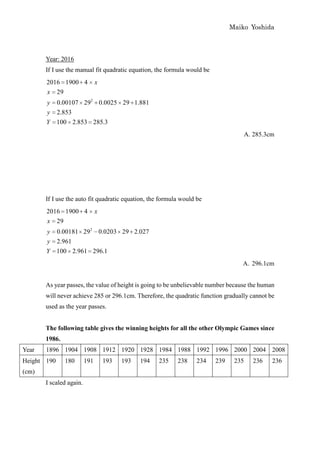
       Year: 2016
       If I use the manual fit quadratic equation, the formula would be
       2016 1900 4             x
       x 29
       y     0.00107 292 0.0025 29 1.881
       y     2.853
       Y     100 2.853 285.3
                                                                                       A. 285.3cm


       If I use the auto fit quadratic equation, the formula would be
       2016 1900 4             x
       x 29
       y     0.00181 292 0.0203 29 2.027
       y     2.961
       Y     100 2.961 296.1
                                                                                   A. 296.1cm


       As year passes, the value of height is going to be unbelievable number because the human
       will never achieve 285 or 296.1cm. Therefore, the quadratic function gradually cannot be
       used as the year passes.


       The following table gives the winning heights for all the other Olympic Games since
       1986.
Year   1896 1904 1908 1912 1920 1928 1984 1988 1992 1996 2000 2004 2008
Height 190     180       191       193   193   194   235   238    234     239    235     236    236
(cm)
       I scaled again.
Maiko Yoshida


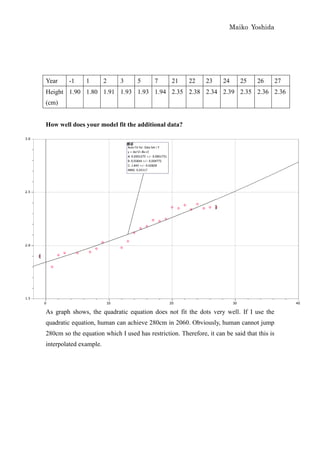
Year     -1    1        2    3      5     7      21     22     23    24     25     26        27
Height 1.90 1.80 1.91 1.93 1.93 1.94 2.35 2.38 2.34 2.39 2.35 2.36 2.36
(cm)


How well does your model fit the additional data?


As graph shows, the quadratic equation does not fit the dots very well. If I use the
quadratic equation, human can achieve 280cm in 2060. Obviously, human cannot jump
280cm so the equation which I used has restriction. Therefore, it can be said that this is
interpolated example.
Maiko Yoshida


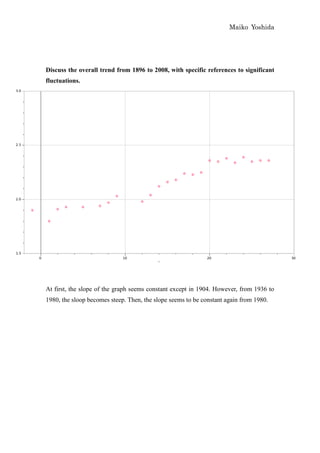
Discuss the overall trend from 1896 to 2008, with specific references to significant
fluctuations.


At first, the slope of the graph seems constant except in 1904. However, from 1936 to
1980, the sloop becomes steep. Then, the slope seems to be constant again from 1980.
Maiko Yoshida


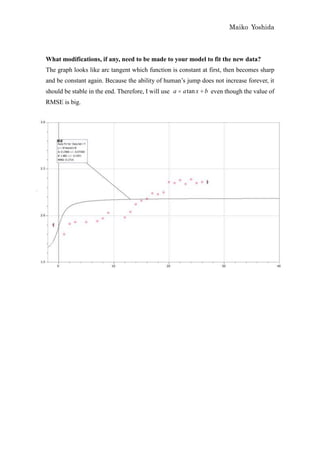
What modifications, if any, need to be made to your model to fit the new data?
The graph looks like arc tangent which function is constant at first, then becomes sharp
and be constant again. Because the ability of human’s jump does not increase forever, it
should be stable in the end. Therefore, I will use a   atan x b even though the value of
RMSE is big.

Ia

  • 1.
    Maiko Yoshida GOLD MEDALHEIGHTS The table below gives the height (in centimeters) achived by the gold medalists at various Olympic Games. Year 1932 1936 1948 1952 1956 1960 1964 1968 1972 1976 1980 Height 197 203 198 204 212 216 218 224 223 225 236 (cm) Using technology, plot the data points on a graph. Define all variables used and state any parameters clearly. Discuss any possible constraints of the task. Note: The Olympic Games were not held in 1940 and 1944. Year 8 9 12 13 14 15 16 17 18 19 20 Height 1.97 2.03 1.98 2.04 2.12 2.16 2.18 2.24 2.23 2.25 2.36 (cm) X=1900+4x Y=100y
  • 2.
    Maiko Yoshida If thenumbers were big, a computational error would be big, as well. In order to avoid this, and also to calculate easily, I scaled the numbers. Year: X=1900+4x Ex. 1932=1900+4(8) x=8 Height: Y=100y Ex. 197=100(1.97) y=1.97 Parameters y ax 2 bx c a represents a direction and how the graph opens For example, if a is positive value, it means the quadratic graph open to upward. b the relationship between a and b is x 2a c represents y-intersect Possible constraints are that X can only be 8,9,10,11,12,13,14,15,16,17,18,19,20. y can only be positive real number. What type of function models the behaviour of the graph? Explain why you chose this function. Analytically create an equation to model the data in the above table. The height once decreases but basically it increases, as years pass so I think quadratic equation is the best fit. I picked three examples up to make a manual equation to model the data. I used 1932, 1960 and 1980 because these are at the first year, last year and middle year of the data so it can be said that these three points are typical of this graph. For creating the equation, I used matrix. First year (1932) 1.97=64a+8b+c Middle year (1960) 2.16=225a+15b+c Last year (1980) 2.36=400a+20b+c
  • 3.
    Maiko Yoshida 64 8 1 a 1.97 225 15 1 b = 2.16 400 20 1 c 2.38 y 0.0010714286 x 2 0.0025 x 1.881428571 On a new set of axes, draw your model function and the original graph. Comment on any differences. Discuss the limitations of your model. Refine your model if necessary. My model function almost fits the original dots but some point such as x=12 or 13 do not suit to the graph. In order to refine the graph, I focused on the turning point. In this graph, there are 4 turning points. Therefore, I made quintic equation. y ax 5 bx 4 cx 3 dx 2 ex f
  • 4.
    Maiko Yoshida This equationseems much better to fit the graph within x=8 to 20. Use technology to find another function that models the data. On a new set of axes, draw both your model functions. Comment on any differences. I tried several equations by using logger-pro and checked the RMSE, which means Root Mean Square Error. The smaller this value, the graph is much better fit. y ax 2 bx c Quadratic function RMSE=0.03868
  • 5.
    Maiko Yoshida y= abx cx 2 dx 3 Cubic function RMSE=0.03942 y aln(bx) Natural log function RMSE=0.05681
  • 6.
    Maiko Yoshida y alog(bx) Base-10 logarithm RMSE=0.05681 y mx b Linear function RMSE=0.04523 Because RMSE of quadratic function is the smallest value, it can be said that quadratic equation is the best fitted function.
  • 7.
    Maiko Yoshida The graphwhich shown above is the auto fit quadratic function The graph which shown above is the manual quadratic function.
  • 8.
    Maiko Yoshida The graphwhich two graphs combined is shown below. The RMSE of manual equation is 0.0480387. The RMSE of auto fit equation is 0.03868. Although there are some errors between manual equation and auto fit equation, it seems almost same because two of RMSE are nearly same, as well.
  • 9.
    Maiko Yoshida Had theGames been held in 1940 and 1944, estimate what the winning heights would have been and justify your answers. Year: 1940 If I use the manual fit quadratic equation, the formula would be 1940 1900 4 x x 10 y 0.00107 102 0.0025 10 1.881 y 2.013 Y 100 2.013 201.3 A. 201.3 cm If I use the auto fit quadratic equation, the formula would be 1940 1900 4 x x 10 y 0.00181 102 0.0203 10 2.027 y 2.005 Y 100 2.005 200.5 A. 200.5cm Year: 1944 If I use the manual fit quadratic equation, the formula would be 1944 1900 4 x x 11 y 0.00107 112 0.0025 10 1.881 y 2.035 Y 100 2.035 203.5 A. 203.5cm
  • 10.
    Maiko Yoshida If Iuse the auto fit quadratic equation, the formula would be 1944 1900 4 x x 11 y 0.00181 112 0.0203 11 2.027 y 2.02 Y 100 2.022 202.2 A. 202.2cm The answers are appropriate because the answers which I got are almost same value as the graph above. Use your model to predict the winning height in 1984 and in 2016. Comment on your answers. Year: 1984 If I use the manual fit quadratic equation, the formula would be 1984 1900 4 x x 21 y 0.00107 212 0.0025 21 1.881 y 2.405 Y 100 2.405 240.5 A. 240.5cm If I use the auto fit quadratic equation, the formula would be 1984 1900 4 x x 21 y 0.00181 212 0.0203 21 2.027 y 2.398 Y 100 2.398 239.8 A. 239.8cm
  • 11.
    Maiko Yoshida Year: 2016 If I use the manual fit quadratic equation, the formula would be 2016 1900 4 x x 29 y 0.00107 292 0.0025 29 1.881 y 2.853 Y 100 2.853 285.3 A. 285.3cm If I use the auto fit quadratic equation, the formula would be 2016 1900 4 x x 29 y 0.00181 292 0.0203 29 2.027 y 2.961 Y 100 2.961 296.1 A. 296.1cm As year passes, the value of height is going to be unbelievable number because the human will never achieve 285 or 296.1cm. Therefore, the quadratic function gradually cannot be used as the year passes. The following table gives the winning heights for all the other Olympic Games since 1986. Year 1896 1904 1908 1912 1920 1928 1984 1988 1992 1996 2000 2004 2008 Height 190 180 191 193 193 194 235 238 234 239 235 236 236 (cm) I scaled again.
  • 12.
    Maiko Yoshida Year -1 1 2 3 5 7 21 22 23 24 25 26 27 Height 1.90 1.80 1.91 1.93 1.93 1.94 2.35 2.38 2.34 2.39 2.35 2.36 2.36 (cm) How well does your model fit the additional data? As graph shows, the quadratic equation does not fit the dots very well. If I use the quadratic equation, human can achieve 280cm in 2060. Obviously, human cannot jump 280cm so the equation which I used has restriction. Therefore, it can be said that this is interpolated example.
  • 13.
    Maiko Yoshida Discuss theoverall trend from 1896 to 2008, with specific references to significant fluctuations. At first, the slope of the graph seems constant except in 1904. However, from 1936 to 1980, the sloop becomes steep. Then, the slope seems to be constant again from 1980.
  • 14.
    Maiko Yoshida What modifications,if any, need to be made to your model to fit the new data? The graph looks like arc tangent which function is constant at first, then becomes sharp and be constant again. Because the ability of human’s jump does not increase forever, it should be stable in the end. Therefore, I will use a atan x b even though the value of RMSE is big.