The  iSchools  Project Project Briefing 2008
UNESCO’s Model of ICT Development in Education Emerging Applying Transforming Infusing Pedagogy Technology Stages of ICT development Basic iSchools Package
CICT-HCDG’s  Forecasts by 2010 Education: 100% of all public HS are ICT enabled Incorporation of ICT in the curriculum Improve the PC to Student ratio from 1:300HS to 1:50 At least 80% of public school teachers & government workers are ICT literate At least 40% are ICT competent At least 20% are NICS-Teachers & NICS-CS compliant A nation competent in the use of ICT as a tool for sustainable human development A Culture of Creative ICT Use An Educational System that Maximizes the Use of ICT in Learning  World Class Knowledge Worker
eQuality Program for SUCs iSchools eSchools eSkwela Content Development NICS for Teachers CICT-HCDG’s Contribution to the ICT4E Agenda
About iSchools What is iSchools What we wish to achieve Components What we have done so far Our implementation strategies
Project Description The  iSchools Project  is one of the flagship projects of CICT  It focuses in integrating ICT in education towards  strengthening classroom learning and instruction  by expanding access to various sources of information.  It aims to enhance the ability of high school in the country to compete for jobs, future education & other growth opportunities.
Goal, Objectives, Outputs To help establish an Educational System that maximizes the use of ICT in learning  to Improve teaching and learning through the use of ICT  A Socially prepared school community To establish the necessary ICT infrastructure and applications To intensify competency based professional development programs To integrate ICT into the curriculum to Improve school governance  to identify, develop, install management improvement application systems
iSchools Project Life Cycle Project briefing Community mobilization Sustainability planning-workshop Acquisition of hardware deployment CILC + ICT4BE Laboratory Mgt Website Development Library Mgt ICT Integration in teaching SEM Project closure meetings & workshops Site inspection Site preparation Choosing a pilot site Social preparation phase deployment Training  Project Closure
Other Project Initiatives Participatory  Content  Development Addresses the needs of previous computerization recipients and to maximize hardware resources Gather and Solicit the support of school leaders in using ICT for Education Build the capability and Empower Educators & Learners to build their own learning contents PC Recycling
What we have done so far What we have done so far WILL in 360 iSchools nationwide Training for PHS Sustainability Planning CILC  Lab Mgt Web Dev’t Library Mgt TOTs for SUC implementer We are still in the process of completing the internet connection of the 2006F-2007 iSchools We need to conduct the project closure activities End of project intervention    iSchools operationalization
Strategies for Implementation The CICT-HCDG, through its eQuality Program for SUCs, joined hands to implement the iSchools Project. Social preparation activities Deployment  Training of Trainers Progress Monitoring SUC implements iSchools at the beneficiary level as Project coordinators Trainers  Technical consultants SUC CICT PHS
Criteria for choosing Potential Beneficiary Public High School Must Must integrate ICT in education Not be a recipient of previous computerization projects  Have presence of stable & sufficient supply of electricity  Contribute in the ICT development of the community  Adhere to technical requirements: space, security, outlets, fixtures, etc.  Have strong support from school community and development partners  Designate an ICT coordinator and alternate/assistant  Ensure optimal laboratory utilization  Presence of internet connection in the area
What you will get Wireless Internet Learning Laboratory (WILL) Capability Building Programs Strengthened Local Educational and Institutional Partnership
WILL Laboratory 15 desktops, 16 UPS, server, printer, LCD projector, air-conditioning unit, iSchools signage, wireless router, 1+1 year internet connection EdUbuntu Laptop that will also serve as a mobile laboratory and for use by teachers when attending iSchools training Faculty Room 2 desktops with UPS EdUbuntu Library Desktop with Anilag Library Mgt System EdUbuntu Principal Desktop with Edubuntu 1 1 1 5 1 4 1 3 1 2 0 1 0 2 0 3 0 4 0 5 T 8 . 0 0 m t r s . 6 . 0 0 m t r s . w i n d o w t y p e a i r c o n 2 H P W i r e l e s s R o u t e r 0 6 0 7 0 8 0 9 1 0
Capability Building Sustainability Planning-Workshop (4 pax) Principal, PTCA rep, LGU-LSB rep, DepEd ICTC CILC + ICT4E (20 pax) Principal, ICTC, Designated Lab Manager, Librarian, Web developer, 15 more teachers or senior students who have not attended the same training in the past Laboratory Mgt Designated Laboratory Manager who will pass the CICT Assessment Exam + 1 Website Development Designated Laboratory Manager Adviser of the school paper (for content generation) OR senior English Teacher Library Mgt Designated Librarian
Strengthened Partnership Technical assistance, Guidance, Mentoring from  our partner SUCs Strengthened community cooperation PTCA, LGU, others Collaboration with other iSchools recipients Opportunities for future projects, initiatives
Your Counterpart RESPONSIBILITIES Before During After
Before Deployment All non ICT requirements of the laboratory shall be considered as counterpart fund of the beneficiary school, such as: The cost of wire that will connect the faculty room, library and the principal’s office to the laboratory. A room with at least 48-sqm space, at least 10 feet in height and windows near the ceiling on both sides of the room (passive cooling approach to minimize heat emissions) Counterpart Responsibilities: WILL 100% compliance = DEPLOYMENT
Before Deployment All non ICT requirements of the laboratory shall be considered as counterpart fund of the beneficiary school, such as: Cost of refurbishing the laboratory, which includes: electrical wiring necessary for the laboratory, including the circuit breaker and a dedicated (sub) electric meter Provision of electric fans and exhaust fans Painting (preferably white on one wall to serve as the projector screen) Grills and locks for the windows and door Tables and chairs Physical security to safeguard the equipment. A standard room design with electrical plan will be provided through our partner SUCs. Counterpart Responsibilities: WILL 100% compliance = DEPLOYMENT
Prerequisites to Hardware Deployment Laboratory Signed MOA with all  your  stakeholders  Counterpart Responsibilities: WILL 1 1 1 5 1 4 1 3 1 2 0 1 0 2 0 3 0 4 0 5 T 8 . 0 0 m t r s . 6 . 0 0 m t r s . w i n d o w t y p e a i r c o n 2 H P W i r e l e s s R o u t e r 0 6 0 7 0 8 0 9 1 0
Counterpart Responsibilities: WILL After Deployment 100% utilization for teaching Implement Action Plans and ICT-based lesson plans prepared during training Submit monthly utilization report Maintain utilization record  Hardware maintenance/upgrade if possible Laboratory maintenance Room Equipment Schedule of use Sustainability/upgrade of the internet connection CeC component  open to the community Source for financial sustainability
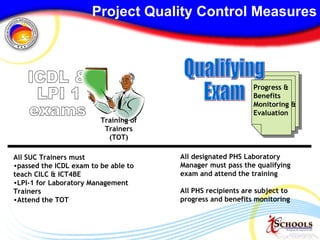
Project Quality Control Measures All SUC Trainers must  passed the ICDL exam to be able to teach CILC & ICT4BE LPI-1 for Laboratory Management Trainers  Attend the TOT All designated PHS Laboratory Manager must pass the qualifying exam and attend the training All PHS recipients are subject to progress and benefits monitoring ICDL &  LPI 1  exams Training of Trainers (TOT) Progress & Benefits Monitoring & Evaluation  Qualifying  Exam
Counterpart Responsibilities:  Capability Building Before the Training Provide list of potential trainees two weeks prior to the scheduled training Take assessment exams During the training Attend training programs  Come on time Participate Abide Host rules
Required outputs from participants Sustainability Planning Sustainability plan CILC Rollout schedule Work plan in the use of lab for teaching Schedule of classes; type of ICT classes to conduct Lesson plan Laboratory Mgt PC maintenance plan Laboratory usage plan  Web Dev’t School’s website Library Mgt Library conversion plan
After the Training Apply what you have learned Implement your action plans Establish/join support groups Ensure ICT use in Education ICT literacy for senior students (4 th , 3 rd , 2 nd , 1 st  year students) Use of the laboratory in teaching subject courses Counterpart Responsibilities:  Capability Building
Counterpart Responsibilities Strengthened Partnership The School Head  must  lead the development of the multi-party Agreement Identify responsibilities of each partner Ensure that all operations needs are assigned
For details you may get in touch with the following: iSchools Project Management Office at  [email_address] Tel # 02-920.0101 local 299 | 381-3340 Telefax # 02-920.7412 Include SUC contact details here Thank You

I Schools For Cpu

  • 1.
    The iSchools Project Project Briefing 2008
  • 2.
    UNESCO’s Model ofICT Development in Education Emerging Applying Transforming Infusing Pedagogy Technology Stages of ICT development Basic iSchools Package
  • 3.
    CICT-HCDG’s Forecastsby 2010 Education: 100% of all public HS are ICT enabled Incorporation of ICT in the curriculum Improve the PC to Student ratio from 1:300HS to 1:50 At least 80% of public school teachers & government workers are ICT literate At least 40% are ICT competent At least 20% are NICS-Teachers & NICS-CS compliant A nation competent in the use of ICT as a tool for sustainable human development A Culture of Creative ICT Use An Educational System that Maximizes the Use of ICT in Learning World Class Knowledge Worker
  • 4.
    eQuality Program forSUCs iSchools eSchools eSkwela Content Development NICS for Teachers CICT-HCDG’s Contribution to the ICT4E Agenda
  • 5.
    About iSchools Whatis iSchools What we wish to achieve Components What we have done so far Our implementation strategies
  • 6.
    Project Description The iSchools Project is one of the flagship projects of CICT It focuses in integrating ICT in education towards strengthening classroom learning and instruction by expanding access to various sources of information. It aims to enhance the ability of high school in the country to compete for jobs, future education & other growth opportunities.
  • 7.
    Goal, Objectives, OutputsTo help establish an Educational System that maximizes the use of ICT in learning to Improve teaching and learning through the use of ICT A Socially prepared school community To establish the necessary ICT infrastructure and applications To intensify competency based professional development programs To integrate ICT into the curriculum to Improve school governance to identify, develop, install management improvement application systems
  • 8.
    iSchools Project LifeCycle Project briefing Community mobilization Sustainability planning-workshop Acquisition of hardware deployment CILC + ICT4BE Laboratory Mgt Website Development Library Mgt ICT Integration in teaching SEM Project closure meetings & workshops Site inspection Site preparation Choosing a pilot site Social preparation phase deployment Training Project Closure
  • 9.
    Other Project InitiativesParticipatory Content Development Addresses the needs of previous computerization recipients and to maximize hardware resources Gather and Solicit the support of school leaders in using ICT for Education Build the capability and Empower Educators & Learners to build their own learning contents PC Recycling
  • 10.
    What we havedone so far What we have done so far WILL in 360 iSchools nationwide Training for PHS Sustainability Planning CILC Lab Mgt Web Dev’t Library Mgt TOTs for SUC implementer We are still in the process of completing the internet connection of the 2006F-2007 iSchools We need to conduct the project closure activities End of project intervention  iSchools operationalization
  • 11.
    Strategies for ImplementationThe CICT-HCDG, through its eQuality Program for SUCs, joined hands to implement the iSchools Project. Social preparation activities Deployment Training of Trainers Progress Monitoring SUC implements iSchools at the beneficiary level as Project coordinators Trainers Technical consultants SUC CICT PHS
  • 12.
    Criteria for choosingPotential Beneficiary Public High School Must Must integrate ICT in education Not be a recipient of previous computerization projects Have presence of stable & sufficient supply of electricity Contribute in the ICT development of the community Adhere to technical requirements: space, security, outlets, fixtures, etc. Have strong support from school community and development partners Designate an ICT coordinator and alternate/assistant Ensure optimal laboratory utilization Presence of internet connection in the area
  • 13.
    What you willget Wireless Internet Learning Laboratory (WILL) Capability Building Programs Strengthened Local Educational and Institutional Partnership
  • 14.
    WILL Laboratory 15desktops, 16 UPS, server, printer, LCD projector, air-conditioning unit, iSchools signage, wireless router, 1+1 year internet connection EdUbuntu Laptop that will also serve as a mobile laboratory and for use by teachers when attending iSchools training Faculty Room 2 desktops with UPS EdUbuntu Library Desktop with Anilag Library Mgt System EdUbuntu Principal Desktop with Edubuntu 1 1 1 5 1 4 1 3 1 2 0 1 0 2 0 3 0 4 0 5 T 8 . 0 0 m t r s . 6 . 0 0 m t r s . w i n d o w t y p e a i r c o n 2 H P W i r e l e s s R o u t e r 0 6 0 7 0 8 0 9 1 0
  • 15.
    Capability Building SustainabilityPlanning-Workshop (4 pax) Principal, PTCA rep, LGU-LSB rep, DepEd ICTC CILC + ICT4E (20 pax) Principal, ICTC, Designated Lab Manager, Librarian, Web developer, 15 more teachers or senior students who have not attended the same training in the past Laboratory Mgt Designated Laboratory Manager who will pass the CICT Assessment Exam + 1 Website Development Designated Laboratory Manager Adviser of the school paper (for content generation) OR senior English Teacher Library Mgt Designated Librarian
  • 16.
    Strengthened Partnership Technicalassistance, Guidance, Mentoring from our partner SUCs Strengthened community cooperation PTCA, LGU, others Collaboration with other iSchools recipients Opportunities for future projects, initiatives
  • 17.
  • 18.
    Before Deployment Allnon ICT requirements of the laboratory shall be considered as counterpart fund of the beneficiary school, such as: The cost of wire that will connect the faculty room, library and the principal’s office to the laboratory. A room with at least 48-sqm space, at least 10 feet in height and windows near the ceiling on both sides of the room (passive cooling approach to minimize heat emissions) Counterpart Responsibilities: WILL 100% compliance = DEPLOYMENT
  • 19.
    Before Deployment Allnon ICT requirements of the laboratory shall be considered as counterpart fund of the beneficiary school, such as: Cost of refurbishing the laboratory, which includes: electrical wiring necessary for the laboratory, including the circuit breaker and a dedicated (sub) electric meter Provision of electric fans and exhaust fans Painting (preferably white on one wall to serve as the projector screen) Grills and locks for the windows and door Tables and chairs Physical security to safeguard the equipment. A standard room design with electrical plan will be provided through our partner SUCs. Counterpart Responsibilities: WILL 100% compliance = DEPLOYMENT
  • 20.
    Prerequisites to HardwareDeployment Laboratory Signed MOA with all your stakeholders Counterpart Responsibilities: WILL 1 1 1 5 1 4 1 3 1 2 0 1 0 2 0 3 0 4 0 5 T 8 . 0 0 m t r s . 6 . 0 0 m t r s . w i n d o w t y p e a i r c o n 2 H P W i r e l e s s R o u t e r 0 6 0 7 0 8 0 9 1 0
  • 21.
    Counterpart Responsibilities: WILLAfter Deployment 100% utilization for teaching Implement Action Plans and ICT-based lesson plans prepared during training Submit monthly utilization report Maintain utilization record Hardware maintenance/upgrade if possible Laboratory maintenance Room Equipment Schedule of use Sustainability/upgrade of the internet connection CeC component open to the community Source for financial sustainability
  • 22.
    Project Quality ControlMeasures All SUC Trainers must passed the ICDL exam to be able to teach CILC & ICT4BE LPI-1 for Laboratory Management Trainers Attend the TOT All designated PHS Laboratory Manager must pass the qualifying exam and attend the training All PHS recipients are subject to progress and benefits monitoring ICDL & LPI 1 exams Training of Trainers (TOT) Progress & Benefits Monitoring & Evaluation Qualifying Exam
  • 23.
    Counterpart Responsibilities: Capability Building Before the Training Provide list of potential trainees two weeks prior to the scheduled training Take assessment exams During the training Attend training programs Come on time Participate Abide Host rules
  • 24.
    Required outputs fromparticipants Sustainability Planning Sustainability plan CILC Rollout schedule Work plan in the use of lab for teaching Schedule of classes; type of ICT classes to conduct Lesson plan Laboratory Mgt PC maintenance plan Laboratory usage plan Web Dev’t School’s website Library Mgt Library conversion plan
  • 25.
    After the TrainingApply what you have learned Implement your action plans Establish/join support groups Ensure ICT use in Education ICT literacy for senior students (4 th , 3 rd , 2 nd , 1 st year students) Use of the laboratory in teaching subject courses Counterpart Responsibilities: Capability Building
  • 26.
    Counterpart Responsibilities StrengthenedPartnership The School Head must lead the development of the multi-party Agreement Identify responsibilities of each partner Ensure that all operations needs are assigned
  • 27.
    For details youmay get in touch with the following: iSchools Project Management Office at [email_address] Tel # 02-920.0101 local 299 | 381-3340 Telefax # 02-920.7412 Include SUC contact details here Thank You