1. Read the Additional Policies and Procedures handout independently and write down any questions.
2. Go to the new assigned seat indicated by the number on the handout given at the door.
3. Questions about the handout will be reviewed as a class.
• Go tonew assigned seat (number and handout given at the door).
Read independently the Additional Policies and Procedures handout,
and write down questions in preparation for review as a class.
2.
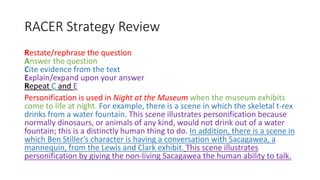
RACER Strategy Review
Restate/rephrasethe question
Answer the question
Cite evidence from the text
Explain/expand upon your answer
Repeat C and E
Personification is used in Night at the Museum when the museum exhibits
come to life at night. For example, there is a scene in which the skeletal t-rex
drinks from a water fountain. This scene illustrates personification because
normally dinosaurs, or animals of any kind, would not drink out of a water
fountain; this is a distinctly human thing to do. In addition, there is a scene in
which Ben Stiller’s character is having a conversation with Sacagawea, a
mannequin, from the Lewis and Clark exhibit. This scene illustrates
personification by giving the non-living Sacagawea the human ability to talk.
3.
I Have aDream Notes
Unit 2: Struggle for Freedom
Place a new tab labeled “Struggle for Freedom” on the first page of your I Have a
Dream Notes.
4.
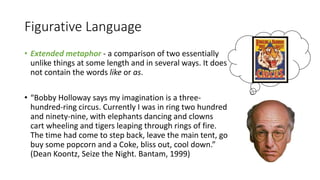
Figurative Language
• Extendedmetaphor - a comparison of two essentially
unlike things at some length and in several ways. It does
not contain the words like or as.
• “Bobby Holloway says my imagination is a three-
hundred-ring circus. Currently I was in ring two hundred
and ninety-nine, with elephants dancing and clowns
cart wheeling and tigers leaping through rings of fire.
The time had come to step back, leave the main tent, go
buy some popcorn and a Coke, bliss out, cool down.”
(Dean Koontz, Seize the Night. Bantam, 1999)
5.
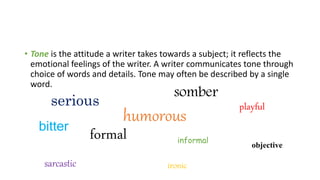
• Tone isthe attitude a writer takes towards a subject; it reflects the
emotional feelings of the writer. A writer communicates tone through
choice of words and details. Tone may often be described by a single
word.
serious
humorous
playful
formal informal
somber
sarcastic ironic
bitter
objective
6.
Examples of Tone
•“It is a truth universally acknowledged, that a single man in possession of a
good fortune, must be in want of a wife.”
• Jane Austen, Pride and Prejudice
• I couldn’t forgive [Tom] or like him, but I saw that what he had done was,
to him, entirely justified. It was all very careless and confused. They were
careless people, Tom and Daisy – they smashed up things and creatures
and then retreated back into their money or their vast carelessness, or
whatever it was that kept them together, and let other people clean up the
mess they had made.
• F. Scott Fitzgerald, The Great Gatsby
Brainstorm: Civil RightsMovement
(5 minutes)
• With your designated partner, spend 5 minutes brainstorming
everything you know about the civil rights movement. Write your list
in your notes.
• Civil Rights Brainstorm:

![Examples of Tone
• “It is a truth universally acknowledged, that a single man in possession of a
good fortune, must be in want of a wife.”
• Jane Austen, Pride and Prejudice
• I couldn’t forgive [Tom] or like him, but I saw that what he had done was,
to him, entirely justified. It was all very careless and confused. They were
careless people, Tom and Daisy – they smashed up things and creatures
and then retreated back into their money or their vast carelessness, or
whatever it was that kept them together, and let other people clean up the
mess they had made.
• F. Scott Fitzgerald, The Great Gatsby](https://image.slidesharecdn.com/presentation-151028123643-lva1-app6892/85/I-Have-a-Dream-Speech-6-320.jpg)