The Holocaust (1933-1945)
• The Holocaust was the systematic, bureaucratic, state-sponsored
persecution and murder of six million Jews by the Nazi regime and its
collaborators.
• Holocaust is a word of Greek origin meaning "sacrifice by fire.”
• The Nazis, who came to power in Germany in January 1933, believed
that Germans were "racially superior" and that the Jews, deemed
"inferior," were an alien threat to the so-called German racial
community.
• In 1933, the Jewish population of Europe stood at over nine million.
Most European Jews lived in countries that Nazi Germany would
occupy or influence during World War II.
Prisoner Tattoos of Auschwitz Complex
• Prisoners of the Auschwitz
concentration camp complex
were tattooed with their
identification numbers.
• Reduced human lives to
numbers.
Maus I—My Father Bleeds History
Overview
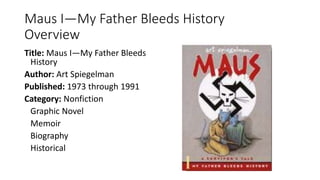
Title: Maus I—My Father Bleeds
History
Author: Art Spiegelman
Published: 1973 through 1991
Category: Nonfiction
Graphic Novel
Memoir
Biography
Historical
Art Spiegelman
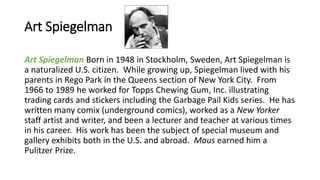
Art Spiegelman Born in 1948 in Stockholm, Sweden, Art Spiegelman is
a naturalized U.S. citizen. While growing up, Spiegelman lived with his
parents in Rego Park in the Queens section of New York City. From
1966 to 1989 he worked for Topps Chewing Gum, Inc. illustrating
trading cards and stickers including the Garbage Pail Kids series. He has
written many comix (underground comics), worked as a New Yorker
staff artist and writer, and been a lecturer and teacher at various times
in his career. His work has been the subject of special museum and
gallery exhibits both in the U.S. and abroad. Maus earned him a
Pulitzer Prize.
Characters
Art(ie
Spiegelman):
Author/Narrator & son of Vladek
Spiegelman
Vladek
Spiegelman:
Father of Art & Survivor of the Holocaust
Anja
Spiegelman:
1st wife of Vladek Spiegelman, mother of Art
and Richieu.
Mala
Spiegelman:
2nd wife of Vladek Spiegelman, survivor of the
Holocaust.
Francoise
Mouly:
Wife of Art. Although she is French. Art also
draws her as a mouse because she converted
to Judaism.
Maus I—My Father Bleeds History
Summary
Maus is a story within a story: Art Spiegelman, the son of two survivors
of the Holocaust, tells how he interviewed his father, Vladek, about his
Holocaust experience, and it tells the story of the father's persecution
and survival. It is written in a graphic novel format, with various types
of animals representing the various nationalities and religions
(however, Jews are mice, no matter what nationality they are).
• Visual metaphor — any visual symbol or picture that is used to
represent something else. They are often used in political cartoons.
Maus I—My Father Bleeds History
General Characters
Maus I
• The Jews are represented by mice.
• The Germans are represented by cats.
• The Americans are represented by dogs.
• The Poles are represented by pigs.
List characteristics of a…
Look at the pictures
Why do you think Spiegelman used animals for symbols rather than
drawing humans?

Maus Notes Part I (second section)

  • 1.
    The Holocaust (1933-1945) •The Holocaust was the systematic, bureaucratic, state-sponsored persecution and murder of six million Jews by the Nazi regime and its collaborators. • Holocaust is a word of Greek origin meaning "sacrifice by fire.” • The Nazis, who came to power in Germany in January 1933, believed that Germans were "racially superior" and that the Jews, deemed "inferior," were an alien threat to the so-called German racial community. • In 1933, the Jewish population of Europe stood at over nine million. Most European Jews lived in countries that Nazi Germany would occupy or influence during World War II.
  • 2.
    Prisoner Tattoos ofAuschwitz Complex • Prisoners of the Auschwitz concentration camp complex were tattooed with their identification numbers. • Reduced human lives to numbers.
  • 3.
    Maus I—My FatherBleeds History Overview Title: Maus I—My Father Bleeds History Author: Art Spiegelman Published: 1973 through 1991 Category: Nonfiction Graphic Novel Memoir Biography Historical
  • 4.
    Art Spiegelman Art SpiegelmanBorn in 1948 in Stockholm, Sweden, Art Spiegelman is a naturalized U.S. citizen. While growing up, Spiegelman lived with his parents in Rego Park in the Queens section of New York City. From 1966 to 1989 he worked for Topps Chewing Gum, Inc. illustrating trading cards and stickers including the Garbage Pail Kids series. He has written many comix (underground comics), worked as a New Yorker staff artist and writer, and been a lecturer and teacher at various times in his career. His work has been the subject of special museum and gallery exhibits both in the U.S. and abroad. Maus earned him a Pulitzer Prize.
  • 5.
    Characters Art(ie Spiegelman): Author/Narrator & sonof Vladek Spiegelman Vladek Spiegelman: Father of Art & Survivor of the Holocaust Anja Spiegelman: 1st wife of Vladek Spiegelman, mother of Art and Richieu. Mala Spiegelman: 2nd wife of Vladek Spiegelman, survivor of the Holocaust. Francoise Mouly: Wife of Art. Although she is French. Art also draws her as a mouse because she converted to Judaism.
  • 6.
    Maus I—My FatherBleeds History Summary Maus is a story within a story: Art Spiegelman, the son of two survivors of the Holocaust, tells how he interviewed his father, Vladek, about his Holocaust experience, and it tells the story of the father's persecution and survival. It is written in a graphic novel format, with various types of animals representing the various nationalities and religions (however, Jews are mice, no matter what nationality they are).
  • 7.
    • Visual metaphor— any visual symbol or picture that is used to represent something else. They are often used in political cartoons.
  • 8.
    Maus I—My FatherBleeds History General Characters Maus I • The Jews are represented by mice. • The Germans are represented by cats. • The Americans are represented by dogs. • The Poles are represented by pigs.
  • 9.
  • 10.
  • 11.
  • 12.
  • 13.
    Look at thepictures Why do you think Spiegelman used animals for symbols rather than drawing humans?

Editor's Notes

  • #7 Stopped here during first period
  • #16 Graphic novels use text and pictures to present information; they differ from comics in that they usually contain stand-alone stories with complex plots. Persepolis – Persepolis is an autobiographical graphic novel by Marjane Satrapi depicting her childhood up to her early adult years in Iran during and after the Islamic revolution. My Friend Dahmer – In My Friend Dahmer, a haunting and original graphic novel, writer-artist Backderf creates a surprisingly sympathetic portrait of a disturbed young man struggling against the morbid urges emanating from the deep recesses of his psyche—a shy kid, a teenage alcoholic, and a goofball who never quite fit in with his classmates. Cancer Vixen — a memoir about dealing with breast cancer
  • #17 Stopped here period 4 — review comic elements
  • #20 Stopped here 3rd Period — go over the elements on the persepolis comic and the direction of reading.