FSA Practice Notes
Your FSA response should…
• Be formatted with at least 5 paragraphs
• Incorporate the following conventions:
• Avoid first and second person pronouns
• I, me, my, we, you, your, us, our, we
• Avoid contractions
• Include proper spelling, grammar, and punctuation
• Avoid exclamation points
Your introductory paragraph needs to…
• Include a hook
• Preview points that will be made in body paragraphs
• Include a thesis statement or claim that states controlling idea or
position on issue
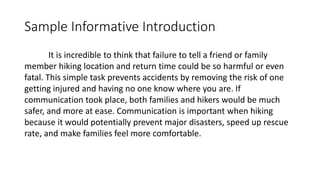
Sample Informative Introduction
It is incredible to think that failure to tell a friend or family
member hiking location and return time could be so harmful or even
fatal. This simple task prevents accidents by removing the risk of one
getting injured and having no one know where you are. If
communication took place, both families and hikers would be much
safer, and more at ease. Communication is important when hiking
because it would potentially prevent major disasters, speed up rescue
rate, and make families feel more comfortable.
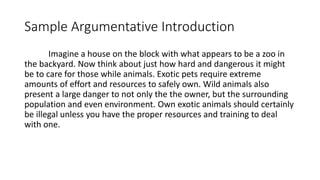
Sample Argumentative Introduction
Imagine a house on the block with what appears to be a zoo in
the backyard. Now think about just how hard and dangerous it might
be to care for those while animals. Exotic pets require extreme
amounts of effort and resources to safely own. Wild animals also
present a large danger to not only the the owner, but the surrounding
population and even environment. Own exotic animals should certainly
be illegal unless you have the proper resources and training to deal
with one.
Your body paragraphs should…
• Incorporate transitions at the beginning and within to guide reader
through ideas
• Correctly cite two pieces of evidence with parenthetical citations
• If you do not cite your evidence, the highest you can get is 2 out of 4 points.
• Introduce quotes with quote sandwich or colon
Sample Body Paragraph
To begin, the average American citizen absolutely does not have the
appropriate resources or training to handle a wild animal as a pet. As
mentioned by author Mia Lewis, “Most people who own exotic pets find
them irresistible – and manageable – when they are small. But an adorable
lion cub becomes a powerful adult soon enough” (103). Several people who
wish to own wild animals really only wish to own them when they are young,
because a baby tiger does not seem dangerous at all. However, when it
becomes an adult, their opinion of that cute little cub may change rapidly.
On top of this, the owner must also be able to provide a sturdy enclosure
that properly replicates the animal’s natural habitat, the appropriate food,
and have knowledge about the animal itself (Lewis 104). There are very few
people on Earth who can properly handle and own an exotic pet, and most
of these people work at a zoo. Anyone who cannot provide the necessities
required to keep an exotic animal should absolutely not be allowed to own
one.
An argumentative essay must include…
• An opposing claim and counterclaim
• If you do not incorporate these elements for an argumentative prompt, you
will only receive a 2 out of 4 points for purpose, focus, and organization.
• Introduce these points by your third or fourth body paragraph.
• Again, you must cite evidence for your counterclaim.
Sample Opposing Claim/Counterclaim
Some may argue that if they are taking the risk of obtaining an
exotic pet, they would know the dangers and necessities associated
with animal. But on the other hand, even some professional pet
owners end up not being able to provide or take care of their exotic pet
in the long run (Lewis 68). When they cannot provide for their pets,
they end up keeping them in cages to keep them from harming anyone.
This is a cruel and unusual life style, as they are confined to enclosures
once the owners are not able to provide for them any longer, leaving
their lives dull and unnatural.
Conclusion should…
• Restate thesis or claim
• Summarize points made
• Leave the reader with an interesting thought
• If you are writing an argumentative essay, consider a call to action
FSA Practice Editing Activity (15 min)
Using notes, review your FSA practice essay and:
1. Make edit marks on essay to correct for convention mistakes.
2. At the end of your essay, write a list of three areas in which you need to
improve.
• If you have a sample essay, make a list of three areas in which the writer needs to
improve.
3. Circle scores in each category of attached rubric to determine essay score.
4. Turn in to homework folder in the back.

FSA Practice Notes

  • 1.
  • 2.
    Your FSA responseshould… • Be formatted with at least 5 paragraphs • Incorporate the following conventions: • Avoid first and second person pronouns • I, me, my, we, you, your, us, our, we • Avoid contractions • Include proper spelling, grammar, and punctuation • Avoid exclamation points
  • 3.
    Your introductory paragraphneeds to… • Include a hook • Preview points that will be made in body paragraphs • Include a thesis statement or claim that states controlling idea or position on issue
  • 4.
    Sample Informative Introduction Itis incredible to think that failure to tell a friend or family member hiking location and return time could be so harmful or even fatal. This simple task prevents accidents by removing the risk of one getting injured and having no one know where you are. If communication took place, both families and hikers would be much safer, and more at ease. Communication is important when hiking because it would potentially prevent major disasters, speed up rescue rate, and make families feel more comfortable.
  • 5.
    Sample Argumentative Introduction Imaginea house on the block with what appears to be a zoo in the backyard. Now think about just how hard and dangerous it might be to care for those while animals. Exotic pets require extreme amounts of effort and resources to safely own. Wild animals also present a large danger to not only the the owner, but the surrounding population and even environment. Own exotic animals should certainly be illegal unless you have the proper resources and training to deal with one.
  • 6.
    Your body paragraphsshould… • Incorporate transitions at the beginning and within to guide reader through ideas • Correctly cite two pieces of evidence with parenthetical citations • If you do not cite your evidence, the highest you can get is 2 out of 4 points. • Introduce quotes with quote sandwich or colon
  • 7.
    Sample Body Paragraph Tobegin, the average American citizen absolutely does not have the appropriate resources or training to handle a wild animal as a pet. As mentioned by author Mia Lewis, “Most people who own exotic pets find them irresistible – and manageable – when they are small. But an adorable lion cub becomes a powerful adult soon enough” (103). Several people who wish to own wild animals really only wish to own them when they are young, because a baby tiger does not seem dangerous at all. However, when it becomes an adult, their opinion of that cute little cub may change rapidly. On top of this, the owner must also be able to provide a sturdy enclosure that properly replicates the animal’s natural habitat, the appropriate food, and have knowledge about the animal itself (Lewis 104). There are very few people on Earth who can properly handle and own an exotic pet, and most of these people work at a zoo. Anyone who cannot provide the necessities required to keep an exotic animal should absolutely not be allowed to own one.
  • 8.
    An argumentative essaymust include… • An opposing claim and counterclaim • If you do not incorporate these elements for an argumentative prompt, you will only receive a 2 out of 4 points for purpose, focus, and organization. • Introduce these points by your third or fourth body paragraph. • Again, you must cite evidence for your counterclaim.
  • 9.
    Sample Opposing Claim/Counterclaim Somemay argue that if they are taking the risk of obtaining an exotic pet, they would know the dangers and necessities associated with animal. But on the other hand, even some professional pet owners end up not being able to provide or take care of their exotic pet in the long run (Lewis 68). When they cannot provide for their pets, they end up keeping them in cages to keep them from harming anyone. This is a cruel and unusual life style, as they are confined to enclosures once the owners are not able to provide for them any longer, leaving their lives dull and unnatural.
  • 10.
    Conclusion should… • Restatethesis or claim • Summarize points made • Leave the reader with an interesting thought • If you are writing an argumentative essay, consider a call to action
  • 11.
    FSA Practice EditingActivity (15 min) Using notes, review your FSA practice essay and: 1. Make edit marks on essay to correct for convention mistakes. 2. At the end of your essay, write a list of three areas in which you need to improve. • If you have a sample essay, make a list of three areas in which the writer needs to improve. 3. Circle scores in each category of attached rubric to determine essay score. 4. Turn in to homework folder in the back.

Editor's Notes

  • #2 We’re going to take a short set of notes based on the issues that are still cropping up in your essays collectively. All of this will be review, but it’s important for you to take notes because you will use these notes to help you review your practice essay for the FSA Practice Editing Activity that you’ll do when we’re done.
  • #3 During the practice test, I was asked by a few students whether or not you should write a 5 paragraph essay; going into the FSA, assume that your essay should be at least 5 paragraphs long. First and second person pronouns are still cropping up all over the place. Just as a reminder, avoid them, as they are not a part of formal voice, which is what you want to have in this essay. Avoid contractions. Tattoo it on your arm. Avoid, avoid, avoid. Be sure to proofread when you’re done. You get two full hours for the FSA; you should not finish in an hour. Go back through and carefully proofread. You have to sit in that room for 120 minutes regardless of whether or not you’re done, so take advantage of the time to make sure your essay is as perfect as possible. Avoid exclamation points. They’re not formal.
  • #4 As a reminder, think of how you can hook your audience in to your introduction. Who can remind us of one way to hook a reader in? What’s one more way you can hook a reader in? Many introductions are a little short; they don’t have to be, and one way to beef them up is to preview the points you are going to make, so if you are writing an argumentative essay on why you should not own an exotic pet, you could preview the reasons that 1) it’s really expensive and many people don’t have adequate resources and 2) they are dangerous. Give a scenario that demonstrates the danger; that could also serve as your hook. Don’t forget to end your introduction with your thesis statement or claim.
  • #5 Here’s a sample introduction from an informative essay written during this timed write. Can I have a volunteer read this? What is the thesis statement? Notice that it comes at the end of the introductory paragraph. What are the three points that will be discussed? What is one thing this writer could improve?
  • #6 Here is a sample essay for the argumentative prompt. Can I get a volunteer to read this for us? Is the hook effective? Why? Does the writer preview the points that will be discussed? What are they? What is the claim? Where is it located in the paragraph?
  • #7 See your handout on using transitions effectively if you are unclear on transitions you can use. If you don’t incorporate transitions effectively, your essay will be choppy, and you will only get a 3 or a 2 in purpose, focus, and organization. Many students only cited one piece of evidence in their body paragraphs, and many of you didn’t cite any of your evidence at all. If you don’t cite evidence, the highest you can get for evidence and elaboration is a 2 out of 4 points, so don’t forget to add that parenthetical citation at the end of your evidence sentence, whether quote or paragraph. Don’t forget to introduce quotes with a quote sandwich or a sentence followed by a colon to introduce the idea. Quotes cannot stand on their own.
  • #8 Can I have a volunteer read this for us? What are the transitions? Look at the parenthetical citations; this is the correct way to cite if you know the author and page number. You were given authors and page numbers for almost all of your articles, unless you had the argumentative essay, in which case you had one article in which you had the organization name instead of an author name. Make sure to use the last name and page number in the parenthetical citation. Notice too that the evidence is explained and connected back to the claim that one should not own exotic pets.
  • #9 You do not know if you’re going to get an informative or an argumentative prompt. You know that your prompt is argumentative if you see the words “claim” and “counterclaim.” If you don’t see these words, likely it is informative. If you get an argumentative essay, don’t forget to include an opposing claim and counterclaim. Who can remind us of what an opposing claim is? And what is the counterclaim? Introduce these by your third or fourth body paragraph; allow your first two body paragraphs to include reasons that support the claim in your introduction. Don’t forget to cite your evidence!
  • #10 Who will volunteer to read this for us? What is the opposing claim? What is the counterclaim? Notice that there is a citation.
  • #11 A a review, don’t forget to restate your thesis or claim in your concluding paragraph. You should also summarize the points you made to remind the reader of where you have been. Leave the reader with an interesting thought – aka zinger – consider a call to action that tells the reader to take some action.