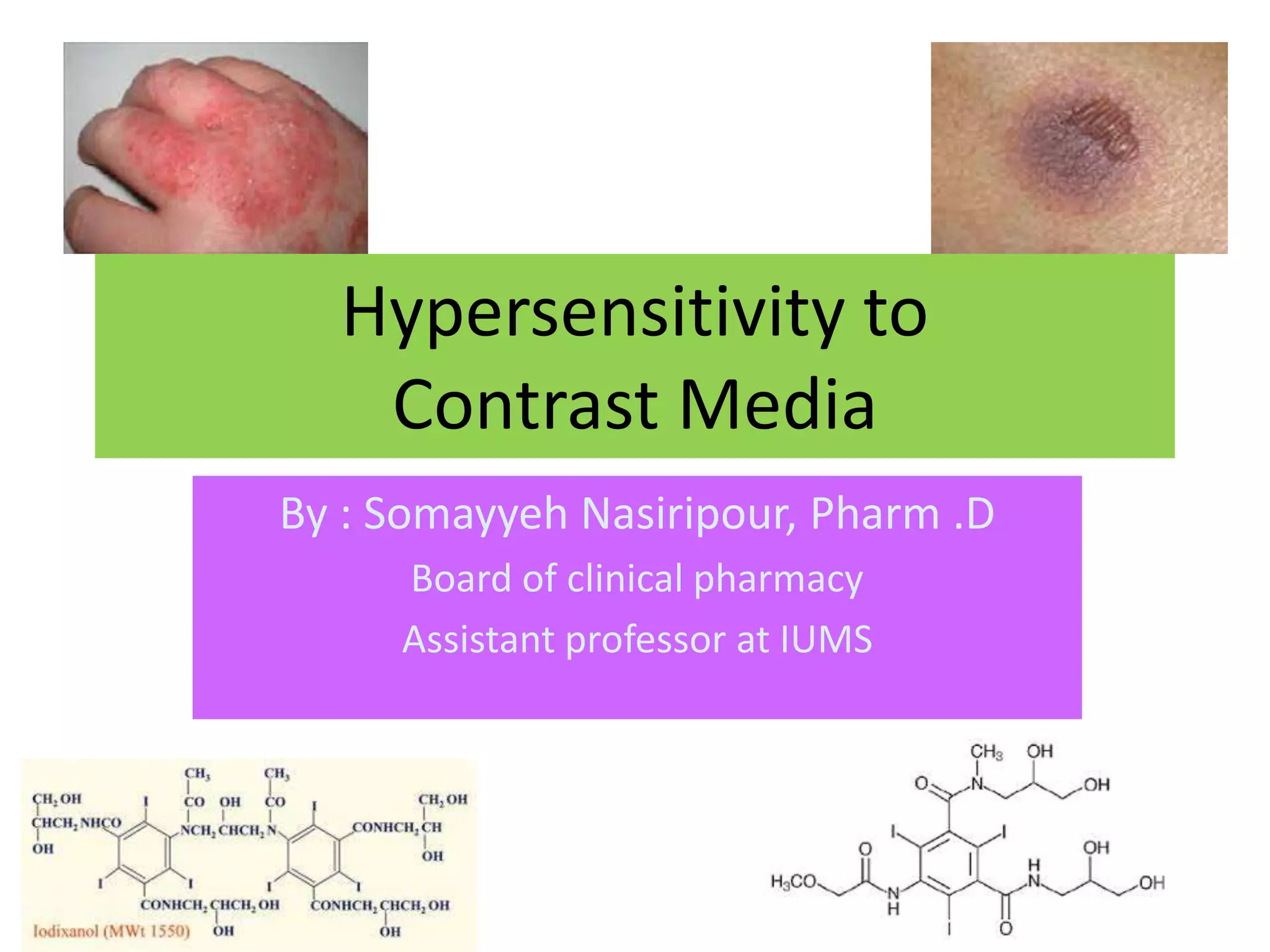
Hypersensitivity to
Contrast Media
By : Somayyeh Nasiripour, Pharm .D
Board of clinical pharmacy
Assistant professor at IUMS
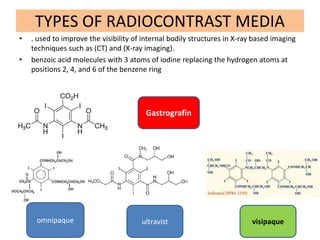
TYPES OF RADIOCONTRAST MEDIA
• . used to improve the visibility of internal bodily structures in X-ray based imaging
techniques such as (CT) and (X-ray imaging).
• benzoic acid molecules with 3 atoms of iodine replacing the hydrogen atoms at
positions 2, 4, and 6 of the benzene ring
Gastrografin
omnipaque ultravist visipaque
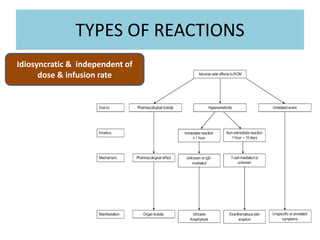
TYPES OF REACTIONS
Idiosyncratic & independent of
dose & infusion rate
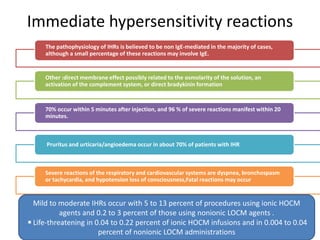
Immediate hypersensitivity reactions
The pathophysiology of IHRs is believed to be non IgE-mediated in the majority of cases,
although a small percentage of these reactions may involve IgE.
Other :direct membrane effect possibly related to the osmolarity of the solution, an
activation of the complement system, or direct bradykinin formation
70% occur within 5 minutes after injection, and 96 % of severe reactions manifest within 20
minutes.
Pruritus and urticaria/angioedema occur in about 70% of patients with IHR
Severe reactions of the respiratory and cardiovascular systems are dyspnea, bronchospasm
or tachycardia, and hypotension loss of consciousness,Fatal reactions may occur
Mild to moderate IHRs occur with 5 to 13 percent of procedures using ionic HOCM
agents and 0.2 to 3 percent of those using nonionic LOCM agents .
◾Life-threatening in 0.04 to 0.22 percent of ionic HOCM infusions and in 0.004 to 0.04
percent of nonionic LOCM administrations
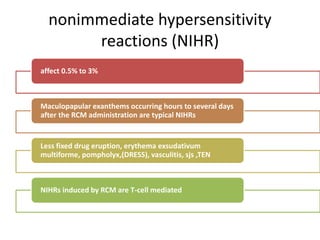
nonimmediate hypersensitivity
reactions (NIHR)
affect 0.5% to 3%
Maculopapular exanthems occurring hours to several days
after the RCM administration are typical NIHRs
Less fixed drug eruption, erythema exsudativum
multiforme, pompholyx,(DRESS), vasculitis, sjs ,TEN
NIHRs induced by RCM are T-cell mediated
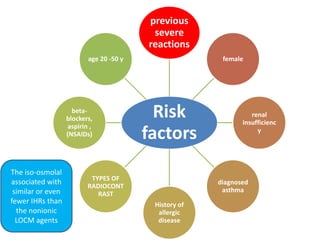
Risk
factors
previous
severe
reactions
female
renal
insufficienc
y
diagnosed
asthma
History of
allergic
disease
TYPES OF
RADIOCONT
RAST
beta-
blockers,
aspirin ,
(NSAIDs)
age 20 -50 y
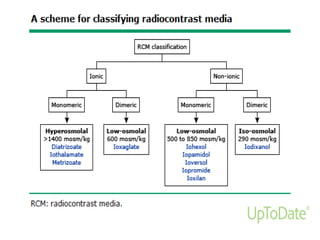
The iso-osmolal
associated with
similar or even
fewer IHRs than
the nonionic
LOCM agents
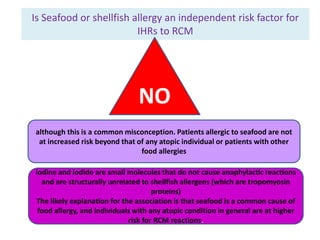
Is Seafood or shellfish allergy an independent risk factor for
IHRs to RCM
NO
although this is a common misconception. Patients allergic to seafood are not
at increased risk beyond that of any atopic individual or patients with other
food allergies
iodine and iodide are small molecules that do not cause anaphylactic reactions
and are structurally unrelated to shellfish allergens (which are tropomyosin
proteins)
The likely explanation for the association is that seafood is a common cause of
food allergy, and individuals with any atopic condition in general are at higher
risk for RCM reactions.
IS povidone-iodine allergy an independent
risk factor for IHRs to RCM
NO
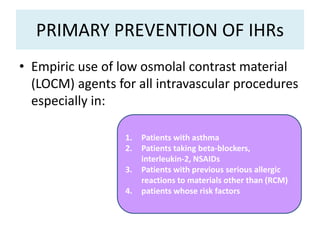
PRIMARY PREVENTION OF IHRs
• Empiric use of low osmolal contrast material
(LOCM) agents for all intravascular procedures
especially in:
1. Patients with asthma
2. Patients taking beta-blockers,
interleukin-2, NSAIDs
3. Patients with previous serious allergic
reactions to materials other than (RCM)
4. patients whose risk factors
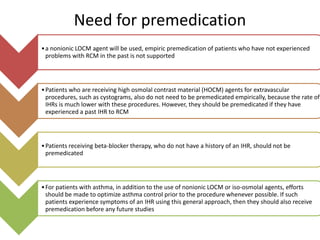
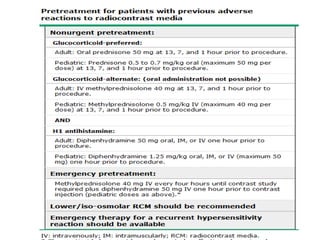
Need for premedication
•a nonionic LOCM agent will be used, empiric premedication of patients who have not experienced
problems with RCM in the past is not supported
•Patients who are receiving high osmolal contrast material (HOCM) agents for extravascular
procedures, such as cystograms, also do not need to be premedicated empirically, because the rate of
IHRs is much lower with these procedures. However, they should be premedicated if they have
experienced a past IHR to RCM
•Patients receiving beta-blocker therapy, who do not have a history of an IHR, should not be
premedicated
•For patients with asthma, in addition to the use of nonionic LOCM or iso-osmolal agents, efforts
should be made to optimize asthma control prior to the procedure whenever possible. If such
patients experience symptoms of an IHR using this general approach, then they should also receive
premedication before any future studies
Use of a different radiocontrast agent
For patients who developed IHRs to HOCM agents in the past, either a
nonionic LOCM, an iso-osmolal agent (iodixanol), or a gadolinium-based agent
should be used for future procedures, in combination with premedications
For patients who experienced a hypersensitivity reaction to a nonionic LOCM
in the past, we suggest either an iso-osmolal agent (iodixanol) or gadolinium-
based agent, in combination with premedications
Several series and case reports document successful use of
gadolinium chelates for arteriography, discography, or spiral
computed tomography (CT) in patients with previous IHRs to
iodinated RCM
rare patients with IHRs to iodinated RCM who also
react to gadolinium, despite premedication ESP IHR
No reports for NIHR
Diagnostic Methods
• Plasma or serum level His ( immediately )
• Tryptase (1-2 hr )
• skin testing
• If skin testing is pursued, it should be performed by allergy experts experienced in
drug allergy and trained in treating acute allergic reactions, since there is a very
small risk of systemic allergic reactions to the testing itself
• Ideally, skin testing should be performed within two to six months of the original
reaction
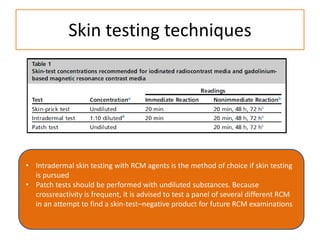
Skin testing techniques
• Intradermal skin testing with RCM agents is the method of choice if skin testing
is pursued
• Patch tests should be performed with undiluted substances. Because
crossreactivity is frequent, it is advised to test a panel of several different RCM
in an attempt to find a skin-test–negative product for future RCM examinations
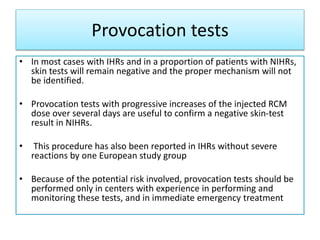
Provocation tests
• In most cases with IHRs and in a proportion of patients with NIHRs,
skin tests will remain negative and the proper mechanism will not
be identified.
• Provocation tests with progressive increases of the injected RCM
dose over several days are useful to confirm a negative skin-test
result in NIHRs.
• This procedure has also been reported in IHRs without severe
reactions by one European study group
• Because of the potential risk involved, provocation tests should be
performed only in centers with experience in performing and
monitoring these tests, and in immediate emergency treatment
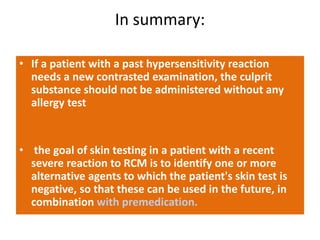
In summary:
• If a patient with a past hypersensitivity reaction
needs a new contrasted examination, the culprit
substance should not be administered without any
allergy test
• the goal of skin testing in a patient with a recent
severe reaction to RCM is to identify one or more
alternative agents to which the patient's skin test is
negative, so that these can be used in the future, in
combination with premedication.
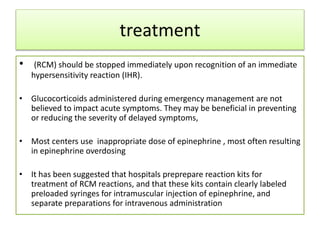
treatment
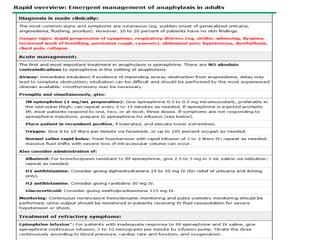
• (RCM) should be stopped immediately upon recognition of an immediate
hypersensitivity reaction (IHR).
• Glucocorticoids administered during emergency management are not
believed to impact acute symptoms. They may be beneficial in preventing
or reducing the severity of delayed symptoms,
• Most centers use inappropriate dose of epinephrine , most often resulting
in epinephrine overdosing
• It has been suggested that hospitals preprepare reaction kits for
treatment of RCM reactions, and that these kits contain clearly labeled
preloaded syringes for intramuscular injection of epinephrine, and
separate preparations for intravenous administration
Hypersensitivity to Contrast Media

Hypersensitivity to Contrast Media

  • 1.
    Hypersensitivity to Contrast Media By: Somayyeh Nasiripour, Pharm .D Board of clinical pharmacy Assistant professor at IUMS
  • 2.
    TYPES OF RADIOCONTRASTMEDIA • . used to improve the visibility of internal bodily structures in X-ray based imaging techniques such as (CT) and (X-ray imaging). • benzoic acid molecules with 3 atoms of iodine replacing the hydrogen atoms at positions 2, 4, and 6 of the benzene ring Gastrografin omnipaque ultravist visipaque
  • 5.
    TYPES OF REACTIONS Idiosyncratic& independent of dose & infusion rate
  • 6.
    Immediate hypersensitivity reactions Thepathophysiology of IHRs is believed to be non IgE-mediated in the majority of cases, although a small percentage of these reactions may involve IgE. Other :direct membrane effect possibly related to the osmolarity of the solution, an activation of the complement system, or direct bradykinin formation 70% occur within 5 minutes after injection, and 96 % of severe reactions manifest within 20 minutes. Pruritus and urticaria/angioedema occur in about 70% of patients with IHR Severe reactions of the respiratory and cardiovascular systems are dyspnea, bronchospasm or tachycardia, and hypotension loss of consciousness,Fatal reactions may occur Mild to moderate IHRs occur with 5 to 13 percent of procedures using ionic HOCM agents and 0.2 to 3 percent of those using nonionic LOCM agents . ◾Life-threatening in 0.04 to 0.22 percent of ionic HOCM infusions and in 0.004 to 0.04 percent of nonionic LOCM administrations
  • 7.
    nonimmediate hypersensitivity reactions (NIHR) affect0.5% to 3% Maculopapular exanthems occurring hours to several days after the RCM administration are typical NIHRs Less fixed drug eruption, erythema exsudativum multiforme, pompholyx,(DRESS), vasculitis, sjs ,TEN NIHRs induced by RCM are T-cell mediated
  • 8.
    Risk factors previous severe reactions female renal insufficienc y diagnosed asthma History of allergic disease TYPES OF RADIOCONT RAST beta- blockers, aspirin, (NSAIDs) age 20 -50 y The iso-osmolal associated with similar or even fewer IHRs than the nonionic LOCM agents
  • 9.
    Is Seafood orshellfish allergy an independent risk factor for IHRs to RCM NO although this is a common misconception. Patients allergic to seafood are not at increased risk beyond that of any atopic individual or patients with other food allergies iodine and iodide are small molecules that do not cause anaphylactic reactions and are structurally unrelated to shellfish allergens (which are tropomyosin proteins) The likely explanation for the association is that seafood is a common cause of food allergy, and individuals with any atopic condition in general are at higher risk for RCM reactions.
  • 10.
    IS povidone-iodine allergyan independent risk factor for IHRs to RCM NO
  • 11.
    PRIMARY PREVENTION OFIHRs • Empiric use of low osmolal contrast material (LOCM) agents for all intravascular procedures especially in: 1. Patients with asthma 2. Patients taking beta-blockers, interleukin-2, NSAIDs 3. Patients with previous serious allergic reactions to materials other than (RCM) 4. patients whose risk factors
  • 12.
    Need for premedication •anonionic LOCM agent will be used, empiric premedication of patients who have not experienced problems with RCM in the past is not supported •Patients who are receiving high osmolal contrast material (HOCM) agents for extravascular procedures, such as cystograms, also do not need to be premedicated empirically, because the rate of IHRs is much lower with these procedures. However, they should be premedicated if they have experienced a past IHR to RCM •Patients receiving beta-blocker therapy, who do not have a history of an IHR, should not be premedicated •For patients with asthma, in addition to the use of nonionic LOCM or iso-osmolal agents, efforts should be made to optimize asthma control prior to the procedure whenever possible. If such patients experience symptoms of an IHR using this general approach, then they should also receive premedication before any future studies
  • 14.
    Use of adifferent radiocontrast agent For patients who developed IHRs to HOCM agents in the past, either a nonionic LOCM, an iso-osmolal agent (iodixanol), or a gadolinium-based agent should be used for future procedures, in combination with premedications For patients who experienced a hypersensitivity reaction to a nonionic LOCM in the past, we suggest either an iso-osmolal agent (iodixanol) or gadolinium- based agent, in combination with premedications Several series and case reports document successful use of gadolinium chelates for arteriography, discography, or spiral computed tomography (CT) in patients with previous IHRs to iodinated RCM rare patients with IHRs to iodinated RCM who also react to gadolinium, despite premedication ESP IHR No reports for NIHR
  • 15.
    Diagnostic Methods • Plasmaor serum level His ( immediately ) • Tryptase (1-2 hr ) • skin testing • If skin testing is pursued, it should be performed by allergy experts experienced in drug allergy and trained in treating acute allergic reactions, since there is a very small risk of systemic allergic reactions to the testing itself • Ideally, skin testing should be performed within two to six months of the original reaction
  • 16.
    Skin testing techniques •Intradermal skin testing with RCM agents is the method of choice if skin testing is pursued • Patch tests should be performed with undiluted substances. Because crossreactivity is frequent, it is advised to test a panel of several different RCM in an attempt to find a skin-test–negative product for future RCM examinations
  • 17.
    Provocation tests • Inmost cases with IHRs and in a proportion of patients with NIHRs, skin tests will remain negative and the proper mechanism will not be identified. • Provocation tests with progressive increases of the injected RCM dose over several days are useful to confirm a negative skin-test result in NIHRs. • This procedure has also been reported in IHRs without severe reactions by one European study group • Because of the potential risk involved, provocation tests should be performed only in centers with experience in performing and monitoring these tests, and in immediate emergency treatment
  • 18.
    In summary: • Ifa patient with a past hypersensitivity reaction needs a new contrasted examination, the culprit substance should not be administered without any allergy test • the goal of skin testing in a patient with a recent severe reaction to RCM is to identify one or more alternative agents to which the patient's skin test is negative, so that these can be used in the future, in combination with premedication.
  • 19.
    treatment • (RCM) shouldbe stopped immediately upon recognition of an immediate hypersensitivity reaction (IHR). • Glucocorticoids administered during emergency management are not believed to impact acute symptoms. They may be beneficial in preventing or reducing the severity of delayed symptoms, • Most centers use inappropriate dose of epinephrine , most often resulting in epinephrine overdosing • It has been suggested that hospitals preprepare reaction kits for treatment of RCM reactions, and that these kits contain clearly labeled preloaded syringes for intramuscular injection of epinephrine, and separate preparations for intravenous administration