





Hyperemesis Gravidarum
By
Dr. Ahmed Nasef
Assistant lecturer at
obstetrics& gynecology
department – Benha
university- Egypt
What is emesis
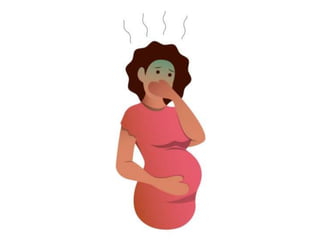
Emesis = vomiting
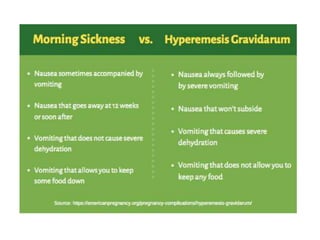
May be called morning sickness
It doesn’t affect general condition of the patient
When it happens?
Occurs in 1st trimester of pregnancy
Usually happens in the morning so the name
morning sickness
Is it one of the normal symptoms of
pregnancy?
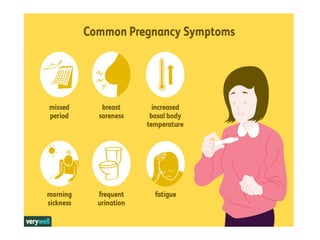
Yes emesis is one of the frequently occurring
symptoms of pregnancy
About more than two thirds of pregnant women
present with emesis
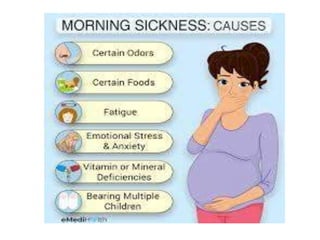
What causes emesis with pregnancy?
The exact cause of morning sickness is
unknown. Hormonal changes are thought to
play a role in morning sickness especially rising
HCG levels in pregnancy 1st trimester
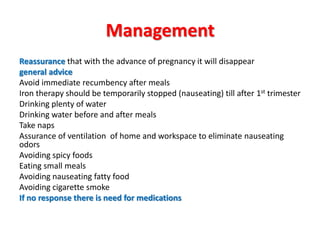
Management
Reassurance that with the advance of pregnancy it will disappear
general advice
Avoid immediate recumbency after meals
Iron therapy should be temporarily stopped (nauseating) till after 1st trimester
Drinking plenty of water
Drinking water before and after meals
Take naps
Assurance of ventilation of home and workspace to eliminate nauseating
odors
Avoiding spicy foods
Eating small meals
Avoiding nauseating fatty food
Avoiding cigarette smoke
If no response there is need for medications
So where is the problem?
The problem is not in emesis, its in
hyperemesis
But what is hyperemesis?
HEG
It is defined as severe recurrent vomiting to a
degree that affects the general condition
What is the incidence of HEG?
About 0.1 to 1% of pregnant women presented
by HEG
What are the causes of HEG?
Different theories explain HEG
Psychological theory
as it starts soon after knowing that she is pregnant
Only in front of her husband
Hormonal theory
Due to elevated levels of HCG (which occurs in
vesicular mole& in twins)
Increased levels of T3& T4 may play a role
Vitamin deficiency
B1& B6 deficiency
Who is at increased risk?
PG
Multiple gestations
Trophoblastic disease (as vesicular mole)
HEG in previous pregnancies
Overweight
Family history of HEG
Stages& clinical presentation of
HEG
1st stage of HEG
Vomiting of food, fluids Which starts mild then
increase in frequency to
become severe intolerable
may be all the day, not
related to meals, not
controlled by usual drugs
Then may be blood tinged
due to injury of esophagus&
pharynx from recurrent
attacks of vomiting (Mallory
Weiss syndrome)
2nd stage of HEG
Stage of starvation
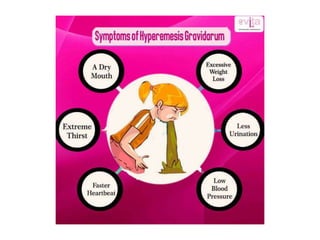
Starvation
Dehydration
Electrolyte imbalance
(decreased Na, K, Cl)
Dry inelastic skin
Thirst sensation
Dry tongue
Drowsiness
Sunken eyes
Constipation
Oliguria
Hypotension
tachycardia
3rd stage of HEG
Stage of organ affection Wernicke's encephalopathy
(degeneration of Wernicke's
area in basal ganglia in
brain)
Retinal detachment&
blindness
Starvation ketosis
Liver failure (fatty
infiltration& necrosis)
Kidney failure (tubular
necrosis)
Heart failure
What is ketosis?
Normally body uses glucose to meet energy
needs& major source for glucose is coming from
diet
But in case of HEG there is decrease in glucose
levels in diet so body use lipids to obtain energy
needs which will develop ketones which will be
elevated in blood and then passes out of the
body in urine
Management of HEG
Admission to hospital
Full history taking
Examination
Investigations
Observation
Treatment
Admission to hospital
Reassurance of the patient
Isolation in single room
Behave with sympathy with the patient
Speak with relatives especially husband to
decrease any psychological stress on the patient
Investigations
CBC
Increased Hct (due to hypovolemia)
Electrolyte levels
Decreased Na& K levels in blood
Urine analysis
Increased ketones in urine& no glucose
Thyroid profile
T3& T4 may be increased
Liver function tests (ALT& AST)
Kidney function tests (serum creatinine)
Fundus examination
Diet
NPO
Iv fluids (till 24-48 hrs after stoppage of
vomiting)
Then restart gradually by clear fluids&
carbohydrate meals with no fats or spices
Drugs
1st line (histamine receptor blockers) which act on both CTZ&
VC in brain so decrease vomiting as meclizine& cyclizine
(Navidoxine)
2nd line (dopamine receptor blockers) which act on CTZ
AS metoclopramide (Primperan)& chlorpromazine (Neurazine)
3rd line (serotonin receptor blockers)
Which act on both CTZ& VC as ondanesteron& granisetron
(Zofran)
Vitamin B6 may be added
Corticosteroids may be added if no response to the above
drugs
observation
Mother
Frequency of vomiting
Vital data
Laboratory results
Fundus examination
Any symptoms suggestive of
organ affection
Fetus
Ultrasound (US)
When to do TOP?
Deterioration of the general condition in spite of
treatment
Deterioration of organs affected
Methods:
By use of ecbolics, D&C or suction evacuation in
1st trimester
Or may be hysterotomy if in 2nd trimester
Take home messages
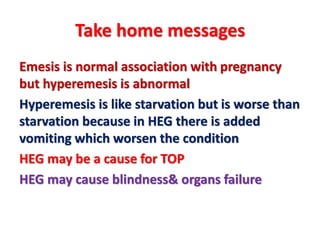
Emesis is normal association with pregnancy
but hyperemesis is abnormal
Hyperemesis is like starvation but is worse than
starvation because in HEG there is added
vomiting which worsen the condition
HEG may be a cause for TOP
HEG may cause blindness& organs failure
Hyperemesis gravidarum

Hyperemesis gravidarum

  • 1.
    Hyperemesis Gravidarum By Dr. AhmedNasef Assistant lecturer at obstetrics& gynecology department – Benha university- Egypt
  • 4.
    What is emesis Emesis= vomiting May be called morning sickness It doesn’t affect general condition of the patient
  • 6.
    When it happens? Occursin 1st trimester of pregnancy Usually happens in the morning so the name morning sickness
  • 7.
    Is it oneof the normal symptoms of pregnancy? Yes emesis is one of the frequently occurring symptoms of pregnancy About more than two thirds of pregnant women present with emesis
  • 9.
    What causes emesiswith pregnancy? The exact cause of morning sickness is unknown. Hormonal changes are thought to play a role in morning sickness especially rising HCG levels in pregnancy 1st trimester
  • 11.
    Management Reassurance that withthe advance of pregnancy it will disappear general advice Avoid immediate recumbency after meals Iron therapy should be temporarily stopped (nauseating) till after 1st trimester Drinking plenty of water Drinking water before and after meals Take naps Assurance of ventilation of home and workspace to eliminate nauseating odors Avoiding spicy foods Eating small meals Avoiding nauseating fatty food Avoiding cigarette smoke If no response there is need for medications
  • 12.
    So where isthe problem?
  • 13.
    The problem isnot in emesis, its in hyperemesis
  • 15.
    But what ishyperemesis?
  • 16.
    HEG It is definedas severe recurrent vomiting to a degree that affects the general condition
  • 17.
    What is theincidence of HEG? About 0.1 to 1% of pregnant women presented by HEG
  • 18.
    What are thecauses of HEG? Different theories explain HEG Psychological theory as it starts soon after knowing that she is pregnant Only in front of her husband Hormonal theory Due to elevated levels of HCG (which occurs in vesicular mole& in twins) Increased levels of T3& T4 may play a role Vitamin deficiency B1& B6 deficiency
  • 19.
    Who is atincreased risk? PG Multiple gestations Trophoblastic disease (as vesicular mole) HEG in previous pregnancies Overweight Family history of HEG
  • 20.
  • 21.
    1st stage ofHEG Vomiting of food, fluids Which starts mild then increase in frequency to become severe intolerable may be all the day, not related to meals, not controlled by usual drugs Then may be blood tinged due to injury of esophagus& pharynx from recurrent attacks of vomiting (Mallory Weiss syndrome)
  • 22.
    2nd stage ofHEG Stage of starvation Starvation Dehydration Electrolyte imbalance (decreased Na, K, Cl) Dry inelastic skin Thirst sensation Dry tongue Drowsiness Sunken eyes Constipation Oliguria Hypotension tachycardia
  • 24.
    3rd stage ofHEG Stage of organ affection Wernicke's encephalopathy (degeneration of Wernicke's area in basal ganglia in brain) Retinal detachment& blindness Starvation ketosis Liver failure (fatty infiltration& necrosis) Kidney failure (tubular necrosis) Heart failure
  • 25.
    What is ketosis? Normallybody uses glucose to meet energy needs& major source for glucose is coming from diet But in case of HEG there is decrease in glucose levels in diet so body use lipids to obtain energy needs which will develop ketones which will be elevated in blood and then passes out of the body in urine
  • 26.
    Management of HEG Admissionto hospital Full history taking Examination Investigations Observation Treatment
  • 27.
    Admission to hospital Reassuranceof the patient Isolation in single room Behave with sympathy with the patient Speak with relatives especially husband to decrease any psychological stress on the patient
  • 29.
    Investigations CBC Increased Hct (dueto hypovolemia) Electrolyte levels Decreased Na& K levels in blood Urine analysis Increased ketones in urine& no glucose Thyroid profile T3& T4 may be increased Liver function tests (ALT& AST) Kidney function tests (serum creatinine) Fundus examination
  • 30.
    Diet NPO Iv fluids (till24-48 hrs after stoppage of vomiting) Then restart gradually by clear fluids& carbohydrate meals with no fats or spices
  • 31.
    Drugs 1st line (histaminereceptor blockers) which act on both CTZ& VC in brain so decrease vomiting as meclizine& cyclizine (Navidoxine) 2nd line (dopamine receptor blockers) which act on CTZ AS metoclopramide (Primperan)& chlorpromazine (Neurazine) 3rd line (serotonin receptor blockers) Which act on both CTZ& VC as ondanesteron& granisetron (Zofran) Vitamin B6 may be added Corticosteroids may be added if no response to the above drugs
  • 32.
    observation Mother Frequency of vomiting Vitaldata Laboratory results Fundus examination Any symptoms suggestive of organ affection Fetus Ultrasound (US)
  • 33.
    When to doTOP? Deterioration of the general condition in spite of treatment Deterioration of organs affected Methods: By use of ecbolics, D&C or suction evacuation in 1st trimester Or may be hysterotomy if in 2nd trimester
  • 35.
    Take home messages Emesisis normal association with pregnancy but hyperemesis is abnormal Hyperemesis is like starvation but is worse than starvation because in HEG there is added vomiting which worsen the condition HEG may be a cause for TOP HEG may cause blindness& organs failure