NAUSEA AND VOMITING
PIYUSH PARASHAR
INTRODUCTION
• Nausea and vomiting in pregnancy is a symptom which
may be related to pregnancy or may be a manifestation of
some medical- surgical – gynecological complications,
which can occur at any time during pregnancy.
• The former is by far the most common one and is called
vomiting of pregnancy.
CAUSES OF VOMITING IN
PREGNANCY
EARLY PREGNANCY
• Related to pregnancy
 Simple vomiting ( morning sickness,
emesis gravidarum).
 Hyperemesis gravidarum (pernicious
vomiting)
 Associated with pregnancy
LATE PREGNANCY
• Related to pregnancy
 Continuation or reappearance of
simple vomiting of pregnancy.
 Acute fulminating pre- eclampsia.
 Medical- surgical –gynecological
causes in early pregnancy
 Hiatus hernia
CAUSES OF VOMITING IN
PREGNANCY
MEDICAL
o Intestinal infestations
o Infections
 UTI
 H. Pylori
o Hepatitis
o Ketoacidosis of diabetes
o Pyelonephritis, uremia
SURGICAL
o Appendicitis
o Peptic ulcer
o Intestinal obstruction
o Cholecystitis
o Pancreatitis
GYNECOLOGICAL
 Twisted ovarian tumor
 Red degeneration of fibroid
NAUSEA AND VOMITING IN
PREGNANCY
• The vomiting is related to the pregnant state.
• Other causes of nausea and vomiting should be excluded.
• Depending up on the severity, it is classified as:
i. Simple vomiting of pregnancy or milder type.
ii. Hyperemesis gravidarum or severe type.
SIMPLE VOMITING
• The patient complains of nausea and occasional sickness on rising in the
morning.
• Slight vomiting is so common in early pregnancy that it is considered as a
symptom of pregnancy.
• It may occur at other times of the day. The vomitus is small and clear or bile
stained.
• It does not produce any impairment of health or restrict the normal activities
of the women.
• The feature disappears with or without treatment by 12- 14th week of
pregnancy.
• High level of serum human chorionic gonadotrophin, estrogen and altered
immunological states are considered responsible for initiation of the
manifestation.
SIMPLE
VOMITING
• Assurance is important.
• NVP is thought to be fetal protective.
• Taking of dry toast or biscuit and avoidance
of fatty and spicy foods are enough to
relieve the symptoms in majority.
• Supplementation with vitamin 𝐵1 100mg
daily is helpful.
• If the simple measures fail, antiemetic drugs-
trifluoperazine ( Espazine) 1mg twice daily is
quite effective.
• Promethazine and ondansetron can be
used.
• Patient is advised to take plenty of fluids (2.5L
in 24 hours) and fruit juice.
MANAGEMENT
HYPEREMESIS
GRAVIDARUM (HG)
DEFINITION
•It is severe type of vomiting of pregnancy
which has got deleterious effect on the
health of mother and/or incapacitates
her in day-to- day activities.
INCIDENCE
• There has been marked fall in the incidence during the last 30 years.
• It is now a rarity in hospital practice.
• The reasons are-
Better application of family planning knowledge which reduces the number
of unplanned pregnancies.
Early visit to the antenatal clinic
Potent anti- histaminic and anti emetic drugs.
RISK FACTORS
• It is mostly limited to the first trimester
and resolves in 20 weeks.
• Most common in first pregnancy,
with the tendency to recur in
subsequent pregnancies
• Younger age
• Low body mass
• History of motion sickness or
migraine.
• It has got a familial history- mother
and sisters also suffer from the same
manifestations.
• Women suffered nausea and
vomiting while on COCs. More
prevalent in hydatidiform mole and
multiple pregnancy.
• More common in unplanned
pregnancies but much less amongst
illegitimate ones.
THEORIES
HORMONAL
a. Excess of chorionic gonadotrophin or higher biological activity of HCG is
associated. This is proved by the frequency of vomiting at the peak level of
hcg and also increased association with hydatidiform mole or multiple
pregnancy when the HCG titer is very much raised.
b. High serum level of estrogen.
c. Progesterone excess leading to relaxation of the cardiac sphincter and
simultaneous retention of gastric fluids due to impaired gastric motility.
d. Other hormones involved are: thyroxine, prolactin, leptin and adrenocortical
hormone.
THEORIES
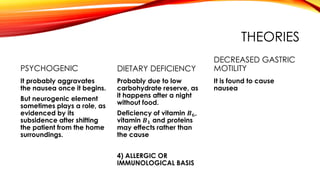
PSYCHOGENIC
It probably aggravates
the nausea once it begins.
But neurogenic element
sometimes plays a role, as
evidenced by its
subsidence after shifting
the patient from the home
surroundings.
DIETARY DEFICIENCY
Probably due to low
carbohydrate reserve, as
it happens after a night
without food.
Deficiency of vitamin 𝑩 𝟔,
vitamin 𝑩 𝟏 and proteins
may effects rather than
the cause
4) ALLERGIC OR
IMMUNOLOGICAL BASIS
DECREASED GASTRIC
MOTILITY
It is found to cause
nausea
THEORIES
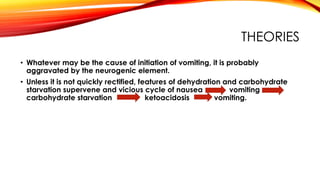
• Whatever may be the cause of initiation of vomiting, it is probably
aggravated by the neurogenic element.
• Unless it is not quickly rectified, features of dehydration and carbohydrate
starvation supervene and vicious cycle of nausea vomiting
carbohydrate starvation ketoacidosis vomiting.
PATHOLOGY
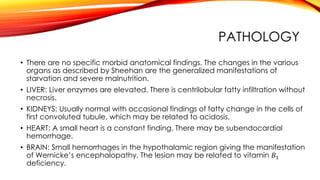
• There are no specific morbid anatomical findings. The changes in the various
organs as described by Sheehan are the generalized manifestations of
starvation and severe malnutrition.
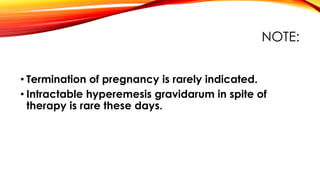
• LIVER: Liver enzymes are elevated. There is centrilobular fatty infiltration without
necrosis.
• KIDNEYS: Usually normal with occasional findings of fatty change in the cells of
first convoluted tubule, which may be related to acidosis.
• HEART: A small heart is a constant finding. There may be subendocardial
hemorrhage.
• BRAIN: Small hemorrhages in the hypothalamic region giving the manifestation
of Wernicke’s encephalopathy. The lesion may be related to vitamin 𝐵1
deficiency.
METABOLIC,
BIOCHEMICAL AND
CIRCULATORY
CHANGES
METABOLIC CHANGES
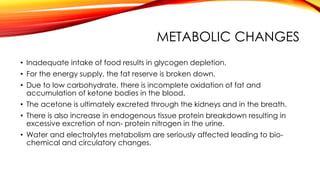
• Inadequate intake of food results in glycogen depletion.

• For the energy supply, the fat reserve is broken down.
• Due to low carbohydrate, there is incomplete oxidation of fat and
accumulation of ketone bodies in the blood.
• The acetone is ultimately excreted through the kidneys and in the breath.
• There is also increase in endogenous tissue protein breakdown resulting in
excessive excretion of non- protein nitrogen in the urine.
• Water and electrolytes metabolism are seriously affected leading to bio-
chemical and circulatory changes.
BIOCHEMICAL AND CIRCULATORY
CHANGES
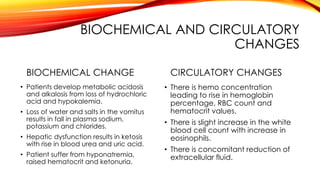
BIOCHEMICAL CHANGE
• Patients develop metabolic acidosis
and alkalosis from loss of hydrochloric
acid and hypokalemia.
• Loss of water and salts in the vomitus
results in fall in plasma sodium,
potassium and chlorides.
• Hepatic dysfunction results in ketosis
with rise in blood urea and uric acid.
• Patient suffer from hyponatremia,
raised hematocrit and ketonuria.
CIRCULATORY CHANGES
• There is hemo concentration
leading to rise in hemoglobin
percentage, RBC count and
hematocrit values.
• There is slight increase in the white
blood cell count with increase in
eosinophils.
• There is concomitant reduction of
extracellular fluid.
CLINICAL COURSE
• From the management and prognostic point of view, the cases are
grouped into:
 EARLY
 LATE ( moderate to severe)
The patient is usually a nullipara, in early pregnancy. The onset is
insidious.
CLINICAL COURSE
• EARLY
o Vomiting occurs throughout the
day.
o Normal day to day activities are
curtailed.
o There is no evidence of dehydration
or starvation.
• LATE
o Evidences of dehydration and
starvation are present.
LATE CASES
• Evidences of dehydration and starvation are present.
• SYMPTOMS: Vomiting is increased in frequency with retching.
• Urine quantity is diminished even to the stage of oliguria.
• Epigastric pain, constipation may occur.
• Complications may appear if not treated.
o SIGNS: Features of dehydration and ketoacidosis: Dry coated tongue,
acetone smell in breath, tachycardia, hypotension, rise in temperature may
be noted, jaundice is a late feature.
o Vaginal examination and/or ultra sonography is done to confirm the
diagnosis of pregnancy.
INVESTIGATIONS
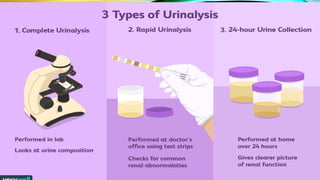
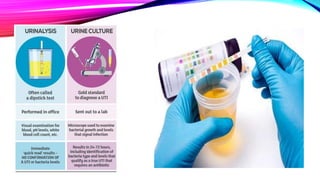
URINALYSIS
• Quantity- small
• Dark color
• High specific gravity with acidic reaction
• Presence of acetone, occasional presence of protein and rarely bile
pigments
• Diminished or even absence of chloride.
BIOCHEMICAL AND CIRCULATORY
CHANGES
• LFTs are abnormal in many patients with rise in the level of
serum transaminases and bilirubin.
• Jaundice may be present.
• Routine and periodic estimation of the serum electrolytes
(sodium, potassium and chloride) is helpful in management
of the case.
SERUM TSH, 𝑇3AND FREE 𝑇4,
OPTHALMOSCOPIC EXAMINATION
AND ECG
SERUM TSH, 𝑇3 AND
FREE 𝑇4
Women may suffer
from transient
phase of thyroid
dysfunction.
OPTHALMOSCOPIC
EXAMINATION
It is required if the
patient is seriously
ill.
Retinal
hemorrhage and
detachment of the
retina are the most
unfavourable
signs.
ECG
When there is
abnormal serum
potassium level.
DIAGNOSIS
• The pregnancy is to be confirmed first.
• Thereafter, all the associated causes of vomiting (enumerated before) are to
be excluded.
• ULTRASONOGRAPHY is useful not only to confirm the pregnancy but also to
exclude other obstetric (hydatidiform mole, multiple pregnancy),
gynecological, surgical or medical causes of vomiting.
• Differential diagnosis: When vomiting is persistent in spite of usual treatment
other causes of severe vomiting should be considered and investigated.
COMPLICATIONS
MATERNAL:
 Neurologic complications:
a. Wernicke’s encephalopathy
b. Beriberi due to thiamine
deficiency
c. Pontine myelinolysis
d. Peripheral neuritis
e. Korsakoff’s psychosis
 Stress ulcers in stomach
 Esophageal tear
 Jaundice, hepatic failure
 Convulsions and coma
 Hypoprothrombinemia due to
vitamin k deficiency
 Renal failure
 Effects on fetus: Fetal risks may be
due to low birth weight and preterm
birth.
PREVENTION
• To take small amount and at frequent intervals
• To drink fluids in between meals and not after the meals.
• Not to lie down immediately after meals.
• To avoid food that causes gastric irritation.
• To avoid food and odors that trigger nausea and vomiting.
MANAGEMENT
PRINCIPLES
• The principles in management are:
Maintenance of hydration
To control vomiting
To correct the fluids and electrolyte imbalance
To correct metabolic disturbances.
To prevent the serious complications.
To correct vitamin deficiencies.
Care of pregnancy
HOSPITALIZATION
• Indications are:
o Protracted NVP despite the use of oral antiemetics
o Continued NVP with ketonuria and/or weight loss > 5%
o Presence of any comorbidity ( medical/ surgical).
FLUIDS
• oral feeding is withheld for at least 24 hours after the cessation of vomiting.
• During this period, fluid is given through intravenous drip method.
• The amount of fluid to be infused in 24 hours is calculated as follows:
The total amount of fluid approximates 3 liters, of which half is 5% dextrose
and half is Ringer’s solution.
Extra amount of crystalloids equal to the amount of vomitus and urine in 24
hours, is to be added.
Serum electrolyte should be estimated and corrected if there is any
abnormality.
Enteral nutrition through nasogastric tube may also be given.
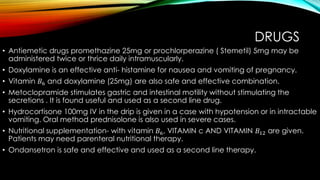
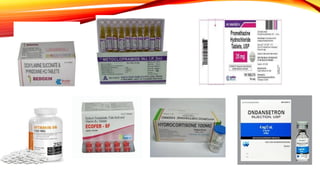
DRUGS
• Antiemetic drugs promethazine 25mg or prochlorperazine ( Stemetil) 5mg may be
administered twice or thrice daily intramuscularly.
• Doxylamine is an effective anti- histamine for nausea and vomiting of pregnancy.
• Vitamin 𝐵6 and doxylamine (25mg) are also safe and effective combination.
• Metoclopramide stimulates gastric and intestinal motility without stimulating the
secretions . It is found useful and used as a second line drug.
• Hydrocortisone 100mg IV in the drip is given in a case with hypotension or in intractable
vomiting. Oral method prednisolone is also used in severe cases.
• Nutritional supplementation- with vitamin 𝐵6, VITAMIN c AND VITAMIN 𝐵12 are given.
Patients may need parenteral nutritional therapy.
• Ondansetron is safe and effective and used as a second line therapy.
NURSING CARE
• Sympathetic but firm handling of the patient is essential.
• Social and psychological support should be extended.
• Parenteral thiamine should be given to prevent Wernicke’s
encephalopathy.
• The maternal complications and preventive measures are to be taken as
below:
Neurologic complications are to be treated with Inj. Thiamine 100mg IV
daily.
Stress ulcer with the use of proton pump inhibitors (IV).
Hemoconcentration may need thromboprophylaxis with LMWH.
Woman with NVP and HG need to be multidisciplinary team
management involving physician, psychiatrist, nutritionist and the
midwife.
NURSING CARE
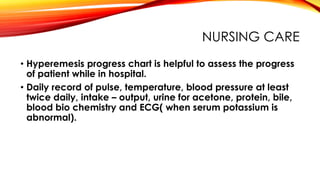
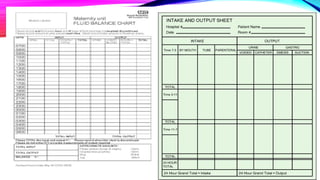
• Hyperemesis progress chart is helpful to assess the progress
of patient while in hospital.
• Daily record of pulse, temperature, blood pressure at least
twice daily, intake – output, urine for acetone, protein, bile,
blood bio chemistry and ECG( when serum potassium is
abnormal).
CLINICAL FEATURES OF
IMPROVEMENT
I. Subsidence of vomiting.
II. Feeling of hunger.
III. Better look.
IV. Normalization of blood biochemistry electrolytes).
V. Disappearance of acetone from the breath and urine.
VI. Normal pulse and blood pressure.
VII. Normal urine output
VIII. Normal fetal growth on follow up.
DIET
• Before the intravenous fluid is omitted, the fods are given
orally.
• At first, dry carbohydrate foods like biscuits, bread and toast
are given.
• Small but frequent feeds are recommended.
• Gradually full diet is restored.
NOTE:
• Termination of pregnancy is rarely indicated.
• Intractable hyperemesis gravidarum in spite of
therapy is rare these days.
Nausea and vomiting

Nausea and vomiting

  • 1.
  • 3.
    INTRODUCTION • Nausea andvomiting in pregnancy is a symptom which may be related to pregnancy or may be a manifestation of some medical- surgical – gynecological complications, which can occur at any time during pregnancy. • The former is by far the most common one and is called vomiting of pregnancy.
  • 5.
    CAUSES OF VOMITINGIN PREGNANCY EARLY PREGNANCY • Related to pregnancy  Simple vomiting ( morning sickness, emesis gravidarum).  Hyperemesis gravidarum (pernicious vomiting)  Associated with pregnancy LATE PREGNANCY • Related to pregnancy  Continuation or reappearance of simple vomiting of pregnancy.  Acute fulminating pre- eclampsia.  Medical- surgical –gynecological causes in early pregnancy  Hiatus hernia
  • 6.
    CAUSES OF VOMITINGIN PREGNANCY MEDICAL o Intestinal infestations o Infections  UTI  H. Pylori o Hepatitis o Ketoacidosis of diabetes o Pyelonephritis, uremia SURGICAL o Appendicitis o Peptic ulcer o Intestinal obstruction o Cholecystitis o Pancreatitis GYNECOLOGICAL  Twisted ovarian tumor  Red degeneration of fibroid
  • 7.
    NAUSEA AND VOMITINGIN PREGNANCY • The vomiting is related to the pregnant state. • Other causes of nausea and vomiting should be excluded. • Depending up on the severity, it is classified as: i. Simple vomiting of pregnancy or milder type. ii. Hyperemesis gravidarum or severe type.
  • 8.
    SIMPLE VOMITING • Thepatient complains of nausea and occasional sickness on rising in the morning. • Slight vomiting is so common in early pregnancy that it is considered as a symptom of pregnancy. • It may occur at other times of the day. The vomitus is small and clear or bile stained. • It does not produce any impairment of health or restrict the normal activities of the women. • The feature disappears with or without treatment by 12- 14th week of pregnancy. • High level of serum human chorionic gonadotrophin, estrogen and altered immunological states are considered responsible for initiation of the manifestation.
  • 9.
    SIMPLE VOMITING • Assurance isimportant. • NVP is thought to be fetal protective. • Taking of dry toast or biscuit and avoidance of fatty and spicy foods are enough to relieve the symptoms in majority. • Supplementation with vitamin 𝐵1 100mg daily is helpful. • If the simple measures fail, antiemetic drugs- trifluoperazine ( Espazine) 1mg twice daily is quite effective. • Promethazine and ondansetron can be used. • Patient is advised to take plenty of fluids (2.5L in 24 hours) and fruit juice. MANAGEMENT
  • 10.
  • 11.
    DEFINITION •It is severetype of vomiting of pregnancy which has got deleterious effect on the health of mother and/or incapacitates her in day-to- day activities.
  • 12.
    INCIDENCE • There hasbeen marked fall in the incidence during the last 30 years. • It is now a rarity in hospital practice. • The reasons are- Better application of family planning knowledge which reduces the number of unplanned pregnancies. Early visit to the antenatal clinic Potent anti- histaminic and anti emetic drugs.
  • 13.
    RISK FACTORS • Itis mostly limited to the first trimester and resolves in 20 weeks. • Most common in first pregnancy, with the tendency to recur in subsequent pregnancies • Younger age • Low body mass • History of motion sickness or migraine. • It has got a familial history- mother and sisters also suffer from the same manifestations. • Women suffered nausea and vomiting while on COCs. More prevalent in hydatidiform mole and multiple pregnancy. • More common in unplanned pregnancies but much less amongst illegitimate ones.
  • 14.
  • 15.
    HORMONAL a. Excess ofchorionic gonadotrophin or higher biological activity of HCG is associated. This is proved by the frequency of vomiting at the peak level of hcg and also increased association with hydatidiform mole or multiple pregnancy when the HCG titer is very much raised. b. High serum level of estrogen. c. Progesterone excess leading to relaxation of the cardiac sphincter and simultaneous retention of gastric fluids due to impaired gastric motility. d. Other hormones involved are: thyroxine, prolactin, leptin and adrenocortical hormone.
  • 16.
    THEORIES PSYCHOGENIC It probably aggravates thenausea once it begins. But neurogenic element sometimes plays a role, as evidenced by its subsidence after shifting the patient from the home surroundings. DIETARY DEFICIENCY Probably due to low carbohydrate reserve, as it happens after a night without food. Deficiency of vitamin 𝑩 𝟔, vitamin 𝑩 𝟏 and proteins may effects rather than the cause 4) ALLERGIC OR IMMUNOLOGICAL BASIS DECREASED GASTRIC MOTILITY It is found to cause nausea
  • 17.
    THEORIES • Whatever maybe the cause of initiation of vomiting, it is probably aggravated by the neurogenic element. • Unless it is not quickly rectified, features of dehydration and carbohydrate starvation supervene and vicious cycle of nausea vomiting carbohydrate starvation ketoacidosis vomiting.
  • 18.
    PATHOLOGY • There areno specific morbid anatomical findings. The changes in the various organs as described by Sheehan are the generalized manifestations of starvation and severe malnutrition. • LIVER: Liver enzymes are elevated. There is centrilobular fatty infiltration without necrosis. • KIDNEYS: Usually normal with occasional findings of fatty change in the cells of first convoluted tubule, which may be related to acidosis. • HEART: A small heart is a constant finding. There may be subendocardial hemorrhage. • BRAIN: Small hemorrhages in the hypothalamic region giving the manifestation of Wernicke’s encephalopathy. The lesion may be related to vitamin 𝐵1 deficiency.
  • 19.
  • 20.
    METABOLIC CHANGES • Inadequateintake of food results in glycogen depletion. • For the energy supply, the fat reserve is broken down. • Due to low carbohydrate, there is incomplete oxidation of fat and accumulation of ketone bodies in the blood. • The acetone is ultimately excreted through the kidneys and in the breath. • There is also increase in endogenous tissue protein breakdown resulting in excessive excretion of non- protein nitrogen in the urine. • Water and electrolytes metabolism are seriously affected leading to bio- chemical and circulatory changes.
  • 21.
    BIOCHEMICAL AND CIRCULATORY CHANGES BIOCHEMICALCHANGE • Patients develop metabolic acidosis and alkalosis from loss of hydrochloric acid and hypokalemia. • Loss of water and salts in the vomitus results in fall in plasma sodium, potassium and chlorides. • Hepatic dysfunction results in ketosis with rise in blood urea and uric acid. • Patient suffer from hyponatremia, raised hematocrit and ketonuria. CIRCULATORY CHANGES • There is hemo concentration leading to rise in hemoglobin percentage, RBC count and hematocrit values. • There is slight increase in the white blood cell count with increase in eosinophils. • There is concomitant reduction of extracellular fluid.
  • 22.
    CLINICAL COURSE • Fromthe management and prognostic point of view, the cases are grouped into:  EARLY  LATE ( moderate to severe) The patient is usually a nullipara, in early pregnancy. The onset is insidious.
  • 23.
    CLINICAL COURSE • EARLY oVomiting occurs throughout the day. o Normal day to day activities are curtailed. o There is no evidence of dehydration or starvation. • LATE o Evidences of dehydration and starvation are present.
  • 24.
    LATE CASES • Evidencesof dehydration and starvation are present. • SYMPTOMS: Vomiting is increased in frequency with retching. • Urine quantity is diminished even to the stage of oliguria. • Epigastric pain, constipation may occur. • Complications may appear if not treated. o SIGNS: Features of dehydration and ketoacidosis: Dry coated tongue, acetone smell in breath, tachycardia, hypotension, rise in temperature may be noted, jaundice is a late feature. o Vaginal examination and/or ultra sonography is done to confirm the diagnosis of pregnancy.
  • 25.
  • 26.
    URINALYSIS • Quantity- small •Dark color • High specific gravity with acidic reaction • Presence of acetone, occasional presence of protein and rarely bile pigments • Diminished or even absence of chloride.
  • 29.
    BIOCHEMICAL AND CIRCULATORY CHANGES •LFTs are abnormal in many patients with rise in the level of serum transaminases and bilirubin. • Jaundice may be present. • Routine and periodic estimation of the serum electrolytes (sodium, potassium and chloride) is helpful in management of the case.
  • 30.
    SERUM TSH, 𝑇3ANDFREE 𝑇4, OPTHALMOSCOPIC EXAMINATION AND ECG SERUM TSH, 𝑇3 AND FREE 𝑇4 Women may suffer from transient phase of thyroid dysfunction. OPTHALMOSCOPIC EXAMINATION It is required if the patient is seriously ill. Retinal hemorrhage and detachment of the retina are the most unfavourable signs. ECG When there is abnormal serum potassium level.
  • 31.
    DIAGNOSIS • The pregnancyis to be confirmed first. • Thereafter, all the associated causes of vomiting (enumerated before) are to be excluded. • ULTRASONOGRAPHY is useful not only to confirm the pregnancy but also to exclude other obstetric (hydatidiform mole, multiple pregnancy), gynecological, surgical or medical causes of vomiting. • Differential diagnosis: When vomiting is persistent in spite of usual treatment other causes of severe vomiting should be considered and investigated.
  • 33.
    COMPLICATIONS MATERNAL:  Neurologic complications: a.Wernicke’s encephalopathy b. Beriberi due to thiamine deficiency c. Pontine myelinolysis d. Peripheral neuritis e. Korsakoff’s psychosis  Stress ulcers in stomach  Esophageal tear  Jaundice, hepatic failure  Convulsions and coma  Hypoprothrombinemia due to vitamin k deficiency  Renal failure  Effects on fetus: Fetal risks may be due to low birth weight and preterm birth.
  • 35.
    PREVENTION • To takesmall amount and at frequent intervals • To drink fluids in between meals and not after the meals. • Not to lie down immediately after meals. • To avoid food that causes gastric irritation. • To avoid food and odors that trigger nausea and vomiting.
  • 36.
  • 37.
    PRINCIPLES • The principlesin management are: Maintenance of hydration To control vomiting To correct the fluids and electrolyte imbalance To correct metabolic disturbances. To prevent the serious complications. To correct vitamin deficiencies. Care of pregnancy
  • 38.
    HOSPITALIZATION • Indications are: oProtracted NVP despite the use of oral antiemetics o Continued NVP with ketonuria and/or weight loss > 5% o Presence of any comorbidity ( medical/ surgical).
  • 39.
    FLUIDS • oral feedingis withheld for at least 24 hours after the cessation of vomiting. • During this period, fluid is given through intravenous drip method. • The amount of fluid to be infused in 24 hours is calculated as follows: The total amount of fluid approximates 3 liters, of which half is 5% dextrose and half is Ringer’s solution. Extra amount of crystalloids equal to the amount of vomitus and urine in 24 hours, is to be added. Serum electrolyte should be estimated and corrected if there is any abnormality. Enteral nutrition through nasogastric tube may also be given.
  • 40.
    DRUGS • Antiemetic drugspromethazine 25mg or prochlorperazine ( Stemetil) 5mg may be administered twice or thrice daily intramuscularly. • Doxylamine is an effective anti- histamine for nausea and vomiting of pregnancy. • Vitamin 𝐵6 and doxylamine (25mg) are also safe and effective combination. • Metoclopramide stimulates gastric and intestinal motility without stimulating the secretions . It is found useful and used as a second line drug. • Hydrocortisone 100mg IV in the drip is given in a case with hypotension or in intractable vomiting. Oral method prednisolone is also used in severe cases. • Nutritional supplementation- with vitamin 𝐵6, VITAMIN c AND VITAMIN 𝐵12 are given. Patients may need parenteral nutritional therapy. • Ondansetron is safe and effective and used as a second line therapy.
  • 42.
    NURSING CARE • Sympatheticbut firm handling of the patient is essential. • Social and psychological support should be extended. • Parenteral thiamine should be given to prevent Wernicke’s encephalopathy. • The maternal complications and preventive measures are to be taken as below: Neurologic complications are to be treated with Inj. Thiamine 100mg IV daily. Stress ulcer with the use of proton pump inhibitors (IV). Hemoconcentration may need thromboprophylaxis with LMWH. Woman with NVP and HG need to be multidisciplinary team management involving physician, psychiatrist, nutritionist and the midwife.
  • 43.
    NURSING CARE • Hyperemesisprogress chart is helpful to assess the progress of patient while in hospital. • Daily record of pulse, temperature, blood pressure at least twice daily, intake – output, urine for acetone, protein, bile, blood bio chemistry and ECG( when serum potassium is abnormal).
  • 45.
    CLINICAL FEATURES OF IMPROVEMENT I.Subsidence of vomiting. II. Feeling of hunger. III. Better look. IV. Normalization of blood biochemistry electrolytes). V. Disappearance of acetone from the breath and urine. VI. Normal pulse and blood pressure. VII. Normal urine output VIII. Normal fetal growth on follow up.
  • 46.
    DIET • Before theintravenous fluid is omitted, the fods are given orally. • At first, dry carbohydrate foods like biscuits, bread and toast are given. • Small but frequent feeds are recommended. • Gradually full diet is restored.
  • 47.
    NOTE: • Termination ofpregnancy is rarely indicated. • Intractable hyperemesis gravidarum in spite of therapy is rare these days.