HYPERACIDITY
Definition
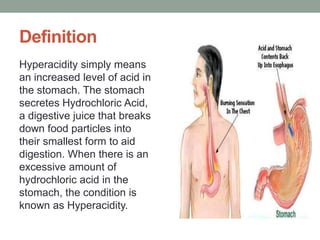
Hyperacidity simply means
an increased level of acid in
the stomach. The stomach
secretes Hydrochloric Acid,
a digestive juice that breaks
down food particles into
their smallest form to aid
digestion. When there is an
excessive amount of
hydrochloric acid in the
stomach, the condition is
known as Hyperacidity.
Causes
• Eating foods that do not suit the constitution or foods that
should not be taken together (milk and fish, milk and salt)
• Excessively sour or spicy foods and liquids, white flour
products and white sugar products
• Smoking and excessive consumption of tea, coffee and alcohol
• Eating in a state of indigestion
• Suppressing urges of urination and stool
• Sleeping in the daytime after meals
• Staying awake late into the night
• Excessive stress, anger and hunger
• Excessive exposure to sun and heat
• Gastro duodenal ulcer
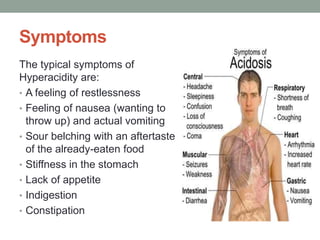
Symptoms
The typical symptoms of
Hyperacidity are:
• A feeling of restlessness
• Feeling of nausea (wanting to
throw up) and actual vomiting
• Sour belching with an aftertaste
of the already-eaten food
• Stiffness in the stomach
• Lack of appetite
• Indigestion
• Constipation
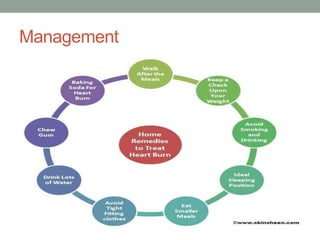
Management
Diet and Lifestyle Advice
• Avoid tea, coffee, and carbonated or alcoholic beverages
• Avoid processed and fermented foods
• Avoid using garlic, ginger, onions, tomatoes, and vinegar
in cooking
• Also avoid rich gravies, sour, salty, and spicy foods
• Curd should be strictly avoided at night
• Take meals in a relaxed atmosphere at regular intervals
Diet for Hyperacidity
• Eliminate or drastically reduce your intake of foods that
increase or contribute to acidity. Acidic foods such as
citrus fruit and tomatoes and foods such as garlic, leeks,
onions, mustard, vinegar, pepper, and cabbage should be
avoided
• Increase foods such as bananas, papayas, apples, and
watermelon that help reduce acidity by naturally
neutralizing acids in the stomach. Fruits such as peaches,
grapes, and berries should be eaten in moderation as too
much can cause heartburn as well.
Activities
Activities that put too much pressure on the stomach and
cause acid reflux, such as bending;
• lifting heavy objects,
• Straining and
• Coughing
• Do not wear tight clothes and lose weight if you are obese
• Stop smoking and limit your intake of alcohol
Practice Yoga
• Vajrasana,
• Bhujangasana
• Salabhasana
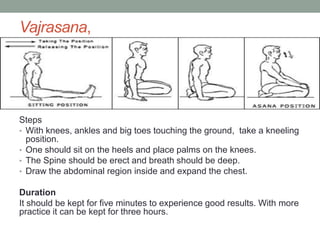
Vajrasana,
Steps
• With knees, ankles and big toes touching the ground, take a kneeling
position.
• One should sit on the heels and place palms on the knees.
• The Spine should be erect and breath should be deep.
• Draw the abdominal region inside and expand the chest.
Duration
It should be kept for five minutes to experience good results. With more
practice it can be kept for three hours.
BENEFITS
Vajrasan helps in
• Digestion of food,
• Dyspeptics
• Flatulence
• Nerves and muscles of the legs and thighs are
strengthened.
• Myalgia in the knees, legs, toes and thighs disappears.
• Sciatica vanishes.
Precaution
• The people having stiff joints and whose movements have
become difficult, should practice this Asana with a lot of
care. Such persons should practice this Asana after
getting the joints free and relaxed.
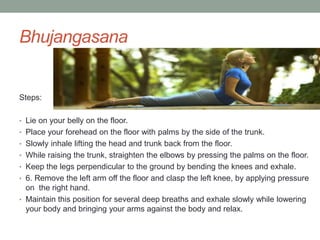
Bhujangasana
Steps:
• Lie on your belly on the floor.
• Place your forehead on the floor with palms by the side of the trunk.
• Slowly inhale lifting the head and trunk back from the floor.
• While raising the trunk, straighten the elbows by pressing the palms on the floor.
• Keep the legs perpendicular to the ground by bending the knees and exhale.
• 6. Remove the left arm off the floor and clasp the left knee, by applying pressure
on the right hand.
• Maintain this position for several deep breaths and exhale slowly while lowering
your body and bringing your arms against the body and relax.
Benefits
• Massages the internal organs, especially the digestive
organs
• Builds strength in the muscles of the upper back
• Increases flexibility in the lower back
• Removes rounded shoulders
• Helps relieve menstrual problems
Cautions
• Lower back problems
• Arthritis in spine or wrists
• Carpal tunnel syndrome
• Pregnancy
• Internal organ surgery
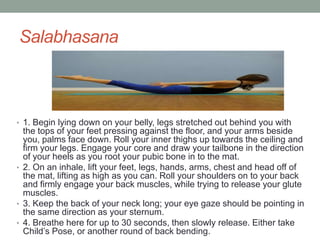
Salabhasana
• 1. Begin lying down on your belly, legs stretched out behind you with
the tops of your feet pressing against the floor, and your arms beside
you, palms face down. Roll your inner thighs up towards the ceiling and
firm your legs. Engage your core and draw your tailbone in the direction
of your heels as you root your pubic bone in to the mat.
• 2. On an inhale, lift your feet, legs, hands, arms, chest and head off of
the mat, lifting as high as you can. Roll your shoulders on to your back
and firmly engage your back muscles, while trying to release your glute
muscles.
• 3. Keep the back of your neck long; your eye gaze should be pointing in
the same direction as your sternum.
• 4. Breathe here for up to 30 seconds, then slowly release. Either take
Child’s Pose, or another round of back bending.
Benefits
• Stretches the chest, shoulders and abdominals
• Strengthens the upper and lower back, arms and legs
• Prepares the body for deeper back bending
• Improves posture
Cautions
• Back, neck or spinal injuries
• Pregnancy
Practice Pranayama
• Bhastrika Pranayama,
• Shitali Pranayama and
• Shitkari Pranayama
Bhastrika Pranayama
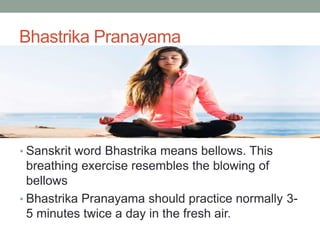
• Sanskrit word Bhastrika means bellows. This
breathing exercise resembles the blowing of
bellows
• Bhastrika Pranayama should practice normally 3-
5 minutes twice a day in the fresh air.
Steps for Bhastrika Pranayama
1. Sit comfortably on flat ground. Those who can’t sit on
ground can sit on chair because this pranayama is
related to the breath.
2. Take a deep breath through both nostrils and fill the
lungs with air and then exhale with hissing sound.
3. Inhale deeply and exhale completely.
4. Do this for 2 min to 5 minutes max and see the result in
a few days.
Benefits of Bhastrika Pranayama
• It improves blood circulation.
• Keep away the heart related problems.
• Provide relaxation to body and mind.
• Improves your concentration.
• Helps to stronger the lungs.
• Relive stress depression and hypertension.
• Cures obesity and arthritis.
• Increases appetite.
• Cure asthma, headache, Migraine, neurological
problems, depression, gastric problems.
Precaution
• can do this pranayama by slowly, medium and fast way.
• Those suffering from lungs and heart problems and high
blood pressure can perform slowly
Shitali Pranayama
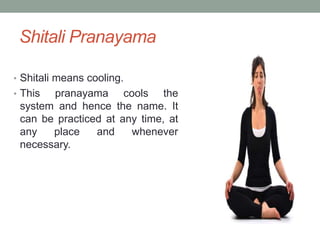
• Shitali means cooling.
• This pranayama cools the
system and hence the name. It
can be practiced at any time, at
any place and whenever
necessary.
Steps for Shitali Pranayama
• Sit straight on the floor. Open your mouth slightly, in such
a way that the tip of your tongue should be closer to both
lines of the teeth.
• Inhale fresh air slowly and steadily through and between
the lines of the teeth with a medium speed. Inhaling
should be in such a way that the incoming air touches the
tongue all the way from the tip to the very base.
• When you have inhaled enough air, exhale through both
nostrils at a medium speed.
• Again inhale through the mouth in the same way and
continue this process for up to 5 rounds
Benefits of Shitali Pranayama
• It activates the liver and spleen, improve digestion and
relieve thirst
• Helps deal with stress more effectively.
• Helps lower blood pressure.
• You are able to sleep better, thus helping fight insomnia.
• Mental calmness can help deal with anger and anxiety.
Precaution
• Do not Practice more than ten rounds at a time.
• While practicing Shitali for the first time, some practitioner
would catch cold or get a sore throat. In such case it is
better to stop further practice.
• Avoid these techniques during the extreme cold days of
winter.
• Also, avoid these if you are suffering from a cold or
congestion.
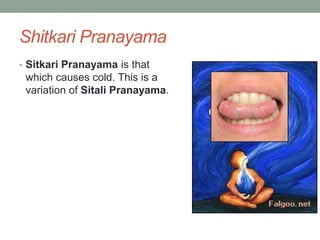
Shitkari Pranayama
• Sitkari Pranayama is that
which causes cold. This is a
variation of Sitali Pranayama.
Steps for Shitkari Pranayama
• Sit in padmasana, sukhasana or siddhasana posture.
• Keep the back straight.
• Open the mouth first.
• Slowly fold the tongue and touch the middle part of the
hard palate.
• Now, you are in ready state.
• Inhale the air through the mouth by the sides with an
‘ooss’ sound.
• Slowly exhale air through the nostrils. This is one round.
• Practice this for 15 to 20 rounds.
Benefits of Shitkari Pranayama
The regular practice of shitkari
• Helps to cure acidity, indigestion
• Lowers the body heat,
• Clears your complexion and
• Helps you in controlling thirst ,hunger and sleep.
• Reduces high blood pressure.
Precaution
• Persons with high blood pressure may find greater strain
in Sitkari than in Sitali Pranayama.
Hyperacidity

Hyperacidity

  • 1.
  • 2.
    Definition Hyperacidity simply means anincreased level of acid in the stomach. The stomach secretes Hydrochloric Acid, a digestive juice that breaks down food particles into their smallest form to aid digestion. When there is an excessive amount of hydrochloric acid in the stomach, the condition is known as Hyperacidity.
  • 3.
    Causes • Eating foodsthat do not suit the constitution or foods that should not be taken together (milk and fish, milk and salt) • Excessively sour or spicy foods and liquids, white flour products and white sugar products • Smoking and excessive consumption of tea, coffee and alcohol • Eating in a state of indigestion • Suppressing urges of urination and stool • Sleeping in the daytime after meals • Staying awake late into the night • Excessive stress, anger and hunger • Excessive exposure to sun and heat • Gastro duodenal ulcer
  • 4.
    Symptoms The typical symptomsof Hyperacidity are: • A feeling of restlessness • Feeling of nausea (wanting to throw up) and actual vomiting • Sour belching with an aftertaste of the already-eaten food • Stiffness in the stomach • Lack of appetite • Indigestion • Constipation
  • 5.
  • 6.
    Diet and LifestyleAdvice • Avoid tea, coffee, and carbonated or alcoholic beverages • Avoid processed and fermented foods • Avoid using garlic, ginger, onions, tomatoes, and vinegar in cooking • Also avoid rich gravies, sour, salty, and spicy foods • Curd should be strictly avoided at night • Take meals in a relaxed atmosphere at regular intervals
  • 7.
    Diet for Hyperacidity •Eliminate or drastically reduce your intake of foods that increase or contribute to acidity. Acidic foods such as citrus fruit and tomatoes and foods such as garlic, leeks, onions, mustard, vinegar, pepper, and cabbage should be avoided • Increase foods such as bananas, papayas, apples, and watermelon that help reduce acidity by naturally neutralizing acids in the stomach. Fruits such as peaches, grapes, and berries should be eaten in moderation as too much can cause heartburn as well.

  • 8.
    Activities Activities that puttoo much pressure on the stomach and cause acid reflux, such as bending; • lifting heavy objects, • Straining and • Coughing • Do not wear tight clothes and lose weight if you are obese • Stop smoking and limit your intake of alcohol
  • 9.
    Practice Yoga • Vajrasana, •Bhujangasana • Salabhasana
  • 10.
    Vajrasana, Steps • With knees,ankles and big toes touching the ground, take a kneeling position. • One should sit on the heels and place palms on the knees. • The Spine should be erect and breath should be deep. • Draw the abdominal region inside and expand the chest. Duration It should be kept for five minutes to experience good results. With more practice it can be kept for three hours.
  • 11.
    BENEFITS Vajrasan helps in •Digestion of food, • Dyspeptics • Flatulence • Nerves and muscles of the legs and thighs are strengthened. • Myalgia in the knees, legs, toes and thighs disappears. • Sciatica vanishes.
  • 12.
    Precaution • The peoplehaving stiff joints and whose movements have become difficult, should practice this Asana with a lot of care. Such persons should practice this Asana after getting the joints free and relaxed.
  • 13.
    Bhujangasana Steps: • Lie onyour belly on the floor. • Place your forehead on the floor with palms by the side of the trunk. • Slowly inhale lifting the head and trunk back from the floor. • While raising the trunk, straighten the elbows by pressing the palms on the floor. • Keep the legs perpendicular to the ground by bending the knees and exhale. • 6. Remove the left arm off the floor and clasp the left knee, by applying pressure on the right hand. • Maintain this position for several deep breaths and exhale slowly while lowering your body and bringing your arms against the body and relax.
  • 14.
    Benefits • Massages theinternal organs, especially the digestive organs • Builds strength in the muscles of the upper back • Increases flexibility in the lower back • Removes rounded shoulders • Helps relieve menstrual problems
  • 15.
    Cautions • Lower backproblems • Arthritis in spine or wrists • Carpal tunnel syndrome • Pregnancy • Internal organ surgery
  • 16.
    Salabhasana • 1. Beginlying down on your belly, legs stretched out behind you with the tops of your feet pressing against the floor, and your arms beside you, palms face down. Roll your inner thighs up towards the ceiling and firm your legs. Engage your core and draw your tailbone in the direction of your heels as you root your pubic bone in to the mat. • 2. On an inhale, lift your feet, legs, hands, arms, chest and head off of the mat, lifting as high as you can. Roll your shoulders on to your back and firmly engage your back muscles, while trying to release your glute muscles. • 3. Keep the back of your neck long; your eye gaze should be pointing in the same direction as your sternum. • 4. Breathe here for up to 30 seconds, then slowly release. Either take Child’s Pose, or another round of back bending.
  • 17.
    Benefits • Stretches thechest, shoulders and abdominals • Strengthens the upper and lower back, arms and legs • Prepares the body for deeper back bending • Improves posture
  • 18.
    Cautions • Back, neckor spinal injuries • Pregnancy
  • 19.
    Practice Pranayama • BhastrikaPranayama, • Shitali Pranayama and • Shitkari Pranayama
  • 20.
    Bhastrika Pranayama • Sanskritword Bhastrika means bellows. This breathing exercise resembles the blowing of bellows • Bhastrika Pranayama should practice normally 3- 5 minutes twice a day in the fresh air.
  • 21.
    Steps for BhastrikaPranayama 1. Sit comfortably on flat ground. Those who can’t sit on ground can sit on chair because this pranayama is related to the breath. 2. Take a deep breath through both nostrils and fill the lungs with air and then exhale with hissing sound. 3. Inhale deeply and exhale completely. 4. Do this for 2 min to 5 minutes max and see the result in a few days.
  • 22.
    Benefits of BhastrikaPranayama • It improves blood circulation. • Keep away the heart related problems. • Provide relaxation to body and mind. • Improves your concentration. • Helps to stronger the lungs. • Relive stress depression and hypertension. • Cures obesity and arthritis. • Increases appetite. • Cure asthma, headache, Migraine, neurological problems, depression, gastric problems.
  • 23.
    Precaution • can dothis pranayama by slowly, medium and fast way. • Those suffering from lungs and heart problems and high blood pressure can perform slowly
  • 24.
    Shitali Pranayama • Shitalimeans cooling. • This pranayama cools the system and hence the name. It can be practiced at any time, at any place and whenever necessary.
  • 25.
    Steps for ShitaliPranayama • Sit straight on the floor. Open your mouth slightly, in such a way that the tip of your tongue should be closer to both lines of the teeth. • Inhale fresh air slowly and steadily through and between the lines of the teeth with a medium speed. Inhaling should be in such a way that the incoming air touches the tongue all the way from the tip to the very base. • When you have inhaled enough air, exhale through both nostrils at a medium speed. • Again inhale through the mouth in the same way and continue this process for up to 5 rounds
  • 26.
    Benefits of ShitaliPranayama • It activates the liver and spleen, improve digestion and relieve thirst • Helps deal with stress more effectively. • Helps lower blood pressure. • You are able to sleep better, thus helping fight insomnia. • Mental calmness can help deal with anger and anxiety.
  • 27.
    Precaution • Do notPractice more than ten rounds at a time. • While practicing Shitali for the first time, some practitioner would catch cold or get a sore throat. In such case it is better to stop further practice. • Avoid these techniques during the extreme cold days of winter. • Also, avoid these if you are suffering from a cold or congestion.
  • 28.
    Shitkari Pranayama • SitkariPranayama is that which causes cold. This is a variation of Sitali Pranayama.
  • 29.
    Steps for ShitkariPranayama • Sit in padmasana, sukhasana or siddhasana posture. • Keep the back straight. • Open the mouth first. • Slowly fold the tongue and touch the middle part of the hard palate. • Now, you are in ready state. • Inhale the air through the mouth by the sides with an ‘ooss’ sound. • Slowly exhale air through the nostrils. This is one round. • Practice this for 15 to 20 rounds.
  • 30.
    Benefits of ShitkariPranayama The regular practice of shitkari • Helps to cure acidity, indigestion • Lowers the body heat, • Clears your complexion and • Helps you in controlling thirst ,hunger and sleep. • Reduces high blood pressure.
  • 31.
    Precaution • Persons withhigh blood pressure may find greater strain in Sitkari than in Sitali Pranayama.