Professional Ethics in Engineering
Background (5 hours)
Prof. Dr. Hari Krishna Shrestha
Nepal Engineering College
Changunarayan, Bhaktapur
July 2017
1.0 Background
1.1 History of Engineering practice
1.2 Cultural, Political, Societal motivations and limitations
1.3 Impacts and consequences of technology on society
1.4 Education and training of technologists, scientists and engineers
Updated: August 12, 2017
1.1 History of Engineering Practice
• Engineering: Application of data, information,
knowledge and technique for practical
beneficial use.
• “Beneficial for whom?” and “Are the benefits
sustainable?” are relatively modern issues in
Professional Engineering Practices.
• If a particular engineering project benefits only a few
persons in a society, is it justifiable? If an engineering
project’s benefit is unsustainable, should the society
promote it?
1.1 History of Engineering Practice
Short History of Engineering Practice
• Concrete is used for arched bridges, roads and aqueducts in Rome
(1200 BC-1 AD)
• Gunpowder use improved (1-1000 AD)
• Manufacturing and use of silk and glass (1000-1400 AD)
• Toilet, telescope, vacuum, and Gas Law (1400 – 1700 AD)
• Industrial revolution, steam engine, Society of Engineers (UK), cast
iron building (1700-1800 AD)
• Mechanical automation, railroad, telegraph (1800-1825 AD)
• Reinforced concrete, synthetic plastic material, Oil well, mass
production of steel, typewriter (1825-1875 AD)
• Telephone, light bulb, gasoline engine, automobile (1875-1900 AD)
1.1 History of Engineering Practice
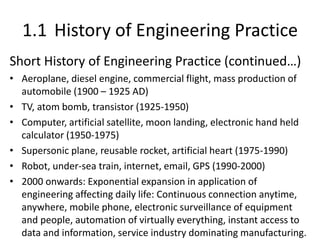
Short History of Engineering Practice (continued…)
• Aeroplane, diesel engine, commercial flight, mass production of
automobile (1900 – 1925 AD)
• TV, atom bomb, transistor (1925-1950)
• Computer, artificial satellite, moon landing, electronic hand held
calculator (1950-1975)
• Supersonic plane, reusable rocket, artificial heart (1975-1990)
• Robot, under-sea train, internet, email, GPS (1990-2000)
• 2000 onwards: Exponential expansion in application of
engineering affecting daily life: Continuous connection anytime,
anywhere, mobile phone, electronic surveillance of equipment
and people, automation of virtually everything, instant access to
data and information, service industry dominating manufacturing.
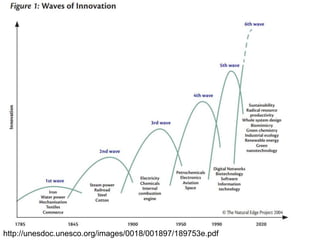
http://unesdoc.unesco.org/images/0018/001897/189753e.pdf
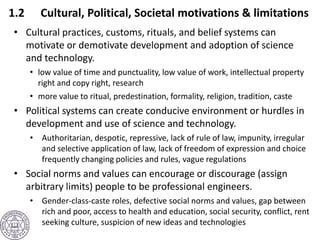
1.2 Cultural, Political, Societal motivations & limitations
• Cultural practices, customs, rituals, and belief systems can
motivate or demotivate development and adoption of science
and technology.
• low value of time and punctuality, low value of work, intellectual property
right and copy right, research
• more value to ritual, predestination, formality, religion, tradition, caste
• Political systems can create conducive environment or hurdles in
development and use of science and technology.
• Authoritarian, despotic, repressive, lack of rule of law, impunity, irregular
and selective application of law, lack of freedom of expression and choice
frequently changing policies and rules, vague regulations
• Social norms and values can encourage or discourage (assign
arbitrary limits) people to be professional engineers.
• Gender-class-caste roles, defective social norms and values, gap between
rich and poor, access to health and education, social security, conflict, rent
seeking culture, suspicion of new ideas and technologies
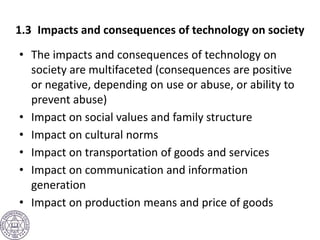
1.3 Impacts and consequences of technology on society
• The impacts and consequences of technology on
society are multifaceted (consequences are positive
or negative, depending on use or abuse, or ability to
prevent abuse)
• Impact on social values and family structure
• Impact on cultural norms
• Impact on transportation of goods and services
• Impact on communication and information
generation
• Impact on production means and price of goods
1.3 Impacts and Consequences of Technology on Socio-
economic parameters (positive): a) Agriculture
Impact on Impact
Food
Production
Mechanized, increasing, Green Revolution, GMF,
vertical hydroponic
Food
Processing
Food processing getting complex, requiring industrial
management
Food
Preservation
Food security increasing, for most, better food
preservation
Commercializat
ion
From subsistence to cash crop, patented seeds and
food processing techniques
Food Variety Increasing, year round availability, no more seasonal
Fertilizer/Pesticide From organic to chemical, pesticide use increasing
Water use Increasing due to cash crops & agricultural
intensification; reduced by micro-irrigation
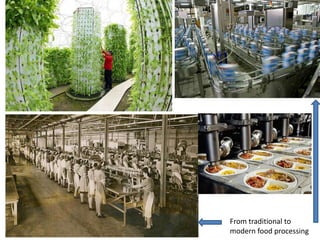
Hydroponic agriculture
From traditional to
modern food processing
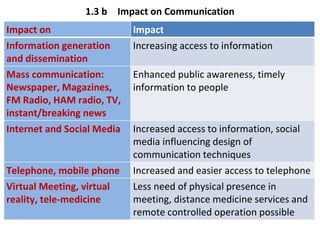
1.3 b Impact on Communication
Impact on Impact
Information generation
and dissemination
Increasing access to information
Mass communication:
Newspaper, Magazines,
FM Radio, HAM radio, TV,
instant/breaking news
Enhanced public awareness, timely
information to people
Internet and Social Media Increased access to information, social
media influencing design of
communication techniques
Telephone, mobile phone Increased and easier access to telephone
Virtual Meeting, virtual
reality, tele-medicine
Less need of physical presence in
meeting, distance medicine services and
remote controlled operation possible
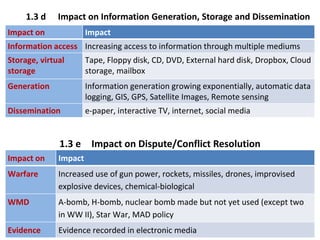
1.3 d Impact on Information Generation, Storage and Dissemination
Impact on Impact
Information access Increasing access to information through multiple mediums
Storage, virtual
storage
Tape, Floppy disk, CD, DVD, External hard disk, Dropbox, Cloud
storage, mailbox
Generation Information generation growing exponentially, automatic data
logging, GIS, GPS, Satellite Images, Remote sensing
Dissemination e-paper, interactive TV, internet, social media
Impact on Impact
Warfare Increased use of gun power, rockets, missiles, drones, improvised
explosive devices, chemical-biological
WMD A-bomb, H-bomb, nuclear bomb made but not yet used (except two
in WW II), Star War, MAD policy
Evidence Evidence recorded in electronic media
1.3 e Impact on Dispute/Conflict Resolution
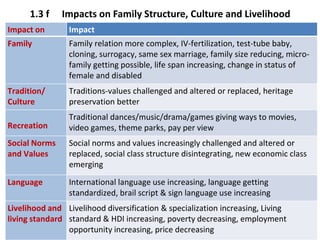
1.3 f Impacts on Family Structure, Culture and Livelihood
Impact on Impact
Family Family relation more complex, IV-fertilization, test-tube baby,
cloning, surrogacy, same sex marriage, family size reducing, micro-
family getting possible, life span increasing, change in status of
female and disabled
Tradition/
Culture
Traditions-values challenged and altered or replaced, heritage
preservation better
Recreation
Traditional dances/music/drama/games giving ways to movies,
video games, theme parks, pay per view
Social Norms
and Values
Social norms and values increasingly challenged and altered or
replaced, social class structure disintegrating, new economic class
emerging
Language International language use increasing, language getting
standardized, brail script & sign language use increasing
Livelihood and
living standard
Livelihood diversification & specialization increasing, Living
standard & HDI increasing, poverty decreasing, employment
opportunity increasing, price decreasing
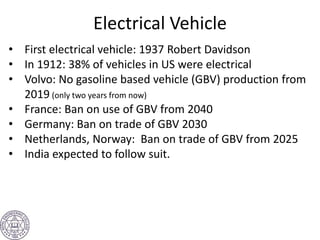
Electrical Vehicle
• First electrical vehicle: 1937 Robert Davidson
• In 1912: 38% of vehicles in US were electrical
• Volvo: No gasoline based vehicle (GBV) production from
2019 (only two years from now)
• France: Ban on use of GBV from 2040
• Germany: Ban on trade of GBV 2030
• Netherlands, Norway: Ban on trade of GBV from 2025
• India expected to follow suit.
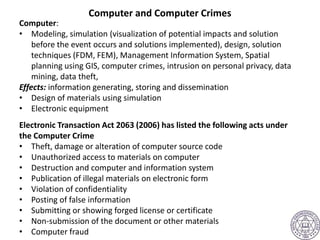
Computer and Computer Crimes
Computer:
• Modeling, simulation (visualization of potential impacts and solution
before the event occurs and solutions implemented), design, solution
techniques (FDM, FEM), Management Information System, Spatial
planning using GIS, computer crimes, intrusion on personal privacy, data
mining, data theft,
Effects: information generating, storing and dissemination
• Design of materials using simulation
• Electronic equipment
Electronic Transaction Act 2063 (2006) has listed the following acts under
the Computer Crime
• Theft, damage or alteration of computer source code
• Unauthorized access to materials on computer
• Destruction and computer and information system
• Publication of illegal materials on electronic form
• Violation of confidentiality
• Posting of false information
• Submitting or showing forged license or certificate
• Non-submission of the document or other materials
• Computer fraud
1.4 Education and training of
technologists, scientists and engineers
• Continuous education and training (E&T) is a regular process for the
technologists, scientists and engineers (TSE)
• New concept, knowledge, technology, hardware and software, materials,
equipment, tools, gadgets, keep coming in the market. New policies,
acts/laws, rules and standards are periodically adopted. The TSE need to keep
up with the latest developments to prevent themselves from being out of
date.
o Information & Technology Policy 2000; Science & Technology Policy, 2005
o The Electronic Transactions Act 2006
o Electronic Transactions Rule 2007
o Nepal Electronic Cheque Clearing Rule Book, 2011 (ECC Rule)
o e-governance, e-bidding, e-procurement, e-banking, e-sewa,
o High Level Commission for Information Technology
• Nepal Administrative Staff College caters to the continuous E&T needs of
administrative staff; no similar institute for TSEs in Nepal.
• Continuing Education Division/IoE partially caters to the needs of TSEs
• Currently a myriad of different organizations are filling the gap of lack of
formal system of E&T for TSEs in Nepal.
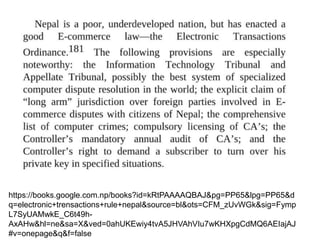
https://books.google.com.np/books?id=kRtPAAAAQBAJ&pg=PP65&lpg=PP65&d
q=electronic+trensactions+rule+nepal&source=bl&ots=CFM_zUvWGk&sig=Fymp
L7SyUAMwkE_C6t49h-
AxAHw&hl=ne&sa=X&ved=0ahUKEwiy4tvA5JHVAhVIu7wKHXpgCdMQ6AEIajAJ
#v=onepage&q&f=false
Potential Questions
• List the type of cultural, political and societal practices which
motivate development of science and technology in a society.
• List the type of cultural, political and societal practices which
limit development of science and technology in a society.
• What is the impact of development of ICT in social values?
• What is the impact of computers in mechanized production, and
how has it impacted society?
• What are the different forms of computer crimes, and how has
computer crime impacted society?
• What should be the modality of the education and training of
the technologists, scientists and engineers?
• What specific type of training should the electronics engineers
and/or electrical engineers be provided?

Professional Ethics in Engineering Chapter 1 Background HKS

  • 1.
    Professional Ethics inEngineering Background (5 hours) Prof. Dr. Hari Krishna Shrestha Nepal Engineering College Changunarayan, Bhaktapur July 2017 1.0 Background 1.1 History of Engineering practice 1.2 Cultural, Political, Societal motivations and limitations 1.3 Impacts and consequences of technology on society 1.4 Education and training of technologists, scientists and engineers Updated: August 12, 2017
  • 2.
    1.1 History ofEngineering Practice • Engineering: Application of data, information, knowledge and technique for practical beneficial use. • “Beneficial for whom?” and “Are the benefits sustainable?” are relatively modern issues in Professional Engineering Practices. • If a particular engineering project benefits only a few persons in a society, is it justifiable? If an engineering project’s benefit is unsustainable, should the society promote it?
  • 3.
    1.1 History ofEngineering Practice Short History of Engineering Practice • Concrete is used for arched bridges, roads and aqueducts in Rome (1200 BC-1 AD) • Gunpowder use improved (1-1000 AD) • Manufacturing and use of silk and glass (1000-1400 AD) • Toilet, telescope, vacuum, and Gas Law (1400 – 1700 AD) • Industrial revolution, steam engine, Society of Engineers (UK), cast iron building (1700-1800 AD) • Mechanical automation, railroad, telegraph (1800-1825 AD) • Reinforced concrete, synthetic plastic material, Oil well, mass production of steel, typewriter (1825-1875 AD) • Telephone, light bulb, gasoline engine, automobile (1875-1900 AD)
  • 4.
    1.1 History ofEngineering Practice Short History of Engineering Practice (continued…) • Aeroplane, diesel engine, commercial flight, mass production of automobile (1900 – 1925 AD) • TV, atom bomb, transistor (1925-1950) • Computer, artificial satellite, moon landing, electronic hand held calculator (1950-1975) • Supersonic plane, reusable rocket, artificial heart (1975-1990) • Robot, under-sea train, internet, email, GPS (1990-2000) • 2000 onwards: Exponential expansion in application of engineering affecting daily life: Continuous connection anytime, anywhere, mobile phone, electronic surveillance of equipment and people, automation of virtually everything, instant access to data and information, service industry dominating manufacturing.
  • 5.
  • 6.
    1.2 Cultural, Political,Societal motivations & limitations • Cultural practices, customs, rituals, and belief systems can motivate or demotivate development and adoption of science and technology. • low value of time and punctuality, low value of work, intellectual property right and copy right, research • more value to ritual, predestination, formality, religion, tradition, caste • Political systems can create conducive environment or hurdles in development and use of science and technology. • Authoritarian, despotic, repressive, lack of rule of law, impunity, irregular and selective application of law, lack of freedom of expression and choice frequently changing policies and rules, vague regulations • Social norms and values can encourage or discourage (assign arbitrary limits) people to be professional engineers. • Gender-class-caste roles, defective social norms and values, gap between rich and poor, access to health and education, social security, conflict, rent seeking culture, suspicion of new ideas and technologies
  • 7.
    1.3 Impacts andconsequences of technology on society • The impacts and consequences of technology on society are multifaceted (consequences are positive or negative, depending on use or abuse, or ability to prevent abuse) • Impact on social values and family structure • Impact on cultural norms • Impact on transportation of goods and services • Impact on communication and information generation • Impact on production means and price of goods
  • 8.
    1.3 Impacts andConsequences of Technology on Socio- economic parameters (positive): a) Agriculture Impact on Impact Food Production Mechanized, increasing, Green Revolution, GMF, vertical hydroponic Food Processing Food processing getting complex, requiring industrial management Food Preservation Food security increasing, for most, better food preservation Commercializat ion From subsistence to cash crop, patented seeds and food processing techniques Food Variety Increasing, year round availability, no more seasonal Fertilizer/Pesticide From organic to chemical, pesticide use increasing Water use Increasing due to cash crops & agricultural intensification; reduced by micro-irrigation
  • 9.
    Hydroponic agriculture From traditionalto modern food processing
  • 10.
    1.3 b Impacton Communication Impact on Impact Information generation and dissemination Increasing access to information Mass communication: Newspaper, Magazines, FM Radio, HAM radio, TV, instant/breaking news Enhanced public awareness, timely information to people Internet and Social Media Increased access to information, social media influencing design of communication techniques Telephone, mobile phone Increased and easier access to telephone Virtual Meeting, virtual reality, tele-medicine Less need of physical presence in meeting, distance medicine services and remote controlled operation possible
  • 11.
    1.3 d Impacton Information Generation, Storage and Dissemination Impact on Impact Information access Increasing access to information through multiple mediums Storage, virtual storage Tape, Floppy disk, CD, DVD, External hard disk, Dropbox, Cloud storage, mailbox Generation Information generation growing exponentially, automatic data logging, GIS, GPS, Satellite Images, Remote sensing Dissemination e-paper, interactive TV, internet, social media Impact on Impact Warfare Increased use of gun power, rockets, missiles, drones, improvised explosive devices, chemical-biological WMD A-bomb, H-bomb, nuclear bomb made but not yet used (except two in WW II), Star War, MAD policy Evidence Evidence recorded in electronic media 1.3 e Impact on Dispute/Conflict Resolution
  • 12.
    1.3 f Impactson Family Structure, Culture and Livelihood Impact on Impact Family Family relation more complex, IV-fertilization, test-tube baby, cloning, surrogacy, same sex marriage, family size reducing, micro- family getting possible, life span increasing, change in status of female and disabled Tradition/ Culture Traditions-values challenged and altered or replaced, heritage preservation better Recreation Traditional dances/music/drama/games giving ways to movies, video games, theme parks, pay per view Social Norms and Values Social norms and values increasingly challenged and altered or replaced, social class structure disintegrating, new economic class emerging Language International language use increasing, language getting standardized, brail script & sign language use increasing Livelihood and living standard Livelihood diversification & specialization increasing, Living standard & HDI increasing, poverty decreasing, employment opportunity increasing, price decreasing
  • 14.
    Electrical Vehicle • Firstelectrical vehicle: 1937 Robert Davidson • In 1912: 38% of vehicles in US were electrical • Volvo: No gasoline based vehicle (GBV) production from 2019 (only two years from now) • France: Ban on use of GBV from 2040 • Germany: Ban on trade of GBV 2030 • Netherlands, Norway: Ban on trade of GBV from 2025 • India expected to follow suit.
  • 15.
    Computer and ComputerCrimes Computer: • Modeling, simulation (visualization of potential impacts and solution before the event occurs and solutions implemented), design, solution techniques (FDM, FEM), Management Information System, Spatial planning using GIS, computer crimes, intrusion on personal privacy, data mining, data theft, Effects: information generating, storing and dissemination • Design of materials using simulation • Electronic equipment Electronic Transaction Act 2063 (2006) has listed the following acts under the Computer Crime • Theft, damage or alteration of computer source code • Unauthorized access to materials on computer • Destruction and computer and information system • Publication of illegal materials on electronic form • Violation of confidentiality • Posting of false information • Submitting or showing forged license or certificate • Non-submission of the document or other materials • Computer fraud
  • 16.
    1.4 Education andtraining of technologists, scientists and engineers • Continuous education and training (E&T) is a regular process for the technologists, scientists and engineers (TSE) • New concept, knowledge, technology, hardware and software, materials, equipment, tools, gadgets, keep coming in the market. New policies, acts/laws, rules and standards are periodically adopted. The TSE need to keep up with the latest developments to prevent themselves from being out of date. o Information & Technology Policy 2000; Science & Technology Policy, 2005 o The Electronic Transactions Act 2006 o Electronic Transactions Rule 2007 o Nepal Electronic Cheque Clearing Rule Book, 2011 (ECC Rule) o e-governance, e-bidding, e-procurement, e-banking, e-sewa, o High Level Commission for Information Technology • Nepal Administrative Staff College caters to the continuous E&T needs of administrative staff; no similar institute for TSEs in Nepal. • Continuing Education Division/IoE partially caters to the needs of TSEs • Currently a myriad of different organizations are filling the gap of lack of formal system of E&T for TSEs in Nepal.
  • 17.
  • 18.
    Potential Questions • Listthe type of cultural, political and societal practices which motivate development of science and technology in a society. • List the type of cultural, political and societal practices which limit development of science and technology in a society. • What is the impact of development of ICT in social values? • What is the impact of computers in mechanized production, and how has it impacted society? • What are the different forms of computer crimes, and how has computer crime impacted society? • What should be the modality of the education and training of the technologists, scientists and engineers? • What specific type of training should the electronics engineers and/or electrical engineers be provided?