The document presents a low complexity near optimal detector for spatial modulation in MIMO systems, which significantly mitigates inter-antenna interference and enhances energy efficiency. It details the performance of the proposed matched filter-based detector, comparing it with existing methods such as maximum likelihood and conventional matched filter techniques through simulation results. The findings indicate that the modified matched filter achieves near-optimal performance with reduced complexity, particularly when estimating active transmitting antennas and symbols separately.
![International Journal of Electrical and Computer Engineering (IJECE)
Vol. 7, No. 2, April 2017, pp. 818~822
ISSN: 2088-8708, DOI: 10.11591/ijece.v7i2.pp818-822 818
Journal homepage: http://iaesjournal.com/online/index.php/IJECE
Hybrid Low Complex near Optimal Detector for Spatial
Modulation
P. Rajani Kumari1
, K. Chenna Kesava Reddy2
, K.S. Ramesh3
1,3
Department of Electronics and Communication Engineering, K.L University, India
2
Department of Electronics and Communication Engineering, Adama University, Ethiopia
Article Info ABSTRACT
Article history:
Received Sep 14, 2016
Revised Feb 22, 2017
Accepted Mar 6, 2017
In our previous work maximum throughput in multi stream MIMO is
analyzed by overcoming the inter antenna interference. To mitigate the Inter
antenna interference spatial modulation can be used. Spatial Modulation
(SM) aided MIMO systems are the emerging MIMO systems which are low
complex and energy efficient. These systems additionally use spatial
dimensions for transmitting information. In this paper a low complex
detector based on matched filter is proposed for spatial modulation to achieve
near maximum likelihood performance while avoiding exhaustive ML search
since MF based detector exhibits a considerable reduced complexity since
activated transmitting antenna and modulated amplitude phase modulation
constellation are estimated separately. Simulation results show the
performance of the proposed method with optimal ML detector, MRC and
conventional matched filter methods.
Keyword:
Energy efficient
Low complex
Matched filter
Maximum likelihood
MRC
Spatial Modulation Copyright © 2017 Institute of Advanced Engineering and Science.
All rights reserved.
Corresponding Author:
P. Rajani Kumari,
Department of Electrical and Computer Engineering,
K.L University,
Green Fields, Vaddeswaram, Guntur, Andhra Pradesh, India 522502.
Email: prajanikumari.kl@gmail.com
1. INTRODUCTION
The performance of the wireless communication systems can be enhanced by using multiple
antennas at the transmitter, receiver, or both, this signal processing technique is known as Multiple Input
Multiple Output (MIMO) [1], [2]. This signal processing technique can be used to overcome the multipath
scattering effect. MIMO uses random fading and multipath propagation to increase the transmission rate and
can achieve capacity gain or diversity gain. In [3], [4] transmission techniques in MIMO can be extended to
time-domain, frequency domain or combination of both time-domain and frequency domain. To achieve the
freedom offered by MIMO channels, a transmission technique as to be designed to achieve the diverse range
of real time requirements and to overcome the tradeoff among computational complexity and the achievable
bit error rate (BER) and maximum transmission rate [5].
Recently proposed single RF chain [6], spatial modulation (SM) is a promising among the MIMO
techniques. Spatial Modulated MIMO uses the indices of the transmitting antennas (TAs) for transmitting
information, apart from traditional Amplitude and Phase Modulation (APM) [7]. Potentiality of SM-MIMO
is higher when compared to that of space-time coding at a given SNR [8]. SM-MIMO uses only single TA at
any instant which is the most prominent benefit. Since only single TA is active SM can overcome the
multiple radio frequency chain so that Inter-Antenna synchronization and the inter antenna interference can
be mitigated, which has a great effect in traditional MIMO techniques [9]. The additional benefit of SM is, as
it is using only single RF chain total power consumption can be reduced [10], [11]. In fact, only a single
power amplifier is needed for implementing SM-MIMO systems, which is typically responsible for the vast
majority of power dissipation at the transmitter.](https://image.slidesharecdn.com/v3022feb1716oct1612639-26831-2-ed-201016021123/85/Hybrid-Low-Complex-near-Optimal-Detector-for-Spatial-Modulation-1-320.jpg)
![International Journal of Electrical and Computer Engineering (IJECE)
Vol. 7, No. 2, April 2017, pp. 818~822
ISSN: 2088-8708, DOI: 10.11591/ijece.v7i2.pp818-822 818
Journal homepage: http://iaesjournal.com/online/index.php/IJECE
Hybrid Low Complex near Optimal Detector for Spatial
Modulation
P. Rajani Kumari1
, K. Chenna Kesava Reddy2
, K.S. Ramesh3
1,3
Department of Electronics and Communication Engineering, K.L University, India
2
Department of Electronics and Communication Engineering, Adama University, Ethiopia
Article Info ABSTRACT
Article history:
Received Sep 14, 2016
Revised Feb 22, 2017
Accepted Mar 6, 2017
In our previous work maximum throughput in multi stream MIMO is
analyzed by overcoming the inter antenna interference. To mitigate the Inter
antenna interference spatial modulation can be used. Spatial Modulation
(SM) aided MIMO systems are the emerging MIMO systems which are low
complex and energy efficient. These systems additionally use spatial
dimensions for transmitting information. In this paper a low complex
detector based on matched filter is proposed for spatial modulation to achieve
near maximum likelihood performance while avoiding exhaustive ML search
since MF based detector exhibits a considerable reduced complexity since
activated transmitting antenna and modulated amplitude phase modulation
constellation are estimated separately. Simulation results show the
performance of the proposed method with optimal ML detector, MRC and
conventional matched filter methods.
Keyword:
Energy efficient
Low complex
Matched filter
Maximum likelihood
MRC
Spatial Modulation Copyright © 2017 Institute of Advanced Engineering and Science.
All rights reserved.
Corresponding Author:
P. Rajani Kumari,
Department of Electrical and Computer Engineering,
K.L University,
Green Fields, Vaddeswaram, Guntur, Andhra Pradesh, India 522502.
Email: prajanikumari.kl@gmail.com
1. INTRODUCTION
The performance of the wireless communication systems can be enhanced by using multiple
antennas at the transmitter, receiver, or both, this signal processing technique is known as Multiple Input
Multiple Output (MIMO) [1], [2]. This signal processing technique can be used to overcome the multipath
scattering effect. MIMO uses random fading and multipath propagation to increase the transmission rate and
can achieve capacity gain or diversity gain. In [3], [4] transmission techniques in MIMO can be extended to
time-domain, frequency domain or combination of both time-domain and frequency domain. To achieve the
freedom offered by MIMO channels, a transmission technique as to be designed to achieve the diverse range
of real time requirements and to overcome the tradeoff among computational complexity and the achievable
bit error rate (BER) and maximum transmission rate [5].
Recently proposed single RF chain [6], spatial modulation (SM) is a promising among the MIMO
techniques. Spatial Modulated MIMO uses the indices of the transmitting antennas (TAs) for transmitting
information, apart from traditional Amplitude and Phase Modulation (APM) [7]. Potentiality of SM-MIMO
is higher when compared to that of space-time coding at a given SNR [8]. SM-MIMO uses only single TA at
any instant which is the most prominent benefit. Since only single TA is active SM can overcome the
multiple radio frequency chain so that Inter-Antenna synchronization and the inter antenna interference can
be mitigated, which has a great effect in traditional MIMO techniques [9]. The additional benefit of SM is, as
it is using only single RF chain total power consumption can be reduced [10], [11]. In fact, only a single
power amplifier is needed for implementing SM-MIMO systems, which is typically responsible for the vast
majority of power dissipation at the transmitter.](https://image.slidesharecdn.com/v3022feb1716oct1612639-26831-2-ed-201016021123/75/Hybrid-Low-Complex-near-Optimal-Detector-for-Spatial-Modulation-1-2048.jpg)
![ ISSN:2088-8708
IJECE Vol. 7, No. 2, April 2017 : 818–822
819
In this paper section 2 deals with spatial modulation system model, optimal detector and sub optimal
detector for decoding spatial modulated data. In section 3 hybrid low complex near optimal detector is
proposed for SM. Section 4 deals with the simulation results and its discussion.
2. SPATIAL MODULATION
2.1. System Model
Consider Nt and Nr are the no of transmitting antennas and the receiving antennas respectively. In
case of conventional MIMO systems takes advantage of all transmitting antennas and transmit multiple data
streams through them simultaneously.
In case of SM-MIMO bit streams generated by source are divided into, spatial symbols and
constellation symbols. No of bits used to represent spatial symbol is given by and bits for
constellation symbol is given by where M is modulation index. Spatial bits are used to denote the
active antenna and the bits in the constellation symbol are used to choose symbol in signal constellation.
In this paper is used to denote the active transmitting antenna where * + and symbol
transmitted through is denoted by where * + . The transmitted vector for given and
is given by (1)
[ ] (1)
where [.]T
denotes transpose of the matrix.
The received vector is given by (2)
(2)
where H is the channel matrix and n- 1xNr Additive White Gaussian Noise (AWGN) with zero mean and
as variance. Equation 2 can be modified as Equation 3.
(3)
2.2. ML Detector
ML algorithm has an optimal performance for SM system. But the complexity of ML detector is
very high with exhaustive search for „l‟ i.e., active transmitting antenna and„s‟ i.e., modulated APM
constellation. Estimated „l‟ and„s‟ is given as
( ) ‖ ‖ (4)
where „l‟ is transmitting antenna, Nt number of transmitting antennas, S denotes symbol alphabet.
2.3. MRC Detector
The MRC [12] based sub-optimal SM detector decouples the transmit antenna and symbol
estimation processes. The transmit antenna index is estimated first followed by symbol estimation. In
general, these two estimation processes are interdependent and their subsequent decoupling during detection
leads to reduced performance. In this method the Hermitian transpose of the channel matrix H is multiplied
by the received signal Y in order to formulate the decision metric of Z.
(5)
Then, the index q of the activated dispersion matrix is given as
(6)
Transmit antenna estimate is assumed to be correct and based on this assumption combined symbol is given
by
(7)](https://image.slidesharecdn.com/v3022feb1716oct1612639-26831-2-ed-201016021123/85/Hybrid-Low-Complex-near-Optimal-Detector-for-Spatial-Modulation-2-320.jpg)
![IJECE ISSN: 2088-8708
Hybrid Low Complex near Optimal Detector for Spatial Modulation (P. Rajani Kumari)
820
2.4. MF Detector
In this method same like MRC the Hermitian transpose of the channel matrix H is multiplied by the
received signal Y in order to formulate the decision metric of Z.
(8)
Then, the index q of the activated dispersion matrix and the transmitted symbol index l are estimated
separately, as follows:
(9)
‖ ‖ (10)
3. MODIFIED MATCHED FILTER BASED DETECTOR
In this method each column in channel matrix H is normalized and transformed as shown below
̂ [‖ ‖ ‖ ‖
] (11)
MF detector decision metric is given as
̂ (12)
Then a vector by vector exhaustive search is done on the decision metric for the estimation of the active
transmitting antenna.
(̂ ̂) ‖ ‖ ‖ ‖ (13)
(̂ ̂) , ‖ ‖{ ( ) ( ) ( ) ( )} ‖ ‖ - (14)
where real(), imag() represent real and imaginary part respectively. In order to reduce the complexity of the
detection relying on above Equation, we introduced the separate detection of q and l. active transmit antenna
is given by
̂ , ‖ ‖{ ( ) ( ) ( ) ( )} ‖ ‖ - (15)
By using above detected transmit antenna, symbol index s is detected as
̂ ‖ ̂‖ (16)
The complexity of detection of ̂ of above modified MF detector can future be reduced as
̂ [ ( )
| ( )|
| |
( )
( )
| |
] (17)
For detection of symbol index l, same Equation used in detection of l in modified MF is used.
4. RESULTS AND ANALYSIS
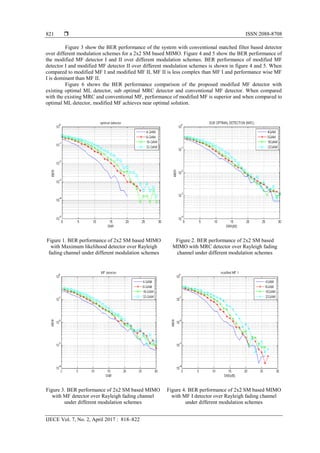
Bit Error Rate (BER) performance of the spatial modulation based MIMO over various detectors is
analyzed and compared with the modified matched filter I and II. A 2x2 MIMO configuration with various
modulation schemes like 4-QAM, 8-QAM, 16-QAM and 32-QAM is implemented under Rayleigh fading
channel, here one bit is used to select the transmitting antenna and remaining bits are transmitted through the
selected antenna. BER performance of 2x2 SM based MIMO with maximum likelihood detector is shown in
figure, at BER=10-3
from the simulation result effect of modulation schemes can be clearly seen. BER
performance of the MRC detector is illustrated in Figure 2.](https://image.slidesharecdn.com/v3022feb1716oct1612639-26831-2-ed-201016021123/85/Hybrid-Low-Complex-near-Optimal-Detector-for-Spatial-Modulation-3-320.jpg)
![IJECE ISSN: 2088-8708
Hybrid Low Complex near Optimal Detector for Spatial Modulation (P. Rajani Kumari)
822
Figure 5. BER performance of 2x2 SM based MIMO
with MF II detector over Rayleigh fading channel
under different modulation schemes
Figure 6. BER performance comparison of ML,
MRC, MF and Modified MF I
5. CONCLUSION
From the simulation result we can conclude that the modified version of the matched filter based
detector achieves near optimal solution. As the detection of the active antenna element and the transmitted
data are estimated separately done in modified MF the complexity of the detector is reduced when compared
with the optimal detector. When the two different variants of the MF detectors are compared the performance
of the modified MF I is better than the second one were as the complexity of modified MF I is high when
compared to MF II.
REFERENCES
[1] P. Rajani Kumari, Dr. K. Chenna Kesava Reddy and Dr. K.S. Ramesh, “Ordered Successive Interference
Cancellation for Maximum Throughput in Multi Stream MIMO using Different Modulation Schemes”, Indian
Journal of Science and Technology, Vol 9(9), March 2016.
[2] Kehinde Odeyemi, Erastus Ogunti, “Capacity Enhancement for High Data Rate Wireless Communication System”,
International Journal of Electrical and Computer Engineering, 2014; 4(5), 800-809.
[3] S. Sugiura, S. Chen, and L. Hanzo, “MIMO-aided nearcapacity turbo transceivers: Taxonomy and performance
versus complexity”, IEEE Commun. Surveys Tutorials. 2012; 14(2), 421-442.
[4] S. Sugiura, S. Chen, and L. Hanzo, “A universal space-time architecture for multiple-antenna aided systems”, IEEE
Commun. Surveys Tutorials. 2012; 14(2), 401-420.
[5] J. Mietzner, R. Schober, L. Lampe, W.H. Gerstacker, and P.A. Hoeher, “Multiple-Antenna Techniques for Wireless
Communications-A Comprehensive Literature Survey”, IEEE Communications Surveys & Tutorials, 2009; 11(2),
87- 105.
[6] R.Y. Mesleh, H. Haas, S. Sinanovic, C.W. Ahn, and S. Yun, “Spatial Modulation”, IEEE Trans. Veh. Technol.
2008; 57(4), 2228-2241.
[7] L. Hanzo, S.X. Ng, T. Keller, and W. Webb, “Quadrature Amplitude Modulation: From Basics to Adaptive Trellis-
Coded, Turbo-Equalised and Space-Time Coded OFDM, CDMA and MC-CDMA Systems”, John Wiley and IEEE
Press, 2004.
[8] M. Di Renzo, H. Haas, and P.M. Grant, “Spatial Modulation for Multiple-Antenna Wireless Systems: A Survey”,
IEEE Commun. Mag. 2011; 49(12), 182-191.
[9] M. Di Renzo, H. Haas, A. Ghrayeb, S. Sugiura, and L. Hanzo, “Spatial Modulation for Generalized MIMO:
Challenges, Opportunities and Implementation”, Proceedings of the IEEE, 2014; 102(1), 56-103.
[10] A. Stavridis, S. Sinanovic, M. Di Renzo, H. Haas, and P.M. Grant, “An Energy Saving base Station Employing
Spatial Modulation”, IEEE Int. Workshop on Computer-Aided Modeling Analysis and Design of Communication
Links and Networks, Barcelona, Spain, Sept. 2012; 1-6.
[11] A. Stavridis, S. Sinanovic, M. Di Renzo, and H. Haas, “Energy Evaluation of Spatial Modulation at a Multi-
Antenna base Station”, IEEE Veh. Technol. Conf. -Fall, Barcelona, Spain, Sept. 2013, 1-5.
[12] Vaibhav. S. Hendre, M. Murugan, Sneha Kamthe, P”erformance Analysis of Transmit Antenna Selection with
MRC in MIMO for Image Transmission in Multipath Fading Channels Using Simulink”, International Journal of
Electrical and Computer Engineering, 2015; 5(1), 119-128.](https://image.slidesharecdn.com/v3022feb1716oct1612639-26831-2-ed-201016021123/85/Hybrid-Low-Complex-near-Optimal-Detector-for-Spatial-Modulation-5-320.jpg)


