‘Dysfunctional Family’ by Yinka Shonibare
In pairs, answer the following questions:
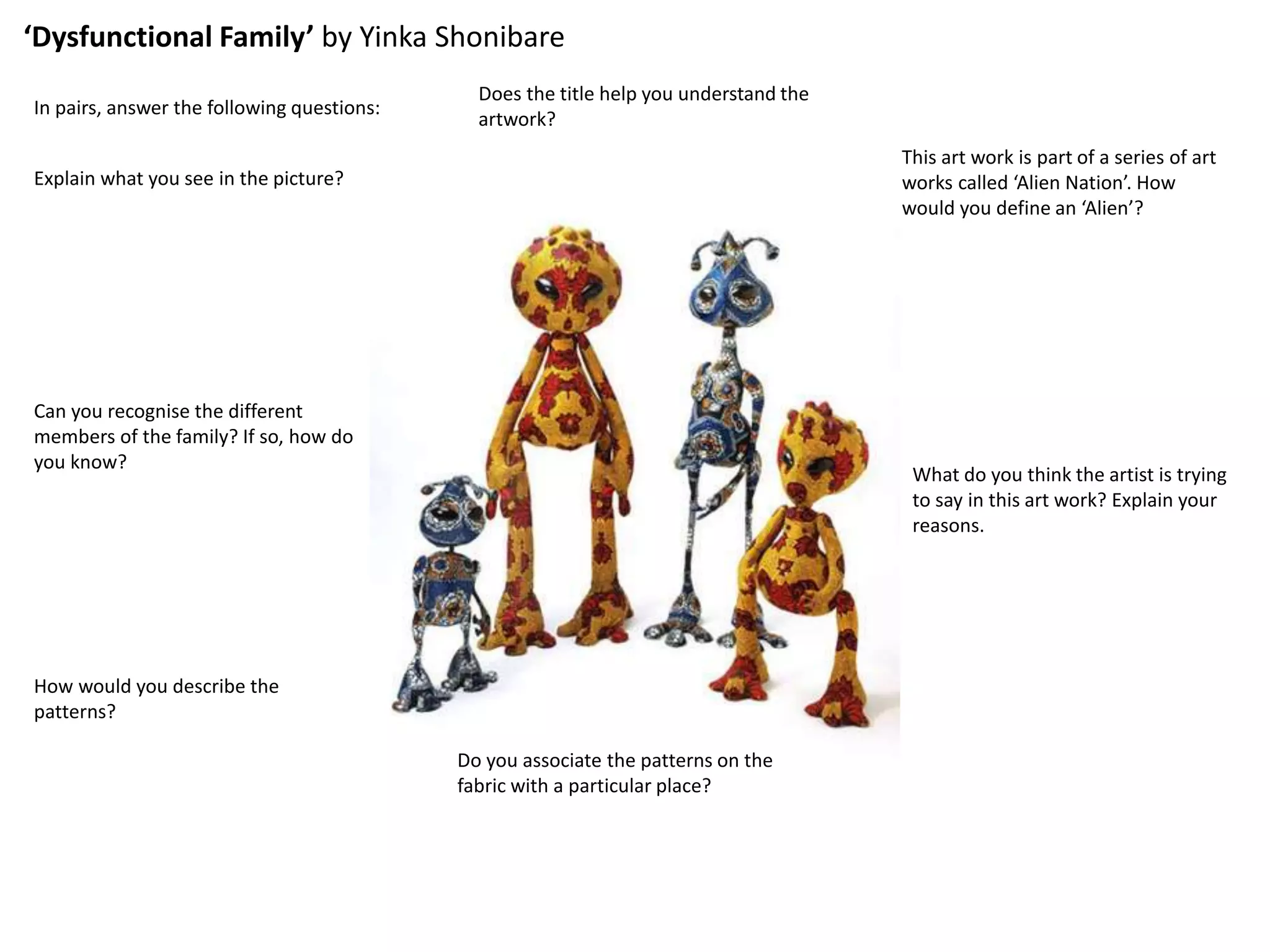
Explain what you see in the picture?
Can you recognise the different
members of the family? If so, how do
you know?
How would you describe the
patterns?
Do you associate the patterns on the
fabric with a particular place?
What do you think the artist is trying
to say in this art work? Explain your
reasons.
This art work is part of a series of art
works called ‘Alien Nation’. How
would you define an ‘Alien’?
Does the title help you understand the
artwork?
Homework:
1. Write the title- ‘ Dysfunctional Family’ 1999 by Yinka Shonibare -in your
sketchbook.
2. Draw one or more of the figures in colour.
3. Write up your comments from the questions completed in class. Try to use
the specific vocab below.
Grade 1:
Write out each question and
answer each one in full
sentences. Try to include the
words below:
Pattern
Colourful
Batik
Sculpture
Foreign
Alien
Grade 2:
Use the answers from the
class task to help you write a
short paragraph about this
work. Use the grade 1 words
and those below:
Issue based work
Installation
Race
Class
Identity
Alienation
Grade 3<
Collect more information about other
themes Shonibare addresses in his
work. Write a short paragraph
covering the answers from the
lesson and introducing the
information you have discovered.
Use the grade 1, 2 and 3 vocab
within your writing.
Colonialism
Globalisation
Status
Multiculturalism
Stereotype
Controversial
Think carefully about the overall presentation. You may wish to create a border featuring some of the
patterns Shonibare uses or include images of his other work.

Hwk 1 Shonibare

  • 1.
    ‘Dysfunctional Family’ byYinka Shonibare In pairs, answer the following questions: Explain what you see in the picture? Can you recognise the different members of the family? If so, how do you know? How would you describe the patterns? Do you associate the patterns on the fabric with a particular place? What do you think the artist is trying to say in this art work? Explain your reasons. This art work is part of a series of art works called ‘Alien Nation’. How would you define an ‘Alien’? Does the title help you understand the artwork?
  • 2.
    Homework: 1. Write thetitle- ‘ Dysfunctional Family’ 1999 by Yinka Shonibare -in your sketchbook. 2. Draw one or more of the figures in colour. 3. Write up your comments from the questions completed in class. Try to use the specific vocab below. Grade 1: Write out each question and answer each one in full sentences. Try to include the words below: Pattern Colourful Batik Sculpture Foreign Alien Grade 2: Use the answers from the class task to help you write a short paragraph about this work. Use the grade 1 words and those below: Issue based work Installation Race Class Identity Alienation Grade 3< Collect more information about other themes Shonibare addresses in his work. Write a short paragraph covering the answers from the lesson and introducing the information you have discovered. Use the grade 1, 2 and 3 vocab within your writing. Colonialism Globalisation Status Multiculturalism Stereotype Controversial Think carefully about the overall presentation. You may wish to create a border featuring some of the patterns Shonibare uses or include images of his other work.

Editor's Notes

  • #2 Like most of Shonibare’s works, Dysfunctional Family is a playful exploration of status, alienation, and multiculturalism. This is accentuated by the artist’s use of batik, a colorful, patterned material often used as a symbol for exoticism or “Africanness.” The fabric, however, is not indigenous to Africa, but is actually colonial in origin. First made in Indonesia, it was imported to Holland and reproduced by English designers. Dysfunctional Family consists of four stuffed mannequins of a stereotypical “space-alien” family that, at about four feet high, look like oversized cartoon toys. The artist here uses the patterned fabric as a metaphor for the phenomenon of cultural confusion, unveiling the notion of identity as a construct. At the same time, he uses the creatures to play on the notion of the foreign–or “alien”–in today’s social fabric