Manuel S. Preckler Alonso
 Introduction
 HVDC transmission
 Technical aspects of HVDC
 Economic considerations
 Environmental issues
Index
 Introduction
 HVDC transmission
 Examples around the World
 UK – Continental Europe
 Brazil – Argentina
 Inter – Island in New Zealand
 Southern Hami – Zhengzhou UHVDC
 Changji – Guquan UHVDC
Index
 Introduction
 HVDC transmission
 Examples around the World
Index
 Examples in the US
 California
 New York –New Jersey
 References
 Questions?
Introduction
 Main Characteristics
 Definition: High-Voltage Direct Current (HVDC)
 HVDC usually uses voltages between 100 kV and 1,500 kV
 Mostly used in electricity transmission
[1]
AC transmission
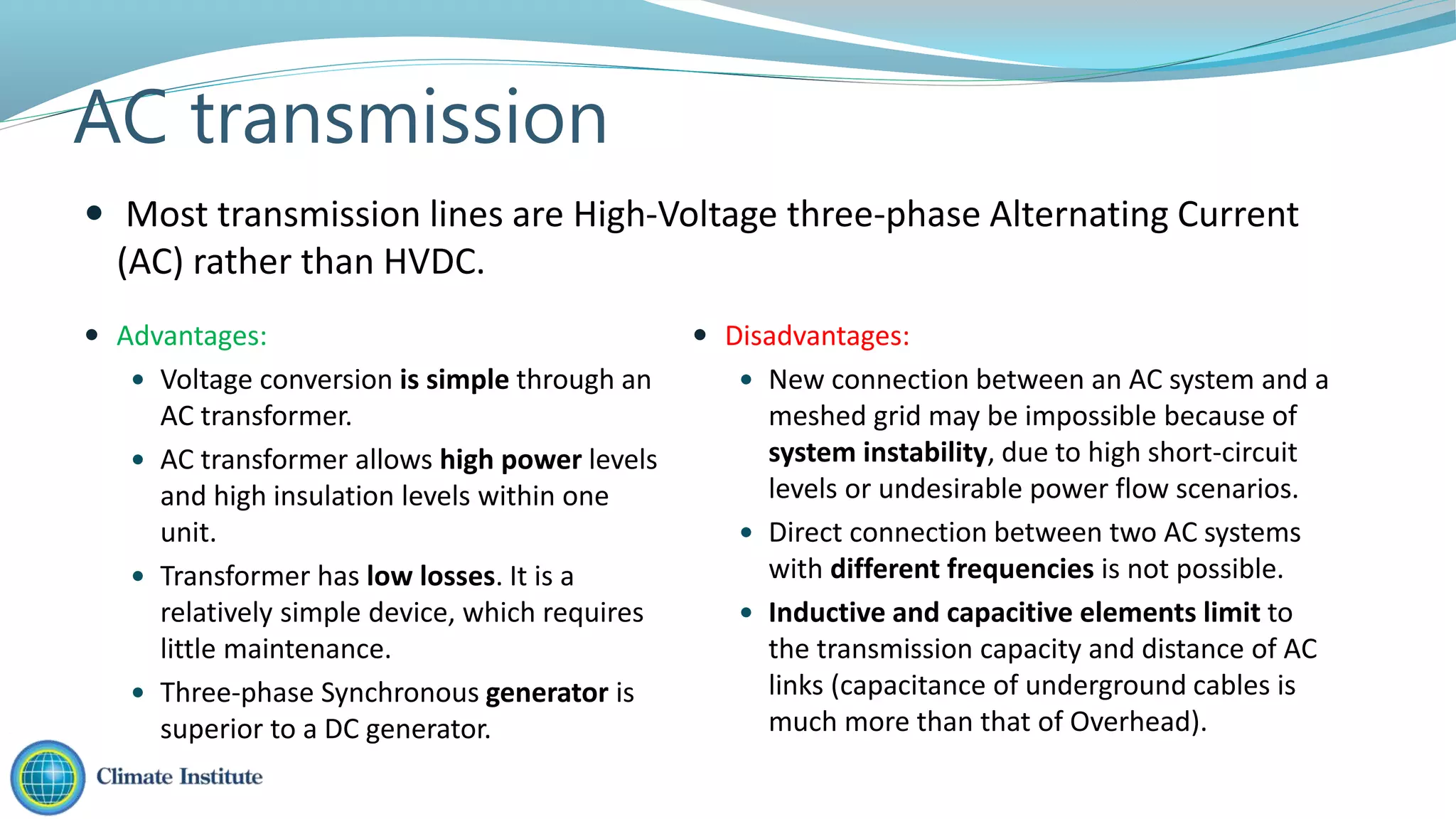
 Most transmission lines are High-Voltage three-phase Alternating Current
(AC) rather than HVDC.
 Advantages:
 Voltage conversion is simple through an
AC transformer.
 AC transformer allows high power levels
and high insulation levels within one
unit.
 Transformer has low losses. It is a
relatively simple device, which requires
little maintenance.
 Three-phase Synchronous generator is
superior to a DC generator.
 Disadvantages:
 New connection between an AC system and a
meshed grid may be impossible because of
system instability, due to high short-circuit
levels or undesirable power flow scenarios.
 Direct connection between two AC systems
with different frequencies is not possible.
 Inductive and capacitive elements limit to
the transmission capacity and distance of AC
links (capacitance of underground cables is
much more than that of Overhead).
 What makes HVDC grids possible now?
 HVDC Light systems and components are, now, mature (Power Electronics
technology has improved enough to fulfill HVDC requirements).
 An efficient HVDC breaker is available. It can sectionalize multiterminal HVDC
systems into several protection zones to facilitate fault clearance with continuous
transmission in the non-affected areas.
HVDC transmission
 1. Technical aspects of HVDC
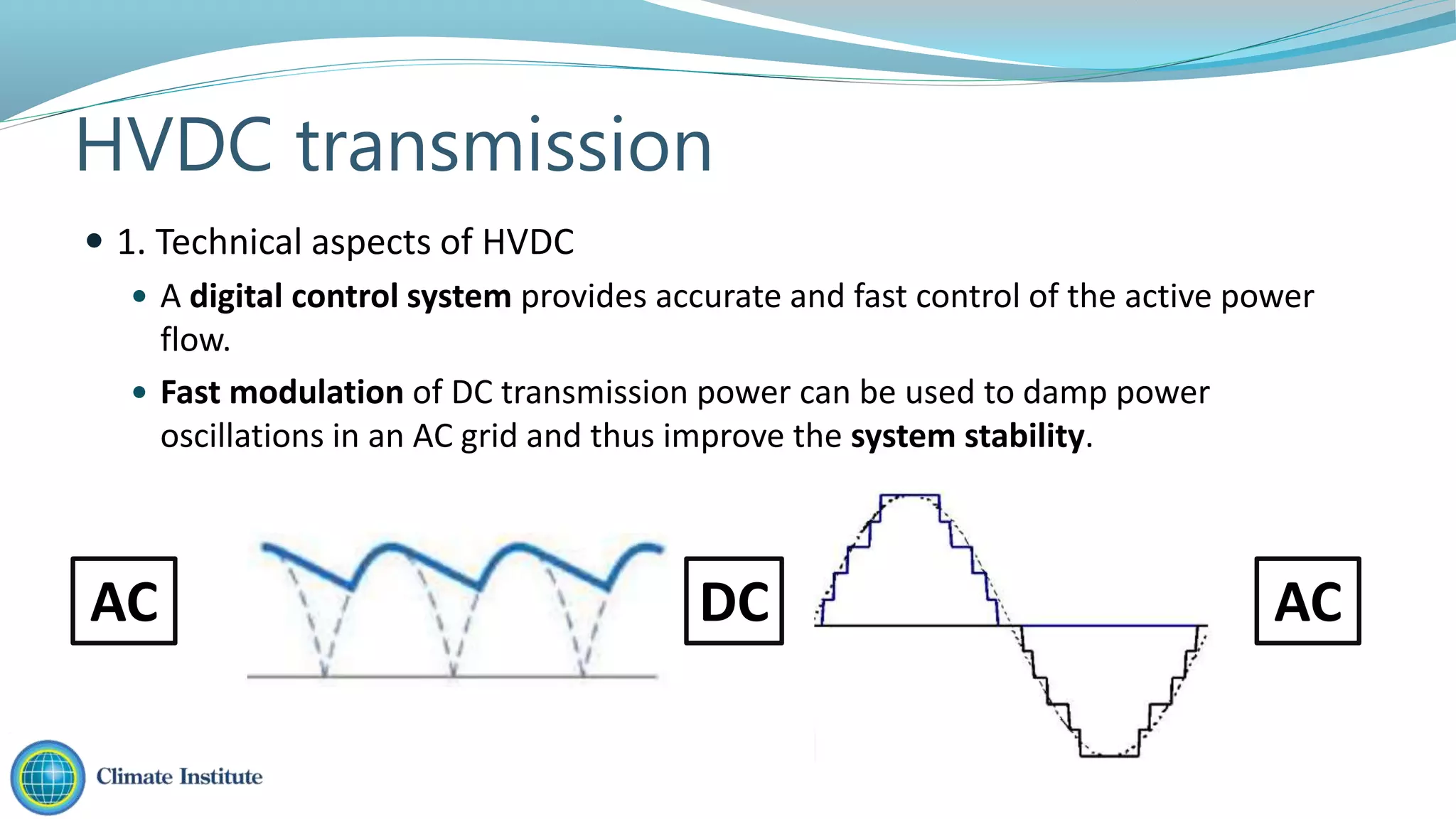
 A digital control system provides accurate and fast control of the active power
flow.
 Fast modulation of DC transmission power can be used to damp power
oscillations in an AC grid and thus improve the system stability.
HVDC transmission
AC DC AC
 1. Technical aspects of HVDC
 A DC link allows power transmission between AC networks with different
frequencies or networks, which can not be synchronized, for other reasons.
HVDC transmission
 1. Technical aspects of HVDC
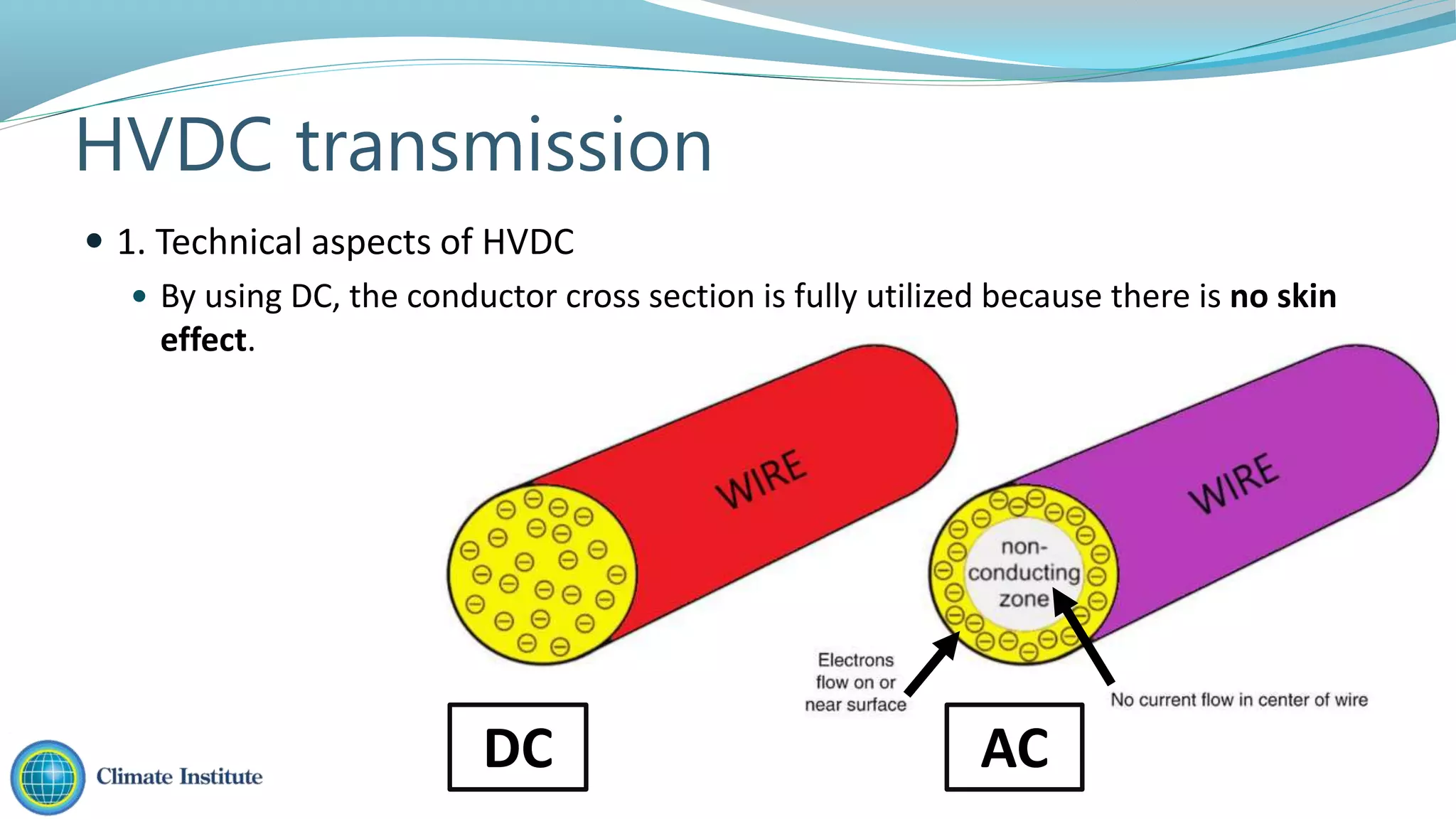
 By using DC, the conductor cross section is fully utilized because there is no skin
effect.
HVDC transmission
DC AC
 1. Technical aspects of HVDC
 Inductive and capacitive parameters do not limit the transmission capacity or the
maximum length of a DC overhead line or cable.
HVDC transmission
[2]
 1. Technical aspects of HVDC
 Inductive and capacitive parameters do not limit the transmission capacity or the
maximum length of a DC overhead line or cable.
HVDC transmission
DC
AC
[2]
 Converter stations needed to connect to AC power grids are very expensive.
 The conversion process consumes reactive power. As a result, it is necessary to
install filter-compensation units and reactive power compensation units.
 Only two conductors are necessary to transmit electricity, and with lower losses
than AC systems of similar scope.
 2. Economic considerations
HVDC transmission
HVDC transmission
 2. Economic considerations
 DC Terminals >> AC Terminals
 DC Lines < AC Lines
 DC Losses < AC Losses
[3]
 Less visual impact (even less if it is underground).
 Transmission possibilities contribute to a more efficient utilization of existing
power plants and facilitate the inclusion of renewable energies.
 The land coverage and the associated right-of-way cost for an HVDC overhead
transmission line is not as high as that of an AC line.
 Less visual impact (even less if it is underground).
 3. Environmental issues
HVDC transmission
[4]
 Less visual impact (even less if it is underground).
 3. Environmental issues
HVDC transmission
[4]
AC Overhead Example
 Less visual impact (even less if it is underground).
 3. Environmental issues
HVDC transmission
[4]
DC Overhead Example
 Less visual impact (even less if it is underground).
 3. Environmental issues
HVDC transmission
[4]DC Underground Example
 Frequency is 50 Hz and Voltage 230 V
 Different Regional Groups
 Synchronous grid of Continental Europe
 RG Nordic
 RG UK
 RG Ireland
 RG Baltic
Examples around the World
 Europe
[5]
 UK – Continental Europe interconnections
 HVDC Cross-Channel (UK - France)
 2000 MW bi-pole system and ± 270 kV
 73 km (45 mi) long with 46 km (29 mi)
submarine cables
 BritNed (UK - Netherlads)
 1000 MW bi-pole system and ± 450 kV
 260 km (160 mi) long with 250 km (155 mi)
submarine cables
Examples around the World
 Europe
[5]
Examples around the World
 Europe
[6]
Examples around the World
 South America
 Brazil – 60 Hz
 Argentina – 50 Hz
[7]
Examples around the World
 South America
[7]
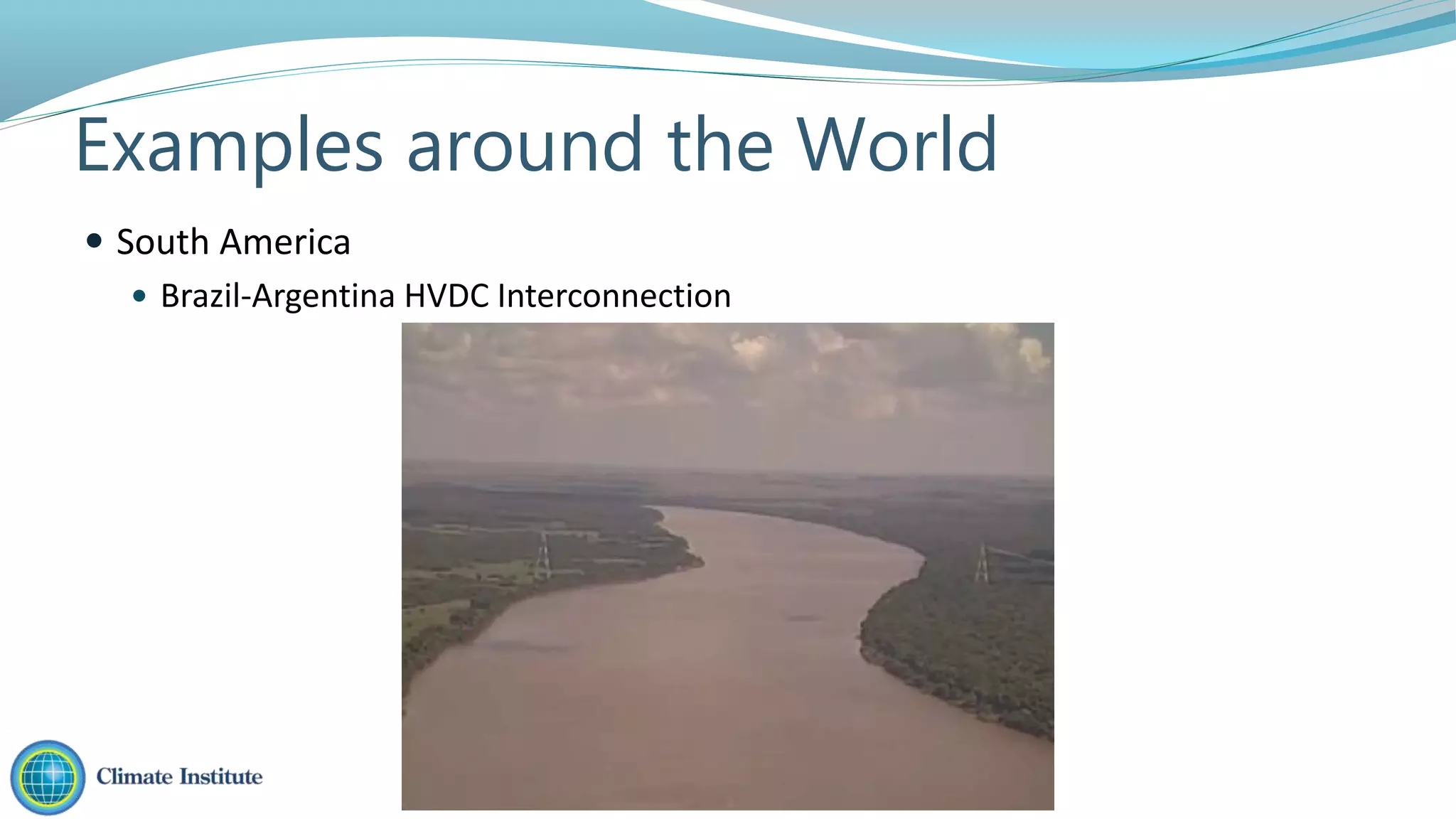
 Brazil-Argentina HVDC Interconnection
 2,200 MW (2 x 1,100 MW) with ± 70 kV (DC)
 500 kV (AC) (both sides)
 135 km (84 mi) in Argentina
 Crosses the Uruguay river (Border Arg-Brz)
 132 + 223 km (82 + 138 mi) in Brazil
Examples around the World
 South America
 Brazil-Argentina HVDC Interconnection
[7]
Examples around the World
 South America
 Brazil-Argentina HVDC Interconnection
[7]
Examples around the World
 South America
 Brazil-Argentina HVDC Interconnection
Examples around the World
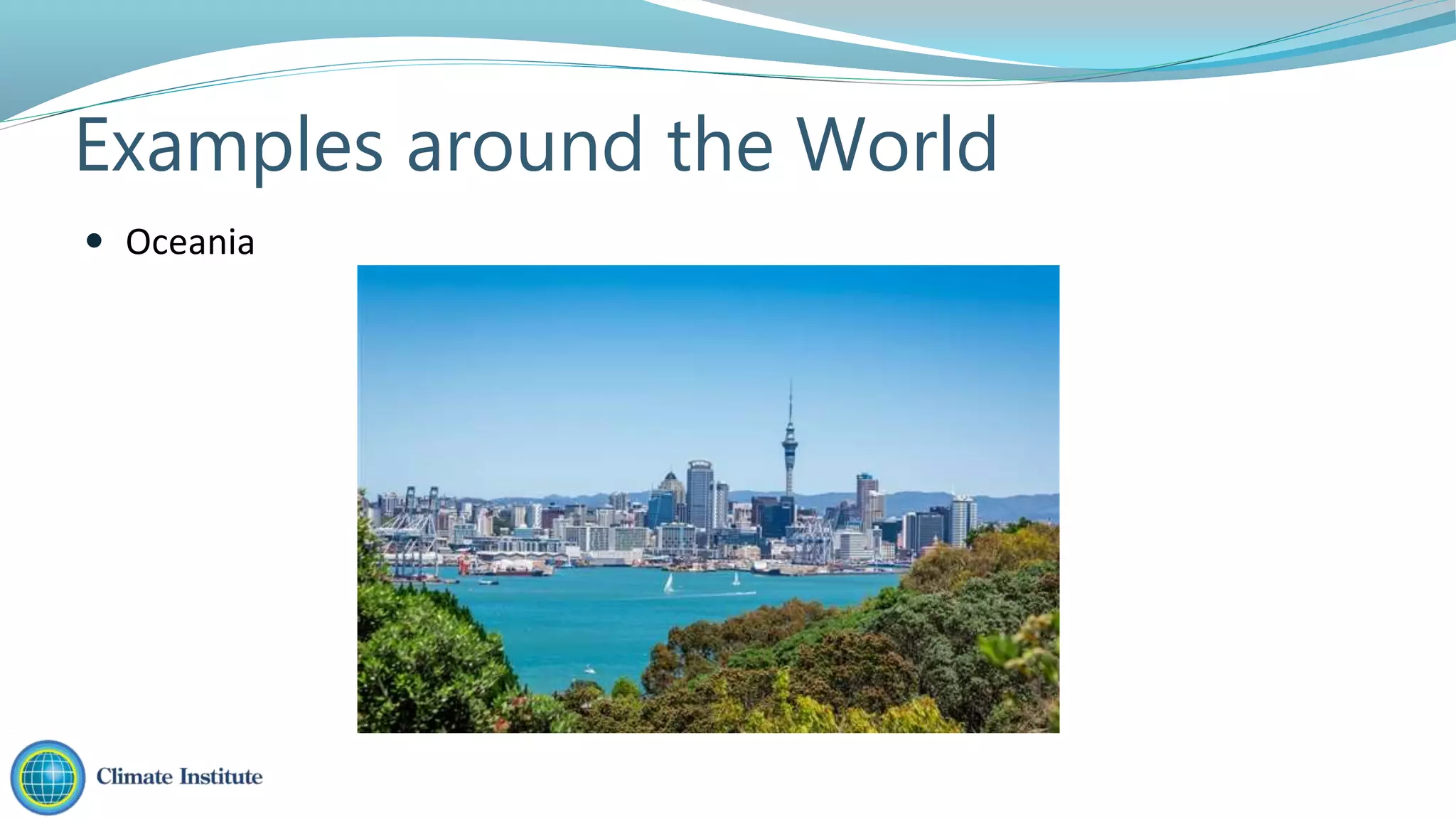
 Oceania
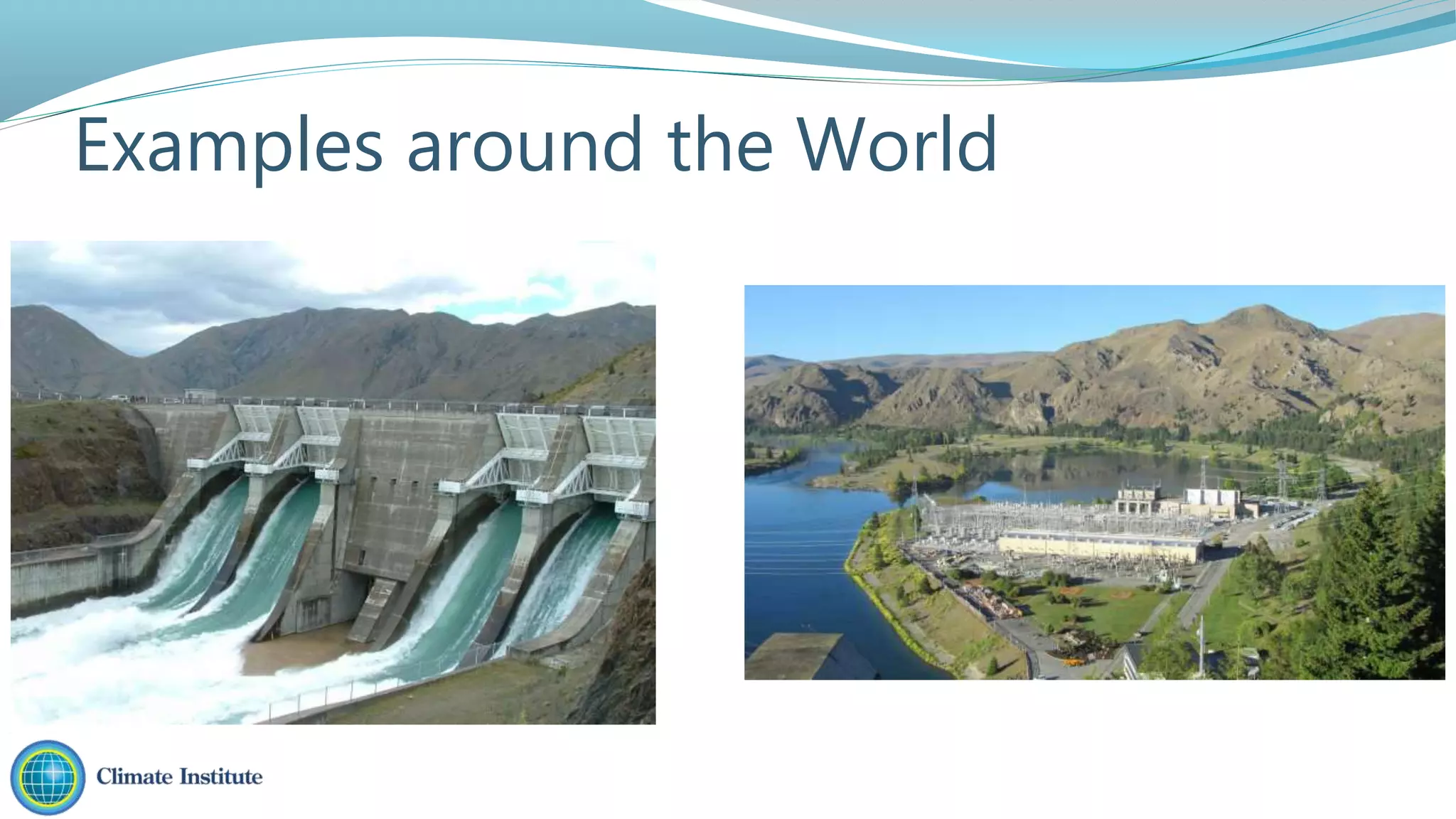
 HVDC Inter-Island in New Zealand
 Connects hydro turbines in South Island and
North Island (where there is more electricity
consumption)
 1200 MW bipolar with ±350 kV
 534 km (332 mi) overhead lines in South Island
 40 km (25 mi) submarine cables
 37 km (23 mi) overhead lines in North Island
[8]
[9]
Examples around the World
 Oceania
Examples around the World
 Asia
 Southern Hami–Zhengzhou UHVDC in China
 Transmission capacity of 8,000 MW
 Voltage is ± 800 kV
 Total length is 2,210 km (1,370 mi)
[10]
Examples around the World
 Asia
 Southern Hami–Zhengzhou UHVDC in China
 Transmission capacity of 8,000 MW
 Voltage is ± 800 kV
 Total length is 2,210 km (1,370 mi)
[10]
Examples around the World
 Asia
 Southern Hami–Zhengzhou UHVDC in China
 Transmission capacity of 8,000 MW
 Voltage is ± 800 kV
 Total length is 2,210 km (1,370 mi)
[11]
[10]
Examples around the World
 Asia
 The Changji-Guquan UHVDC in China
 Transmission capacity of 12,000 MW
 Voltage is ± 1,100 kV
 Total length is 3,293 km (2,046 mi)
 On Dec. 31, 2018
[10]
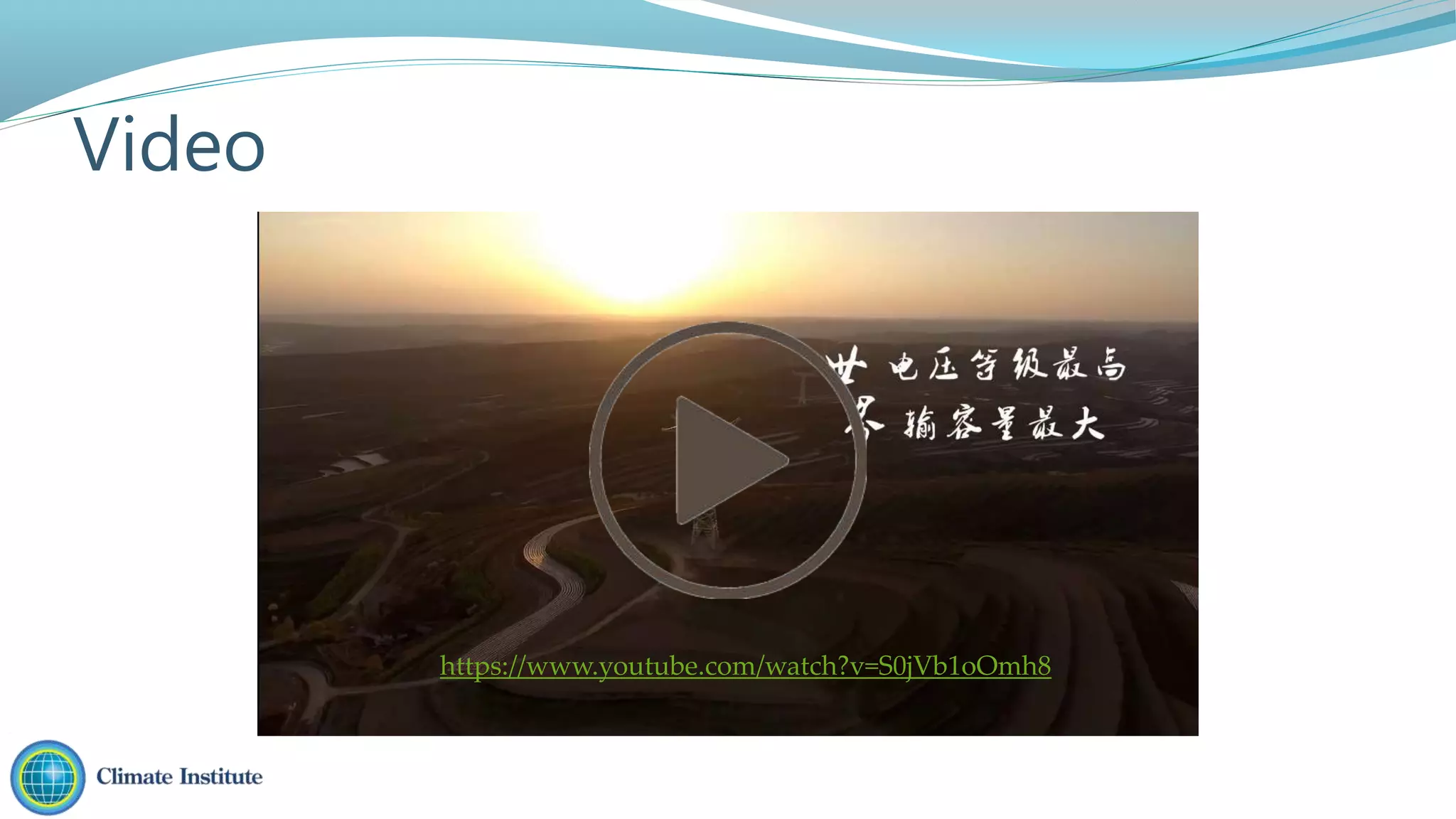
Video
https://www.youtube.com/watch?v=S0jVb1oOmh8
Examples in the US
 California
[12]
Examples in the US
 California
 Trans Bay Cable (San Francisco and Pittsburg)
 400 MW power with voltage ±200 kV
 Modular Multi-Level Converter (MMC) VSC
system
 53 mi (85 km)
[12]
Examples in the US
 California
[12]
Examples in the US
 California
[12]
Examples in the US
 California
[12]
Examples in the US
 New York – New Jersey
[13]
Examples in the US
 New York – New Jersey
 Neptune Project
 660 MW power with voltage ±500 kV
 It carries 22 percent of Long Island's electricity
 50 mi (80 km) undersea and 15 mi (25 km)
underground
[13]
Images
 [1] Federal Energy Regulatory Commission
 https://www.ferc.gov/industries/electric/indus-act/reliability/blackout/ch1-3.pdf
 [2] CIGRE Working Group B1.40. Offshore generation cable Connection
 http://www.e-cigre.org/publication/610-offshore-generation-cable-connections
 [3] SIEMENS High Voltage Direct Current Transmission.
 www.siemens.com/energy/hvdc
 [4] ABB Introducing HVDC
 https://new.abb.com/systems/hvdc/
 [5] Synchronous grid of Continental Europe
 https://en.wikipedia.org/wiki/Synchronous_grid_of_Continental_Europe
 [6] First published in The Economist, U.K., February 2nd, 2019, By Kal
Images
 [7]“Garabi” the Argentina – Brazil 1000 MW Interconnection Commissioning
and Early Operating Experience
 https://new.abb.com/systems/hvdc/references/brazil-argentina-hvdc-interconnection
 [8] New Zealand HVDC Inter-Island
 https://new.abb.com/systems/hvdc/references/new-zealand
 [9] Siemens completes HVDC transmission link for New Zealand
 https://www.siemens.com/press/en/feature/2013/energy/2013-09-hvdc.php#ii141
 [10] UHV State Grid Corporation of China
 http://www.sgcc.com.cn/html/sgcc_main_en/col2017112610/column_2017112610_1.shtml
 [11] Zhongzhou Converter Station (800kV UHV DC Transmission Project)
 https://www.zhihu.com/question/20737584
Images
 [12] TRANS BAY CABLE
 http://www.transbaycable.com/
 [13] Neptune Regional Transmission System
 http://neptunerts.com/
Questions?
THANK YOU.
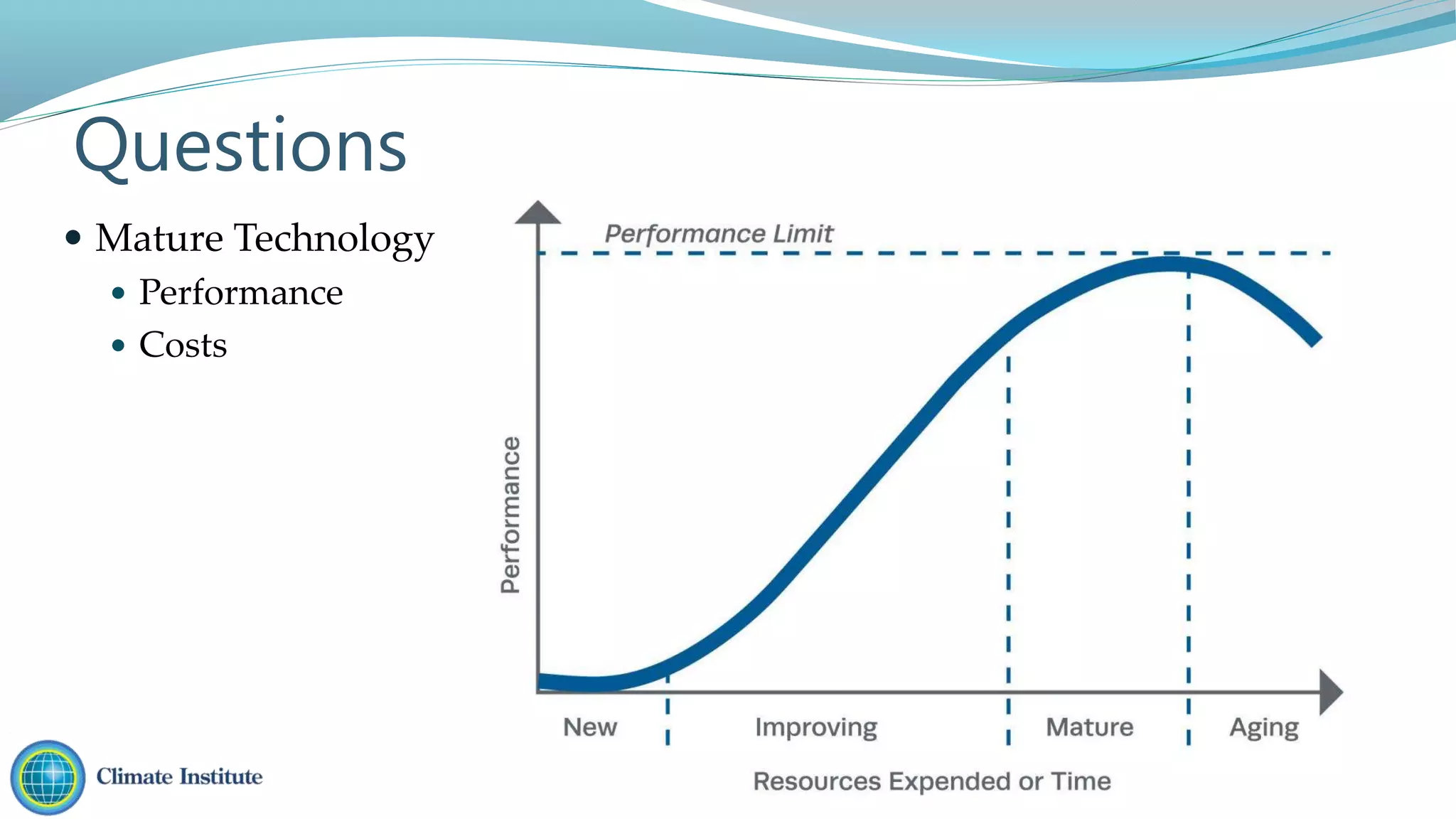
Questions
 Mature Technology
 Performance
 Costs
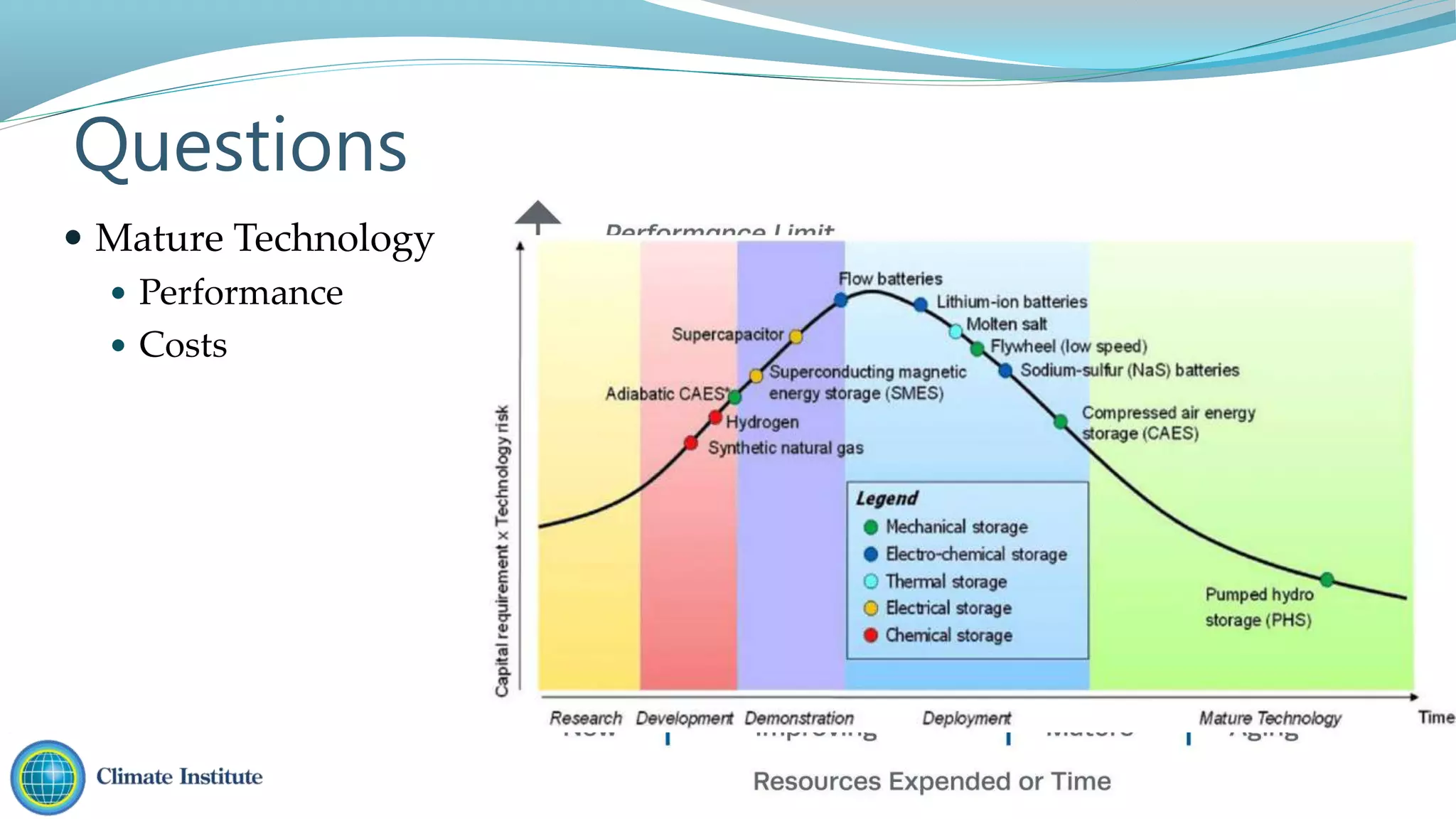
Questions
 Mature Technology
 Performance
 Costs

HVDC Technology Climate Institute

  • 1.
  • 2.
     Introduction  HVDCtransmission  Technical aspects of HVDC  Economic considerations  Environmental issues Index
  • 3.
     Introduction  HVDCtransmission  Examples around the World  UK – Continental Europe  Brazil – Argentina  Inter – Island in New Zealand  Southern Hami – Zhengzhou UHVDC  Changji – Guquan UHVDC Index
  • 4.
     Introduction  HVDCtransmission  Examples around the World Index  Examples in the US  California  New York –New Jersey  References  Questions?
  • 5.
    Introduction  Main Characteristics Definition: High-Voltage Direct Current (HVDC)  HVDC usually uses voltages between 100 kV and 1,500 kV  Mostly used in electricity transmission [1]
  • 6.
    AC transmission  Mosttransmission lines are High-Voltage three-phase Alternating Current (AC) rather than HVDC.  Advantages:  Voltage conversion is simple through an AC transformer.  AC transformer allows high power levels and high insulation levels within one unit.  Transformer has low losses. It is a relatively simple device, which requires little maintenance.  Three-phase Synchronous generator is superior to a DC generator.  Disadvantages:  New connection between an AC system and a meshed grid may be impossible because of system instability, due to high short-circuit levels or undesirable power flow scenarios.  Direct connection between two AC systems with different frequencies is not possible.  Inductive and capacitive elements limit to the transmission capacity and distance of AC links (capacitance of underground cables is much more than that of Overhead).
  • 7.
     What makesHVDC grids possible now?  HVDC Light systems and components are, now, mature (Power Electronics technology has improved enough to fulfill HVDC requirements).  An efficient HVDC breaker is available. It can sectionalize multiterminal HVDC systems into several protection zones to facilitate fault clearance with continuous transmission in the non-affected areas. HVDC transmission
  • 8.
     1. Technicalaspects of HVDC  A digital control system provides accurate and fast control of the active power flow.  Fast modulation of DC transmission power can be used to damp power oscillations in an AC grid and thus improve the system stability. HVDC transmission AC DC AC
  • 9.
     1. Technicalaspects of HVDC  A DC link allows power transmission between AC networks with different frequencies or networks, which can not be synchronized, for other reasons. HVDC transmission
  • 10.
     1. Technicalaspects of HVDC  By using DC, the conductor cross section is fully utilized because there is no skin effect. HVDC transmission DC AC
  • 11.
     1. Technicalaspects of HVDC  Inductive and capacitive parameters do not limit the transmission capacity or the maximum length of a DC overhead line or cable. HVDC transmission [2]
  • 12.
     1. Technicalaspects of HVDC  Inductive and capacitive parameters do not limit the transmission capacity or the maximum length of a DC overhead line or cable. HVDC transmission DC AC [2]
  • 13.
     Converter stationsneeded to connect to AC power grids are very expensive.  The conversion process consumes reactive power. As a result, it is necessary to install filter-compensation units and reactive power compensation units.  Only two conductors are necessary to transmit electricity, and with lower losses than AC systems of similar scope.  2. Economic considerations HVDC transmission
  • 14.
    HVDC transmission  2.Economic considerations  DC Terminals >> AC Terminals  DC Lines < AC Lines  DC Losses < AC Losses [3]
  • 15.
     Less visualimpact (even less if it is underground).  Transmission possibilities contribute to a more efficient utilization of existing power plants and facilitate the inclusion of renewable energies.  The land coverage and the associated right-of-way cost for an HVDC overhead transmission line is not as high as that of an AC line.  Less visual impact (even less if it is underground).  3. Environmental issues HVDC transmission [4]
  • 16.
     Less visualimpact (even less if it is underground).  3. Environmental issues HVDC transmission [4] AC Overhead Example
  • 17.
     Less visualimpact (even less if it is underground).  3. Environmental issues HVDC transmission [4] DC Overhead Example
  • 18.
     Less visualimpact (even less if it is underground).  3. Environmental issues HVDC transmission [4]DC Underground Example
  • 19.
     Frequency is50 Hz and Voltage 230 V  Different Regional Groups  Synchronous grid of Continental Europe  RG Nordic  RG UK  RG Ireland  RG Baltic Examples around the World  Europe [5]
  • 20.
     UK –Continental Europe interconnections  HVDC Cross-Channel (UK - France)  2000 MW bi-pole system and ± 270 kV  73 km (45 mi) long with 46 km (29 mi) submarine cables  BritNed (UK - Netherlads)  1000 MW bi-pole system and ± 450 kV  260 km (160 mi) long with 250 km (155 mi) submarine cables Examples around the World  Europe [5]
  • 21.
    Examples around theWorld  Europe [6]
  • 22.
    Examples around theWorld  South America  Brazil – 60 Hz  Argentina – 50 Hz [7]
  • 23.
    Examples around theWorld  South America [7]  Brazil-Argentina HVDC Interconnection  2,200 MW (2 x 1,100 MW) with ± 70 kV (DC)  500 kV (AC) (both sides)  135 km (84 mi) in Argentina  Crosses the Uruguay river (Border Arg-Brz)  132 + 223 km (82 + 138 mi) in Brazil
  • 24.
    Examples around theWorld  South America  Brazil-Argentina HVDC Interconnection [7]
  • 25.
    Examples around theWorld  South America  Brazil-Argentina HVDC Interconnection [7]
  • 26.
    Examples around theWorld  South America  Brazil-Argentina HVDC Interconnection
  • 27.
    Examples around theWorld  Oceania  HVDC Inter-Island in New Zealand  Connects hydro turbines in South Island and North Island (where there is more electricity consumption)  1200 MW bipolar with ±350 kV  534 km (332 mi) overhead lines in South Island  40 km (25 mi) submarine cables  37 km (23 mi) overhead lines in North Island [8] [9]
  • 28.
  • 29.
    Examples around theWorld  Oceania
  • 30.
    Examples around theWorld  Asia  Southern Hami–Zhengzhou UHVDC in China  Transmission capacity of 8,000 MW  Voltage is ± 800 kV  Total length is 2,210 km (1,370 mi) [10]
  • 31.
    Examples around theWorld  Asia  Southern Hami–Zhengzhou UHVDC in China  Transmission capacity of 8,000 MW  Voltage is ± 800 kV  Total length is 2,210 km (1,370 mi) [10]
  • 32.
    Examples around theWorld  Asia  Southern Hami–Zhengzhou UHVDC in China  Transmission capacity of 8,000 MW  Voltage is ± 800 kV  Total length is 2,210 km (1,370 mi) [11] [10]
  • 33.
    Examples around theWorld  Asia  The Changji-Guquan UHVDC in China  Transmission capacity of 12,000 MW  Voltage is ± 1,100 kV  Total length is 3,293 km (2,046 mi)  On Dec. 31, 2018 [10]
  • 34.
  • 35.
    Examples in theUS  California [12]
  • 36.
    Examples in theUS  California  Trans Bay Cable (San Francisco and Pittsburg)  400 MW power with voltage ±200 kV  Modular Multi-Level Converter (MMC) VSC system  53 mi (85 km) [12]
  • 37.
    Examples in theUS  California [12]
  • 38.
    Examples in theUS  California [12]
  • 39.
    Examples in theUS  California [12]
  • 40.
    Examples in theUS  New York – New Jersey [13]
  • 41.
    Examples in theUS  New York – New Jersey  Neptune Project  660 MW power with voltage ±500 kV  It carries 22 percent of Long Island's electricity  50 mi (80 km) undersea and 15 mi (25 km) underground [13]
  • 42.
    Images  [1] FederalEnergy Regulatory Commission  https://www.ferc.gov/industries/electric/indus-act/reliability/blackout/ch1-3.pdf  [2] CIGRE Working Group B1.40. Offshore generation cable Connection  http://www.e-cigre.org/publication/610-offshore-generation-cable-connections  [3] SIEMENS High Voltage Direct Current Transmission.  www.siemens.com/energy/hvdc  [4] ABB Introducing HVDC  https://new.abb.com/systems/hvdc/  [5] Synchronous grid of Continental Europe  https://en.wikipedia.org/wiki/Synchronous_grid_of_Continental_Europe  [6] First published in The Economist, U.K., February 2nd, 2019, By Kal
  • 43.
    Images  [7]“Garabi” theArgentina – Brazil 1000 MW Interconnection Commissioning and Early Operating Experience  https://new.abb.com/systems/hvdc/references/brazil-argentina-hvdc-interconnection  [8] New Zealand HVDC Inter-Island  https://new.abb.com/systems/hvdc/references/new-zealand  [9] Siemens completes HVDC transmission link for New Zealand  https://www.siemens.com/press/en/feature/2013/energy/2013-09-hvdc.php#ii141  [10] UHV State Grid Corporation of China  http://www.sgcc.com.cn/html/sgcc_main_en/col2017112610/column_2017112610_1.shtml  [11] Zhongzhou Converter Station (800kV UHV DC Transmission Project)  https://www.zhihu.com/question/20737584
  • 44.
    Images  [12] TRANSBAY CABLE  http://www.transbaycable.com/  [13] Neptune Regional Transmission System  http://neptunerts.com/
  • 45.
  • 46.
  • 48.
  • 49.

Editor's Notes

  • #6 Transmission is the part of the so called "power grid” , where the electricity is transported from the generation plants to the distribution stations.
  • #7 Question1- DC generators?? have high losses due to the rotating armature segment and brush resistance. A.C. machines are simple , robust and do mot require much attention for their repairs and maintenance during their use. A.C. can easily be converted into D.C. with the help of rectifiers.
  • #8 A mature technology is a technology that has been in use for long enough that most of its initial faults and inherent problems have been removed or reduced by further development. In some contexts, it may also refer to technology that has not seen widespread use, but whose scientific background is well understood. Pole to pole faults in DC cause mayor damages. https://www-sciencedirect-com.nlhhg.idm.oclc.org/science/article/pii/S1364032115006607 Since the AC fault current has a sinusoidal shape, it has two zero crossing points in each period. Hence, the fault interrupting devices can break the currents during a zero crossing of the current waveform. However, DC fault currents do not cross a zero point. Consequently, AC breakers are not suitable for breaking DC fault current. •In AC power systems, the fault impedance consists of reactance and resistance limits the fault current where the value of reactance is normally larger than its resistance. In DC networks, however, the value of reactance is quite negligible as compared to the network resistance. Consequently, not only the peak value of DC fault currents is higher than the peak value of fault currents in counterpart AC systems, but also the lower value of the fault impedance gives rise to a higher rate of change of the DC fault currents Since DC faults cause a high-raising-rate currents, faults in VSC-based DC systems develops faster than AC systems [34], [51]. On the other hand, the withstand rating of semiconductor devices employed in VSCs is fairly lower than that in AC power generators [41]. Consequently, the protection systems in DC networks must operate relatively faster in order to prevent any damage to the converter׳s semiconductor (particularly, freewheeling diodes). The operating time of DC protection systems, which is in the range of several milliseconds, is typically less than the operating time of AC protection systems 
  • #9 The connection between the AC and DC is made through Power Electronics.
  • #10 Very useful for connecting two or more Asynchronous network. For example UK grid and Europe grid.
  • #11 The skin effect limits the amount of power that can be transmitted.
  • #12 The inductance and capacitance increase when the voltage increases. That is why after 75 km with 400kV (AC) no active power reaches the other end, just reactive power. The more reactive the load, the more is the shuttling power requirement.
  • #13 The inductance and capacitance increase when the voltage increases. That is why after 75 km with 400kV (AC) no active power reaches the other end, just reactive power. The more reactive the load, the more is the shuttling power requirement.
  • #14 https://electrical-engineering-portal.com/8-main-disadvantages-of-hvdc-transmission https://www.researchgate.net/publication/224407967_A_tariff_for_reactive_power
  • #16 +1= It is also possible to increase the power transmission capacity for existing rights of way. PV systems generate in DC. New generation of wind turbines have a
  • #17 +1= It is also possible to increase the power transmission capacity for existing rights of way. PV systems generate in DC. New generation of wind turbines have a
  • #18 +1= It is also possible to increase the power transmission capacity for existing rights of way. PV systems generate in DC. New generation of wind turbines have a
  • #19 +1= It is also possible to increase the power transmission capacity for existing rights of way. PV systems generate in DC. New generation of wind turbines have a
  • #20 Cross-Channel (Sellindge converter station and Les Mandarins converter station) BritNed (Isle of Grain in Kent, the United Kingdom; and Maasvlakte in Rotterdam, the Netherlands.) https://www.britned.com/more-facts-and-figures/ https://en.wikipedia.org/wiki/BritNed https://en.wikipedia.org/wiki/HVDC_Cross-Channel
  • #21 Cross-Channel (Sellindge converter station and Les Mandarins converter station) BritNed (Isle of Grain in Kent, the United Kingdom; and Maasvlakte in Rotterdam, the Netherlands.) https://www.britned.com/more-facts-and-figures/ https://en.wikipedia.org/wiki/BritNed https://en.wikipedia.org/wiki/HVDC_Cross-Channel
  • #22 Cross-Channel (Sellindge converter station and Les Mandarins converter station) BritNed (Isle of Grain in Kent, the United Kingdom; and Maasvlakte in Rotterdam, the Netherlands.) https://www.britned.com/more-facts-and-figures/ https://en.wikipedia.org/wiki/BritNed https://en.wikipedia.org/wiki/HVDC_Cross-Channel
  • #23 https://new.abb.com/systems/hvdc/references/brazil-argentina-hvdc-interconnection
  • #24 https://new.abb.com/systems/hvdc/references/brazil-argentina-hvdc-interconnection
  • #25 https://new.abb.com/systems/hvdc/references/brazil-argentina-hvdc-interconnection
  • #26 https://new.abb.com/systems/hvdc/references/brazil-argentina-hvdc-interconnection
  • #27 https://new.abb.com/systems/hvdc/references/brazil-argentina-hvdc-interconnection
  • #28 The HVDC system runs 611 kilometers as a single backbone from the hydro turbines in a series of dams centered on Benmore in the South Island, source of 50 percent of the country’s total power output, to Haywards, from where it is dispatched onwards to Auckland, the country’s biggest city
  • #29 The HVDC system runs 611 kilometers as a single backbone from the hydro turbines in a series of dams centered on Benmore in the South Island, source of 50 percent of the country’s total power output, to Haywards, from where it is dispatched onwards to Auckland, the country’s biggest city
  • #30 The HVDC system runs 611 kilometers as a single backbone from the hydro turbines in a series of dams centered on Benmore in the South Island, source of 50 percent of the country’s total power output, to Haywards, from where it is dispatched onwards to Auckland, the country’s biggest city
  • #31 10 - http://www.sgcc.com.cn/html/sgcc_main_en/col2017112610/column_2017112610_1.shtml#here 11 - https://www.zhihu.com/question/20737584 Zhengzhou is one of the most important cities in inland China. It is the economic center of the province and the surrounding areas. Around 10 million inhabitants. Hami, half a million, and with high quality raw resources include coal. Also there is a wind farm in the area with 67 3MW turbines, a total of 201 MW nominal power. https://www.thewindpower.net/windfarm_en_20871_hami-yandun.php
  • #32 10 - http://www.sgcc.com.cn/html/sgcc_main_en/col2017112610/column_2017112610_1.shtml#here 11 - https://www.zhihu.com/question/20737584 Zhengzhou is one of the most important cities in inland China. It is the economic center of the province and the surrounding areas. Around 10 million inhabitants. Hami, half a million, and with high quality raw resources include coal. Also there is a wind farm in the area with 67 3MW turbines, a total of 201 MW nominal power. https://www.thewindpower.net/windfarm_en_20871_hami-yandun.php
  • #33 10 - http://www.sgcc.com.cn/html/sgcc_main_en/col2017112610/column_2017112610_1.shtml#here 11 - https://www.zhihu.com/question/20737584 Zhengzhou is one of the most important cities in inland China. It is the economic center of the province and the surrounding areas. Around 10 million inhabitants. Hami, half a million, and with high quality raw resources include coal. Also there is a wind farm in the area with 67 3MW turbines, a total of 201 MW nominal power. https://www.thewindpower.net/windfarm_en_20871_hami-yandun.php
  • #34 http://www.sgcc.com.cn/html/sgcc_main_en/col2017112406/2019-01/18/20190118183221870335071_1.shtml
  • #38 cable coil
  • #39 cable coil
  • #40 cable coil