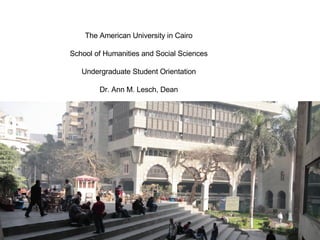
The American University in Cairo School of Humanities and Social Sciences Undergraduate Student Orientation Dr. Ann M. Lesch, Dean
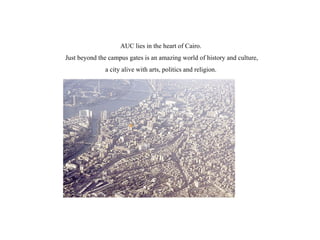
AUC lies in the heart of Cairo.  Just beyond the campus gates is an amazing world of history and culture,  a city alive with arts, politics and religion.
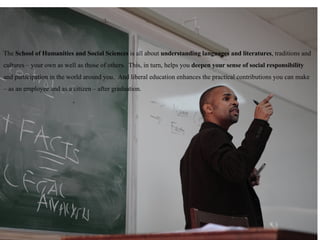
The  School of Humanities and Social Sciences  is all about  understanding languages and literatures , traditions and cultures – your own as well as those of others.  This, in turn, helps you  deepen your sense of social responsibility  and participation in the world around you.  And liberal education enhances the practical contributions you can make – as an employee and as a citizen – after graduation. The  School of Humanities and Social Sciences  is all about  understanding languages and literatures , traditions and cultures – your own as well as those of others.  This, in turn, helps you  deepen your sense of social responsibility  and participation in the world around you.  And liberal education enhances the practical contributions you can make – as an employee and as a citizen – after graduation.
Liberal education  stresses critical thinking ,  creative approaches to problem-solving, openness to new ways of thinking, and gaining the ability to express your ideas clearly and   convincingly.  The practical benefits of liberal education are significant.  Employers don’t want narrow specialists.  They want people who can  think on their feet, come up with creative solutions, engage in team work, and look to the future.
Of course, the  Core Curriculum  is fundamental to this kind of critical thinking, and all the majors – in all the Schools – foster critical thinking.  Your professors will encourage you to participate in discussions and actively question them, rather than just listening passively to lectures.  They will encourage you to keep an open mind, be curious, and be flexible. During FYE you will have the chance to talk to faculty in the 3 schools about the benefits of each major.  There will be several professors from the Humanities and Social Sciences, who will be glad to talk to you about the career opportunities in their fields as well as about their majors and about the possibility of double majoring or minoring  – which lets you benefit from more than one degree program.
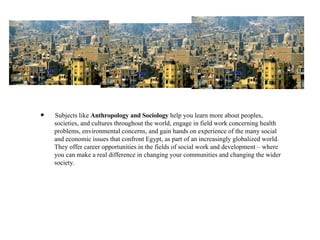
Subjects like  Anthropology and Sociology  help you learn more about peoples, societies, and cultures throughout the world, engage in field work concerning health problems, environmental concerns, and gain hands on experience of the many social and economic issues that confront Egypt, as part of an increasingly globalized world.  They offer career opportunities in the fields of social work and development – where you can make a real difference in changing your communities and changing the wider society.
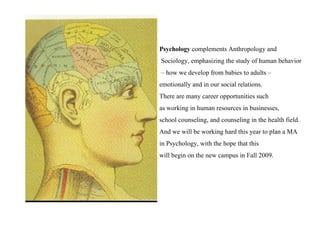
Psychology  complements Anthropology and Sociology, emphasizing the study of human behavior –  how we develop from babies to adults –  emotionally and in our social relations.  There are many career opportunities such  as working in human resources in businesses,  school counseling, and counseling in the health field.  And we will be working hard this year to plan a MA  in Psychology, with the hope that this  will begin on the new campus in Fall 2009.
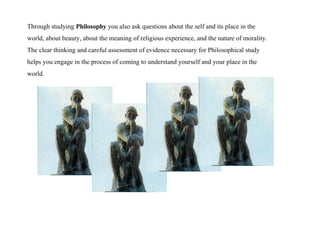
Through studying  Philosophy  you also ask questions about the self and its place in the world, about beauty, about the meaning of religious experience, and the nature of morality.  The clear thinking and careful assessment of evidence necessary for Philosophical study helps you engage in the process of coming to understand yourself and your place in the world.
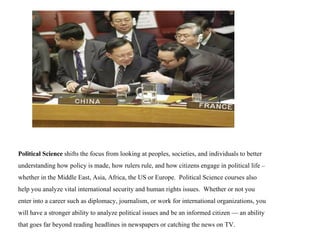
Political Science  shifts the focus from looking at peoples, societies, and individuals to better understanding how policy is made, how rulers rule, and how citizens engage in political life – whether in the Middle East, Asia, Africa, the US or Europe.  Political Science courses also help you analyze vital international security and human rights issues.  Whether or not you enter into a career such as diplomacy, journalism, or work for international organizations, you will have a stronger ability to analyze political issues and be an informed citizen — an ability that goes far beyond reading headlines in newspapers or catching the news on TV.
Many programs take you into the past, to explore where you have  come from and gain deeper insight into where you are going.  Egyptology and Coptic studies  introduce you to the ancient  history and culture of Egypt.  History  covers the world: from the  ancient Mediterranean, to medieval Europe, to modern Europe, the  United States, and Asia.  There are even opportunities to study  about cultures based on religious systems that are very different  from  Islam  and  Christianity,  such as  Hinduism  and  Buddhism . And there are also important programs that cut across disciplines:  Arabic Studies  helps you combine analysis of the history of the Middle East with reading Arabic literature, examining Islamic art and architecture, and studying Islamic law.  The  Middle East Studies  program relates that history and culture to pressing contemporary political and socio-economic issues. .
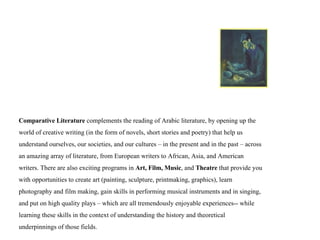
Comparative Literature  complements the reading of Arabic literature, by opening up the world of creative writing (in the form of novels, short stories and poetry) that help us understand ourselves, our societies, and our cultures – in the present and in the past – across an amazing array of literature, from European writers to African, Asia, and American writers.   There are also exciting programs in  Art, Film, Music , and  Theatre  that provide you with opportunities to create art (painting, sculpture, printmaking, graphics), learn photography and film making, gain skills in performing musical instruments and in singing, and put on high quality plays – which are all tremendously enjoyable experiences-- while learning these skills in the context of understanding the history and theoretical underpinnings of those fields.
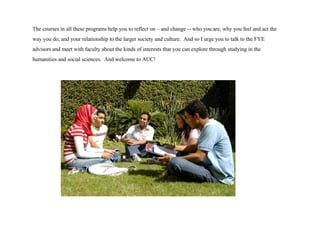
The courses in all these programs help you to reflect on – and change -- who you are, why you feel and act the way you do, and your relationship to the larger society and culture.  And so I urge you to talk to the FYE advisors and meet with faculty about the kinds of interests that you can explore through studying in the humanities and social sciences.  And welcome to AUC!

Huss O F07

  • 1.
    The American Universityin Cairo School of Humanities and Social Sciences Undergraduate Student Orientation Dr. Ann M. Lesch, Dean
  • 2.
    AUC lies inthe heart of Cairo. Just beyond the campus gates is an amazing world of history and culture, a city alive with arts, politics and religion.
  • 3.
    The Schoolof Humanities and Social Sciences is all about understanding languages and literatures , traditions and cultures – your own as well as those of others. This, in turn, helps you deepen your sense of social responsibility and participation in the world around you. And liberal education enhances the practical contributions you can make – as an employee and as a citizen – after graduation. The School of Humanities and Social Sciences is all about understanding languages and literatures , traditions and cultures – your own as well as those of others. This, in turn, helps you deepen your sense of social responsibility and participation in the world around you. And liberal education enhances the practical contributions you can make – as an employee and as a citizen – after graduation.
  • 4.
    Liberal education stresses critical thinking , creative approaches to problem-solving, openness to new ways of thinking, and gaining the ability to express your ideas clearly and convincingly. The practical benefits of liberal education are significant. Employers don’t want narrow specialists. They want people who can think on their feet, come up with creative solutions, engage in team work, and look to the future.
  • 5.
    Of course, the Core Curriculum is fundamental to this kind of critical thinking, and all the majors – in all the Schools – foster critical thinking. Your professors will encourage you to participate in discussions and actively question them, rather than just listening passively to lectures. They will encourage you to keep an open mind, be curious, and be flexible. During FYE you will have the chance to talk to faculty in the 3 schools about the benefits of each major. There will be several professors from the Humanities and Social Sciences, who will be glad to talk to you about the career opportunities in their fields as well as about their majors and about the possibility of double majoring or minoring – which lets you benefit from more than one degree program.
  • 6.
    Subjects like Anthropology and Sociology help you learn more about peoples, societies, and cultures throughout the world, engage in field work concerning health problems, environmental concerns, and gain hands on experience of the many social and economic issues that confront Egypt, as part of an increasingly globalized world. They offer career opportunities in the fields of social work and development – where you can make a real difference in changing your communities and changing the wider society.
  • 7.
    Psychology complementsAnthropology and Sociology, emphasizing the study of human behavior – how we develop from babies to adults – emotionally and in our social relations. There are many career opportunities such as working in human resources in businesses, school counseling, and counseling in the health field. And we will be working hard this year to plan a MA in Psychology, with the hope that this will begin on the new campus in Fall 2009.
  • 8.
    Through studying Philosophy you also ask questions about the self and its place in the world, about beauty, about the meaning of religious experience, and the nature of morality. The clear thinking and careful assessment of evidence necessary for Philosophical study helps you engage in the process of coming to understand yourself and your place in the world.
  • 9.
    Political Science shifts the focus from looking at peoples, societies, and individuals to better understanding how policy is made, how rulers rule, and how citizens engage in political life – whether in the Middle East, Asia, Africa, the US or Europe. Political Science courses also help you analyze vital international security and human rights issues. Whether or not you enter into a career such as diplomacy, journalism, or work for international organizations, you will have a stronger ability to analyze political issues and be an informed citizen — an ability that goes far beyond reading headlines in newspapers or catching the news on TV.
  • 10.
    Many programs takeyou into the past, to explore where you have come from and gain deeper insight into where you are going. Egyptology and Coptic studies introduce you to the ancient history and culture of Egypt. History covers the world: from the ancient Mediterranean, to medieval Europe, to modern Europe, the United States, and Asia. There are even opportunities to study about cultures based on religious systems that are very different from Islam and Christianity, such as Hinduism and Buddhism . And there are also important programs that cut across disciplines: Arabic Studies helps you combine analysis of the history of the Middle East with reading Arabic literature, examining Islamic art and architecture, and studying Islamic law. The Middle East Studies program relates that history and culture to pressing contemporary political and socio-economic issues. .
  • 11.
    Comparative Literature complements the reading of Arabic literature, by opening up the world of creative writing (in the form of novels, short stories and poetry) that help us understand ourselves, our societies, and our cultures – in the present and in the past – across an amazing array of literature, from European writers to African, Asia, and American writers. There are also exciting programs in Art, Film, Music , and Theatre that provide you with opportunities to create art (painting, sculpture, printmaking, graphics), learn photography and film making, gain skills in performing musical instruments and in singing, and put on high quality plays – which are all tremendously enjoyable experiences-- while learning these skills in the context of understanding the history and theoretical underpinnings of those fields.
  • 12.
    The courses inall these programs help you to reflect on – and change -- who you are, why you feel and act the way you do, and your relationship to the larger society and culture. And so I urge you to talk to the FYE advisors and meet with faculty about the kinds of interests that you can explore through studying in the humanities and social sciences. And welcome to AUC!