A New Model:
Advancing Organizational Security
Through Peacebuilding
Who Are We?
 Michele Chubirka, aka "Mrs. Y.," is a recovering UNIX
engineer working in security. She is also the host of the
Healthy Paranoia podcast, the information security feed
of Packetpushers, and official nerd hunter. She likes
long walks in hubsites, traveling to security
conferences, and spending time in the Bat Cave.
Sincerely believes that every problem can be solved
with a "for" loop.

 Joe Weston is a workshop facilitator, consultant, and
author of the book Mastering Respectful Confrontation.
He is also the founder of the Heartwalker Peace
Project, which creates opportunities for connection,
discussion, and creative collaboration.
Who We Aren’t
Special Request
 Importance of feeling heard.
 Please put laptops and phones away for now.
A Language of Violence
 The taxonomy of information security is borrowed from
the language of war.

 How does this impact the way we interact with our user
community?

 How does this affect the practitioners?
Peacebuilding Levels
 Personal

 Social
 Institutional
Personal + social = institutional change
"The human brain hasn't had a hardware upgrade in about
100,000 years."

Daniel Goleman, Author of Emotional Intelligence
Users Aren’t Stupid
 We spend millions of dollars on security products and
at the end of the day, the weakest link is the user.

 Even with training, users make the wrong choices.
 What if the problem isn’t about the user at all, but us?
Something isn’t working
 We’re swimming in data, but we still can’t make
predictions about intrusions.

 How can we realistically change user behavior?
User: Definition
People who aren’t us.
 Developers
 Administrative Staff
 Management
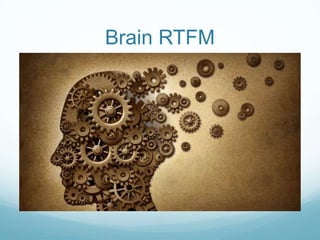
Brain RTFM
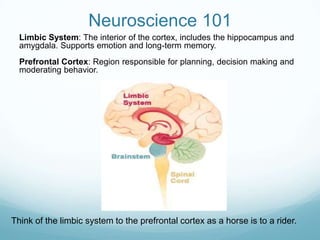
Neuroscience 101
Limbic System: The interior of the cortex, includes the hippocampus and
amygdala. Supports emotion and long-term memory.
Prefrontal Cortex: Region responsible for planning, decision making and
moderating behavior.

Think of the limbic system to the prefrontal cortex as a horse is to a rider.
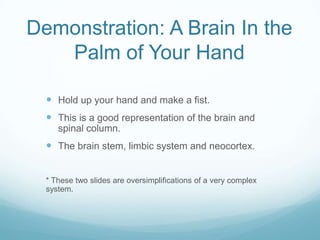
Demonstration: A Brain In the
Palm of Your Hand
 Hold up your hand and make a fist.
 This is a good representation of the brain and
spinal column.

 The brain stem, limbic system and neocortex.
* These two slides are oversimplifications of a very complex
system.
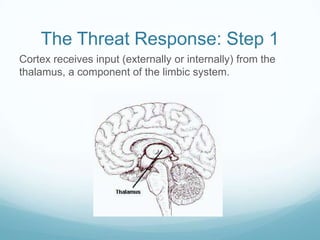
The Threat Response: Step 1
Cortex receives input (externally or internally) from the
thalamus, a component of the limbic system.
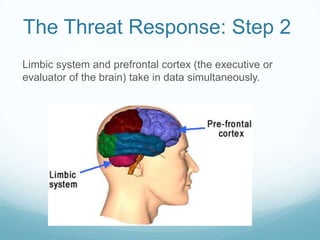
The Threat Response: Step 2
Limbic system and prefrontal cortex (the executive or
evaluator of the brain) take in data simultaneously.
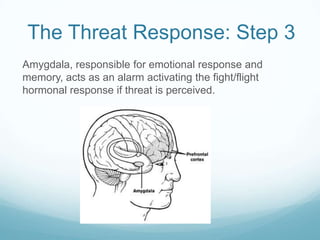
The Threat Response: Step 3
Amygdala, responsible for emotional response and
memory, acts as an alarm activating the fight/flight
hormonal response if threat is perceived.
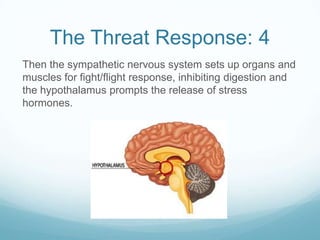
The Threat Response: 4
Then the sympathetic nervous system sets up organs and
muscles for fight/flight response, inhibiting digestion and
the hypothalamus prompts the release of stress
hormones.
Emotional Contagion
 The limbic system is an “open loop,” influenced by
other people’s emotions, aka mirror neurons.

 Mirror neurons activate when an animal performs an
action or when an animal observes the same action of
another animal.

 They are thought to be the basis of empathy.
 Also called emotional contagion.
Negativity
 The brain has a negativity bias because the limbic
system is quicker than the prefrontal cortex at
perceiving and analyzing potential threats.

 Traumatic experiences are “stickier” than positive,
happy experiences, i.e. harder to un-map.
No Escape From Threat
 Most of us are in a permanent state of cortisol overload
due to the constant stressors of modern life and the
fact that stress hormones stay in the body for hours.

 This decreases intellectual capacity, memory capacity
and lowers impulse control.

 Stress makes you stupid.
Amygdala Hijack
Key indicator: intense and immediate emotional reaction,
followed by the understanding that it was inappropriate.

 I thought that stick on the ground was a snake!
 I don’t like you or I’m bored, so I won’t cooperate or listen to
what you have to say.

 That guy who cut me off in traffic was trying to kill me!
 Why were you so insulting to me in that email yesterday?
(studies show there’s a negativity bias in email.)

 Other examples?
Thin Slicing: Warren Harding
Syndrome
 Human beings make quick decisions based on intuition.
Think “love at first site” or a “gut reaction.”

 This is sometimes called “Thin Slicing.”
 One example is “Warren Harding Syndrome.” A
mediocre presidential candidate, Americans voted for
him , because he was tall, good looking and charming.
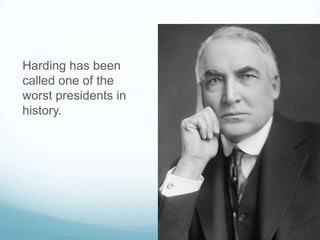
Harding has been
called one of the
worst presidents in
history.
Thin Slicing: Bedside Manner
 The likelihood of a doctor being sued has little to do
with the number of errors made.

 In an analysis of malpractice lawsuits, there was no
correlation between the number of mistakes by doctors
and how many lawsuits were filed against them.
Malpractice?
 In studies, psychologists were able to predict which
doctors would be sued more by analyzing the amount
of time spent with patients and if the tone of their voices
sounded “concerned.”

 Patients file lawsuits because of how they are treated.
The Power of Mirror Neurons
Marie Dasborough observed two groups:

 One group was given negative feedback accompanied
by positive emotional signs, nods and smiles.

 Another was provided positive feedback that was
delivered using negative emotional cues, frowns and
narrowed eyes.
Entrainment
 Those who received the positive feedback
accompanied by negative emotional signs reported that
they felt worse than participants who received negative
feedback given with positive emotional cues.

 The delivery was more important than the message.

 Your emotions and actions will be mirrored by those
around you.

 This is similar to a phenomenon known in physics as
entrainment.
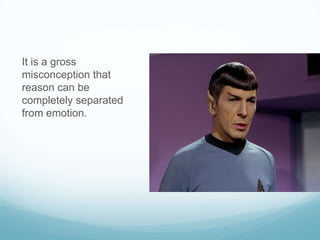
There’s No Mr. Spock
 Neurologist, Dr. Antonio Damasio, had a patient who
had been a successful corporate lawyer.

 A tumor was discovered in his prefrontal lobes and the
surgeon who removed it inadvertently severed the
circuit between this area and his amygdala.
Somatic Marker
 There was no obvious damage to his cognitive abilities,
but his life fell apart.

 It was discovered that he couldn’t make decisions
when presented with the simplest choices.

 He no longer had any feelings regarding these options,
no preferences.

 This is the basis for Damasio’s Somatic Marker
Hypothesis, in which it is proposed that emotions assist
with complex decision-making.
It is a gross
misconception that
reason can be
completely separated
from emotion.
You’re the Threat
 The WAY we present information is just as important as
WHAT we present.

 In the first few minutes we interact with someone, we’re
being assessed for our potential to provide reward or
punishment.

 Could I have some carrot with that stick?
It’s Tribal
 As humans, we’re constantly trying to maximize
pleasure or minimize pain.

 That black, unwashed t-shirt and body art may feel like
a personal statement, but it can impact and even
alienate those we’re trying to convince.

 Are you a member of their tribe?
That was the bad news.

Now for the good.
Training That Works
 The Dynamic Feedback Loop

 In the 1960s, Stanford University psychologist Albert
Bandura determined that giving individuals a clear goal
and a method of evaluating progress increased the
likelihood that they would achieve it.
Feedback Loops
Where are they used?

 Personal training, leadership coaching, digital speeding
signs.

 In Garden Grove, California, the use of digital
speeding signs reduced speeds on an average of 10%.

 This was more effective than police ticketing.
Let’s Have Some Fun
Draw the letter “e” in the air in front of
you.

*This is a decade-old method social scientists use to measure
perspective-taking – the ability to put yourself in someone else’s
shoes.
Communication That Works
• Interaction based on the core competencies of
Emotional Intelligence, such as self-awareness, selfregulation, empathy, and motivation.

• Social engineers already use some of these skills to
create emotional and social affinity with a target. It’s
called pseudo-empathy.

• Conflict resolution methods such as those based on
Non Violent Communication (NVC) and Restorative
Practices.
Self Awareness Exercise
It’s called “labeling”

 Think of it like putting yourself in debug mode.
 Process emotions or sensations you experience in real
time.

Let’s try it.

 Say to yourself, “Right now, I’m experiencing….”
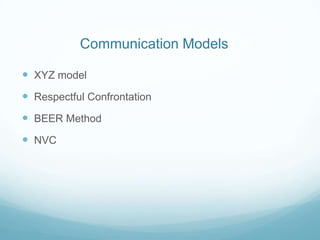
Communication Models
 XYZ model
 Respectful Confrontation
 BEER Method

 NVC
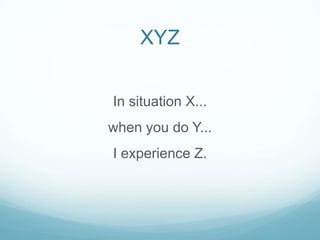
XYZ
In situation X...
when you do Y...
I experience Z.
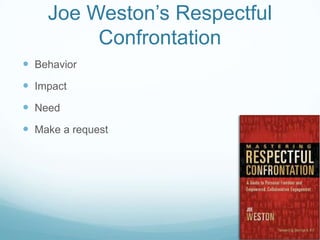
Joe Weston’s Respectful
Confrontation
 Behavior

 Impact
 Need
 Make a request
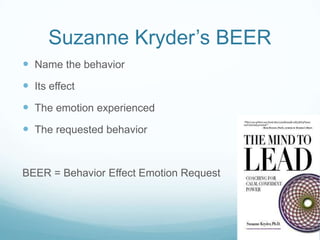
Suzanne Kryder’s BEER
 Name the behavior

 Its effect
 The emotion experienced
 The requested behavior

BEER = Behavior Effect Emotion Request
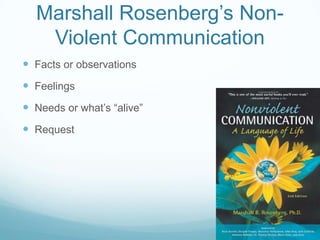
Marshall Rosenberg’s NonViolent Communication
 Facts or observations

 Feelings
 Needs or what’s “alive”
 Request
Respect
 If you want respect, you have to give it.

 How do we disrespect our users?
 Sophos study said only 4% of IT staff trust their users.
 What percentage of users trust US?
“How To Break a Terrorist”
Two tragedies to Abu Ghraib.

 The human cruelty
 The obvious failure of humiliation and violence in
gathering intelligence.

Interrogator, Matthew Alexander, discovered that building
rapport with prisoners was the most efficient way to get
information and stop terrorism in Iraq.
“The quickest way to get most (but not all) captives talking
is to be nice to them.”

Mark Bowden, author of Black Hawk Down
Motivation
Study sponsored by the Federal Reserve Bank found
three main factors motivate people in their work.
 Autonomy
 Mastery
 Purpose
If we want security “wins” we have to include everyone as
partners in a cooperative process.
Neuroplasticity: You Can
Change Your Brain
 It is no longer believed that the brain becomes static
after childhood.

 The brain is always changing. This is caused by
physiological, environmental and behavioral factors.

 A study found increased cortical gyrification with more
years of mindfulness practice.

 Higher gyrification usually correlates to intelligence.
Practicing Respectful
Confrontation
My Truth != The Truth
Synonymous?
True Power

Brute Force

Confrontation
Conflict

Assertiveness
Aggression
Concepts to Explore
True Power != Brute Force

Confrontation != Conflict

Assertiveness != Aggression
Four Pillars of True Power
 Grounding

 Focus
 Strength

 Flexibility
Vulnerability != Weakness
It is only in your vulnerability
that your true power

is revealed.
“Water is fluid, soft, and yielding. But water will wear away
rock, which is rigid and cannot yield. As a rule, whatever
is fluid, soft, and yielding will overcome whatever is rigid
and hard. This is another paradox: what is soft is strong.”

Lao Tzu
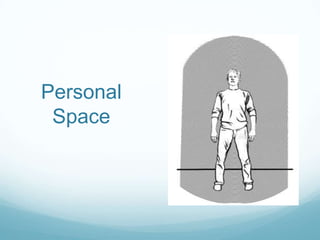
Personal
Space
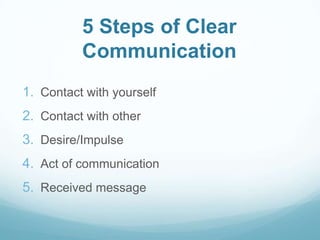
5 Steps of Clear
Communication
1. Contact with yourself
2. Contact with other

3. Desire/Impulse
4. Act of communication
5. Received message
Key Takeaways
 Bad trumps good in the human brain.
 You can’t turn your emotions off or leave them at home. It’s
like wearing a bad toupee. You aren’t fooling anyone.

 If the limbic system is an open loop, we’re all responsible for
the quality of the emotional landscape.

 Stress makes you stupid, by shutting down blood flow to the
critical pre-frontal lobes. If you set off a stress response in
someone, you minimize the chance of having a rational
dialogue with them.

 Confrontation isn’t always negative. Resistance to change
can be a valuable source of feedback.
Cyber Peace
 Peaceful doesn’t mean passive.

 Peace isn’t the absence of war or conflict.
 Violence isn’t always physical. There are subtle ways to
commit harm against another.

Let’s stop blaming the victims and work in partnership
with our users to empower each other in our mutual goal
of enterprise security.
“If you use government to show them the Way and punishment to keep them
true, the people will grow evasive and lose all remorse. But if you use integrity
to show them the Way and Ritual to keep them true, they’ll cultivate remorse
and always see deeply into things.”
From “The Analects” of Confucius 5th century B.C.E.
Where Can You Find Us?
Michele Chubirka, spending quality time in kernel mode.
http://www.healthyparanoia.net
Twitter @MrsYisWhy
Google+ MrsYisWhy
networksecurityprincess@gmail.com

Joe Weston, writing and teaching workshops.
http://www.respectfulconfrontation.com/
References


Zehr, Howard The Little Book of Restorative Justice, 2002



Chubirka, Michele “Is Cyber Security a Form of Violence?” http://packetpushers.net/is-cyber-security-a-form-of-violence/, 1/31/2012



Goleman, Daniel Working with Emotional Intelligence, 1998



Goleman, Daniel and Boyatzis, Richard “Social Intelligence and Biology of Leadership” Harvard Business Review, 9/08



Kryder, Suzanne The Mind To Lead, 2011



Weston, Joe Mastering Respectful Confrontation, 2011



Pink, Daniel Drive, 2009



Pink, Daniel “Why bosses need to show their soft side” The TeleGraph 7/17/11



Gladwell, Malcolm Blink, 2005



Alexander, Matthew How to Break a Terrorist: The U.S. Interrogators Who Used Brains, Not Brutality, to Take Down the
Deadliest Man in Iraq, 2008



Siegel, Daniel The Mindful Brain, 2007



Hanson, Rick Buddha’s Brain, 2009



Rosenberg, Marshall B. Nonviolent Communication, 2005



Luders, Kurth, Mayer, Toga, Narr and Gaser, The unique brain anatomy of meditation practitioners: alterations in cortical gyrification,
2012

A New Model: Advancing Organizational Security Through Peacebuilding-1st draft

  • 1.
    A New Model: AdvancingOrganizational Security Through Peacebuilding
  • 2.
    Who Are We? Michele Chubirka, aka "Mrs. Y.," is a recovering UNIX engineer working in security. She is also the host of the Healthy Paranoia podcast, the information security feed of Packetpushers, and official nerd hunter. She likes long walks in hubsites, traveling to security conferences, and spending time in the Bat Cave. Sincerely believes that every problem can be solved with a "for" loop.  Joe Weston is a workshop facilitator, consultant, and author of the book Mastering Respectful Confrontation. He is also the founder of the Heartwalker Peace Project, which creates opportunities for connection, discussion, and creative collaboration.
  • 3.
  • 4.
    Special Request  Importanceof feeling heard.  Please put laptops and phones away for now.
  • 5.
    A Language ofViolence  The taxonomy of information security is borrowed from the language of war.  How does this impact the way we interact with our user community?  How does this affect the practitioners?
  • 6.
    Peacebuilding Levels  Personal Social  Institutional Personal + social = institutional change
  • 7.
    "The human brainhasn't had a hardware upgrade in about 100,000 years." Daniel Goleman, Author of Emotional Intelligence
  • 8.
    Users Aren’t Stupid We spend millions of dollars on security products and at the end of the day, the weakest link is the user.  Even with training, users make the wrong choices.  What if the problem isn’t about the user at all, but us?
  • 9.
    Something isn’t working We’re swimming in data, but we still can’t make predictions about intrusions.  How can we realistically change user behavior?
  • 10.
    User: Definition People whoaren’t us.  Developers  Administrative Staff  Management
  • 11.
  • 12.
    Neuroscience 101 Limbic System:The interior of the cortex, includes the hippocampus and amygdala. Supports emotion and long-term memory. Prefrontal Cortex: Region responsible for planning, decision making and moderating behavior. Think of the limbic system to the prefrontal cortex as a horse is to a rider.
  • 13.
    Demonstration: A BrainIn the Palm of Your Hand  Hold up your hand and make a fist.  This is a good representation of the brain and spinal column.  The brain stem, limbic system and neocortex. * These two slides are oversimplifications of a very complex system.
  • 14.
    The Threat Response:Step 1 Cortex receives input (externally or internally) from the thalamus, a component of the limbic system.
  • 15.
    The Threat Response:Step 2 Limbic system and prefrontal cortex (the executive or evaluator of the brain) take in data simultaneously.
  • 16.
    The Threat Response:Step 3 Amygdala, responsible for emotional response and memory, acts as an alarm activating the fight/flight hormonal response if threat is perceived.
  • 17.
    The Threat Response:4 Then the sympathetic nervous system sets up organs and muscles for fight/flight response, inhibiting digestion and the hypothalamus prompts the release of stress hormones.
  • 18.
    Emotional Contagion  Thelimbic system is an “open loop,” influenced by other people’s emotions, aka mirror neurons.  Mirror neurons activate when an animal performs an action or when an animal observes the same action of another animal.  They are thought to be the basis of empathy.  Also called emotional contagion.
  • 19.
    Negativity  The brainhas a negativity bias because the limbic system is quicker than the prefrontal cortex at perceiving and analyzing potential threats.  Traumatic experiences are “stickier” than positive, happy experiences, i.e. harder to un-map.
  • 20.
    No Escape FromThreat  Most of us are in a permanent state of cortisol overload due to the constant stressors of modern life and the fact that stress hormones stay in the body for hours.  This decreases intellectual capacity, memory capacity and lowers impulse control.  Stress makes you stupid.
  • 21.
    Amygdala Hijack Key indicator:intense and immediate emotional reaction, followed by the understanding that it was inappropriate.  I thought that stick on the ground was a snake!  I don’t like you or I’m bored, so I won’t cooperate or listen to what you have to say.  That guy who cut me off in traffic was trying to kill me!  Why were you so insulting to me in that email yesterday? (studies show there’s a negativity bias in email.)  Other examples?
  • 22.
    Thin Slicing: WarrenHarding Syndrome  Human beings make quick decisions based on intuition. Think “love at first site” or a “gut reaction.”  This is sometimes called “Thin Slicing.”  One example is “Warren Harding Syndrome.” A mediocre presidential candidate, Americans voted for him , because he was tall, good looking and charming.
  • 23.
    Harding has been calledone of the worst presidents in history.
  • 24.
    Thin Slicing: BedsideManner  The likelihood of a doctor being sued has little to do with the number of errors made.  In an analysis of malpractice lawsuits, there was no correlation between the number of mistakes by doctors and how many lawsuits were filed against them.
  • 25.
    Malpractice?  In studies,psychologists were able to predict which doctors would be sued more by analyzing the amount of time spent with patients and if the tone of their voices sounded “concerned.”  Patients file lawsuits because of how they are treated.
  • 26.
    The Power ofMirror Neurons Marie Dasborough observed two groups:  One group was given negative feedback accompanied by positive emotional signs, nods and smiles.  Another was provided positive feedback that was delivered using negative emotional cues, frowns and narrowed eyes.
  • 27.
    Entrainment  Those whoreceived the positive feedback accompanied by negative emotional signs reported that they felt worse than participants who received negative feedback given with positive emotional cues.  The delivery was more important than the message.  Your emotions and actions will be mirrored by those around you.  This is similar to a phenomenon known in physics as entrainment.
  • 28.
    There’s No Mr.Spock  Neurologist, Dr. Antonio Damasio, had a patient who had been a successful corporate lawyer.  A tumor was discovered in his prefrontal lobes and the surgeon who removed it inadvertently severed the circuit between this area and his amygdala.
  • 29.
    Somatic Marker  Therewas no obvious damage to his cognitive abilities, but his life fell apart.  It was discovered that he couldn’t make decisions when presented with the simplest choices.  He no longer had any feelings regarding these options, no preferences.  This is the basis for Damasio’s Somatic Marker Hypothesis, in which it is proposed that emotions assist with complex decision-making.
  • 30.
    It is agross misconception that reason can be completely separated from emotion.
  • 31.
    You’re the Threat The WAY we present information is just as important as WHAT we present.  In the first few minutes we interact with someone, we’re being assessed for our potential to provide reward or punishment.  Could I have some carrot with that stick?
  • 32.
    It’s Tribal  Ashumans, we’re constantly trying to maximize pleasure or minimize pain.  That black, unwashed t-shirt and body art may feel like a personal statement, but it can impact and even alienate those we’re trying to convince.  Are you a member of their tribe?
  • 33.
    That was thebad news. Now for the good.
  • 34.
    Training That Works The Dynamic Feedback Loop  In the 1960s, Stanford University psychologist Albert Bandura determined that giving individuals a clear goal and a method of evaluating progress increased the likelihood that they would achieve it.
  • 35.
    Feedback Loops Where arethey used?  Personal training, leadership coaching, digital speeding signs.  In Garden Grove, California, the use of digital speeding signs reduced speeds on an average of 10%.  This was more effective than police ticketing.
  • 36.
    Let’s Have SomeFun Draw the letter “e” in the air in front of you. *This is a decade-old method social scientists use to measure perspective-taking – the ability to put yourself in someone else’s shoes.
  • 37.
    Communication That Works •Interaction based on the core competencies of Emotional Intelligence, such as self-awareness, selfregulation, empathy, and motivation. • Social engineers already use some of these skills to create emotional and social affinity with a target. It’s called pseudo-empathy. • Conflict resolution methods such as those based on Non Violent Communication (NVC) and Restorative Practices.
  • 38.
    Self Awareness Exercise It’scalled “labeling”  Think of it like putting yourself in debug mode.  Process emotions or sensations you experience in real time. Let’s try it.  Say to yourself, “Right now, I’m experiencing….”
  • 39.
    Communication Models  XYZmodel  Respectful Confrontation  BEER Method  NVC
  • 40.
    XYZ In situation X... whenyou do Y... I experience Z.
  • 41.
    Joe Weston’s Respectful Confrontation Behavior  Impact  Need  Make a request
  • 42.
    Suzanne Kryder’s BEER Name the behavior  Its effect  The emotion experienced  The requested behavior BEER = Behavior Effect Emotion Request
  • 43.
    Marshall Rosenberg’s NonViolentCommunication  Facts or observations  Feelings  Needs or what’s “alive”  Request
  • 44.
    Respect  If youwant respect, you have to give it.  How do we disrespect our users?  Sophos study said only 4% of IT staff trust their users.  What percentage of users trust US?
  • 45.
    “How To Breaka Terrorist” Two tragedies to Abu Ghraib.  The human cruelty  The obvious failure of humiliation and violence in gathering intelligence. Interrogator, Matthew Alexander, discovered that building rapport with prisoners was the most efficient way to get information and stop terrorism in Iraq.
  • 46.
    “The quickest wayto get most (but not all) captives talking is to be nice to them.” Mark Bowden, author of Black Hawk Down
  • 47.
    Motivation Study sponsored bythe Federal Reserve Bank found three main factors motivate people in their work.  Autonomy  Mastery  Purpose If we want security “wins” we have to include everyone as partners in a cooperative process.
  • 48.
    Neuroplasticity: You Can ChangeYour Brain  It is no longer believed that the brain becomes static after childhood.  The brain is always changing. This is caused by physiological, environmental and behavioral factors.  A study found increased cortical gyrification with more years of mindfulness practice.  Higher gyrification usually correlates to intelligence.
  • 49.
  • 51.
    My Truth !=The Truth
  • 52.
  • 53.
    Concepts to Explore TruePower != Brute Force Confrontation != Conflict Assertiveness != Aggression
  • 54.
    Four Pillars ofTrue Power  Grounding  Focus  Strength  Flexibility
  • 55.
    Vulnerability != Weakness Itis only in your vulnerability that your true power is revealed.
  • 57.
    “Water is fluid,soft, and yielding. But water will wear away rock, which is rigid and cannot yield. As a rule, whatever is fluid, soft, and yielding will overcome whatever is rigid and hard. This is another paradox: what is soft is strong.” Lao Tzu
  • 63.
  • 64.
    5 Steps ofClear Communication 1. Contact with yourself 2. Contact with other 3. Desire/Impulse 4. Act of communication 5. Received message
  • 65.
    Key Takeaways  Badtrumps good in the human brain.  You can’t turn your emotions off or leave them at home. It’s like wearing a bad toupee. You aren’t fooling anyone.  If the limbic system is an open loop, we’re all responsible for the quality of the emotional landscape.  Stress makes you stupid, by shutting down blood flow to the critical pre-frontal lobes. If you set off a stress response in someone, you minimize the chance of having a rational dialogue with them.  Confrontation isn’t always negative. Resistance to change can be a valuable source of feedback.
  • 66.
    Cyber Peace  Peacefuldoesn’t mean passive.  Peace isn’t the absence of war or conflict.  Violence isn’t always physical. There are subtle ways to commit harm against another. Let’s stop blaming the victims and work in partnership with our users to empower each other in our mutual goal of enterprise security.
  • 67.
    “If you usegovernment to show them the Way and punishment to keep them true, the people will grow evasive and lose all remorse. But if you use integrity to show them the Way and Ritual to keep them true, they’ll cultivate remorse and always see deeply into things.” From “The Analects” of Confucius 5th century B.C.E.
  • 68.
    Where Can YouFind Us? Michele Chubirka, spending quality time in kernel mode. http://www.healthyparanoia.net Twitter @MrsYisWhy Google+ MrsYisWhy networksecurityprincess@gmail.com Joe Weston, writing and teaching workshops. http://www.respectfulconfrontation.com/
  • 69.
    References  Zehr, Howard TheLittle Book of Restorative Justice, 2002  Chubirka, Michele “Is Cyber Security a Form of Violence?” http://packetpushers.net/is-cyber-security-a-form-of-violence/, 1/31/2012  Goleman, Daniel Working with Emotional Intelligence, 1998  Goleman, Daniel and Boyatzis, Richard “Social Intelligence and Biology of Leadership” Harvard Business Review, 9/08  Kryder, Suzanne The Mind To Lead, 2011  Weston, Joe Mastering Respectful Confrontation, 2011  Pink, Daniel Drive, 2009  Pink, Daniel “Why bosses need to show their soft side” The TeleGraph 7/17/11  Gladwell, Malcolm Blink, 2005  Alexander, Matthew How to Break a Terrorist: The U.S. Interrogators Who Used Brains, Not Brutality, to Take Down the Deadliest Man in Iraq, 2008  Siegel, Daniel The Mindful Brain, 2007  Hanson, Rick Buddha’s Brain, 2009  Rosenberg, Marshall B. Nonviolent Communication, 2005  Luders, Kurth, Mayer, Toga, Narr and Gaser, The unique brain anatomy of meditation practitioners: alterations in cortical gyrification, 2012

Editor's Notes

  • #5 I’d like you to rewrite this in your language.
  • #67 What’s on the side of an LA police car? Protect and serve.