Applied
Neurosciences
Lab
Neurosciences
What are they?
What do they are good for?
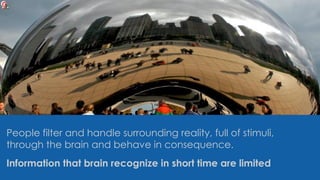
People filter and handle surrounding reality, full of stimuli,
through the brain and behave in consequence.
Information that brain recognize in short time are limited
What
Neurosciences
are?
Neurosciences study the nervous system: how it is and how
it process information
They explain us how we decide,
how we memorize, how we communicate through
If we apply these knowledges to everyday life, we can
understand people's different behaviours and explain how
they act.
Neurosciences can increase society's competitiveness and
wellness: public and private companies, social sphere, training
authority, associations.
What do they are good for?
About us
We are a team of
researchers with
different and integrated
skills: Neurosciences,
Sociology, Statistics,
Marketing, Psychology,
Economics, Education.
What do we do
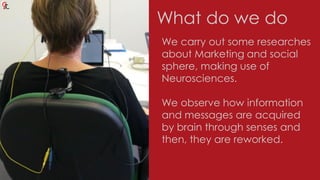
We carry out some researches
about Marketing and social
sphere, making use of
Neurosciences.
We observe how information
and messages are acquired
by brain through senses and
then, they are reworked.
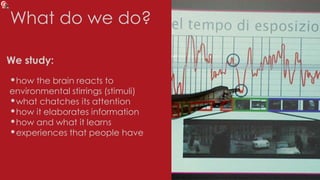
What do we do?
•how the brain reacts to
environmental stirrings (stimuli)
•what chatches its attention
•how it elaborates information
•how and what it learns
•experiences that people have
We study:
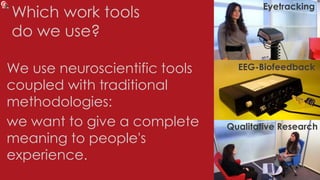
Which work tools
do we use?
We use neuroscientific tools
coupled with traditional
methodologies:
we want to give a complete
meaning to people's
experience.
Eyetracking
EEG-Biofeedback
Qualitative Research
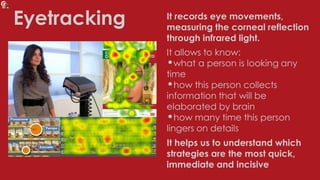
Eyetracking It records eye movements,
measuring the corneal reflection
through infrared light.
It allows to know:
•what a person is looking any
time
•how this person collects
information that will be
elaborated by brain
•how many time this person
lingers on details
It helps us to understand which
strategies are the most quick,
immediate and incisive
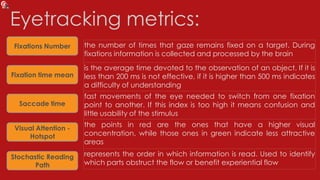
Eyetracking metrics:
Fixations Number
Fixation time mean
Saccade time
Visual Attention -
Hotspot
Stochastic Reading
Path
the number of times that gaze remains fixed on a target. During
fixations information is collected and processed by the brain
is the average time devoted to the observation of an object. If it is
less than 200 ms is not effective, if it is higher than 500 ms indicates
a difficulty of understanding
fast movements of the eye needed to switch from one fixation
point to another. If this index is too high it means confusion and
little usability of the stimulus
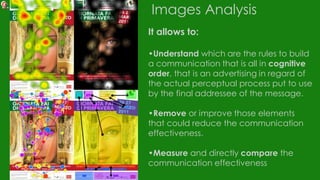
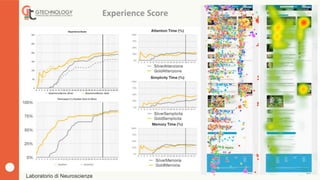
the points in red are the ones that have a higher visual
concentration, while those ones in green indicate less attractive
areas
represents the order in which information is read. Used to identify
which parts obstruct the flow or benefit experiential flow
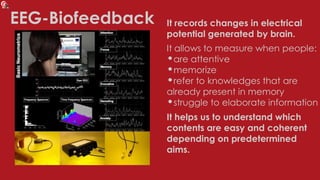
EEG-Biofeedback It records changes in electrical
potential generated by brain.
It allows to measure when people:
•are attentive
•memorize
•refer to knowledges that are
already present in memory
•struggle to elaborate information
It helps us to understand which
contents are easy and coherent
depending on predetermined
aims.
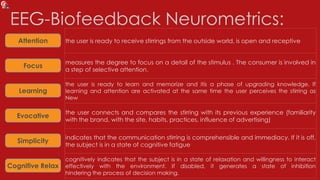
EEG-Biofeedback Neurometrics:
Attention the user is ready to receive stirrings from the outside world, is open and receptive
measures the degree to focus on a detail of the stimulus . The consumer is involved in
a step of selective attention.
the user is ready to learn and memorize and itís a phase of upgrading knowledge. If
learning and attention are activated at the same time the user perceives the stirring as
New
the user connects and compares the stirring with its previous experience (familiarity
with the brand, with the site, habits, practices, influence of advertising)
indicates that the communication stirring is comprehensible and immediacy. If it is off,
the subject is in a state of cognitive fatigue
cognitively indicates that the subject is in a state of relaxation and willingness to interact
effectively with the environment. If disabled, it generates a state of inhibition
hindering the process of decision making.
Focus
Learning
Evocative
Simplicity
Cognitive Relax
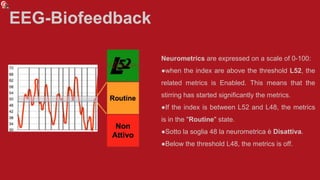
EEG-Biofeedback
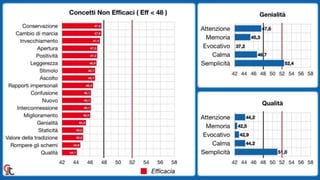
Neurometrics are expressed on a scale of 0-100:
●when the index are above the threshold L52, the
related metrics is Enabled. This means that the
stirring has started significantly the metrics.
●If the index is between L52 and L48, the metrics
is in the "Routine" state.
●Sotto la soglia 48 la neurometrica è Disattiva.
●Below the threshold L48, the metrics is off.
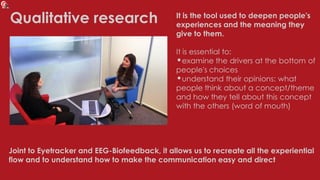
Qualitative research It is the tool used to deepen people's
experiences and the meaning they
give to them.
It is essential to:
•examine the drivers at the bottom of
people's choices
•understand their opinions: what
people think about a concept/theme
and how they tell about this concept
with the others (word of mouth)
Joint to Eyetracker and EEG-Biofeedback, it allows us to recreate all the experiential
flow and to understand how to make the communication easy and direct
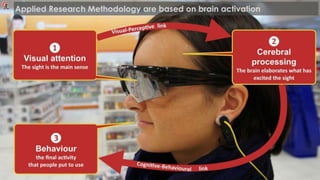
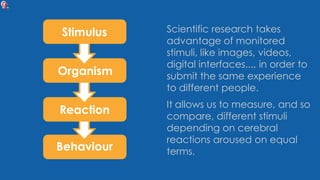
Behaviour
Reaction
Scientific research takes
advantage of monitored
stimuli, like images, videos,
digital interfaces..., in order to
submit the same experience
to different people.
It allows us to measure, and so
compare, different stimuli
depending on cerebral
reactions aroused on equal
terms.
Organism
Stimulus
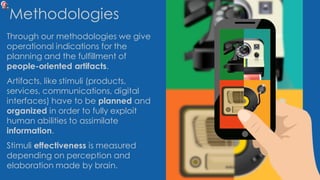
Through our methodologies we give
operational indications for the
planning and the fulfillment of
people-oriented artifacts.
Artifacts, like stimuli (products,
services, communications, digital
interfaces) have to be planned and
organized in order to fully exploit
human abilities to assimilate
information.
Stimuli effectiveness is measured
depending on perception and
elaboration made by brain.
Methodologies
Attention economy
Attention economy drives our brain
towards the key points of the reality
we get in contact with everyday.
Media saturation brings the
competition between companies to
create effective products and
services that are easy to understand
by the brain.
Each company's productive activity,
from product or service conception
to planning, communication and
selling, has to vie with users' brain!
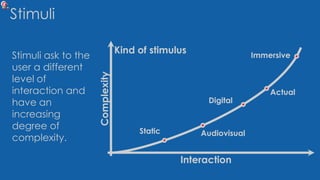
Stimuli
Stimuli ask to the
user a different
level of
interaction and
have an
increasing
degree of
complexity.
Kind of stimulus
Audiovisual
Digital
Immersive
Interaction
Complexity
Static
Actual
Stimuli:
Applied Neurosciences Lab, for every kind of stimulus, has created research
methodologies to measure effectiveness of it.
A stimulus is effective when, on a perceptual - cognitive level, information
included in it are attractive, easy to elaborate, memorized and
reconnected to one's own knowledge.
The stimulus effectiveness can be directly compared with that one of other
stimuli, in order to define which solution is the best.
Neurosciences answer to questions like:
How many people see the object?
Which elements of the object are more seen and in which proportion?
Has the object been seen for a sufficient time to elaborate its contents?
Is the object the first, the second...to be seen? And the potential
competitors?
Is the object appealing?
Is the object recognizable?
Do people memorize the object?
Are the object and its message easily enjoyed?
Do the message produce Awareness about the product/object/brand?
Which action/ behaviours are produced by the object?
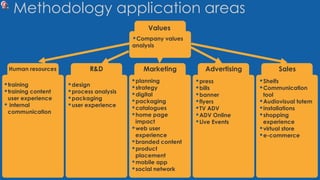
Methodology application areas
MarketingR&D SalesAdvertisingHuman resources
•training
•training content
user experience
• internal
communication
•design
•process analysis
•packaging
•user experience
•planning
•strategy
•digital
•packaging
•catalogues
•home page
impact
•web user
experience
•branded content
•product
placement
•mobile app
•social network
•press
•bills
•banner
•flyers
•TV ADV
•ADV Online
•Live Events
•Shelfs
•Communication
tool
•Audiovisual totem
•installations
•shopping
experience
•virtual store
•e-commerce
Values
•Company values
analysis
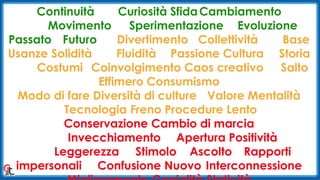
Company values
In order to
communicate it's
necessary to have
strong bases to share
internally, on which
built one's own
products and services
Continuità Curiosità SfidaCambiamento
Movimento Sperimentazione Evoluzione
Passato Futuro Divertimento Collettività Base
Usanze Solidità Fluidità Passione Cultura Storia
Costumi Coinvolgimento Caos creativo Salto
Effimero Consumismo
Modo di fare Diversità di culture Valore Mentalità
Tecnologia Freno Procedure Lento
Conservazione Cambio di marcia
Invecchiamento Apertura Positività
Leggerezza Stimolo Ascolto Rapporti
impersonali Confusione Nuovo Interconnessione
Static Advertising
A visual artifact is incisive when
information included in it are
read according to an univocal
order with a sufficient time to be
understood by the brain in a
easy, unforgettable and
appealing way.
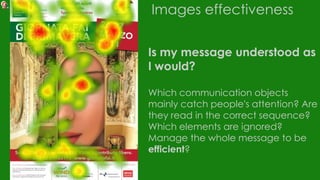
Images effectiveness
Is my message understood as
I would?
Which communication objects
mainly catch people's attention? Are
they read in the correct sequence?
Which elements are ignored?
Manage the whole message to be
efficient?
Images Analysis
It allows to:
•Understand which are the rules to build
a communication that is all in cognitive
order, that is an advertising in regard of
the actual perceptual process put to use
by the final addressee of the message.
•Remove or improve those elements
that could reduce the communication
effectiveness.
•Measure and directly compare the
communication effectiveness
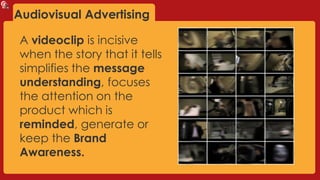
Audiovisual Advertising
A videoclip is incisive
when the story that it tells
simplifies the message
understanding, focuses
the attention on the
product which is
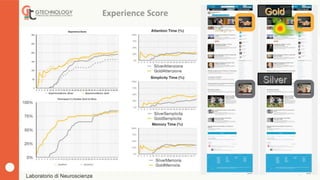
reminded, generate or
keep the Brand
Awareness.
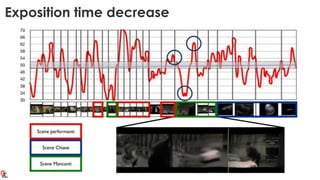
Exposition time decrease
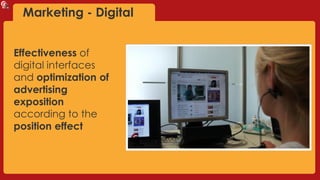
Marketing - Digital
Effectiveness of
digital interfaces
and optimization of
advertising
exposition
according to the
position effect
Gold
Silver
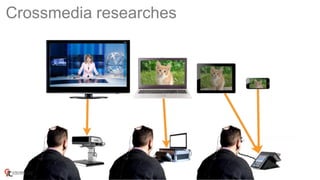
Crossmedia researches
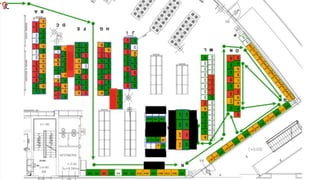
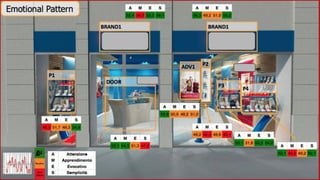
Exhibition centres
Promotional places
are complex,
expensive and very
competitive spaces.
One's own products
positioning in
coherent, strategic
and cheap points is
the key to success.
Applied Neurosciences Lab
Registered office
Via Pier Paolo Pasolini 15,
41123 Modena (MO)
Phone: +39 059 5966052
E-mail: info@gtfondazione.org
Headquarters
Via Carlo Darwin 20
20143 Milano (MI)
Phone: +39 02 39306680
E-mail: labneuro@gtfondazione.org
Applied Neurosciences Lab
Scientific director : Francesco Gallucci
Research team:
• Riccardo Trecciola
• Valeria Trezzi
• Martina Di Bartolomeo

NeuroscienceLaboratory__03_2016C

  • 1.
  • 2.
    Neurosciences What are they? Whatdo they are good for?
  • 3.
    People filter andhandle surrounding reality, full of stimuli, through the brain and behave in consequence. Information that brain recognize in short time are limited
  • 4.
    What Neurosciences are? Neurosciences study thenervous system: how it is and how it process information They explain us how we decide, how we memorize, how we communicate through
  • 5.
    If we applythese knowledges to everyday life, we can understand people's different behaviours and explain how they act. Neurosciences can increase society's competitiveness and wellness: public and private companies, social sphere, training authority, associations. What do they are good for?
  • 6.
    About us We area team of researchers with different and integrated skills: Neurosciences, Sociology, Statistics, Marketing, Psychology, Economics, Education.
  • 7.
    What do wedo We carry out some researches about Marketing and social sphere, making use of Neurosciences. We observe how information and messages are acquired by brain through senses and then, they are reworked.
  • 8.
    What do wedo? •how the brain reacts to environmental stirrings (stimuli) •what chatches its attention •how it elaborates information •how and what it learns •experiences that people have We study:
  • 10.
    Which work tools dowe use? We use neuroscientific tools coupled with traditional methodologies: we want to give a complete meaning to people's experience. Eyetracking EEG-Biofeedback Qualitative Research
  • 11.
    Eyetracking It recordseye movements, measuring the corneal reflection through infrared light. It allows to know: •what a person is looking any time •how this person collects information that will be elaborated by brain •how many time this person lingers on details It helps us to understand which strategies are the most quick, immediate and incisive
  • 12.
    Eyetracking metrics: Fixations Number Fixationtime mean Saccade time Visual Attention - Hotspot Stochastic Reading Path the number of times that gaze remains fixed on a target. During fixations information is collected and processed by the brain is the average time devoted to the observation of an object. If it is less than 200 ms is not effective, if it is higher than 500 ms indicates a difficulty of understanding fast movements of the eye needed to switch from one fixation point to another. If this index is too high it means confusion and little usability of the stimulus the points in red are the ones that have a higher visual concentration, while those ones in green indicate less attractive areas represents the order in which information is read. Used to identify which parts obstruct the flow or benefit experiential flow
  • 13.
    EEG-Biofeedback It recordschanges in electrical potential generated by brain. It allows to measure when people: •are attentive •memorize •refer to knowledges that are already present in memory •struggle to elaborate information It helps us to understand which contents are easy and coherent depending on predetermined aims.
  • 14.
    EEG-Biofeedback Neurometrics: Attention theuser is ready to receive stirrings from the outside world, is open and receptive measures the degree to focus on a detail of the stimulus . The consumer is involved in a step of selective attention. the user is ready to learn and memorize and itís a phase of upgrading knowledge. If learning and attention are activated at the same time the user perceives the stirring as New the user connects and compares the stirring with its previous experience (familiarity with the brand, with the site, habits, practices, influence of advertising) indicates that the communication stirring is comprehensible and immediacy. If it is off, the subject is in a state of cognitive fatigue cognitively indicates that the subject is in a state of relaxation and willingness to interact effectively with the environment. If disabled, it generates a state of inhibition hindering the process of decision making. Focus Learning Evocative Simplicity Cognitive Relax
  • 15.
    EEG-Biofeedback Neurometrics are expressedon a scale of 0-100: ●when the index are above the threshold L52, the related metrics is Enabled. This means that the stirring has started significantly the metrics. ●If the index is between L52 and L48, the metrics is in the "Routine" state. ●Sotto la soglia 48 la neurometrica è Disattiva. ●Below the threshold L48, the metrics is off.
  • 16.
    Qualitative research Itis the tool used to deepen people's experiences and the meaning they give to them. It is essential to: •examine the drivers at the bottom of people's choices •understand their opinions: what people think about a concept/theme and how they tell about this concept with the others (word of mouth) Joint to Eyetracker and EEG-Biofeedback, it allows us to recreate all the experiential flow and to understand how to make the communication easy and direct
  • 17.
    Behaviour Reaction Scientific research takes advantageof monitored stimuli, like images, videos, digital interfaces..., in order to submit the same experience to different people. It allows us to measure, and so compare, different stimuli depending on cerebral reactions aroused on equal terms. Organism Stimulus
  • 18.
    Through our methodologieswe give operational indications for the planning and the fulfillment of people-oriented artifacts. Artifacts, like stimuli (products, services, communications, digital interfaces) have to be planned and organized in order to fully exploit human abilities to assimilate information. Stimuli effectiveness is measured depending on perception and elaboration made by brain. Methodologies
  • 19.
    Attention economy Attention economydrives our brain towards the key points of the reality we get in contact with everyday. Media saturation brings the competition between companies to create effective products and services that are easy to understand by the brain. Each company's productive activity, from product or service conception to planning, communication and selling, has to vie with users' brain!
  • 20.
    Stimuli Stimuli ask tothe user a different level of interaction and have an increasing degree of complexity. Kind of stimulus Audiovisual Digital Immersive Interaction Complexity Static Actual
  • 21.
    Stimuli: Applied Neurosciences Lab,for every kind of stimulus, has created research methodologies to measure effectiveness of it. A stimulus is effective when, on a perceptual - cognitive level, information included in it are attractive, easy to elaborate, memorized and reconnected to one's own knowledge. The stimulus effectiveness can be directly compared with that one of other stimuli, in order to define which solution is the best.
  • 22.
    Neurosciences answer toquestions like: How many people see the object? Which elements of the object are more seen and in which proportion? Has the object been seen for a sufficient time to elaborate its contents? Is the object the first, the second...to be seen? And the potential competitors? Is the object appealing? Is the object recognizable? Do people memorize the object? Are the object and its message easily enjoyed? Do the message produce Awareness about the product/object/brand? Which action/ behaviours are produced by the object?
  • 23.
    Methodology application areas MarketingR&DSalesAdvertisingHuman resources •training •training content user experience • internal communication •design •process analysis •packaging •user experience •planning •strategy •digital •packaging •catalogues •home page impact •web user experience •branded content •product placement •mobile app •social network •press •bills •banner •flyers •TV ADV •ADV Online •Live Events •Shelfs •Communication tool •Audiovisual totem •installations •shopping experience •virtual store •e-commerce Values •Company values analysis
  • 24.
    Company values In orderto communicate it's necessary to have strong bases to share internally, on which built one's own products and services
  • 26.
    Continuità Curiosità SfidaCambiamento MovimentoSperimentazione Evoluzione Passato Futuro Divertimento Collettività Base Usanze Solidità Fluidità Passione Cultura Storia Costumi Coinvolgimento Caos creativo Salto Effimero Consumismo Modo di fare Diversità di culture Valore Mentalità Tecnologia Freno Procedure Lento Conservazione Cambio di marcia Invecchiamento Apertura Positività Leggerezza Stimolo Ascolto Rapporti impersonali Confusione Nuovo Interconnessione
  • 27.
    Static Advertising A visualartifact is incisive when information included in it are read according to an univocal order with a sufficient time to be understood by the brain in a easy, unforgettable and appealing way.
  • 28.
    Images effectiveness Is mymessage understood as I would? Which communication objects mainly catch people's attention? Are they read in the correct sequence? Which elements are ignored? Manage the whole message to be efficient?
  • 29.
    Images Analysis It allowsto: •Understand which are the rules to build a communication that is all in cognitive order, that is an advertising in regard of the actual perceptual process put to use by the final addressee of the message. •Remove or improve those elements that could reduce the communication effectiveness. •Measure and directly compare the communication effectiveness
  • 30.
    Audiovisual Advertising A videoclipis incisive when the story that it tells simplifies the message understanding, focuses the attention on the product which is reminded, generate or keep the Brand Awareness.
  • 31.
  • 32.
    Marketing - Digital Effectivenessof digital interfaces and optimization of advertising exposition according to the position effect
  • 33.
  • 35.
  • 36.
    Exhibition centres Promotional places arecomplex, expensive and very competitive spaces. One's own products positioning in coherent, strategic and cheap points is the key to success.
  • 39.
    Applied Neurosciences Lab Registeredoffice Via Pier Paolo Pasolini 15, 41123 Modena (MO) Phone: +39 059 5966052 E-mail: info@gtfondazione.org Headquarters Via Carlo Darwin 20 20143 Milano (MI) Phone: +39 02 39306680 E-mail: labneuro@gtfondazione.org Applied Neurosciences Lab Scientific director : Francesco Gallucci Research team: • Riccardo Trecciola • Valeria Trezzi • Martina Di Bartolomeo