GENERATIVE AI: A
COMPREHENSIVE TECH STACK
BREAKDOWN
Talk to our Consultant
 
Listen to the article
Generative AI has become more mainstream than ever, thanks to the
popularity of ChatGPT, the proliferation of image-to-text tools and the
appearance of catchy avatars on our social media feeds. Global adoption of
generative AI has opened up new frontiers in content generation, and
 
businesses have a fun way to innovate and scale. The Financial
Times reported that investments in generative AI exceeded $2 billion in 2022.
The Wall Street Journal set OpenAI’s potential sale price at $29 Billion, which
clearly shows the immense interest of corporations and investors in
generative AI technology. Businesses are exploring the endless possibilities
of generative AI as the world embraces technology and automation. This type
of arti몭cial intelligence can create autonomous digital-only businesses that
can interact with people without the need for human intervention.
As enterprises begin to use generative AI for various purposes, such as
marketing, customer service and learning, we see rapid adoption of
generative AI across industries. This type of AI can generate marketing
content, pitch documents and product ideas, create sophisticated advertising
campaigns and do much more. Generative AI allows for absolute
customizability, improving conversion rates and boosting revenue for
businesses. DeepMind’s Alpha Code, GoogleLab, OpenAI’s ChatGPT, DALL-E,
MidJourney, Jasper and Stable Di몭usion are some of the prominent
generative AI platforms being widely used currently.
This technology has many use cases, including business and customer
applications, customer management systems, digital healthcare, automated
software engineering and customer management systems. It is worth noting,
however, that this type of AI technology constantly evolves, indicating
endless opportunities for autonomous enterprises. This article will take a
deep dive into the generative AI tech stack to provide readers with an
insider’s perspective on the working of generative AI.
What is generative AI?
An overview of the generative AI stack
Application frameworks: The cornerstone of the generative AI stack
Models: Generative AI’s brain
Data: Feeding information to the AI
The evaluation platform: Measuring and monitoring performance
Deployment: Moving applications into production
Why is a comprehensive tech stack essential in building e몭ective
generative AI systems?
A detailed overview of the generative AI tech stack
Application layer
Model layer
Infrastructure layer
Things to consider while choosing a generative AI tech stack
What is generative AI?
Generative AI is a type of arti몭cial intelligence that can produce new data,
images, text, or music resembling the dataset it was trained on. This is
achieved through “generative modeling,” which utilizes statistical algorithms
to learn the patterns and relationships within the dataset and leverage this
knowledge to generate new data. Generative AI’s capabilities go far beyond
creating fun mobile apps and avatars. They are used to create art pieces,
design, code, blog posts and all types of high-quality content. Generative AI
uses semi-supervised and unsupervised learning algorithms to process large
amounts of data to create outputs. Using large language models, computer
programs in generative AI understand the text and create new content. The
neural network, the heart of generative AI, detects the characteristics of
speci몭c images or text and then applies them when necessary. Computer
programs can use generative AI to predict patterns and produce the
corresponding content. However, it is worth noting that generative AI models
are limited in their parameters, and human involvement is essential to make
the most of generative AI, both at the beginning and the end of model
training.
To achieve desired results, generative AI uses GANs and transformers.
GAN – General Adversarial Network
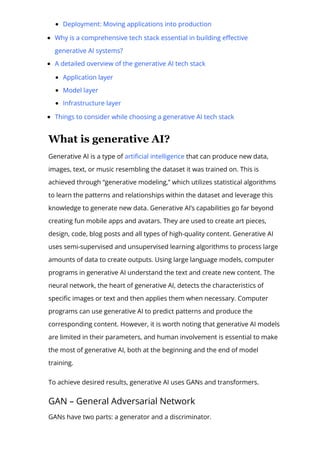
GANs have two parts: a generator and a discriminator.
The generative neural network creates outputs upon request and is usually
exposed to the necessary data to learn patterns. It needs assistance from the
discriminative neural network to improve further. The discriminator neural
network, the second element of the model, attempts to distinguish real-
world data from the model’s fake data. The 몭rst model that fools the second
model gets rewarded every time, which is why the algorithm is often called
an adversarial model. This allows the model to improve itself without any
human input.
Generator
Random input Real
examples
Real
examples
Real
examples
Transformers
Transformers are another important component in generative AI that can
produce impressive results. Transformers use a sequence rather than
individual data points when transforming input into output. This makes them
more e몭cient in processing data when the context matters. Texts contain
more than words, and transformers frequently translate and generate them.
Transformers can also be used to create a foundation model, which is useful
when engineers work on algorithms that can transform natural language
requests into commands, such as creating images or text based on user
description.
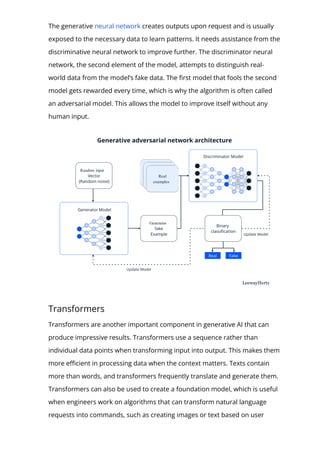
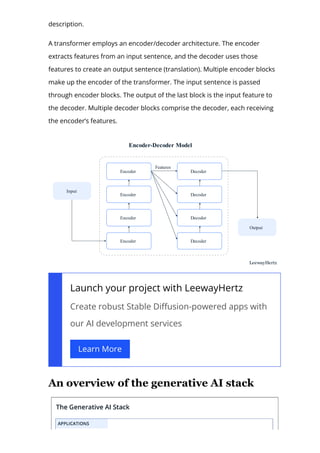
A transformer employs an encoder/decoder architecture. The encoder
extracts features from an input sentence, and the decoder uses those
features to create an output sentence (translation). Multiple encoder blocks
make up the encoder of the transformer. The input sentence is passed
through encoder blocks. The output of the last block is the input feature to
the decoder. Multiple decoder blocks comprise the decoder, each receiving
the encoder’s features.
Encoder­Decoder Model
Input
Output
Encoder Decoder
Decoder
Decoder
Decoder
Encoder
Encoder
Encoder
Features
LeewayHertz
Launch your project with LeewayHertz
Create robust Stable Di몭usion-powered apps with
our AI development services
Learn More
An overview of the generative AI stack
With generative AI quickly gaining traction across industries, we have a
comprehensive generative AI tech stack, which simpli몭es the development
process, accelerating innovation. Before delving into the details of a speci몭c
generative AI tech stack, let us talk about the generic tech stack used for
generative AI solution development. Here is why your understanding of a
generic tech stack is important:
Foundation of knowledge: The generic generative AI tech stack provides a
foundational understanding of the essential components, frameworks, and
technologies involved in generative AI. It helps establish a comprehensive
knowledge base before diving into speci몭c tech stacks, ensuring a solid
understanding of the overall landscape.
Guiding development decisions: By grasping the generic tech stack,
developers can make informed decisions about which speci몭c technologies
and tools to employ for di몭erent stages of generative AI development. It
serves as a guide for selecting the appropriate frameworks, libraries, and
platforms that align with the overall goals and requirements of the project.
Interoperability and integration: A deep understanding of the generic tech
stack facilitates better interoperability and integration of di몭erent
components within the generative AI system. It helps identify potential
points of integration with other systems and ensures seamless
collaboration between di몭erent technologies and tools.
Flexibility and adaptability: Familiarity with the generic tech stack allows
developers to adapt and switch between di몭erent speci몭c tech stacks
more e몭ectively. It enables them to understand the underlying principles
and concepts that transcend speci몭c implementations, providing 몭exibility
in selecting the most suitable tools for the task at hand.
Future-proo몭ng: By gaining a solid foundation in the generic tech stack,
developers are better prepared for future advancements and changes in
the generative AI landscape. They can stay updated with emerging
technologies and trends, making it easier to adopt new tools and adapt to
evolving industry practices.
Serving as a basis for specialization: Once the generic stack is understood,
one can then specialize and dig into the speci몭c technologies, tools, and
techniques involved in a particular generative AI stack. This allows for a
more focused and detailed understanding of tools and technologies
required how generative AI can be applied in a speci몭c context.
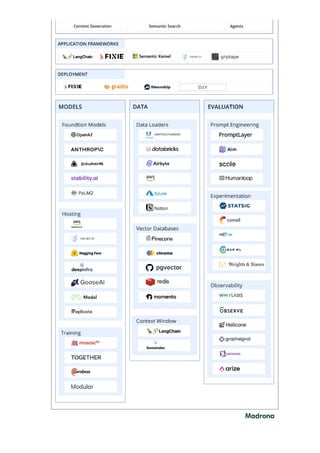
Here is an overview of the generic tech stack for generative AI development:
Application frameworks: The cornerstone of the
generative AI stack
Application frameworks form the cornerstone of the tech stack by o몭ering a
rationalized programming model that swiftly absorbs new innovations. These
frameworks, such as LangChain, Fixie, Microsoft’s Semantic Kernel, and
Google Cloud’s Vertex AI, help developers create applications that can
autonomously generate new content, develop semantic systems for natural
language search, and even enable task performance by AI agents.
Models: Generative AI’s brain
At the core of generative AI stack are Foundation Models (FMs), which
function as the ‘brain’ and enable human-like reasoning. These models can
be proprietary, developed by organizations such as Open AI, Anthropic, or
Cohere, or they can be open-source. Developers also have the option to train
their own models. In order to optimize the application, developers can
choose to use multiple FMs. These models can be hosted on servers or
deployed on edge devices and browsers, which enhances security and
reduces latency and cost.
Data: Feeding information to the AI
Language Learning Models (LLMs) have the ability to reason about the data
they have been trained on. To make the models more e몭ective and precise,
developers need to operationalize their data. Data loaders and vector
databases play a signi몭cant role in this process, helping developers to ingest
structured and unstructured data, and e몭ectively store and query data
vectors. Additionally, techniques like retrieval-augmented generation are
used for personalizing model outputs.
The evaluation platform: Measuring and monitoring
performance
Choosing the right balance between model performance, cost, and latency is
a challenge in generative AI. To overcome this, developers utilize various
evaluation tools that help determine the best prompts, track online and
o몭ine experimentation, and monitor model performance in real-time. For
prompt engineering, experimentation, and observability, along with various
No Code / Low Code tooling, tracking tools, and platforms like WhyLabs’
LangKit are used.
Deployment: Moving applications into production
Lastly, in the deployment phase, developers aim to move their applications
into production. They can choose to self-host these applications or use third-
party services for deployment. Tools like Fixie enable developers to build,
share, and deploy AI applications seamlessly.
In conclusion, the generative AI stack is a comprehensive ecosystem that
supports the development, testing, and deployment of AI applications,
thereby transforming the way we create, synthesize information, and work.
Why is a comprehensive tech stack
essential in building effective generative AI
systems?
A tech stack refers to a set of technologies, frameworks, and tools used to
build and deploy software applications. A comprehensive tech stack is crucial
in building e몭ective generative AI systems, which include various
components, such as machine learning frameworks, programming
languages, cloud infrastructure, and data processing tools. These
fundamental components and their importance in a generative AI tech stack
have been discussed here:
Machine learning frameworks: Generative AI systems rely on complex
machine learning models to generate new data. Machine learning
frameworks such as TensorFlow, PyTorch and Keras provide a set of tools
and APIs to build and train models, and they also provide a variety of pre-
built models for image, text, and music generation. So these frameworks
and APIs should be integral to the generative AI tech stack. These
frameworks also o몭er 몭exibility in designing and customizing the models
to achieve the desired level of accuracy and quality.
Programming languages: Programming languages are crucial in building
generative AI systems that balance ease of use and the performance of
generative AI models. Python is the most commonly used language in the
몭eld of machine learning and is preferred for building generative AI
systems due to its simplicity, readability, and extensive library support.
Other programming languages like R and Julia are also used in some cases.
Cloud infrastructure: Generative AI systems require large amounts of
computing power and storage capacity to train and run the models.
Including cloud infrastructures in a generative AI tech stack is essential as it
provides the scalability and 몭exibility needed to deploy generative AI
systems. Cloud providers like Amazon Web Services (AWS), Google Cloud
Platform (GCP), and Microsoft Azure o몭er a range of services like virtual
machines, storage, and machine learning platforms.
Data processing tools: Data is critical in building generative AI systems. The
data must be preprocessed, cleaned, and transformed before it can be
used to train the models. Data processing tools like Apache Spark and
Apache Hadoop are commonly used in a generative AI tech stack to handle
large datasets e몭ciently. These tools also provide data visualization and
exploration capabilities, which can help understand the data and identify
patterns.
A well-designed generative AI tech stack can improve the system’s accuracy,
scalability, and reliability, enabling faster development and deployment of
generative AI applications.
Here is a comprehensive generative AI tech stack.
Component Technologies
Machine learning frameworks TensorFlow, PyTorch, Keras
Programming languages Python, Julia, R
Data preprocessing NumPy, Pandas, OpenCV
Visualization Matplotlib, Seaborn, Plotly
Other tools
Jupyter Notebook, Anaconda,
Git
Generative models
GANs, VAEs, Autoencoders,
LSTMs
Deployment Flask, Docker, Kubernetes
Cloud services AWS, GCP, Azure
A detailed overview of the generative AI
tech stack
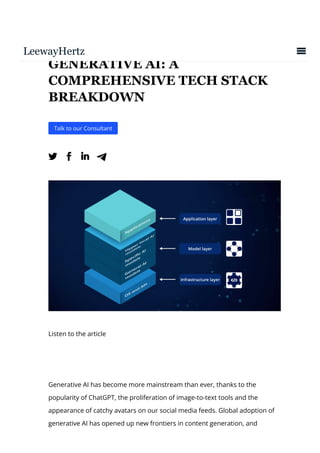
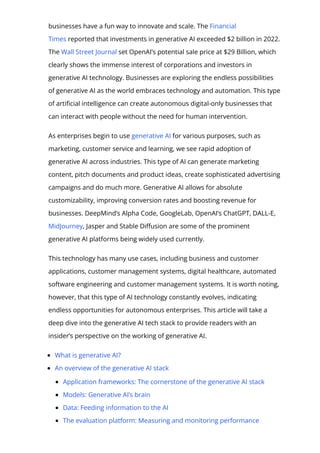
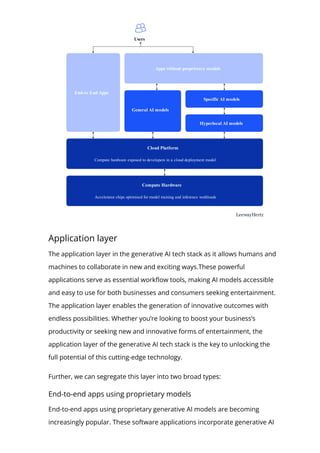
The generative AI tech stack comprises three fundamental layers:
The applications layer includes end-to-end apps or third-party APIs that
integrate generative AI models into user-facing products.
The model layer comprises proprietary APIs or open-source checkpoints
that power AI products. This layer requires a hosting solution for
deployment.
The infrastructure layer encompasses cloud platforms and hardware
manufacturers responsible for running training and inference workloads
for generative AI models.
Let’s dive deep into each layer.
End­to End Apps
Users
General AI models
Cloud Platform
Compute Hardware
Specific AI models
Hyperlocal AI models
Apps without proprietary models
Compute hardware exposed to developers in a cloud deployment model
Accelerator chips optimised for model training and inference workloads
LeewayHertz
Application layer
The application layer in the generative AI tech stack as it allows humans and
machines to collaborate in new and exciting ways.These powerful
applications serve as essential work몭ow tools, making AI models accessible
and easy to use for both businesses and consumers seeking entertainment.
The application layer enables the generation of innovative outcomes with
endless possibilities. Whether you’re looking to boost your business’s
productivity or seeking new and innovative forms of entertainment, the
application layer of the generative AI tech stack is the key to unlocking the
full potential of this cutting-edge technology.
Further, we can segregate this layer into two broad types:
End-to-end apps using proprietary models
End-to-end apps using proprietary generative AI models are becoming
increasingly popular. These software applications incorporate generative AI
models into a user-facing product and are responsible for all aspects of the
generative AI pipeline, including data collection, model training, inference,
and deployment to production. The proprietary generative AI models used in
these apps are developed and owned by a company or organization, typically
protected by intellectual property rights and not publicly available. Instead,
they are made available to customers as part of a software product or
service.
Companies that develop these models have domain-speci몭c expertise in a
particular area. For instance, a company specializing in computer vision
might develop an end-to-end app that uses a proprietary generative AI model
to create realistic images or videos where the models are highly specialized
and can be trained to generate outputs tailored to a speci몭c use case or
industry. Some popular examples of such apps include OpenAI’s DALL-E,
Codex, and ChatGPT.
These apps have a broad range of applications, from generating text and
images to automating customer service and creating personalized
recommendations. They have the potential to bring about signi몭cant changes
in multiple industries by providing highly tailored and customized outputs
that cater to the speci몭c needs of businesses and individuals. As the 몭eld of
generative AI continues to evolve, we will likely see even more innovative
end-to-end apps using proprietary generative AI models that push the
boundaries of what is possible.
Apps without proprietary models
Apps that utilize generative AI models but do not rely on proprietary models
are commonly used in end-user-facing B2B and B2C applications. These
types of apps are usually built using open-source generative AI frameworks
or libraries, such as TensorFlow, PyTorch, or Keras. These frameworks
provide developers with the tools they need to build custom generative AI
models for speci몭c use cases. Some popular examples of these apps include
RunwayML, StyleGAN, NeuralStyler, and others. By using open-source
frameworks and libraries, developers can access a broad range of resources
and support communities to build their own generative AI models that are
highly customizable and can be tailored to meet speci몭c business needs,
enabling organizations to create highly specialized outputs that are
impossible with proprietary models.
Using open-source frameworks and libraries also helps democratize access
to generative AI technology, making it accessible to a broader range of
individuals and businesses. By enabling developers to build their own
models, these tools foster innovation and creativity, driving new use cases
and applications for generative AI technology.
Model layer
The above apps are based on AI models, that operate across a trifecta of
layers. The unique combination of these layers allows maximum 몭exibility,
depending on your market’s speci몭c needs and nuances. Whether you
require a broad range of features or hyper-focused specialization, the three
layers of AI engines below provide the foundation for creating remarkable
generative tech outputs.
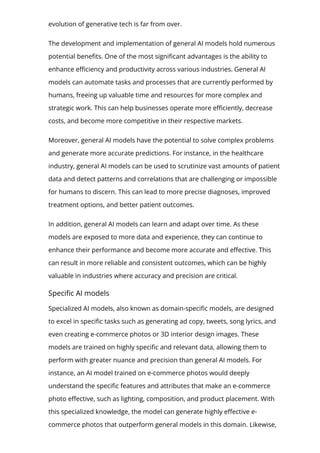
General AI models
At the heart of the generative tech revolution lies the foundational
breakthrough of general AI models. General AI models are a type of arti몭cial
intelligence that aims to replicate human-like thinking and decision-making
processes. Unlike narrow AI models designed to perform speci몭c tasks or
solve speci몭c problems, general AI models are intended to be more versatile
and adaptable, and they can perform a wide range of tasks and learn from
experience. These versatile models, including GPT-3 for text, DALL-E-2 for
images, Whisper for voice, and Stable Di몭usion for various applications, can
handle a broad range of outputs across categories such as text, images,
videos, speech, and games. Designed to be user-friendly and open-source,
these models represent a powerful starting point for the advancements in
for the generative tech stack. However, this is just the beginning, and the
evolution of generative tech is far from over.
The development and implementation of general AI models hold numerous
potential bene몭ts. One of the most signi몭cant advantages is the ability to
enhance e몭ciency and productivity across various industries. General AI
models can automate tasks and processes that are currently performed by
humans, freeing up valuable time and resources for more complex and
strategic work. This can help businesses operate more e몭ciently, decrease
costs, and become more competitive in their respective markets.
Moreover, general AI models have the potential to solve complex problems
and generate more accurate predictions. For instance, in the healthcare
industry, general AI models can be used to scrutinize vast amounts of patient
data and detect patterns and correlations that are challenging or impossible
for humans to discern. This can lead to more precise diagnoses, improved
treatment options, and better patient outcomes.
In addition, general AI models can learn and adapt over time. As these
models are exposed to more data and experience, they can continue to
enhance their performance and become more accurate and e몭ective. This
can result in more reliable and consistent outcomes, which can be highly
valuable in industries where accuracy and precision are critical.
Speci몭c AI models
Specialized AI models, also known as domain-speci몭c models, are designed
to excel in speci몭c tasks such as generating ad copy, tweets, song lyrics, and
even creating e-commerce photos or 3D interior design images. These
models are trained on highly speci몭c and relevant data, allowing them to
perform with greater nuance and precision than general AI models. For
instance, an AI model trained on e-commerce photos would deeply
understand the speci몭c features and attributes that make an e-commerce
photo e몭ective, such as lighting, composition, and product placement. With
this specialized knowledge, the model can generate highly e몭ective e-
commerce photos that outperform general models in this domain. Likewise,
speci몭c AI models trained on song lyrics can generate lyrics with greater
nuances and subtlety than general models. These models analyze the
structure, tone, and style of di몭erent genres and artists to generate lyrics
that are not only grammatically correct but also stylistically and thematically
appropriate for a speci몭c artist or genre.
As generative tech continues to evolve, more specialized models are
expected to become open-sourced and available to a broader range of users.
This will make it easier for businesses and individuals to access and use
these highly e몭ective AI models, potentially leading to new innovations and
breakthroughs in various industries.
Hyperlocal AI models
Hyperlocal AI models are the pinnacle of generative technology and excel in
their speci몭c 몭elds. With hyperlocal and often proprietary data, these models
can achieve unparalleled levels of accuracy and speci몭city in their outputs.
These models can generate outputs with exceptional precision, from writing
scienti몭c articles that adhere to the style of a speci몭c journal to creating
interior design models that meet the aesthetic preferences of a particular
individual. The capabilities of hyperlocal AI models extend to creating e-
commerce photos that are perfectly lit and shadowed to align with a speci몭c
company’s branding or marketing strategy. These models are designed to be
specialists in their 몭elds, enabling them to produce highly customized and
accurate outputs.
As generative tech advances, hyperlocal AI models are expected to become
even more sophisticated and precise, which could lead to new innovations
and breakthroughs in various industries. These models can potentially
transform how businesses operate by providing highly customized outputs
that align with their speci몭c needs. This will result in increased e몭ciency,
productivity, and pro몭tability for businesses.
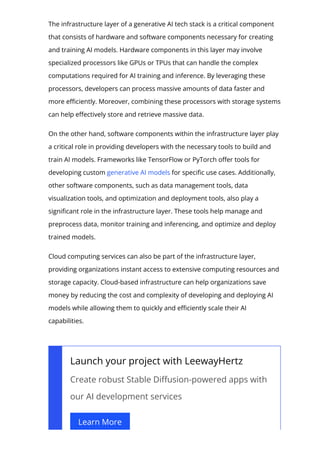
Infrastructure layer
The infrastructure layer of a generative AI tech stack is a critical component
that consists of hardware and software components necessary for creating
and training AI models. Hardware components in this layer may involve
specialized processors like GPUs or TPUs that can handle the complex
computations required for AI training and inference. By leveraging these
processors, developers can process massive amounts of data faster and
more e몭ciently. Moreover, combining these processors with storage systems
can help e몭ectively store and retrieve massive data.
On the other hand, software components within the infrastructure layer play
a critical role in providing developers with the necessary tools to build and
train AI models. Frameworks like TensorFlow or PyTorch o몭er tools for
developing custom generative AI models for speci몭c use cases. Additionally,
other software components, such as data management tools, data
visualization tools, and optimization and deployment tools, also play a
signi몭cant role in the infrastructure layer. These tools help manage and
preprocess data, monitor training and inferencing, and optimize and deploy
trained models.
Cloud computing services can also be part of the infrastructure layer,
providing organizations instant access to extensive computing resources and
storage capacity. Cloud-based infrastructure can help organizations save
money by reducing the cost and complexity of developing and deploying AI
models while allowing them to quickly and e몭ciently scale their AI
capabilities.
Launch your project with LeewayHertz
Create robust Stable Di몭usion-powered apps with
our AI development services
Learn More
Things to consider while choosing a
generative AI tech stack
Project speci몭cations and features
It is important to consider your project’s size and purpose when creating a
generative AI tech stack, as they signi몭cantly impact which technologies are
chosen. The more important the project, the more complex and extensive
the tech stack. Medium and large projects require more complex technology
stacks with multiple levels of programming languages and frameworks to
ensure integrity and performance. From a generative AI context, the
following points must be taken into consideration as part of project
speci몭cations and features while creating a generative AI tech stack –
The type of data you plan to generate, such as images, text, or music, will
in몭uence your choice of the generative AI technique. For instance, GANs
are typically used for image and video data, while RNNs are more suitable
for text and music data.
The project’s complexity, such as the number of input variables, the
number of layers in the model, and the size of the dataset, will also impact
the choice of the generative AI tech stack. Complex projects may require
more powerful hardware like GPUs and advanced frameworks like
TensorFlow or PyTorch.
If your project requires scalability, such as generating a large number of
variations or supporting too many users, you may need to choose a
generative AI tech stack that can scale easily, such as cloud-based solutions
like AWS, Google Cloud Platform, or Azure.
The accuracy of the generative AI model is critical for many applications,
such as drug discovery or autonomous driving. If accuracy is a primary
concern, you may need to choose a technique known for its high accuracy,
such as VAEs or RNNs.
The speed of the generative AI model may be a crucial factor in some
applications, such as real-time video generation or online chatbots. In such
cases, you may need to choose a generative AI tech stack that prioritizes
speed, such as using lightweight models or optimizing the code for
performance.
Experience and resources
It is essential to have deep technical and architectural knowledge to select
the right generative AI tech stack. It is crucial to be able to distinguish
between di몭erent technologies and select the speci몭c technologies
meticulously when creating stacks so that you can work con몭dently. The
decision should not force developers to lose time learning about the
technology and be unable to move forward e몭ectively.
Here are some ways experience and resources impact the choice of
technology:
The experience and expertise of the development team can impact the
choice of technology. If the team has extensive experience in a particular
programming language or framework, choosing a generative AI tech stack
that aligns with their expertise may be bene몭cial to expedite development.
The availability of resources, such as hardware and software, can also
impact the choice of technology. If the team has access to powerful
hardware such as GPUs, they may be able to use more advanced
frameworks such as TensorFlow or PyTorch to develop the system.
The availability of training and support resources is also an important
factor. If the development team requires training or support to use a
particular technology e몭ectively, it may be necessary to choose a
generative AI tech stack that has a robust support community or training
resources.
The budget for the project can also in몭uence what technology stack is
used. More advanced frameworks and hardware can be expensive, so
choosing a more cost-e몭ective tech stack that meets the project’s
requirements may be necessary if the project has a limited budget.
The maintenance and support requirements of the system can also impact
the choice of technology. If the system requires regular updates and
maintenance, it may be bene몭cial to choose a generative AI tech stack that
is easy to maintain and that comes with a reliable support community.
Scalability
Scalability is an essential feature of your application’s architecture that
determines whether your application can handle an increased load. Hence,
your technology stack should be able to handle such growth if
necessary. There are two types of scaling: vertical and horizontal. The 몭rst
refers to the ability to handle increasing users across multiple devices,
whereas horizontal scaling refers to the ability to add new features and
elements to the application in the future.
Here are some factors that matter when it comes to scalability in a
generative AI tech stack:
When it comes to choosing a generative AI tech stack, the size of the
dataset plays a critical role. As large datasets require more powerful
hardware and software to handle, a distributed computing framework like
Apache Spark may be essential for e몭cient data processing.
Additionally, the number of users interacting with the system is another
signi몭cant consideration. If a large number of users are expected, choosing
a tech stack that can handle a high volume of requests may be necessary.
This may involve opting for a cloud-based solution or a microservices
architecture.
Real-time processing is yet another consideration where the system must
be highly scalable in applications such as live video generation or online
chatbots to cope with the volume of requests. In such cases, optimizing the
code for performance or using a lightweight model may be necessary to
ensure the system can process requests quickly.
In scenarios where batch processing is required, such as generating
multiple variations of a dataset, the system must be capable of handling
large-scale batch processing. Again, a distributed computing framework
such as Apache Spark may be necessary for e몭cient data processing.
Finally, cloud-based solutions like AWS, Google Cloud Platform, or Azure
can o몭er scalability by providing resources on demand. They can easily
scale up or down based on the system’s requirements, making them a
popular choice for highly scalable generative AI systems.
Security
Every end user wants their data to be secure. When forming tech stacks,
selecting high-security technologies is important, especially when it comes to
online payments.
Here is how the need for security can impact the choice of technology:
Generative AI systems are often trained on large datasets, some of which
may contain sensitive information. As a result, data security is a signi몭cant
concern. Choosing a tech stack with built-in security features such as
encryption, access controls, and data masking can help mitigate the risks
associated with data breaches.
The models used in generative AI systems are often a valuable intellectual
property that must be protected from theft or misuse. Therefore, choosing
a tech stack with built-in security features is essential to prevent
unauthorized access to the models.
The generative AI system’s infrastructure must be secured to prevent
unauthorized access or attacks. Choosing a tech stack with robust security
features such as 몭rewalls, intrusion detection systems, and monitoring
tools can help keep the system secure.
Depending on the nature of the generative AI system, there may be legal
or regulatory requirements that must be met. For example, if the system is
used in healthcare or 몭nance, it may need to comply with HIPAA or PCI-DSS
regulations. Choosing a tech stack with built-in compliance features can
help ensure that the system meets the necessary regulatory requirements.
Generative AI systems may require user authentication and authorization
to control system access or data access. Choosing a tech stack with robust
user authentication and authorization features can help ensure that only
authorized users can access the system and its data.
Conclusion
A generative AI tech stack is crucial for any organization incorporating AI into
its operations. The proper implementation of the tech stack is essential for
unlocking the full potential of generative AI models and achieving desired
outcomes, from automating routine tasks to creating highly customized
outputs that meet speci몭c business needs. A well-implemented generative AI
tech stack can help businesses streamline their work몭ows, reduce costs, and
improve overall e몭ciency. With the right hardware and software components
in place, organizations can take advantage of specialized processors, storage
systems, and cloud computing services to develop, train, and deploy AI
models at scale. Moreover, using open-source generative AI frameworks or
libraries, such as TensorFlow, PyTorch, or Keras, provides developers with
the necessary tools to build custom generative AI models for speci몭c use
cases. This enables businesses to create highly tailored and industry-speci몭c
solutions that meet their unique needs and achieve their speci몭c goals.
In today’s competitive business landscape, organizations that fail to embrace
the potential of generative AI may 몭nd themselves falling behind. By
implementing a robust generative AI tech stack, businesses can stay ahead of
the curve and unlock new possibilities for growth, innovation, and
pro몭tability. So, it is imperative for businesses to invest in the right tools and
infrastructure to develop and deploy generative AI models successfully.
Experience the transformative power of generative AI for your business. Schedule
a consultation today with LeewayHertz AI experts and explore the possibilities!
Author’s Bio
Author’s Bio
Akash Takyar
CEO LeewayHertz
Akash Takyar is the founder and CEO at LeewayHertz. The experience of
building over 100+ platforms for startups and enterprises allows Akash to
rapidly architect and design solutions that are scalable and beautiful.
Akash's ability to build enterprise-grade technology solutions has attracted
over 30 Fortune 500 companies, including Siemens, 3M, P&G and Hershey’s.
Akash is an early adopter of new technology, a passionate technology
enthusiast, and an investor in AI and IoT startups.
Write to Akash
Start a conversation by filling the form
Once you let us know your requirement, our technical expert will schedule a
call and discuss your idea in detail post sign of an NDA.
All information will be kept con몭dential.
Name Phone
Company Email
Tell us about your project
Send me the signed Non-Disclosure Agreement (NDA )
Start a conversation
Insights
Redefining logistics: The impact of generative AI in
supply chains
Incorporating generative AI promises to be a game-changer for supply chain
management, propelling it into an era of unprecedented innovation.
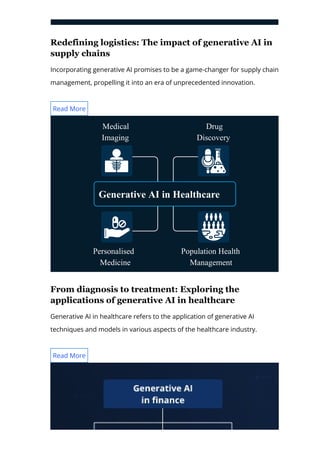
From diagnosis to treatment: Exploring the
applications of generative AI in healthcare
Generative AI in healthcare refers to the application of generative AI
techniques and models in various aspects of the healthcare industry.
Read More
Medical
Imaging
Personalised
Medicine
Population Health
Management
Drug
Discovery
Generative AI in Healthcare
Read More
LEEWAYHERTZPORTFOLIO
SERVICES GENERATIVE AI
About Us
Global AI Club
Careers
Case Studies
Work
Community
TraceRx
ESPN
Filecoin
Lottery of People
World Poker Tour
Chrysallis.AI
Generative AI
Arti몭cial Intelligence & ML
Generative AI Development
Generative AI Consulting
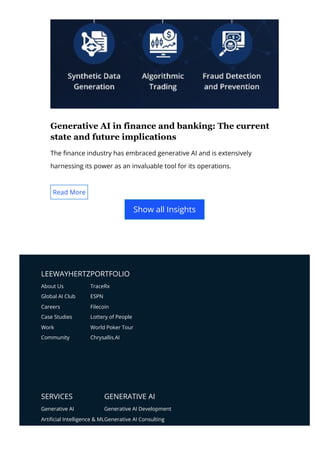
Generative AI in finance and banking: The current
state and future implications
The 몭nance industry has embraced generative AI and is extensively
harnessing its power as an invaluable tool for its operations.
Read More
Show all Insights
Privacy & Cookies Policy
INDUSTRIES PRODUCTS
CONTACT US
Get In Touch
415-301-2880
info@leewayhertz.com
jobs@leewayhertz.com
388 Market Street
Suite 1300
San Francisco, California 94111
Sitemap
Web3
Blockchain
Software Development
Hire Developers
Generative AI Integration
LLM Development
Prompt Engineering
ChatGPT Developers
Consumer Electronics
Financial Markets
Healthcare
Logistics
Manufacturing
Startup
Whitelabel Crypto Wallet
Whitelabel Blockchain Explorer
Whitelabel Crypto Exchange
Whitelabel Enterprise Crypto Wallet
Whitelabel DAO
 
©2023 LeewayHertz. All Rights Reserved.

Generative AI: A Comprehensive Tech Stack Breakdown

  • 1.
    GENERATIVE AI: A COMPREHENSIVETECH STACK BREAKDOWN Talk to our Consultant   Listen to the article Generative AI has become more mainstream than ever, thanks to the popularity of ChatGPT, the proliferation of image-to-text tools and the appearance of catchy avatars on our social media feeds. Global adoption of generative AI has opened up new frontiers in content generation, and  
  • 2.
    businesses have afun way to innovate and scale. The Financial Times reported that investments in generative AI exceeded $2 billion in 2022. The Wall Street Journal set OpenAI’s potential sale price at $29 Billion, which clearly shows the immense interest of corporations and investors in generative AI technology. Businesses are exploring the endless possibilities of generative AI as the world embraces technology and automation. This type of arti몭cial intelligence can create autonomous digital-only businesses that can interact with people without the need for human intervention. As enterprises begin to use generative AI for various purposes, such as marketing, customer service and learning, we see rapid adoption of generative AI across industries. This type of AI can generate marketing content, pitch documents and product ideas, create sophisticated advertising campaigns and do much more. Generative AI allows for absolute customizability, improving conversion rates and boosting revenue for businesses. DeepMind’s Alpha Code, GoogleLab, OpenAI’s ChatGPT, DALL-E, MidJourney, Jasper and Stable Di몭usion are some of the prominent generative AI platforms being widely used currently. This technology has many use cases, including business and customer applications, customer management systems, digital healthcare, automated software engineering and customer management systems. It is worth noting, however, that this type of AI technology constantly evolves, indicating endless opportunities for autonomous enterprises. This article will take a deep dive into the generative AI tech stack to provide readers with an insider’s perspective on the working of generative AI. What is generative AI? An overview of the generative AI stack Application frameworks: The cornerstone of the generative AI stack Models: Generative AI’s brain Data: Feeding information to the AI The evaluation platform: Measuring and monitoring performance
  • 3.
    Deployment: Moving applicationsinto production Why is a comprehensive tech stack essential in building e몭ective generative AI systems? A detailed overview of the generative AI tech stack Application layer Model layer Infrastructure layer Things to consider while choosing a generative AI tech stack What is generative AI? Generative AI is a type of arti몭cial intelligence that can produce new data, images, text, or music resembling the dataset it was trained on. This is achieved through “generative modeling,” which utilizes statistical algorithms to learn the patterns and relationships within the dataset and leverage this knowledge to generate new data. Generative AI’s capabilities go far beyond creating fun mobile apps and avatars. They are used to create art pieces, design, code, blog posts and all types of high-quality content. Generative AI uses semi-supervised and unsupervised learning algorithms to process large amounts of data to create outputs. Using large language models, computer programs in generative AI understand the text and create new content. The neural network, the heart of generative AI, detects the characteristics of speci몭c images or text and then applies them when necessary. Computer programs can use generative AI to predict patterns and produce the corresponding content. However, it is worth noting that generative AI models are limited in their parameters, and human involvement is essential to make the most of generative AI, both at the beginning and the end of model training. To achieve desired results, generative AI uses GANs and transformers. GAN – General Adversarial Network GANs have two parts: a generator and a discriminator.
  • 4.
    The generative neuralnetwork creates outputs upon request and is usually exposed to the necessary data to learn patterns. It needs assistance from the discriminative neural network to improve further. The discriminator neural network, the second element of the model, attempts to distinguish real- world data from the model’s fake data. The 몭rst model that fools the second model gets rewarded every time, which is why the algorithm is often called an adversarial model. This allows the model to improve itself without any human input. Generator Random input Real examples Real examples Real examples Transformers Transformers are another important component in generative AI that can produce impressive results. Transformers use a sequence rather than individual data points when transforming input into output. This makes them more e몭cient in processing data when the context matters. Texts contain more than words, and transformers frequently translate and generate them. Transformers can also be used to create a foundation model, which is useful when engineers work on algorithms that can transform natural language requests into commands, such as creating images or text based on user
  • 5.
    description. A transformer employsan encoder/decoder architecture. The encoder extracts features from an input sentence, and the decoder uses those features to create an output sentence (translation). Multiple encoder blocks make up the encoder of the transformer. The input sentence is passed through encoder blocks. The output of the last block is the input feature to the decoder. Multiple decoder blocks comprise the decoder, each receiving the encoder’s features. Encoder­Decoder Model Input Output Encoder Decoder Decoder Decoder Decoder Encoder Encoder Encoder Features LeewayHertz Launch your project with LeewayHertz Create robust Stable Di몭usion-powered apps with our AI development services Learn More An overview of the generative AI stack
  • 7.
    With generative AIquickly gaining traction across industries, we have a comprehensive generative AI tech stack, which simpli몭es the development process, accelerating innovation. Before delving into the details of a speci몭c generative AI tech stack, let us talk about the generic tech stack used for generative AI solution development. Here is why your understanding of a generic tech stack is important: Foundation of knowledge: The generic generative AI tech stack provides a foundational understanding of the essential components, frameworks, and technologies involved in generative AI. It helps establish a comprehensive knowledge base before diving into speci몭c tech stacks, ensuring a solid understanding of the overall landscape. Guiding development decisions: By grasping the generic tech stack, developers can make informed decisions about which speci몭c technologies and tools to employ for di몭erent stages of generative AI development. It serves as a guide for selecting the appropriate frameworks, libraries, and platforms that align with the overall goals and requirements of the project. Interoperability and integration: A deep understanding of the generic tech stack facilitates better interoperability and integration of di몭erent components within the generative AI system. It helps identify potential points of integration with other systems and ensures seamless collaboration between di몭erent technologies and tools. Flexibility and adaptability: Familiarity with the generic tech stack allows developers to adapt and switch between di몭erent speci몭c tech stacks more e몭ectively. It enables them to understand the underlying principles and concepts that transcend speci몭c implementations, providing 몭exibility in selecting the most suitable tools for the task at hand. Future-proo몭ng: By gaining a solid foundation in the generic tech stack, developers are better prepared for future advancements and changes in the generative AI landscape. They can stay updated with emerging technologies and trends, making it easier to adopt new tools and adapt to evolving industry practices.
  • 8.
    Serving as abasis for specialization: Once the generic stack is understood, one can then specialize and dig into the speci몭c technologies, tools, and techniques involved in a particular generative AI stack. This allows for a more focused and detailed understanding of tools and technologies required how generative AI can be applied in a speci몭c context. Here is an overview of the generic tech stack for generative AI development: Application frameworks: The cornerstone of the generative AI stack Application frameworks form the cornerstone of the tech stack by o몭ering a rationalized programming model that swiftly absorbs new innovations. These frameworks, such as LangChain, Fixie, Microsoft’s Semantic Kernel, and Google Cloud’s Vertex AI, help developers create applications that can autonomously generate new content, develop semantic systems for natural language search, and even enable task performance by AI agents. Models: Generative AI’s brain At the core of generative AI stack are Foundation Models (FMs), which function as the ‘brain’ and enable human-like reasoning. These models can be proprietary, developed by organizations such as Open AI, Anthropic, or Cohere, or they can be open-source. Developers also have the option to train their own models. In order to optimize the application, developers can choose to use multiple FMs. These models can be hosted on servers or deployed on edge devices and browsers, which enhances security and reduces latency and cost. Data: Feeding information to the AI Language Learning Models (LLMs) have the ability to reason about the data they have been trained on. To make the models more e몭ective and precise, developers need to operationalize their data. Data loaders and vector databases play a signi몭cant role in this process, helping developers to ingest structured and unstructured data, and e몭ectively store and query data
  • 9.
    vectors. Additionally, techniqueslike retrieval-augmented generation are used for personalizing model outputs. The evaluation platform: Measuring and monitoring performance Choosing the right balance between model performance, cost, and latency is a challenge in generative AI. To overcome this, developers utilize various evaluation tools that help determine the best prompts, track online and o몭ine experimentation, and monitor model performance in real-time. For prompt engineering, experimentation, and observability, along with various No Code / Low Code tooling, tracking tools, and platforms like WhyLabs’ LangKit are used. Deployment: Moving applications into production Lastly, in the deployment phase, developers aim to move their applications into production. They can choose to self-host these applications or use third- party services for deployment. Tools like Fixie enable developers to build, share, and deploy AI applications seamlessly. In conclusion, the generative AI stack is a comprehensive ecosystem that supports the development, testing, and deployment of AI applications, thereby transforming the way we create, synthesize information, and work. Why is a comprehensive tech stack essential in building effective generative AI systems? A tech stack refers to a set of technologies, frameworks, and tools used to build and deploy software applications. A comprehensive tech stack is crucial in building e몭ective generative AI systems, which include various components, such as machine learning frameworks, programming languages, cloud infrastructure, and data processing tools. These fundamental components and their importance in a generative AI tech stack have been discussed here:
  • 10.
    Machine learning frameworks:Generative AI systems rely on complex machine learning models to generate new data. Machine learning frameworks such as TensorFlow, PyTorch and Keras provide a set of tools and APIs to build and train models, and they also provide a variety of pre- built models for image, text, and music generation. So these frameworks and APIs should be integral to the generative AI tech stack. These frameworks also o몭er 몭exibility in designing and customizing the models to achieve the desired level of accuracy and quality. Programming languages: Programming languages are crucial in building generative AI systems that balance ease of use and the performance of generative AI models. Python is the most commonly used language in the 몭eld of machine learning and is preferred for building generative AI systems due to its simplicity, readability, and extensive library support. Other programming languages like R and Julia are also used in some cases. Cloud infrastructure: Generative AI systems require large amounts of computing power and storage capacity to train and run the models. Including cloud infrastructures in a generative AI tech stack is essential as it provides the scalability and 몭exibility needed to deploy generative AI systems. Cloud providers like Amazon Web Services (AWS), Google Cloud Platform (GCP), and Microsoft Azure o몭er a range of services like virtual machines, storage, and machine learning platforms. Data processing tools: Data is critical in building generative AI systems. The data must be preprocessed, cleaned, and transformed before it can be used to train the models. Data processing tools like Apache Spark and Apache Hadoop are commonly used in a generative AI tech stack to handle large datasets e몭ciently. These tools also provide data visualization and exploration capabilities, which can help understand the data and identify patterns. A well-designed generative AI tech stack can improve the system’s accuracy, scalability, and reliability, enabling faster development and deployment of generative AI applications.
  • 11.
    Here is acomprehensive generative AI tech stack. Component Technologies Machine learning frameworks TensorFlow, PyTorch, Keras Programming languages Python, Julia, R Data preprocessing NumPy, Pandas, OpenCV Visualization Matplotlib, Seaborn, Plotly Other tools Jupyter Notebook, Anaconda, Git Generative models GANs, VAEs, Autoencoders, LSTMs Deployment Flask, Docker, Kubernetes Cloud services AWS, GCP, Azure A detailed overview of the generative AI tech stack The generative AI tech stack comprises three fundamental layers: The applications layer includes end-to-end apps or third-party APIs that integrate generative AI models into user-facing products. The model layer comprises proprietary APIs or open-source checkpoints that power AI products. This layer requires a hosting solution for deployment. The infrastructure layer encompasses cloud platforms and hardware manufacturers responsible for running training and inference workloads for generative AI models. Let’s dive deep into each layer.
  • 12.
    End­to End Apps Users GeneralAI models Cloud Platform Compute Hardware Specific AI models Hyperlocal AI models Apps without proprietary models Compute hardware exposed to developers in a cloud deployment model Accelerator chips optimised for model training and inference workloads LeewayHertz Application layer The application layer in the generative AI tech stack as it allows humans and machines to collaborate in new and exciting ways.These powerful applications serve as essential work몭ow tools, making AI models accessible and easy to use for both businesses and consumers seeking entertainment. The application layer enables the generation of innovative outcomes with endless possibilities. Whether you’re looking to boost your business’s productivity or seeking new and innovative forms of entertainment, the application layer of the generative AI tech stack is the key to unlocking the full potential of this cutting-edge technology. Further, we can segregate this layer into two broad types: End-to-end apps using proprietary models End-to-end apps using proprietary generative AI models are becoming increasingly popular. These software applications incorporate generative AI
  • 13.
    models into auser-facing product and are responsible for all aspects of the generative AI pipeline, including data collection, model training, inference, and deployment to production. The proprietary generative AI models used in these apps are developed and owned by a company or organization, typically protected by intellectual property rights and not publicly available. Instead, they are made available to customers as part of a software product or service. Companies that develop these models have domain-speci몭c expertise in a particular area. For instance, a company specializing in computer vision might develop an end-to-end app that uses a proprietary generative AI model to create realistic images or videos where the models are highly specialized and can be trained to generate outputs tailored to a speci몭c use case or industry. Some popular examples of such apps include OpenAI’s DALL-E, Codex, and ChatGPT. These apps have a broad range of applications, from generating text and images to automating customer service and creating personalized recommendations. They have the potential to bring about signi몭cant changes in multiple industries by providing highly tailored and customized outputs that cater to the speci몭c needs of businesses and individuals. As the 몭eld of generative AI continues to evolve, we will likely see even more innovative end-to-end apps using proprietary generative AI models that push the boundaries of what is possible. Apps without proprietary models Apps that utilize generative AI models but do not rely on proprietary models are commonly used in end-user-facing B2B and B2C applications. These types of apps are usually built using open-source generative AI frameworks or libraries, such as TensorFlow, PyTorch, or Keras. These frameworks provide developers with the tools they need to build custom generative AI models for speci몭c use cases. Some popular examples of these apps include RunwayML, StyleGAN, NeuralStyler, and others. By using open-source frameworks and libraries, developers can access a broad range of resources
  • 14.
    frameworks and libraries,developers can access a broad range of resources and support communities to build their own generative AI models that are highly customizable and can be tailored to meet speci몭c business needs, enabling organizations to create highly specialized outputs that are impossible with proprietary models. Using open-source frameworks and libraries also helps democratize access to generative AI technology, making it accessible to a broader range of individuals and businesses. By enabling developers to build their own models, these tools foster innovation and creativity, driving new use cases and applications for generative AI technology. Model layer The above apps are based on AI models, that operate across a trifecta of layers. The unique combination of these layers allows maximum 몭exibility, depending on your market’s speci몭c needs and nuances. Whether you require a broad range of features or hyper-focused specialization, the three layers of AI engines below provide the foundation for creating remarkable generative tech outputs. General AI models At the heart of the generative tech revolution lies the foundational breakthrough of general AI models. General AI models are a type of arti몭cial intelligence that aims to replicate human-like thinking and decision-making processes. Unlike narrow AI models designed to perform speci몭c tasks or solve speci몭c problems, general AI models are intended to be more versatile and adaptable, and they can perform a wide range of tasks and learn from experience. These versatile models, including GPT-3 for text, DALL-E-2 for images, Whisper for voice, and Stable Di몭usion for various applications, can handle a broad range of outputs across categories such as text, images, videos, speech, and games. Designed to be user-friendly and open-source, these models represent a powerful starting point for the advancements in for the generative tech stack. However, this is just the beginning, and the evolution of generative tech is far from over.
  • 15.
    evolution of generativetech is far from over. The development and implementation of general AI models hold numerous potential bene몭ts. One of the most signi몭cant advantages is the ability to enhance e몭ciency and productivity across various industries. General AI models can automate tasks and processes that are currently performed by humans, freeing up valuable time and resources for more complex and strategic work. This can help businesses operate more e몭ciently, decrease costs, and become more competitive in their respective markets. Moreover, general AI models have the potential to solve complex problems and generate more accurate predictions. For instance, in the healthcare industry, general AI models can be used to scrutinize vast amounts of patient data and detect patterns and correlations that are challenging or impossible for humans to discern. This can lead to more precise diagnoses, improved treatment options, and better patient outcomes. In addition, general AI models can learn and adapt over time. As these models are exposed to more data and experience, they can continue to enhance their performance and become more accurate and e몭ective. This can result in more reliable and consistent outcomes, which can be highly valuable in industries where accuracy and precision are critical. Speci몭c AI models Specialized AI models, also known as domain-speci몭c models, are designed to excel in speci몭c tasks such as generating ad copy, tweets, song lyrics, and even creating e-commerce photos or 3D interior design images. These models are trained on highly speci몭c and relevant data, allowing them to perform with greater nuance and precision than general AI models. For instance, an AI model trained on e-commerce photos would deeply understand the speci몭c features and attributes that make an e-commerce photo e몭ective, such as lighting, composition, and product placement. With this specialized knowledge, the model can generate highly e몭ective e- commerce photos that outperform general models in this domain. Likewise,
  • 16.
    speci몭c AI modelstrained on song lyrics can generate lyrics with greater nuances and subtlety than general models. These models analyze the structure, tone, and style of di몭erent genres and artists to generate lyrics that are not only grammatically correct but also stylistically and thematically appropriate for a speci몭c artist or genre. As generative tech continues to evolve, more specialized models are expected to become open-sourced and available to a broader range of users. This will make it easier for businesses and individuals to access and use these highly e몭ective AI models, potentially leading to new innovations and breakthroughs in various industries. Hyperlocal AI models Hyperlocal AI models are the pinnacle of generative technology and excel in their speci몭c 몭elds. With hyperlocal and often proprietary data, these models can achieve unparalleled levels of accuracy and speci몭city in their outputs. These models can generate outputs with exceptional precision, from writing scienti몭c articles that adhere to the style of a speci몭c journal to creating interior design models that meet the aesthetic preferences of a particular individual. The capabilities of hyperlocal AI models extend to creating e- commerce photos that are perfectly lit and shadowed to align with a speci몭c company’s branding or marketing strategy. These models are designed to be specialists in their 몭elds, enabling them to produce highly customized and accurate outputs. As generative tech advances, hyperlocal AI models are expected to become even more sophisticated and precise, which could lead to new innovations and breakthroughs in various industries. These models can potentially transform how businesses operate by providing highly customized outputs that align with their speci몭c needs. This will result in increased e몭ciency, productivity, and pro몭tability for businesses. Infrastructure layer The infrastructure layer of a generative AI tech stack is a critical component
  • 17.
    The infrastructure layerof a generative AI tech stack is a critical component that consists of hardware and software components necessary for creating and training AI models. Hardware components in this layer may involve specialized processors like GPUs or TPUs that can handle the complex computations required for AI training and inference. By leveraging these processors, developers can process massive amounts of data faster and more e몭ciently. Moreover, combining these processors with storage systems can help e몭ectively store and retrieve massive data. On the other hand, software components within the infrastructure layer play a critical role in providing developers with the necessary tools to build and train AI models. Frameworks like TensorFlow or PyTorch o몭er tools for developing custom generative AI models for speci몭c use cases. Additionally, other software components, such as data management tools, data visualization tools, and optimization and deployment tools, also play a signi몭cant role in the infrastructure layer. These tools help manage and preprocess data, monitor training and inferencing, and optimize and deploy trained models. Cloud computing services can also be part of the infrastructure layer, providing organizations instant access to extensive computing resources and storage capacity. Cloud-based infrastructure can help organizations save money by reducing the cost and complexity of developing and deploying AI models while allowing them to quickly and e몭ciently scale their AI capabilities. Launch your project with LeewayHertz Create robust Stable Di몭usion-powered apps with our AI development services Learn More
  • 18.
    Things to considerwhile choosing a generative AI tech stack Project speci몭cations and features It is important to consider your project’s size and purpose when creating a generative AI tech stack, as they signi몭cantly impact which technologies are chosen. The more important the project, the more complex and extensive the tech stack. Medium and large projects require more complex technology stacks with multiple levels of programming languages and frameworks to ensure integrity and performance. From a generative AI context, the following points must be taken into consideration as part of project speci몭cations and features while creating a generative AI tech stack – The type of data you plan to generate, such as images, text, or music, will in몭uence your choice of the generative AI technique. For instance, GANs are typically used for image and video data, while RNNs are more suitable for text and music data. The project’s complexity, such as the number of input variables, the number of layers in the model, and the size of the dataset, will also impact the choice of the generative AI tech stack. Complex projects may require more powerful hardware like GPUs and advanced frameworks like TensorFlow or PyTorch. If your project requires scalability, such as generating a large number of variations or supporting too many users, you may need to choose a generative AI tech stack that can scale easily, such as cloud-based solutions like AWS, Google Cloud Platform, or Azure. The accuracy of the generative AI model is critical for many applications, such as drug discovery or autonomous driving. If accuracy is a primary concern, you may need to choose a technique known for its high accuracy, such as VAEs or RNNs. The speed of the generative AI model may be a crucial factor in some applications, such as real-time video generation or online chatbots. In such
  • 19.
    applications, such asreal-time video generation or online chatbots. In such cases, you may need to choose a generative AI tech stack that prioritizes speed, such as using lightweight models or optimizing the code for performance. Experience and resources It is essential to have deep technical and architectural knowledge to select the right generative AI tech stack. It is crucial to be able to distinguish between di몭erent technologies and select the speci몭c technologies meticulously when creating stacks so that you can work con몭dently. The decision should not force developers to lose time learning about the technology and be unable to move forward e몭ectively. Here are some ways experience and resources impact the choice of technology: The experience and expertise of the development team can impact the choice of technology. If the team has extensive experience in a particular programming language or framework, choosing a generative AI tech stack that aligns with their expertise may be bene몭cial to expedite development. The availability of resources, such as hardware and software, can also impact the choice of technology. If the team has access to powerful hardware such as GPUs, they may be able to use more advanced frameworks such as TensorFlow or PyTorch to develop the system. The availability of training and support resources is also an important factor. If the development team requires training or support to use a particular technology e몭ectively, it may be necessary to choose a generative AI tech stack that has a robust support community or training resources. The budget for the project can also in몭uence what technology stack is used. More advanced frameworks and hardware can be expensive, so choosing a more cost-e몭ective tech stack that meets the project’s requirements may be necessary if the project has a limited budget.
  • 20.
    The maintenance andsupport requirements of the system can also impact the choice of technology. If the system requires regular updates and maintenance, it may be bene몭cial to choose a generative AI tech stack that is easy to maintain and that comes with a reliable support community. Scalability Scalability is an essential feature of your application’s architecture that determines whether your application can handle an increased load. Hence, your technology stack should be able to handle such growth if necessary. There are two types of scaling: vertical and horizontal. The 몭rst refers to the ability to handle increasing users across multiple devices, whereas horizontal scaling refers to the ability to add new features and elements to the application in the future. Here are some factors that matter when it comes to scalability in a generative AI tech stack: When it comes to choosing a generative AI tech stack, the size of the dataset plays a critical role. As large datasets require more powerful hardware and software to handle, a distributed computing framework like Apache Spark may be essential for e몭cient data processing. Additionally, the number of users interacting with the system is another signi몭cant consideration. If a large number of users are expected, choosing a tech stack that can handle a high volume of requests may be necessary. This may involve opting for a cloud-based solution or a microservices architecture. Real-time processing is yet another consideration where the system must be highly scalable in applications such as live video generation or online chatbots to cope with the volume of requests. In such cases, optimizing the code for performance or using a lightweight model may be necessary to ensure the system can process requests quickly. In scenarios where batch processing is required, such as generating multiple variations of a dataset, the system must be capable of handling
  • 21.
    large-scale batch processing.Again, a distributed computing framework such as Apache Spark may be necessary for e몭cient data processing. Finally, cloud-based solutions like AWS, Google Cloud Platform, or Azure can o몭er scalability by providing resources on demand. They can easily scale up or down based on the system’s requirements, making them a popular choice for highly scalable generative AI systems. Security Every end user wants their data to be secure. When forming tech stacks, selecting high-security technologies is important, especially when it comes to online payments. Here is how the need for security can impact the choice of technology: Generative AI systems are often trained on large datasets, some of which may contain sensitive information. As a result, data security is a signi몭cant concern. Choosing a tech stack with built-in security features such as encryption, access controls, and data masking can help mitigate the risks associated with data breaches. The models used in generative AI systems are often a valuable intellectual property that must be protected from theft or misuse. Therefore, choosing a tech stack with built-in security features is essential to prevent unauthorized access to the models. The generative AI system’s infrastructure must be secured to prevent unauthorized access or attacks. Choosing a tech stack with robust security features such as 몭rewalls, intrusion detection systems, and monitoring tools can help keep the system secure. Depending on the nature of the generative AI system, there may be legal or regulatory requirements that must be met. For example, if the system is used in healthcare or 몭nance, it may need to comply with HIPAA or PCI-DSS regulations. Choosing a tech stack with built-in compliance features can help ensure that the system meets the necessary regulatory requirements.
  • 22.
    Generative AI systemsmay require user authentication and authorization to control system access or data access. Choosing a tech stack with robust user authentication and authorization features can help ensure that only authorized users can access the system and its data. Conclusion A generative AI tech stack is crucial for any organization incorporating AI into its operations. The proper implementation of the tech stack is essential for unlocking the full potential of generative AI models and achieving desired outcomes, from automating routine tasks to creating highly customized outputs that meet speci몭c business needs. A well-implemented generative AI tech stack can help businesses streamline their work몭ows, reduce costs, and improve overall e몭ciency. With the right hardware and software components in place, organizations can take advantage of specialized processors, storage systems, and cloud computing services to develop, train, and deploy AI models at scale. Moreover, using open-source generative AI frameworks or libraries, such as TensorFlow, PyTorch, or Keras, provides developers with the necessary tools to build custom generative AI models for speci몭c use cases. This enables businesses to create highly tailored and industry-speci몭c solutions that meet their unique needs and achieve their speci몭c goals. In today’s competitive business landscape, organizations that fail to embrace the potential of generative AI may 몭nd themselves falling behind. By implementing a robust generative AI tech stack, businesses can stay ahead of the curve and unlock new possibilities for growth, innovation, and pro몭tability. So, it is imperative for businesses to invest in the right tools and infrastructure to develop and deploy generative AI models successfully. Experience the transformative power of generative AI for your business. Schedule a consultation today with LeewayHertz AI experts and explore the possibilities! Author’s Bio
  • 23.
    Author’s Bio Akash Takyar CEOLeewayHertz Akash Takyar is the founder and CEO at LeewayHertz. The experience of building over 100+ platforms for startups and enterprises allows Akash to rapidly architect and design solutions that are scalable and beautiful. Akash's ability to build enterprise-grade technology solutions has attracted over 30 Fortune 500 companies, including Siemens, 3M, P&G and Hershey’s. Akash is an early adopter of new technology, a passionate technology enthusiast, and an investor in AI and IoT startups. Write to Akash Start a conversation by filling the form Once you let us know your requirement, our technical expert will schedule a call and discuss your idea in detail post sign of an NDA. All information will be kept con몭dential.
  • 24.
    Name Phone Company Email Tellus about your project Send me the signed Non-Disclosure Agreement (NDA ) Start a conversation Insights
  • 25.
    Redefining logistics: Theimpact of generative AI in supply chains Incorporating generative AI promises to be a game-changer for supply chain management, propelling it into an era of unprecedented innovation. From diagnosis to treatment: Exploring the applications of generative AI in healthcare Generative AI in healthcare refers to the application of generative AI techniques and models in various aspects of the healthcare industry. Read More Medical Imaging Personalised Medicine Population Health Management Drug Discovery Generative AI in Healthcare Read More
  • 26.
    LEEWAYHERTZPORTFOLIO SERVICES GENERATIVE AI AboutUs Global AI Club Careers Case Studies Work Community TraceRx ESPN Filecoin Lottery of People World Poker Tour Chrysallis.AI Generative AI Arti몭cial Intelligence & ML Generative AI Development Generative AI Consulting Generative AI in finance and banking: The current state and future implications The 몭nance industry has embraced generative AI and is extensively harnessing its power as an invaluable tool for its operations. Read More Show all Insights
  • 27.
    Privacy & CookiesPolicy INDUSTRIES PRODUCTS CONTACT US Get In Touch 415-301-2880 info@leewayhertz.com jobs@leewayhertz.com 388 Market Street Suite 1300 San Francisco, California 94111 Sitemap Web3 Blockchain Software Development Hire Developers Generative AI Integration LLM Development Prompt Engineering ChatGPT Developers Consumer Electronics Financial Markets Healthcare Logistics Manufacturing Startup Whitelabel Crypto Wallet Whitelabel Blockchain Explorer Whitelabel Crypto Exchange Whitelabel Enterprise Crypto Wallet Whitelabel DAO   ©2023 LeewayHertz. All Rights Reserved.