presentation
By
Angad Singh
M.Phil. Bio-statistics and Demography
IIPS Mumbai
9 October , 2017
Women Trafficking in India
Human Trafficking
is
as prevalent , present & real
as
Earth, water and air
INTRODUCTION
Traffic in human being means selling and buying men and women like good
Women trafficking is a group of crimes involving the exploitation of
women for financial gains which is violation of fundamental human
rights.
Women trafficking is the 3rd largest international crime.
 20,000 girls are transported every year from India.
 Millions of women and children are victims of trafficking.
Women trafficking is a part of the larger problem of slavery Women
trafficking is when Women are transported, by force or deception, to
become enslaved.
 Traffickers use blackmail, abuse, and threats to force victims to
comply with their wishes in the destination country.
 Usually caused by poverty/lack of economic opportunities, especially
for women and children, and a demand for certain services in the
destination country
Constitutional Provisions on
Trafficking
• Trafficking in Human Beings or Persons is prohibited
under the Constitution of India. The specific provisions
relates to Article 23 (1) of the Constitution which is as
follows:-
• 'Traffic in human beings and begar and other similar forms
of forced labour are prohibited and any contravention of this
provision shall be an offence punishable in accordance with
law'.
• Convention on the Rights of the Child (CRC) and its Optional
Protocols (Sale of Children, Child Prostitution and Child
Pornography) [Ratified]
• Convention on Elimination of all forms of Discrimination
against Women (CEDAW) [Ratified]
• UN Convention Against Transnational Organized Crime
[Signed]
• Protocol to Prevent, Suppress and Punish Trafficking in
Persons, Especially. Women and Children supplementing above
Convention [Signed]
• • Millennium Development Goals (MDGs).
International Legal Instruments
SAARC
• SAARC Convention on Preventing and
Combating Trafficking in Women and
Children for Prostitution [Ratified].
• SAARC Convention on Regional
Arrangements for Promotion of Child
Welfare in South Asia [Ratified].
• SAARC Charter where trafficking issues to
be addressed at regional level
National Legal Framework
• Immoral Traffic Prevention Act, 1956 (being
amended)
• Indian Penal Code (select provisions)
• Juvenile Justice ( Care and Protection of
Children) Act 2000
• Child Marriage Prohibition Act 2006
National Policies and Plans
• National Child Labour Policy, 1987
• National Policy for the Empowerment of Women, 2001
• National Plan of Action to combat trafficking and commercial
sexual exploitation of women and children (1998)
• National Plan of Action for Children, 2004
• Integrated National Plan of Action to Prevent and Combat
Trafficking of Human Beings, with Special focus on Women and
Children (being formulated)—will look at trafficking for all
purposes
COMMISSIONS
• National Commission for Human Rights.
• National Commission for Women.
• Nation Commission for Protection of Child
Rights.
REASONS BEHIND WT
• Prostitution
• Religious Traditions
• Labor Exploitation
• Organ Trading
• Begging , Entertainment
• Adoption
• Marriages
• Pornography
• Enmity
10
11
• 22ndnd
largest criminal industry after druglargest criminal industry after drug
trafficking.trafficking.
• 2.70 crore people are victims of HT world wide.2.70 crore people are victims of HT world wide.
• 95 % experience physical or sexual violence95 % experience physical or sexual violence
• 40 lac prostitutes in India40 lac prostitutes in India
• 40 % of them are minor40 % of them are minor
• 80 % victims of HT are women & girls80 % victims of HT are women & girls
HUMAN TRAFFICKING IS AHUMAN TRAFFICKING IS A
REALITYREALITY
Case Reported of Human
Trafficking (2015)
• India total – 6877, Stats – 6772, UT's – 105
• 1.) Assam – 1494 , (21.7%)
• 2.) West Bengal – 1522 (18.2%)
• 3.) Tamil Nadu – 577 (8.4%)
• 4.) Telangana – 561 (8.2%)
• 5.) Karnataka - 507 (7.4%)
• 6.) Maharashtra – 421 (6.1%)
• Girls imported from foreign countries – 0.0
(Reference NCRB -2015)
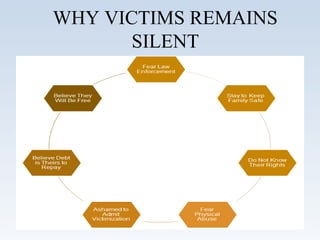
WHY VICTIMS REMAINS
SILENT
Combating Trafficking has been a
non-priority , neglected and unimportantnon-priority , neglected and unimportant
area for
the police, the people and the societythe police, the people and the society
14
ROOTS OF HUMAN
TRAFFICKING
Human trafficking is economy driven & demand
generated .
Demand &Supply nexus
• PovertyPoverty
• Illiteracy and UnemploymentIlliteracy and Unemployment
• Bad governanceBad governance
• Skewed DevelopmentSkewed Development
• Gender based violenceGender based violence
• Demand for the victimsDemand for the victims
• Poor enforcement of lawsPoor enforcement of laws
• Lack of concern and indifference of the societyLack of concern and indifference of the society
15
Dimensions of HT in India
- Supplier (Gulf Countries)Supplier (Gulf Countries)
- Transit point (For Nepalis and Bangladeshis)- Transit point (For Nepalis and Bangladeshis)
- Receiver (From Nepal and Bangladesh)- Receiver (From Nepal and Bangladesh)
Indian share in victims of HT world over is 4.7 %
Young Boys and Girls are trafficked from
economically under develop areas to
economically well off states within India.
COMBATTING HUMAN TRAFFICKING
Prevention
Protection Prosecution
17
2. SOCIETY’S MIND SET
• Not ready to accept victims of human trafficking as
equal human beings worth re-integrating with society
• Response of stake holders has been unwelcoming
generally with few exceptions
18
Family Response
Weep
Curse
Forget &
Hate
19
Police Response
Take
Make
Fake &
Forget
20
Societal Response
Joke
Mock
Laugh &
Hate
21
Protection Home Manager’s Response
Receive
Deceive
Abuse &
Dispose
22
NGO’s Response
Discovery
Recovery
Custody
Study
Publish &
Rubbish
23
Ideal Response
Suppress
Prevent
Educate
Regulate
Rehabilitate &
Re-integrate
24
IMPACT ON THE SOCIETY
Fuels organized crime
Deprives countries of human capital
Promotes social breakdown
Undermines public heal
Subverts government authority
Imposes enormous economic cost
IMPACT ON VICTIMS
 Loss of support from family and community
 Loss of proper education
 Obstacles in physical development
 Psychological Traumas
3. CHANGE APPROACH TOWARDS
COMBATING PROSTITUTION
• Break demand-supply nexus
• Make prostitution per se an offence &
customer liable
• Attempt in 2006 to amend PITA failed
• Do we have the mechanism & infrastructure
to rehabilitate and reintegrate 40 lac sex
workers ?
27
4. BREAKING DEMAND SUPPLY
CIRCLE (REDUCING DEMAND)
• Improve male-female sex ratio
• Proper enforcement of MTP & PCPNDT Laws
• Educating the masses about importance of girl child
• Strengthening moral fiber of the society
• Sex-ratio(0-6) age group- all India- 919,
Haryana- 834, improved by 10 points in last
decade 28
5. BREAKING DEMAND-SUPPLY
NEXUS
(REDUCING SUPPLY)
• Rehabilitation of children of sex workers
• Reintegration of rescued sex workers
• Post work rehabilitation of sex workers
• Rehabilitation and reintegration of active sex workers
• Ujjawala scheme of Govt. of India
29
Combating HT for Labor Exploitation
Laws are strict, enforcement is weak
• Demand in every middle class family & in small time business
• Mushrooming of placement service agencies
• How to improve enforcement machinery, Non-priority area
• Rehabilitation of the victims, lack of infrastructure
• Public to be awakened for not employing children
• Disabilities of civil nature for industries employing child labour
• Enforcement of Right to education laws
• Definition of child needs revisit
• Zero tolerance on child labour
COMBATTING TRAFFICKING FORCOMBATTING TRAFFICKING FOR
MARRIAGESMARRIAGES
• Trafficked for marriage, re-trafficked,
re-trafficked and so on
• Breaking the nexus of re-trafficking
• Strict action against traffickers
• Such trafficked women become facilitator
• Trafficked women are treated second rate citizen
• Protection of civil, personal and social rights of
the trafficked brides and their off-springs
31
TRAFFICKING FOR ORGAN TRADE,
BEGGING RECREATION, PORNOGRAPHIC
PURPOSES
• Laws are strict
• Law enforcement agencies need to be
educated and geared up
• Focus and priority
32
WHAT IS LACKING?
• Orientation
• Competency
• Will power
• Public co-operation
• Focus
• Supervision and monitoring
33
Way ahead……
•NCRB to collect data
•Anti-Human Trafficking Bureau for quality
investigation
•National Portal on HT where citizen can upload pictures
and information about trafficked person
•Continuous public awareness campaign
•Create adequate infrastructure for rehabilitation and re-
integration of victims of HT as per PITA, JJ Act etc.
•Central legislation for preventing religious prostitution
& begging
• Improve Sex Ratio,
• Research should be encouraged in the Universities
• Involving civil society, for identification & rehabilitation
• Enforcement of existing laws to be ensured.
• Accountability of all law enforcement agencies
including Police , Labor deptt, Social Welfare deptt,
Health deptt etc. should be fixed for inadequate
enforcement of law.
Remember
• Human life is a gift of our Creator and it should never be
for sale. -President BushPresident Bush
• Human Trafficking is a degradation of our common
Humanity - Barrack ObamaBarrack Obama
• Civilization can not sustain unless justice is given to every
soul.
37

Women trafficing

  • 1.
    presentation By Angad Singh M.Phil. Bio-statisticsand Demography IIPS Mumbai 9 October , 2017 Women Trafficking in India
  • 2.
    Human Trafficking is as prevalent, present & real as Earth, water and air
  • 3.
    INTRODUCTION Traffic in humanbeing means selling and buying men and women like good Women trafficking is a group of crimes involving the exploitation of women for financial gains which is violation of fundamental human rights. Women trafficking is the 3rd largest international crime.  20,000 girls are transported every year from India.  Millions of women and children are victims of trafficking. Women trafficking is a part of the larger problem of slavery Women trafficking is when Women are transported, by force or deception, to become enslaved.  Traffickers use blackmail, abuse, and threats to force victims to comply with their wishes in the destination country.  Usually caused by poverty/lack of economic opportunities, especially for women and children, and a demand for certain services in the destination country
  • 4.
    Constitutional Provisions on Trafficking •Trafficking in Human Beings or Persons is prohibited under the Constitution of India. The specific provisions relates to Article 23 (1) of the Constitution which is as follows:- • 'Traffic in human beings and begar and other similar forms of forced labour are prohibited and any contravention of this provision shall be an offence punishable in accordance with law'.
  • 5.
    • Convention onthe Rights of the Child (CRC) and its Optional Protocols (Sale of Children, Child Prostitution and Child Pornography) [Ratified] • Convention on Elimination of all forms of Discrimination against Women (CEDAW) [Ratified] • UN Convention Against Transnational Organized Crime [Signed] • Protocol to Prevent, Suppress and Punish Trafficking in Persons, Especially. Women and Children supplementing above Convention [Signed] • • Millennium Development Goals (MDGs). International Legal Instruments
  • 6.
    SAARC • SAARC Conventionon Preventing and Combating Trafficking in Women and Children for Prostitution [Ratified]. • SAARC Convention on Regional Arrangements for Promotion of Child Welfare in South Asia [Ratified]. • SAARC Charter where trafficking issues to be addressed at regional level
  • 7.
    National Legal Framework •Immoral Traffic Prevention Act, 1956 (being amended) • Indian Penal Code (select provisions) • Juvenile Justice ( Care and Protection of Children) Act 2000 • Child Marriage Prohibition Act 2006
  • 8.
    National Policies andPlans • National Child Labour Policy, 1987 • National Policy for the Empowerment of Women, 2001 • National Plan of Action to combat trafficking and commercial sexual exploitation of women and children (1998) • National Plan of Action for Children, 2004 • Integrated National Plan of Action to Prevent and Combat Trafficking of Human Beings, with Special focus on Women and Children (being formulated)—will look at trafficking for all purposes
  • 9.
    COMMISSIONS • National Commissionfor Human Rights. • National Commission for Women. • Nation Commission for Protection of Child Rights.
  • 10.
    REASONS BEHIND WT •Prostitution • Religious Traditions • Labor Exploitation • Organ Trading • Begging , Entertainment • Adoption • Marriages • Pornography • Enmity 10
  • 11.
    11 • 22ndnd largest criminalindustry after druglargest criminal industry after drug trafficking.trafficking. • 2.70 crore people are victims of HT world wide.2.70 crore people are victims of HT world wide. • 95 % experience physical or sexual violence95 % experience physical or sexual violence • 40 lac prostitutes in India40 lac prostitutes in India • 40 % of them are minor40 % of them are minor • 80 % victims of HT are women & girls80 % victims of HT are women & girls HUMAN TRAFFICKING IS AHUMAN TRAFFICKING IS A REALITYREALITY
  • 12.
    Case Reported ofHuman Trafficking (2015) • India total – 6877, Stats – 6772, UT's – 105 • 1.) Assam – 1494 , (21.7%) • 2.) West Bengal – 1522 (18.2%) • 3.) Tamil Nadu – 577 (8.4%) • 4.) Telangana – 561 (8.2%) • 5.) Karnataka - 507 (7.4%) • 6.) Maharashtra – 421 (6.1%) • Girls imported from foreign countries – 0.0 (Reference NCRB -2015)
  • 13.
  • 14.
    Combating Trafficking hasbeen a non-priority , neglected and unimportantnon-priority , neglected and unimportant area for the police, the people and the societythe police, the people and the society 14
  • 15.
    ROOTS OF HUMAN TRAFFICKING Humantrafficking is economy driven & demand generated . Demand &Supply nexus • PovertyPoverty • Illiteracy and UnemploymentIlliteracy and Unemployment • Bad governanceBad governance • Skewed DevelopmentSkewed Development • Gender based violenceGender based violence • Demand for the victimsDemand for the victims • Poor enforcement of lawsPoor enforcement of laws • Lack of concern and indifference of the societyLack of concern and indifference of the society 15
  • 16.
    Dimensions of HTin India - Supplier (Gulf Countries)Supplier (Gulf Countries) - Transit point (For Nepalis and Bangladeshis)- Transit point (For Nepalis and Bangladeshis) - Receiver (From Nepal and Bangladesh)- Receiver (From Nepal and Bangladesh) Indian share in victims of HT world over is 4.7 % Young Boys and Girls are trafficked from economically under develop areas to economically well off states within India.
  • 17.
  • 18.
    2. SOCIETY’S MINDSET • Not ready to accept victims of human trafficking as equal human beings worth re-integrating with society • Response of stake holders has been unwelcoming generally with few exceptions 18
  • 19.
  • 20.
  • 21.
  • 22.
    Protection Home Manager’sResponse Receive Deceive Abuse & Dispose 22
  • 23.
  • 24.
  • 25.
    IMPACT ON THESOCIETY Fuels organized crime Deprives countries of human capital Promotes social breakdown Undermines public heal Subverts government authority Imposes enormous economic cost
  • 26.
    IMPACT ON VICTIMS Loss of support from family and community  Loss of proper education  Obstacles in physical development  Psychological Traumas
  • 27.
    3. CHANGE APPROACHTOWARDS COMBATING PROSTITUTION • Break demand-supply nexus • Make prostitution per se an offence & customer liable • Attempt in 2006 to amend PITA failed • Do we have the mechanism & infrastructure to rehabilitate and reintegrate 40 lac sex workers ? 27
  • 28.
    4. BREAKING DEMANDSUPPLY CIRCLE (REDUCING DEMAND) • Improve male-female sex ratio • Proper enforcement of MTP & PCPNDT Laws • Educating the masses about importance of girl child • Strengthening moral fiber of the society • Sex-ratio(0-6) age group- all India- 919, Haryana- 834, improved by 10 points in last decade 28
  • 29.
    5. BREAKING DEMAND-SUPPLY NEXUS (REDUCINGSUPPLY) • Rehabilitation of children of sex workers • Reintegration of rescued sex workers • Post work rehabilitation of sex workers • Rehabilitation and reintegration of active sex workers • Ujjawala scheme of Govt. of India 29
  • 30.
    Combating HT forLabor Exploitation Laws are strict, enforcement is weak • Demand in every middle class family & in small time business • Mushrooming of placement service agencies • How to improve enforcement machinery, Non-priority area • Rehabilitation of the victims, lack of infrastructure • Public to be awakened for not employing children • Disabilities of civil nature for industries employing child labour • Enforcement of Right to education laws • Definition of child needs revisit • Zero tolerance on child labour
  • 31.
    COMBATTING TRAFFICKING FORCOMBATTINGTRAFFICKING FOR MARRIAGESMARRIAGES • Trafficked for marriage, re-trafficked, re-trafficked and so on • Breaking the nexus of re-trafficking • Strict action against traffickers • Such trafficked women become facilitator • Trafficked women are treated second rate citizen • Protection of civil, personal and social rights of the trafficked brides and their off-springs 31
  • 32.
    TRAFFICKING FOR ORGANTRADE, BEGGING RECREATION, PORNOGRAPHIC PURPOSES • Laws are strict • Law enforcement agencies need to be educated and geared up • Focus and priority 32
  • 33.
    WHAT IS LACKING? •Orientation • Competency • Will power • Public co-operation • Focus • Supervision and monitoring 33
  • 34.
    Way ahead…… •NCRB tocollect data •Anti-Human Trafficking Bureau for quality investigation •National Portal on HT where citizen can upload pictures and information about trafficked person •Continuous public awareness campaign •Create adequate infrastructure for rehabilitation and re- integration of victims of HT as per PITA, JJ Act etc. •Central legislation for preventing religious prostitution & begging
  • 35.
    • Improve SexRatio, • Research should be encouraged in the Universities • Involving civil society, for identification & rehabilitation • Enforcement of existing laws to be ensured. • Accountability of all law enforcement agencies including Police , Labor deptt, Social Welfare deptt, Health deptt etc. should be fixed for inadequate enforcement of law.
  • 36.
    Remember • Human lifeis a gift of our Creator and it should never be for sale. -President BushPresident Bush • Human Trafficking is a degradation of our common Humanity - Barrack ObamaBarrack Obama • Civilization can not sustain unless justice is given to every soul.
  • 37.