Ritambhara
Justwant singh
Ashu
 Human trafficking is a group of crimes
involving the exploitation of men, women
and children for financial gains which is
violation of fundamental human right.
 Human trafficking is the 3rd largest
international crime.
 Over one million people trafficked
annually.
 Millions of men, women and children are
victims of human trafficking .
 Human trafficking is a part of the larger
problem of slavery.
 human trafficking is when people are
transported, by force or deception, to become
enslaved.
 Traffickers use blackmail, abuse, and threats to
force victims to comply with their wishes in the
destination country .
 Usually caused by poverty/lack of economic
opportunities, especially for women and children,
and a demand for certain services in the
destination country.
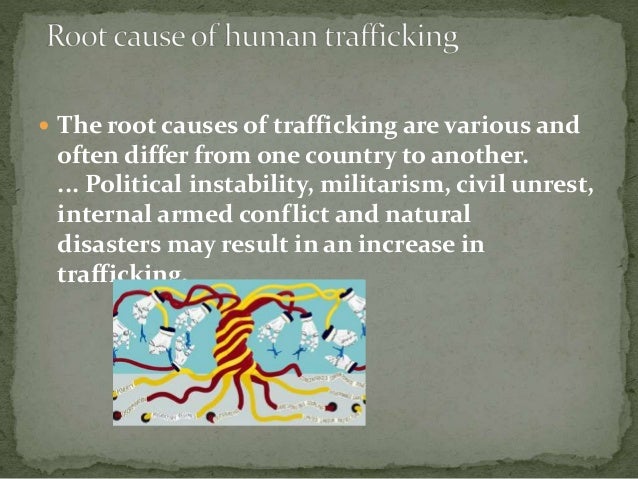
 The root causes of trafficking are various and
often differ from one country to another.
... Political instability, militarism, civil unrest,
internal armed conflict and natural
disasters may result in an increase in
trafficking.
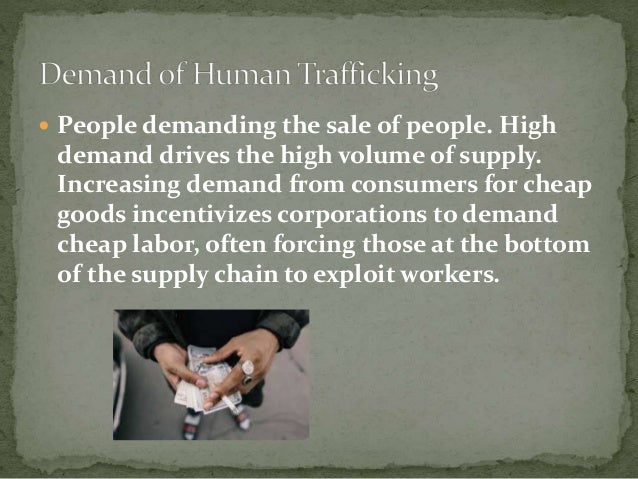
 People demanding the sale of people. High
demand drives the high volume of supply.
Increasing demand from consumers for cheap
goods incentivizes corporations to demand
cheap labor, often forcing those at the bottom
of the supply chain to exploit workers.
 Human Trafficking is the recruitment,
transportation, transfer, harbouring or receipt
of people through force, fraud or deception,
with the aim of exploiting them for
profit. Men, women and children of all ages
and from all backgrounds can become victims
of this crime, which occurs in every region of
the world.
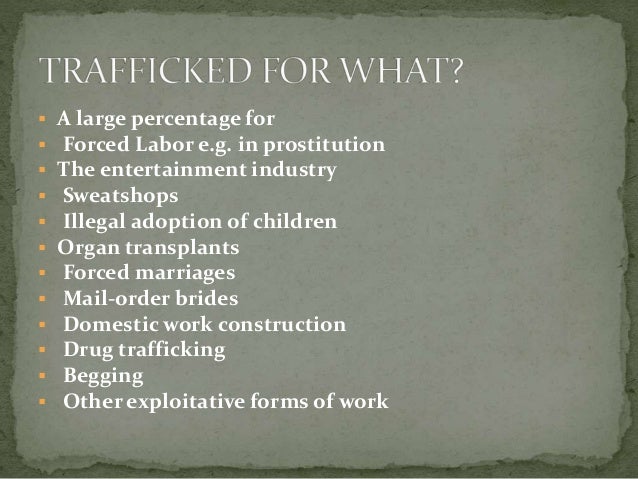
 A large percentage for
 Forced Labor e.g. in prostitution
 The entertainment industry
 Sweatshops
 Illegal adoption of children
 Organ transplants
 Forced marriages
 Mail-order brides
 Domestic work construction
 Drug trafficking
 Begging
 Other exploitative forms of work
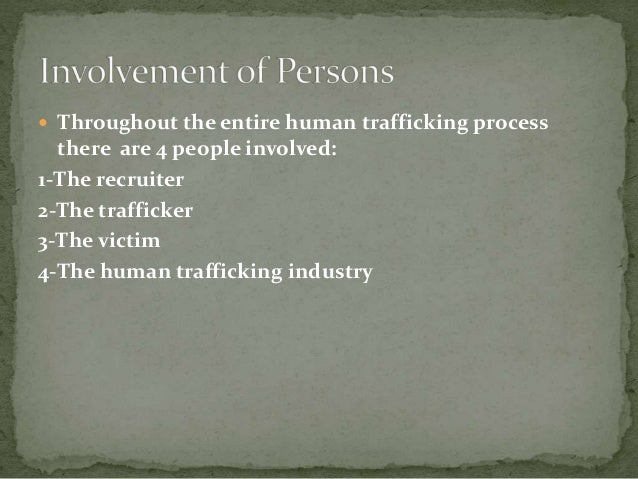
 Throughout the entire human trafficking process
there are 4 people involved:
1-The recruiter
2-The trafficker
3-The victim
4-The human trafficking industry
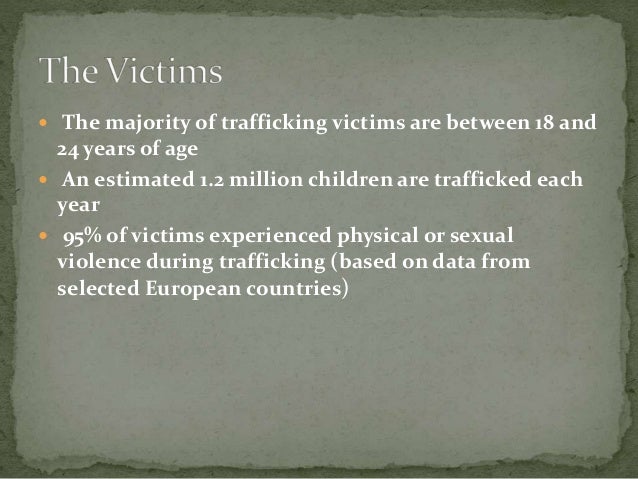
 The majority of trafficking victims are between 18 and
24 years of age
 An estimated 1.2 million children are trafficked each
year
 95% of victims experienced physical or sexual
violence during trafficking (based on data from
selected European countries)
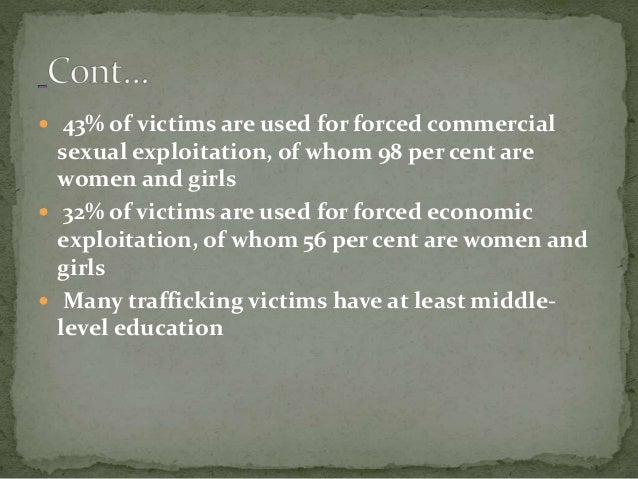
 43% of victims are used for forced commercial
sexual exploitation, of whom 98 per cent are
women and girls
 32% of victims are used for forced economic
exploitation, of whom 56 per cent are women and
girls
 Many trafficking victims have at least middle-
level education
 POVERTY
 UNEMPLOYMENT
 DISPLACEMENT
 LACK OF KNOWLEDGE OR EXPERIENCE
 BROKEN FAMILIES
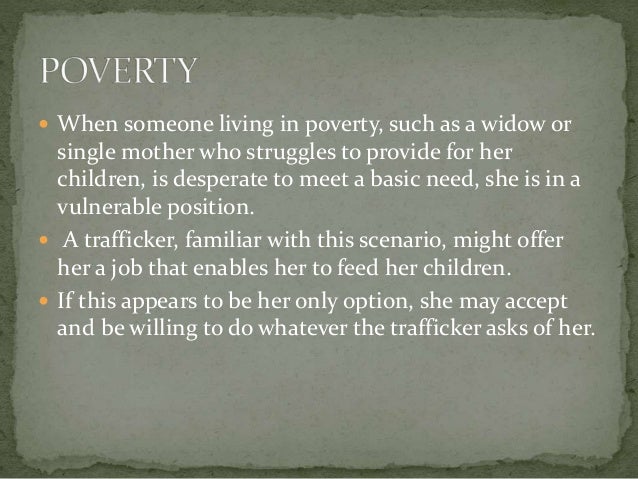
 When someone living in poverty, such as a widow or
single mother who struggles to provide for her
children, is desperate to meet a basic need, she is in a
vulnerable position.
 A trafficker, familiar with this scenario, might offer
her a job that enables her to feed her children.
 If this appears to be her only option, she may accept
and be willing to do whatever the trafficker asks of her.
 Traffickers target unemployed individuals and often
use deception to persuade them to leave home and
take a job in another city or country.
 The position may initially sound promising, but once
the individual arrives at the destination, it is often
much different than what was described.
 To keep them from leaving, traffickers may confiscate
their victims’ passports or IDs. They might also pay for
transportation, shelter, clothing, or food so their
victims are indebted to them and feel obligated to
work.
 War, political instability, and natural disasters can
displace individuals or entire families.
 When people are forced to flee their homes and
communities, they can experience financial hardship,
homelessness, and culture shock.
 Children who have lost their parents, for example, are
easy targets for traffickers. Without a safe place to call
home or a guardian to provide for and protect them,
these children become vulnerable to abuse, unfair
treatment, and trafficking
 Inexperience may lead individuals down a path that
ends in exploitation.
 A teenager who is approached by a trafficker may
accept an attractive job offer, seeing it as a great
opportunity at such a young age.
 An immigrant who arrives in a foreign country may
not understand his or her rights, may be unfamiliar
with the nation’s laws, or may not know the national
language.
 A trafficker will quickly take advantage of these types
of situations.
 Individuals who are cast out of their homes,
abandoned, or placed into the child welfare system are
highly vulnerable to human trafficking.
 Runaways, youth experiencing homelessness, and
those who live in isolation are often targeted. When
someone feels alone or unloved or has been abused in
the past, they may be willing to take great risks.
 They may feel as though they have little to lose or may
even find comfort living with their trafficker.
 Some traffickers offer love and acceptance to lure
individuals to work for them.
 MENTAL TRAUMA
 PHYSICAL TRAUMA
 BACKBITING
 LACK OF INDEPENDENT LIVING SKILLS
 “Because traffickers dehumanize and objectify their
victims, victims’ innate sense of power, visibility, and
dignity often become obscured.”
 Victims of human trafficking can experience
devastating psychological effects during and after their
trafficking experience.
 Many survivors may end up experiencing post-
traumatic stress, difficulty in relationships, depression,
memory loss, anxiety, fear, guilt, shame, and other
severe forms of mental trauma.
 Many victims also experience physical injuries. Those who have
been sexually exploited are often abused by their traffickers and
customers.
 They may be raped, beaten, and subjected to abuse over a long
period of time.
 There is also a higher risk of contracting sexually transmitted
diseases, infections, diabetes, cancer, and other illnesses.
 A lack of proper medical care allows these conditions to spread
and worsen—often affecting an individual’s health permanently.
 Victims of forced labor may work in dangerous conditions for
long hours doing repetitive tasks. They may also be exposed to
dangerous contaminants or work with heavy equipment.
 As a result, many are subjected to serious infections, respiratory
problems, injuries, impairments, and exhaustion.
 Individuals who are being trafficked can quickly become
isolated from friends, family, and other social circles.
 This may be due to their personal feelings of guilt and
shame or because they’ve relocated and now live far away
from their community.
 Either way, victims can become isolated, withdrawn, and
lose contact with most people.
 Some individuals who return home or escape a trafficking
situation may even be excluded from social groups due to a
stigma they now face; they may be shunned by their family
and friends and feel unloved and unwanted.
 Unfortunately, this isolation can make them vulnerable to
being trafficked again or lead them to return to an abusive
lifestyle.
 Many victims who escape a trafficking situation lack
advanced education and the resources needed to live
independently.
 They may not understand laws in the country where they
now reside or may not speak the language.
 They may have been trafficked at a young age and were
unable to attend school or go to college.
 After being confined to the same job for a long period of
time and not being allowed to learn new skills, victims can
become dependent.
 When the time comes, they may have a hard time living on
their own.
 Human trafficking is a multi-dimensional threat: it
deprives people of their human rights and freedoms, it
is a GlobalHealth risk, and it fuels the growth of
organized crime.
 Human trafficking has a devastating impact on
individual victims, who often suffer physical and
emotional abuse, rape, threats against self and family,
passport theft, and even death.
 But the impact of human trafficking goes beyond
individual victims; it undermines the safety and
security of all nations it touches.
 Trafficking in Human Beings or Persons is prohibited
under the Constitution of India under Article 23
 The Immoral Traffic (Prevention) Act, 1956 (ITPA)
 Criminal Law (amendment) Act 2013 .
 Protection of Children from Sexual offences (POCSO)
Act, 2012
 Prohibition of Child Marriage Act, 2006
 Bonded Labour System (Abolition) Act, 1976
 Child Labour (Prohibition and Regulation) Act, 1986
 Fundraising
 Volunteer
 Be aware of the signs of human trafficking
 Advocate.
 Hold events to raise awareness
 Boycott products and companies that permit human
 Help survivors
 Stay informed.
 Report suspicions
 Help combat the demand
 Holding a fundraiser and donating the money raised to one of
the countless organizations that help to fight human trafficking
not only gives money to the cause but also brings awareness
to the issue. Most organizations working to fight human
trafficking are nonprofit organizations that rely on donations.
Holding fundraisers helps maintain these nonprofits.
 Volunteering time and effort to an anti-trafficking organization
is a great way to contribute to the fight against human
trafficking. In addition to helping the organization itself, the
more volunteers there are, the greater the outreach can be. For
For example, Unseen is a nonprofit organization that helps
victims of human trafficking by providing specialist care to help
them along the road to recovery.
 Being educated on signs that could indicate someone
is a victim of human trafficking increases the
likelihood of reporting and could give a voice to
victims who do not feel comfortable speaking out for
themselves
 Meeting with or reaching out to local, state and
federal representatives informs them that their
constituents are passionate about fighting human
trafficking, and brings the issue to their attention.
This increases the likelihood that they will do
something about it.
 Raising awareness for human trafficking can also get more
people involved and interested in joining the fight. It can
create a chain reaction, leading to more people lobbying,
fundraising and educating themselves. Regardless of what the
event is, they are efficient ways to raise awareness for a cause
and gain new followers.
 Many goods produced in the India and abroad are
products of victims of human trafficking. Being
conscientious about the products consumed and the
companies supported is an easy way to contribute to
the fight against human trafficking
 Donate clothes and other goods to shelters for victims of
human trafficking. Also, encourage businesses to give jobs to
survivors, helping them get back on their feet and get a fresh
start. If applicable, offering legal advice to survivors allows
them an opportunity to not only move forward but to gain
justice.
 It is important to know the resources available.
When we traveling it is beneficial to look up the
emergency phone number of the given country, to
enable quick reports should a trafficking victim be
spotted.
Human trafficking

Human trafficking

  • 1.
  • 2.
     Human traffickingis a group of crimes involving the exploitation of men, women and children for financial gains which is violation of fundamental human right.  Human trafficking is the 3rd largest international crime.  Over one million people trafficked annually.  Millions of men, women and children are victims of human trafficking .  Human trafficking is a part of the larger problem of slavery.
  • 3.
     human traffickingis when people are transported, by force or deception, to become enslaved.  Traffickers use blackmail, abuse, and threats to force victims to comply with their wishes in the destination country .  Usually caused by poverty/lack of economic opportunities, especially for women and children, and a demand for certain services in the destination country.
  • 4.
     The rootcauses of trafficking are various and often differ from one country to another. ... Political instability, militarism, civil unrest, internal armed conflict and natural disasters may result in an increase in trafficking.
  • 5.
     People demandingthe sale of people. High demand drives the high volume of supply. Increasing demand from consumers for cheap goods incentivizes corporations to demand cheap labor, often forcing those at the bottom of the supply chain to exploit workers.
  • 6.
     Human Traffickingis the recruitment, transportation, transfer, harbouring or receipt of people through force, fraud or deception, with the aim of exploiting them for profit. Men, women and children of all ages and from all backgrounds can become victims of this crime, which occurs in every region of the world.
  • 7.
     A largepercentage for  Forced Labor e.g. in prostitution  The entertainment industry  Sweatshops  Illegal adoption of children  Organ transplants  Forced marriages  Mail-order brides  Domestic work construction  Drug trafficking  Begging  Other exploitative forms of work
  • 8.
     Throughout theentire human trafficking process there are 4 people involved: 1-The recruiter 2-The trafficker 3-The victim 4-The human trafficking industry
  • 9.
     The majorityof trafficking victims are between 18 and 24 years of age  An estimated 1.2 million children are trafficked each year  95% of victims experienced physical or sexual violence during trafficking (based on data from selected European countries)
  • 10.
     43% ofvictims are used for forced commercial sexual exploitation, of whom 98 per cent are women and girls  32% of victims are used for forced economic exploitation, of whom 56 per cent are women and girls  Many trafficking victims have at least middle- level education
  • 11.
     POVERTY  UNEMPLOYMENT DISPLACEMENT  LACK OF KNOWLEDGE OR EXPERIENCE  BROKEN FAMILIES
  • 12.
     When someoneliving in poverty, such as a widow or single mother who struggles to provide for her children, is desperate to meet a basic need, she is in a vulnerable position.  A trafficker, familiar with this scenario, might offer her a job that enables her to feed her children.  If this appears to be her only option, she may accept and be willing to do whatever the trafficker asks of her.
  • 13.
     Traffickers targetunemployed individuals and often use deception to persuade them to leave home and take a job in another city or country.  The position may initially sound promising, but once the individual arrives at the destination, it is often much different than what was described.  To keep them from leaving, traffickers may confiscate their victims’ passports or IDs. They might also pay for transportation, shelter, clothing, or food so their victims are indebted to them and feel obligated to work.
  • 14.
     War, politicalinstability, and natural disasters can displace individuals or entire families.  When people are forced to flee their homes and communities, they can experience financial hardship, homelessness, and culture shock.  Children who have lost their parents, for example, are easy targets for traffickers. Without a safe place to call home or a guardian to provide for and protect them, these children become vulnerable to abuse, unfair treatment, and trafficking
  • 15.
     Inexperience maylead individuals down a path that ends in exploitation.  A teenager who is approached by a trafficker may accept an attractive job offer, seeing it as a great opportunity at such a young age.  An immigrant who arrives in a foreign country may not understand his or her rights, may be unfamiliar with the nation’s laws, or may not know the national language.  A trafficker will quickly take advantage of these types of situations.
  • 16.
     Individuals whoare cast out of their homes, abandoned, or placed into the child welfare system are highly vulnerable to human trafficking.  Runaways, youth experiencing homelessness, and those who live in isolation are often targeted. When someone feels alone or unloved or has been abused in the past, they may be willing to take great risks.  They may feel as though they have little to lose or may even find comfort living with their trafficker.  Some traffickers offer love and acceptance to lure individuals to work for them.
  • 17.
     MENTAL TRAUMA PHYSICAL TRAUMA  BACKBITING  LACK OF INDEPENDENT LIVING SKILLS
  • 18.
     “Because traffickersdehumanize and objectify their victims, victims’ innate sense of power, visibility, and dignity often become obscured.”  Victims of human trafficking can experience devastating psychological effects during and after their trafficking experience.  Many survivors may end up experiencing post- traumatic stress, difficulty in relationships, depression, memory loss, anxiety, fear, guilt, shame, and other severe forms of mental trauma.
  • 19.
     Many victimsalso experience physical injuries. Those who have been sexually exploited are often abused by their traffickers and customers.  They may be raped, beaten, and subjected to abuse over a long period of time.  There is also a higher risk of contracting sexually transmitted diseases, infections, diabetes, cancer, and other illnesses.  A lack of proper medical care allows these conditions to spread and worsen—often affecting an individual’s health permanently.  Victims of forced labor may work in dangerous conditions for long hours doing repetitive tasks. They may also be exposed to dangerous contaminants or work with heavy equipment.  As a result, many are subjected to serious infections, respiratory problems, injuries, impairments, and exhaustion.
  • 20.
     Individuals whoare being trafficked can quickly become isolated from friends, family, and other social circles.  This may be due to their personal feelings of guilt and shame or because they’ve relocated and now live far away from their community.  Either way, victims can become isolated, withdrawn, and lose contact with most people.  Some individuals who return home or escape a trafficking situation may even be excluded from social groups due to a stigma they now face; they may be shunned by their family and friends and feel unloved and unwanted.  Unfortunately, this isolation can make them vulnerable to being trafficked again or lead them to return to an abusive lifestyle.
  • 21.
     Many victimswho escape a trafficking situation lack advanced education and the resources needed to live independently.  They may not understand laws in the country where they now reside or may not speak the language.  They may have been trafficked at a young age and were unable to attend school or go to college.  After being confined to the same job for a long period of time and not being allowed to learn new skills, victims can become dependent.  When the time comes, they may have a hard time living on their own.
  • 22.
     Human traffickingis a multi-dimensional threat: it deprives people of their human rights and freedoms, it is a GlobalHealth risk, and it fuels the growth of organized crime.  Human trafficking has a devastating impact on individual victims, who often suffer physical and emotional abuse, rape, threats against self and family, passport theft, and even death.  But the impact of human trafficking goes beyond individual victims; it undermines the safety and security of all nations it touches.
  • 23.
     Trafficking inHuman Beings or Persons is prohibited under the Constitution of India under Article 23  The Immoral Traffic (Prevention) Act, 1956 (ITPA)  Criminal Law (amendment) Act 2013 .  Protection of Children from Sexual offences (POCSO) Act, 2012  Prohibition of Child Marriage Act, 2006  Bonded Labour System (Abolition) Act, 1976  Child Labour (Prohibition and Regulation) Act, 1986
  • 24.
     Fundraising  Volunteer Be aware of the signs of human trafficking  Advocate.  Hold events to raise awareness  Boycott products and companies that permit human  Help survivors  Stay informed.  Report suspicions  Help combat the demand
  • 25.
     Holding afundraiser and donating the money raised to one of the countless organizations that help to fight human trafficking not only gives money to the cause but also brings awareness to the issue. Most organizations working to fight human trafficking are nonprofit organizations that rely on donations. Holding fundraisers helps maintain these nonprofits.
  • 26.
     Volunteering timeand effort to an anti-trafficking organization is a great way to contribute to the fight against human trafficking. In addition to helping the organization itself, the more volunteers there are, the greater the outreach can be. For For example, Unseen is a nonprofit organization that helps victims of human trafficking by providing specialist care to help them along the road to recovery.
  • 27.
     Being educatedon signs that could indicate someone is a victim of human trafficking increases the likelihood of reporting and could give a voice to victims who do not feel comfortable speaking out for themselves
  • 28.
     Meeting withor reaching out to local, state and federal representatives informs them that their constituents are passionate about fighting human trafficking, and brings the issue to their attention. This increases the likelihood that they will do something about it.
  • 29.
     Raising awarenessfor human trafficking can also get more people involved and interested in joining the fight. It can create a chain reaction, leading to more people lobbying, fundraising and educating themselves. Regardless of what the event is, they are efficient ways to raise awareness for a cause and gain new followers.
  • 30.
     Many goodsproduced in the India and abroad are products of victims of human trafficking. Being conscientious about the products consumed and the companies supported is an easy way to contribute to the fight against human trafficking
  • 31.
     Donate clothesand other goods to shelters for victims of human trafficking. Also, encourage businesses to give jobs to survivors, helping them get back on their feet and get a fresh start. If applicable, offering legal advice to survivors allows them an opportunity to not only move forward but to gain justice.
  • 32.
     It isimportant to know the resources available. When we traveling it is beneficial to look up the emergency phone number of the given country, to enable quick reports should a trafficking victim be spotted.