Human
TraffickingPRESENTED BY: AMPER, IAN B.
ANTALLAN, CYNTHIA A.
BADILLES, ALLAIN CAILE
PNU-MINDANAO
 Human trafficking is the act of forcefully transporting or
recruiting persons for the purpose of exploitation, which
include prostitution or sexual exploitation, forced labor , slavery,
or removal of organs.
 According to the United Nations Office on Drugs and Crime,
human trafficking is defined as “the recruitment,
transportation, transfer, harbouring or receipt of persons,
means of the treat or use of force or other forms of
 Trafficking of individuals is a serious crime and a heinous
violation of human rights.
 “Every year, thousands of men, women and children
into the hands of traffickers, in their own countries
abroad. Almost every country in the world is affected by
trafficking, whether as a country of origin, transit or
destination for victims,” said the UN.
Although one case may differ from another, most human
trafficking cases follow the same pattern, according to a
report of the United Nations Office on Drugs and Crime
(UNODC):
 (1) people are abducted or recruited in a country of
origin;
 (2) transferred through transit regions; and then
(3) exploited in a destination country.
The UNODC cites 3 elements that
constitute human trafficking:
1. the criminal act of recruitment, transportation,
transfer, harbouring, or receipt of persons within or
across national borders
2. by means of: threat or use of force, coercion,
abduction, fraud, deception, abuse of power or
vulnerability, or giving payments or benefits to a
person in control of the victim
The UNODC cites 3 elements that
constitute human trafficking:
3. for the purpose of exploitation, which
includes, at a minimum, exploiting the
prostitution of others, other forms of sexual
exploitation, forced labor or services, slavery or
similar practices, and the removal of organs
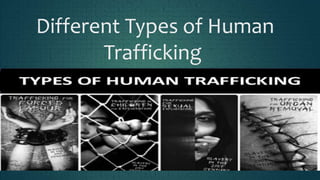
Different Types of Human
Trafficking
Different Types of Human Trafficking
The United Nations Office on Drugs and
Crime suggested that 53 percent of the
victims are forced into sexual exploitation.
09 Apr 2016 - http://borgenproject.org/human-trafficking/
1.Sex Trafficking
Different Types of Human Trafficking
 “Sex trafficking is the recruitment, transportation,
or harbouring of persons through threat, use of
force, or other coercion for the purpose of sexual
exploitation. This includes movement across borders,
as well as within the victim’s own country,” affirmed
Human Trafficking Search.
09 Apr 2016 - http://borgenproject.org/human-trafficking/
1.Sex Trafficking
Involuntary servitude happens when a
domestic worker becomes enslaved in an
exploitative position they are incapable
of escaping.
09 Apr 2016 - http://borgenproject.org/human-trafficking/
2. Involuntary Domestic Servitude
 “Domestic servitude is the seemingly normal practice
of live-in help that is used as a cover for the
exploitation and control of someone, usually from
another country. It is a form of forced labor, but it also
warrants its own category of slavery because of the
unique contexts and challenges it presents,” said End
Slavery Now.
09 Apr 2016 - http://borgenproject.org/human-trafficking/
2. Involuntary Domestic Servitude
 “Forced labor is work or service that is extorted from
someone under the menace of any penalty and work
or service that the person has not offered
voluntarily.”
 The International Labour Organization estimated that
approximately 20.9 million people are enslaved to
forced labor, and 4.5 are subjected to sexual forced
exploitation.
3. Forced Labor
 “Debt bondage is a type of forced labor, involving a
debt that cannot be paid off in a reasonable time,”
said Human Trafficking Search.
 It is a period of debt during which there is no
freedom, consequently, it is also known as debt
slavery.
4. Debt Bondage
 Child soldiers are described as persons under the age
of 18, who have been recruited by armed forces in
any capacity. Currently, there are thousands of
soldiers worldwide.
 “The definition includes both boys and girls who are
used as fighters, cooks, porters, messengers, spies, or
for sexual purposes,” added Human Trafficking
Search.
5. Child Soldiers
There are approximately 1.8 million children
subjected to prostitution or pornography
globally.
The Human Trafficking Search defined it as “a
sexual exploitation by an adult with respect to a
child, usually accompanied by a payment to the
child or one or more third parties.”
6. Child Sex Trafficking
A child is considered to be involved in child
labor activities if this minor is between the
ages of 0 and 18, is involved in a type of
work inappropriate for their age and in a
dangerous work environment.
7. Child Labor
However, there are several forms of child
labor. The most common ones are related to
the informal sector of the economy and are
linked to agricultural labor, mining,
construction and begging in the streets.
7. Child Labor
Organ harvesting involves trafficking people in
order to use their internal organs for transplant.
The illegal trade is dominated by demand for
kidneys. These are the only major organs that
can be wholly transplanted with relatively few
risks to the life of the donor.
8. Organ harvesting
◦ Promised a “better life”
◦ “Help” immigrating
◦ Fake jobs
◦ No negative aspects
◦ Kidnapped
◦ Beaten
◦ Raped
 Rarely fed, washed, no medical attention
 Beaten, raped, drugged.
 Passports confiscated Fear
"Anti-Trafficking in Persons
Act of 2003"
http://karapatangbabae.weebly.com/batas-laban-sa-trafficking-ra-9208.html
Section 4 of Republic Act 9208, otherwise known as
the "Anti-Trafficking in Persons Act of 2003", deems it
unlawful for any person, natural or juridical, to commit
any of the following acts:
(a) To recruit, transport, transfer, harbor, provide, or receive a
person by any means, including those done under the
pretext of domestic or overseas employment or training or
apprenticeship, for the purpose of prostitution, pornography,
sexual exploitation, forced labor, slavery, involuntary
servitude or debt bondage;
(b) To introduce or match for money, profit, or
material, economic or other consideration, any person
or, as provided for under Republic Act No. 6955, any
Filipino women to a foreign national, for marriage for
the purpose of acquiring, buying, offering, selling or
trading him/her to engage in prostitution,
pornography, sexual exploitation, forced labor,
slavery, involuntary servitude or debt bondage;
(c) To offer or contract marriage, real or
simulated, for the purpose of acquiring,
buying, offering, selling, or trading them to
engage in prostitution, pornography, sexual
exploitation, forced labor or slavery,
involuntary servitude or debt bondage;
(d) To undertake or organize tours and travel
plans consisting of tourism packages or
activities for the purpose of utilizing and
offering persons for prostitution, pornography
or sexual exploitation;
(e) To maintain or hire a person to engage in
prostitution or pornography;
(f) To adopt or facilitate the adoption of
persons for the purpose of prostitution,
pornography, sexual exploitation, forced
labor, slavery, involuntary servitude or debt
bondage;
(g) To recruit, hire, adopt, transport or abduct a
person, by means of threat or use of force, fraud
deceit, violence, coercion, or intimidation for the
purpose of removal or sale of organs of said
person; and
(h) To recruit, transport or adopt a child to engage
in armed activities in the Philippines or abroad.
Ang sinumang mapatunayang nagkasala sa ilalim ng
Sec. 4 ng RA 9208 ay mapaparusahan ng pagkakulong
ng dalawampung (20) taon at magbabayad ng
multang hindi bababa sa isang milyong piso
(P1,000,000.00) ngunit hindi tataas sa dalawang
milyong piso (P2,000,000.00).
Ang sinumang bibili o magbabayad ng serbisyo ng
biktima ng trafficking ay mapaparusahan sa unang
pagkakataon ng anim (6) na buwan na community
at magbabayad ng multa na limampung libong piso
(P50,000.00). Para sa mga susunod na pagkakataon, ang
parusa ay pagkakulong ng isang (1) taon at
pagmumulta ng isandaang libong piso (P100,000.00).
REPUBLIC ACT No. 10364
http://www.lawphil.net/statutes/repacts/ra2013/ra_10364_2013.html
This Act shall be known as the "Expanded Anti-Trafficking
in Persons Act of 2012”
An act to institute policies to eliminate trafficking in
persons especially women and children, establishing the
necessary institutional mechanisms for the protection and
support of trafficked persons, providing penalties for its
violations and for other purposes.
1.Upang mapangalagaan ang karapatan
ng biktima, ang pagdinig sa kaso ng
trafficking ay confidential.
2. Hindi rin maaaring parusahan ang biktima para
sa mga krimeng nagawa lamang bilang
pagsunod sa mga kagustuhan ng may-sala.
3.Mapasailalim sa witness protection program
kung kinakailangan.
4.Iba pang suportang serbisyo mula sa iba’t ibang ahensya ng
pamahalaan:
a) Lugar na matitirhan (DSWD)
b) Counseling (DSWD)
c) Libreng serbisyo panlegal (DOJ/POEA)
d) Mga serbisyong medikal at sikolohikal
e) Mga programang pangkabuhayan
f) Pagtulong sa edukasyon ng batang biktima
Philippines is a source, transit, and destination
for human trafficking.
20,000 – 100,000 Philippine and foreign child
victims in the Philippines
Foreign tourists, particularly other Asians,
sexually exploit women and children.
Philippine men, women, and girls were trafficked for
labor and sexual exploitation to Saudi Arabia,
Kuwait, the United Arab Emirates, Qatar, Bahrain,
Malaysia, Hong Kong, Singapore, Japan, South
Africa, North America, and Europe.
300,000 – 400,000 trafficked women
60,000 – 100, 000 trafficked children
The Philippines is a transit country for
victims trafficked from China.
The Philippines is a destination country for a
small number of women who are trafficked
from the People’s Republic of China (P.R.C.),
South Korea, Japan, and Russia for sexual
exploitation.
 The Philippines has internal trafficking of
women and children from rural areas,
particularly the Visayas and Mindanao, to
urban areas, such as Metro Manila and Cebu,
for sexual exploitation or forced labor as
domestic workers, factory workers, or in the
drug trade.
http://cnnphilippines.com/news/2016/09/23/Philippines-fight-against-
trafficking.html

Human trafficking

  • 1.
    Human TraffickingPRESENTED BY: AMPER,IAN B. ANTALLAN, CYNTHIA A. BADILLES, ALLAIN CAILE PNU-MINDANAO
  • 2.
     Human traffickingis the act of forcefully transporting or recruiting persons for the purpose of exploitation, which include prostitution or sexual exploitation, forced labor , slavery, or removal of organs.  According to the United Nations Office on Drugs and Crime, human trafficking is defined as “the recruitment, transportation, transfer, harbouring or receipt of persons, means of the treat or use of force or other forms of
  • 3.
     Trafficking ofindividuals is a serious crime and a heinous violation of human rights.  “Every year, thousands of men, women and children into the hands of traffickers, in their own countries abroad. Almost every country in the world is affected by trafficking, whether as a country of origin, transit or destination for victims,” said the UN.
  • 5.
    Although one casemay differ from another, most human trafficking cases follow the same pattern, according to a report of the United Nations Office on Drugs and Crime (UNODC):  (1) people are abducted or recruited in a country of origin;  (2) transferred through transit regions; and then (3) exploited in a destination country.
  • 6.
    The UNODC cites3 elements that constitute human trafficking: 1. the criminal act of recruitment, transportation, transfer, harbouring, or receipt of persons within or across national borders 2. by means of: threat or use of force, coercion, abduction, fraud, deception, abuse of power or vulnerability, or giving payments or benefits to a person in control of the victim
  • 7.
    The UNODC cites3 elements that constitute human trafficking: 3. for the purpose of exploitation, which includes, at a minimum, exploiting the prostitution of others, other forms of sexual exploitation, forced labor or services, slavery or similar practices, and the removal of organs
  • 9.
    Different Types ofHuman Trafficking
  • 10.
    Different Types ofHuman Trafficking The United Nations Office on Drugs and Crime suggested that 53 percent of the victims are forced into sexual exploitation. 09 Apr 2016 - http://borgenproject.org/human-trafficking/ 1.Sex Trafficking
  • 11.
    Different Types ofHuman Trafficking  “Sex trafficking is the recruitment, transportation, or harbouring of persons through threat, use of force, or other coercion for the purpose of sexual exploitation. This includes movement across borders, as well as within the victim’s own country,” affirmed Human Trafficking Search. 09 Apr 2016 - http://borgenproject.org/human-trafficking/ 1.Sex Trafficking
  • 12.
    Involuntary servitude happenswhen a domestic worker becomes enslaved in an exploitative position they are incapable of escaping. 09 Apr 2016 - http://borgenproject.org/human-trafficking/ 2. Involuntary Domestic Servitude
  • 13.
     “Domestic servitudeis the seemingly normal practice of live-in help that is used as a cover for the exploitation and control of someone, usually from another country. It is a form of forced labor, but it also warrants its own category of slavery because of the unique contexts and challenges it presents,” said End Slavery Now. 09 Apr 2016 - http://borgenproject.org/human-trafficking/ 2. Involuntary Domestic Servitude
  • 14.
     “Forced laboris work or service that is extorted from someone under the menace of any penalty and work or service that the person has not offered voluntarily.”  The International Labour Organization estimated that approximately 20.9 million people are enslaved to forced labor, and 4.5 are subjected to sexual forced exploitation. 3. Forced Labor
  • 15.
     “Debt bondageis a type of forced labor, involving a debt that cannot be paid off in a reasonable time,” said Human Trafficking Search.  It is a period of debt during which there is no freedom, consequently, it is also known as debt slavery. 4. Debt Bondage
  • 16.
     Child soldiersare described as persons under the age of 18, who have been recruited by armed forces in any capacity. Currently, there are thousands of soldiers worldwide.  “The definition includes both boys and girls who are used as fighters, cooks, porters, messengers, spies, or for sexual purposes,” added Human Trafficking Search. 5. Child Soldiers
  • 17.
    There are approximately1.8 million children subjected to prostitution or pornography globally. The Human Trafficking Search defined it as “a sexual exploitation by an adult with respect to a child, usually accompanied by a payment to the child or one or more third parties.” 6. Child Sex Trafficking
  • 18.
    A child isconsidered to be involved in child labor activities if this minor is between the ages of 0 and 18, is involved in a type of work inappropriate for their age and in a dangerous work environment. 7. Child Labor
  • 19.
    However, there areseveral forms of child labor. The most common ones are related to the informal sector of the economy and are linked to agricultural labor, mining, construction and begging in the streets. 7. Child Labor
  • 20.
    Organ harvesting involvestrafficking people in order to use their internal organs for transplant. The illegal trade is dominated by demand for kidneys. These are the only major organs that can be wholly transplanted with relatively few risks to the life of the donor. 8. Organ harvesting
  • 21.
    ◦ Promised a“better life” ◦ “Help” immigrating ◦ Fake jobs ◦ No negative aspects ◦ Kidnapped ◦ Beaten ◦ Raped
  • 22.
     Rarely fed,washed, no medical attention  Beaten, raped, drugged.  Passports confiscated Fear
  • 23.
    "Anti-Trafficking in Persons Actof 2003" http://karapatangbabae.weebly.com/batas-laban-sa-trafficking-ra-9208.html
  • 24.
    Section 4 ofRepublic Act 9208, otherwise known as the "Anti-Trafficking in Persons Act of 2003", deems it unlawful for any person, natural or juridical, to commit any of the following acts: (a) To recruit, transport, transfer, harbor, provide, or receive a person by any means, including those done under the pretext of domestic or overseas employment or training or apprenticeship, for the purpose of prostitution, pornography, sexual exploitation, forced labor, slavery, involuntary servitude or debt bondage;
  • 25.
    (b) To introduceor match for money, profit, or material, economic or other consideration, any person or, as provided for under Republic Act No. 6955, any Filipino women to a foreign national, for marriage for the purpose of acquiring, buying, offering, selling or trading him/her to engage in prostitution, pornography, sexual exploitation, forced labor, slavery, involuntary servitude or debt bondage;
  • 26.
    (c) To offeror contract marriage, real or simulated, for the purpose of acquiring, buying, offering, selling, or trading them to engage in prostitution, pornography, sexual exploitation, forced labor or slavery, involuntary servitude or debt bondage;
  • 27.
    (d) To undertakeor organize tours and travel plans consisting of tourism packages or activities for the purpose of utilizing and offering persons for prostitution, pornography or sexual exploitation; (e) To maintain or hire a person to engage in prostitution or pornography;
  • 28.
    (f) To adoptor facilitate the adoption of persons for the purpose of prostitution, pornography, sexual exploitation, forced labor, slavery, involuntary servitude or debt bondage;
  • 29.
    (g) To recruit,hire, adopt, transport or abduct a person, by means of threat or use of force, fraud deceit, violence, coercion, or intimidation for the purpose of removal or sale of organs of said person; and (h) To recruit, transport or adopt a child to engage in armed activities in the Philippines or abroad.
  • 30.
    Ang sinumang mapatunayangnagkasala sa ilalim ng Sec. 4 ng RA 9208 ay mapaparusahan ng pagkakulong ng dalawampung (20) taon at magbabayad ng multang hindi bababa sa isang milyong piso (P1,000,000.00) ngunit hindi tataas sa dalawang milyong piso (P2,000,000.00).
  • 31.
    Ang sinumang bibilio magbabayad ng serbisyo ng biktima ng trafficking ay mapaparusahan sa unang pagkakataon ng anim (6) na buwan na community at magbabayad ng multa na limampung libong piso (P50,000.00). Para sa mga susunod na pagkakataon, ang parusa ay pagkakulong ng isang (1) taon at pagmumulta ng isandaang libong piso (P100,000.00).
  • 32.
    REPUBLIC ACT No.10364 http://www.lawphil.net/statutes/repacts/ra2013/ra_10364_2013.html This Act shall be known as the "Expanded Anti-Trafficking in Persons Act of 2012” An act to institute policies to eliminate trafficking in persons especially women and children, establishing the necessary institutional mechanisms for the protection and support of trafficked persons, providing penalties for its violations and for other purposes.
  • 33.
    1.Upang mapangalagaan angkarapatan ng biktima, ang pagdinig sa kaso ng trafficking ay confidential.
  • 34.
    2. Hindi rinmaaaring parusahan ang biktima para sa mga krimeng nagawa lamang bilang pagsunod sa mga kagustuhan ng may-sala. 3.Mapasailalim sa witness protection program kung kinakailangan.
  • 35.
    4.Iba pang suportangserbisyo mula sa iba’t ibang ahensya ng pamahalaan: a) Lugar na matitirhan (DSWD) b) Counseling (DSWD) c) Libreng serbisyo panlegal (DOJ/POEA) d) Mga serbisyong medikal at sikolohikal e) Mga programang pangkabuhayan f) Pagtulong sa edukasyon ng batang biktima
  • 36.
    Philippines is asource, transit, and destination for human trafficking. 20,000 – 100,000 Philippine and foreign child victims in the Philippines Foreign tourists, particularly other Asians, sexually exploit women and children.
  • 37.
    Philippine men, women,and girls were trafficked for labor and sexual exploitation to Saudi Arabia, Kuwait, the United Arab Emirates, Qatar, Bahrain, Malaysia, Hong Kong, Singapore, Japan, South Africa, North America, and Europe.
  • 38.
    300,000 – 400,000trafficked women 60,000 – 100, 000 trafficked children
  • 39.
    The Philippines isa transit country for victims trafficked from China. The Philippines is a destination country for a small number of women who are trafficked from the People’s Republic of China (P.R.C.), South Korea, Japan, and Russia for sexual exploitation.
  • 40.
     The Philippineshas internal trafficking of women and children from rural areas, particularly the Visayas and Mindanao, to urban areas, such as Metro Manila and Cebu, for sexual exploitation or forced labor as domestic workers, factory workers, or in the drug trade.
  • 43.