HUMAN RIGHTS :
ISSUES &
CHALLENGES
• The Universal Declaration of Human Rights came
into existence shortly after the Second World War,
reflecting the wishes of people at the time to try and
never see such a horror again.
• This section attempts to highlight some of the gross
human rights violations, racial hatred, the effects of
media suppression, distortion and bias, that still
occur around the world — both near and far from
home.
Democracy
• Democracy is a valued principle, so much so that
some people have sacrificed their lives to fight for it.
While no system is perfect, it seems that democracy
is once again under assault.
• What are the challenges posed in a democratic
system and are established safeguards helping to
strengthen democracy or are their forces successfully
weakening it?
Racism
• Racism is the belief that characteristics and abilities
can be attributed to people simply on the basis of
their race and that some racial groups are superior to
others.
• Racism and discrimination have been used as
powerful weapons encouraging fear or hatred of
others in times of conflict and war, and even during
economic downturns. This article explores racism
from around the world
Women’s Rights
• Women’s rights around the world is an important indicator to understand
global well-being.
• A major global women’s rights treaty was ratified by the majority of the
world’s nations a few decades ago.
• Yet, despite many successes in empowering women, numerous issues still exist
in all areas of life, ranging from the cultural, political to the economic.
• For example, women often work more than men, yet are paid less; gender
discrimination affects girls and women throughout their lifetime; and women
and girls are often are the ones that suffer the most poverty.
• Gender equality furthers the cause of child survival and development for all
of society, so the importance of women’s rights and gender equality should
not be underestimated.
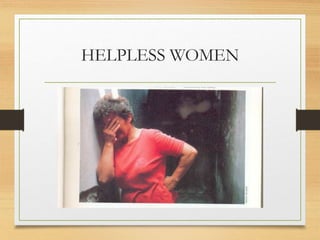
HELPLESS WOMEN
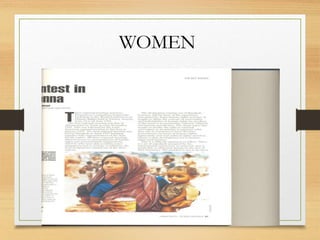
WOMEN
Rights of Indigenous People
• There are approximately 370 million indigenous
people spanning 70 countries, worldwide.
• Historically they have often been dispossessed of
their lands, or in the centre of conflict for access to
valuable resources because of where they live, or, in
yet other cases, struggling to live the way they would
like. Indeed, indigenous people are often amongst the
most disadvantaged people in the world.
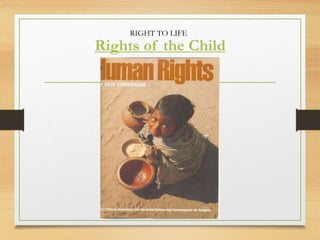
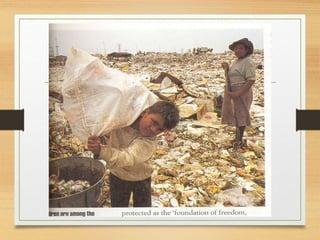
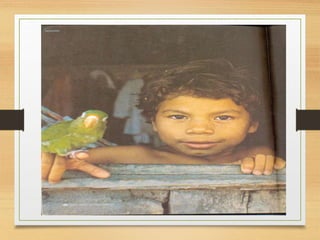
Rights of the Child
RIGHT TO LIFE
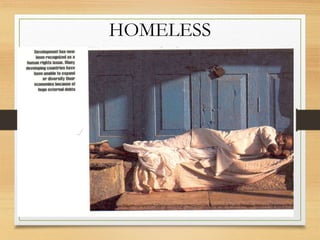
HOMELESS
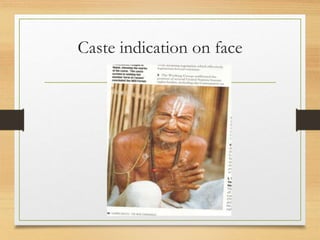
Caste indication on face
Corporations and Human Rights
• Large, transnational corporations are becoming increasingly powerful.
• As profits are naturally the most important goal, damaging results can arise,
such as violation of human rights, lobbying for and participating in
manipulated international agreements, environmental damage, child labour,
driving towards cheaper and cheaper labour, and so on.
• Multinational corporations claim that their involvement in foreign countries
is actually a constructive engagement as it can promote human rights in
non-democratic nations. However, it seems that that is more of a
convenient excuse to continue exploitative practices.
• THANK YOU

HUMAN RIGHTS ISSUES and CHALLENGES.pptx

  • 1.
  • 2.
    • The UniversalDeclaration of Human Rights came into existence shortly after the Second World War, reflecting the wishes of people at the time to try and never see such a horror again.
  • 3.
    • This sectionattempts to highlight some of the gross human rights violations, racial hatred, the effects of media suppression, distortion and bias, that still occur around the world — both near and far from home.
  • 4.
    Democracy • Democracy isa valued principle, so much so that some people have sacrificed their lives to fight for it. While no system is perfect, it seems that democracy is once again under assault. • What are the challenges posed in a democratic system and are established safeguards helping to strengthen democracy or are their forces successfully weakening it?
  • 5.
    Racism • Racism isthe belief that characteristics and abilities can be attributed to people simply on the basis of their race and that some racial groups are superior to others. • Racism and discrimination have been used as powerful weapons encouraging fear or hatred of others in times of conflict and war, and even during economic downturns. This article explores racism from around the world
  • 6.
    Women’s Rights • Women’srights around the world is an important indicator to understand global well-being. • A major global women’s rights treaty was ratified by the majority of the world’s nations a few decades ago. • Yet, despite many successes in empowering women, numerous issues still exist in all areas of life, ranging from the cultural, political to the economic. • For example, women often work more than men, yet are paid less; gender discrimination affects girls and women throughout their lifetime; and women and girls are often are the ones that suffer the most poverty. • Gender equality furthers the cause of child survival and development for all of society, so the importance of women’s rights and gender equality should not be underestimated.
  • 7.
  • 8.
  • 9.
    Rights of IndigenousPeople • There are approximately 370 million indigenous people spanning 70 countries, worldwide. • Historically they have often been dispossessed of their lands, or in the centre of conflict for access to valuable resources because of where they live, or, in yet other cases, struggling to live the way they would like. Indeed, indigenous people are often amongst the most disadvantaged people in the world.
  • 10.
    Rights of theChild RIGHT TO LIFE
  • 12.
  • 13.
  • 14.
    Corporations and HumanRights • Large, transnational corporations are becoming increasingly powerful. • As profits are naturally the most important goal, damaging results can arise, such as violation of human rights, lobbying for and participating in manipulated international agreements, environmental damage, child labour, driving towards cheaper and cheaper labour, and so on. • Multinational corporations claim that their involvement in foreign countries is actually a constructive engagement as it can promote human rights in non-democratic nations. However, it seems that that is more of a convenient excuse to continue exploitative practices.
  • 16.