Performance Management at
The Case of Stack Ranking
Rebecca Ackerman
Ann Dickson
Sasha Goluskin
Zebulun Lounder
Lindsay Mejer
Jeet Raut
Nisi Zhang
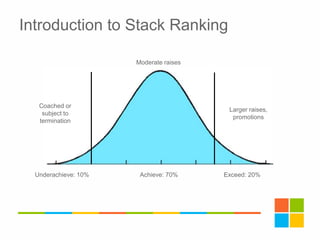
Introduction to Stack Ranking
Moderate raises
Larger raises,
promotions
Coached or
subject to
termination
Underachieve: 10% Achieve: 70% Exceed: 20%
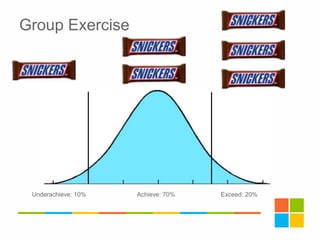
Group Exercise
Underachieve: 10% Achieve: 70% Exceed: 20%
Group Exercise
1. Do you agree with the way your performance
was measured? Why or why not?
2. Would you consider using this criteria for
determining your participation grade? Why or
why not?
Group Exercise
3. Does the reward (candy or your grade)
incentivize you to try to work better with your
group? Can you come up with a stronger
incentive?
Group Exercise
4. Do you feel the process was fair?
5. Does everyone deserve an A?
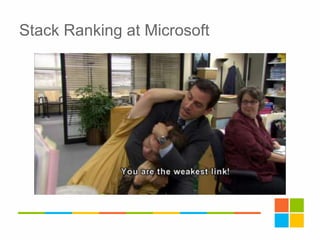
Stack Ranking at Microsoft
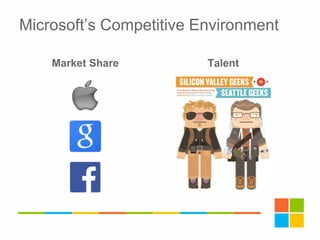
Microsoft’s Competitive Environment
Market Share Talent
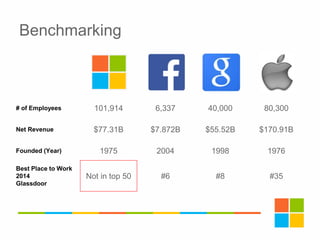
# of Employees 101,914 6,337 40,000 80,300
Net Revenue $77.31B $7.872B $55.52B $170.91B
Founded (Year) 1975 2004 1998 1976
Best Place to Work
2014
Glassdoor
Not in top 50 #6 #8 #35
Benchmarking
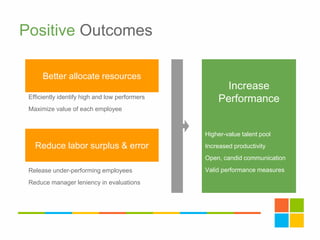
Positive Outcomes
Efficiently identify high and low performers
Maximize value of each employee
Better allocate resources
Reduce labor surplus & error
Release under-performing employees
Reduce manager leniency in evaluations
Increase
Performance
Higher-value talent pool
Increased productivity
Open, candid communication
Valid performance measures
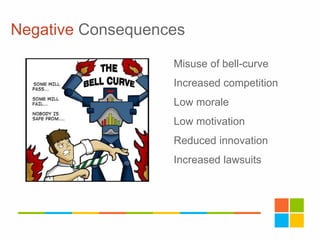
Negative Consequences
Misuse of bell-curve
Increased competition
Low morale
Low motivation
Reduced innovation
Increased lawsuits
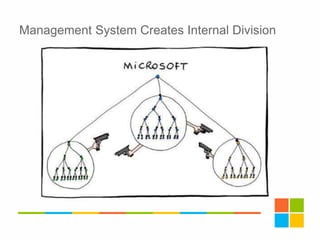
Management System Creates Internal Division
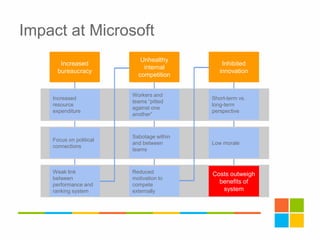
Impact at Microsoft
Increased
bureaucracy
Inhibited
innovation
Unhealthy
internal
competition
Increased
resource
expenditure
Short-term vs.
long-term
perspective
Workers and
teams “pitted
against one
another”
Focus on political
connections
Low morale
Sabotage within
and between
teams
Weak link
between
performance and
ranking system
Reduced
motivation to
compete
externally
Costs outweigh
benefits of
system
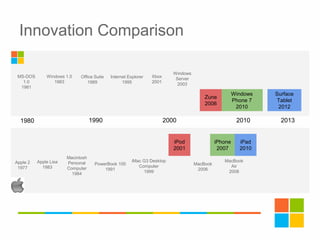
Innovation Comparison
Apple 2
1977
Apple Lisa
1983
Macintosh
Personal
Computer
1984
PowerBook 100
1991
iMac G3 Desktop
Computer
1999
iPod
2001
MacBook
2006
iPhone
2007
MacBook
Air
2008
iPad
2010
1980 1990 2000 2010
MS-DOS
1.0
1981
Windows 1.0
1983
Office Suite
1989
Internet Explorer
1995
Xbox
2001
Windows
Server
2003
Windows
Phone 7
2010
Surface
Tablet
2012
Zune
2006
2013
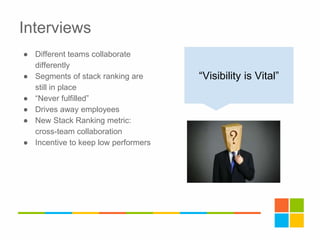
Interviews
● Different teams collaborate
differently
● Segments of stack ranking are
still in place
● “Never fulfilled”
● Drives away employees
● New Stack Ranking metric:
cross-team collaboration
● Incentive to keep low performers
“Visibility is Vital”
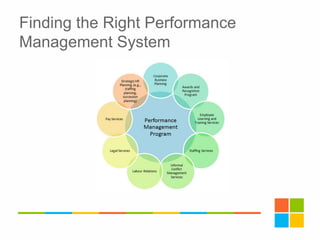
Finding the Right Performance
Management System
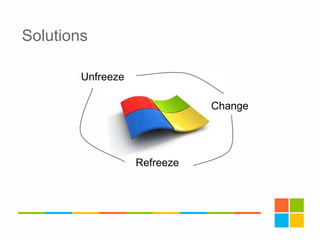
Solutions
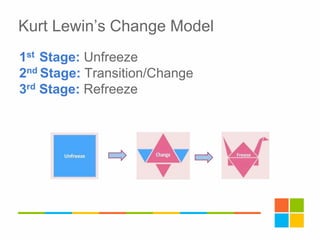
Unfreeze
Change
Refreeze
Kurt Lewin’s Change Model
1st Stage: Unfreeze
2nd Stage: Transition/Change
3rd Stage: Refreeze
1st stage: Unfreeze
● Raise managers’ awareness of employee dissatisfaction
● Get employees to recognize the needs for change
● Find ways to motivate employees
“The framing for me is all about getting people to commit and engage in an
authentic way, and for us to feel that energy as a team”
-Satya Nadella, new CEO
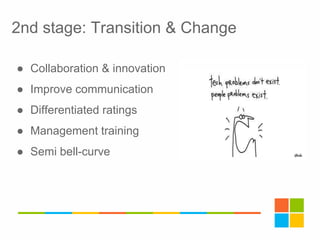
● Collaboration & innovation
● Improve communication
● Differentiated ratings
● Management training
● Semi bell-curve
2nd stage: Transition & Change
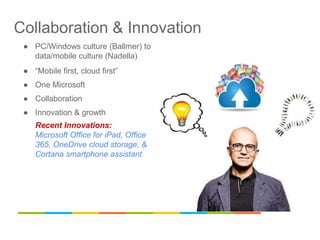
Collaboration & Innovation
● PC/Windows culture (Ballmer) to
data/mobile culture (Nadella)
● “Mobile first, cloud first”
● One Microsoft
● Collaboration
● Innovation & growth
Recent Innovations:
Microsoft Office for iPad, Office
365, OneDrive cloud storage, &
Cortana smartphone assistant
Improve Communication
● Increase employee understanding of performance management system,
including feedback & rankings
● Provide employees with clear expectations on rankings and goals
● Initiate dialogue with employees on performance expectations
● Reduce competition within teams
● Set goals with employees for performance
Results: Decreases link between performance evaluations and
turnover. Decisions regarding termination are perceived as being more
fair - resulting in increased trust in management, prosocial behavior,
and organizational loyalty.
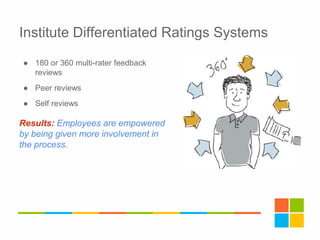
Institute Differentiated Ratings Systems
● 180 or 360 multi-rater feedback
reviews
● Peer reviews
● Self reviews
Results: Employees are empowered
by being given more involvement in
the process.
Create More Robust Evaluation Training
Focus on Manager Training:
● Increase awareness of biases, e.g. halo effect
● Training to judge performance against shared rubric
● Focus on employee strengths
● Develop manager feedback skills
● Use leadership styles, such as trait approach
Results: Leaders become more adept at assessing social dynamics of
situations and navigating challenges.
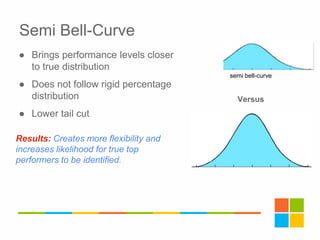
Semi Bell-Curve
● Brings performance levels closer
to true distribution
● Does not follow rigid percentage
distribution
● Lower tail cut
Results: Creates more flexibility and
increases likelihood for true top
performers to be identified.
semi bell-curve
Versus
dfdf
3rd Stage: Refreeze
● Cement cultural changes with more productive and stronger ranking
system
● Expectancy theory - link performance with positive outcomes
● Celebrate innovation through positive reinforcement and rewards
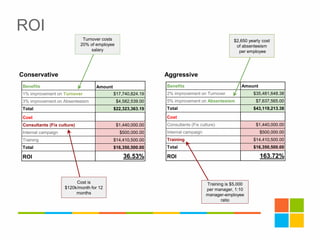
ROI
Conservative Aggressive
Benefits Amount
2% improvement on Turnover $35,481,648.38
5% improvement on Absenteeism $7,637,565.00
Total $43,119,213.38
Cost
Consultants (Fix culture) $1,440,000.00
Internal campaign $500,000.00
Training $14,410,500.00
Total $16,350,500.00
ROI 163.72%
Turnover costs
20% of employee
salary
Cost is
$120k/month for 12
months
Training is $5,000
per manager, 1:10
manager-employee
ratio
$2,650 yearly cost
of absenteeism
per employee
Benefits Amount
1% improvement on Turnover $17,740,824.19
3% improvement on Absenteeism $4,582,539.00
Total $22,323,363.19
Cost
Consultants (Fix culture) $1,440,000.00
Internal campaign $500,000.00
Training $14,410,500.00
Total $16,350,500.00
ROI 36.53%
Concluding Remarks

Performance Management at Microsoft: The Case of Stack Ranking

  • 1.
    Performance Management at TheCase of Stack Ranking
  • 2.
    Rebecca Ackerman Ann Dickson SashaGoluskin Zebulun Lounder Lindsay Mejer Jeet Raut Nisi Zhang
  • 3.
    Introduction to StackRanking Moderate raises Larger raises, promotions Coached or subject to termination Underachieve: 10% Achieve: 70% Exceed: 20%
  • 4.
    Group Exercise Underachieve: 10%Achieve: 70% Exceed: 20%
  • 5.
    Group Exercise 1. Doyou agree with the way your performance was measured? Why or why not? 2. Would you consider using this criteria for determining your participation grade? Why or why not?
  • 6.
    Group Exercise 3. Doesthe reward (candy or your grade) incentivize you to try to work better with your group? Can you come up with a stronger incentive?
  • 7.
    Group Exercise 4. Doyou feel the process was fair? 5. Does everyone deserve an A?
  • 9.
  • 10.
  • 11.
    # of Employees101,914 6,337 40,000 80,300 Net Revenue $77.31B $7.872B $55.52B $170.91B Founded (Year) 1975 2004 1998 1976 Best Place to Work 2014 Glassdoor Not in top 50 #6 #8 #35 Benchmarking
  • 12.
    Positive Outcomes Efficiently identifyhigh and low performers Maximize value of each employee Better allocate resources Reduce labor surplus & error Release under-performing employees Reduce manager leniency in evaluations Increase Performance Higher-value talent pool Increased productivity Open, candid communication Valid performance measures
  • 13.
    Negative Consequences Misuse ofbell-curve Increased competition Low morale Low motivation Reduced innovation Increased lawsuits
  • 14.
    Management System CreatesInternal Division
  • 15.
    Impact at Microsoft Increased bureaucracy Inhibited innovation Unhealthy internal competition Increased resource expenditure Short-termvs. long-term perspective Workers and teams “pitted against one another” Focus on political connections Low morale Sabotage within and between teams Weak link between performance and ranking system Reduced motivation to compete externally Costs outweigh benefits of system
  • 17.
    Innovation Comparison Apple 2 1977 AppleLisa 1983 Macintosh Personal Computer 1984 PowerBook 100 1991 iMac G3 Desktop Computer 1999 iPod 2001 MacBook 2006 iPhone 2007 MacBook Air 2008 iPad 2010 1980 1990 2000 2010 MS-DOS 1.0 1981 Windows 1.0 1983 Office Suite 1989 Internet Explorer 1995 Xbox 2001 Windows Server 2003 Windows Phone 7 2010 Surface Tablet 2012 Zune 2006 2013
  • 18.
    Interviews ● Different teamscollaborate differently ● Segments of stack ranking are still in place ● “Never fulfilled” ● Drives away employees ● New Stack Ranking metric: cross-team collaboration ● Incentive to keep low performers “Visibility is Vital”
  • 19.
    Finding the RightPerformance Management System
  • 20.
  • 21.
    Kurt Lewin’s ChangeModel 1st Stage: Unfreeze 2nd Stage: Transition/Change 3rd Stage: Refreeze
  • 22.
    1st stage: Unfreeze ●Raise managers’ awareness of employee dissatisfaction ● Get employees to recognize the needs for change ● Find ways to motivate employees “The framing for me is all about getting people to commit and engage in an authentic way, and for us to feel that energy as a team” -Satya Nadella, new CEO
  • 23.
    ● Collaboration &innovation ● Improve communication ● Differentiated ratings ● Management training ● Semi bell-curve 2nd stage: Transition & Change
  • 24.
    Collaboration & Innovation ●PC/Windows culture (Ballmer) to data/mobile culture (Nadella) ● “Mobile first, cloud first” ● One Microsoft ● Collaboration ● Innovation & growth Recent Innovations: Microsoft Office for iPad, Office 365, OneDrive cloud storage, & Cortana smartphone assistant
  • 25.
    Improve Communication ● Increaseemployee understanding of performance management system, including feedback & rankings ● Provide employees with clear expectations on rankings and goals ● Initiate dialogue with employees on performance expectations ● Reduce competition within teams ● Set goals with employees for performance Results: Decreases link between performance evaluations and turnover. Decisions regarding termination are perceived as being more fair - resulting in increased trust in management, prosocial behavior, and organizational loyalty.
  • 26.
    Institute Differentiated RatingsSystems ● 180 or 360 multi-rater feedback reviews ● Peer reviews ● Self reviews Results: Employees are empowered by being given more involvement in the process.
  • 27.
    Create More RobustEvaluation Training Focus on Manager Training: ● Increase awareness of biases, e.g. halo effect ● Training to judge performance against shared rubric ● Focus on employee strengths ● Develop manager feedback skills ● Use leadership styles, such as trait approach Results: Leaders become more adept at assessing social dynamics of situations and navigating challenges.
  • 28.
    Semi Bell-Curve ● Bringsperformance levels closer to true distribution ● Does not follow rigid percentage distribution ● Lower tail cut Results: Creates more flexibility and increases likelihood for true top performers to be identified. semi bell-curve Versus dfdf
  • 29.
    3rd Stage: Refreeze ●Cement cultural changes with more productive and stronger ranking system ● Expectancy theory - link performance with positive outcomes ● Celebrate innovation through positive reinforcement and rewards
  • 30.
    ROI Conservative Aggressive Benefits Amount 2%improvement on Turnover $35,481,648.38 5% improvement on Absenteeism $7,637,565.00 Total $43,119,213.38 Cost Consultants (Fix culture) $1,440,000.00 Internal campaign $500,000.00 Training $14,410,500.00 Total $16,350,500.00 ROI 163.72% Turnover costs 20% of employee salary Cost is $120k/month for 12 months Training is $5,000 per manager, 1:10 manager-employee ratio $2,650 yearly cost of absenteeism per employee Benefits Amount 1% improvement on Turnover $17,740,824.19 3% improvement on Absenteeism $4,582,539.00 Total $22,323,363.19 Cost Consultants (Fix culture) $1,440,000.00 Internal campaign $500,000.00 Training $14,410,500.00 Total $16,350,500.00 ROI 36.53%
  • 31.

Editor's Notes

  • #2 Annie Functional Breakout (Worldwide) https://www.microsoft.com/en-us/news/inside_ms.aspx#RevenueHeadcount Engineering: 43,629 Sales & Marketing Support Group: 50,662 Finance, HR & Legal: 4,628 Business Functions: 2,994
  • #4 Annie Microsoft terminology: Underachieve: Demonstrates little potential to advance Achieve: Demonstrates potential at minimum to broaden in one’s role or to advance one’s career stage or level as a leader either as a people manager and/or individual contributor. Past performance suggests capability of delivering consistent and significant contributions over a long term. Competencies typically at expected levels. Exceed: Demonstrates potential to advance faster than average as a leader – either as a People Manager and/or individual contributor – preferably multiple levels or two career stages. Past performance suggests capability of delivering exceptional results over long-term. Competencies typically are at or above expected levels. Image from: http://www.globalnerdy.com/2013/08/26/stack-ranking-observations-from-my-time-at-microsoft/
  • #5 Lindsay How stack ranking applies to group exercise Managers give out candy Ask students to imagine that participation grades were stack ranked according to group: In each group, only 20% of students receive As, 70% receive Bs, and 10% receive Cs or below.
  • #6 Annie Measurement is important We used an imperfect measure of listening, what would you have measured? Why? Have you decided criteria for how you’re going to grade each other? Would you consider using the criteria you just created to determine each of your participation grades?
  • #7 Lindsay Reward and incentives are important Does this reward (your grade) incentivize you to try to work better with your group? Can you come up with a stronger incentive?
  • #8 Annie Fairness of program Did you perceive any procedural injustice? Does everyone deserve an A? If everyone does, its possible your standards are too low. If you feel like your grade was unfair, what measurements would you use to make the evaluation measurements more aligned with performance in this group project? Now we’re going to step back and discuss how this relates to how Microsoft measures performance.
  • #9 Jeet: company background
  • #10 Jeet: Background, explain details of current system
  • #11 Jeet microsoft competes on 2 fronts with its competitors, for both market share and talent. -this helps justify why we chose the 3 companies. who are the most likely to be competitive for talent with Microsoft. While Amazon might be a closer neighbor in Seattle, it has a very different business None do forced stack ranking Foster competitive work Apple, Facebook, and Google Environments that aim to build strong teams Use peer assessments as part of their performance management system Image: http://www.geekwire.com/2012/infographic-seattle-geeks-silicon-valley-geeks/
  • #12 Jeet microsoft info: as of June 2013 https://www.microsoft.com/en-us/news/inside_ms.aspx#RevenueHeadcount facebook: Ranking from Glassdoor: http://www.glassdoor.com/Best-Places-to-Work-LST_KQ0,19.htm Microsoft Employee Breakdown: Engineering: 43,629 Sales & Marketing Support Group: 50,662 Finance, HR & Legal: 4,628 Business Functions: 2,994
  • #13 Sasha http://www.forbes.com/sites/robertsher/2012/07/10/the-case-for-stack-ranking-of-employees/ The benefits arise from the company’s ability to clearly identify high- from low-potential employees, empowering leaders to direct resources to high-performers and replace low-performers or reduce the workforce by releasing them. Through these efforts, the company can reduce expenses associated with poorly allocated benefits or labor surplus and maximize the value of each employee
  • #14 Sasha small sample size cant be expected to be bell curve, the competition is destructive, low morale as a result of demotivating tactics for high performers, reduced innovation as a result of lowered risk taking, increased lawsuits as a result of discriminatory rankings/subjective nature of rank
  • #15 (Picture is already linked to start at 00:36) http://youtu.be/bQ0SgT1uKog: Minute 00:36-01:20 https://www.youtube.com/watch?v=fhbgfDXq_hI
  • #16 sasha Motivated by salary, bonuses, benefits, promotions, not OCBs 1. Increased Bureaucracy: The system spawned a cumbersome bureaucracy that consumed additional administrative and managerial time and resources Significant expenditure of resources: Employees were ranked not within their individual teams, but within larger Microsoft groups. Therefore, managers spent a significant amount of time and resources first determining employees’ ranking within their team, and then haggling with other managers to determine the ranking of individual employees within their entire group. Focus on creating political connections: Encouraged employees to loop managers from their broader group into sometimes irrelevant conversations with the goal of increasing their visibility and achieving a higher ranking Resulted in weak connection between performance and ranking 2. Unhealthy internal competition Employees describe an environment in which workers and teams were pitted against one another, in some cases leading to intentional sabotage within or between teams 3. Inhibited innovation Employees say they avoided working with other high-potential employees in order to maintain a higher ranking on a lower-performing team, reducing the opportunity for creativity and innovation across the company Six-month evaluation period limited employees’ perspective of performance, encouraging them to focus on short-term, individualistic gains rather than long-term gains for the company
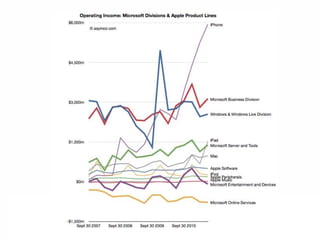
  • #17 Sasha http://www.asymco.com/2011/10/02/ios-vs-microsoft-comparing-the-bottom-lines/ What’s important to highlight here is: 1. How Microsoft’s only growing businesses are enterprise-related (Business Division and Server Tools). 2. The main areas of innovation, in terms of regaining market share from competitors, is in the Online Services and Entertainment and Devices divisions, which are on a downward trend and underperforming compared to Apple. This highlights Microsoft’s difficulty competing externally in these areas. 3. All of Microsoft’s divisions are pretty volatile, especially compared to Apple’s.
  • #18 Sasha Demonstrates how Microsoft is lagging in innovation -- instead of creating ground-breaking products, Microsoft is simply reacting to the innovations of its competitors, and doing so years later. http://wallstcheatsheet.com/investing/apples-product-timeline-the-best-of-the-best.html/?a=viewall http://inventors.about.com/od/CorporateProfiles/a/Timeline-Of-Microsoft-Corporation.htm
  • #19 5 buckets/tiers for rankings, hard percentages per bucket/tier, on a bell curve developers rate others in hierarchical rank one above and below, every 2 increases in paygrade = title change manager didn’t allow feedback on immediate team to prevent backlash tier 5 are never fired, much more expensive to hire and retrain them to give more training bing, azure teams really busy/bad work-life balance, legacy Windows products are easy/good work-life balance formerly biannual checkin/review, now "connect", managers are supposed to check in more often to give more regular feedback, but they don't Stack ranking improves org. over time, though intimidating, demotivational , never fulfuilled see rank when you get a title changed Visibility- big decision maker Keep low performers New pillar, cross team collaboration Left because unhappy with review
  • #20 Rebecca How can you leverage performance management system to enable your company to reach its full potential? How do you feel the process could have improved your motivation? Do you feel we could have done something better to increase your performance? Performance Management system is the backbone to how human capital is managed. Image from: https://www.tbs-sct.gc.ca/tou/pmc-dgr/images/pmpg-mpgr07-eng.jpg
  • #21 Solutions: Rebecca & NIsi Stack ranking stunted the company's potential for growth, employee satisfaction, innovation, and competitive advantage on major technology trends. In order to regain a competitive edge and create a positive environment, Microsoft needs to redefine its culture and link it to a performance management system that will support its goals.
  • #22 We propose utilizing Kurt Lewin's Change Model, that frames the change process in three stages - unfreeze, transition, refreeze in order to transform revitalize Microsoft’s culture into one of even stronger innovation and collaboration (Kreitner and Kinicki, 2013).
  • #23 Dissatisfaction with the current system leads to "unfreeze" stage Status quo is challenged and the leadership needs to acknowledge the current downfalls of the system and propose new changes. In this instance, the management team needs to become aware of employee dissatisfaction with the ranking system and make it their goal to restore employee motivation and dedication to their work. Microsoft’s new CEO, Satya Nadella conveyed his belief in motivating employees as a way to drive change, saying “The framing for me is all about getting people to commit and engage in an authentic way, and for us to feel that energy as a team” (Bryant, 2014). The whole system needs to be reevaluated in order for the culture change to be successful have to create the buy-in for change - change can happen
  • #24 The second phase of the model, known as the transition phase, is the point at which significant change needs to occur (Kreitner and Kinicki, 2013).
  • #25 Solutions: Rebecca & NIsi CEO Steve Ballmer focus was PCs and Windows Nadella’s focus on turning Microsoft into a data driven culture “mobile first, cloud first” This shift signifies Microsoft’s recognition that it needs to respond to changes in technology trends in order to remain competitive Nadella stresses the need for embracing innovation and growth Recent product developments and releases have proven this pursuit for innovation Ex: Microsoft Office for iPad, Office 365, OneDrive cloud storage, and Cortana, a personal phone-based assistant The move toward innovation and collaboration should be reinforced through the company’s performance management system In order to support Microsoft’s changing culture, stack ranking should be modified to align with company values
  • #26 Solutions: Rebecca & NIsi Managers should make expectations clear Should explain how stack ranking system works and what type of rubric measurement is being used This includes the role of feedback and weight of low rankings in career development Employee strengths should be studied and weaknesses identified as areas for improvement, solidifying the link between evaluation and compensation and creating dialogue around team performance expectations Managers shold set goals with employees Rankings can also be expanded to incorporate 360-degree feedback Deemphasize the association between performance evaluations and lay-offs so employees can focus on fixing their performance areas rather than their employment status Communication between top management and employees needs to be clear and transparent so that any decisions regarding termination will be seen as fair Perceived fairness will increase trust in management, prosocial behavior, and loyalty to the organization, all important components for creating a unified culture Helping employees understand such decisions will also shift the primary use of stack ranking, decreasing the link between performance evaluations and turnover
  • #27 Solutions: Rebecca & NIsi
  • #28 Solutions: Rebecca & NIsi Management training essential in performance review systems shared rubric - makes it more standardized Implement training that will assist the management team in aligning the ranking system with the company culture and values Focus on leadership management training to revamp its culture from the top down For instance, Microsoft could design trainings based on leadership theory such as the trait approach, which focuses on traits effective leaders demonstrate This would educate leaders on how to assess the social dynamics of a particular situation and navigate challenges, such as a conversation with an employee concerning low ranking Managers should be made aware of natural biases, such as the halo effect, and be trained to judge employees on a behavior-based rubric.
  • #29 Solutions: Rebecca & NIsi As an alternative to a traditional bell-curve, a semi-bell curve can bring performance levels closer to their true distribution Aas rigidity at the top and bottom of the curve is lowered to create more flexibility More likely to identify true top performers There are clear benefits in maintaining a degree of pressure that motivates employees to increase performance, however when the pressure gets too high, employees lose motivation This is particularly salient in companies that have a large pool of effective workers, causing high performers to be ranked as mediocre due to redistribution within the bell curve Therefore, it is important to strike a delicate balance between maintaining an appropriate degree of pressure while simultaneously preventing lowered morale Image taken from: Manu Cornet (cc)
  • #30 Solutions: Rebecca & NIsi
  • #32 Annie/Lindsay Group exercise Microsoft performance management Benchmarking Relevant research Stack ranking at Microsoft Solutions ROI Microsoft provide us the opportunity to better understand the controversial topic of stack ranking by trying to balance the positive possibilities it offers for assessing an organization’s talent with the potentially detrimental side effects it can have on that organization’s culture.