Introduction to Human Resource
Management
Rupan Chakaravarthi
Trainer
1
EMAIL ID:rupan104@gmail.com
WHAT’S APP NO:9941566911
Human Resources
ď‚— HR is the total knowledge, skills, creative abilities,
talentsand aptitudesof an organisationÇŻs workforceas
well as the values, attitudes and beliefs of the
individuals involved
2
What is Human Resource
Management (HRM)?
ď‚— Human resource management is the effective use
of human resources in order to enhance
organizational performance
ď‚— HRM is the art of procuring, developing and
maintaining competent workforce to achieve goals
of an organisation in an effective and efficient
manner
3
Evolution of HRM Concept
 Labour / Manpower – denotes physical abilities &
capacities of employees – commodity - wages based on
demand & supply
 Personnel – persons employed in service – employees
as a whole
ď‚— HR- denotes resources of all the people who contribute
their services to the attainment of organisational goals
4
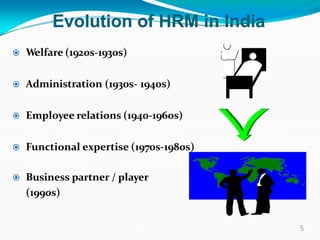
Evolution of HRM in India
 Welfare (1920s-1930s)
 Administration (1930s- 1940s)
 Employee relations (1940-1960s)
 Functional expertise (1970s-1980s)
 Business partner / player
(1990s)
5
Importance of HRM
 HR – most important resource
ď‚— Put other resources to proper use
ď‚— Help transform lifeless factors of production into
useful products
 Capable of enlargement – produce extraordinary
things when inspired
ď‚— Can help organisation achieve results quickly,
efficiently & effectively
6
Objectives of HRM
ď‚— Maximize the return on investment from the
organization's human capital and minimize
financial risk
ď‚— To align the capabilities and behaviors of
employees with the short-term and long-term
goals of the organisation
7
Objectives of HRM
 Societal objectives
To be ethically & socially responsible to the needs of the
society while minimizing the negative impact of such
demands upon the organization
 Organizational objectives
To recognize the role of HRM in bringing about
organizational effectiveness
 Functional objectives
To maintain the departmentÇŻscontributionata level
appropriate to the organizationÇŻs needs
 Personal objectives
To assist employees in achieving their personal goals in a
manner that their personal goalsenhance the individualÇŻs
contribution to the organization 8
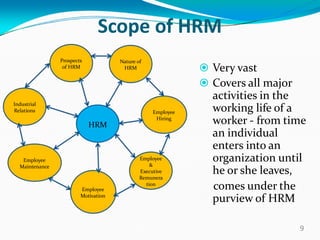
Scope of HRM
 Very vast
 Covers all major
activities in the
working life of a
worker - from time
an individual
enters into an
organization until
he or she leaves,
comes under the
purview of HRM
Prospects
of HRM
HRM
Nature of
HRM
Industrial
Relations
Employee
Maintenance
Employee
Hiring
Employee
&
Executive
Remunera
tion
Employee
Motivation
9
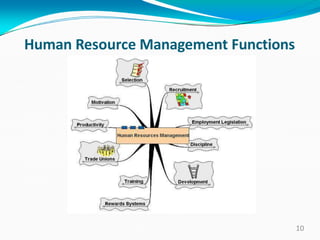
Human Resource Management Functions
10
Recruitment
11
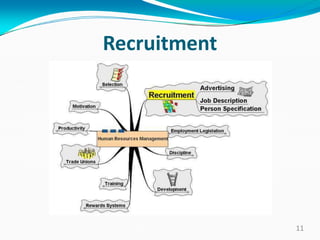
Recruitment
ď‚— The process by which a job vacancy
is identified and potential employees are notified
ď‚— The nature of the recruitment process
is regulated and subject to employment law
ď‚— Main forms of recruitment: through advertising in
newspapers, magazines, trade papers and internal
vacancy lists, company websites
12
Recruitment
 Job description – outline of the role of the job
holder
 Person specification – outline of the skills and
qualities required of the post holder
ď‚— Applicants may demonstrate their suitability
through application form, letter or curriculum
vitae (CV)
13
Selection
14
Selection
ď‚— The process of assessing candidates and appointing a
post holder
 Applicants short listed – most suitable candidates
selected
 Selection process – varies according to organisation
15
Selection
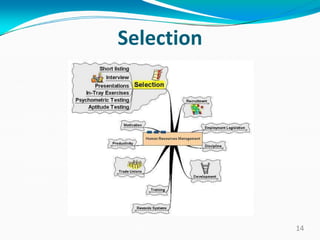
 Interview – most common method
 Psychometric testing – assessing the personality of the
applicants – will they fit in?
 Aptitude testing – assessing the skills of applicants
 In-tray exercise – activity based around what the applicant
will be doing, e.g. writing a letter to a disgruntled customer
 Presentation – looking for different skills as well as the
ideas of the candidate
16
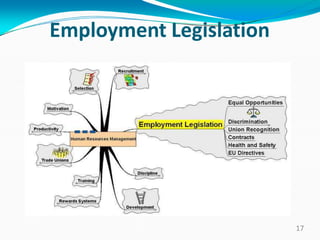
Employment Legislation
17
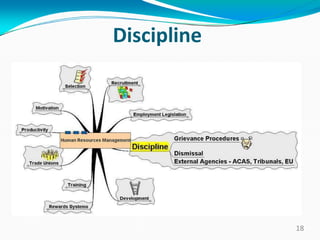
Discipline
18
Discipline
 Firms cannot just Ǯsackǯworkers
ď‚— Wide range of procedures and steps in dealing
with workplace conflict
ď‚— Informal meetings
ď‚— Formal meetings
ď‚— Verbal warnings
ď‚— Written warnings
ď‚— Grievance procedures
ď‚— Working with external agencies
19
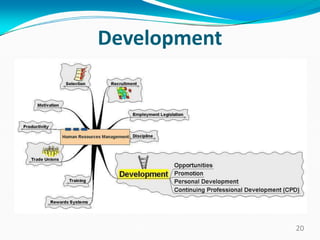
Development
20
Development
ď‚— Developing the employee can be regarded as investing
in a valuable asset
ď‚— A source of motivation
ď‚— A source of helping the employee fulfil potential
21
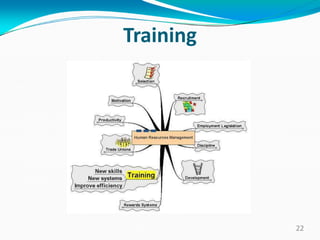
Training
22
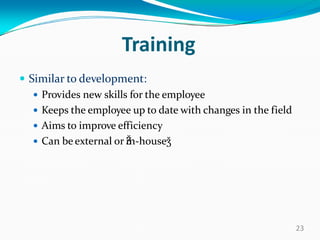
Training
ď‚— Similar to development:
ď‚— Provides new skills for the employee
ď‚— Keeps the employee up to date with changes in the field
ď‚— Aims to improve efficiency
 Can be external or Ǯin-houseǯ
23
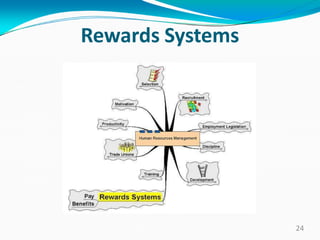
Rewards Systems
24
Rewards Systems
ď‚— The system of pay and benefits used by the firm to
reward workers
ď‚— Money not the only method
ď‚— Fringe benefits
ď‚— Flexibility at work
ď‚— Holidays, etc.
25
Trade Unions
26
Trade Unions
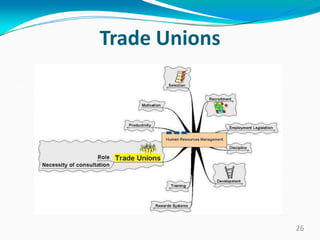
ď‚— Importance of building relationships with
employee representatives
ď‚— Role of Trade Unions has changed
ď‚— Importance of consultation and negotiation and
working with trade unions
ď‚— Contributes to smooth change management and
leadership
27
Productivity
28
Productivity
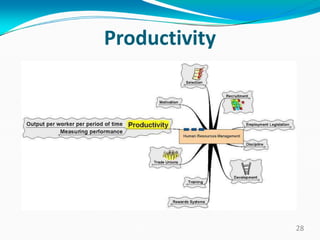
ď‚— Measuring performance:
ď‚— How to value the workers contribution
ď‚— Difficulty in measuring some types of output especially
in the service industry
ď‚— Appraisal
ď‚— Meant to be non-judgmental
ď‚— Involves the worker and a nominated appraiser
ď‚— Agreeing strengths, weaknesses and ways forward to help both
employee and organisation
29
Motivation
ď‚— Motivating employees to perform up to their potential
is the key to maintaining a productive, successful
business
 Ways in which you can motivate employees –
ď‚— Interact - Talk to your employees regularly
ď‚— Recognition & Appreciation - A job well done should be
appreciated and encouraged
ď‚— Pay them Right - Pay employees for what they are worth
and they will be happy to work.
ď‚— New challenges - Give employees new and interesting
challenges to keep them stimulated and learning
30
THANK YOU
EMAIL ID:rupan104@gmail.com
WHAT’S APP NO:9941566911
31

Human resource management

  • 1.
    Introduction to HumanResource Management Rupan Chakaravarthi Trainer 1 EMAIL ID:rupan104@gmail.com WHAT’S APP NO:9941566911
  • 2.
    Human Resources ď‚— HRis the total knowledge, skills, creative abilities, talentsand aptitudesof an organisationÇŻs workforceas well as the values, attitudes and beliefs of the individuals involved 2
  • 3.
    What is HumanResource Management (HRM)? ď‚— Human resource management is the effective use of human resources in order to enhance organizational performance ď‚— HRM is the art of procuring, developing and maintaining competent workforce to achieve goals of an organisation in an effective and efficient manner 3
  • 4.
    Evolution of HRMConcept  Labour / Manpower – denotes physical abilities & capacities of employees – commodity - wages based on demand & supply  Personnel – persons employed in service – employees as a whole  HR- denotes resources of all the people who contribute their services to the attainment of organisational goals 4
  • 5.
    Evolution of HRMin India  Welfare (1920s-1930s)  Administration (1930s- 1940s)  Employee relations (1940-1960s)  Functional expertise (1970s-1980s)  Business partner / player (1990s) 5
  • 6.
    Importance of HRM HR – most important resource  Put other resources to proper use  Help transform lifeless factors of production into useful products  Capable of enlargement – produce extraordinary things when inspired  Can help organisation achieve results quickly, efficiently & effectively 6
  • 7.
    Objectives of HRM ď‚—Maximize the return on investment from the organization's human capital and minimize financial risk ď‚— To align the capabilities and behaviors of employees with the short-term and long-term goals of the organisation 7
  • 8.
    Objectives of HRM Societal objectives To be ethically & socially responsible to the needs of the society while minimizing the negative impact of such demands upon the organization  Organizational objectives To recognize the role of HRM in bringing about organizational effectiveness  Functional objectives To maintain the departmentǯscontributionata level appropriate to the organizationǯs needs  Personal objectives To assist employees in achieving their personal goals in a manner that their personal goalsenhance the individualǯs contribution to the organization 8
  • 9.
    Scope of HRM Very vast  Covers all major activities in the working life of a worker - from time an individual enters into an organization until he or she leaves, comes under the purview of HRM Prospects of HRM HRM Nature of HRM Industrial Relations Employee Maintenance Employee Hiring Employee & Executive Remunera tion Employee Motivation 9
  • 10.
  • 11.
  • 12.
    Recruitment ď‚— The processby which a job vacancy is identified and potential employees are notified ď‚— The nature of the recruitment process is regulated and subject to employment law ď‚— Main forms of recruitment: through advertising in newspapers, magazines, trade papers and internal vacancy lists, company websites 12
  • 13.
    Recruitment  Job description– outline of the role of the job holder  Person specification – outline of the skills and qualities required of the post holder  Applicants may demonstrate their suitability through application form, letter or curriculum vitae (CV) 13
  • 14.
  • 15.
    Selection  The processof assessing candidates and appointing a post holder  Applicants short listed – most suitable candidates selected  Selection process – varies according to organisation 15
  • 16.
    Selection  Interview –most common method  Psychometric testing – assessing the personality of the applicants – will they fit in?  Aptitude testing – assessing the skills of applicants  In-tray exercise – activity based around what the applicant will be doing, e.g. writing a letter to a disgruntled customer  Presentation – looking for different skills as well as the ideas of the candidate 16
  • 17.
  • 18.
  • 19.
    Discipline  Firms cannotjust Ǯsackǯworkers  Wide range of procedures and steps in dealing with workplace conflict  Informal meetings  Formal meetings  Verbal warnings  Written warnings  Grievance procedures  Working with external agencies 19
  • 20.
  • 21.
    Development ď‚— Developing theemployee can be regarded as investing in a valuable asset ď‚— A source of motivation ď‚— A source of helping the employee fulfil potential 21
  • 22.
  • 23.
    Training  Similar todevelopment:  Provides new skills for the employee  Keeps the employee up to date with changes in the field  Aims to improve efficiency  Can be external or Ǯin-houseǯ 23
  • 24.
  • 25.
    Rewards Systems ď‚— Thesystem of pay and benefits used by the firm to reward workers ď‚— Money not the only method ď‚— Fringe benefits ď‚— Flexibility at work ď‚— Holidays, etc. 25
  • 26.
  • 27.
    Trade Unions ď‚— Importanceof building relationships with employee representatives ď‚— Role of Trade Unions has changed ď‚— Importance of consultation and negotiation and working with trade unions ď‚— Contributes to smooth change management and leadership 27
  • 28.
  • 29.
    Productivity ď‚— Measuring performance: ď‚—How to value the workers contribution ď‚— Difficulty in measuring some types of output especially in the service industry ď‚— Appraisal ď‚— Meant to be non-judgmental ď‚— Involves the worker and a nominated appraiser ď‚— Agreeing strengths, weaknesses and ways forward to help both employee and organisation 29
  • 30.
    Motivation  Motivating employeesto perform up to their potential is the key to maintaining a productive, successful business  Ways in which you can motivate employees –  Interact - Talk to your employees regularly  Recognition & Appreciation - A job well done should be appreciated and encouraged  Pay them Right - Pay employees for what they are worth and they will be happy to work.  New challenges - Give employees new and interesting challenges to keep them stimulated and learning 30
  • 31.