⊹ Human resourcemanagement is
concerned with how efficiently the human
resources are put to work and effectively
utilized so that employees contribute to
their fullest extent towards
attainment of organizational objectives.
⊹ It is the process of acquiring, training,
appraising, and compensating employees,
and of attending to their labour relations,
health and safety, and fairness concerns.
2
3.
definitions
Edwin Flippo
Human ResourceManagement as “planning, organizing, directing,
controlling of procurement, development, compensation, integration ,
maintenance and separation of human resources to the end that
individual, organizational and social objectives are achieved.”
The National Institute of Personal Management
(NIPM) of India has defined human resources – personal management as
“that part of management which is concerned with people at work and
with their relationship within an enterprise. Its aim is to bring together and
develop into an effective organization of the men and women who make
up enterprise and having regard for the well – being of the individuals and
of working groups, to enable them to make their best contribution to its
success”.
3
4.
nature
A Managerial Process
•Human resource management is an important aspect of
management that involves planning, organising, directing,
staffing and controlling of human resources so as to achieve
organisational success.
• Human resource management is “the art of getting things done
by others”.
• Human resource management is concerned with how efficiently
the human resources are put to work and effectively utilized so
that employees contribute to their fullest extent towards
attainment of organizational objectives.
Forward Looking
• HRM attempts to assess the future human resource requirement
and assures availability of required work force at right place and
right time.
• It focuses on improving the potential of the existing workforce
through motivation, training and development to meet the
4
5.
Mixture of Artand Science
• It is art because it deals with the qualitative aspect like skill, knowledge,
talent and creativity of the work force and aims at nurturing and
developing the quality of the work force.
• It is an art of engaging the best person at work and managing the
personnel to bring out the best performance.
• It is the art of maintaining cordial relationship with the employees and
motivating them to contribute their best towards achievement of
organisational objectives.
• Human resource management requires the art of understanding the
behavioural science of employees.
• It is a science as different scientific techniques are applied for
recruitment, selection, training and development and appraisal and
motivation of the workforce.
All Pervasive
• It is needed in all kinds of organizations. Human resource management is
needed in different functional areas of management like production,
marketing, finance.
• It has immense significance in handling workforce at all level-top, middle
and lower level and all categories of employees-skilled, unskilled,
technical, professional, clerical and managerial.
5
6.
Continuous Process
• HRMinvolves a series of activities, beginning with identifying the work
force requirement, to recruitment and selection, training, performance
appraisal.
• HRM is a never-ending process as analysis of present human resource
position and forecasting the future requirement and analysis of
performance of the work force and other related activities are carried
out on a continuous basis.
Key to Organisational Success
• The growth, survival and development of the organization, its
profitability, productivity, innovativeness largely depends upon the
quality of the work force and how efficiently the work force is put to
work and managed efficiently.
Utilization of Human Capital
• HRM is concerned with effective utilization of human capital. Effective
utilization means employing the human resource in such a manner so
as to maximize productivity and return.
• The quality of human resources may be modified by motivation,
training, education and development.
• Effective utilization of human resource will lead to optimum utilization
of all other resources. 6
7.
Management of Individuals
•Human resource management deals with management of every individual
working in the organisation.
• People work as individuals and in groups in the organization.
• HRM recognizes individuality and individual differences and manages
people with differing characteristics.
Dynamic
• Every individual working in an organisation possesses different and distinct
physiological, psychological, sociological and ethical qualities.
• Furthermore their quality, behaviour is not static. Hence managing of
human resource is a complex activity and “one size fits all” plans and
strategies related to managing human resources is not applicable.
Integration of Individual and Organizational Objectives
• Human resource management integrates the individual and organisational
objectives.
• All human resource plans, objectives and activities are in accordance with
the organisational objectives and policies.
• HRM matches the available work force with the organizational requirement
and helps in achieving success.
• It tries to build and maintain harmonious and cordial relations between
7
Human Resource
Planning (HRP)
•It is the first step of human resource management.
• HRP is a process through which the company makes an
assessment of the present manpower-the number of
people employed, number of post vacant, whether there
is excess or shortage of staff and prepares plans and
policies to deal with them accordingly.
• It also estimates the future man power requirement.
• It matches the supply and availability of manpower with
the company’s purpose and makes the best person
available for the job.
9
10.
Job Analysis
• Jobanalysis provides a detailed picture of the nature of
job, the skill and abilities required to perform the job, the
duties and responsibilities of the worker required for the
job.
• Job Analysis provides the basis for recruitment, training
and development of staff.
• Every job is analysed to identify the inherent
requirement of the job – “what the job demands of a
worker.
• This helps in the process of recruitment and selection, to
appoint the appropriate person for the job and also
facilitates arranging training and development
programme for the employees to match their skill and
abilities with the job requirement.
10
11.
JOB EVALUATION
• Itforms the basis of wage and salary determination.
• Different jobs are compared and evaluated to
determine the relative importance of different jobs
within the organization.
• The jobs are compared, graded and ranked.
• Job evaluation determines how much pay to be affixed
to the particular job on the basis of their importance in
the organisation functioning.
• This helps to determine a fair wage and salary and to
determine a rational pay structure.
11
12.
Recruitment and
Selection
• Thecompany on the basis of human resource planning
and job analysis identifies the requirement of personnel
and explores different internal and external sources
from where manpower can be acquired. This process is
called recruitment. The right person is selected and put
to work.
• The selection process involves steps like receiving
applications, tests, interviews, medical examination and
final selection. Right selection and placement provides
employee satisfaction which improves their productivity
and efficiency and benefits the organization.
12
13.
Performance Appraisal
• Itis a systematic method of evaluating the performance
of employees.
• This helps to assess the efficiency, strength and weakness
of the employees.
• It is a controlling process whereby the employees’
performance is matched with the standard level of
performance and remedial measures taken in case actual
performance does not meet the standard.
• It helps the management in their decision-making
relating to promotion, pay hike that may be rewarded if
the employee meets standard or outperforms the
standard.
• It also helps the management to decide about the
training and development needs for employees, who
needs up gradation and development of skill.
13
14.
Training and
Development
• Humanresource management is concerned with arrangement
of training and development programme for the newly
appointed staff as well as for existing employees.
• This helps to enhance the qualitative and quantitative
performance of the work force.
• Training helps the employees to cope up with the changing
technological and other internal and external work situations.
• Training and development make employees excel in their
present post as well as make them competent for future higher
job responsibilities.
14
15.
Employee Compensation
• Humanresource management performs the function of
determining the pay structure for different employees
on the basis of qualification, efficiency, experience,
nature of the job.
• It also determines rewards and incentives to be paid for
their contribution towards the organisation.
15
16.
Employee Motivation
• Motivationof employees is essential for retention and
sustenance of employees within the organisation.
• Motivation plays an important role in management of
personnel.
• It helps to improve productivity of personnel. There are
different ways by which employees may be encouraged.
• Recognition and reward for performance, promotion, pay-
hike, and other monetary and non-monetary rewards
motivate the employees.
16
17.
Employee Welfare
• Humanresource management focuses on the welfare of
employees by providing canteen facilities, creches, rest
and lunch rooms, housing, transport, medical assistance,
education, health and safety, medical care, sickness
benefits, recreation facilities.
• It aims at improving the quality of work life by providing
a better environment worth working, job security,
flexible working hours, eliminating workplace hazards,
which will have a positive impact on the productivity and
quality of work.
• Along with monetary benefits provided to employees
these non-monetary benefits improves the morale of the
employees and motivates them.
17
18.
Industrial Relation
• Labourunrest, conflicts between the work groups and
between workers and management over issues like low
wage, bad work environment are common problems that
must be handled carefully by establishing a balance between
the worker’s interest and interest of the organisation and
management.
• Human resource management considers establishment and
maintenance of harmonious and cordial relation between
employer and employees.
• This is achieved through careful interactions with labour or
employee unions, addressing their grievances and settling
the disputes effectively through negotiation, joint
consultation, collective bargaining, in order to maintain
peace and harmony in the organization.
18
19.
Objectives
To help theorganization achieve its goals
• HRM is the means to assist the organization to achieve its
goals.
• It ensures effective utilization of Human Resources which in
turn results in the efficient utilization of all the other
organizational resources.
To employ a skilled workforce and focus on their training
and development:
• HRM aims at employing the skills and abilities of the
workforce efficiently.
• It generates maximum development of Human Resources
within the organization by offering opportunities for growth
to employees through training and development.
19
20.
⊹ To ensureemployee job satisfaction and
maintain a quality of work-life
• HRM focuses on fulfilling the personal objectives of
the employees which helps in enhancing their
contribution to the organization.
• Their objective is to ensure respect for human
beings by providing various services and welfare
facilities to the personnel.
⊹ Societal Objective
• HRM must ensure that there is compliance with the
legal and ethical standards of the society at each
level and function of the organization.
• It implies that organizations manage human
resources in an ethical and socially responsible
manner. 20
To maintain qualityof
work life
• Quality of work life is the perception of
employees regarding the relationship
between working condition with
management.
• Simply, it is the relationship between
employees and total work environment.
• Quality of work life is concerned with the
employee’s perception of physical as well as
psychological wellbeing at workplace and it
can be obtained by maintaining work
autonomy, work freedom, job recognition,
belongingness, rewards, etc.
22
23.
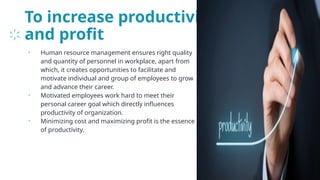
To increase productivity
andprofit
• Human resource management ensures right quality
and quantity of personnel in workplace, apart from
which, it creates opportunities to facilitate and
motivate individual and group of employees to grow
and advance their career.
• Motivated employees work hard to meet their
personal career goal which directly influences
productivity of organization.
• Minimizing cost and maximizing profit is the essence
of productivity.
23
24.
To produce employees
whoare easily
adaptable to change
• Human resource management performs various
functions, among which training and development
of employees is one of the vital ones.
• Training and development programs keep
employees updated with skills necessary to adjust
with alteration of organization’s environment,
structure and technology.
24
25.
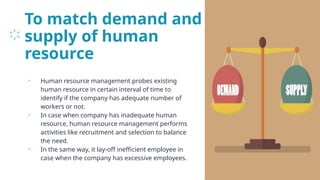
To match demandand
supply of human
resource
• Human resource management probes existing
human resource in certain interval of time to
identify if the company has adequate number of
workers or not.
• In case when company has inadequate human
resource, human resource management performs
activities like recruitment and selection to balance
the need.
• In the same way, it lay-off inefficient employee in
case when the company has excessive employees.
25
26.
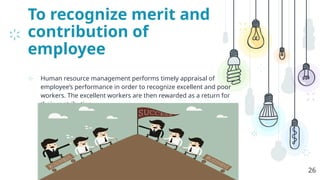
To recognize meritand
contribution of
employee
⊹ Human resource management performs timely appraisal of
employee’s performance in order to recognize excellent and poor
workers. The excellent workers are then rewarded as a return for
their contribution.
26
27.
To retain
employees and
motivatethem to
accomplish
company’s goal
• Utilizing human resource to their fullest and
maintaining them in the company for a long
term is a major function of human resource
management.
• Under this function, HRM performs tasks like
providing fringe benefits, compensation and
rewards to the deserving employees.
• These activities do not only help in retaining
employees in the company but also in
achieving organization’s goal effectively.
27
28.
To resolve conflicts
⊹In any company, either
big or small, conflicts may
arise between any
parties/group. Conflicts
are inevitable and they
should not be ignored.
Human resource
management acts as a
consultant to sort out
such conflicts timely and
conduct other
organizational activities
smoothly.
28
29.
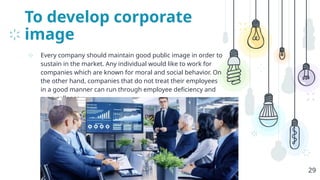
To develop corporate
image
⊹Every company should maintain good public image in order to
sustain in the market. Any individual would like to work for
companies which are known for moral and social behavior. On
the other hand, companies that do not treat their employees
in a good manner can run through employee deficiency and
even collapse.
29
31
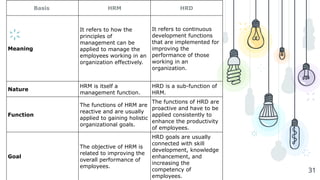
Basis HRM HRD
Meaning
Itrefers to how the
principles of
management can be
applied to manage the
employees working in an
organization effectively.
It refers to continuous
development functions
that are implemented for
improving the
performance of those
working in an
organization.
Nature
HRM is itself a
management function.
HRD is a sub-function of
HRM.
Function
The functions of HRM are
reactive and are usually
applied to gaining holistic
organizational goals.
The functions of HRD are
proactive and have to be
applied consistently to
enhance the productivity
of employees.
Goal
The objective of HRM is
related to improving the
overall performance of
employees.
HRD goals are usually
connected with skill
development, knowledge
enhancement, and
increasing the
competency of
employees.
32.
32
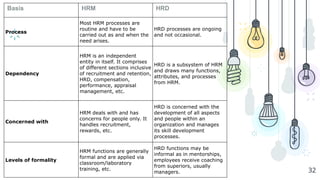
Basis HRM HRD
Process
MostHRM processes are
routine and have to be
carried out as and when the
need arises.
HRD processes are ongoing
and not occasional.
Dependency
HRM is an independent
entity in itself. It comprises
of different sections inclusive
of recruitment and retention,
HRD, compensation,
performance, appraisal
management, etc.
HRD is a subsystem of HRM
and draws many functions,
attributes, and processes
from HRM.
Concerned with
HRM deals with and has
concerns for people only. It
handles recruitment,
rewards, etc.
HRD is concerned with the
development of all aspects
and people within an
organization and manages
its skill development
processes.
Levels of formality
HRM functions are generally
formal and are applied via
classroom/laboratory
training, etc.
HRD functions may be
informal as in mentorships,
employees receive coaching
from superiors, usually
managers.
Case study
Kalyan InternationalHospitals Ltd. entered a foreign country with
a high quality and low price strategy
(due to low salary cost).
The company invested heavily in the state of the art medical
technology and equipment.
The company started commercial operations and failed to provide
even minimally acceptable quality services. Hence, it failed to attract
patients.
The enquiry into the issue revealed that the doctors do not have the
required skills in critical areas to provide high quality treatment?
34
35.
analysis
⊹ Company’s strategyshould be formulated
by considering HR aspects and the HR
should be managed on the basis of
company’s strategies.
⊹ Moreover, the vital aspect in strategic
management is HRM.
35
36.
strategy
⊹ A strategyis a unified course of action
to achieve the goal.
⊹ Henry Mintzberg
⊹ Strategy is a pattern in a stream of
decisions and actions.
⊹ The pattern of decisions is aimed at
achieving the goals and objectives of a
company/organization.
36
37.
Strategic human resourcemanagement is
defined as ‘the linking of human resources
with strategic goals and objectives in order
to improve business performance and
develop innovative organizational culture
that foster innovation and flexibility.
37
38.
DEFINITIONS
⊹ “Strategic humanresource management means formulating and
executing human resource policies and practices that produce the
employee competencies and behaviours that the company needs to
achieve its strategic aims.”- Gary Dessler.
⊹ “Strategic human resource management is an approach to making
decisions on the intentions and plans of the organization concerning
the employment relationship and the organization’s recruitment,
training, development, performance management, and the
organization’s strategies, policies, and practices.” – Armstrong.
⊹ Strategic human resource management (SHRM) is defined as “the
pattern of planned human resource deployments and activities
intended to enable an organization to achieve its goals.” – Wright &
McMahan. 38
39.
Inferences from the
definitions
⊹Components of SHRM
• It focuses on an organization’s human resources (people) as
the primary source of the organization’s competitive
advantage.
• The activities highlight the HR programs, policies, and
practices as the means through which the organization’s
people can be deployed to gain a competitive advantage.
• The pattern and plan imply a fit between HR strategy and the
organization’s business strategy (vertical fit) and between all
HR activities (horizontal fit).
• The people, practices, and planned patterns are all
purposeful, directed towards the achievement of the
organization’s goals.
39
40.
The aim ofstrategic hRM
⊹ Advance flexibility innovation, and
competitive advantage.
⊹ Develop a fit for purpose organizational
culture.
⊹ Improve business performance.
40
Recognition of the
outsideEnvironment
Outside environment presents some opportunities and threats to the
organization in the form of-
• Laws
• Economic conditions
• Social and demographic change
• Domestic and international political forces
• Technology and so on.
A strategic human resource strategy explicitly recognizes the threats and
opportunities in each area and attempts to capitalize on the
opportunities while minimizing or deflecting the effect of threats.
42
43.
The impact of
Competition
•The forces of competition in attracting, rewarding, and
using employees have a major effect on corporate human
resource strategy.
• Forces play out in local, regional, and national labour
markets.
• Labour market dynamics of wage rates, unemployment
rates, working conditions, benefits levels minimum wage
legislation, and competition reputation all have an impact
on and are affected by strategic human resource decisions.
43
44.
Long-range Focus
A strategichuman resource
management should be long-range
focus cause this is not easy to change
the strategic human resource policy.
44
45.
Choice and decision-
makingfocus
In other words, the strategy has a problem solving or problem
preventing focus.
The strategy concentrates on the question, “what should the
organization do and why?” This action orientation requires that
decisions be made and carried out.
45
46.
Consideration of all
personnel
Astrategic approach to human resources is concerned with all of
the firm’s employees, not just its hourly or operational personnel.
Traditionally, human resource management focuses on hourly
employees, with most clerical exempt employees also included.
⊹
46
47.
Integration with the
corporatestrategy
Human resource strategy adopted by a
firm should be integrated with the firm’s
corporate strategy.
47
HRM in Personnel
Management
⊹This is typically direct manpower management that involves
manpower planning, hiring (recruitment and selection),
training and development, induction and orientation, transfer,
promotion, compensation, layoff and retrenchment,
employee productivity.
⊹ The overall objective here is to ascertain individual growth,
development and effectiveness which indirectly contribute to
organizational development.
⊹ It also includes performance appraisal, developing new skills,
disbursement of wages, incentives, allowances, traveling
policies and procedures and other related courses of actions.
49
50.
HRM in Industrial
Relations
⊹Since it is a highly sensitive area, it needs careful interactions with labor
or employee unions, addressing their grievances and settling the
disputes effectively in order to maintain peace and harmony in the
organization.
⊹ It is the art and science of understanding the employment (union-
management) relations, joint consultation, disciplinary procedures,
solving problems with mutual efforts, understanding human behavior
and maintaining work relations, collective bargaining and settlement of
disputes.
⊹ The main aim is to safeguarding the interest of employees by securing
the highest level of understanding to the extent that does not leave a
negative impact on organization.
⊹ It is about establishing, growing and promoting industrial democracy to
safeguard the interests of both employees and management.
50
51.
HRM in Employee
Welfare
⊹This particular aspect of HRM deals with working conditions and amenities
at workplace. This includes a wide array of responsibilities and services such
as safety services, health services, welfare funds, social security and medical
services. It also covers appointment of safety officers, making the
environment worth working, eliminating workplace hazards, support by top
management, job safety, safeguarding machinery, cleanliness, proper
ventilation and lighting, sanitation, medical care, sickness benefits,
employment injury benefits, personal injury benefits, maternity benefits,
unemployment benefits and family benefits.
⊹ It also relates to supervision, employee counselling, establishing
harmonious relationships with employees, education and training.
⊹ Employee welfare is about determining employees’ real needs and fulfilling
them with active participation of both management and employees.
⊹ In addition to this, it also takes care of canteen facilities, crèches, rest and
lunch rooms, housing, transport, medical assistance, education, health and
safety, recreation facilities, etc.
51
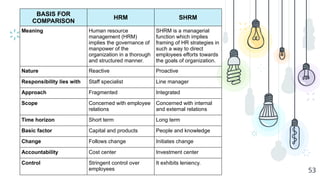
53
BASIS FOR
COMPARISON
HRM SHRM
MeaningHuman resource
management (HRM)
implies the governance of
manpower of the
organization in a thorough
and structured manner.
SHRM is a managerial
function which implies
framing of HR strategies in
such a way to direct
employees efforts towards
the goals of organization.
Nature Reactive Proactive
Responsibility lies with Staff specialist Line manager
Approach Fragmented Integrated
Scope Concerned with employee
relations
Concerned with internal
and external relations
Time horizon Short term Long term
Basic factor Capital and products People and knowledge
Change Follows change Initiates change
Accountability Cost center Investment center
Control Stringent control over
employees
It exhibits leniency.
55
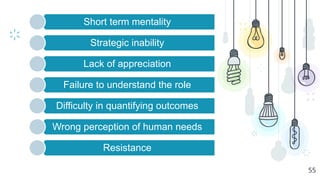
Short term mentality
Strategicinability
Lack of appreciation
Failure to understand the role
Difficulty in quantifying outcomes
Wrong perception of human needs
Resistance
Understand the business
strategyand current
state challenges
• Consider the goals and expected
outcomes for the organization.
• Is the organization pursuing a growth
strategy?
• Or, is it trying to turn around
underperforming business lines?
57
58.
contribute to
organizational growth
andsuccess.
• Seek to understand what you are
asking your workforce to do in
service of the goals.
• What new or different skills,
competencies, and behaviours are
needed?
• What are the best functions and
positions needed to deliver on
these expectations?
58
59.
Design and implementyour
HR talent strategy
• Once you know where the organization is
headed and what it requires of its people
to get there, HR must determine the
gaps between its current workforce and
what is required to accomplish the
organization’s business goals.
• Define strategies needed to acquire,
train, develop, performance manage, and
reward the very high-performing talent
that will carry your organization into the 59
60.
Measure your HRstrategy
Whether you use an HR scorecard or
other metrics, these measures indicate if
your HR talent strategy is successful or
when a course correction is necessary.
60
TQM isthe enhancement to the traditional way of
doing business.
It is a proven technique to guarantee survival in the
world-class competition.
TQM is for the most part common sense.
Analyzing three words (TQM), we have:
Total—Made up of the whole
Quality—Degree of excellence a product or service
provides
Management—Act, art, or manner of handling,
controlling, directing, etc.
Therefore TQM is the art of managing the whole to
achieve the excellence.
63
64.
TQM isdefined as both philosophy and a set of
guiding principles that represents the foundation of a
continuously improving organization.
It is the application of quantitative methods and
human resources to improve all the processes within
an organization and exceed customer needs now and
in future.
TQM integrates fundamental management
techniques, existing improvement efforts, and
technical tools under disciplined approach.
64
65.
⊹ Total qualitymanagement or TQM is a structured
approach to overall organizational management.
⊹ The focus of the process is to improve the quality
of an organization's outputs including goods and
services through the continual improvement of
internal practices.
⊹ Total quality management is a term that was
found in the 1950s.
⊹ It was developed by William Deming a
management consultant. 65
66.
CRUX
• TQM isthe continuous process of detecting
and reducing or eliminating errors in
manufacturing streamlining supply chain
management improving the customer
experience and ensuring that employees are
up to speed with training.
• It is doing the right thing, right the first time;
always striving for improvement and always
satisfy the customer. 66
67.
Principles
⊹ 1. CUSTOMERFOCUSED
Finally the customer's feedback determines
the level of quality, no matter what a system
works to bring up quality improvement,
training employees, unifying quality into the
design process or upgrading software,
the customer controls whether the efforts
were important.
67
68.
2. total employee
involvement
⊹All employees take part in working toward
common goals.
⊹ Total employee engagement can only be
obtained after they have moved fear from
⊹ the organization; when employee
empowerment has occurred and when
management has created the proper
environment high performance work
systems involve continuous improvement
efforts with normal business activities. 68
69.
3. process centred
•A fundamental part of TQM is its focus on
process thinking.
• A process is a series of steps that take inputs
from suppliers and transform them into
outputs that are delivered to customers.
• The steps required to carry out the process
are defined and we should continuously
monitor performance measures in order to
detect unexpected variation.
69
70.
4. Integrated system
•An organization should have an integrated
system that provide effective total quality
management.
• This may be an implied system or one based
on a quality standard such as ISO 9001 but it
should be understood and applied across all
functions and divisions of the organization.
70
71.
5. DECISION MAKINGON
FACTS
⊹ In order to know how well an organization
is operating; data on performance
measures is mandatory.
⊹ Total Quality Management requires that an
organization frequently collect and analyse
data in order to improve decision-making
accuracy.
71
72.
6. strategic and
systematicapproach
⊹ A significant part of the management of quality
is the strategic or systematic approach to
achieving an organizational goal.
⊹ This process is called strategic planning or
strategic management and this includes the
formation of a strategic plan that combines
quality as a core component
72
73.
7.COMMUNICATION
• During day-to-dayoperation and times of
organizational change effective
communication plays a significant part in
maintaining morale and motivating
employees at all levels.
• Communication involves strategies practice
and timeliness.
73
74.
linkage
⊹ TQM &HRM are in pursuit of the
same goals
⊹ Profitability,
⊹ Productivity,
⊹ Customer orientation, and
⊹ Motivated workforce.
74
75.
LINKAGE
• To befully successful and self-sustained
TQM would require an extensive
refashioning of HRM practices
• Successful implementation of various
TQM practices are positively related to
HRM functions.
75
76.
• The linkbetween HRM and TQM was
identified as being in the area of
development and empowerment of people
and shift from a control based style of
management to an empowered
management.
• Attention is focused on coaching and
learning. It is generally accepted that a
TQM environment fosters employee
empowerment. 76