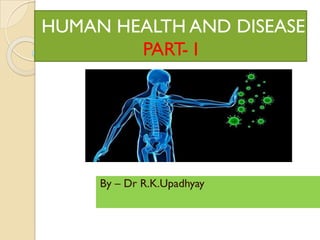
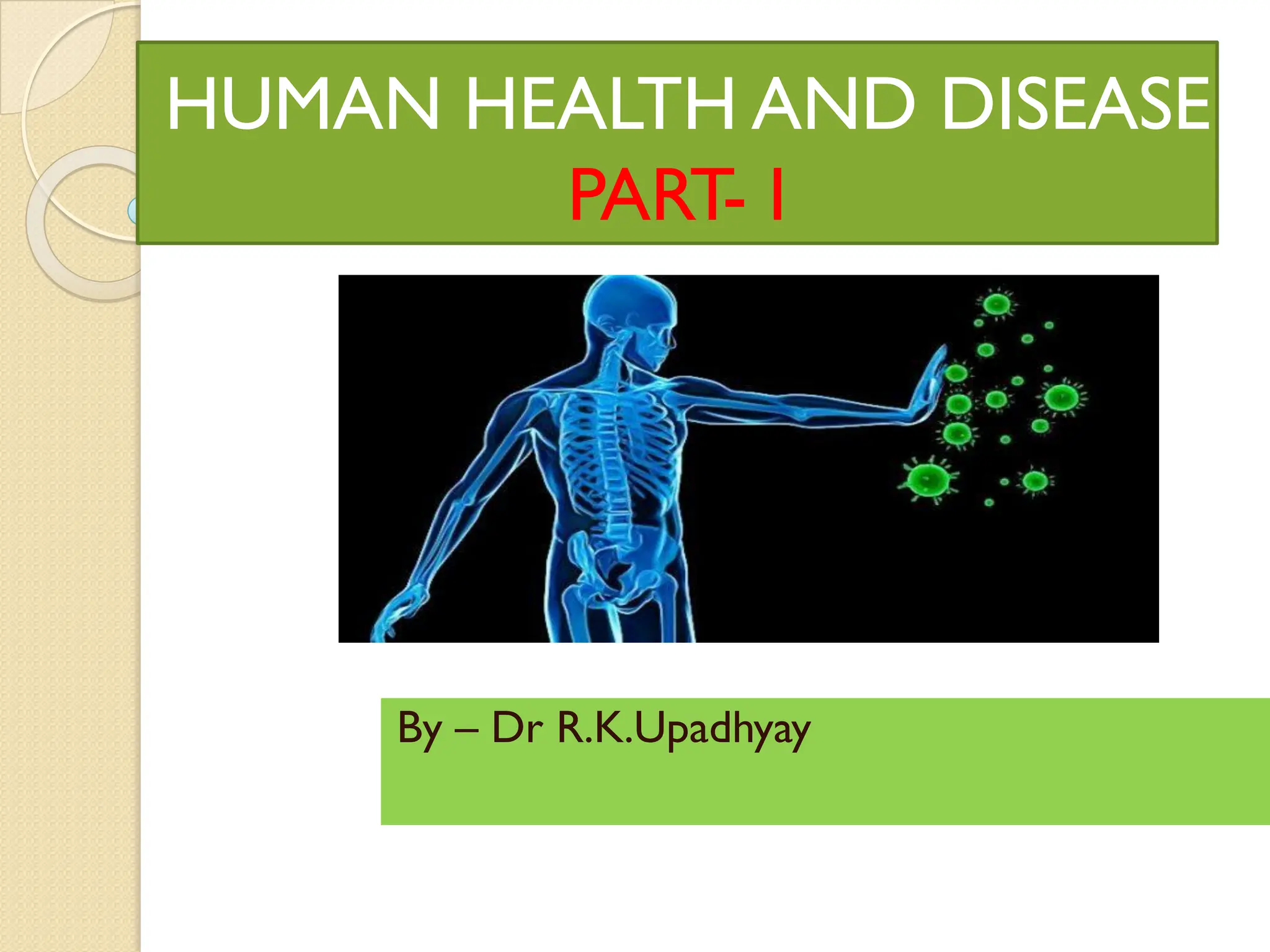
HUMAN HEALTH AND DISEASE
PART- I
By – Dr R.K.Upadhyay
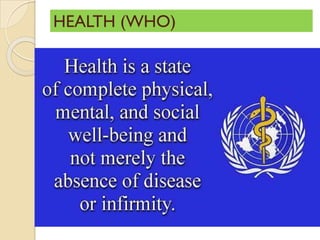
HEALTH (WHO)
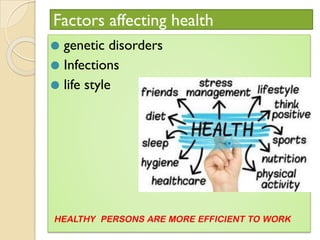
Factors affecting health
⚫ genetic disorders
⚫ Infections
⚫ life style
HEALTHY PERSONS ARE MORE EFFICIENT TO WORK
DISEASE
⚫ Medical conditions that are associated
with specific symptoms and signs
⚫ TYPES-
1- Infectious diseases - AIDS
II- Deficiency diseases – Scurvy
III- Hereditary diseases - Hemophilia
IV- Physiological diseases – Depression
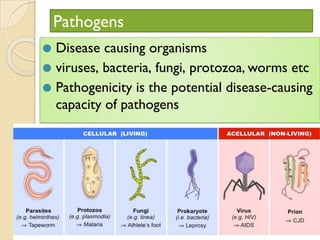
Pathogens
⚫ Disease causing organisms
⚫ viruses, bacteria, fungi, protozoa, worms etc
⚫ Pathogenicity is the potential disease-causing
capacity of pathogens
Infectious and Non infectious disease
⚫ Diseases which are easily transmitted
from one person to another, are called
infectious diseases.
⚫ Example- Flu, Pox,AIDS
⚫ A non-communicable disease is a disease
that is not transmissible directly from one
person to another.
⚫ Example - Parkinson's disease, diabetes
autoimmune diseases, osteoarthritis, cataracts,
etc
COMMON DISEASES IN HUMANS
Typhoid
Pneumonia
Common cold
Malaria
Amoebiasis (amoebic dysentery)
Ascariasis
Elephantiasis or Filariasis
Ringworms
HIV/AIDS
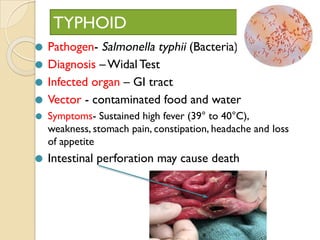
TYPHOID
⚫ Pathogen- Salmonella typhii (Bacteria)
⚫ Diagnosis – Widal Test
⚫ Infected organ – GI tract
⚫ Vector - contaminated food and water
⚫ Symptoms- Sustained high fever (39° to 40°C),
weakness, stomach pain, constipation, headache and loss
of appetite
⚫ Intestinal perforation may cause death
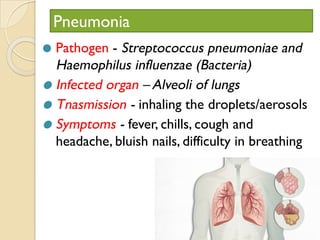
Pneumonia
⚫ Pathogen - Streptococcus pneumoniae and
Haemophilus influenzae (Bacteria)
⚫ Infected organ – Alveoli of lungs
⚫ Tnasmission - inhaling the droplets/aerosols
⚫ Symptoms - fever, chills, cough and
headache, bluish nails, difficulty in breathing
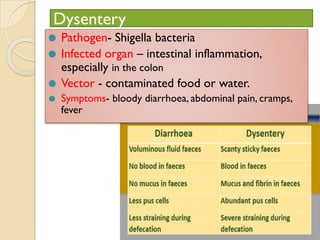
Dysentery
⚫ Pathogen- Shigella bacteria
⚫ Infected organ – intestinal inflammation,
especially in the colon
⚫ Vector - contaminated food or water.
⚫ Symptoms- bloody diarrhoea, abdominal pain, cramps,
fever
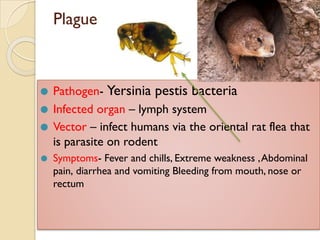
Plague
⚫ Pathogen- Yersinia pestis bacteria
⚫ Infected organ – lymph system
⚫ Vector – infect humans via the oriental rat flea that
is parasite on rodent
⚫ Symptoms- Fever and chills, Extreme weakness ,Abdominal
pain, diarrhea and vomiting Bleeding from mouth, nose or
rectum
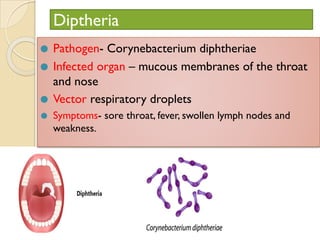
Diptheria
⚫ Pathogen- Corynebacterium diphtheriae
⚫ Infected organ – mucous membranes of the throat
and nose
⚫ Vector respiratory droplets
⚫ Symptoms- sore throat, fever, swollen lymph nodes and
weakness.
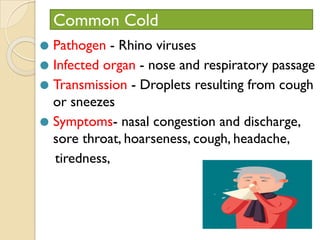
Common Cold
⚫ Pathogen - Rhino viruses
⚫ Infected organ - nose and respiratory passage
⚫ Transmission - Droplets resulting from cough
or sneezes
⚫ Symptoms- nasal congestion and discharge,
sore throat, hoarseness, cough, headache,
tiredness,
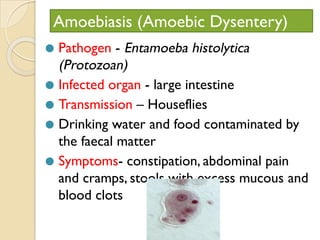
Amoebiasis (Amoebic Dysentery)
⚫ Pathogen - Entamoeba histolytica
(Protozoan)
⚫ Infected organ - large intestine
⚫ Transmission – Houseflies
⚫ Drinking water and food contaminated by
the faecal matter
⚫ Symptoms- constipation, abdominal pain
and cramps, stools with excess mucous and
blood clots
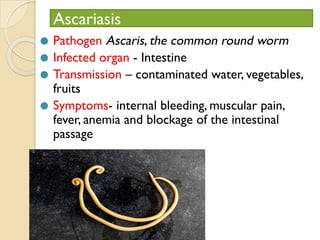
Ascariasis
⚫ Pathogen Ascaris, the common round worm
⚫ Infected organ - Intestine
⚫ Transmission – contaminated water, vegetables,
fruits
⚫ Symptoms- internal bleeding, muscular pain,
fever, anemia and blockage of the intestinal
passage
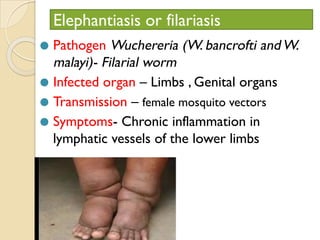
Elephantiasis or filariasis
⚫ Pathogen Wuchereria (W. bancrofti and W.
malayi)- Filarial worm
⚫ Infected organ – Limbs , Genital organs
⚫ Transmission – female mosquito vectors
⚫ Symptoms- Chronic inflammation in
lymphatic vessels of the lower limbs
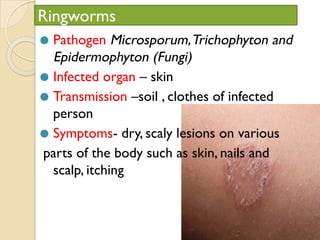
Ringworms
⚫ Pathogen Microsporum,Trichophyton and
Epidermophyton (Fungi)
⚫ Infected organ – skin
⚫ Transmission –soil , clothes of infected
person
⚫ Symptoms- dry, scaly lesions on various
parts of the body such as skin, nails and
scalp, itching
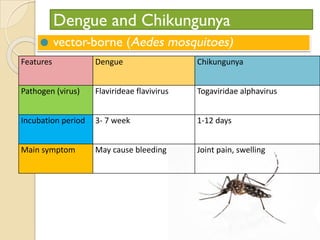
Dengue and Chikungunya
⚫ vector-borne (Aedes mosquitoes)
Features Dengue Chikungunya
Pathogen (virus) Flavirideae flavivirus Togaviridae alphavirus
Incubation period 3- 7 week 1-12 days
Main symptom May cause bleeding Joint pain, swelling
THANKYOU
HUMAN HEALTH AND DISEASE
MALARIA
By – Dr R.K.Upadhyay
PGT, Biology
MALARI A
⚫ Pathogen Plasmodium (P. vivax, P. malaria
and P. falciparum)- Protozoan
⚫ Malignant malaria caused by Plasmodium
falciparum can fatal.
⚫ Hosts – Mosquito and Human
⚫ Infective stage - Sporozoite
⚫ Infected organ – Liver
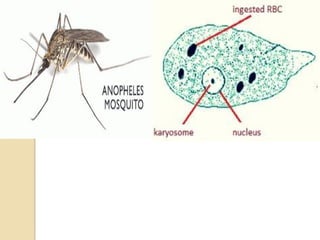
⚫ Transmission – female anopheles mosquito
⚫ Symptoms- fiver with chill
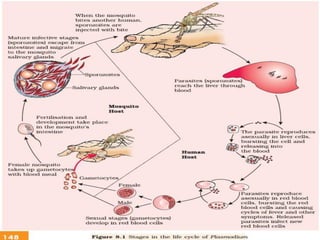
⚫ Sporozoites enters the human body through the bite
of infected female Anopheles mosquito.
⚫ The parasites multiply within the liver cells and then
attack the red blood cells (RBCs)
⚫ Rupture of RBCs causes release of toxic haemozoin.
⚫ Haemozoin is responsible for the chill and high fever
recurring every three to four days.
⚫ When a female Anopheles mosquito bites an infected
person, these parasites enter the mosquito’s body.
⚫ In mosquito body the parasites multiply and form
sporozoites.
⚫ Sporozoites are stored in their salivary glands.
⚫ When mosquito bites human they inject spozoites
into body.
MALARI A
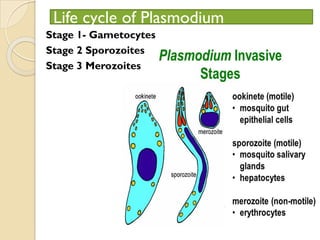
Life cycle of Plasmodium
Stage 1- Gametocytes
Stage 2 Sporozoites
Stage 3 Merozoites
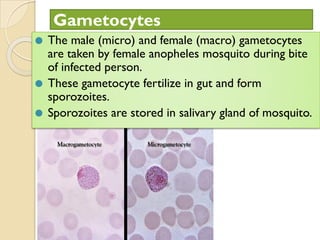
Gametocytes
⚫ The male (micro) and female (macro) gametocytes
are taken by female anopheles mosquito during bite
of infected person.
⚫ These gametocyte fertilize in gut and form
sporozoites.
⚫ Sporozoites are stored in salivary gland of mosquito.
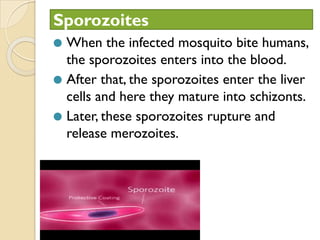
Sporozoites
⚫ When the infected mosquito bite humans,
the sporozoites enters into the blood.
⚫ After that, the sporozoites enter the liver
cells and here they mature into schizonts.
⚫ Later, these sporozoites rupture and
release merozoites.
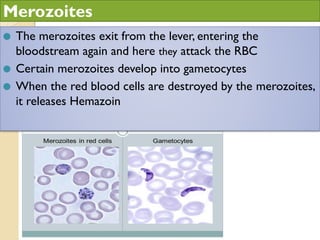
⚫ The merozoites exit from the lever, entering the
bloodstream again and here they attack the RBC
⚫ Certain merozoites develop into gametocytes
⚫ When the red blood cells are destroyed by the merozoites,
it releases Hemazoin
Merozoites
HUMAN HEALTH AND DISEASE
HIV/ AIDS
By – Dr R.K.Upadhyay
PGT, Biology
AIDS
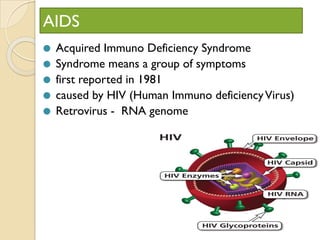
⚫ Acquired Immuno Deficiency Syndrome
⚫ Syndrome means a group of symptoms
⚫ first reported in 1981
⚫ caused by HIV (Human Immuno deficiencyVirus)
⚫ Retrovirus - RNA genome
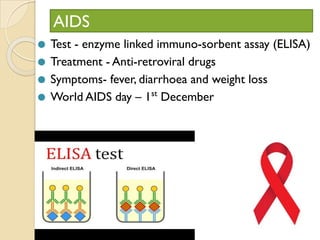
⚫ Test - enzyme linked immuno-sorbent assay (ELISA)
⚫ Treatment - Anti-retroviral drugs
⚫ Symptoms- fever, diarrhoea and weight loss
⚫ World AIDS day – 1st
December
AIDS
Transmission of HIV
sexual contact with infected person
by transfusion of contaminated blood and blood
products
by sharing infected needles as in the case of
intravenous drug abusers
from infected mother to her child through
placenta
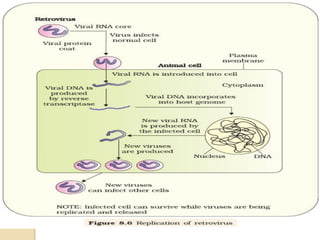
⚫ virus enters into macrophages where RNA
genome of the virus replicates to form viral DNA
with the help of the enzyme reverse transcriptase.
⚫ This viral DNA gets incorporated into host cell’s
DNA and directs the infected cells to produce
virus particles.
⚫ The macrophages continue to produce virus and
acts as a HIV factory.
⚫ Simultaneously, HIV enters into helper T
lymphocytes , replicates and produce progeny
viruses.
⚫ The progeny viruses released in the blood attack
other helper T-lymphocytes.
⚫ This is leading to a progressive decrease in the
number of helper T lymphocytes in the body.
THANKYOU

HUMAN HEALTH AND DISEASE.pptx presentation.pdf

  • 1.
    HUMAN HEALTH ANDDISEASE PART- I By – Dr R.K.Upadhyay
  • 2.
  • 3.
    Factors affecting health ⚫genetic disorders ⚫ Infections ⚫ life style HEALTHY PERSONS ARE MORE EFFICIENT TO WORK
  • 4.
    DISEASE ⚫ Medical conditionsthat are associated with specific symptoms and signs ⚫ TYPES- 1- Infectious diseases - AIDS II- Deficiency diseases – Scurvy III- Hereditary diseases - Hemophilia IV- Physiological diseases – Depression
  • 5.
    Pathogens ⚫ Disease causingorganisms ⚫ viruses, bacteria, fungi, protozoa, worms etc ⚫ Pathogenicity is the potential disease-causing capacity of pathogens
  • 6.
    Infectious and Noninfectious disease ⚫ Diseases which are easily transmitted from one person to another, are called infectious diseases. ⚫ Example- Flu, Pox,AIDS ⚫ A non-communicable disease is a disease that is not transmissible directly from one person to another. ⚫ Example - Parkinson's disease, diabetes autoimmune diseases, osteoarthritis, cataracts, etc
  • 7.
    COMMON DISEASES INHUMANS Typhoid Pneumonia Common cold Malaria Amoebiasis (amoebic dysentery) Ascariasis Elephantiasis or Filariasis Ringworms HIV/AIDS
  • 8.
    TYPHOID ⚫ Pathogen- Salmonellatyphii (Bacteria) ⚫ Diagnosis – Widal Test ⚫ Infected organ – GI tract ⚫ Vector - contaminated food and water ⚫ Symptoms- Sustained high fever (39° to 40°C), weakness, stomach pain, constipation, headache and loss of appetite ⚫ Intestinal perforation may cause death
  • 9.
    Pneumonia ⚫ Pathogen -Streptococcus pneumoniae and Haemophilus influenzae (Bacteria) ⚫ Infected organ – Alveoli of lungs ⚫ Tnasmission - inhaling the droplets/aerosols ⚫ Symptoms - fever, chills, cough and headache, bluish nails, difficulty in breathing
  • 10.
    Dysentery ⚫ Pathogen- Shigellabacteria ⚫ Infected organ – intestinal inflammation, especially in the colon ⚫ Vector - contaminated food or water. ⚫ Symptoms- bloody diarrhoea, abdominal pain, cramps, fever
  • 11.
    Plague ⚫ Pathogen- Yersiniapestis bacteria ⚫ Infected organ – lymph system ⚫ Vector – infect humans via the oriental rat flea that is parasite on rodent ⚫ Symptoms- Fever and chills, Extreme weakness ,Abdominal pain, diarrhea and vomiting Bleeding from mouth, nose or rectum
  • 12.
    Diptheria ⚫ Pathogen- Corynebacteriumdiphtheriae ⚫ Infected organ – mucous membranes of the throat and nose ⚫ Vector respiratory droplets ⚫ Symptoms- sore throat, fever, swollen lymph nodes and weakness.
  • 13.
    Common Cold ⚫ Pathogen- Rhino viruses ⚫ Infected organ - nose and respiratory passage ⚫ Transmission - Droplets resulting from cough or sneezes ⚫ Symptoms- nasal congestion and discharge, sore throat, hoarseness, cough, headache, tiredness,
  • 14.
    Amoebiasis (Amoebic Dysentery) ⚫Pathogen - Entamoeba histolytica (Protozoan) ⚫ Infected organ - large intestine ⚫ Transmission – Houseflies ⚫ Drinking water and food contaminated by the faecal matter ⚫ Symptoms- constipation, abdominal pain and cramps, stools with excess mucous and blood clots
  • 15.
    Ascariasis ⚫ Pathogen Ascaris,the common round worm ⚫ Infected organ - Intestine ⚫ Transmission – contaminated water, vegetables, fruits ⚫ Symptoms- internal bleeding, muscular pain, fever, anemia and blockage of the intestinal passage
  • 16.
    Elephantiasis or filariasis ⚫Pathogen Wuchereria (W. bancrofti and W. malayi)- Filarial worm ⚫ Infected organ – Limbs , Genital organs ⚫ Transmission – female mosquito vectors ⚫ Symptoms- Chronic inflammation in lymphatic vessels of the lower limbs
  • 17.
    Ringworms ⚫ Pathogen Microsporum,Trichophytonand Epidermophyton (Fungi) ⚫ Infected organ – skin ⚫ Transmission –soil , clothes of infected person ⚫ Symptoms- dry, scaly lesions on various parts of the body such as skin, nails and scalp, itching
  • 18.
    Dengue and Chikungunya ⚫vector-borne (Aedes mosquitoes) Features Dengue Chikungunya Pathogen (virus) Flavirideae flavivirus Togaviridae alphavirus Incubation period 3- 7 week 1-12 days Main symptom May cause bleeding Joint pain, swelling
  • 19.
  • 20.
    HUMAN HEALTH ANDDISEASE MALARIA By – Dr R.K.Upadhyay PGT, Biology
  • 21.
    MALARI A ⚫ PathogenPlasmodium (P. vivax, P. malaria and P. falciparum)- Protozoan ⚫ Malignant malaria caused by Plasmodium falciparum can fatal. ⚫ Hosts – Mosquito and Human ⚫ Infective stage - Sporozoite ⚫ Infected organ – Liver ⚫ Transmission – female anopheles mosquito ⚫ Symptoms- fiver with chill
  • 23.
    ⚫ Sporozoites entersthe human body through the bite of infected female Anopheles mosquito. ⚫ The parasites multiply within the liver cells and then attack the red blood cells (RBCs) ⚫ Rupture of RBCs causes release of toxic haemozoin. ⚫ Haemozoin is responsible for the chill and high fever recurring every three to four days. ⚫ When a female Anopheles mosquito bites an infected person, these parasites enter the mosquito’s body. ⚫ In mosquito body the parasites multiply and form sporozoites. ⚫ Sporozoites are stored in their salivary glands. ⚫ When mosquito bites human they inject spozoites into body. MALARI A
  • 25.
    Life cycle ofPlasmodium Stage 1- Gametocytes Stage 2 Sporozoites Stage 3 Merozoites
  • 26.
    Gametocytes ⚫ The male(micro) and female (macro) gametocytes are taken by female anopheles mosquito during bite of infected person. ⚫ These gametocyte fertilize in gut and form sporozoites. ⚫ Sporozoites are stored in salivary gland of mosquito.
  • 27.
    Sporozoites ⚫ When theinfected mosquito bite humans, the sporozoites enters into the blood. ⚫ After that, the sporozoites enter the liver cells and here they mature into schizonts. ⚫ Later, these sporozoites rupture and release merozoites.
  • 28.
    ⚫ The merozoitesexit from the lever, entering the bloodstream again and here they attack the RBC ⚫ Certain merozoites develop into gametocytes ⚫ When the red blood cells are destroyed by the merozoites, it releases Hemazoin Merozoites
  • 29.
    HUMAN HEALTH ANDDISEASE HIV/ AIDS By – Dr R.K.Upadhyay PGT, Biology
  • 30.
    AIDS ⚫ Acquired ImmunoDeficiency Syndrome ⚫ Syndrome means a group of symptoms ⚫ first reported in 1981 ⚫ caused by HIV (Human Immuno deficiencyVirus) ⚫ Retrovirus - RNA genome
  • 31.
    ⚫ Test -enzyme linked immuno-sorbent assay (ELISA) ⚫ Treatment - Anti-retroviral drugs ⚫ Symptoms- fever, diarrhoea and weight loss ⚫ World AIDS day – 1st December AIDS
  • 32.
    Transmission of HIV sexualcontact with infected person by transfusion of contaminated blood and blood products by sharing infected needles as in the case of intravenous drug abusers from infected mother to her child through placenta
  • 33.
    ⚫ virus entersinto macrophages where RNA genome of the virus replicates to form viral DNA with the help of the enzyme reverse transcriptase. ⚫ This viral DNA gets incorporated into host cell’s DNA and directs the infected cells to produce virus particles. ⚫ The macrophages continue to produce virus and acts as a HIV factory. ⚫ Simultaneously, HIV enters into helper T lymphocytes , replicates and produce progeny viruses. ⚫ The progeny viruses released in the blood attack other helper T-lymphocytes. ⚫ This is leading to a progressive decrease in the number of helper T lymphocytes in the body.
  • 35.