Human Growth &Human Growth &
DevelopmentDevelopment
 Pre-natalPre-natal
DevelopmentDevelopment
 Post-natalPost-natal
DevelopmentDevelopment
www.indiandentalacademy.comwww.indiandentalacademy.com
[JX Huxley][JX Huxley]
‘‘Self-multiplication of living substance’.Self-multiplication of living substance’.
[Krogman][Krogman]
‘‘Increase in size, change in proportion & progressiveIncrease in size, change in proportion & progressive
complexity’.complexity’.
[Meredith][Meredith]
‘‘Entire series of sequential anatomic & physiologicalEntire series of sequential anatomic & physiological
changes taking place from the beginning of prenatalchanges taking place from the beginning of prenatal
life to senility’.life to senility’.
[Moyers][Moyers]
‘‘Quantitative aspect of biologic development per unitQuantitative aspect of biologic development per unit
of time’.of time’.
[Moss][Moss]
‘‘Change in any morphological parameter which isChange in any morphological parameter which is
measurable’.measurable’.
www.indiandentalacademy.comwww.indiandentalacademy.com
 Thorough background in craniofacialThorough background in craniofacial
growth & development is necessary forgrowth & development is necessary for
every dentist. Even for those who neverevery dentist. Even for those who never
work with children, it is difficult towork with children, it is difficult to
comprehend conditions observed incomprehend conditions observed in
adults without understanding theadults without understanding the
developmental processes that produceddevelopmental processes that produced
these problems.these problems.
[William R.[William R.
Proffit]Proffit]
www.indiandentalacademy.comwww.indiandentalacademy.com
““Embryology is the study of formationEmbryology is the study of formation
& development of the embryo from& development of the embryo from
the movement of its inception up tothe movement of its inception up to
the time when it is born an infant”.the time when it is born an infant”.
 Kaspar FriedrichKaspar Friedrich
(Described modern Embryology)(Described modern Embryology)
www.indiandentalacademy.comwww.indiandentalacademy.com
 During first 2months we call the developingDuring first 2months we call the developing
individualindividual An EmbryoAn Embryo
 From third month until birthFrom third month until birth FetusFetus
 From birth to 1yr of ageFrom birth to 1yr of age An InfantAn Infant
 A young child who is just beginning to walkA young child who is just beginning to walk
ToddlerToddler
 Period shows onset of puberty. Period markPeriod shows onset of puberty. Period mark
the secondary sex characters [12-15y(G) 13-the secondary sex characters [12-15y(G) 13-
16y(B)]16y(B)] TeenagerTeenager
 Developing from child to an adult (13-19y)Developing from child to an adult (13-19y)
AdolescentAdolescent
 Body attained full growth & maturity of anBody attained full growth & maturity of an
organism (18-21y)organism (18-21y) AdultAdultwww.indiandentalacademy.comwww.indiandentalacademy.com
 As an Orthodontics we are interested inAs an Orthodontics we are interested in
understanding how the face changesunderstanding how the face changes
from its embryonic form throughfrom its embryonic form through
childhood, adolescence & adulthood.childhood, adolescence & adulthood.
www.indiandentalacademy.comwww.indiandentalacademy.com
 To understand how & where growthTo understand how & where growth
occurs, how much growth isoccurs, how much growth is
remaining, in which direction & whenremaining, in which direction & when
growth will express itself, what rolesgrowth will express itself, what roles
the genetic & environmental factorsthe genetic & environmental factors
play in influencing facial growth & inplay in influencing facial growth & in
turn how we can influence theseturn how we can influence these
factors with our Treatment, tofactors with our Treatment, to
achieved the optimum results in theachieved the optimum results in the
potential of each individual person.potential of each individual person.
Answer of all these questions will comeAnswer of all these questions will come
when we know the human growth &when we know the human growth &
development.development.
www.indiandentalacademy.comwww.indiandentalacademy.com
 Although our understanding ofAlthough our understanding of
gross Anatomy & Embryology aregross Anatomy & Embryology are
unlikely to change in future.unlikely to change in future.
 Advances in clinical treatment areAdvances in clinical treatment are
predicated on the bases of solidpredicated on the bases of solid
foundation of anatomic knowledge.foundation of anatomic knowledge.
www.indiandentalacademy.comwww.indiandentalacademy.com
PrenatalPrenatal
DevelopmentDevelopment
 Period Of OvumPeriod Of Ovum
 Period Of EmbryoPeriod Of Embryo
 Period Of FetusPeriod Of Fetus
HippocratesHippocrates——’Father of Medicine’ &’Father of Medicine’ &
‘Founder of Anatomy’‘Founder of Anatomy’
www.indiandentalacademy.comwww.indiandentalacademy.com
o Period of OvumPeriod of Ovum
 From the fertilization to the end of 14From the fertilization to the end of 14thth
day.day.
 Cleavage of the ovum.Cleavage of the ovum.
 Ovum is only 1.5mm in length.Ovum is only 1.5mm in length.
www.indiandentalacademy.comwww.indiandentalacademy.com
 Period of EmbryoPeriod of Embryo
 1414thth
day to 56day to 56thth
day.day.
 Formation of Embryonic DiscFormation of Embryonic Disc
 Formation of Pharyngeal archesFormation of Pharyngeal arches
 Formation of nasal pitsFormation of nasal pits
 Development of Cranial structuresDevelopment of Cranial structures
 Development of pre-oral region {Palate;Development of pre-oral region {Palate;
Tongue; Maxilla; Mandible}Tongue; Maxilla; Mandible}
www.indiandentalacademy.comwww.indiandentalacademy.com
o Period of FetusPeriod of Fetus
5656thth
day to 270 days/3day to 270 days/3rdrd
to 9to 9thth
months (till birth).months (till birth).
B/w 8B/w 8thth
to 12to 12thth
weeks of IULweeks of IUL
Fetus triples in length from 20mm to 60mm.Fetus triples in length from 20mm to 60mm.
By 3By 3rdrd
monthmonth
Face assumes a more human appearance.Face assumes a more human appearance.
From 12From 12thth
to 36to 36thth
week of IULweek of IUL
Head increases in length from approximatelyHead increases in length from approximately
18mm to 120mm; in width from 12mm to 74mm;18mm to 120mm; in width from 12mm to 74mm;
in height from 20mm to 100mmin height from 20mm to 100mm
www.indiandentalacademy.comwww.indiandentalacademy.com
o Cranium to face ratioCranium to face ratio
 During Embryonic period—40:1During Embryonic period—40:1
 During 4During 4thth
month of IUL—5:1month of IUL—5:1
 At Birth—8:1At Birth—8:1
 At Adulthood—2:1At Adulthood—2:1
AristotleAristotle——’Father of Ancient Anatomy’’Father of Ancient Anatomy’
He forecasted idea of ‘Genetic & Hereditary’He forecasted idea of ‘Genetic & Hereditary’
www.indiandentalacademy.comwww.indiandentalacademy.com
TeratogensTeratogens— ‘Growing embryo if exposed to— ‘Growing embryo if exposed to
certain chemical/physical agents duringcertain chemical/physical agents during
pregnancy which causes structuralpregnancy which causes structural
developmental abnormalities’.developmental abnormalities’.
www.indiandentalacademy.comwww.indiandentalacademy.com
 First 2weeksFirst 2weeks  Not sensitive.Not sensitive.
{High rate of lethality}{High rate of lethality}
 3—8weeks3—8weeks Greatest sensitivityGreatest sensitivity
Period for each organ.Period for each organ.
 9—38weeks9—38weeks Decreasing sensitivity.Decreasing sensitivity.
‘Functional maturation Period’‘Functional maturation Period’
 3—8weeks3—8weeks ‘Period of‘Period of
Embryogenesis’.Embryogenesis’.
 8—38weeks8—38weeks ‘Period of Foetogenesis’.‘Period of Foetogenesis’.
www.indiandentalacademy.comwww.indiandentalacademy.com
 Since the baby's face develops soSince the baby's face develops so
early in the pregnancy, even whenearly in the pregnancy, even when
these factors are minimizedthese factors are minimized
through proper prenatal care, thethrough proper prenatal care, the
damage may have already occurreddamage may have already occurred
to the child before the mother wasto the child before the mother was
even aware that she was pregnant.even aware that she was pregnant.
www.indiandentalacademy.comwww.indiandentalacademy.com
FertilizationFertilization
 At the moment when one spermatozoonAt the moment when one spermatozoon
meets & fuses with one ovum. Themeets & fuses with one ovum. The
development of new individual begins.development of new individual begins.
This process of fusion is calledThis process of fusion is called
Fertilization.Fertilization.
 Fused Ovum & Spermatozoon formFused Ovum & Spermatozoon form
Zygote.Zygote.
 Fertilization occurs in theFertilization occurs in the ampullaampulla of theof the
uterine tube.uterine tube.
www.indiandentalacademy.comwww.indiandentalacademy.com
 RobertRobert
HookeHooke——
identified &identified &
name thename the
‘cell’.‘cell’.
www.indiandentalacademy.comwww.indiandentalacademy.com
Cell DivisionCell Division
 When after cell division, the daughterWhen after cell division, the daughter
cell must have chromosomes identical incell must have chromosomes identical in
number to those in the mother cell. Thisnumber to those in the mother cell. This
type of cell division is calledtype of cell division is called Mitosis.Mitosis.
 When after division, the chromosome of theWhen after division, the chromosome of the
daughter cell becomes non-identical indaughter cell becomes non-identical in
number to those in the mother cell. Thisnumber to those in the mother cell. This
type of cell division is calledtype of cell division is called Meiosis.Meiosis.
www.indiandentalacademy.comwww.indiandentalacademy.com
Two-Cell-Stage ofTwo-Cell-Stage of
EmbryoEmbryo
 During Fertilization Chromosomes of theDuring Fertilization Chromosomes of the
ovum (23-Female chromosomes) fused withovum (23-Female chromosomes) fused with
chromosomes of the spermatozoon (23-Malechromosomes of the spermatozoon (23-Male
Chromosomes) so that the fertilized ovumChromosomes) so that the fertilized ovum
now has the 46 chromosomes in all. Each ofnow has the 46 chromosomes in all. Each of
the 46 chromosomes then splits into two.the 46 chromosomes then splits into two.
Meanwhile, a spindle is formed, & oneMeanwhile, a spindle is formed, & one
chromosome of each pair moves to each endchromosome of each pair moves to each end
of the spindle leading to the formation ofof the spindle leading to the formation of
two daughter cells.two daughter cells.
www.indiandentalacademy.comwww.indiandentalacademy.com
 These two cells undergo series of divisions.These two cells undergo series of divisions.
This process of subdivision of ovum intoThis process of subdivision of ovum into
smaller cells is calledsmaller cells is called Cleavage.Cleavage.
 zygote {after 30hrs after fertilization}:zygote {after 30hrs after fertilization}:
Two blastomeresTwo blastomeres
Four blastomeresFour blastomeres
Eight blastomeresEight blastomeres
Repeated mitotic divisions
www.indiandentalacademy.comwww.indiandentalacademy.com
Formation of MorulaFormation of Morula
 As cleavage proceeds the ovum comes toAs cleavage proceeds the ovum comes to
have 12 to 32 blastomeres cells. Thehave 12 to 32 blastomeres cells. The
developing human is now calleddeveloping human is now called Morula.Morula.
(It resembles a(It resembles a mulberry or black berry)mulberry or black berry)
Gregory Johann MendelGregory Johann Mendel ——PublishedPublished
experiments on plant hybridization.experiments on plant hybridization.
‘Father of Genetics’‘Father of Genetics’
www.indiandentalacademy.comwww.indiandentalacademy.com
Formation ofFormation of
BlastocystBlastocyst
 When morula enters uterus (4When morula enters uterus (4thth
days afterdays after
fertilization), fluid filled space appears inside thefertilization), fluid filled space appears inside the
morula.morula.
 As the fluid increases in the blastocystic cavity ,itAs the fluid increases in the blastocystic cavity ,it
separates the blastomeres into two parts:separates the blastomeres into two parts:
TrophoblastTrophoblast {outer cell layer}{outer cell layer}
EmbryoblastEmbryoblast {inner cell mass}{inner cell mass}
At this stage of development theAt this stage of development the
conceptus is called aconceptus is called a blastocystblastocyst
www.indiandentalacademy.comwww.indiandentalacademy.com
TROPHOBLASTTROPHOBLAST
 Inner layer of cytotrophoblastInner layer of cytotrophoblast
 Outer mass of syncytiotrophoblastOuter mass of syncytiotrophoblast
www.indiandentalacademy.comwww.indiandentalacademy.com
Formation of EmbryonicFormation of Embryonic
DiscDisc
 Embryobalsts form the embryonic Spherical discEmbryobalsts form the embryonic Spherical disc
which forms three germ layers.which forms three germ layers.
1]1] EndodermEndoderm (Hypoblast-Cuboidal cells)—Inside (1(Hypoblast-Cuboidal cells)—Inside (1stst
germ layer to be formed)germ layer to be formed)
2]2] EctodermEctoderm (Epiblast-Columnar cell)—Outside (2(Epiblast-Columnar cell)—Outside (2ndnd
germ layer)germ layer)
3]3] MesodermMesoderm ––In the middleIn the middle
www.indiandentalacademy.comwww.indiandentalacademy.com
 Endoderm spread & lined the blastocysticEndoderm spread & lined the blastocystic
cavity with the flattened cells, now thiscavity with the flattened cells, now this
cavity is calledcavity is called Primary Yolk Sac.Primary Yolk Sac.
www.indiandentalacademy.comwww.indiandentalacademy.com
Extra-embryonicExtra-embryonic
MesodermMesoderm
 Cells of the trophoblasts give origin to the massCells of the trophoblasts give origin to the mass
of cells—of cells—
Extra-embryonic mesodermExtra-embryonic mesoderm -which lie b/w-which lie b/w
trophoblast & primary yolk sac.trophoblast & primary yolk sac.
Extra-embryonic Somatic MesodermExtra-embryonic Somatic Mesoderm ——
Line the Cytotrophoblast & covers the amnion.Line the Cytotrophoblast & covers the amnion.
Extra-embryonic Visceral MesodermExtra-embryonic Visceral Mesoderm ——
Covers the yolk sac.Covers the yolk sac.
www.indiandentalacademy.comwww.indiandentalacademy.com
Prochordal PlateProchordal Plate
 Prochordal plate cellsProchordal plate cells develops as adevelops as a
localized thickening of endodermal cellslocalized thickening of endodermal cells
& indicate the site of buccopharyngeal& indicate the site of buccopharyngeal
membrane separating the oral cavity frommembrane separating the oral cavity from
Oropharynx (Future cranial region ofOropharynx (Future cranial region of
embryo & Future site of mouth)embryo & Future site of mouth)
 At one area cubical cells of the endodermAt one area cubical cells of the endoderm
become columnar—become columnar— Prochordal plate.Prochordal plate. ItIt
determines the central axis of the embryo &determines the central axis of the embryo &
divide the embryo into right & left halves &divide the embryo into right & left halves &
also distinguish its head & tail ends.also distinguish its head & tail ends.
www.indiandentalacademy.comwww.indiandentalacademy.com
Primitive StreakPrimitive Streak
 Near the tail end of the disc, begin to proliferate & formNear the tail end of the disc, begin to proliferate & form
an epiblastic elevation that bulges into the amniotican epiblastic elevation that bulges into the amniotic
cavity—cavity— Primitive Streak.Primitive Streak. The primitive streak is atThe primitive streak is at
first a rounded swelling but with the elongation of thefirst a rounded swelling but with the elongation of the
embryonic disc it becomes linear & lies at the centralembryonic disc it becomes linear & lies at the central
axis of the disc.axis of the disc.
 Primitive pitPrimitive pit surrounded by the elevatedsurrounded by the elevated
Primitive nodePrimitive node is located at the cranial end of theis located at the cranial end of the
primitive streak.primitive streak.
Since the cells forming the primitive are leuripotent, theirSince the cells forming the primitive are leuripotent, their
persistence may give rise to tumors containing all thepersistence may give rise to tumors containing all the
three germ layers.three germ layers. TeratomaTeratoma
www.indiandentalacademy.comwww.indiandentalacademy.com
NotochordNotochord
 NotochordNotochord –It is the midline structure,–It is the midline structure,
which develops in the region extending fromwhich develops in the region extending from
the cranial end of the primitive streak to thethe cranial end of the primitive streak to the
caudal end of the prochordal plate.caudal end of the prochordal plate.
(Notochord develops from the anterior(Notochord develops from the anterior
extremity of primitive streak.)extremity of primitive streak.)
www.indiandentalacademy.comwww.indiandentalacademy.com
Neural TubeNeural Tube
 Ectoderm overlying the notochordEctoderm overlying the notochord
undergoes changes that result in theundergoes changes that result in the
formation of—formation of— Neural tube.Neural tube. NeuralNeural
tube gives rise to brain & spinal cord.tube gives rise to brain & spinal cord.
www.indiandentalacademy.comwww.indiandentalacademy.com
Neural PlateNeural Plate
 Notochord functions as the primaryNotochord functions as the primary
inductor in the early embryoinductor in the early embryo
 The developing notochord induces theThe developing notochord induces the
overlying embryonic ectoderm tooverlying embryonic ectoderm to
thicken and form thethicken and form the “neural plate”“neural plate”
[Primordium of central nervous system][Primordium of central nervous system]
www.indiandentalacademy.comwww.indiandentalacademy.com
Intra-embryonicIntra-embryonic
MesodermMesoderm
 Some cellsSome cells
proliferate in theproliferate in the
region of theregion of the
primitive streak,primitive streak,
pass sidewayspass sideways
pushingpushing
themselves b/wthemselves b/w
ectoderm &ectoderm &
endoderm—endoderm—
Intra-Intra-
embryonicembryonic
www.indiandentalacademy.comwww.indiandentalacademy.com
GastrulationGastrulation
 The process of formation of primitive streakThe process of formation of primitive streak
& the intra-embryonic mesoderm by the& the intra-embryonic mesoderm by the
streak is calledstreak is called ‘Gastrulation’.‘Gastrulation’.
 Intra-embryonic membrane spreadsIntra-embryonic membrane spreads
throughout the disc except in the region ofthroughout the disc except in the region of
prochordal plate, which is later form theprochordal plate, which is later form the
Buccopharyngeal membrane.Buccopharyngeal membrane. BPM isBPM is
composed of ectoderm & endoderm.composed of ectoderm & endoderm.
www.indiandentalacademy.comwww.indiandentalacademy.com
Intra-embryonic mesoderm subdivided intoIntra-embryonic mesoderm subdivided into
three parts—three parts—
1]1] Paraxial mesodermParaxial mesoderm
2]2] Lateral mesodermLateral mesoderm
3]3] Intermediate mesodermIntermediate mesoderm
In 1638, 1In 1638, 1stst
-human dissection was done in America.-human dissection was done in America.
www.indiandentalacademy.comwww.indiandentalacademy.com
[1] Paraxial[1] Paraxial
MesodermMesoderm
OOn either side of the notochord. It is organized inton either side of the notochord. It is organized into
the segments called “somitomeres”. These arethe segments called “somitomeres”. These are
arranged into somite. Each somite give rise to:-arranged into somite. Each somite give rise to:-
 Sclerotome –cartilage & bone of the axial &Sclerotome –cartilage & bone of the axial &
paraxial skeleton (remember neural crest cellsparaxial skeleton (remember neural crest cells
give rise to cartilage & bone of the skull & face).give rise to cartilage & bone of the skull & face).
 Myotome –segmental muscle component.Myotome –segmental muscle component.
 Dermatome—Segmental skin component.Dermatome—Segmental skin component.
 Each myotome & dermatome has its own muscleEach myotome & dermatome has its own muscle
& nerve component.& nerve component.
www.indiandentalacademy.comwww.indiandentalacademy.com
[2] Lateral Mesoderm[2] Lateral Mesoderm
LLateral side of the notochord. Differentiateateral side of the notochord. Differentiate
into excretory unit of urinary system &into excretory unit of urinary system &
Gonads.Gonads.
www.indiandentalacademy.comwww.indiandentalacademy.com
[3] Inter-mediate[3] Inter-mediate
MesodermMesoderm
BBetween Paraxial & Lateral mesoderms.etween Paraxial & Lateral mesoderms.
Split into partial & visceral layers.Split into partial & visceral layers.
 In the head region, cranial to somites,In the head region, cranial to somites,
somitomeres give origin to thesomitomeres give origin to the
mesenchyme.mesenchyme.
 Striated muscle of the tongue is derivedStriated muscle of the tongue is derived
from the occipital myotome.from the occipital myotome.
www.indiandentalacademy.comwww.indiandentalacademy.com
StomodeumStomodeum
 Cranial most structure of the embryo enlargesCranial most structure of the embryo enlarges
& show two big bulging, cranial bulging& show two big bulging, cranial bulging
develops future brain & a little below formdevelops future brain & a little below form
pericardium. In-between them there is apericardium. In-between them there is a
depression calleddepression called StomodeumStomodeum,, the floor ofthe floor of
which is formed by the BPM.which is formed by the BPM.
www.indiandentalacademy.comwww.indiandentalacademy.com
 Foregut is bounded ventrally by theForegut is bounded ventrally by the
pericardium & dorsally by thepericardium & dorsally by the
developing brain. Cranially, it is at firstdeveloping brain. Cranially, it is at first
separated from the stomodeum by BPM.separated from the stomodeum by BPM.
When this membrane breaks down, theWhen this membrane breaks down, the
foregut open to the exterior through theforegut open to the exterior through the
stomodeum.stomodeum. Stomodeum is the futureStomodeum is the future
mouth.mouth.
 Primordial of the craniofacial complexPrimordial of the craniofacial complex
develops fromdevelops from Hensen’s node.Hensen’s node.
www.indiandentalacademy.comwww.indiandentalacademy.com
Pharyngeal ArchesPharyngeal Arches
44thth
week after conceptionweek after conception,, neck is formed by theneck is formed by the
elongation of the region b/w the pericardium &elongation of the region b/w the pericardium &
stomodeum. This elongation is due to thestomodeum. This elongation is due to the
appearance of a series of segmental mesodermalappearance of a series of segmental mesodermal
round tubular thickening in the wall of theround tubular thickening in the wall of the
cranial most of the foregut. These are calledcranial most of the foregut. These are called
Pharyngeal/Branchial arches.Pharyngeal/Branchial arches. TheseThese
enlargement is bounded by cleft & grooves thatenlargement is bounded by cleft & grooves that
helps defined each other.helps defined each other.
www.indiandentalacademy.comwww.indiandentalacademy.com
Time table of the eventsTime table of the events
Development of the embryo from fertilizationDevelopment of the embryo from fertilization
up to the disc— ‘Pre-organogenesis period’.up to the disc— ‘Pre-organogenesis period’.
 22ndnd
days after fertilization—Two-Cell-Stagedays after fertilization—Two-Cell-Stage
embryo.embryo.
 33rdrd
days— Morulla developed.days— Morulla developed.
 44thth
day—Blastocyst formed.day—Blastocyst formed.
 88thth
day—Disc established (Bilaminar Disc stage)day—Disc established (Bilaminar Disc stage)
 1414thth
day—Prochordal plate & Primitive streakday—Prochordal plate & Primitive streak
formed.formed.
 1616thth
day—Embryonic disc with three germday—Embryonic disc with three germ
layers/ Gastrulation (Trilaminar Disc stage).layers/ Gastrulation (Trilaminar Disc stage).
www.indiandentalacademy.comwww.indiandentalacademy.com
First Evidence ofFirst Evidence of
FormationFormation
 Seen inSeen in late Somitic Periodlate Somitic Period (4(4thth
-8-8thth
week IUL)week IUL)
 During this period mesenchymal tissueDuring this period mesenchymal tissue
derived from primitive streak, neural crest &derived from primitive streak, neural crest &
occipital sclerotomes condense around theoccipital sclerotomes condense around the
developing brain. Thus a capsule is formeddeveloping brain. Thus a capsule is formed
around the brain calledaround the brain called Ectomenix /Ectomenix /
Ectomeningeal capsule.Ectomeningeal capsule.
 Basal portion of this capsule gives rise to theBasal portion of this capsule gives rise to the
future cranial base.future cranial base.
www.indiandentalacademy.comwww.indiandentalacademy.com
4040thth
Day OnwardsDay Onwards
 Ectomeningeal capsule is slowly convertedEctomeningeal capsule is slowly converted
into cartilage (onset of cranial baseinto cartilage (onset of cranial base
formation).formation).
 Conversion of mesenchymal cells intoConversion of mesenchymal cells into
cartilage/ chondrification occurs in 4 regions.cartilage/ chondrification occurs in 4 regions.
1)1) ParachordalParachordal
2)2) HypophysealHypophyseal
3)3) NasalNasal
4)4) OticOtic
www.indiandentalacademy.comwww.indiandentalacademy.com
ParachordalParachordal
 Chondrification centers formingChondrification centers forming
around the cranial end of the notochordaround the cranial end of the notochord
are calledare called Parachordal cartilages.Parachordal cartilages.
www.indiandentalacademy.comwww.indiandentalacademy.com
HypophysealHypophyseal
 Cranial to the termination of notochord, (at the level of theCranial to the termination of notochord, (at the level of the
oro-pharyngeal membrane) hypophyseal pouch developsoro-pharyngeal membrane) hypophyseal pouch develops
which give rise towhich give rise to anterior lobe of the pituitary gland.anterior lobe of the pituitary gland.
 --On either side of the hypophyseal stem two hypophyseal /--On either side of the hypophyseal stem two hypophyseal /
post sphenoid cartilages develop. These cartilages fusepost sphenoid cartilages develop. These cartilages fuse
together & formtogether & form posterior part of the body of sphenoid.posterior part of the body of sphenoid.
 --Cranial to the pituitary gland, two presphenoid /--Cranial to the pituitary gland, two presphenoid /
trabecular cartilages develop which fuse together & formtrabecular cartilages develop which fuse together & form
anterior part of the body of sphenoidanterior part of the body of sphenoid.. Anteriorly, theAnteriorly, the
presphenoid cartilage forms a vertical cartilaginous platepresphenoid cartilage forms a vertical cartilaginous plate
called mesethmoid cartilage which gives rise to thecalled mesethmoid cartilage which gives rise to the
perpendicular plate of ethmoid & cristagalliperpendicular plate of ethmoid & cristagalli..
 --Lateral to the pituitary gland chondrification centers are--Lateral to the pituitary gland chondrification centers are
seen which formseen which form lesser wing (Orbito-sphenoid) &lesser wing (Orbito-sphenoid) &
greater wing of sphenoid.greater wing of sphenoid.
www.indiandentalacademy.comwww.indiandentalacademy.com
NasalNasal
 Initially during development, a capsuleInitially during development, a capsule
is seen around the nasal sense organ.is seen around the nasal sense organ.
This capsule chondrifies & forms theThis capsule chondrifies & forms the
cartilages of the nostrilscartilages of the nostrils which fusewhich fuse
with the cartilages of the cranial base.with the cartilages of the cranial base.
www.indiandentalacademy.comwww.indiandentalacademy.com
OticOtic
 A capsule is seen around the vestibulo-A capsule is seen around the vestibulo-
cochlear sense organs. This capsulecochlear sense organs. This capsule
chondrifies & later ossifies to give risechondrifies & later ossifies to give rise
to theto the mastoid & petrous portion ofmastoid & petrous portion of
the temporal bonethe temporal bone. Otic cartilages. Otic cartilages
also fuse with the cartilages of thealso fuse with the cartilages of the
cranial base.cranial base.
www.indiandentalacademy.comwww.indiandentalacademy.com
 Initially separate centres of cartilageInitially separate centres of cartilage
formation in the cranial base, fuseformation in the cranial base, fuse
together into a single irregular & greatlytogether into a single irregular & greatly
perforated cranial base. [Earlyperforated cranial base. [Early
development of the various nerve &development of the various nerve &
vessels from & to the brain results invessels from & to the brain results in
numerous perforations (foramina)].numerous perforations (foramina)].
 The ossifying chondro-cranial meets theThe ossifying chondro-cranial meets the
ossifying desmocranium (cranial vault)ossifying desmocranium (cranial vault)
to formto form neurocranium.neurocranium.
www.indiandentalacademy.comwww.indiandentalacademy.com
Chondro-cranialChondro-cranial
OssificationOssification
 Cranial base which is now in a cartilaginousCranial base which is now in a cartilaginous
form undergoesform undergoes ossification.ossification.
 Bone of the cranial base undergo bothBone of the cranial base undergo both
endochondralendochondral as well asas well as intra-intra-
membranous ossifications.membranous ossifications.
www.indiandentalacademy.comwww.indiandentalacademy.com

Ossification—Ossification— “It is a process of“It is a process of
formation of bone & it includes theformation of bone & it includes the
proliferation of collagen & groundproliferation of collagen & ground
substance with subsequentsubstance with subsequent
deposition of calcium salts”.deposition of calcium salts”.

Calcification—Calcification— “It is simply deposition“It is simply deposition
of calcium slats without theof calcium slats without the
presence of osteoblasts”.presence of osteoblasts”.
www.indiandentalacademy.comwww.indiandentalacademy.com

Intra-membranous Ossification—Intra-membranous Ossification— “Type of“Type of
ossification in which mesenchymeossification in which mesenchyme
is directly converted into bone”.is directly converted into bone”.

Intra-cartilaginous Ossification—Intra-cartilaginous Ossification— “Type of“Type of
ossification in which at firstossification in which at first
mesenchyme is condensed &mesenchyme is condensed &
converted into cartilaginousconverted into cartilaginous
models. These models are destroyedmodels. These models are destroyed
gradually & replacing in the bone”.gradually & replacing in the bone”.
www.indiandentalacademy.comwww.indiandentalacademy.com
Centre of Ossification—Centre of Ossification— “It is a“It is a
particular point/points from whichparticular point/points from which
ossification starts”.ossification starts”.
It may be primary or secondaryIt may be primary or secondary

Primary centre of Ossification—Primary centre of Ossification— “It is that“It is that
centre of ossification which appearscentre of ossification which appears
first in a bone & usually before birth”.first in a bone & usually before birth”.

Secondary centre of Ossification—Secondary centre of Ossification— “It is that“It is that
centre of ossification which appearscentre of ossification which appears
after the appearance of primary centreafter the appearance of primary centre
& usually after birth, from this centre& usually after birth, from this centre
small part of bone is formed”.small part of bone is formed”.www.indiandentalacademy.comwww.indiandentalacademy.com
Law of OssificationLaw of Ossification
1)1) When there are two secondary centersWhen there are two secondary centers
in a bone, the centre which appears firstin a bone, the centre which appears first
unites last.unites last.
2)2) Duration of nutrient foramen is alwaysDuration of nutrient foramen is always
away from the growing end of bone.away from the growing end of bone.
3)3) When there are two growing ends of theWhen there are two growing ends of the
bone. The end which grow longer &bone. The end which grow longer &
fuses later than the other end isfuses later than the other end is
considered the growing end of the bone.considered the growing end of the bone.
www.indiandentalacademy.comwww.indiandentalacademy.com
Wolff’s LawWolff’s Law
 ““Bone formation & arrangement ofBone formation & arrangement of
trabeculae of cancelleous bone istrabeculae of cancelleous bone is
directly proportional to stress &directly proportional to stress &
strain”.strain”.
Stress & strain have influences in bone growth,Stress & strain have influences in bone growth,
compressive force helps resorption of bone whereascompressive force helps resorption of bone whereas
tensile force favors bone formation.tensile force favors bone formation.
www.indiandentalacademy.comwww.indiandentalacademy.com
Occipital BoneOccipital Bone
 Bone shows both endochondral & intra-membranousBone shows both endochondral & intra-membranous
ossification. Seven ossification centres are seen, two intra-ossification. Seven ossification centres are seen, two intra-
membranous & five endochondralmembranous & five endochondral
Supra- nuchal Squamous partSupra- nuchal Squamous part ossifies intra-ossifies intra-
membranously from one pair of ossification centres whichmembranously from one pair of ossification centres which
appear in the 8th week of IUL.appear in the 8th week of IUL.
Infra- nuchal Squamous partInfra- nuchal Squamous part ossifiesossifies
endochondrally from two centres which appear at the 10thendochondrally from two centres which appear at the 10th
week of IUL.week of IUL.
Basillar partBasillar part ossifies endochondrally from a singleossifies endochondrally from a single
median ossification centre appearing in the 11th week of IUL.median ossification centre appearing in the 11th week of IUL.
This gives rise to the anterior portion of the occipitalThis gives rise to the anterior portion of the occipital
condyles & anterior boundary of foramen magnum.condyles & anterior boundary of foramen magnum.
A pair of endochondral ossification centresA pair of endochondral ossification centres
appears in the 12th week forming the lateral boundary ofappears in the 12th week forming the lateral boundary of
www.indiandentalacademy.comwww.indiandentalacademy.com
Temporal BoneTemporal Bone
 Ossifies both endochondrally & intramembranouslyOssifies both endochondrally & intramembranously
from 11 centres.from 11 centres.
Squamous Part of the temporal boneSquamous Part of the temporal bone
ossifies from a single intra-membranous centre thatossifies from a single intra-membranous centre that
appears in 8th week of IUL.appears in 8th week of IUL.
Tympanic RingTympanic Ring ossifies from four intra-ossifies from four intra-
membranous centres, appears in 12th week of IUL.membranous centres, appears in 12th week of IUL.
Petrous part of temporal bonePetrous part of temporal bone ossifiesossifies
from four endochondral centers, appears in 5thfrom four endochondral centers, appears in 5th
month of IUL.month of IUL.
Styloid ProcessStyloid Process ossifies from two endochondralossifies from two endochondral
centres.centres. www.indiandentalacademy.comwww.indiandentalacademy.com
Ethmoid BoneEthmoid Bone
 Shows only endochondral ossificationShows only endochondral ossification
with three ossifies centres.with three ossifies centres.
One centralOne central located centrally thatlocated centrally that
forms the median floor of the anteriorforms the median floor of the anterior
cranial fossa.cranial fossa.
Two lateralTwo lateral centres in the nasalcentres in the nasal
capsule.capsule.
www.indiandentalacademy.comwww.indiandentalacademy.com
Sphenoid BoneSphenoid Bone
 Shows Both ossifications with 15 centres.Shows Both ossifications with 15 centres.
Lesser WingLesser Wing —Endochondral ossification, centre is seen in—Endochondral ossification, centre is seen in
orbito -sphenoid cartilageorbito -sphenoid cartilage
Greater Wing & Lateral Pterygoid plateGreater Wing & Lateral Pterygoid plate ——
Two intra-membranous ossification centres are seen in theTwo intra-membranous ossification centres are seen in the
alisphenoid cartilage. A part of the greater wing ossifiesalisphenoid cartilage. A part of the greater wing ossifies
endochondrally.endochondrally.
Medial Pterygoid plateMedial Pterygoid plate —Ossifies endochondrally—Ossifies endochondrally
from a secondary cartilage in the hamular process.from a secondary cartilage in the hamular process.
Anterior part of body of SphenoidAnterior part of body of Sphenoid —Ossifies—Ossifies
endochondrally from five centres (two paired & one in theendochondrally from five centres (two paired & one in the
midline). The centre of ossification is seen in pre-sphenoidmidline). The centre of ossification is seen in pre-sphenoid
cartilage.cartilage.
Posterior part of body of SphenoidPosterior part of body of Sphenoid —Ossifies—Ossifies
endochondrally from four centres. Centre of ossification isendochondrally from four centres. Centre of ossification is
post-sphenoid cartilage.post-sphenoid cartilage.
www.indiandentalacademy.comwww.indiandentalacademy.com
 Cranial base (Chondro -cranium) isCranial base (Chondro -cranium) is
important junction b/w cranialimportant junction b/w cranial
vault & facial skeleton. Cranial basevault & facial skeleton. Cranial base
is relatively stable during growthis relatively stable during growth
compare to cranial vault & facialcompare to cranial vault & facial
skeleton.skeleton.
www.indiandentalacademy.comwww.indiandentalacademy.com
Flexure of the CranialFlexure of the Cranial
BaseBase
 During embryonic & early fetal period, cranial baseDuring embryonic & early fetal period, cranial base
flexed in the region b/w pituitary fossa & sphenoflexed in the region b/w pituitary fossa & spheno
-occipital junction.-occipital junction.
 Flexure of the cranial base is accompanied withFlexure of the cranial base is accompanied with
flexure of developing brain stem, thus the spinalflexure of developing brain stem, thus the spinal
cord & foramen magnum which developed by flexedcord & foramen magnum which developed by flexed
backwards, flexing & developing downwards. Thisbackwards, flexing & developing downwards. This
flexure of the cranial base aids in increasing theflexure of the cranial base aids in increasing the
neurocranial capacity.neurocranial capacity.
 At around 10th week of IUL, the flexion of the baseAt around 10th week of IUL, the flexion of the base
is about 65is about 65°°. This flattens out a bit at the time of. This flattens out a bit at the time of
birth.birth. www.indiandentalacademy.comwww.indiandentalacademy.com
Uneven Nature ofUneven Nature of
Growth of Cranial BaseGrowth of Cranial Base
 Anterior & posterior parts of the cranial baseAnterior & posterior parts of the cranial base
grow at different rates. Between 10grow at different rates. Between 10thth
& 14& 14thth
weeks of IUL, anterior cranial base increasesweeks of IUL, anterior cranial base increases
in length & width by seven times, whilein length & width by seven times, while
during the same period the posterior cranialduring the same period the posterior cranial
base increases only five fold.base increases only five fold.
www.indiandentalacademy.comwww.indiandentalacademy.com
44thth
Week IULWeek IUL
 A prominent bulgeA prominent bulge appears at theappears at the
ventral aspect of the embryo. Below theventral aspect of the embryo. Below the
bulge a shallow depression developsbulge a shallow depression develops
called Stomodeum (Primitive mouth).called Stomodeum (Primitive mouth).
Floor of the stomodeum is formed byFloor of the stomodeum is formed by
BPM which separates the stomodeumBPM which separates the stomodeum
from the foregut.from the foregut.
 Around same time, branchial arches formAround same time, branchial arches form
in the region of future head & neck.in the region of future head & neck.
www.indiandentalacademy.comwww.indiandentalacademy.com
 Maxilla develops from a centre ofMaxilla develops from a centre of
ossification in the mesenchyme ofossification in the mesenchyme of
the maxillary process of the 1stthe maxillary process of the 1st
mandibular arch.mandibular arch.
 1st arch plays an important role1st arch plays an important role
in the development of nasoin the development of naso
-maxillary region.-maxillary region.
www.indiandentalacademy.comwww.indiandentalacademy.com
Fronto -nasalFronto -nasal
ProcessProcess
 Mesoderm covering the developingMesoderm covering the developing
forebrain proliferates as a downwardforebrain proliferates as a downward
projection that overlaps the upper part ofprojection that overlaps the upper part of
stomodeum calledstomodeum called Fronto -nasalFronto -nasal
process.process.
 Stomodeum is thus overlappedStomodeum is thus overlapped
superiorly by the fronto -nasal process.superiorly by the fronto -nasal process.
www.indiandentalacademy.comwww.indiandentalacademy.com
Mandibular ProcessMandibular Process
 Mandibular arches of both the sidesMandibular arches of both the sides
form the lateral walls of the stomodeum.form the lateral walls of the stomodeum.
Mandibular arch gives of a bud from itsMandibular arch gives of a bud from its
dorsal end called maxillary process.dorsal end called maxillary process.
maxillary process grows ventro-medio-maxillary process grows ventro-medio-
cranial to the main part of thecranial to the main part of the
mandibular arch which is now calledmandibular arch which is now called
mandibular process.mandibular process.
www.indiandentalacademy.comwww.indiandentalacademy.com
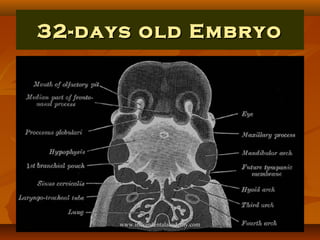
 Thus at this stage stomodeumThus at this stage stomodeum
is overlapped from above by theis overlapped from above by the
frontal process, below by thefrontal process, below by the
mandibular process & on eithermandibular process & on either
side by the maxillary process.side by the maxillary process.
www.indiandentalacademy.comwww.indiandentalacademy.com
32-days old Embryo32-days old Embryo
www.indiandentalacademy.comwww.indiandentalacademy.com
Nasal PitsNasal Pits
 Ectoderm overlying the fronto-nasalEctoderm overlying the fronto-nasal
process shows bilateral localizedprocess shows bilateral localized
thickenings above the stomodeum whichthickenings above the stomodeum which
soon sink & form thesoon sink & form the nasal pitsnasal pits. The. The
formation of these nasal pits divides theformation of these nasal pits divides the
fronto-nasal process into two parts.fronto-nasal process into two parts.
1]1] Medial nasal processMedial nasal process
2]2] Lateral nasal process.Lateral nasal process.
www.indiandentalacademy.comwww.indiandentalacademy.com
 Two mandibular processes growTwo mandibular processes grow
medially & fuse to form themedially & fuse to form the lowerlower
lip & lower jaw.lip & lower jaw.
www.indiandentalacademy.comwww.indiandentalacademy.com
 No primary cartilage exists in theNo primary cartilage exists in the
maxillary processmaxillary process, but the centre of, but the centre of
ossification is associated closely with theossification is associated closely with the
cartilage of the nasal capsule. From thiscartilage of the nasal capsule. From this
center, bone formation spreadscenter, bone formation spreads
posteriorly below theposteriorly below the orbitorbit towards thetowards the
developingdeveloping zygomazygoma & anteriorly towards& anteriorly towards
the futurethe future incisor regionincisor region, ossification, ossification
also spreads superiorly to form thealso spreads superiorly to form the
frontal process.frontal process.
www.indiandentalacademy.comwww.indiandentalacademy.com
Lateral AlveolarLateral Alveolar
PlatePlate
 As a result of this pattern of boneAs a result of this pattern of bone
deposition adeposition a bony troughbony trough forms for theforms for the
infraorbital nerve. From this trough ainfraorbital nerve. From this trough a
downward extension of bone forms thedownward extension of bone forms the
lateral alveolar platelateral alveolar plate for the maxillaryfor the maxillary
tooth germs.tooth germs.
www.indiandentalacademy.comwww.indiandentalacademy.com
 Ossification also spreadsOssification also spreads
into the palatine process tointo the palatine process to
form the hard palate.form the hard palate.
www.indiandentalacademy.comwww.indiandentalacademy.com
Medial AlveolarMedial Alveolar
PlatePlate
 Medial alveolar plateMedial alveolar plate develops from thedevelops from the
junction of the palatal process & the mainjunction of the palatal process & the main
body of the forming maxilla. This platebody of the forming maxilla. This plate
together with its lateral counterpart, formstogether with its lateral counterpart, forms
a trough of bone around a maxillary tootha trough of bone around a maxillary tooth
germs.germs.
www.indiandentalacademy.comwww.indiandentalacademy.com
Secondary CartilageSecondary Cartilage
 Secondary cartilage has some contributesSecondary cartilage has some contributes
into the development of maxilla. Ainto the development of maxilla. A
zygomatic cartilagezygomatic cartilage appears in theappears in the
developing zygomatic process.developing zygomatic process.
At birth maxilla is relatively smallAt birth maxilla is relatively small
because the maxillary sinus has notbecause the maxillary sinus has not
yet developed.yet developed.
www.indiandentalacademy.comwww.indiandentalacademy.com
 PalatePalate is formed byis formed by Maxillary Process;Maxillary Process;
Palatal Process; Fronto -nasal process.Palatal Process; Fronto -nasal process.
 Fronto -nasal process gives rise to theFronto -nasal process gives rise to the
premaxillary region (which carries thepremaxillary region (which carries the
incisor teeth), while the palatal shelvesincisor teeth), while the palatal shelves
form the rest of the palate.form the rest of the palate.
www.indiandentalacademy.comwww.indiandentalacademy.com
Palatal ProcessPalatal Process
 From each maxillary process, a palate likeFrom each maxillary process, a palate like
shelves grows medially. This is called palatalshelves grows medially. This is called palatal
process. As the palatal shelves grow medially,process. As the palatal shelves grow medially,
their union is prevented by the presence oftheir union is prevented by the presence of
tongue. Thus initially the developing palataltongue. Thus initially the developing palatal
shelves grow vertically downwards towardsshelves grow vertically downwards towards
the floor of the mouth.the floor of the mouth.
Sometime during the 7th week of IUL,Sometime during the 7th week of IUL,
transformation in the position of the palataltransformation in the position of the palatal
shelves occurs. They change from a vertical to ashelves occurs. They change from a vertical to a
horizontal position.horizontal position.
www.indiandentalacademy.comwww.indiandentalacademy.com
Fusion of Two PalatalFusion of Two Palatal
ProcessesProcesses
 Two palatal shelves, by 8 ½ week of IUL,Two palatal shelves, by 8 ½ week of IUL,
are in close approximation with eachare in close approximation with each
other. Initially the two palatal shelvesother. Initially the two palatal shelves
are covered by an epithelial lining. Asare covered by an epithelial lining. As
they join, the epithelial cells degenerate.they join, the epithelial cells degenerate.
The connective tissue of the palatalThe connective tissue of the palatal
shelves intermingle with each othershelves intermingle with each other
resulting in their fusion.resulting in their fusion.
www.indiandentalacademy.comwww.indiandentalacademy.com
Complete PalatalComplete Palatal
FusionFusion
 Each palatal process fuses with posteriorEach palatal process fuses with posterior
margin of the primitive palate (formedmargin of the primitive palate (formed
from the frontonasal process). Then twofrom the frontonasal process). Then two
palatal processes fuse with each other inpalatal processes fuse with each other in
the midline. There fusion begin anteriorlythe midline. There fusion begin anteriorly
& proceeds backwards. Medial edge of the& proceeds backwards. Medial edge of the
palatal processes fuse with the free lowerpalatal processes fuse with the free lower
edge of the nasal septum, thus separatingedge of the nasal septum, thus separating
the two nasal cavities from each other &the two nasal cavities from each other &
from the mouth.from the mouth.
www.indiandentalacademy.comwww.indiandentalacademy.com
Ossification ofOssification of
PalatePalate
 Occurs from 8th week of IUL.Occurs from 8th week of IUL.
 This is an intra-membranous type ofThis is an intra-membranous type of
ossification. Mesoderm in the palate undergoesossification. Mesoderm in the palate undergoes
ossification to form the hard palate.ossification to form the hard palate.
 Ossification does not extend into the posteriorOssification does not extend into the posterior
most portions, which remain as the soft palate.most portions, which remain as the soft palate.
 Palate ossifies from a single centre derivedPalate ossifies from a single centre derived
from the maxilla.from the maxilla.
 The mid-palatal suture ossifies by 12-14years.The mid-palatal suture ossifies by 12-14years.
www.indiandentalacademy.comwww.indiandentalacademy.com
 Oblique facial cleft results due toOblique facial cleft results due to
Improper fusion b/w maxillary & lateralImproper fusion b/w maxillary & lateral
nasal process.nasal process.
www.indiandentalacademy.comwww.indiandentalacademy.com
4141stst
to 45to 45thth
day IULday IUL
 Mandible is formed by Meckel’sMandible is formed by Meckel’s
cartilage of 1st branchial arch,cartilage of 1st branchial arch,
which has close positionalwhich has close positional
relationship to the developingrelationship to the developing
mandible but makes nomandible but makes no
contributioncontribution
(Guiding the growth of mandible).(Guiding the growth of mandible).
www.indiandentalacademy.comwww.indiandentalacademy.com
66thth
Week of IULWeek of IUL
 Meckel’s cartilage appears as a solid hyalineMeckel’s cartilage appears as a solid hyaline
cartilaginous rod covered by fibro-cellularcartilaginous rod covered by fibro-cellular
membrane.membrane.
www.indiandentalacademy.comwww.indiandentalacademy.com
 Cartilage extendsCartilage extends from a developing earfrom a developing ear
region (Otic Capsule) to the midlineregion (Otic Capsule) to the midline
(Symphysis).(Symphysis).
www.indiandentalacademy.comwww.indiandentalacademy.com
 First structure toFirst structure to
develop in thedevelop in the
primordium of theprimordium of the
lower jaw is thelower jaw is the
mandibularmandibular
division ofdivision of
trigeminal nerve.trigeminal nerve.
www.indiandentalacademy.comwww.indiandentalacademy.com
 Trigeminal nerve has a close relationship toTrigeminal nerve has a close relationship to
Meckel’s cartilageMeckel’s cartilage, beginning 2/3rd of the way, beginning 2/3rd of the way
along the length of the cartilage. At this pointalong the length of the cartilage. At this point
mandibular nerve divides into lingual & inferiormandibular nerve divides into lingual & inferior
alveolar branches, which run along medial &alveolar branches, which run along medial &
lateral aspects of the cartilage, respectively. Inferiorlateral aspects of the cartilage, respectively. Inferior
alveolar nerve further divides into incisor & mentalalveolar nerve further divides into incisor & mental
branches more anteriorly.branches more anteriorly.
www.indiandentalacademy.comwww.indiandentalacademy.com
During 6During 6thth
Week ofWeek of
IULIUL
 On the lateral aspect of Meckel’sOn the lateral aspect of Meckel’s
cartilage, acartilage, a condensation ofcondensation of
mesenchymemesenchyme occurs in the angle formedoccurs in the angle formed
by the division of the inferior alveolarby the division of the inferior alveolar
nerve & its incisor & mental branches.nerve & its incisor & mental branches.
www.indiandentalacademy.comwww.indiandentalacademy.com
NeurotrophicNeurotrophic
FactorsFactors
 Produced byProduced by
nervenerve
inducedinduced
osteogenesisosteogenesis
in thein the
ossificationossification
centers.centers.
www.indiandentalacademy.comwww.indiandentalacademy.com
77thth
Week of IULWeek of IUL
 Intramembranous ossificationIntramembranous ossification beginsbegins
in this condensation. A singlein this condensation. A single
ossification centre for each half of theossification centre for each half of the
mandible arises in the region ofmandible arises in the region of mentalmental
foramen.foramen. From this centre ofFrom this centre of
ossification, bone formation spreadsossification, bone formation spreads
rapidly anteriorly to the midline &rapidly anteriorly to the midline &
posteriorly towards the point where theposteriorly towards the point where the
mandibular nerve divides into its lingualmandibular nerve divides into its lingual
& inferior alveolar branches.& inferior alveolar branches.
www.indiandentalacademy.comwww.indiandentalacademy.com
 This spread of new bone formationThis spread of new bone formation
occurs anteriorly along the lateral aspectoccurs anteriorly along the lateral aspect
of Meckel’s cartilage, forming aof Meckel’s cartilage, forming a troughtrough
that consists ofthat consists of lateral & medial plateslateral & medial plates
that units beneath thethat units beneath the incisor nerveincisor nerve..
www.indiandentalacademy.comwww.indiandentalacademy.com
 This trough of bone extends to theThis trough of bone extends to the midline,midline,
where it comes into close approximation withwhere it comes into close approximation with
similar trough of opposite side.similar trough of opposite side.
 The two separate centre of ossifications remainThe two separate centre of ossifications remain
separated at theseparated at the mandibular symphysismandibular symphysis untiluntil
shortly after birth.shortly after birth.
 The trough is soon converted into aThe trough is soon converted into a canalcanal asas
bone forms over the nerve, joining the lateralbone forms over the nerve, joining the lateral
& medial plates.& medial plates.
www.indiandentalacademy.comwww.indiandentalacademy.com
Inferior Alveolar NerveInferior Alveolar Nerve
CanalCanal
 Backward extension of ossification along the lateral aspect ofBackward extension of ossification along the lateral aspect of
Meckel’s cartilage forms a gutter, later converted into a canalMeckel’s cartilage forms a gutter, later converted into a canal
that contains the inferior alveolar nerve.that contains the inferior alveolar nerve.
 This backward extension of ossification proceeds to the pointThis backward extension of ossification proceeds to the point
where the mandibular nerve divides into the inferior alveolarwhere the mandibular nerve divides into the inferior alveolar
& lingual nerves.& lingual nerves.
 From this bony canal, (extending from the division ofFrom this bony canal, (extending from the division of
mandibular nerve to the midline) medial & lateral alveolarmandibular nerve to the midline) medial & lateral alveolar
plates of bone develop in relation to the forming tooth germsplates of bone develop in relation to the forming tooth germs
so that the tooth germ occupy the secondary trough of bone.so that the tooth germ occupy the secondary trough of bone.
This trough is partitioned, & thus the teeth come to occupyThis trough is partitioned, & thus the teeth come to occupy
individual compartments, which finally are totally enclosedindividual compartments, which finally are totally enclosed
by growth of bone over the tooth germ. In this way the bodyby growth of bone over the tooth germ. In this way the body
of the mandible essentially is formed.of the mandible essentially is formed.www.indiandentalacademy.comwww.indiandentalacademy.com
Ramus of theRamus of the
MandibleMandible
 DDevelops by a rapid spread of ossificationevelops by a rapid spread of ossification
posteriorly into the mesenchyme of the 1stposteriorly into the mesenchyme of the 1st
arch, turning away from Meckel’s cartilage.arch, turning away from Meckel’s cartilage.
This point of divergence is marked by theThis point of divergence is marked by the
lingulalingula in the adult mandiblein the adult mandible
(the point at which the inferior(the point at which the inferior
alveolar nerve enters the body of thealveolar nerve enters the body of the
mandible).mandible).
www.indiandentalacademy.comwww.indiandentalacademy.com
 Ossification stops at the site that will laterOssification stops at the site that will later
become the mandibular lingula from wherebecome the mandibular lingula from where
Meckel’s cartilage continues into the middle earMeckel’s cartilage continues into the middle ear
& develops into the& develops into the auditory ossicles (Malleusauditory ossicles (Malleus
& Incus).& Incus).
www.indiandentalacademy.comwww.indiandentalacademy.com
SphenomandibularSphenomandibular
LigamentLigament
 From the sphenoid to the division ofFrom the sphenoid to the division of
mandibular nerve into its alveolar & lingualmandibular nerve into its alveolar & lingual
branches, thebranches, the cartilage is lost totallycartilage is lost totally , but, but
its fibro-cellular capsule persists as theits fibro-cellular capsule persists as the
sphenomandibular ligament.sphenomandibular ligament.
 From the lingula forward to the division ofFrom the lingula forward to the division of
the alveolar nerve into its incisor & mentalthe alveolar nerve into its incisor & mental
branches,branches, Meckel’s cartilage is resorbedMeckel’s cartilage is resorbed
completely.completely.
www.indiandentalacademy.comwww.indiandentalacademy.com
1010thth
Week of IULWeek of IUL
 Rudimentary mandible is formedRudimentary mandible is formed
almost entirely by membranousalmost entirely by membranous
ossification with (it must be stress) littleossification with (it must be stress) little
direct involvement of Meckel’s cartilage.direct involvement of Meckel’s cartilage.
Forward from this point to the midlineForward from this point to the midline
some evidence exits that cartilage mightsome evidence exits that cartilage might
make a small contribution to themake a small contribution to the
mandible by means of endochondralmandible by means of endochondral
ossification???ossification???
www.indiandentalacademy.comwww.indiandentalacademy.com
Secondary GrowthSecondary Growth
CartilagesCartilages
 Further growth of the mandibleFurther growth of the mandible
until birth is influenceduntil birth is influenced
strongly by the appearance ofstrongly by the appearance of
three secondary growth cartilages.three secondary growth cartilages.
[Endochondral Bone Formation][Endochondral Bone Formation]
www.indiandentalacademy.comwww.indiandentalacademy.com
1] Condylar1] Condylar
CartilageCartilage
Appears during 12th week of developmentAppears during 12th week of development
& rapidly formed a carrot-shaped mass that& rapidly formed a carrot-shaped mass that
occupies most of the developing ramus. Thisoccupies most of the developing ramus. This
mass of cartilage is converted quickly tomass of cartilage is converted quickly to
bone by endochondral ossification so that atbone by endochondral ossification so that at
20weeks only a thin layer of cartilage is20weeks only a thin layer of cartilage is
remains in the condylar head. This remnantremains in the condylar head. This remnant
of cartilage persists until the end of secondof cartilage persists until the end of second
decade of life, providing the mechanism fordecade of life, providing the mechanism for
growth of mandible, in the same way as thegrowth of mandible, in the same way as the
epiphyseal cartilage does in the limbs.epiphyseal cartilage does in the limbs.www.indiandentalacademy.comwww.indiandentalacademy.com
2] Coronoid2] Coronoid
CartilageCartilage
Appears about 4th month of development,Appears about 4th month of development,
surrounding the anterior border & top ofsurrounding the anterior border & top of
the coronoid process. Coronoid cartilagethe coronoid process. Coronoid cartilage
is a transient growth cartilage is believedis a transient growth cartilage is believed
to grow as a response to the developingto grow as a response to the developing
temporalis muscle & disappears longtemporalis muscle & disappears long
before birth.before birth.
www.indiandentalacademy.comwww.indiandentalacademy.com
3] Symphyseal3] Symphyseal
CartilageCartilage
In the mental region, on either side of theIn the mental region, on either side of the
symphysis, two cartilages, appear in thesymphysis, two cartilages, appear in the
connective tissue b/w the two ends ofconnective tissue b/w the two ends of
Meckel’s cartilage but are entirelyMeckel’s cartilage but are entirely
independent of it. They are obliteratedindependent of it. They are obliterated
within the 1st year after birth.within the 1st year after birth.
www.indiandentalacademy.comwww.indiandentalacademy.com
 Thus the mandible is aThus the mandible is a membranousmembranous
bonebone ,, developed in relation to thedeveloped in relation to the
nerve of the 1st archnerve of the 1st arch & almost& almost
entirely independent of Meckel’sentirely independent of Meckel’s
cartilage.cartilage.
www.indiandentalacademy.comwww.indiandentalacademy.com
Development of LowerDevelopment of Lower
LipLip
Mandibular processes of the two sides growMandibular processes of the two sides grow
towards each other & fuse in the midline. Theytowards each other & fuse in the midline. They
now form the lower margin of the stomodeumnow form the lower margin of the stomodeum
(remember mouth develops from stomodeum)—(remember mouth develops from stomodeum)—
the two mandibular processes give rise to lowerthe two mandibular processes give rise to lower
lip & lower jaw.lip & lower jaw.
www.indiandentalacademy.comwww.indiandentalacademy.com
Development of UpperDevelopment of Upper
LipLip
 Each maxillary process grow medially & fusesEach maxillary process grow medially & fuses
with the lateral nasal process & then medialwith the lateral nasal process & then medial
nasal process. Medial & lateral processes alsonasal process. Medial & lateral processes also
fuse each other. In this way the nasal pits (nowfuse each other. In this way the nasal pits (now
called—External nares) are cut off from thecalled—External nares) are cut off from the
stomodeum.stomodeum.
 Maxillary processes undergo considerableMaxillary processes undergo considerable
growth. At the same time the frontonasalgrowth. At the same time the frontonasal
process becomes much narrower from side toprocess becomes much narrower from side to
side, with the result that the two external naresside, with the result that the two external nares
come closer together. Stomodeum is nowcome closer together. Stomodeum is now
bounded above by the upper lip.bounded above by the upper lip.
www.indiandentalacademy.comwww.indiandentalacademy.com
 Mesodermal basis of lateral part ofMesodermal basis of lateral part of
the upper lip is formed from thethe upper lip is formed from the
maxillary process. The overlyingmaxillary process. The overlying
skin is derived from ectodermskin is derived from ectoderm
covering this process. Mesodermalcovering this process. Mesodermal
basis of medial part of the lip (calledbasis of medial part of the lip (called
Philtrum) is formed from thePhiltrum) is formed from the
frontonasal process.frontonasal process.
www.indiandentalacademy.comwww.indiandentalacademy.com
Development of NoseDevelopment of Nose
 It receives contribution from the frontonasal processIt receives contribution from the frontonasal process
& from the medial & lateral processes of the right && from the medial & lateral processes of the right &
left sides. We have seen that the external nares areleft sides. We have seen that the external nares are
formed when the nasal pits are cut off from theformed when the nasal pits are cut off from the
stomodeum by the fusion of the maxillary process withstomodeum by the fusion of the maxillary process with
the medial nasal process. We have also noted that thethe medial nasal process. We have also noted that the
frontonasal process becomes progressively narrow &frontonasal process becomes progressively narrow &
its deeper part ultimately form the nasal septum.its deeper part ultimately form the nasal septum.
Mesoderm becomes heaped up in the median plane toMesoderm becomes heaped up in the median plane to
form the prominent of the nose. Simultaneously aform the prominent of the nose. Simultaneously a
groove appears b/w the region of the nose.groove appears b/w the region of the nose.
Floor of the nasal cavity is formed byFloor of the nasal cavity is formed by Palatine process of maxilla & horizontalPalatine process of maxilla & horizontal
part of palatine bone.part of palatine bone. www.indiandentalacademy.comwww.indiandentalacademy.com
Development ofDevelopment of
CheekCheek
 After formation of upper & lower lips, StomodeumAfter formation of upper & lower lips, Stomodeum
(which can now be called the mouth) is very broad. In(which can now be called the mouth) is very broad. In
its lateral part it is bounded above by the maxillaryits lateral part it is bounded above by the maxillary
process & below by the mandibular process. Theseprocess & below by the mandibular process. These
processes undergo progressive fusion with each otherprocesses undergo progressive fusion with each other
to form the cheeks.to form the cheeks.
 We have seen that the during the formation of theWe have seen that the during the formation of the
upper lip maxillary process fuses with the lateral nasalupper lip maxillary process fuses with the lateral nasal
process. This fusion not only occurs in the region ofprocess. This fusion not only occurs in the region of
the lip but also from the stomodeum to the medialthe lip but also from the stomodeum to the medial
angle of the developing eye. For some time this line ofangle of the developing eye. For some time this line of
fusion is marked by a groove called naso -optic furrow/fusion is marked by a groove called naso -optic furrow/
nasolacrimal sulcus. A strip of ectoderm becomesnasolacrimal sulcus. A strip of ectoderm becomes
buried along this furrow & give rise to theburied along this furrow & give rise to the
nasolacrimal duct.nasolacrimal duct. www.indiandentalacademy.comwww.indiandentalacademy.com
Development ofDevelopment of
TongueTongueEpitheliumEpithelium
 Anterior 2/3rd—From two lingual swelling & oneAnterior 2/3rd—From two lingual swelling & one
tuberculum impar (from the 1st branchial arch)—tuberculum impar (from the 1st branchial arch)—
Lingual Nerve & Chordatympani.Lingual Nerve & Chordatympani.
 Posterior 1/3rd— From the cranial half ofPosterior 1/3rd— From the cranial half of
hypobranchial eminence (From 3rd arch)—hypobranchial eminence (From 3rd arch)—
Glossopharyngeal Nerve.Glossopharyngeal Nerve.
 Posterior most part—(From 4th arch)—VagusPosterior most part—(From 4th arch)—Vagus
Nerve.Nerve.
MusclesMuscles
 Develop from occipital myotomes—GlossoDevelop from occipital myotomes—Glosso
-pharyngeal Nerve.-pharyngeal Nerve.
Connective tissueConnective tissue
 Develop from local mesenchyme.Develop from local mesenchyme.
 1st papillae to appear on tongue — Circumvallate.1st papillae to appear on tongue — Circumvallate.
 Intrinsic muscles of the tongue develop from—Intrinsic muscles of the tongue develop from—
Occipital myotomes.Occipital myotomes.www.indiandentalacademy.comwww.indiandentalacademy.com
Development of TMJDevelopment of TMJ
 At 3mons of gestation, the secondary jawAt 3mons of gestation, the secondary jaw
joint, the TMJ begins to form. It starts withjoint, the TMJ begins to form. It starts with
condensation of mesenchyme called thecondensation of mesenchyme called the
Temporal Blastema & Condylar Blastema.Temporal Blastema & Condylar Blastema.
 A cleft appears above the condylar blastema toA cleft appears above the condylar blastema to
form the inferior joint cavity & the condylarform the inferior joint cavity & the condylar
blastema differentiates into condylar cartilage.blastema differentiates into condylar cartilage.
Another cleft occurs in the temporal blastomaAnother cleft occurs in the temporal blastoma
to form the superior joint space.to form the superior joint space.
Simultaneously the articular disc is formed.Simultaneously the articular disc is formed.
The temporal blastoma gets ossified.The temporal blastoma gets ossified.
TMJ is the last joint to be formed in the body.TMJ is the last joint to be formed in the body.
The complete development of this joint is over only by 12th year.The complete development of this joint is over only by 12th year.
www.indiandentalacademy.comwww.indiandentalacademy.com
Development of SalivaryDevelopment of Salivary
GlandsGlands
 Ectomesenchyme of 1st arch is essential forEctomesenchyme of 1st arch is essential for
the complete development of salivary glands.the complete development of salivary glands.
1st Parotid gland develops, followed by submandibular & sublingual1st Parotid gland develops, followed by submandibular & sublingual
glands.glands.
 Primordial of the parotid & submandibularPrimordial of the parotid & submandibular
glands appear during the 6th week, whereasglands appear during the 6th week, whereas
the primordium of the sublingual glandthe primordium of the sublingual gland
appears after 7th -8th weeks of fetal life.appears after 7th -8th weeks of fetal life.
 The minor salivary glands begin theirThe minor salivary glands begin their
development during the 3rd month.development during the 3rd month.
www.indiandentalacademy.comwww.indiandentalacademy.com

Human growth & development

  • 1.
    Human Growth &HumanGrowth & DevelopmentDevelopment  Pre-natalPre-natal DevelopmentDevelopment  Post-natalPost-natal DevelopmentDevelopment www.indiandentalacademy.comwww.indiandentalacademy.com
  • 2.
    [JX Huxley][JX Huxley] ‘‘Self-multiplicationof living substance’.Self-multiplication of living substance’. [Krogman][Krogman] ‘‘Increase in size, change in proportion & progressiveIncrease in size, change in proportion & progressive complexity’.complexity’. [Meredith][Meredith] ‘‘Entire series of sequential anatomic & physiologicalEntire series of sequential anatomic & physiological changes taking place from the beginning of prenatalchanges taking place from the beginning of prenatal life to senility’.life to senility’. [Moyers][Moyers] ‘‘Quantitative aspect of biologic development per unitQuantitative aspect of biologic development per unit of time’.of time’. [Moss][Moss] ‘‘Change in any morphological parameter which isChange in any morphological parameter which is measurable’.measurable’. www.indiandentalacademy.comwww.indiandentalacademy.com
  • 3.
     Thorough backgroundin craniofacialThorough background in craniofacial growth & development is necessary forgrowth & development is necessary for every dentist. Even for those who neverevery dentist. Even for those who never work with children, it is difficult towork with children, it is difficult to comprehend conditions observed incomprehend conditions observed in adults without understanding theadults without understanding the developmental processes that produceddevelopmental processes that produced these problems.these problems. [William R.[William R. Proffit]Proffit] www.indiandentalacademy.comwww.indiandentalacademy.com
  • 4.
    ““Embryology is thestudy of formationEmbryology is the study of formation & development of the embryo from& development of the embryo from the movement of its inception up tothe movement of its inception up to the time when it is born an infant”.the time when it is born an infant”.  Kaspar FriedrichKaspar Friedrich (Described modern Embryology)(Described modern Embryology) www.indiandentalacademy.comwww.indiandentalacademy.com
  • 5.
     During first2months we call the developingDuring first 2months we call the developing individualindividual An EmbryoAn Embryo  From third month until birthFrom third month until birth FetusFetus  From birth to 1yr of ageFrom birth to 1yr of age An InfantAn Infant  A young child who is just beginning to walkA young child who is just beginning to walk ToddlerToddler  Period shows onset of puberty. Period markPeriod shows onset of puberty. Period mark the secondary sex characters [12-15y(G) 13-the secondary sex characters [12-15y(G) 13- 16y(B)]16y(B)] TeenagerTeenager  Developing from child to an adult (13-19y)Developing from child to an adult (13-19y) AdolescentAdolescent  Body attained full growth & maturity of anBody attained full growth & maturity of an organism (18-21y)organism (18-21y) AdultAdultwww.indiandentalacademy.comwww.indiandentalacademy.com
  • 6.
     As anOrthodontics we are interested inAs an Orthodontics we are interested in understanding how the face changesunderstanding how the face changes from its embryonic form throughfrom its embryonic form through childhood, adolescence & adulthood.childhood, adolescence & adulthood. www.indiandentalacademy.comwww.indiandentalacademy.com
  • 7.
     To understandhow & where growthTo understand how & where growth occurs, how much growth isoccurs, how much growth is remaining, in which direction & whenremaining, in which direction & when growth will express itself, what rolesgrowth will express itself, what roles the genetic & environmental factorsthe genetic & environmental factors play in influencing facial growth & inplay in influencing facial growth & in turn how we can influence theseturn how we can influence these factors with our Treatment, tofactors with our Treatment, to achieved the optimum results in theachieved the optimum results in the potential of each individual person.potential of each individual person. Answer of all these questions will comeAnswer of all these questions will come when we know the human growth &when we know the human growth & development.development. www.indiandentalacademy.comwww.indiandentalacademy.com
  • 8.
     Although ourunderstanding ofAlthough our understanding of gross Anatomy & Embryology aregross Anatomy & Embryology are unlikely to change in future.unlikely to change in future.  Advances in clinical treatment areAdvances in clinical treatment are predicated on the bases of solidpredicated on the bases of solid foundation of anatomic knowledge.foundation of anatomic knowledge. www.indiandentalacademy.comwww.indiandentalacademy.com
  • 9.
    PrenatalPrenatal DevelopmentDevelopment  Period OfOvumPeriod Of Ovum  Period Of EmbryoPeriod Of Embryo  Period Of FetusPeriod Of Fetus HippocratesHippocrates——’Father of Medicine’ &’Father of Medicine’ & ‘Founder of Anatomy’‘Founder of Anatomy’ www.indiandentalacademy.comwww.indiandentalacademy.com
  • 10.
    o Period ofOvumPeriod of Ovum  From the fertilization to the end of 14From the fertilization to the end of 14thth day.day.  Cleavage of the ovum.Cleavage of the ovum.  Ovum is only 1.5mm in length.Ovum is only 1.5mm in length. www.indiandentalacademy.comwww.indiandentalacademy.com
  • 11.
     Period ofEmbryoPeriod of Embryo  1414thth day to 56day to 56thth day.day.  Formation of Embryonic DiscFormation of Embryonic Disc  Formation of Pharyngeal archesFormation of Pharyngeal arches  Formation of nasal pitsFormation of nasal pits  Development of Cranial structuresDevelopment of Cranial structures  Development of pre-oral region {Palate;Development of pre-oral region {Palate; Tongue; Maxilla; Mandible}Tongue; Maxilla; Mandible} www.indiandentalacademy.comwww.indiandentalacademy.com
  • 12.
    o Period ofFetusPeriod of Fetus 5656thth day to 270 days/3day to 270 days/3rdrd to 9to 9thth months (till birth).months (till birth). B/w 8B/w 8thth to 12to 12thth weeks of IULweeks of IUL Fetus triples in length from 20mm to 60mm.Fetus triples in length from 20mm to 60mm. By 3By 3rdrd monthmonth Face assumes a more human appearance.Face assumes a more human appearance. From 12From 12thth to 36to 36thth week of IULweek of IUL Head increases in length from approximatelyHead increases in length from approximately 18mm to 120mm; in width from 12mm to 74mm;18mm to 120mm; in width from 12mm to 74mm; in height from 20mm to 100mmin height from 20mm to 100mm www.indiandentalacademy.comwww.indiandentalacademy.com
  • 13.
    o Cranium toface ratioCranium to face ratio  During Embryonic period—40:1During Embryonic period—40:1  During 4During 4thth month of IUL—5:1month of IUL—5:1  At Birth—8:1At Birth—8:1  At Adulthood—2:1At Adulthood—2:1 AristotleAristotle——’Father of Ancient Anatomy’’Father of Ancient Anatomy’ He forecasted idea of ‘Genetic & Hereditary’He forecasted idea of ‘Genetic & Hereditary’ www.indiandentalacademy.comwww.indiandentalacademy.com
  • 14.
    TeratogensTeratogens— ‘Growing embryoif exposed to— ‘Growing embryo if exposed to certain chemical/physical agents duringcertain chemical/physical agents during pregnancy which causes structuralpregnancy which causes structural developmental abnormalities’.developmental abnormalities’. www.indiandentalacademy.comwww.indiandentalacademy.com
  • 15.
  • 16.
     First 2weeksFirst2weeks  Not sensitive.Not sensitive. {High rate of lethality}{High rate of lethality}  3—8weeks3—8weeks Greatest sensitivityGreatest sensitivity Period for each organ.Period for each organ.  9—38weeks9—38weeks Decreasing sensitivity.Decreasing sensitivity. ‘Functional maturation Period’‘Functional maturation Period’  3—8weeks3—8weeks ‘Period of‘Period of Embryogenesis’.Embryogenesis’.  8—38weeks8—38weeks ‘Period of Foetogenesis’.‘Period of Foetogenesis’. www.indiandentalacademy.comwww.indiandentalacademy.com
  • 17.
     Since thebaby's face develops soSince the baby's face develops so early in the pregnancy, even whenearly in the pregnancy, even when these factors are minimizedthese factors are minimized through proper prenatal care, thethrough proper prenatal care, the damage may have already occurreddamage may have already occurred to the child before the mother wasto the child before the mother was even aware that she was pregnant.even aware that she was pregnant. www.indiandentalacademy.comwww.indiandentalacademy.com
  • 18.
    FertilizationFertilization  At themoment when one spermatozoonAt the moment when one spermatozoon meets & fuses with one ovum. Themeets & fuses with one ovum. The development of new individual begins.development of new individual begins. This process of fusion is calledThis process of fusion is called Fertilization.Fertilization.  Fused Ovum & Spermatozoon formFused Ovum & Spermatozoon form Zygote.Zygote.  Fertilization occurs in theFertilization occurs in the ampullaampulla of theof the uterine tube.uterine tube. www.indiandentalacademy.comwww.indiandentalacademy.com
  • 19.
     RobertRobert HookeHooke—— identified &identified& name thename the ‘cell’.‘cell’. www.indiandentalacademy.comwww.indiandentalacademy.com
  • 20.
  • 21.
    Cell DivisionCell Division When after cell division, the daughterWhen after cell division, the daughter cell must have chromosomes identical incell must have chromosomes identical in number to those in the mother cell. Thisnumber to those in the mother cell. This type of cell division is calledtype of cell division is called Mitosis.Mitosis.  When after division, the chromosome of theWhen after division, the chromosome of the daughter cell becomes non-identical indaughter cell becomes non-identical in number to those in the mother cell. Thisnumber to those in the mother cell. This type of cell division is calledtype of cell division is called Meiosis.Meiosis. www.indiandentalacademy.comwww.indiandentalacademy.com
  • 22.
  • 23.
  • 24.
  • 25.
    Two-Cell-Stage ofTwo-Cell-Stage of EmbryoEmbryo During Fertilization Chromosomes of theDuring Fertilization Chromosomes of the ovum (23-Female chromosomes) fused withovum (23-Female chromosomes) fused with chromosomes of the spermatozoon (23-Malechromosomes of the spermatozoon (23-Male Chromosomes) so that the fertilized ovumChromosomes) so that the fertilized ovum now has the 46 chromosomes in all. Each ofnow has the 46 chromosomes in all. Each of the 46 chromosomes then splits into two.the 46 chromosomes then splits into two. Meanwhile, a spindle is formed, & oneMeanwhile, a spindle is formed, & one chromosome of each pair moves to each endchromosome of each pair moves to each end of the spindle leading to the formation ofof the spindle leading to the formation of two daughter cells.two daughter cells. www.indiandentalacademy.comwww.indiandentalacademy.com
  • 26.
     These twocells undergo series of divisions.These two cells undergo series of divisions. This process of subdivision of ovum intoThis process of subdivision of ovum into smaller cells is calledsmaller cells is called Cleavage.Cleavage.  zygote {after 30hrs after fertilization}:zygote {after 30hrs after fertilization}: Two blastomeresTwo blastomeres Four blastomeresFour blastomeres Eight blastomeresEight blastomeres Repeated mitotic divisions www.indiandentalacademy.comwww.indiandentalacademy.com
  • 27.
    Formation of MorulaFormationof Morula  As cleavage proceeds the ovum comes toAs cleavage proceeds the ovum comes to have 12 to 32 blastomeres cells. Thehave 12 to 32 blastomeres cells. The developing human is now calleddeveloping human is now called Morula.Morula. (It resembles a(It resembles a mulberry or black berry)mulberry or black berry) Gregory Johann MendelGregory Johann Mendel ——PublishedPublished experiments on plant hybridization.experiments on plant hybridization. ‘Father of Genetics’‘Father of Genetics’ www.indiandentalacademy.comwww.indiandentalacademy.com
  • 28.
  • 29.
  • 30.
    Formation ofFormation of BlastocystBlastocyst When morula enters uterus (4When morula enters uterus (4thth days afterdays after fertilization), fluid filled space appears inside thefertilization), fluid filled space appears inside the morula.morula.  As the fluid increases in the blastocystic cavity ,itAs the fluid increases in the blastocystic cavity ,it separates the blastomeres into two parts:separates the blastomeres into two parts: TrophoblastTrophoblast {outer cell layer}{outer cell layer} EmbryoblastEmbryoblast {inner cell mass}{inner cell mass} At this stage of development theAt this stage of development the conceptus is called aconceptus is called a blastocystblastocyst www.indiandentalacademy.comwww.indiandentalacademy.com
  • 31.
  • 32.
    TROPHOBLASTTROPHOBLAST  Inner layerof cytotrophoblastInner layer of cytotrophoblast  Outer mass of syncytiotrophoblastOuter mass of syncytiotrophoblast www.indiandentalacademy.comwww.indiandentalacademy.com
  • 33.
  • 34.
    Formation of EmbryonicFormationof Embryonic DiscDisc  Embryobalsts form the embryonic Spherical discEmbryobalsts form the embryonic Spherical disc which forms three germ layers.which forms three germ layers. 1]1] EndodermEndoderm (Hypoblast-Cuboidal cells)—Inside (1(Hypoblast-Cuboidal cells)—Inside (1stst germ layer to be formed)germ layer to be formed) 2]2] EctodermEctoderm (Epiblast-Columnar cell)—Outside (2(Epiblast-Columnar cell)—Outside (2ndnd germ layer)germ layer) 3]3] MesodermMesoderm ––In the middleIn the middle www.indiandentalacademy.comwww.indiandentalacademy.com
  • 35.
     Endoderm spread& lined the blastocysticEndoderm spread & lined the blastocystic cavity with the flattened cells, now thiscavity with the flattened cells, now this cavity is calledcavity is called Primary Yolk Sac.Primary Yolk Sac. www.indiandentalacademy.comwww.indiandentalacademy.com
  • 36.
  • 37.
    Extra-embryonicExtra-embryonic MesodermMesoderm  Cells ofthe trophoblasts give origin to the massCells of the trophoblasts give origin to the mass of cells—of cells— Extra-embryonic mesodermExtra-embryonic mesoderm -which lie b/w-which lie b/w trophoblast & primary yolk sac.trophoblast & primary yolk sac. Extra-embryonic Somatic MesodermExtra-embryonic Somatic Mesoderm —— Line the Cytotrophoblast & covers the amnion.Line the Cytotrophoblast & covers the amnion. Extra-embryonic Visceral MesodermExtra-embryonic Visceral Mesoderm —— Covers the yolk sac.Covers the yolk sac. www.indiandentalacademy.comwww.indiandentalacademy.com
  • 38.
  • 39.
  • 40.
    Prochordal PlateProchordal Plate Prochordal plate cellsProchordal plate cells develops as adevelops as a localized thickening of endodermal cellslocalized thickening of endodermal cells & indicate the site of buccopharyngeal& indicate the site of buccopharyngeal membrane separating the oral cavity frommembrane separating the oral cavity from Oropharynx (Future cranial region ofOropharynx (Future cranial region of embryo & Future site of mouth)embryo & Future site of mouth)  At one area cubical cells of the endodermAt one area cubical cells of the endoderm become columnar—become columnar— Prochordal plate.Prochordal plate. ItIt determines the central axis of the embryo &determines the central axis of the embryo & divide the embryo into right & left halves &divide the embryo into right & left halves & also distinguish its head & tail ends.also distinguish its head & tail ends. www.indiandentalacademy.comwww.indiandentalacademy.com
  • 41.
  • 42.
    Primitive StreakPrimitive Streak Near the tail end of the disc, begin to proliferate & formNear the tail end of the disc, begin to proliferate & form an epiblastic elevation that bulges into the amniotican epiblastic elevation that bulges into the amniotic cavity—cavity— Primitive Streak.Primitive Streak. The primitive streak is atThe primitive streak is at first a rounded swelling but with the elongation of thefirst a rounded swelling but with the elongation of the embryonic disc it becomes linear & lies at the centralembryonic disc it becomes linear & lies at the central axis of the disc.axis of the disc.  Primitive pitPrimitive pit surrounded by the elevatedsurrounded by the elevated Primitive nodePrimitive node is located at the cranial end of theis located at the cranial end of the primitive streak.primitive streak. Since the cells forming the primitive are leuripotent, theirSince the cells forming the primitive are leuripotent, their persistence may give rise to tumors containing all thepersistence may give rise to tumors containing all the three germ layers.three germ layers. TeratomaTeratoma www.indiandentalacademy.comwww.indiandentalacademy.com
  • 43.
  • 44.
  • 45.
  • 46.
    NotochordNotochord  NotochordNotochord –Itis the midline structure,–It is the midline structure, which develops in the region extending fromwhich develops in the region extending from the cranial end of the primitive streak to thethe cranial end of the primitive streak to the caudal end of the prochordal plate.caudal end of the prochordal plate. (Notochord develops from the anterior(Notochord develops from the anterior extremity of primitive streak.)extremity of primitive streak.) www.indiandentalacademy.comwww.indiandentalacademy.com
  • 47.
    Neural TubeNeural Tube Ectoderm overlying the notochordEctoderm overlying the notochord undergoes changes that result in theundergoes changes that result in the formation of—formation of— Neural tube.Neural tube. NeuralNeural tube gives rise to brain & spinal cord.tube gives rise to brain & spinal cord. www.indiandentalacademy.comwww.indiandentalacademy.com
  • 48.
  • 49.
    Neural PlateNeural Plate Notochord functions as the primaryNotochord functions as the primary inductor in the early embryoinductor in the early embryo  The developing notochord induces theThe developing notochord induces the overlying embryonic ectoderm tooverlying embryonic ectoderm to thicken and form thethicken and form the “neural plate”“neural plate” [Primordium of central nervous system][Primordium of central nervous system] www.indiandentalacademy.comwww.indiandentalacademy.com
  • 50.
    Intra-embryonicIntra-embryonic MesodermMesoderm  Some cellsSomecells proliferate in theproliferate in the region of theregion of the primitive streak,primitive streak, pass sidewayspass sideways pushingpushing themselves b/wthemselves b/w ectoderm &ectoderm & endoderm—endoderm— Intra-Intra- embryonicembryonic www.indiandentalacademy.comwww.indiandentalacademy.com
  • 51.
    GastrulationGastrulation  The processof formation of primitive streakThe process of formation of primitive streak & the intra-embryonic mesoderm by the& the intra-embryonic mesoderm by the streak is calledstreak is called ‘Gastrulation’.‘Gastrulation’.  Intra-embryonic membrane spreadsIntra-embryonic membrane spreads throughout the disc except in the region ofthroughout the disc except in the region of prochordal plate, which is later form theprochordal plate, which is later form the Buccopharyngeal membrane.Buccopharyngeal membrane. BPM isBPM is composed of ectoderm & endoderm.composed of ectoderm & endoderm. www.indiandentalacademy.comwww.indiandentalacademy.com
  • 52.
    Intra-embryonic mesoderm subdividedintoIntra-embryonic mesoderm subdivided into three parts—three parts— 1]1] Paraxial mesodermParaxial mesoderm 2]2] Lateral mesodermLateral mesoderm 3]3] Intermediate mesodermIntermediate mesoderm In 1638, 1In 1638, 1stst -human dissection was done in America.-human dissection was done in America. www.indiandentalacademy.comwww.indiandentalacademy.com
  • 53.
    [1] Paraxial[1] Paraxial MesodermMesoderm OOneither side of the notochord. It is organized inton either side of the notochord. It is organized into the segments called “somitomeres”. These arethe segments called “somitomeres”. These are arranged into somite. Each somite give rise to:-arranged into somite. Each somite give rise to:-  Sclerotome –cartilage & bone of the axial &Sclerotome –cartilage & bone of the axial & paraxial skeleton (remember neural crest cellsparaxial skeleton (remember neural crest cells give rise to cartilage & bone of the skull & face).give rise to cartilage & bone of the skull & face).  Myotome –segmental muscle component.Myotome –segmental muscle component.  Dermatome—Segmental skin component.Dermatome—Segmental skin component.  Each myotome & dermatome has its own muscleEach myotome & dermatome has its own muscle & nerve component.& nerve component. www.indiandentalacademy.comwww.indiandentalacademy.com
  • 54.
    [2] Lateral Mesoderm[2]Lateral Mesoderm LLateral side of the notochord. Differentiateateral side of the notochord. Differentiate into excretory unit of urinary system &into excretory unit of urinary system & Gonads.Gonads. www.indiandentalacademy.comwww.indiandentalacademy.com
  • 55.
    [3] Inter-mediate[3] Inter-mediate MesodermMesoderm BBetweenParaxial & Lateral mesoderms.etween Paraxial & Lateral mesoderms. Split into partial & visceral layers.Split into partial & visceral layers.  In the head region, cranial to somites,In the head region, cranial to somites, somitomeres give origin to thesomitomeres give origin to the mesenchyme.mesenchyme.  Striated muscle of the tongue is derivedStriated muscle of the tongue is derived from the occipital myotome.from the occipital myotome. www.indiandentalacademy.comwww.indiandentalacademy.com
  • 56.
  • 57.
  • 58.
  • 59.
    StomodeumStomodeum  Cranial moststructure of the embryo enlargesCranial most structure of the embryo enlarges & show two big bulging, cranial bulging& show two big bulging, cranial bulging develops future brain & a little below formdevelops future brain & a little below form pericardium. In-between them there is apericardium. In-between them there is a depression calleddepression called StomodeumStomodeum,, the floor ofthe floor of which is formed by the BPM.which is formed by the BPM. www.indiandentalacademy.comwww.indiandentalacademy.com
  • 60.
     Foregut isbounded ventrally by theForegut is bounded ventrally by the pericardium & dorsally by thepericardium & dorsally by the developing brain. Cranially, it is at firstdeveloping brain. Cranially, it is at first separated from the stomodeum by BPM.separated from the stomodeum by BPM. When this membrane breaks down, theWhen this membrane breaks down, the foregut open to the exterior through theforegut open to the exterior through the stomodeum.stomodeum. Stomodeum is the futureStomodeum is the future mouth.mouth.  Primordial of the craniofacial complexPrimordial of the craniofacial complex develops fromdevelops from Hensen’s node.Hensen’s node. www.indiandentalacademy.comwww.indiandentalacademy.com
  • 61.
  • 62.
    Pharyngeal ArchesPharyngeal Arches 44thth weekafter conceptionweek after conception,, neck is formed by theneck is formed by the elongation of the region b/w the pericardium &elongation of the region b/w the pericardium & stomodeum. This elongation is due to thestomodeum. This elongation is due to the appearance of a series of segmental mesodermalappearance of a series of segmental mesodermal round tubular thickening in the wall of theround tubular thickening in the wall of the cranial most of the foregut. These are calledcranial most of the foregut. These are called Pharyngeal/Branchial arches.Pharyngeal/Branchial arches. TheseThese enlargement is bounded by cleft & grooves thatenlargement is bounded by cleft & grooves that helps defined each other.helps defined each other. www.indiandentalacademy.comwww.indiandentalacademy.com
  • 63.
  • 64.
    Time table ofthe eventsTime table of the events Development of the embryo from fertilizationDevelopment of the embryo from fertilization up to the disc— ‘Pre-organogenesis period’.up to the disc— ‘Pre-organogenesis period’.  22ndnd days after fertilization—Two-Cell-Stagedays after fertilization—Two-Cell-Stage embryo.embryo.  33rdrd days— Morulla developed.days— Morulla developed.  44thth day—Blastocyst formed.day—Blastocyst formed.  88thth day—Disc established (Bilaminar Disc stage)day—Disc established (Bilaminar Disc stage)  1414thth day—Prochordal plate & Primitive streakday—Prochordal plate & Primitive streak formed.formed.  1616thth day—Embryonic disc with three germday—Embryonic disc with three germ layers/ Gastrulation (Trilaminar Disc stage).layers/ Gastrulation (Trilaminar Disc stage). www.indiandentalacademy.comwww.indiandentalacademy.com
  • 65.
  • 66.
  • 67.
  • 68.
  • 69.
    First Evidence ofFirstEvidence of FormationFormation  Seen inSeen in late Somitic Periodlate Somitic Period (4(4thth -8-8thth week IUL)week IUL)  During this period mesenchymal tissueDuring this period mesenchymal tissue derived from primitive streak, neural crest &derived from primitive streak, neural crest & occipital sclerotomes condense around theoccipital sclerotomes condense around the developing brain. Thus a capsule is formeddeveloping brain. Thus a capsule is formed around the brain calledaround the brain called Ectomenix /Ectomenix / Ectomeningeal capsule.Ectomeningeal capsule.  Basal portion of this capsule gives rise to theBasal portion of this capsule gives rise to the future cranial base.future cranial base. www.indiandentalacademy.comwww.indiandentalacademy.com
  • 70.
    4040thth Day OnwardsDay Onwards Ectomeningeal capsule is slowly convertedEctomeningeal capsule is slowly converted into cartilage (onset of cranial baseinto cartilage (onset of cranial base formation).formation).  Conversion of mesenchymal cells intoConversion of mesenchymal cells into cartilage/ chondrification occurs in 4 regions.cartilage/ chondrification occurs in 4 regions. 1)1) ParachordalParachordal 2)2) HypophysealHypophyseal 3)3) NasalNasal 4)4) OticOtic www.indiandentalacademy.comwww.indiandentalacademy.com
  • 71.
    ParachordalParachordal  Chondrification centersformingChondrification centers forming around the cranial end of the notochordaround the cranial end of the notochord are calledare called Parachordal cartilages.Parachordal cartilages. www.indiandentalacademy.comwww.indiandentalacademy.com
  • 72.
    HypophysealHypophyseal  Cranial tothe termination of notochord, (at the level of theCranial to the termination of notochord, (at the level of the oro-pharyngeal membrane) hypophyseal pouch developsoro-pharyngeal membrane) hypophyseal pouch develops which give rise towhich give rise to anterior lobe of the pituitary gland.anterior lobe of the pituitary gland.  --On either side of the hypophyseal stem two hypophyseal /--On either side of the hypophyseal stem two hypophyseal / post sphenoid cartilages develop. These cartilages fusepost sphenoid cartilages develop. These cartilages fuse together & formtogether & form posterior part of the body of sphenoid.posterior part of the body of sphenoid.  --Cranial to the pituitary gland, two presphenoid /--Cranial to the pituitary gland, two presphenoid / trabecular cartilages develop which fuse together & formtrabecular cartilages develop which fuse together & form anterior part of the body of sphenoidanterior part of the body of sphenoid.. Anteriorly, theAnteriorly, the presphenoid cartilage forms a vertical cartilaginous platepresphenoid cartilage forms a vertical cartilaginous plate called mesethmoid cartilage which gives rise to thecalled mesethmoid cartilage which gives rise to the perpendicular plate of ethmoid & cristagalliperpendicular plate of ethmoid & cristagalli..  --Lateral to the pituitary gland chondrification centers are--Lateral to the pituitary gland chondrification centers are seen which formseen which form lesser wing (Orbito-sphenoid) &lesser wing (Orbito-sphenoid) & greater wing of sphenoid.greater wing of sphenoid. www.indiandentalacademy.comwww.indiandentalacademy.com
  • 73.
    NasalNasal  Initially duringdevelopment, a capsuleInitially during development, a capsule is seen around the nasal sense organ.is seen around the nasal sense organ. This capsule chondrifies & forms theThis capsule chondrifies & forms the cartilages of the nostrilscartilages of the nostrils which fusewhich fuse with the cartilages of the cranial base.with the cartilages of the cranial base. www.indiandentalacademy.comwww.indiandentalacademy.com
  • 74.
    OticOtic  A capsuleis seen around the vestibulo-A capsule is seen around the vestibulo- cochlear sense organs. This capsulecochlear sense organs. This capsule chondrifies & later ossifies to give risechondrifies & later ossifies to give rise to theto the mastoid & petrous portion ofmastoid & petrous portion of the temporal bonethe temporal bone. Otic cartilages. Otic cartilages also fuse with the cartilages of thealso fuse with the cartilages of the cranial base.cranial base. www.indiandentalacademy.comwww.indiandentalacademy.com
  • 75.
     Initially separatecentres of cartilageInitially separate centres of cartilage formation in the cranial base, fuseformation in the cranial base, fuse together into a single irregular & greatlytogether into a single irregular & greatly perforated cranial base. [Earlyperforated cranial base. [Early development of the various nerve &development of the various nerve & vessels from & to the brain results invessels from & to the brain results in numerous perforations (foramina)].numerous perforations (foramina)].  The ossifying chondro-cranial meets theThe ossifying chondro-cranial meets the ossifying desmocranium (cranial vault)ossifying desmocranium (cranial vault) to formto form neurocranium.neurocranium. www.indiandentalacademy.comwww.indiandentalacademy.com
  • 76.
    Chondro-cranialChondro-cranial OssificationOssification  Cranial basewhich is now in a cartilaginousCranial base which is now in a cartilaginous form undergoesform undergoes ossification.ossification.  Bone of the cranial base undergo bothBone of the cranial base undergo both endochondralendochondral as well asas well as intra-intra- membranous ossifications.membranous ossifications. www.indiandentalacademy.comwww.indiandentalacademy.com
  • 77.
     Ossification—Ossification— “It isa process of“It is a process of formation of bone & it includes theformation of bone & it includes the proliferation of collagen & groundproliferation of collagen & ground substance with subsequentsubstance with subsequent deposition of calcium salts”.deposition of calcium salts”.  Calcification—Calcification— “It is simply deposition“It is simply deposition of calcium slats without theof calcium slats without the presence of osteoblasts”.presence of osteoblasts”. www.indiandentalacademy.comwww.indiandentalacademy.com
  • 78.
     Intra-membranous Ossification—Intra-membranous Ossification—“Type of“Type of ossification in which mesenchymeossification in which mesenchyme is directly converted into bone”.is directly converted into bone”.  Intra-cartilaginous Ossification—Intra-cartilaginous Ossification— “Type of“Type of ossification in which at firstossification in which at first mesenchyme is condensed &mesenchyme is condensed & converted into cartilaginousconverted into cartilaginous models. These models are destroyedmodels. These models are destroyed gradually & replacing in the bone”.gradually & replacing in the bone”. www.indiandentalacademy.comwww.indiandentalacademy.com
  • 79.
    Centre of Ossification—Centreof Ossification— “It is a“It is a particular point/points from whichparticular point/points from which ossification starts”.ossification starts”. It may be primary or secondaryIt may be primary or secondary  Primary centre of Ossification—Primary centre of Ossification— “It is that“It is that centre of ossification which appearscentre of ossification which appears first in a bone & usually before birth”.first in a bone & usually before birth”.  Secondary centre of Ossification—Secondary centre of Ossification— “It is that“It is that centre of ossification which appearscentre of ossification which appears after the appearance of primary centreafter the appearance of primary centre & usually after birth, from this centre& usually after birth, from this centre small part of bone is formed”.small part of bone is formed”.www.indiandentalacademy.comwww.indiandentalacademy.com
  • 80.
    Law of OssificationLawof Ossification 1)1) When there are two secondary centersWhen there are two secondary centers in a bone, the centre which appears firstin a bone, the centre which appears first unites last.unites last. 2)2) Duration of nutrient foramen is alwaysDuration of nutrient foramen is always away from the growing end of bone.away from the growing end of bone. 3)3) When there are two growing ends of theWhen there are two growing ends of the bone. The end which grow longer &bone. The end which grow longer & fuses later than the other end isfuses later than the other end is considered the growing end of the bone.considered the growing end of the bone. www.indiandentalacademy.comwww.indiandentalacademy.com
  • 81.
    Wolff’s LawWolff’s Law ““Bone formation & arrangement ofBone formation & arrangement of trabeculae of cancelleous bone istrabeculae of cancelleous bone is directly proportional to stress &directly proportional to stress & strain”.strain”. Stress & strain have influences in bone growth,Stress & strain have influences in bone growth, compressive force helps resorption of bone whereascompressive force helps resorption of bone whereas tensile force favors bone formation.tensile force favors bone formation. www.indiandentalacademy.comwww.indiandentalacademy.com
  • 82.
    Occipital BoneOccipital Bone Bone shows both endochondral & intra-membranousBone shows both endochondral & intra-membranous ossification. Seven ossification centres are seen, two intra-ossification. Seven ossification centres are seen, two intra- membranous & five endochondralmembranous & five endochondral Supra- nuchal Squamous partSupra- nuchal Squamous part ossifies intra-ossifies intra- membranously from one pair of ossification centres whichmembranously from one pair of ossification centres which appear in the 8th week of IUL.appear in the 8th week of IUL. Infra- nuchal Squamous partInfra- nuchal Squamous part ossifiesossifies endochondrally from two centres which appear at the 10thendochondrally from two centres which appear at the 10th week of IUL.week of IUL. Basillar partBasillar part ossifies endochondrally from a singleossifies endochondrally from a single median ossification centre appearing in the 11th week of IUL.median ossification centre appearing in the 11th week of IUL. This gives rise to the anterior portion of the occipitalThis gives rise to the anterior portion of the occipital condyles & anterior boundary of foramen magnum.condyles & anterior boundary of foramen magnum. A pair of endochondral ossification centresA pair of endochondral ossification centres appears in the 12th week forming the lateral boundary ofappears in the 12th week forming the lateral boundary of www.indiandentalacademy.comwww.indiandentalacademy.com
  • 83.
    Temporal BoneTemporal Bone Ossifies both endochondrally & intramembranouslyOssifies both endochondrally & intramembranously from 11 centres.from 11 centres. Squamous Part of the temporal boneSquamous Part of the temporal bone ossifies from a single intra-membranous centre thatossifies from a single intra-membranous centre that appears in 8th week of IUL.appears in 8th week of IUL. Tympanic RingTympanic Ring ossifies from four intra-ossifies from four intra- membranous centres, appears in 12th week of IUL.membranous centres, appears in 12th week of IUL. Petrous part of temporal bonePetrous part of temporal bone ossifiesossifies from four endochondral centers, appears in 5thfrom four endochondral centers, appears in 5th month of IUL.month of IUL. Styloid ProcessStyloid Process ossifies from two endochondralossifies from two endochondral centres.centres. www.indiandentalacademy.comwww.indiandentalacademy.com
  • 84.
    Ethmoid BoneEthmoid Bone Shows only endochondral ossificationShows only endochondral ossification with three ossifies centres.with three ossifies centres. One centralOne central located centrally thatlocated centrally that forms the median floor of the anteriorforms the median floor of the anterior cranial fossa.cranial fossa. Two lateralTwo lateral centres in the nasalcentres in the nasal capsule.capsule. www.indiandentalacademy.comwww.indiandentalacademy.com
  • 85.
    Sphenoid BoneSphenoid Bone Shows Both ossifications with 15 centres.Shows Both ossifications with 15 centres. Lesser WingLesser Wing —Endochondral ossification, centre is seen in—Endochondral ossification, centre is seen in orbito -sphenoid cartilageorbito -sphenoid cartilage Greater Wing & Lateral Pterygoid plateGreater Wing & Lateral Pterygoid plate —— Two intra-membranous ossification centres are seen in theTwo intra-membranous ossification centres are seen in the alisphenoid cartilage. A part of the greater wing ossifiesalisphenoid cartilage. A part of the greater wing ossifies endochondrally.endochondrally. Medial Pterygoid plateMedial Pterygoid plate —Ossifies endochondrally—Ossifies endochondrally from a secondary cartilage in the hamular process.from a secondary cartilage in the hamular process. Anterior part of body of SphenoidAnterior part of body of Sphenoid —Ossifies—Ossifies endochondrally from five centres (two paired & one in theendochondrally from five centres (two paired & one in the midline). The centre of ossification is seen in pre-sphenoidmidline). The centre of ossification is seen in pre-sphenoid cartilage.cartilage. Posterior part of body of SphenoidPosterior part of body of Sphenoid —Ossifies—Ossifies endochondrally from four centres. Centre of ossification isendochondrally from four centres. Centre of ossification is post-sphenoid cartilage.post-sphenoid cartilage. www.indiandentalacademy.comwww.indiandentalacademy.com
  • 86.
     Cranial base(Chondro -cranium) isCranial base (Chondro -cranium) is important junction b/w cranialimportant junction b/w cranial vault & facial skeleton. Cranial basevault & facial skeleton. Cranial base is relatively stable during growthis relatively stable during growth compare to cranial vault & facialcompare to cranial vault & facial skeleton.skeleton. www.indiandentalacademy.comwww.indiandentalacademy.com
  • 87.
    Flexure of theCranialFlexure of the Cranial BaseBase  During embryonic & early fetal period, cranial baseDuring embryonic & early fetal period, cranial base flexed in the region b/w pituitary fossa & sphenoflexed in the region b/w pituitary fossa & spheno -occipital junction.-occipital junction.  Flexure of the cranial base is accompanied withFlexure of the cranial base is accompanied with flexure of developing brain stem, thus the spinalflexure of developing brain stem, thus the spinal cord & foramen magnum which developed by flexedcord & foramen magnum which developed by flexed backwards, flexing & developing downwards. Thisbackwards, flexing & developing downwards. This flexure of the cranial base aids in increasing theflexure of the cranial base aids in increasing the neurocranial capacity.neurocranial capacity.  At around 10th week of IUL, the flexion of the baseAt around 10th week of IUL, the flexion of the base is about 65is about 65°°. This flattens out a bit at the time of. This flattens out a bit at the time of birth.birth. www.indiandentalacademy.comwww.indiandentalacademy.com
  • 88.
    Uneven Nature ofUnevenNature of Growth of Cranial BaseGrowth of Cranial Base  Anterior & posterior parts of the cranial baseAnterior & posterior parts of the cranial base grow at different rates. Between 10grow at different rates. Between 10thth & 14& 14thth weeks of IUL, anterior cranial base increasesweeks of IUL, anterior cranial base increases in length & width by seven times, whilein length & width by seven times, while during the same period the posterior cranialduring the same period the posterior cranial base increases only five fold.base increases only five fold. www.indiandentalacademy.comwww.indiandentalacademy.com
  • 89.
  • 90.
  • 91.
  • 92.
    44thth Week IULWeek IUL A prominent bulgeA prominent bulge appears at theappears at the ventral aspect of the embryo. Below theventral aspect of the embryo. Below the bulge a shallow depression developsbulge a shallow depression develops called Stomodeum (Primitive mouth).called Stomodeum (Primitive mouth). Floor of the stomodeum is formed byFloor of the stomodeum is formed by BPM which separates the stomodeumBPM which separates the stomodeum from the foregut.from the foregut.  Around same time, branchial arches formAround same time, branchial arches form in the region of future head & neck.in the region of future head & neck. www.indiandentalacademy.comwww.indiandentalacademy.com
  • 93.
     Maxilla developsfrom a centre ofMaxilla develops from a centre of ossification in the mesenchyme ofossification in the mesenchyme of the maxillary process of the 1stthe maxillary process of the 1st mandibular arch.mandibular arch.  1st arch plays an important role1st arch plays an important role in the development of nasoin the development of naso -maxillary region.-maxillary region. www.indiandentalacademy.comwww.indiandentalacademy.com
  • 94.
    Fronto -nasalFronto -nasal ProcessProcess Mesoderm covering the developingMesoderm covering the developing forebrain proliferates as a downwardforebrain proliferates as a downward projection that overlaps the upper part ofprojection that overlaps the upper part of stomodeum calledstomodeum called Fronto -nasalFronto -nasal process.process.  Stomodeum is thus overlappedStomodeum is thus overlapped superiorly by the fronto -nasal process.superiorly by the fronto -nasal process. www.indiandentalacademy.comwww.indiandentalacademy.com
  • 95.
    Mandibular ProcessMandibular Process Mandibular arches of both the sidesMandibular arches of both the sides form the lateral walls of the stomodeum.form the lateral walls of the stomodeum. Mandibular arch gives of a bud from itsMandibular arch gives of a bud from its dorsal end called maxillary process.dorsal end called maxillary process. maxillary process grows ventro-medio-maxillary process grows ventro-medio- cranial to the main part of thecranial to the main part of the mandibular arch which is now calledmandibular arch which is now called mandibular process.mandibular process. www.indiandentalacademy.comwww.indiandentalacademy.com
  • 96.
     Thus atthis stage stomodeumThus at this stage stomodeum is overlapped from above by theis overlapped from above by the frontal process, below by thefrontal process, below by the mandibular process & on eithermandibular process & on either side by the maxillary process.side by the maxillary process. www.indiandentalacademy.comwww.indiandentalacademy.com
  • 97.
  • 98.
    32-days old Embryo32-daysold Embryo www.indiandentalacademy.comwww.indiandentalacademy.com
  • 99.
    Nasal PitsNasal Pits Ectoderm overlying the fronto-nasalEctoderm overlying the fronto-nasal process shows bilateral localizedprocess shows bilateral localized thickenings above the stomodeum whichthickenings above the stomodeum which soon sink & form thesoon sink & form the nasal pitsnasal pits. The. The formation of these nasal pits divides theformation of these nasal pits divides the fronto-nasal process into two parts.fronto-nasal process into two parts. 1]1] Medial nasal processMedial nasal process 2]2] Lateral nasal process.Lateral nasal process. www.indiandentalacademy.comwww.indiandentalacademy.com
  • 100.
     Two mandibularprocesses growTwo mandibular processes grow medially & fuse to form themedially & fuse to form the lowerlower lip & lower jaw.lip & lower jaw. www.indiandentalacademy.comwww.indiandentalacademy.com
  • 101.
     No primarycartilage exists in theNo primary cartilage exists in the maxillary processmaxillary process, but the centre of, but the centre of ossification is associated closely with theossification is associated closely with the cartilage of the nasal capsule. From thiscartilage of the nasal capsule. From this center, bone formation spreadscenter, bone formation spreads posteriorly below theposteriorly below the orbitorbit towards thetowards the developingdeveloping zygomazygoma & anteriorly towards& anteriorly towards the futurethe future incisor regionincisor region, ossification, ossification also spreads superiorly to form thealso spreads superiorly to form the frontal process.frontal process. www.indiandentalacademy.comwww.indiandentalacademy.com
  • 102.
    Lateral AlveolarLateral Alveolar PlatePlate As a result of this pattern of boneAs a result of this pattern of bone deposition adeposition a bony troughbony trough forms for theforms for the infraorbital nerve. From this trough ainfraorbital nerve. From this trough a downward extension of bone forms thedownward extension of bone forms the lateral alveolar platelateral alveolar plate for the maxillaryfor the maxillary tooth germs.tooth germs. www.indiandentalacademy.comwww.indiandentalacademy.com
  • 103.
     Ossification alsospreadsOssification also spreads into the palatine process tointo the palatine process to form the hard palate.form the hard palate. www.indiandentalacademy.comwww.indiandentalacademy.com
  • 104.
    Medial AlveolarMedial Alveolar PlatePlate Medial alveolar plateMedial alveolar plate develops from thedevelops from the junction of the palatal process & the mainjunction of the palatal process & the main body of the forming maxilla. This platebody of the forming maxilla. This plate together with its lateral counterpart, formstogether with its lateral counterpart, forms a trough of bone around a maxillary tootha trough of bone around a maxillary tooth germs.germs. www.indiandentalacademy.comwww.indiandentalacademy.com
  • 105.
    Secondary CartilageSecondary Cartilage Secondary cartilage has some contributesSecondary cartilage has some contributes into the development of maxilla. Ainto the development of maxilla. A zygomatic cartilagezygomatic cartilage appears in theappears in the developing zygomatic process.developing zygomatic process. At birth maxilla is relatively smallAt birth maxilla is relatively small because the maxillary sinus has notbecause the maxillary sinus has not yet developed.yet developed. www.indiandentalacademy.comwww.indiandentalacademy.com
  • 106.
     PalatePalate isformed byis formed by Maxillary Process;Maxillary Process; Palatal Process; Fronto -nasal process.Palatal Process; Fronto -nasal process.  Fronto -nasal process gives rise to theFronto -nasal process gives rise to the premaxillary region (which carries thepremaxillary region (which carries the incisor teeth), while the palatal shelvesincisor teeth), while the palatal shelves form the rest of the palate.form the rest of the palate. www.indiandentalacademy.comwww.indiandentalacademy.com
  • 107.
    Palatal ProcessPalatal Process From each maxillary process, a palate likeFrom each maxillary process, a palate like shelves grows medially. This is called palatalshelves grows medially. This is called palatal process. As the palatal shelves grow medially,process. As the palatal shelves grow medially, their union is prevented by the presence oftheir union is prevented by the presence of tongue. Thus initially the developing palataltongue. Thus initially the developing palatal shelves grow vertically downwards towardsshelves grow vertically downwards towards the floor of the mouth.the floor of the mouth. Sometime during the 7th week of IUL,Sometime during the 7th week of IUL, transformation in the position of the palataltransformation in the position of the palatal shelves occurs. They change from a vertical to ashelves occurs. They change from a vertical to a horizontal position.horizontal position. www.indiandentalacademy.comwww.indiandentalacademy.com
  • 108.
    Fusion of TwoPalatalFusion of Two Palatal ProcessesProcesses  Two palatal shelves, by 8 ½ week of IUL,Two palatal shelves, by 8 ½ week of IUL, are in close approximation with eachare in close approximation with each other. Initially the two palatal shelvesother. Initially the two palatal shelves are covered by an epithelial lining. Asare covered by an epithelial lining. As they join, the epithelial cells degenerate.they join, the epithelial cells degenerate. The connective tissue of the palatalThe connective tissue of the palatal shelves intermingle with each othershelves intermingle with each other resulting in their fusion.resulting in their fusion. www.indiandentalacademy.comwww.indiandentalacademy.com
  • 109.
    Complete PalatalComplete Palatal FusionFusion Each palatal process fuses with posteriorEach palatal process fuses with posterior margin of the primitive palate (formedmargin of the primitive palate (formed from the frontonasal process). Then twofrom the frontonasal process). Then two palatal processes fuse with each other inpalatal processes fuse with each other in the midline. There fusion begin anteriorlythe midline. There fusion begin anteriorly & proceeds backwards. Medial edge of the& proceeds backwards. Medial edge of the palatal processes fuse with the free lowerpalatal processes fuse with the free lower edge of the nasal septum, thus separatingedge of the nasal septum, thus separating the two nasal cavities from each other &the two nasal cavities from each other & from the mouth.from the mouth. www.indiandentalacademy.comwww.indiandentalacademy.com
  • 110.
    Ossification ofOssification of PalatePalate Occurs from 8th week of IUL.Occurs from 8th week of IUL.  This is an intra-membranous type ofThis is an intra-membranous type of ossification. Mesoderm in the palate undergoesossification. Mesoderm in the palate undergoes ossification to form the hard palate.ossification to form the hard palate.  Ossification does not extend into the posteriorOssification does not extend into the posterior most portions, which remain as the soft palate.most portions, which remain as the soft palate.  Palate ossifies from a single centre derivedPalate ossifies from a single centre derived from the maxilla.from the maxilla.  The mid-palatal suture ossifies by 12-14years.The mid-palatal suture ossifies by 12-14years. www.indiandentalacademy.comwww.indiandentalacademy.com
  • 111.
     Oblique facialcleft results due toOblique facial cleft results due to Improper fusion b/w maxillary & lateralImproper fusion b/w maxillary & lateral nasal process.nasal process. www.indiandentalacademy.comwww.indiandentalacademy.com
  • 112.
  • 113.
  • 114.
  • 115.
  • 116.
  • 117.
    4141stst to 45to 45thth dayIULday IUL  Mandible is formed by Meckel’sMandible is formed by Meckel’s cartilage of 1st branchial arch,cartilage of 1st branchial arch, which has close positionalwhich has close positional relationship to the developingrelationship to the developing mandible but makes nomandible but makes no contributioncontribution (Guiding the growth of mandible).(Guiding the growth of mandible). www.indiandentalacademy.comwww.indiandentalacademy.com
  • 118.
    66thth Week of IULWeekof IUL  Meckel’s cartilage appears as a solid hyalineMeckel’s cartilage appears as a solid hyaline cartilaginous rod covered by fibro-cellularcartilaginous rod covered by fibro-cellular membrane.membrane. www.indiandentalacademy.comwww.indiandentalacademy.com
  • 119.
     Cartilage extendsCartilageextends from a developing earfrom a developing ear region (Otic Capsule) to the midlineregion (Otic Capsule) to the midline (Symphysis).(Symphysis). www.indiandentalacademy.comwww.indiandentalacademy.com
  • 120.
     First structuretoFirst structure to develop in thedevelop in the primordium of theprimordium of the lower jaw is thelower jaw is the mandibularmandibular division ofdivision of trigeminal nerve.trigeminal nerve. www.indiandentalacademy.comwww.indiandentalacademy.com
  • 121.
     Trigeminal nervehas a close relationship toTrigeminal nerve has a close relationship to Meckel’s cartilageMeckel’s cartilage, beginning 2/3rd of the way, beginning 2/3rd of the way along the length of the cartilage. At this pointalong the length of the cartilage. At this point mandibular nerve divides into lingual & inferiormandibular nerve divides into lingual & inferior alveolar branches, which run along medial &alveolar branches, which run along medial & lateral aspects of the cartilage, respectively. Inferiorlateral aspects of the cartilage, respectively. Inferior alveolar nerve further divides into incisor & mentalalveolar nerve further divides into incisor & mental branches more anteriorly.branches more anteriorly. www.indiandentalacademy.comwww.indiandentalacademy.com
  • 122.
  • 123.
    During 6During 6thth WeekofWeek of IULIUL  On the lateral aspect of Meckel’sOn the lateral aspect of Meckel’s cartilage, acartilage, a condensation ofcondensation of mesenchymemesenchyme occurs in the angle formedoccurs in the angle formed by the division of the inferior alveolarby the division of the inferior alveolar nerve & its incisor & mental branches.nerve & its incisor & mental branches. www.indiandentalacademy.comwww.indiandentalacademy.com
  • 124.
  • 125.
    NeurotrophicNeurotrophic FactorsFactors  Produced byProducedby nervenerve inducedinduced osteogenesisosteogenesis in thein the ossificationossification centers.centers. www.indiandentalacademy.comwww.indiandentalacademy.com
  • 126.
    77thth Week of IULWeekof IUL  Intramembranous ossificationIntramembranous ossification beginsbegins in this condensation. A singlein this condensation. A single ossification centre for each half of theossification centre for each half of the mandible arises in the region ofmandible arises in the region of mentalmental foramen.foramen. From this centre ofFrom this centre of ossification, bone formation spreadsossification, bone formation spreads rapidly anteriorly to the midline &rapidly anteriorly to the midline & posteriorly towards the point where theposteriorly towards the point where the mandibular nerve divides into its lingualmandibular nerve divides into its lingual & inferior alveolar branches.& inferior alveolar branches. www.indiandentalacademy.comwww.indiandentalacademy.com
  • 127.
     This spreadof new bone formationThis spread of new bone formation occurs anteriorly along the lateral aspectoccurs anteriorly along the lateral aspect of Meckel’s cartilage, forming aof Meckel’s cartilage, forming a troughtrough that consists ofthat consists of lateral & medial plateslateral & medial plates that units beneath thethat units beneath the incisor nerveincisor nerve.. www.indiandentalacademy.comwww.indiandentalacademy.com
  • 128.
     This troughof bone extends to theThis trough of bone extends to the midline,midline, where it comes into close approximation withwhere it comes into close approximation with similar trough of opposite side.similar trough of opposite side.  The two separate centre of ossifications remainThe two separate centre of ossifications remain separated at theseparated at the mandibular symphysismandibular symphysis untiluntil shortly after birth.shortly after birth.  The trough is soon converted into aThe trough is soon converted into a canalcanal asas bone forms over the nerve, joining the lateralbone forms over the nerve, joining the lateral & medial plates.& medial plates. www.indiandentalacademy.comwww.indiandentalacademy.com
  • 129.
    Inferior Alveolar NerveInferiorAlveolar Nerve CanalCanal  Backward extension of ossification along the lateral aspect ofBackward extension of ossification along the lateral aspect of Meckel’s cartilage forms a gutter, later converted into a canalMeckel’s cartilage forms a gutter, later converted into a canal that contains the inferior alveolar nerve.that contains the inferior alveolar nerve.  This backward extension of ossification proceeds to the pointThis backward extension of ossification proceeds to the point where the mandibular nerve divides into the inferior alveolarwhere the mandibular nerve divides into the inferior alveolar & lingual nerves.& lingual nerves.  From this bony canal, (extending from the division ofFrom this bony canal, (extending from the division of mandibular nerve to the midline) medial & lateral alveolarmandibular nerve to the midline) medial & lateral alveolar plates of bone develop in relation to the forming tooth germsplates of bone develop in relation to the forming tooth germs so that the tooth germ occupy the secondary trough of bone.so that the tooth germ occupy the secondary trough of bone. This trough is partitioned, & thus the teeth come to occupyThis trough is partitioned, & thus the teeth come to occupy individual compartments, which finally are totally enclosedindividual compartments, which finally are totally enclosed by growth of bone over the tooth germ. In this way the bodyby growth of bone over the tooth germ. In this way the body of the mandible essentially is formed.of the mandible essentially is formed.www.indiandentalacademy.comwww.indiandentalacademy.com
  • 130.
    Ramus of theRamusof the MandibleMandible  DDevelops by a rapid spread of ossificationevelops by a rapid spread of ossification posteriorly into the mesenchyme of the 1stposteriorly into the mesenchyme of the 1st arch, turning away from Meckel’s cartilage.arch, turning away from Meckel’s cartilage. This point of divergence is marked by theThis point of divergence is marked by the lingulalingula in the adult mandiblein the adult mandible (the point at which the inferior(the point at which the inferior alveolar nerve enters the body of thealveolar nerve enters the body of the mandible).mandible). www.indiandentalacademy.comwww.indiandentalacademy.com
  • 131.
     Ossification stopsat the site that will laterOssification stops at the site that will later become the mandibular lingula from wherebecome the mandibular lingula from where Meckel’s cartilage continues into the middle earMeckel’s cartilage continues into the middle ear & develops into the& develops into the auditory ossicles (Malleusauditory ossicles (Malleus & Incus).& Incus). www.indiandentalacademy.comwww.indiandentalacademy.com
  • 132.
    SphenomandibularSphenomandibular LigamentLigament  From thesphenoid to the division ofFrom the sphenoid to the division of mandibular nerve into its alveolar & lingualmandibular nerve into its alveolar & lingual branches, thebranches, the cartilage is lost totallycartilage is lost totally , but, but its fibro-cellular capsule persists as theits fibro-cellular capsule persists as the sphenomandibular ligament.sphenomandibular ligament.  From the lingula forward to the division ofFrom the lingula forward to the division of the alveolar nerve into its incisor & mentalthe alveolar nerve into its incisor & mental branches,branches, Meckel’s cartilage is resorbedMeckel’s cartilage is resorbed completely.completely. www.indiandentalacademy.comwww.indiandentalacademy.com
  • 133.
  • 134.
    1010thth Week of IULWeekof IUL  Rudimentary mandible is formedRudimentary mandible is formed almost entirely by membranousalmost entirely by membranous ossification with (it must be stress) littleossification with (it must be stress) little direct involvement of Meckel’s cartilage.direct involvement of Meckel’s cartilage. Forward from this point to the midlineForward from this point to the midline some evidence exits that cartilage mightsome evidence exits that cartilage might make a small contribution to themake a small contribution to the mandible by means of endochondralmandible by means of endochondral ossification???ossification??? www.indiandentalacademy.comwww.indiandentalacademy.com
  • 135.
    Secondary GrowthSecondary Growth CartilagesCartilages Further growth of the mandibleFurther growth of the mandible until birth is influenceduntil birth is influenced strongly by the appearance ofstrongly by the appearance of three secondary growth cartilages.three secondary growth cartilages. [Endochondral Bone Formation][Endochondral Bone Formation] www.indiandentalacademy.comwww.indiandentalacademy.com
  • 136.
    1] Condylar1] Condylar CartilageCartilage Appearsduring 12th week of developmentAppears during 12th week of development & rapidly formed a carrot-shaped mass that& rapidly formed a carrot-shaped mass that occupies most of the developing ramus. Thisoccupies most of the developing ramus. This mass of cartilage is converted quickly tomass of cartilage is converted quickly to bone by endochondral ossification so that atbone by endochondral ossification so that at 20weeks only a thin layer of cartilage is20weeks only a thin layer of cartilage is remains in the condylar head. This remnantremains in the condylar head. This remnant of cartilage persists until the end of secondof cartilage persists until the end of second decade of life, providing the mechanism fordecade of life, providing the mechanism for growth of mandible, in the same way as thegrowth of mandible, in the same way as the epiphyseal cartilage does in the limbs.epiphyseal cartilage does in the limbs.www.indiandentalacademy.comwww.indiandentalacademy.com
  • 137.
    2] Coronoid2] Coronoid CartilageCartilage Appearsabout 4th month of development,Appears about 4th month of development, surrounding the anterior border & top ofsurrounding the anterior border & top of the coronoid process. Coronoid cartilagethe coronoid process. Coronoid cartilage is a transient growth cartilage is believedis a transient growth cartilage is believed to grow as a response to the developingto grow as a response to the developing temporalis muscle & disappears longtemporalis muscle & disappears long before birth.before birth. www.indiandentalacademy.comwww.indiandentalacademy.com
  • 138.
    3] Symphyseal3] Symphyseal CartilageCartilage Inthe mental region, on either side of theIn the mental region, on either side of the symphysis, two cartilages, appear in thesymphysis, two cartilages, appear in the connective tissue b/w the two ends ofconnective tissue b/w the two ends of Meckel’s cartilage but are entirelyMeckel’s cartilage but are entirely independent of it. They are obliteratedindependent of it. They are obliterated within the 1st year after birth.within the 1st year after birth. www.indiandentalacademy.comwww.indiandentalacademy.com
  • 139.
     Thus themandible is aThus the mandible is a membranousmembranous bonebone ,, developed in relation to thedeveloped in relation to the nerve of the 1st archnerve of the 1st arch & almost& almost entirely independent of Meckel’sentirely independent of Meckel’s cartilage.cartilage. www.indiandentalacademy.comwww.indiandentalacademy.com
  • 140.
  • 141.
  • 142.
  • 143.
  • 144.
    Development of LowerDevelopmentof Lower LipLip Mandibular processes of the two sides growMandibular processes of the two sides grow towards each other & fuse in the midline. Theytowards each other & fuse in the midline. They now form the lower margin of the stomodeumnow form the lower margin of the stomodeum (remember mouth develops from stomodeum)—(remember mouth develops from stomodeum)— the two mandibular processes give rise to lowerthe two mandibular processes give rise to lower lip & lower jaw.lip & lower jaw. www.indiandentalacademy.comwww.indiandentalacademy.com
  • 145.
    Development of UpperDevelopmentof Upper LipLip  Each maxillary process grow medially & fusesEach maxillary process grow medially & fuses with the lateral nasal process & then medialwith the lateral nasal process & then medial nasal process. Medial & lateral processes alsonasal process. Medial & lateral processes also fuse each other. In this way the nasal pits (nowfuse each other. In this way the nasal pits (now called—External nares) are cut off from thecalled—External nares) are cut off from the stomodeum.stomodeum.  Maxillary processes undergo considerableMaxillary processes undergo considerable growth. At the same time the frontonasalgrowth. At the same time the frontonasal process becomes much narrower from side toprocess becomes much narrower from side to side, with the result that the two external naresside, with the result that the two external nares come closer together. Stomodeum is nowcome closer together. Stomodeum is now bounded above by the upper lip.bounded above by the upper lip. www.indiandentalacademy.comwww.indiandentalacademy.com
  • 146.
     Mesodermal basisof lateral part ofMesodermal basis of lateral part of the upper lip is formed from thethe upper lip is formed from the maxillary process. The overlyingmaxillary process. The overlying skin is derived from ectodermskin is derived from ectoderm covering this process. Mesodermalcovering this process. Mesodermal basis of medial part of the lip (calledbasis of medial part of the lip (called Philtrum) is formed from thePhiltrum) is formed from the frontonasal process.frontonasal process. www.indiandentalacademy.comwww.indiandentalacademy.com
  • 147.
    Development of NoseDevelopmentof Nose  It receives contribution from the frontonasal processIt receives contribution from the frontonasal process & from the medial & lateral processes of the right && from the medial & lateral processes of the right & left sides. We have seen that the external nares areleft sides. We have seen that the external nares are formed when the nasal pits are cut off from theformed when the nasal pits are cut off from the stomodeum by the fusion of the maxillary process withstomodeum by the fusion of the maxillary process with the medial nasal process. We have also noted that thethe medial nasal process. We have also noted that the frontonasal process becomes progressively narrow &frontonasal process becomes progressively narrow & its deeper part ultimately form the nasal septum.its deeper part ultimately form the nasal septum. Mesoderm becomes heaped up in the median plane toMesoderm becomes heaped up in the median plane to form the prominent of the nose. Simultaneously aform the prominent of the nose. Simultaneously a groove appears b/w the region of the nose.groove appears b/w the region of the nose. Floor of the nasal cavity is formed byFloor of the nasal cavity is formed by Palatine process of maxilla & horizontalPalatine process of maxilla & horizontal part of palatine bone.part of palatine bone. www.indiandentalacademy.comwww.indiandentalacademy.com
  • 148.
    Development ofDevelopment of CheekCheek After formation of upper & lower lips, StomodeumAfter formation of upper & lower lips, Stomodeum (which can now be called the mouth) is very broad. In(which can now be called the mouth) is very broad. In its lateral part it is bounded above by the maxillaryits lateral part it is bounded above by the maxillary process & below by the mandibular process. Theseprocess & below by the mandibular process. These processes undergo progressive fusion with each otherprocesses undergo progressive fusion with each other to form the cheeks.to form the cheeks.  We have seen that the during the formation of theWe have seen that the during the formation of the upper lip maxillary process fuses with the lateral nasalupper lip maxillary process fuses with the lateral nasal process. This fusion not only occurs in the region ofprocess. This fusion not only occurs in the region of the lip but also from the stomodeum to the medialthe lip but also from the stomodeum to the medial angle of the developing eye. For some time this line ofangle of the developing eye. For some time this line of fusion is marked by a groove called naso -optic furrow/fusion is marked by a groove called naso -optic furrow/ nasolacrimal sulcus. A strip of ectoderm becomesnasolacrimal sulcus. A strip of ectoderm becomes buried along this furrow & give rise to theburied along this furrow & give rise to the nasolacrimal duct.nasolacrimal duct. www.indiandentalacademy.comwww.indiandentalacademy.com
  • 149.
    Development ofDevelopment of TongueTongueEpitheliumEpithelium Anterior 2/3rd—From two lingual swelling & oneAnterior 2/3rd—From two lingual swelling & one tuberculum impar (from the 1st branchial arch)—tuberculum impar (from the 1st branchial arch)— Lingual Nerve & Chordatympani.Lingual Nerve & Chordatympani.  Posterior 1/3rd— From the cranial half ofPosterior 1/3rd— From the cranial half of hypobranchial eminence (From 3rd arch)—hypobranchial eminence (From 3rd arch)— Glossopharyngeal Nerve.Glossopharyngeal Nerve.  Posterior most part—(From 4th arch)—VagusPosterior most part—(From 4th arch)—Vagus Nerve.Nerve. MusclesMuscles  Develop from occipital myotomes—GlossoDevelop from occipital myotomes—Glosso -pharyngeal Nerve.-pharyngeal Nerve. Connective tissueConnective tissue  Develop from local mesenchyme.Develop from local mesenchyme.  1st papillae to appear on tongue — Circumvallate.1st papillae to appear on tongue — Circumvallate.  Intrinsic muscles of the tongue develop from—Intrinsic muscles of the tongue develop from— Occipital myotomes.Occipital myotomes.www.indiandentalacademy.comwww.indiandentalacademy.com
  • 150.
    Development of TMJDevelopmentof TMJ  At 3mons of gestation, the secondary jawAt 3mons of gestation, the secondary jaw joint, the TMJ begins to form. It starts withjoint, the TMJ begins to form. It starts with condensation of mesenchyme called thecondensation of mesenchyme called the Temporal Blastema & Condylar Blastema.Temporal Blastema & Condylar Blastema.  A cleft appears above the condylar blastema toA cleft appears above the condylar blastema to form the inferior joint cavity & the condylarform the inferior joint cavity & the condylar blastema differentiates into condylar cartilage.blastema differentiates into condylar cartilage. Another cleft occurs in the temporal blastomaAnother cleft occurs in the temporal blastoma to form the superior joint space.to form the superior joint space. Simultaneously the articular disc is formed.Simultaneously the articular disc is formed. The temporal blastoma gets ossified.The temporal blastoma gets ossified. TMJ is the last joint to be formed in the body.TMJ is the last joint to be formed in the body. The complete development of this joint is over only by 12th year.The complete development of this joint is over only by 12th year. www.indiandentalacademy.comwww.indiandentalacademy.com
  • 151.
    Development of SalivaryDevelopmentof Salivary GlandsGlands  Ectomesenchyme of 1st arch is essential forEctomesenchyme of 1st arch is essential for the complete development of salivary glands.the complete development of salivary glands. 1st Parotid gland develops, followed by submandibular & sublingual1st Parotid gland develops, followed by submandibular & sublingual glands.glands.  Primordial of the parotid & submandibularPrimordial of the parotid & submandibular glands appear during the 6th week, whereasglands appear during the 6th week, whereas the primordium of the sublingual glandthe primordium of the sublingual gland appears after 7th -8th weeks of fetal life.appears after 7th -8th weeks of fetal life.  The minor salivary glands begin theirThe minor salivary glands begin their development during the 3rd month.development during the 3rd month. www.indiandentalacademy.comwww.indiandentalacademy.com
  • 152.
  • 153.
  • 154.