Human failure


Human Failure, LSCITS, EngD course in Socio-technical Systems,, 2012   Slide 1
In this lecture…
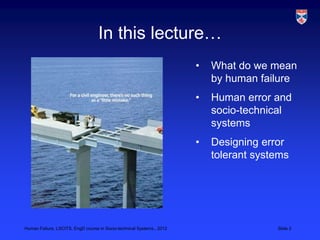
                                                                       •   What do we mean
                                                                           by human failure
                                                                       •   Human error and
                                                                           socio-technical
                                                                           systems
                                                                       •   Designing error
                                                                           tolerant systems


Human Failure, LSCITS, EngD course in Socio-technical Systems,, 2012                    Slide 2
Human failure
 •    Human failures are said to account for
     –   50-70% of aviation disasters
     –   44,000 – 98,000 deaths each year in America result from
         medication errors
     –   60-85% of shuttle incidents at NASA
     –   92-95% of car crashes
     –   70% of shipping accidents

 •    A common reaction to human failure is to blame the
      user
 •       But “To Err is Human”, so we should be concerned
         with designing systems that are resilient to human
         error
Human Failure, LSCITS, EngD course in Socio-technical Systems,, 2012 Slide 3
What is human error?


Human Failure, LSCITS, EngD course in Socio-technical Systems,, 2012   Slide 4
Definitions of human error
  • An inappropriate or undesirable human
    decision or behaviour that reduces or has the
    potential for reducing the
    effectiveness, dependability or performance
    of a system
  •       Examples:
        –      Errors of omission - forget to do something
        –      Errors of commission - doing something incorrectly
        –      Sequence errors - out of order
        –      Timing errors - too slow - too fast - too late

Human Failure, LSCITS, EngD course in Socio-technical Systems,, 2012   Slide 5
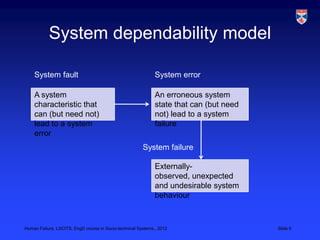
System dependability model

    System fault                                              System error

    A system                                                  An erroneous system
    characteristic that                                       state that can (but need
    can (but need not)                                        not) lead to a system
    lead to a system                                          failure
    error
                                                        System failure

                                                              Externally-
                                                              observed, unexpected
                                                              and undesirable system
                                                              behaviour


Human Failure, LSCITS, EngD course in Socio-technical Systems,, 2012                     Slide 6
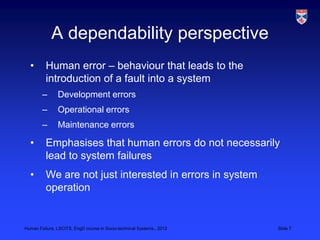
A dependability perspective
  •       Human error – behaviour that leads to the
          introduction of a fault into a system
        –      Development errors
        –      Operational errors
        –      Maintenance errors

  •       Emphasises that human errors do not necessarily
          lead to system failures
  •       We are not just interested in errors in system
          operation


Human Failure, LSCITS, EngD course in Socio-technical Systems,, 2012   Slide 7
Example
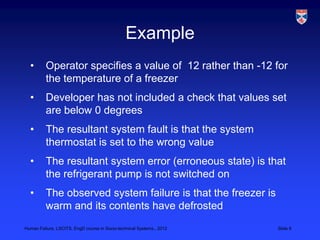
  •       Operator specifies a value of 12 rather than -12 for
          the temperature of a freezer
  •       Developer has not included a check that values set
          are below 0 degrees
  •       The resultant system fault is that the system
          thermostat is set to the wrong value
  •       The resultant system error (erroneous state) is that
          the refrigerant pump is not switched on
  •       The observed system failure is that the freezer is
          warm and its contents have defrosted
Human Failure, LSCITS, EngD course in Socio-technical Systems,, 2012   Slide 8
What is an error?
  •       Determining a human error often involves a
          judgment.
        –      Sometimes a human action is clearly a human error
        –      Sometimes a human action is only clearly an error with
               hindsight
        –      Sometimes a human action that would ordinarily be an error
               is not an error.

  •       Users are not just people who cause errors, but they
          are often the ones who trap and correct errors
          (human or technical errors)
        –      Never simply assume that systems are inherently safe and
               humans introduce errors
        –      Many now prefer the terms “human reliability” or “resilience”
Human Failure, LSCITS, EngD course in Socio-technical Systems,, 2012     Slide 9
Human error ambiguity?
 •    It can be difficult to distinguish between safe and
      erroneous behaviour.
     –       An action that is an error in one context may not be in
             another
         •      Failing to follow procedures for the safe use of ladders

         •      Not an error if the goal is to rescue a child trapped in a fire

 •    Erroneous actions?
     –       Following a rule or instruction if following it causes a failure
     –       Deliberately not following a rule or instruction if resources are
             unavailable or if not following the rule avoids a failure
     –          Deviating from a defined process or procedure to save time
                or improve quality
Human Failure, LSCITS, EngD course in Socio-technical Systems,, 2012    Slide 10
GEMS
  •       GEMS (Generic Error Modelling System) was
          developed by a psychologist, James Reason, at
          Manchester University
  •       Based on the notion that human actions are based
          around:
  •       Intentions, Goals, Plans and Actions
  •       In GEMS, human error occurs as:
        –      The failure to perform some plan or task properly
        –      The failure to apply the correct plan


Human Failure, LSCITS, EngD course in Socio-technical Systems,, 2012   Slide 11
Types of human activity
  •       GEMS distinguishes three ways in which actions are
          performed:
        –         Skills-based performance
              •      Routine things done without much cognitive effort e.g. driving a
                     car
        –         Rule-based performance
              •      Following a set of rules or procedure e.g. transferring data from
                     one system to another
        –         Knowledge based performance
              •      Applying knowledge in completing some task e.g. planning travel
                     from St Andrews to a meeting in Rome

Human Failure, LSCITS, EngD course in Socio-technical Systems,, 2012             Slide 12
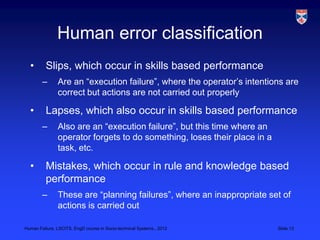
Human error classification
  •       Slips, which occur in skills based performance
        –      Are an “execution failure”, where the operator‟s intentions are
               correct but actions are not carried out properly

  •       Lapses, which also occur in skills based performance
        –      Also are an “execution failure”, but this time where an
               operator forgets to do something, loses their place in a
               task, etc.

  •       Mistakes, which occur in rule and knowledge based
          performance
        –      These are “planning failures”, where an inappropriate set of
               actions is carried out

Human Failure, LSCITS, EngD course in Socio-technical Systems,, 2012      Slide 13
Human error in complex socio-
          technical systems


Human Failure, LSCITS, EngD course in Socio-technical Systems,, 2012   Slide 14
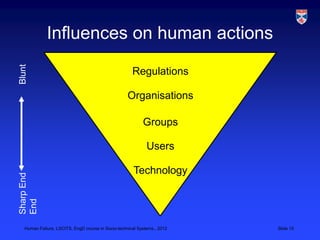
Influences on human actions
Blunt


                                                      Regulations

                                                    Organisations

                                                           Groups

                                                             Users

                                                      Technology
Sharp End
End


   Human Failure, LSCITS, EngD course in Socio-technical Systems,, 2012   Slide 15
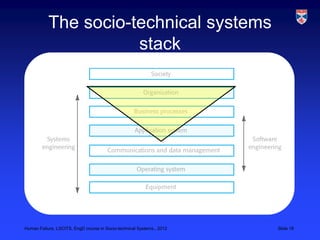
The socio-technical systems
                      stack


Human Failure, LSCITS, EngD course in Socio-technical Systems,, 2012   Slide 16
Human fallibility and
                            dependability
  •       Human fallibility can influence the dependability of an
          LSCITS:
        –      During the development process
        –      During the deployment process
        –      During the maintenance/management process
        –      During the operational process
  •       Errors made during development, deployment and
          maintenance create vulnerabilities that may interact
          with „errors‟ during the operational process to cause
          system failure


Human Failure, LSCITS, EngD course in Socio-technical Systems,, 2012   Slide 17
Example
  •       Maintenance error leads to vulnerability in system
        –      Say the automatic backup disk is switched from A to B to
               check that a change to the backup system has been made
               correctly. The maintainer then forgets to switch the backup
               disk back to A and dismounts B
        –      Consequence of maintenance error is that backups are not
               made

  •       Operator error leads to an erroneous command being
          input to the system
        –      Operator accidentally overwrites a file in the system with
               incorrect data
        –      Goes to backup system to recover previous version of file

  •       File cannot be recovered
Human Failure, LSCITS, EngD course in Socio-technical Systems,, 2012    Slide 18
Failure trajectories
  •       Failures rarely have a single cause. Generally, they
          arise because several events occur simultaneously
        –         Loss of data in a critical system
              •      User mistypes command and instructs data to be deleted
              •      System does not check and ask for confirmation of destructive
                     action
              •      No backup of data available

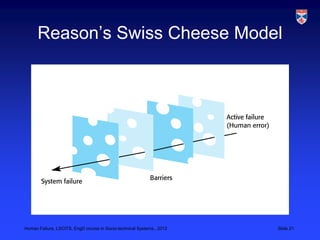
  •       A failure trajectory is a sequence of undesirable
          events that coincide in time, usually initiated by some
          human action. It represents a failure in the defensive
          layers in the system

Human Failure, LSCITS, EngD course in Socio-technical Systems,, 2012          Slide 19
Vulnerabilities and defences
 •    Vulnerabilities
     –    Faults in the (socio-technical) system which, if triggered by a
          human error, can lead to system failure
     –    e.g. missing check on input validity

 •    Defences
     –    System features that avoid, tolerate or recover from human
          error
     –    Type checking that disallows allocation of incorrect types of
          value

 •       When an adverse event happens, the key question is
         not „whose fault was it‟ but „why did the system
         defences fail?‟
Human Failure, LSCITS, EngD course in Socio-technical Systems,, 2012 Slide 20
Reason‟s Swiss Cheese Model


Human Failure, LSCITS, EngD course in Socio-technical Systems,, 2012   Slide 21
Active failures
  •       Active failures
        –      Active failures are the unsafe acts committed by people who are in
               direct contact with the system (slips, lapses, mistakes, and
               procedural violations).
        –      Active failures have a direct and usually short-lived effect on the
               integrity of the defenses.

  •       Latent conditions
        –      Fundamental vulnerabilities in one or more layers of the socio-
               technical system such as system faults, system and process
               misfit, alarm overload, inadequate maintenance, etc.
        –      Latent conditions may lie dormant within the system for many years
               before they combine with active failures and local triggers to create
               an accident opportunity.

Human Failure, LSCITS, EngD course in Socio-technical Systems,, 2012            Slide 22
Defensive layers
• Complex IT systems should have many defensive
  layers:
     – some are engineered - alarms, physical barriers, automatic
       shutdowns,
     – others rely on people - surgeons, anesthetists, pilots, control
       room operators,
     – and others depend on procedures and administrative
       controls.
• In an ideal word, each defensive layer would be intact.
• In reality, they are more like slices of Swiss
  cheese, having many holes- although unlike in the
  cheese, these holes are continually
  opening, shutting, and shifting their location.
 Human Failure, LSCITS, EngD course in Socio-technical Systems,, 2012   Slide 23
Dynamic vulnerabilities
  •       While some vulnerabilities are static (e.g.
          programming errors), others are dynamic and depend
          on the context where the system is used.
  •       For example
        –      vulnerabilities may be related to human actions whose
               performance is dependent on workload, state of mind, etc. An
               operator may be distracted and forget to check something
        –      vulnerabilities may depend on configuration – checks may
               depend on particular programs being up and running so if
               program A is running in a system then a check may be made
               but if program B is running, then the check is not made


Human Failure, LSCITS, EngD course in Socio-technical Systems,, 2012   Slide 24
Human error and complexity
  •       System complexity and change adds to the ambiguity
          of human errors
        –      Many human errors are insignificant and do not lead to failure
        –      Many human errors are spotted and resolved by defensive
               layers in the system
        –      Human actions that are correct may become erroneous
               because of a change elsewhere in the system
        –      An error can be made many times without contributing to a
               failure, but then suddenly, because some system
               components has changed in some way, it will.


Human Failure, LSCITS, EngD course in Socio-technical Systems,, 2012   Slide 25
Human error and complexity
  •       An error can be made many times without
          contributing to a failure, but then suddenly one day it
          will
  •       Example
        –      An operator logs information by sending it to an email
               address which uses an obsolete domain name (dcs.st-
               and.ac.uk)
        –      Version X of the system relies on a DNS that maps the
               obsolete name to the new name (cs.st-andrews.ac.uk) so this
               works OK – no error is reported
        –      Four years after the initial change, a new DNS is installed
               and the domain name mapping is removed
        –      The day after this happens, the system fails because the 26
Human Failure, LSCITS, EngD course in Socio-technical Systems,, 2012   Slide
               email log message cannot be sent
Designing resilient systems


Human Failure, LSCITS, EngD course in Socio-technical Systems,, 2012   Slide 27
System resilience
  •       Failure avoidance
        –      Fault avoidance
        –      Fault detection
        –      Fault tolerance

  •       Failure recovery
        –      Returning to normal operation after the occurrence of a
               system failure


Human Failure, LSCITS, EngD course in Socio-technical Systems,, 2012     Slide 28
Incident reduction
  •       Reduce the number of latent conditions in the
          different layers of the system (plug the holes)
        –      If the number of faults in a software system is reduced, this
               increases the strength of the defensive layer
        –      However, this technical approach ON ITS OWN cannot be
               completely effective as it is practically impossible to reduce
               the number of latent conditions in the system to zero
  •       Increase the number of defensive layers and hence
          reduce the probability of an accident trajectory
          occurring
  •       Reduce the number of active faults that occur


Human Failure, LSCITS, EngD course in Socio-technical Systems,, 2012     Slide 29
Conditions leading to human
                      error
  •       Distractions
  •       Incomplete or incorrect data
  •       Boredom
  •       Inadequate resources
  •       Cognitive overload
  •       Stress
  •       Illness
  •       Time pressure

Human Failure, LSCITS, EngD course in Socio-technical Systems,, 2012   Slide 30
Systems design and human
                      error
  •       Once we begin to understand what human errors are
          possible and how they can come about, we can start
          designing systems that better withstand human error
  •       Avoidance
        –      Design the system so that certain classes of human error are
               eliminated

  •       Detection
        –      Make it easier for the operator and others to spot errors

  •       Tolerance
        –      Ensure that individual errors are unlikely to lead to system
               failure
Human Failure, LSCITS, EngD course in Socio-technical Systems,, 2012       Slide 31
Design guidelines
 •    Minimise potential for slips, lapses and mistakes by
      designing systems and work environments where
      people aren‟t distracted or overwhelmed, but aren‟t
      bored either
 •    Minimise potential for mistakes by designing systems
      and work environments where people are able to
      understand what is happening and the consequences
      of an action
 •    Minimise potential for mistakes by making sure
      people are trained properly
 •       Minimise potential for deliberate violations by making
Human Failure, LSCITS, EngD course in Socio-technicaldesigned and well understood.
         sure rules are well Systems,, 2012                                      Slide 32
Detection and tolerance
  •       Detecting and correcting error
        –      Automated correction can be useful, but can be dangerous!
        –      Alarms and alerts may be better than automated
               correction, but need to be well designed.
        –      Allow for human correction, by making it possible to „undo‟
        –      Make it easier for the user or another person to spot errors
  •       Tolerating human error
        –      Remember, breaking the rules might be for good reasons.
               Think of users as people attempting to do things, rather than
               simply as operators of the system.
        –      Human error is common, so try not to create systems where
               a single human error can cause a failure.

Human Failure, LSCITS, EngD course in Socio-technical Systems,, 2012    Slide 33
Recovery
  •       Design for failure
        –      Discussed in previous module on systems engineering for
               LSCITS

  •       Make work visible
  •       Switch from enforcing mode to auditing mode
  •       Support role transferability
  •       Balance recovery and security


Human Failure, LSCITS, EngD course in Socio-technical Systems,, 2012   Slide 34
Key points
  •       Human error accounts for the majority of all systems failures
  •       Human error is very common, and only occasionally leads to
          failure
  •       The same human action may or may not be an error depending
          on the context of that action
  •       There are methods for analysing and predicting human
          errors, and these can be used to improve system design
  •       Some systems are more prone to accidents than others because
          of the way they have been designed
  •       Critical systems should be designed to minimise or detect
          human error
  •       Blaming the user is a common response to human error, but the
          fault lies with the system and the system engineers.
Human Failure, LSCITS, EngD course in Socio-technical Systems,, 2012   Slide 35

Human failure (LSCITS EngD 2012)

  • 1.
    Human failure Human Failure,LSCITS, EngD course in Socio-technical Systems,, 2012 Slide 1
  • 2.
    In this lecture… • What do we mean by human failure • Human error and socio-technical systems • Designing error tolerant systems Human Failure, LSCITS, EngD course in Socio-technical Systems,, 2012 Slide 2
  • 3.
    Human failure • Human failures are said to account for – 50-70% of aviation disasters – 44,000 – 98,000 deaths each year in America result from medication errors – 60-85% of shuttle incidents at NASA – 92-95% of car crashes – 70% of shipping accidents • A common reaction to human failure is to blame the user • But “To Err is Human”, so we should be concerned with designing systems that are resilient to human error Human Failure, LSCITS, EngD course in Socio-technical Systems,, 2012 Slide 3
  • 4.
    What is humanerror? Human Failure, LSCITS, EngD course in Socio-technical Systems,, 2012 Slide 4
  • 5.
    Definitions of humanerror • An inappropriate or undesirable human decision or behaviour that reduces or has the potential for reducing the effectiveness, dependability or performance of a system • Examples: – Errors of omission - forget to do something – Errors of commission - doing something incorrectly – Sequence errors - out of order – Timing errors - too slow - too fast - too late Human Failure, LSCITS, EngD course in Socio-technical Systems,, 2012 Slide 5
  • 6.
    System dependability model System fault System error A system An erroneous system characteristic that state that can (but need can (but need not) not) lead to a system lead to a system failure error System failure Externally- observed, unexpected and undesirable system behaviour Human Failure, LSCITS, EngD course in Socio-technical Systems,, 2012 Slide 6
  • 7.
    A dependability perspective • Human error – behaviour that leads to the introduction of a fault into a system – Development errors – Operational errors – Maintenance errors • Emphasises that human errors do not necessarily lead to system failures • We are not just interested in errors in system operation Human Failure, LSCITS, EngD course in Socio-technical Systems,, 2012 Slide 7
  • 8.
    Example • Operator specifies a value of 12 rather than -12 for the temperature of a freezer • Developer has not included a check that values set are below 0 degrees • The resultant system fault is that the system thermostat is set to the wrong value • The resultant system error (erroneous state) is that the refrigerant pump is not switched on • The observed system failure is that the freezer is warm and its contents have defrosted Human Failure, LSCITS, EngD course in Socio-technical Systems,, 2012 Slide 8
  • 9.
    What is anerror? • Determining a human error often involves a judgment. – Sometimes a human action is clearly a human error – Sometimes a human action is only clearly an error with hindsight – Sometimes a human action that would ordinarily be an error is not an error. • Users are not just people who cause errors, but they are often the ones who trap and correct errors (human or technical errors) – Never simply assume that systems are inherently safe and humans introduce errors – Many now prefer the terms “human reliability” or “resilience” Human Failure, LSCITS, EngD course in Socio-technical Systems,, 2012 Slide 9
  • 10.
    Human error ambiguity? • It can be difficult to distinguish between safe and erroneous behaviour. – An action that is an error in one context may not be in another • Failing to follow procedures for the safe use of ladders • Not an error if the goal is to rescue a child trapped in a fire • Erroneous actions? – Following a rule or instruction if following it causes a failure – Deliberately not following a rule or instruction if resources are unavailable or if not following the rule avoids a failure – Deviating from a defined process or procedure to save time or improve quality Human Failure, LSCITS, EngD course in Socio-technical Systems,, 2012 Slide 10
  • 11.
    GEMS • GEMS (Generic Error Modelling System) was developed by a psychologist, James Reason, at Manchester University • Based on the notion that human actions are based around: • Intentions, Goals, Plans and Actions • In GEMS, human error occurs as: – The failure to perform some plan or task properly – The failure to apply the correct plan Human Failure, LSCITS, EngD course in Socio-technical Systems,, 2012 Slide 11
  • 12.
    Types of humanactivity • GEMS distinguishes three ways in which actions are performed: – Skills-based performance • Routine things done without much cognitive effort e.g. driving a car – Rule-based performance • Following a set of rules or procedure e.g. transferring data from one system to another – Knowledge based performance • Applying knowledge in completing some task e.g. planning travel from St Andrews to a meeting in Rome Human Failure, LSCITS, EngD course in Socio-technical Systems,, 2012 Slide 12
  • 13.
    Human error classification • Slips, which occur in skills based performance – Are an “execution failure”, where the operator‟s intentions are correct but actions are not carried out properly • Lapses, which also occur in skills based performance – Also are an “execution failure”, but this time where an operator forgets to do something, loses their place in a task, etc. • Mistakes, which occur in rule and knowledge based performance – These are “planning failures”, where an inappropriate set of actions is carried out Human Failure, LSCITS, EngD course in Socio-technical Systems,, 2012 Slide 13
  • 14.
    Human error incomplex socio- technical systems Human Failure, LSCITS, EngD course in Socio-technical Systems,, 2012 Slide 14
  • 15.
    Influences on humanactions Blunt Regulations Organisations Groups Users Technology Sharp End End Human Failure, LSCITS, EngD course in Socio-technical Systems,, 2012 Slide 15
  • 16.
    The socio-technical systems stack Human Failure, LSCITS, EngD course in Socio-technical Systems,, 2012 Slide 16
  • 17.
    Human fallibility and dependability • Human fallibility can influence the dependability of an LSCITS: – During the development process – During the deployment process – During the maintenance/management process – During the operational process • Errors made during development, deployment and maintenance create vulnerabilities that may interact with „errors‟ during the operational process to cause system failure Human Failure, LSCITS, EngD course in Socio-technical Systems,, 2012 Slide 17
  • 18.
    Example • Maintenance error leads to vulnerability in system – Say the automatic backup disk is switched from A to B to check that a change to the backup system has been made correctly. The maintainer then forgets to switch the backup disk back to A and dismounts B – Consequence of maintenance error is that backups are not made • Operator error leads to an erroneous command being input to the system – Operator accidentally overwrites a file in the system with incorrect data – Goes to backup system to recover previous version of file • File cannot be recovered Human Failure, LSCITS, EngD course in Socio-technical Systems,, 2012 Slide 18
  • 19.
    Failure trajectories • Failures rarely have a single cause. Generally, they arise because several events occur simultaneously – Loss of data in a critical system • User mistypes command and instructs data to be deleted • System does not check and ask for confirmation of destructive action • No backup of data available • A failure trajectory is a sequence of undesirable events that coincide in time, usually initiated by some human action. It represents a failure in the defensive layers in the system Human Failure, LSCITS, EngD course in Socio-technical Systems,, 2012 Slide 19
  • 20.
    Vulnerabilities and defences • Vulnerabilities – Faults in the (socio-technical) system which, if triggered by a human error, can lead to system failure – e.g. missing check on input validity • Defences – System features that avoid, tolerate or recover from human error – Type checking that disallows allocation of incorrect types of value • When an adverse event happens, the key question is not „whose fault was it‟ but „why did the system defences fail?‟ Human Failure, LSCITS, EngD course in Socio-technical Systems,, 2012 Slide 20
  • 21.
    Reason‟s Swiss CheeseModel Human Failure, LSCITS, EngD course in Socio-technical Systems,, 2012 Slide 21
  • 22.
    Active failures • Active failures – Active failures are the unsafe acts committed by people who are in direct contact with the system (slips, lapses, mistakes, and procedural violations). – Active failures have a direct and usually short-lived effect on the integrity of the defenses. • Latent conditions – Fundamental vulnerabilities in one or more layers of the socio- technical system such as system faults, system and process misfit, alarm overload, inadequate maintenance, etc. – Latent conditions may lie dormant within the system for many years before they combine with active failures and local triggers to create an accident opportunity. Human Failure, LSCITS, EngD course in Socio-technical Systems,, 2012 Slide 22
  • 23.
    Defensive layers • ComplexIT systems should have many defensive layers: – some are engineered - alarms, physical barriers, automatic shutdowns, – others rely on people - surgeons, anesthetists, pilots, control room operators, – and others depend on procedures and administrative controls. • In an ideal word, each defensive layer would be intact. • In reality, they are more like slices of Swiss cheese, having many holes- although unlike in the cheese, these holes are continually opening, shutting, and shifting their location. Human Failure, LSCITS, EngD course in Socio-technical Systems,, 2012 Slide 23
  • 24.
    Dynamic vulnerabilities • While some vulnerabilities are static (e.g. programming errors), others are dynamic and depend on the context where the system is used. • For example – vulnerabilities may be related to human actions whose performance is dependent on workload, state of mind, etc. An operator may be distracted and forget to check something – vulnerabilities may depend on configuration – checks may depend on particular programs being up and running so if program A is running in a system then a check may be made but if program B is running, then the check is not made Human Failure, LSCITS, EngD course in Socio-technical Systems,, 2012 Slide 24
  • 25.
    Human error andcomplexity • System complexity and change adds to the ambiguity of human errors – Many human errors are insignificant and do not lead to failure – Many human errors are spotted and resolved by defensive layers in the system – Human actions that are correct may become erroneous because of a change elsewhere in the system – An error can be made many times without contributing to a failure, but then suddenly, because some system components has changed in some way, it will. Human Failure, LSCITS, EngD course in Socio-technical Systems,, 2012 Slide 25
  • 26.
    Human error andcomplexity • An error can be made many times without contributing to a failure, but then suddenly one day it will • Example – An operator logs information by sending it to an email address which uses an obsolete domain name (dcs.st- and.ac.uk) – Version X of the system relies on a DNS that maps the obsolete name to the new name (cs.st-andrews.ac.uk) so this works OK – no error is reported – Four years after the initial change, a new DNS is installed and the domain name mapping is removed – The day after this happens, the system fails because the 26 Human Failure, LSCITS, EngD course in Socio-technical Systems,, 2012 Slide email log message cannot be sent
  • 27.
    Designing resilient systems HumanFailure, LSCITS, EngD course in Socio-technical Systems,, 2012 Slide 27
  • 28.
    System resilience • Failure avoidance – Fault avoidance – Fault detection – Fault tolerance • Failure recovery – Returning to normal operation after the occurrence of a system failure Human Failure, LSCITS, EngD course in Socio-technical Systems,, 2012 Slide 28
  • 29.
    Incident reduction • Reduce the number of latent conditions in the different layers of the system (plug the holes) – If the number of faults in a software system is reduced, this increases the strength of the defensive layer – However, this technical approach ON ITS OWN cannot be completely effective as it is practically impossible to reduce the number of latent conditions in the system to zero • Increase the number of defensive layers and hence reduce the probability of an accident trajectory occurring • Reduce the number of active faults that occur Human Failure, LSCITS, EngD course in Socio-technical Systems,, 2012 Slide 29
  • 30.
    Conditions leading tohuman error • Distractions • Incomplete or incorrect data • Boredom • Inadequate resources • Cognitive overload • Stress • Illness • Time pressure Human Failure, LSCITS, EngD course in Socio-technical Systems,, 2012 Slide 30
  • 31.
    Systems design andhuman error • Once we begin to understand what human errors are possible and how they can come about, we can start designing systems that better withstand human error • Avoidance – Design the system so that certain classes of human error are eliminated • Detection – Make it easier for the operator and others to spot errors • Tolerance – Ensure that individual errors are unlikely to lead to system failure Human Failure, LSCITS, EngD course in Socio-technical Systems,, 2012 Slide 31
  • 32.
    Design guidelines • Minimise potential for slips, lapses and mistakes by designing systems and work environments where people aren‟t distracted or overwhelmed, but aren‟t bored either • Minimise potential for mistakes by designing systems and work environments where people are able to understand what is happening and the consequences of an action • Minimise potential for mistakes by making sure people are trained properly • Minimise potential for deliberate violations by making Human Failure, LSCITS, EngD course in Socio-technicaldesigned and well understood. sure rules are well Systems,, 2012 Slide 32
  • 33.
    Detection and tolerance • Detecting and correcting error – Automated correction can be useful, but can be dangerous! – Alarms and alerts may be better than automated correction, but need to be well designed. – Allow for human correction, by making it possible to „undo‟ – Make it easier for the user or another person to spot errors • Tolerating human error – Remember, breaking the rules might be for good reasons. Think of users as people attempting to do things, rather than simply as operators of the system. – Human error is common, so try not to create systems where a single human error can cause a failure. Human Failure, LSCITS, EngD course in Socio-technical Systems,, 2012 Slide 33
  • 34.
    Recovery • Design for failure – Discussed in previous module on systems engineering for LSCITS • Make work visible • Switch from enforcing mode to auditing mode • Support role transferability • Balance recovery and security Human Failure, LSCITS, EngD course in Socio-technical Systems,, 2012 Slide 34
  • 35.
    Key points • Human error accounts for the majority of all systems failures • Human error is very common, and only occasionally leads to failure • The same human action may or may not be an error depending on the context of that action • There are methods for analysing and predicting human errors, and these can be used to improve system design • Some systems are more prone to accidents than others because of the way they have been designed • Critical systems should be designed to minimise or detect human error • Blaming the user is a common response to human error, but the fault lies with the system and the system engineers. Human Failure, LSCITS, EngD course in Socio-technical Systems,, 2012 Slide 35

Editor's Notes

  • #11 Following rules leading to failureExample of departing train with no passengersNot following rules to avoid failureNot following rules because impractical to do soRules are application must be checked and approved by Finance but no-one available to checkApplication submitted without checkingNot following safety procedures (but no failure ensues)Ticket collector on train does not charge extra for an invalid ticket because the ticket holder genuinely misunderstood validity restrictions
  • #14 Example – taking a corner too fast when drivingForgetting to set the permissions on files copied from system A to system BFailing to understand that meeting is in Rome NY rather than Rome Italy
  • #16 Not sure what this slide contributes