2
Chapter 4:Factors AffectingPerformance
1. Fitness And Health
There are two aspects to fitness and health: The disposition of
the AMT prior to taking on employment and the day to day well
being once employed.
PREEMPLOYMENT PHYSICAL
Some employers may require a medical preemployment
physical. This allows the employer to judge the fitness and
health of the applicant. There is an obvious effect upon an
AMTs ability to perform his or her job if through poor physical
fitness or health, the applicant is constrained in some way (such
as freedom of movement). In addition, an airworthiness
authority when considering issuing a license, will consider these
factors and may judge the condition to be of such significance
that a license could not be issued.
DAY TO DAY FITNESS AND HEALTH
EASA Part-66 imposes a requirement that "certifying staff must
not exercise the privileges of their certification authorization if
they know or suspect that their physical or mental condition
renders them unfit".
Responsibility often falls upon the individuals to
determine whether or not they are well enough
to work on a particular day. Alternatively, team
members or supervisors may intervene.
Many conditions can impact on the health and
fitness of an individual, such as:
• Minor physical illness (such as colds, flu, etc.);
• More significant physical illness (such as cancer,
heart conditions, etc.);
• Mental illness (such as depression, anxiety, etc.)
• Minor injury (such as a sprained wrist, etc.)
• Major injury (such as a broken arm, etc.);
• Latent Medical and Environmental Conditions
(LMECs) such as ongoing deterioration, possibly
associated with the aging such as hearing loss,
visual defects, obesity, heart problems, etc.);
• Effects of toxins and other foreign substances
(such as carbon monoxide poisoning, alcohol,...).
3.
3
This is acomplex issue dependent upon the nature of the
illness or condition, its effect upon the individual, the type of
work to be done, environmental conditions, etc. Instead, it is
important that the AMT is aware that his/her performance, and
consequently the safety of aircraft he/she works on, might be
affected adversely by illness or lack of fitness.
AMTs may consider that they are letting down coworkers by not
going to work when ill, especially if there are ongoing
manpower shortages. However, management should generally
allow for contingency for illness. The burden should not be
placed upon an individual to turn up to work when unfit if no
such contingency is available. If the individual has a contagious
illness such as the flu, other workers become at risk as well.
POSITIVE MEASURES
There are many things AMTs can do to help maintain fitness
and health. These include:
• Eating regular meals and a well balanced diet;
• Regular exercise (sufficient to double the resting pulse rate for
20 minutes, three times a week is often recommended);
• Stop smoking;
• Sensible alcohol intake.
4.
4
2. Stress: DomesticAnd Work Related
Stress is the high level of emotional arousal typically associated
with an overload of mental and/or physical activity. Stress is
often associated with anxiety, fear, fatigue, and hostility. It can
also arise as a result of feelings of inadequacy, where we may
feel we don't have the appropriate experience, knowledge, or
capability to complete our allocated tasks. All these feelings can
have a direct and negative impact on performance.
Stress can motivate us and heighten our response to meeting
the challenges we face. In fact, our performance will generally
improve with the onset of stress, but will peak and then begin
to degrade rapidly as stress levels exceed our adaptive abilities
to handle the situation.
Although complex and difficult maintenance activities can
generate stress, there is also both physical and mental stress
that a team member may bring to the situation and which
others may not be able to detect.
CHARACTERISTICS OF STRESS
Stress is often described as being insidious;
that is, it develops slowly and has a gradual and
cumulative effect. It can be well established
before we are aware that it is degrading our
performance. We may think that we are
handling everything quite well, when in fact
there are subtle signs that our performance
has degraded to a point where we can no
longer respond appropriately.
We are all under a certain level of stress at any
given time, but there is a limit to any
individual's capability to adapt to increasing
stress. This stress tolerance level is based on
our ability to cope with a given set of
circumstances. If the number or intensity of
stressors becomes too great, we can become
overloaded. At this point, our performance
begins to decline and our judgment
deteriorates.
5.
5
CAUSES OF STRESS
Anychanges in personal circumstances such as marital
separation, bereavement, difficult family affairs, or financial
concerns can lead to stress and affect our emotional state.
There is also work related stress, which may include real or
imagined commercial pressures, such as the need to juggle
deadlines to get an aircraft on line, and balance economic
considerations with the understanding that lives depend on the
quality of our work. To complicate matters even further,
admitting to suffering from these stresses is often viewed by
coworkers as an admission of weakness or failure. Early
symptoms of stress such as depression or sleep disruption are
often denied. In this situation we tend to look for other ways to
cope with our high levels of stress, such as aggression, drugs or
alcohol.
STRESSORS
Different stressors affect different people to varying extents.
Typical stressors include:
• Physical, such as heat, cold, noise, or the onset of fatigue;
• Psychological, such as worries about real or imagined
problems (e.g. financial problems, ill health, etc.);
• Reactive, such as events occurring in everyday
life (e.g. working under unrealistic time pressure,
bullying, encountering unexpected situations,
etc.).
SYMPTOMS OF STRESS
The symptoms of stress can include:
• Physiological symptoms, such as sweating,
dryness of the mouth etc.;
• Health effects, such as nausea, headaches,
sleep problems, stomach upsets;
• Behavioral symptoms, such as restlessness,
shaking, nervous laughter, taking longer over
tasks, changes to appetite, excessive drinking or
smoking etc.;
• Cognitive effects, such as poor concentration,
indecision, forgetfulness etc.;
• Subjective effects, such as anxiety, irritability,
depression, moodiness, aggression etc.
6.
6
CONSEQUENCES FOR AMTS
Inappropriatelyhigh levels of stress can significantly degrade
performance and as a result can also compromise safety. Under
extreme levels of stress, the following behaviors can be
evident:
• Poor judgment;
• Compromised, or accepting of lower standards;
• Inattention, loss of vigilance and alertness;
• Preoccupation with a single task at the expense of others;
• Forgetting or omitting procedural steps;
• Greater tendency towards losing things;
• Misreading maintenance manuals and procedural steps;
• Loss of time perception;
• Loss of situational awareness.
DOMESTIC STRESS
Domestic stress typically results from major life changes such as
divorce, the birth of a child, or the death of a family member or
close friend. Preoccupation with domestic stress can play on
our mind during working hours, distracting us from our tasks.
This inability to concentrate fully may affect task performance,
error rates and our ability to pay sufficient attention to safety.
WORK RELATED STRESS
Carrying out tasks that are new, or very
challenging or difficult, can make us feel stressed.
Time pressure, lack of standard procedures or
appropriate resources, lack of guidance or
supervision, and interpersonal conflicts all
intensify this stress. Some of these stressors can
be reduced by appropriate workload
management, good communication, good
training etc. The social and managerial aspects of
work can also be stressful; for example if you feel
your job is under threat due to a company
reorganization.
7.
7
MANAGING STRESS
If weall work with a certain amount of stress, how can we
ensure it is kept to an appropriate level? Recognizing high
stress situations such as undergoing divorce, suffering a
bereavement; or having an argument with a spouse or boss are
worries which can build to an unbearable level. Even with low
levels of stress, levels can build; particularly when there is a
multitude of decisions to make or tasks to complete. Before
this occurs, we need to be proactive in managing the stress
load so that it does not become unmanageable. We can control
physiological stressors by strategies like:
• Maintaining good physical fitness and bodily function;
• Engaging in a program of regular physical exercise;
• Getting enough sleep to prevent fatigue;
• Eating a balanced diet;
• Learning and practicing relaxation techniques.
In high pressure situations, relieve stress by establishing
priorities and by appropriately delegating tasks and
responsibilities to other members of the team. In a low
pressure situation, where fatigue, boredom and over familiarity
with the task are the greatest hazards, paying
careful attention to environmental conditions
such as heat, humidity, noise, and lighting can
help to maintain alertness. You can often reduce
mental stressors by making your physical work
environment as stress free as possible.
STRESS COPING STRATEGIES
If coping strategies are to be effective, we need to
identify and deal with the source of the stress,
and not just the symptoms. For example, delegate
workload when necessary, appropriately prioritize
tasks, and sort out problems rather than letting
them fester. We cannot always change the
situation–it may be outside our control–but even
when this is the case, there are a number of
coping strategies we can use.
8.
8
Achieving Relaxation
There arealmost as many techniques, practices, and
treatments for dealing with stress as there are causes of it.
From ancient relaxation techniques to the latest thinking on
proper nutrition; from breathing exercises to repetitive prayer,
there are numerous tools to help people cope. Some
techniques can be especially beneficial under certain
circumstances but not as helpful under others. Understanding
what works for us as individuals and for the stressful
circumstances at hand can require an exploration of a number
of stress reduction methods. And as always, it is important to
know when to seek professional help. These efforts can reward
you richly with better health, greater peace of mind, and a
smoother course through life.
How stressed are you?
The following table lists a number of life events the average
person could expect to experience. To test yourself, just go
through the list and add up the points of the events you have
experienced in the last year. Add the points allocated to each of
these events in the right hand column to find your total
cumulative score. (Table 4-1)
What Your Score Means
Each of us has personal stress adaption
limitations. When we exceed this level, stress
overload may lead to poor health or illness.
Although different people have different
capacities to cope with stress, for the average
person a score of 250 points or more may
indicate that you are suffering from high levels
of stress. People who had become ill had
accumulated a total of 300 stress points or more
in a single year. ‘Ripples of stress' can circulate a
long time after the actual change has taken
place. High stress levels will adversely affect
your immune system and lead to mental or
physical illness if something is not done. It is
very important to lighten the stress load and
develop mechanisms to cope with stress before
something happens. If stress brought on by life
changes is not managed well, and is added to
the stresses in the workplace, performance will
be adversely affected.
10
3. Time PressureAnd Deadlines
TIME PRESSURE AND SELF IMPOSED PRESSURE
There are two types of pressure; actual pressure and self
imposed pressure. The first is real pressure, applied directly or
indirectly, for the task to be completed in a given time. On the
other hand, individuals or teams may feel self imposed
pressure to complete a task within a given time, even when the
time available may be unrealistic or the task may not be
achievable with the allocated resources and time frame.
For an individual, the self imposed pressure is real. For them it
is no different from any actual pressure being applied to the
completion of the task. All pressure (self imposed or otherwise)
will affect the performance of those subjected to it.
Inappropriate pressure applied to an individual or maintenance
team to achieve a task is a safety risk. Actual and self imposed
pressure can be significant drivers for error and taking
maintenance short cuts.
How can inappropriate actual or self imposed
pressure be managed?
• Allocate appropriate time for all maintenance tasks
• Carry out a comprehensive pretask briefing to outline the
task priorities;
• Ensure open two way communication to
identify and mitigate the effects of pressure on
performance and behavior.
Communicating any problems encountered
during the task is vital, particularly when you
cannot complete the task safely because of
insufficient time and resources.
If this occurs you should:
• Ask for help, particularly when the task
requirement is outside your expertise and/or
capabilities;
• Communicate the ramifications of any
unusual or unexpected results;
• Not deviate from procedures or take short
cuts because of time pressure;
• Just do what you can. If you cannot do the
job safely in the time available, complete the
work that you can do, safely and professionally.
11.
11
STRESS AND TIMEPRESSURE IN SHIFT AND TASK HANDOVERS
Ironically, one of the busiest times in the maintenance
environment is during shift and task handovers. Generally
during this time, paperwork is being completed (in a rush) and
a briefing prepared for the oncoming shift. Often, shifts and
supervisors do not get the opportunity for a face to face
handover. The quality of information in shift and task handover
notes varies from organization to organization, and sometimes
is of a very poor standard. Where possible, it is best to have an
overlap between shifts to ensure a face to face handover. In all
cases, provide a written handover to the oncoming shift, team,
or individual taking over a specific task. All organizations should
have a formal process of providing clear information for
task/shift handover to the incoming team.
Managing shift handovers?
Manage stress and time pressure during the shift handover by
planning appropriately, and communicating. Before the shift
ends, identify any obvious and appropriate points in the
maintenance process needed to complete the work. The
outgoing supervisor also needs to allow adequate time for all
tasks (including completing any outstanding documentation)
and for a comprehensive written shift handover log to be
completed before the incoming shift's arrival. An
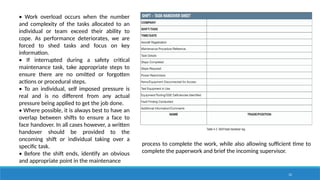
example of a shift/task handover log is included
in Table 4-2.
KEY POINTS
• High levels of stress are a problem for any
individual or maintenance team. The effects of
stress are often subtle and difficult to assess.
• Stress is often described as being insidious; that
is it develops slowly and has a gradual and
cumulative effect. Stress can be well established
before we are aware that it is degrading our
performance.
• Inappropriately high levels of stress can
degrade performance significantly, as a result,
safety can also be compromised.
• Fitness for work is not just a physical condition,
but also a psychological one. It involves being
able to perceive, think, and act to the best of our
ability without the hindering effects of stress,
anger, worry and anxiety.
12.
12
• Work overloadoccurs when the number
and complexity of the tasks allocated to an
individual or team exceed their ability to
cope. As performance deteriorates, we are
forced to shed tasks and focus on key
information.
• If interrupted during a safety critical
maintenance task, take appropriate steps to
ensure there are no omitted or forgotten
actions or procedural steps.
• To an individual, self imposed pressure is
real and is no different from any actual
pressure being applied to get the job done.
• Where possible, it is always best to have an
overlap between shifts to ensure a face to
face handover. In all cases however, a written
handover should be provided to the
oncoming shift or individual taking over a
specific task.
• Before the shift ends, identify an obvious
and appropriate point in the maintenance
process to complete the work, while also allowing sufficient time to
complete the paperwork and brief the incoming supervisor.
13.
13
4. Workload–overload AndUnderload
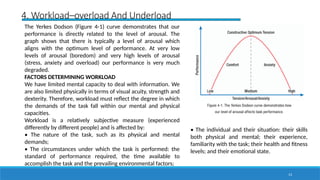
The Yerkes Dodson (Figure 4-1) curve demonstrates that our
performance is directly related to the level of arousal. The
graph shows that there is typically a level of arousal which
aligns with the optimum level of performance. At very low
levels of arousal (boredom) and very high levels of arousal
(stress, anxiety and overload) our performance is very much
degraded.
FACTORS DETERMINING WORKLOAD
We have limited mental capacity to deal with information. We
are also limited physically in terms of visual acuity, strength and
dexterity. Therefore, workload must reflect the degree in which
the demands of the task fall within our mental and physical
capacities.
Workload is a relatively subjective measure (experienced
differently by different people) and is affected by:
• The nature of the task, such as its physical and mental
demands;
• The circumstances under which the task is performed: the
standard of performance required, the time available to
accomplish the task and the prevailing environmental factors;
• The individual and their situation: their skills
both physical and mental; their experience,
familiarity with the task; their health and fitness
levels; and their emotional state.
14.
14
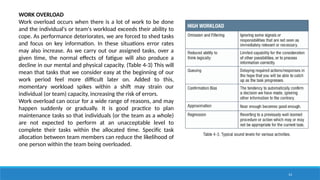
WORK OVERLOAD
Work overloadoccurs when there is a lot of work to be done
and the individual's or team's workload exceeds their ability to
cope. As performance deteriorates, we are forced to shed tasks
and focus on key information. In these situations error rates
may also increase. As we carry out our assigned tasks, over a
given time, the normal effects of fatigue will also produce a
decline in our mental and physical capacity. (Table 4-3) This will
mean that tasks that we consider easy at the beginning of our
work period feel more difficult later on. Added to this,
momentary workload spikes within a shift may strain our
individual (or team) capacity, increasing the risk of errors.
Work overload can occur for a wide range of reasons, and may
happen suddenly or gradually. It is good practice to plan
maintenance tasks so that individuals (or the team as a whole)
are not expected to perform at an unacceptable level to
complete their tasks within the allocated time. Specific task
allocation between team members can reduce the likelihood of
one person within the team being overloaded.
15.
15
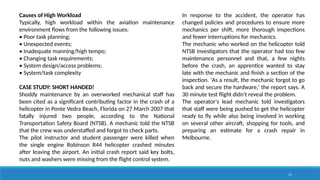
Causes of HighWorkload
Typically, high workload within the aviation maintenance
environment flows from the following issues:
• Poor task planning;
• Unexpected events;
• Inadequate manning/high tempo;
• Changing task requirements;
• System design/access problems;
• System/task complexity
CASE STUDY: SHORT HANDED!
Shoddy maintenance by an overworked mechanical staff has
been cited as a significant contributing factor in the crash of a
helicopter in Ponte Vedra Beach, Florida on 27 March 2007 that
fatally injured two people, according to the National
Transportation Safety Board (NTSB). A mechanic told the NTSB
that the crew was understaffed and forgot to check parts.
The pilot instructor and student passenger were killed when
the single engine Robinson R44 helicopter crashed minutes
after leaving the airport. An initial crash report said key bolts,
nuts and washers were missing from the flight control system.
In response to the accident, the operator has
changed policies and procedures to ensure more
mechanics per shift, more thorough inspections
and fewer interruptions for mechanics.
The mechanic who worked on the helicopter told
NTSB investigators that the operator had too few
maintenance personnel and that, a few nights
before the crash, an apprentice wanted to stay
late with the mechanic and finish a section of the
inspection. 'As a result, the mechanic forgot to go
back and secure the hardware,' the report says. A
30 minute test flight didn't reveal the problem.
The operator's lead mechanic told investigators
that staff were being pushed to get the helicopter
ready to fly while also being involved in working
on several other aircraft, shopping for tools, and
preparing an estimate for a crash repair in
Melbourne.
16.
16
WORK UNDERLOAD
Although rarein the maintenance environment, work under
load does occur. Work under load can result from menial,
simple or very repetitive tasks that are boring, or indeed from a
lack of tasks to do. We are likely to be less attentive when
carrying out repetitive tasks; boredom may set in and may
begin to raise the level of mental stimulation by thinking about
things not related to the task, (e.g. what to do at the weekend).
Under these conditions, situational awareness is degraded and
errors and omissions will increase.
17.
17
5. Sleep AndFatigue, Shift Work
FATIGUE
There are several different meanings of the word:
• Tiredness after hard physical work;
• Emotional fatigue;
• Short term effects of intense concentration on a task;
• An overwhelming need to sleep.
Fatigue can have a major effect on your safety and the quality
of your work when you are maintaining aircraft. We can
distinguish between two types of sleep related fatigue:
• Acute–this is generally only short term and can be remedied
with a good night's sleep
• Chronic–a longer term problem, as there is usually a buildup
of sleep deprivation.
Fatigue can act like a toxin accumulating in our body. We can
generally deal with a small amount of it, and work it out of our
system by catching up on a night's sleep, but chronic fatigue
accumulates and can have increasingly dangerous effects.
The Effects of Fatigue
One obvious hazard of fatigue is that the fatigued
person loses the fight to stay awake while at
work. Clearly this is most dangerous when the
person is operating equipment or driving a
vehicle.
A sleep episode can take the form of a micro
sleep, which is a brief moment (generally
between 2-30 seconds) when the person starts to
enter the first stage of sleep, possibly with their
eyes still open; sometimes for less than a few
seconds before regaining consciousness. The
person is typically unaware that they have
experienced a micro sleep, and may continue to
perform simple repetitive tasks while asleep.
When truck drivers volunteered to wear sleep
monitoring equipment while they worked,
researchers were amazed to find that some
drivers were showing signs of the first stage of
sleep while driving on interstate highways.
18.
18
Sleep deprivation canproduce effects very similar to those
produced by alcohol. An Australian study found that people
who were given a simple task in the early hours of the morning,
after being awake for 17 hours, performed as badly as if they
had a blood alcohol concentration of .05 percent. Seven or
more hours of wakefulness can produce impairment similar to
that produced by a blood alcohol concentration of 0.10
percent. In other words, conducting a complex task when you
are fatigued is like drinking on the job.
Consider These Two Imaginary Scenarios
Scenario 1: You are about to take your first parachute jump. You
are handed your newly packed parachute by your instructor,
Bob. He proudly tells you that he has just prepared your chute
for you. You notice that Bob is leaning a little unsteadily on the
rigging table. You also smell alcohol on his breath. When you
ask Bob about this, he shrugs and tells you that he always likes
to have a few shots of vodka to steady his hand before he starts
rigging chutes.
Scenario 2: You are about to board a Cessna 172 for a brief
flight. T he aircraft has just come out of major maintenance.
You speak with your colleague, Jim, who is also an AMT. He is
normally a cheerful and talkative person, but on
this day he has bags under his eyes and does not
have much to say, except that he is looking
forward to going home and having a good sleep.
He tells you he has just worked 24 hours straight
and is exhausted. He says his last job was a
routine task, but for some reason he had trouble
focusing on it. This last job involved replacing the
aileron control cables on the aircraft you are
about to board.
The above scenarios suggest that the
performance of both Bob and Jim is impaired, the
difference being what has caused that
impairment–alcohol or fatigue. Just like someone
who is intoxicated, if you are fatigued you will
react more slowly, have trouble paying attention,
be prone to memory lapses, and can show
impaired judgment. You may also become
withdrawn and uncommunicative. Boring tasks
requiring close attention (such as some inspection
jobs) are most affected by fatigue.
19.
19
There should beno difference in the way we view and take action on
the behavior of Bob and Jim described above–both are unsafe. The
effects of fatigue on performance are summarized in Table 4-4.
Two common types of fatigue related errors in maintenance:
Memory Failures: Fatigued AMTs are more likely to forget to perform
routine actions, such as replacing oil caps and are more susceptible to
distraction and resulting memory lapses.
Failures to Notice Defects or Problems: Fatigued AMTs have more
difficulty detecting defects during inspections, and may be less likely
to notice problems as a result of inattention or poor concentration.
The reduced performance caused by fatigue imposes a burden on the
aviation industry not only in terms of flight safety, but also in financial
costs through delays, the need for rework, and other inefficiencies.
For example, a turn back of an airliner caused by a relatively simple
error such as a gear lock pin left in place, can cost 10000 $.
20.
20
Case Study
As theupper mount bolts were being torqued, the torque
wrench being used broke. Another torque wrench was
obtained, but it was noticed that it was out of calibration. The
AMT performing the work and I discussed this and rationalized
that "it was only out of calibration by a month or two". We
decided to continue the procedure using the out of calibration
wrench. When it was brought to my attention the following
night, I immediately arranged to have the aircraft grounded and
a torque check done. I don't want to sound like I was making
excuses, but I believe this occurrence is a result of fatigue and
stress. During the previous seven days, both myself and the
other AMT had worked long hours. Over the previous 30 days I
had three days off. In hindsight, I should have recognized then
that I was badly in need of some rest. Instead, I pressed on.
Are we the best judges of our level of fatigue?
People are bad judges of their own level of fatigue. Asking a
fatigued person if they are OK to keep working is like asking
someone who is drunk if they are OK to drive. Even if we are
not good judges of how tired we are, we can still keep track of
how long we have been awake, how much sleep
we have had recently, and the quality of that
sleep. Before starting work, you could ask yourself
these couple of questions.
• How much sleep have I been getting over the
last few nights?
• How long have I been awake?
• Will I be working at a time when I would rather
be sleeping?
• Have I had good quality sleep?
Your answers to these questions can help you
assess how likely you are to be at risk because of
fatigue.
21.
21
The Impact ofFatigue in the Workplace
Some people in the aviation industry see fatigue as a normal
and unavoidable part of aviation maintenance. They consider
that with enough effort, a tired worker can continue to perform
their job effectively. Increased effort or concentration might
help for a few minutes, but it cannot compensate for fatigue
over an entire shift. Fatigue has a very real detrimental impact
on safety in aviation and in many other industries. Table 4-5
shows some myths about sleep and fatigue.
Human error is recognized as a causal factor in the majority of
industrial and transport accidents. Fatigue, in turn, is one of the
major causes of human error. Here are some facts about the
role of fatigue in industrial and transport accidents:
• Industrial and engineering disasters, including
those involving nuclear power, tend to occur in
disproportionate numbers in the early hours of
the morning.
• Shift workers have twice the number of highway
accidents as workers on day schedules.
• Fatigue is involved in 31 per cent of truck
accidents resulting in the death of the driver
• Driving while sleepy is as dangerous as driving
while intoxicated. In some parts of the world, a
driver can be charged with motor vehicle
homicide if they cause a fatality and have not
slept in 24 hours.
22.
22
• Fatigue isthe largest identifiable and preventable cause of
incidents in Australian transport operations. 20-30% of road
accidents involve driver fatigue; 5-15% for fatal road accidents
• Australian road statistics show that sleep deprived individuals
are 4–7 times more likely to have an incident driving to and
from work.
Fatigue is caused by a combination of two processes; sleep debt
and circadian rhythms.
Sleep Debt
Adults generally sleep between seven and eight hours per
night, although the need for sleep varies with some individuals
needing up to 10 hours to remain alert. A century ago, before
the widespread use of electric lighting, people typically slept
around nine hours per night. Today, family demands, work
commitments, and even television habits combine to limit the
opportunities for nighttime sleep. In our busy world, many
people are suffering from sleep deprivation without being
aware of it. Extreme sleep deprivation has severe health
effects, but even mild sleep deprivation can affect health and
our ability to perform tasks in our work and personal lives.
If we obtain less sleep than we need, we build up
a sleep debt. Each successive night of inadequate
sleep adds to the debt. Even reducing our sleep
by just one hour each night over several nights
(getting seven hours when we really need eight)
can reduce our mental efficiency. Shift workers,
who sleep during daylight hours, also build up a
sleep debt because daytime sleep tends to be
briefer and of poorer quality than sleep obtained
at night.
Sleep debts can also occur when sleep is
disrupted by alcohol, drugs, and medical
conditions. Medical conditions that can cause
sleep disruption include the following:
• Insomnia – An inability to get to sleep, or a
difficulty staying asleep. In many cases, insomnia
is a symptom of another problem, such as
medical conditions, side effects of medicines, or
sleep disorders. Insomnia can also be caused by
worry or emotional upsets.
23.
23
• Restless legssyndrome (RLS) – A disorder that causes a strong
urge to move your legs. This urge to move often occurs with
strange and unpleasant feelings such as creeping, tingling, or
burning. Moving your legs relieves the urge and the unpleasant
feelings.
• Periodic limb movements (PLM) – Involuntary leg movements
while asleep. The movements often disrupt sleep and may
cause the person to wake up.
• Sleep apnea – A disorder in which breathing pauses or
becomes shallow during sleep.
Sleep Apnea
Sleep apnea is one of the more common medical conditions
related to sleep disturbance. It is a condition in which breathing
stops for ten seconds or longer during sleep. This reduces the
level of oxygen to the brain and results in disturbed sleep. The
condition is often associated with snoring. During a typical
episode of sleep apnea snoring stops as the person ceases
breathing. After a period of silence, they wake up, gasp or
snort, and then return to snoring.
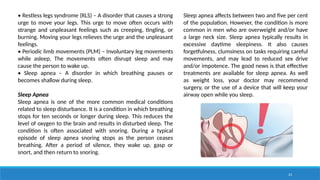
Sleep apnea affects between two and five per cent
of the population. However, the condition is more
common in men who are overweight and/or have
a large neck size. Sleep apnea typically results in
excessive daytime sleepiness. It also causes
forgetfulness, clumsiness on tasks requiring careful
movements, and may lead to reduced sex drive
and/or impotence. The good news is that effective
treatments are available for sleep apnea. As well
as weight loss, your doctor may recommend
surgery, or the use of a device that will keep your
airway open while you sleep.
24.
24
Circadian Rhythms
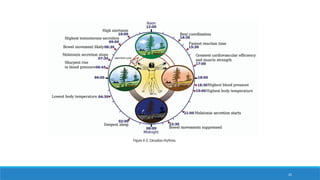
Our bodieshave very steady 24 hour rhythms in their
physiology, biochemistry and behavior. Alertness, body
temperature, sleep tendency, and human error have also been
shown to follow a 24 hour pattern. This is known as circadian
rhythms. (Figure 4-2)
Our body's internal clock is kept on correct time by exposure to
light, particularly early morning light. Our circadian rhythms are
so reliable that even if we are removed from the 24 hour
rhythm of night and day (such as wintering in Antarctica) the
rhythms continue to run. Without regular exposure to a daily
cycle of light and dark, circadian rhythms eventually begin to
'free run' and will no longer align closely with the 24 hour day.
Circadian rhythms have an important role in regulating sleep
patterns. Chemical changes occur in the body as it prepares for
sleep, typically between 8pm and midnight. Body temperature
reaches a low point at around 3am, and then begins rising
steadily as our body gets ready for the day ahead, even before
we are naturally awake.
Do shift workers adapt to permanent night
shifts?
Not usually! Research shows that fewer than 30%
of permanent night shift workers actually adjust
their rhythms to a nighttime schedule. In most
cases, they remain on a typical daytime pattern.
As a result, even workers on regular night shifts
will still experience a strong drive for sleep during
the night, and will find it more difficult to obtain
good quality rest during daylight hours.
Beware the WOCL!
The period from around 2am–5am when we
would normally be asleep is often referred to as
the Window of Circadian Low (WOCL), and is a
time when mental functioning is generally at its
worst. The WOCL is a high risk time for human
error. Even people without a sleep debt find that
their work performance is affected by fatigue
during the WOCL, but a sleep debt will intensify
the negative effects of the WOCL.
26
Studies of thousandsof industrial errors have shown that
although they can occur at any time of day or night, a large
proportion of errors occur at around 3am. There is often a
second, although smaller risk period at around 3pm. That
afternoon period is sometimes called the 'post lunch dip’.
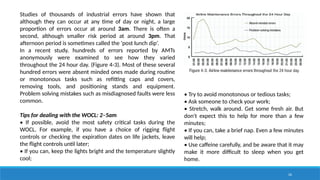
In a recent study, hundreds of errors reported by AMTs
anonymously were examined to see how they varied
throughout the 24 hour day. (Figure 4-3). Most of these several
hundred errors were absent minded ones made during routine
or monotonous tasks such as refitting caps and covers,
removing tools, and positioning stands and equipment.
Problem solving mistakes such as misdiagnosed faults were less
common.
Tips for dealing with the WOCL: 2–5am
• If possible, avoid the most safety critical tasks during the
WOCL. For example, if you have a choice of rigging flight
controls or checking the expiration dates on life jackets, leave
the flight controls until later;
• If you can, keep the lights bright and the temperature slightly
cool;
• Try to avoid monotonous or tedious tasks;
• Ask someone to check your work;
• Stretch, walk around. Get some fresh air. But
don't expect this to help for more than a few
minutes;
• If you can, take a brief nap. Even a few minutes
will help;
• Use caffeine carefully, and be aware that it may
make it more difficult to sleep when you get
home.
27.
27
Factors that increasethe impact of fatigue.
Certain conditions in the workplace can make the effects of
fatigue more severe. These include:
• Low light: A work environment with low illumination reduces
alertness and makes it harder for a fatigued person to fight the
urge to sleep.
• Passive activities: Tasks which are boring, do not involve
physical activity, or are performed while seated, are more likely
to be affected by fatigue. Tasks requiring continuous monitoring
or long tedious inspections tend to be more susceptible to
fatigue related errors.
• Warm temperature: A fatigued person will find it harder to
stay alert if their work environment is warm.
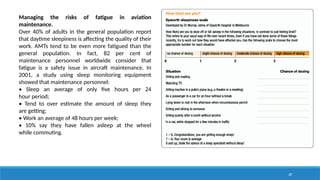
Sleep Inertia ('Sleep Drunkenness’)
In the few minutes after waking up, we may
experience a brief period of confusion, poor
memory and grogginess. This effect, which can
last up to 15 minutes, is known as sleep inertia.
It can be an issue in workplaces where people
have to wake up shortly before they get to work,
for example pilots who sleep in onboard crew
rest facilities. It can also be an issue in
maintenance if you are on call during the night.
Be aware that after waking from a deep sleep it
might take 15 minutes or so before you are alert
enough to get to work.
28.
28
Managing the risksof fatigue in aviation
maintenance.
Over 40% of adults in the general population report
that daytime sleepiness is affecting the quality of their
work. AMTs tend to be even more fatigued than the
general population. In fact, 82 per cent of
maintenance personnel worldwide consider that
fatigue is a safety issue in aircraft maintenance. In
2001, a study using sleep monitoring equipment
showed that maintenance personnel:
• Sleep an average of only five hours per 24
hour period;
• Tend to over estimate the amount of sleep they
are getting;
• Work an average of 48 hours per week;
• 10% say they have fallen asleep at the wheel
while commuting.
29.
29
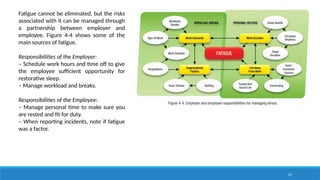
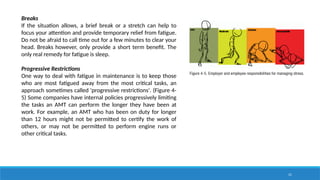
Fatigue cannot beeliminated, but the risks
associated with it can be managed through
a partnership between employer and
employee. Figure 4-4 shows some of the
main sources of fatigue.
Responsibilities of the Employer:
‒ Schedule work hours and time off to give
the employee sufficient opportunity for
restorative sleep.
‒ Manage workload and breaks.
Responsibilities of the Employee:
‒ Manage personal time to make sure you
are rested and fit for duty.
‒ When reporting incidents, note if fatigue
was a factor.
30.
30
Strategies to Dealwith Fatigue
Get More Sleep!
The first and most obvious way to prevent fatigue is to get
more good quality sleep. This is easier said than done,
particularly if you work irregular hours, have a second job, or
have young children.
Controlled Naps
Numerous research studies have shown that even a brief nap
can result in performance improvements. Napping used to be
widely discouraged by employers, but now pilots, air traffic
controllers and others are being allowed to take brief controlled
naps when workload permits.
Here are two types of naps:
• Preventative Nap: A brief sleep before you report for work,
particularly before starting a night shift.
• Restorative Nap: A brief sleep during a break at work can
sharpen your performance for the next couple of hours.
There are two problems to watch out for with naps:
• Avoid taking naps in the hours before you go to bed so as not
to interfere with your main sleep period.
• Naps lasting more than about 40 minutes may
produce sleep inertia, (a feeling of grogginess
that may persist after awakening). The best nap
duration appears to be about 20-25 minutes.
Caffeine
Caffeine is one of the most widely used
stimulants, and if used carefully and in
moderation can be part of an overall fatigue
management strategy. Caffeine has a half life in
the body of around five hours, so shift workers
should be careful to avoid caffeine in the hours
leading up to sleep. If you use caffeine to stay
alert at work, use it selectively, and cut down on
caffeinated drinks at other times. If you develop
a tolerance to caffeine, it will not be as effective
in keeping you alert.
31.
31
Breaks
If the situationallows, a brief break or a stretch can help to
focus your attention and provide temporary relief from fatigue.
Do not be afraid to call time out for a few minutes to clear your
head. Breaks however, only provide a short term benefit. The
only real remedy for fatigue is sleep.
Progressive Restrictions
One way to deal with fatigue in maintenance is to keep those
who are most fatigued away from the most critical tasks, an
approach sometimes called 'progressive restrictions'. (Figure 4-
5) Some companies have internal policies progressively limiting
the tasks an AMT can perform the longer they have been at
work. For example, an AMT who has been on duty for longer
than 12 hours might not be permitted to certify the work of
others, or may not be permitted to perform engine runs or
other critical tasks.
32.
32
SHIFT WORK
Most aircraftmovements occur between 6am and 10pm to fit
in with the requirements of passengers. AMTs are required
when aircraft are on the ground such as during turn arounds.
However, this scheduling means that aircraft are available for
more significant maintenance over night. Thus, aircraft
maintenance is clearly a 24 hour business and it is inevitable, to
fulfill commercial obligations, that AMTs usually work shifts.
Some permanently work the same shift, but the majority cycle
through different shifts.
Advantages and Disadvantages of Shift Work
Advantages include:
• More days off
• Avoiding peak traffic times when traveling to work.
Disadvantages include:
• Working 'unsociable hours', meaning that time available with
friends and family will be disrupted;
• Working when human performance is known to be poorer
(i.e. between 4am and 6am);
• Problems associated with disturbance of the body's various
rhythms (principally sleeping patterns).
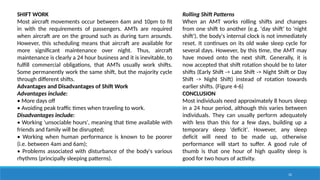
Rolling Shift Patterns
When an AMT works rolling shifts and changes
from one shift to another (e.g. 'day shift' to 'night
shift'), the body's internal clock is not immediately
reset. It continues on its old wake sleep cycle for
several days. However, by this time, the AMT may
have moved onto the next shift. Generally, it is
now accepted that shift rotation should be to later
shifts (Early Shift -> Late Shift -> Night Shift or Day
Shift -> Night Shift) instead of rotation towards
earlier shifts. (Figure 4-6)
CONCLUSION
Most individuals need approximately 8 hours sleep
in a 24 hour period, although this varies between
individuals. They can usually perform adequately
with less than this for a few days, building up a
temporary sleep 'deficit'. However, any sleep
deficit will need to be made up, otherwise
performance will start to suffer. A good rule of
thumb is that one hour of high quality sleep is
good for two hours of activity.
33.
33
6. Alcohol, Medications,And Drug Abuse.
ALCOHOL
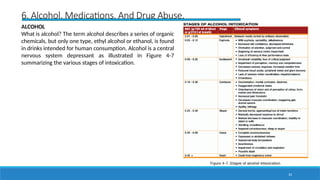
What is alcohol? The term alcohol describes a series of organic
chemicals, but only one type, ethyl alcohol or ethanol, is found
in drinks intended for human consumption. Alcohol is a central
nervous system depressant as illustrated in Figure 4-7
summarizing the various stages of intoxication.
34.
34
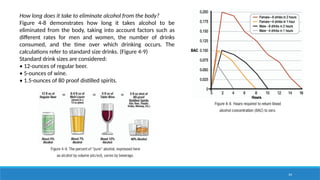
How long doesit take to eliminate alcohol from the body?
Figure 4-8 demonstrates how long it takes alcohol to be
eliminated from the body, taking into account factors such as
different rates for men and women, the number of drinks
consumed, and the time over which drinking occurs. The
calculations refer to standard size drinks. (Figure 4-9)
Standard drink sizes are considered:
• 12-ounces of regular beer.
• 5-ounces of wine.
• 1.5-ounces of 80 proof distilled spirits.
35.
35
Alcohol and Safety
Alcoholis a depressant drug, even though it may feel
stimulating at first. Within minutes of drinking, some alcohol
will be absorbed into the bloodstream. Certain things, such as
eating, affect the alcohol absorption rate; eating slows down
absorption. Even a small amount of alcohol affects decision
making skills. Your ability to perform certain tasks, such as
trouble shooting is quickly affected.
Alcohol and Sleep
Alcohol has a detrimental effect on both the quality of sleep
and on daytime attention. Sleep problems are common in
alcoholics. The effects of alcohol on sleep and attention are
complicated to define and have considerable variability in
individuals.
Disturbance of Paradoxical (REM) Sleep/Slow Wave Sleep
Cycle
Alcohol seems to accelerate falling asleep, at least in subjects
who do not tend to fall asleep immediately. The negative
effects arise later and affect the quality and duration of sleep.
Sleep is a complex phenomenon. There are alternating phases
of deep sleep, called paradoxical or REM sleep during which
the subject dreams, and slow wave sleep.
Undisturbed progression of these two phases
of sleep is essential. Alcohol disturbs or
interrupts this sequence. Thus alcoholics, and
some people who have stopped drinking,
complain about disturbed and fragmented
sleep, frightening dreams, and insomnia.
The disruptive effects of alcohol last well into
the night, even when alcohol has been
eliminated. This is not a phenomenon specific
to alcohol, and also seen with other sedative
products. Snoring is abnormally frequent after
drinking alcohol before going to bed. This is
due to the relaxing effects of alcohol on the
pharyngeal muscles.
36.
36
Daytime Repercussions ofAlcohol's Effects on Sleep
Disturbed sleep or sleep deprivation add to the sedative effects
of alcohol during the day. Alcohol consumed late in the evening
will noticeably reduce the performance of a subject (attention,
dexterity) the following morning. By producing an accumulation
of nights of poor sleep, alcohol can disrupt the normal
sleep/wake cycle. Hence the negative effects of alcohol can
have repercussions on daytime performance.
Alcohol and Attention
The sedative action of alcohol has variable effect on attention,
reducing it and producing diminished performance. This action
is particularly noticeable in subjects who lack sleep or who tend
to be lethargic. Alcohol, even in moderate amounts, seems to
reduce the ability of an individual to waken, to the point where
driving ability is affected, not just in the hours after
consumption, but sometimes for days afterwards.
What would you do?
One of your colleagues has arrived at work for an early shift,
appears to be tired, has bloodshot eyes, and smells of alcohol.
You have worked with this person a number of times before,
and this behavior appears uncharacteristic. Your colleague acts
as if things are normal and is preparing to start the shift.
Do you:
1.Turn a blind eye, ignore him, and hope for the
best?
2. Pull him aside and have a quiet chat, asking if
anything is wrong? In your conversation, you
suggest that if he has been drinking some time
before work, he should call sick and go home.
3. Go straight to your supervisor, saying you
think your colleague may be under the influence
and his ability could be impaired.
4. Quietly suggest that he sees the supervisor
himself, as you think he might be unfit for work.
Remind him that being 'not fit for work', is
unacceptable, given the potential safety
implications.
37.
37
Let's look ateach of these options to see what might be the
best and safest course of action.
1. Taking professionalism, personal standards, and most
importantly safety into consideration, turning a blind eye is
not advisable, and would even play on our own conscience.
How would you feel if an incident involving your colleague,
which you had the power to avoid occurred later?
2. Pulling him aside for a quiet chat may address the
immediate problem on the day, but does nothing to address
a potentially greater problem. Suggesting that he go home
sick conveniently avoids the issue, but may mask problems
with dependence.
3. Advising your supervisor passes on your responsibility to a
higher authority and allows the issue to be dealt with
according to organizational policies. However, the downside
of this option is that you may be labeled a 'snitch', which
this could create personal consequences for you and others
in the future.
4. This then leaves you with the only choice–
the last option. Should you suggest that he tell
the supervisor himself? This is a difficult choice
as it raises internal debates about what is right
for them, right for us, right for the
organization, as well as what is right and best
in the interests of safety.
38.
38
DRUGS
What is adrug? A drug is any substance (solid, liquid or gas)
that brings about physical and/or psychological changes. The
drugs of most concern in the community are those affecting the
central nervous system. They act on the brain and can change
the way you think, feel, or behave. These drugs are known as
psychoactive drugs.
When we use drugs our capacity to think and move is generally
impaired. The changes may be slight, but when involved in
safety sensitive activities, drug use can lead to dangerous
errors.
The effects of alcohol and other drugs include:
• Slowed processing of information;
• Slowed perception;
• Longer reaction time. Responses to hazards are slower, and
the number of inappropriate avoidance maneuvers increases;
• Reduced coordination and ability to track or
follow movement;
• Reduced ability to concentrate;
• Reduced ability to see alternative solutions, to think flexibly;
• Attention problems affecting:
‒ Focused attention–concentrating on a single
task;
‒ Divided attention–coping with a number of
sources of information at once;
‒ Sustained attention–concentrating on one thing
for some time;
‒ Memory (including short term memory, and
memory for visual and spatial information);
‒ Increased risk taking
39.
39
How are drugsclassified?
Drugs are commonly classified according to their legal status,
and their effects on the central nervous system.
Legal Drugs
Laws control the availability, quality, and price of legal drugs.
For example, in the United States, alcohol may not be sold to
persons under the age of 21.
Illegal Drugs
Because they are illegal, there is no quality control on illicit
drugs such as heroin and ecstasy. This means that users can
never be sure that the drug they are taking is what they think it
is.
For example, PMA (paramethoxyamphetamine), a toxic form of
amphetamine, has been sold as ecstasy. The user also cannot
be sure of a drug's strength or purity. Various batches of an
illegally manufactured drugs may have different mixtures of the
drug and additives such as talcum powder, caffeine, or even
poisons.
Depressants
Depressants slow down the functions of the
central nervous system. Depressant drugs do not
necessarily make a person feel depressed. In
small quantities, depressants can cause the user
to feel more relaxed and/or less inhibited. In
large enough quantities they can cause
unconsciousness, vomiting, and even death.
Depressants affect concentration and
coordination. They slow down the ability to
respond to unexpected situations. Examples:
‒ Alcohol;
‒ Cannabis;
‒ Barbiturates (Seconal, Tuinal and Amytal);
‒ Benzodiazepines (tranquilizers), such as
Rohypnol, Valium, Serepax, Mogadon, Normison
and Eupynos;
‒ GHB (gammahydroxybutrate), or Fantasy;
‒ Opiates and opioids, including heroin,
morphine, codeine, and methadone;
‒ Some solvents and inhalants, many of which
are common household products.
Drugs Affecting the Central Nervous System There are three
main types of drug affecting the central nervous system:
depressants, stimulants, and hallucinogens.
40.
40
How do drugsaffect people?
The effects of a drug depend on the type of drug, how much is
used, how it is taken, the characteristics of the person taking it
(body type and mood), and the situation or place at which the
drug is taken. Some factors to consider include:
• How much of the drug is taken and how often;
• How the drug is taken;
• A person's physical characteristics, such as height, weight,
and gender;
• The person's mood and their environment;
• Tolerance to the drug;
• Other drugs used (poly/multiple drug use).
Legal Drugs – Prescription and Over the Counter
The following are some of the over the counter and
prescription types of medication in common use and how they
may affect you. This list is not exhaustive. You should take care
to find out the likely effects of any prescribed drug before you
take it. Always seek advice from your doctor and pharmacist,
and in particular declare what kind of work you do so they can
take that into account when prescribing medication.
Sleeping Tablets
These can dull the senses, cause mental confusion
and slow reaction times. How long this effect lasts
varies from person to person and may be unduly
prolonged. You should seek expert medical advice
before using them.
Antidepressants
These can depress the alerting system and have
contributed to errors, in turn leading to fatal
accidents. You should stop work when starting
antidepressants and only return when it is clear
that there are no adverse side effects.
Antibiotics
Penicillin and the various mycins and cyclines and
sulphur drugs may have short term or delayed
effects which can affect work performance. Their
use indicates that a fairly severe infection may well
be present and, apart from the effects of these
substances themselves, the side effects of the
infection will almost always render a person unfit
for work.
41.
41
Antihistamines
Such drugs arewidely used in cold cures and in the treatment
of hay fever, asthma, and allergic conditions. Many easily
obtainable nasal spray and drops contain antihistamines. Most
antihistamines tend to make the user feel drowsy, making
operation of equipment or vehicles not recommended.
Admittedly, very mild states of hay fever may be adequately
controlled by small doses of anti allergic drugs, but a trial
period to establish the absence of side effects is essential
before going on duty. When individuals are affected by allergic
conditions requiring more than the absolute minimum, and in
all cases of asthma, you should seek medical advice.
'Pep' Pills: (containing caffeine, dexedrine, benzedrine)
Are used to maintain wakefulness can be habit forming.
Individuals vary in their susceptibility to each drug, but all of
them can create dangerous overconfidence. Over dosage may
cause headaches, dizziness and mental disturbances. The use
of 'pep' pills while working cannot be permitted. If tea or coffee
is insufficient, you are not f it for work.
High Blood Pressure Medication
These are proving to be very effective in
controlling this condition. However,
antihypertensive agents all have some side
effects, and should not be administered before
adequate assessment of the need for
treatment. Your doctor should be able to advise
of any side effects you should consider.
Antimalarial
Drugs Antimalarial drugs prescribed in normally
recommended doses do not usually have any
adverse effects.
Oral Contraceptive Tablets
Oral contraceptive tablets in the standard dose
do not usually have adverse effects, although
regular supervision is required
42.
42
Sudafed
Sudafed is thetrade name of a preparation containing
pseudoephedrine hydrochloride. Your doctor may prescribe this
for relief of nasal congestion. Side effects reported are anxiety,
tremor, rapid pulse, and headache. The preparation does not
contain antihistamines, which could sedate and cause
drowsiness, but it can nevertheless affect skilled performance.
Sudafed or similar medications, therefore, should not be taken
when making maintenance decisions or performing safety
critical tasks.
CONCLUSION
Our overall well being is crucial to the safety of aviation
maintenance. Our physical health is effected by how we take
care of our bodies including nutrition and exercise. To maintain
a safety culture in the workplace we need to be aware of how
workload stresses such as time pressure, deadlines, and shift
work influence our attention and performance. Likewise,
outside influences such as domestic stress, sleep, alcohol, and
drugs also can affect our performance. Being aware of how the
above factors influence our abilities will help in maintaining a
safe and error free environment.





![Polymer [ बहुलक ] Chemistry Notes PDF - Irfanullah Mehar - JJ Sir Chemistry.pdf](https://cdn.slidesharecdn.com/ss_thumbnails/polymerchemistrynotespdf-irfanullahmehar-jjsirchemistry-260210172118-3f9b37f7-thumbnail.jpg?width=640&height=640&fit=bounds)


