Human-Computer Interaction Research at IBM T. J. Watson Research Center John C. Thomas Lehman College October 20, 2004
Outline Whirlwind Tour of the Past Whirlwind Tour of the Present In-depth Look at One Project Challenge: A Science of HCI Potential Approaches:  Pattern Languages in HCI Fifteen Properties of Great Design Practical Hacks
Whirlwind Tour of the Past Query By Example (1973-1975) Pencil and Paper studies Deeper Dive on Quantifiers Natural Language Processing (1975-1976) “ Wizard of Oz” studies Psychology of Design (1976-1979) Spectrum of Techniques Corporate Headquarters (1980-1982) Speech Synthesis (1983-1985) Motivation (1986) NYNEX AI Lab (1986-1998) Expert Systems, Machine Vision, Speech Recognition, Robotics, HCI, Intelligent Tutoring Systems IBM Research – Stories and Storytelling (1999-2001) Dynamic Assembly of Learning Objects (2001-2003) Tools for Consultants (2004--)
Whirlwind Tour of the Present Multi-media Everywhere Display Video Parsing Scene Parsing User Interface Technology Speech Recognition Handwriting Recognition Natural Language Research Human Computer Interaction Social Computing New Learning & Teaching Systems Better Tools for SW development, consultants
Learning Objects: Vision and Challenges Learning Materials Modularized with added Metadata “ Best” Materials become available to all Re-purposing and re-use (e.g., Tiger Woods video and physics professor) ----------------------------------------------- Copyright Issues How does metadata get added ? Selection, ordering, coherence issues
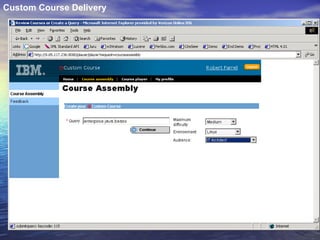
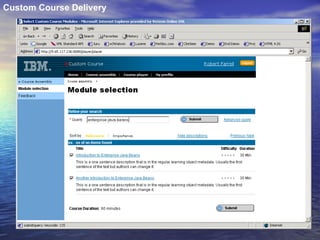
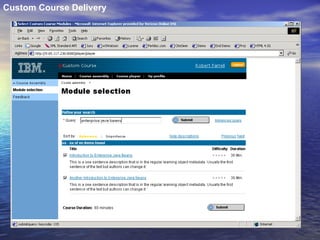
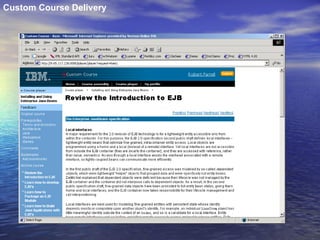
Context Dynamic Assembly allows on-demand material based on background and needs. System allows a person to use a Query Engine and then select from a list of relevance-ordered results. System uses metadata associated with each selected result to construct a pedagogically coherent course from learning objects. Here, domain is WebSphere and Web Services Materials come from IBM Redbooks. Hypothesis: People using Dynamic Assembly will perform significantly better in an on-demand situation than those using the Query Engine alone. Experiment designed to inform this question and also to provide on-going feedback to the design team.
Custom Course Delivery
Iterative Development Began with a series of PowerPoint “simulations” After several iterations, programming began on working system Pilot subjects with “real system” Followed by extensive IGS Field Trial Users had very positive reaction to the system based on questionnaire results; HOWEVER, it seemed that most were either: trying it because they were told to, kicking the tires, or seeing what it “would be like.”  Only a few (and there were some) seemed to be engaged in serious learning.
Experimental Design Rationale Trade-offs between “real people” doing “real work” in their “real setting” at their convenience and control Used IBM  volunteers willing to spend two hours from their own office connected via phone, shadowing, and/or sametime Gave scenario to motivate learning and performance Used very difficult task to avoid ceiling effect Used multiple measures of background, process, and product of learning Group I used Dynamic Assembly; Group II only used (the same) Query Engine
Procedure Volunteers recruited via e-mail Volunteers asked for two hour time slot; given instructions to print out ahead of time; most stayed on phone and spoke aloud during all tasks; some preferred to work silently or send same-time messages. Not all subjects kept appointments; not all subjects turned in all materials – but most (>90%) did turn in all materials.
Tasks Subjects read overview of experiment and were asked if they had any questions Subjects read a scenario to motivate them to design a solution to a customer’s problem Subjects had 55 minutes to learn Subjects had 35 minutes to complete a high level design  Subjects were then quizzed on objective knowledge of WebSphere and Web Services, answered subjective questions about their experience with the software and asked about their relevant background knowledge.
Scenario IBM has the chance for a moderately large software deal with Genysis although … is a strong competitor.   You’ve been called in at the last minute because the person who was supposed to give a client presentation was in a serious automobile accident.  The client exec wanted to reschedule …Genysis … needs to make a decision now.  You will meet with the client in about an hour …provide preliminary high level “design”….  If you can pull this off, your boss would be extremely impressed. Basically, their situation is as follows: Genysis … an international provider of herbs, vitamins, and related health care products; they have a working client-server application that allows registered pharmacists to order their products on-line. …software called “Doser” allows the pharmacist to enter a body weight and get a recommended dosage for particular drugs.  A series of recent events, …have led them to want to publish “Doser” as a Web Service available to the general public.  Moreover…they would like to offer interactions in at least six major languages… as well as English.  Luckily, although the current application is written for an American English, the Model View Controller Pattern was used and formats, help files and messages …separate from …control flow.  Genysis… considering possible use of another Web Service PolyGlot to do translation….
Subjects Subjects were all IBMers Subjects varied considerably both in IT experience generally and knowledge of Web Services and WebSphere from “complete novice” to “levels 3 to 5.” Subjects also varied widely  in “the number of languages I’ve used to write programs of >1000 lines” from 0 to 7.
Evaluating the Designs Design Behavior difficult to quantify; hence, use multiple measures: Quantitative Measures (often correlated with quality) Total Number of Pages in Design/Presentation Number of Words, Boxes, Arrows (not counting what is copied) Number of features present from an expert’s design Qualitative Measures Three experts rating the designs
Total Pages of Output Mean for Custom Course Group = 6.5 Mean for Query Only Group = 1.83 t(24)=2.10, p<.05 Also, a significant correlation between self-reported experience and number of pages; r=.46, t(24)=2.535, p<.01 (one-tailed), p<.02 (two-tailed) When experience is taken into account, the effect of group increases: t(24)=2.66, p<.014
Registry includes herb, vitamins, etc.  WSDL document Existing Java beans Import JAR file into AAT WAR file Web Sphere build Deploy Run Manage Client Service Registry Sample Design from one of the Query Only subjects
Architectural concept  Genysis Doser WebService enabling Sample Design from Custom Course Assembly Subject (p.1)
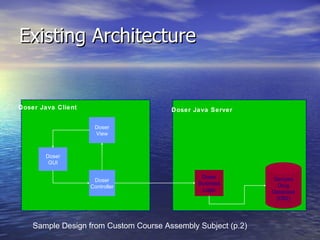
Existing Architecture Doser Business Logic Genysis Drug Database (DB2) Doser Controller Doser View Doser GUI Doser Java Client Doser Java Server Sample Design from Custom Course Assembly Subject (p.2)
Requirements WebService enabling of existing Business Logic Multilanguage (Mandarin, French, German, Italian, Spanish and English) Sample Design from Custom Course Assembly Subject (p.3)
Assumptions Business Logic of existing solutions runs on server New solution runs exactly the same Business Logic Content of the database is language independent (product names and numbers) Sample Design from Custom Course Assembly Subject (p.4)
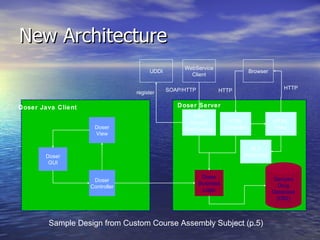
New  Architecture Doser Business Logic Genysis Drug Database (DB2) Doser Controller Doser View Doser GUI Doser Java Client Doser Server RPC Servlet (WebService) HTML Controller HTML View NLS Properties Browser WebService Client SOAP/HTTP HTTP HTTP UDDI register Sample Design from Custom Course Assembly Subject (p.5)
Custom  Course Group had more total design features that matched expert design suggestion Custom Course Group Mean = 10.8 Query Only Group Mean = 8.6 However, previous reported experience dwarfed this effect, r=.463, t (22)=2.35, p<.05 When experience is taken into account, the superiority of the Custom Course Group is significant t(22) = 2.35, p<.03
Experience also correlated with overall “quantity” of design Correlation of Experience with words+boxes+arrows r=.409, t(22)=2.1, p<.05 Custom Course group had more in their designs; when experience taken into account,  Custom Course outperformed the Query Only Group t(22)=2.59, p<.02 Experience also correlated separately with boxes used (r=.418, p<.05), arrows,r=.346, p<.1) and words (r=.367,p<.08) With experience accounted for, Custom Course Group also had significantly more words t(22)=2.46, p<.03
Designs were graded qualitatively by three experts Designs were graded on presentation, level of detail, accuracy, completeness, depth of understanding, and overall Graders tended to agree overall: r (1,2) = .728, r (1,3) = .72, r (2,3)= .734, p<.0001 for all Dynamic Assembly Group produced better designs for all three raters, but not significantly so. Adjusted for experience, more “good designs” in Dynamic Assembly
Conclusions It appears that the subjects from the Dynamic Assembly Group produced more in terms of design and, with experience accounted for, qualitatively better designs as well Individual differences, both in terms of background knowledge and design quality were very large
Why might the Custom Course Group have done better? The extra work involved in making a course may have encouraged them to stay more focused and less scattered. The additional metadata presented in the query results page may have allowed them to go to material better suited to their background and goals. The expectation of building and using a “course” may have induced a more reflective cognitive set. The learning objectives and organization may have served as advanced organizers thus improving learning. The ordering of learning objects within a course may have allowed a more coherent learning experience.
Conclusions Behavior  during  the experiment was qualitatively and quantitatively different for the two groups: The Query Only group spent a short amount of time on a larger number of Learning Objects, focusing on search and navigation The Custom Course Group spent longer amounts of time on fewer (and somewhat different) Learning Objects focusing on reading and understanding  Subjects varied considerably in their queries, Learning Object selections and visits, probably due to differences in their background
“Good” HCI Depends on… Users (People differ in training, ability, etc. Tasks (Speed/Accuracy, Complexity, etc. Context (Work, Play, School, War, Retail… Technology (Typing, Speech Recognition, Gesture Recognition, Virtual Reality, Affect Recognition, etc.
“Good” HCI Depends on… Users  Tasks Context Technology  BUT…. All of these are changing rapidly ALL the TIME !!
How then do we “Cumulate” Knowledge and Develop a True Science ? Scientific Truths are Supposedly independent of time and place One Approach: Pattern Language Second Approach: Fifteen Properties
Potential Forms of Knowledge Known, Predictable, Unchanging, Simple Unknown, Unpredictable, Changing, Complex Algorithms, Formulae, Programs, Machines Patterns Guidelines Heuristics, Principles,  Properties Case Studies Stories Ethical values and fluid intelligence
How can we help the designer DESIGN?
The Importance of the Social Robert Putnam: Making Democracy Work (Italy) Bowling Alone (America) Impacts health of individual more than smoking Impacts on whether we have a sustainable approach to the world’s resources Impact on war and other miseries Corporations now supporting collaboration and communities of practice Socially defined intelligence: Evan’s Thesis on figures analogies
E.g. Washing Dishes Hand Washing Duo Rhythm required Side by side “confessional” Conversation OK Team accomplishes the work High shared stimulus context Using Dishwasher Rhythm not required Unitary better Conversation ? Team or One prepares machine to accomplish the work Moderate shared stimulus context
Fixing Dinner Traditional cooking Negotiation Required High shared stimulus context (same meal) Synchronous activity Conversation likely Microwave No negotiation required (separate meals) Asynchronous activity Conversation less likely (person who is ready first starts some other activity)
Traditional Queue Some shared context; however… Perceived as competition for limited resource (tickets may run out) People in front are costing you time Face to Back of Head orientation Asynchronous movement reinforces individual identity (cf. rowing)
Vibrating Pager Queue The obviousness of the competition has been greatly reduced No requirement to “face the same direction” Face to face interaction possible Conversation is much more likely
Enhanced Telephone Help Desk Queue Many more people need help solving technical problem than servers available People describe problem ASR used to group similar problems People are bridged onto a conference call Synthesis announces to group their areas of overlapping interest Group may be able to solve the individual problems When available, help first gives generic advice
A Pattern Language Christopher Alexander Architectural “Patterns” that capture recurring problems and solutions Organized into a “Pattern Language” – a lattice of inter-related Patterns. Examples:  Eccentric Town Center encourages commuter traffic to stop at Town Center European Pub Gradient of Privacy in homes: porch, entry, living room, dinning room, kitchen, bedroom
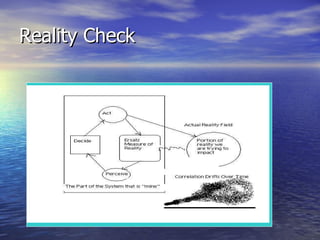
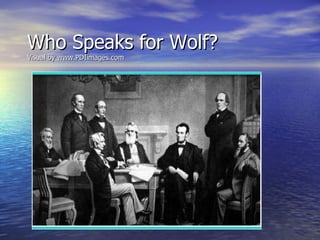
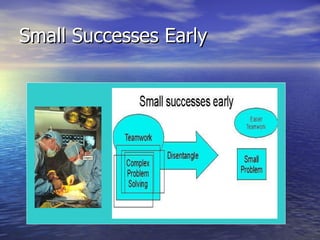
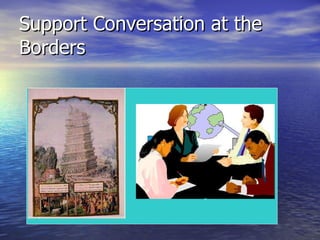
Some Socio-Technical Patterns Community of Communities Reality Check Radical Co-location Small Successes Early Who Speaks for Wolf? Support Conversation at Boundaries Social Proxy Context-setting Entry Answer Garden Registered Anonymity Anonymized Stories for Organizational Learning Mentoring Circle Levels of Authority Rites of Passage
Reality Check
Who Speaks for Wolf? Visual by www.PDIimages.com
Small Successes Early
Support Conversation at the Borders
Christopher Alexander’s Fifteen Properties from The Nature of Order 1. Levels of scale.  2. Strong centers.  3. Boundaries.  4.  Alternating repetition.  5. Positive space.  6. Good shape.  7. Local symmetries.  8. Deep interlock and ambiguity.  9. Contrast.  10. Gradients.  11. Roughness.  12. Echoes.  13. The Void.  14. Simplicity and Inner Calm.  15.  Not-separateness.
Can these be applied to the design of social systems? * Levels of Scale: Organizations, Divisions,  Departments, Projects, Teams, Individual. * Positive Space: Opposite of “not my job”; better to have contention than gaps * The Void: Need empty space and empty time; perhaps even roles of peace * Roughness: Problems arise when designs presume that they have covered every case.
For more information: www.research.ibm.com/knowsoc/ www.truthtable.com/websitewelcome_page_index.html http://www.cpsr.org/conferences/diac02  http://www.welie.com/patterns/plml/ http://www.pliant.org/personal/Tom_Erickson/InteractionPatterns.html http:// www.hcipatterns.org / http:// www.cpsr.org /program/sphere/patterns/ http:// www.ibm.com/developerWorks/patterns / http://jerry.cs.uiuc.edu/~plop/plop2003/cfp2003.html  http:/www.cs.kent.ac.uk/people/staff/saf/patterns/gallery.html http://www.groupware-patterns.org / http://www.lmu.ac.uk/ies/comp/research/isle/janetfinlay/ www.truthtable.com/patterns.html/

Human computer interaction research at ibm t

  • 1.
    Human-Computer Interaction Researchat IBM T. J. Watson Research Center John C. Thomas Lehman College October 20, 2004
  • 2.
    Outline Whirlwind Tourof the Past Whirlwind Tour of the Present In-depth Look at One Project Challenge: A Science of HCI Potential Approaches: Pattern Languages in HCI Fifteen Properties of Great Design Practical Hacks
  • 3.
    Whirlwind Tour ofthe Past Query By Example (1973-1975) Pencil and Paper studies Deeper Dive on Quantifiers Natural Language Processing (1975-1976) “ Wizard of Oz” studies Psychology of Design (1976-1979) Spectrum of Techniques Corporate Headquarters (1980-1982) Speech Synthesis (1983-1985) Motivation (1986) NYNEX AI Lab (1986-1998) Expert Systems, Machine Vision, Speech Recognition, Robotics, HCI, Intelligent Tutoring Systems IBM Research – Stories and Storytelling (1999-2001) Dynamic Assembly of Learning Objects (2001-2003) Tools for Consultants (2004--)
  • 4.
    Whirlwind Tour ofthe Present Multi-media Everywhere Display Video Parsing Scene Parsing User Interface Technology Speech Recognition Handwriting Recognition Natural Language Research Human Computer Interaction Social Computing New Learning & Teaching Systems Better Tools for SW development, consultants
  • 5.
    Learning Objects: Visionand Challenges Learning Materials Modularized with added Metadata “ Best” Materials become available to all Re-purposing and re-use (e.g., Tiger Woods video and physics professor) ----------------------------------------------- Copyright Issues How does metadata get added ? Selection, ordering, coherence issues
  • 6.
    Context Dynamic Assemblyallows on-demand material based on background and needs. System allows a person to use a Query Engine and then select from a list of relevance-ordered results. System uses metadata associated with each selected result to construct a pedagogically coherent course from learning objects. Here, domain is WebSphere and Web Services Materials come from IBM Redbooks. Hypothesis: People using Dynamic Assembly will perform significantly better in an on-demand situation than those using the Query Engine alone. Experiment designed to inform this question and also to provide on-going feedback to the design team.
  • 7.
  • 8.
  • 9.
  • 10.
  • 11.
    Iterative Development Beganwith a series of PowerPoint “simulations” After several iterations, programming began on working system Pilot subjects with “real system” Followed by extensive IGS Field Trial Users had very positive reaction to the system based on questionnaire results; HOWEVER, it seemed that most were either: trying it because they were told to, kicking the tires, or seeing what it “would be like.” Only a few (and there were some) seemed to be engaged in serious learning.
  • 12.
    Experimental Design RationaleTrade-offs between “real people” doing “real work” in their “real setting” at their convenience and control Used IBM volunteers willing to spend two hours from their own office connected via phone, shadowing, and/or sametime Gave scenario to motivate learning and performance Used very difficult task to avoid ceiling effect Used multiple measures of background, process, and product of learning Group I used Dynamic Assembly; Group II only used (the same) Query Engine
  • 13.
    Procedure Volunteers recruitedvia e-mail Volunteers asked for two hour time slot; given instructions to print out ahead of time; most stayed on phone and spoke aloud during all tasks; some preferred to work silently or send same-time messages. Not all subjects kept appointments; not all subjects turned in all materials – but most (>90%) did turn in all materials.
  • 14.
    Tasks Subjects readoverview of experiment and were asked if they had any questions Subjects read a scenario to motivate them to design a solution to a customer’s problem Subjects had 55 minutes to learn Subjects had 35 minutes to complete a high level design Subjects were then quizzed on objective knowledge of WebSphere and Web Services, answered subjective questions about their experience with the software and asked about their relevant background knowledge.
  • 15.
    Scenario IBM hasthe chance for a moderately large software deal with Genysis although … is a strong competitor. You’ve been called in at the last minute because the person who was supposed to give a client presentation was in a serious automobile accident. The client exec wanted to reschedule …Genysis … needs to make a decision now. You will meet with the client in about an hour …provide preliminary high level “design”…. If you can pull this off, your boss would be extremely impressed. Basically, their situation is as follows: Genysis … an international provider of herbs, vitamins, and related health care products; they have a working client-server application that allows registered pharmacists to order their products on-line. …software called “Doser” allows the pharmacist to enter a body weight and get a recommended dosage for particular drugs. A series of recent events, …have led them to want to publish “Doser” as a Web Service available to the general public. Moreover…they would like to offer interactions in at least six major languages… as well as English. Luckily, although the current application is written for an American English, the Model View Controller Pattern was used and formats, help files and messages …separate from …control flow. Genysis… considering possible use of another Web Service PolyGlot to do translation….
  • 16.
    Subjects Subjects wereall IBMers Subjects varied considerably both in IT experience generally and knowledge of Web Services and WebSphere from “complete novice” to “levels 3 to 5.” Subjects also varied widely in “the number of languages I’ve used to write programs of >1000 lines” from 0 to 7.
  • 17.
    Evaluating the DesignsDesign Behavior difficult to quantify; hence, use multiple measures: Quantitative Measures (often correlated with quality) Total Number of Pages in Design/Presentation Number of Words, Boxes, Arrows (not counting what is copied) Number of features present from an expert’s design Qualitative Measures Three experts rating the designs
  • 18.
    Total Pages ofOutput Mean for Custom Course Group = 6.5 Mean for Query Only Group = 1.83 t(24)=2.10, p<.05 Also, a significant correlation between self-reported experience and number of pages; r=.46, t(24)=2.535, p<.01 (one-tailed), p<.02 (two-tailed) When experience is taken into account, the effect of group increases: t(24)=2.66, p<.014
  • 19.
    Registry includes herb,vitamins, etc. WSDL document Existing Java beans Import JAR file into AAT WAR file Web Sphere build Deploy Run Manage Client Service Registry Sample Design from one of the Query Only subjects
  • 20.
    Architectural concept Genysis Doser WebService enabling Sample Design from Custom Course Assembly Subject (p.1)
  • 21.
    Existing Architecture DoserBusiness Logic Genysis Drug Database (DB2) Doser Controller Doser View Doser GUI Doser Java Client Doser Java Server Sample Design from Custom Course Assembly Subject (p.2)
  • 22.
    Requirements WebService enablingof existing Business Logic Multilanguage (Mandarin, French, German, Italian, Spanish and English) Sample Design from Custom Course Assembly Subject (p.3)
  • 23.
    Assumptions Business Logicof existing solutions runs on server New solution runs exactly the same Business Logic Content of the database is language independent (product names and numbers) Sample Design from Custom Course Assembly Subject (p.4)
  • 24.
    New ArchitectureDoser Business Logic Genysis Drug Database (DB2) Doser Controller Doser View Doser GUI Doser Java Client Doser Server RPC Servlet (WebService) HTML Controller HTML View NLS Properties Browser WebService Client SOAP/HTTP HTTP HTTP UDDI register Sample Design from Custom Course Assembly Subject (p.5)
  • 25.
    Custom CourseGroup had more total design features that matched expert design suggestion Custom Course Group Mean = 10.8 Query Only Group Mean = 8.6 However, previous reported experience dwarfed this effect, r=.463, t (22)=2.35, p<.05 When experience is taken into account, the superiority of the Custom Course Group is significant t(22) = 2.35, p<.03
  • 26.
    Experience also correlatedwith overall “quantity” of design Correlation of Experience with words+boxes+arrows r=.409, t(22)=2.1, p<.05 Custom Course group had more in their designs; when experience taken into account, Custom Course outperformed the Query Only Group t(22)=2.59, p<.02 Experience also correlated separately with boxes used (r=.418, p<.05), arrows,r=.346, p<.1) and words (r=.367,p<.08) With experience accounted for, Custom Course Group also had significantly more words t(22)=2.46, p<.03
  • 27.
    Designs were gradedqualitatively by three experts Designs were graded on presentation, level of detail, accuracy, completeness, depth of understanding, and overall Graders tended to agree overall: r (1,2) = .728, r (1,3) = .72, r (2,3)= .734, p<.0001 for all Dynamic Assembly Group produced better designs for all three raters, but not significantly so. Adjusted for experience, more “good designs” in Dynamic Assembly
  • 28.
    Conclusions It appearsthat the subjects from the Dynamic Assembly Group produced more in terms of design and, with experience accounted for, qualitatively better designs as well Individual differences, both in terms of background knowledge and design quality were very large
  • 29.
    Why might theCustom Course Group have done better? The extra work involved in making a course may have encouraged them to stay more focused and less scattered. The additional metadata presented in the query results page may have allowed them to go to material better suited to their background and goals. The expectation of building and using a “course” may have induced a more reflective cognitive set. The learning objectives and organization may have served as advanced organizers thus improving learning. The ordering of learning objects within a course may have allowed a more coherent learning experience.
  • 30.
    Conclusions Behavior during the experiment was qualitatively and quantitatively different for the two groups: The Query Only group spent a short amount of time on a larger number of Learning Objects, focusing on search and navigation The Custom Course Group spent longer amounts of time on fewer (and somewhat different) Learning Objects focusing on reading and understanding Subjects varied considerably in their queries, Learning Object selections and visits, probably due to differences in their background
  • 31.
    “Good” HCI Dependson… Users (People differ in training, ability, etc. Tasks (Speed/Accuracy, Complexity, etc. Context (Work, Play, School, War, Retail… Technology (Typing, Speech Recognition, Gesture Recognition, Virtual Reality, Affect Recognition, etc.
  • 32.
    “Good” HCI Dependson… Users Tasks Context Technology BUT…. All of these are changing rapidly ALL the TIME !!
  • 33.
    How then dowe “Cumulate” Knowledge and Develop a True Science ? Scientific Truths are Supposedly independent of time and place One Approach: Pattern Language Second Approach: Fifteen Properties
  • 34.
    Potential Forms ofKnowledge Known, Predictable, Unchanging, Simple Unknown, Unpredictable, Changing, Complex Algorithms, Formulae, Programs, Machines Patterns Guidelines Heuristics, Principles, Properties Case Studies Stories Ethical values and fluid intelligence
  • 35.
    How can wehelp the designer DESIGN?
  • 36.
    The Importance ofthe Social Robert Putnam: Making Democracy Work (Italy) Bowling Alone (America) Impacts health of individual more than smoking Impacts on whether we have a sustainable approach to the world’s resources Impact on war and other miseries Corporations now supporting collaboration and communities of practice Socially defined intelligence: Evan’s Thesis on figures analogies
  • 37.
    E.g. Washing DishesHand Washing Duo Rhythm required Side by side “confessional” Conversation OK Team accomplishes the work High shared stimulus context Using Dishwasher Rhythm not required Unitary better Conversation ? Team or One prepares machine to accomplish the work Moderate shared stimulus context
  • 38.
    Fixing Dinner Traditionalcooking Negotiation Required High shared stimulus context (same meal) Synchronous activity Conversation likely Microwave No negotiation required (separate meals) Asynchronous activity Conversation less likely (person who is ready first starts some other activity)
  • 39.
    Traditional Queue Someshared context; however… Perceived as competition for limited resource (tickets may run out) People in front are costing you time Face to Back of Head orientation Asynchronous movement reinforces individual identity (cf. rowing)
  • 40.
    Vibrating Pager QueueThe obviousness of the competition has been greatly reduced No requirement to “face the same direction” Face to face interaction possible Conversation is much more likely
  • 41.
    Enhanced Telephone HelpDesk Queue Many more people need help solving technical problem than servers available People describe problem ASR used to group similar problems People are bridged onto a conference call Synthesis announces to group their areas of overlapping interest Group may be able to solve the individual problems When available, help first gives generic advice
  • 42.
    A Pattern LanguageChristopher Alexander Architectural “Patterns” that capture recurring problems and solutions Organized into a “Pattern Language” – a lattice of inter-related Patterns. Examples: Eccentric Town Center encourages commuter traffic to stop at Town Center European Pub Gradient of Privacy in homes: porch, entry, living room, dinning room, kitchen, bedroom
  • 43.
    Some Socio-Technical PatternsCommunity of Communities Reality Check Radical Co-location Small Successes Early Who Speaks for Wolf? Support Conversation at Boundaries Social Proxy Context-setting Entry Answer Garden Registered Anonymity Anonymized Stories for Organizational Learning Mentoring Circle Levels of Authority Rites of Passage
  • 44.
  • 45.
    Who Speaks forWolf? Visual by www.PDIimages.com
  • 46.
  • 47.
  • 48.
    Christopher Alexander’s FifteenProperties from The Nature of Order 1. Levels of scale. 2. Strong centers. 3. Boundaries. 4. Alternating repetition. 5. Positive space. 6. Good shape. 7. Local symmetries. 8. Deep interlock and ambiguity. 9. Contrast. 10. Gradients. 11. Roughness. 12. Echoes. 13. The Void. 14. Simplicity and Inner Calm. 15. Not-separateness.
  • 49.
    Can these beapplied to the design of social systems? * Levels of Scale: Organizations, Divisions, Departments, Projects, Teams, Individual. * Positive Space: Opposite of “not my job”; better to have contention than gaps * The Void: Need empty space and empty time; perhaps even roles of peace * Roughness: Problems arise when designs presume that they have covered every case.
  • 50.
    For more information:www.research.ibm.com/knowsoc/ www.truthtable.com/websitewelcome_page_index.html http://www.cpsr.org/conferences/diac02 http://www.welie.com/patterns/plml/ http://www.pliant.org/personal/Tom_Erickson/InteractionPatterns.html http:// www.hcipatterns.org / http:// www.cpsr.org /program/sphere/patterns/ http:// www.ibm.com/developerWorks/patterns / http://jerry.cs.uiuc.edu/~plop/plop2003/cfp2003.html http:/www.cs.kent.ac.uk/people/staff/saf/patterns/gallery.html http://www.groupware-patterns.org / http://www.lmu.ac.uk/ies/comp/research/isle/janetfinlay/ www.truthtable.com/patterns.html/

Editor's Notes

  • #11 If the course is large, we would like to group things into chapters. And offer prerequites information by intended use (e.g., here are some scenarios…). We plan to use intended use, difficulty, and importance to reorder the material for different types of learners as defined by the audiences.
  • #21 Begriffe und Abkürzungen AL: Artistic Licence. Freie, relativ selten anzutreffende Softwarelizenz, die dem Autor eines Werks &amp;quot;künstlerische Kontrolle&amp;quot; verschaffen soll. BSD: Berkeley Software Distribution. Bekannt geworden im Zusammenhang mit der Familie der BSD-Unix-Derivate der Berekley Universitßt von Kalifornien. Sie stehen unter der eigenen BSD-Lizenz. Copyleft: Von Richard Stallman erfundener Begriff zur Kennzeichnung von Software, die Bestimmungen unterliegt, die dem eigentlichen Copyright zuwiderstehen: Aufhebung des Schutzes geistigen Eigentums, ausdrückliche Erlaubnis zur uneingeschränkten Nutzung, Vervielfältigung, Modifikation und Distribution. Datenbank: Eine Menge von strukturierten Daten, die zusammen mit einem Datenbankmanagementsystem ein Datenbanksystem ergeben. Eine Datenbank wird meist auf mehrere Dateien abgebildet, die Datensätze enthalten, von denen jeder die gleiche Menge von Datenfeldern enthält. DNS/BIND: Domain Name System/Berkeley Internet Name Domain. Weit verbreitete, freie Systemsoftware, die IP-Nummern in IP-Namen umsetzt und Dienste des Internet-Namensystems bereitstellt. E-Mail: Electronic Mail bezeichnet das Versenden von Nachrichten über das Internet. Sowohl Sie als auch Ihr Partner müssen Zugang zum Internet haben. Für das Senden, Empfangen und Verwalten von E-Mails exisitieren zahlreiche Programme, die sogenannten E-Mail-Clients. FSF: Free Software Foundation. 1983 von Richard Stallman gegründete Organisation zur Förderung freier Software in politischer, ideologischer und technischer Weise. GIMP: The GNU Image Manipulation Program. Freie Alternative zu Adobes Bildverarbeitungsprogramm Photoshop mit Plug-In-Konzept. GNOME: GNU&apos;s Network Object Model Environment. Neben KDE die zweite freie, grafische Benutzeroberfläche für Unix. GNU: GNU&apos;s not Unix. Teil des freien Betriebssystems GNU/Linux und Software-Projekt der Free Software Foundation. GPL: Die GNU Public Licence ist das genaue Gegenteil von herkömmlichen Lizenzen bekannter Softwarehersteller. Sie besagt, daß der Quellcode eines Programms, das ihr unterliegt, frei verfügbar ist und von jedem verändert, weiter publiziert und verkauft werden darf unter der Voraussetzung, daß der neu geschaffene Code wiederum der GPL unterliegt. Hacker: Ein Hacker ist jemand, dessen liebstes Hobby das Programmieren mit all seinen Facetten ist. Die Hacker-Kultur zeichnet sich durch offenes, verteiltes Zusammenarbeiten aus, ohne damit einen finanziellen Gewinn zu erzielen. Nicht zu verwechseln mit der im Geheimen arbeitenden Cracker-Gemeinde, die eher destruktiv arbeitet und häufig illegal in Computersysteme eindringt. KDE: K Desktop Environment. Eine intuitive, freie, grafische Bedienoberfläche (Desktop-System) für Unix-Derivate, deren Projekt in Deutschland beheimatet ist. LGPL: GNU Library General Public Licence. Freie Softwarelizenz, die der GPL stark ähnelt, aber die Erlaubnis beinhaltet, LGPL-Programme und -Bibliotheken mit proprietärer Software zu nutzen. MPL: Mozilla Public Licence. Teile des im April 1998 freigegebenen Netscape Communicator 5.0 (Mozilla) unterliegen dieser Lizenz. Im Gegensatz zur NPL enthält sie aber keine Sonderrechte für Netscape. NPL: Netscape Public Licence. Teile des im April 1998 freigegebenen Netscape Communicator 5.0 (Mozilla) unterliegen dieser Lizenz. Open Source: Von der Open Source Initiative eingeführte Bezeichnung zur Beschreibung all dessen, was mit freier Software zu tun hat. Open Source hat den zweideutigen Begriff &amp;quot;freie Software&amp;quot; (kostenlos und frei verfügbar) abglöst. Open Source umfaßt nicht nur die Software selbst, sondern meint auch das verteilte, offene Entwicklungsmodell. OSI: Open Source Initiative. 1997 von Eric Raymond und anderen Verfechtern freier Software aus der Taufe gehobene Organisation zur Förderung freier Software (Open Source). Die OSI führt(e) eine Kampagne durch, die den Begriff und das Markenzeichen &amp;quot;Open Source&amp;quot; in der Industrie etablieren soll(te). Perl: Practical Extraction and Report Language. Eine von Larry Wall entwickelte, interpretierende Programmiersprache, die sich insbesondere für Web-Applikationen eignet. Ursprünglich entstand sie aus dem Unix-Tool awk. PHP: Rekursive Abkürzung f&amp;quot;r PHP Hypertext Preprocessor. Eine in HTML eingebettete Programmiersprache zur Entwicklung von dynamischen Internet-Inhalten und Web-Anwendungen. Tcl/Tk: Tool Command Language/Tool Kit. Freie Skriptsprache zur Anwendungsentwicklung.