Crossing HCI for Development in Asia Pacific
Chaos, Culture, Conflict and Creativity: Toward a Maturity Model for HCI4D!
April 19, 2015	

John C. Thomas, !Problem Solving International	

“IF THERE IS NOT ONE AMONG US WHO CONTAINS SUFFICIENT WISDOM, MANY PEOPLE
TOGETHER MAY FIND A CLEAR PATH.” — Paula Underwood, The Walking People.
OUTLINE
Why HCI4D?	

Provisional Maturity Model	

Examples of Stage 8	

Enhancing Creativity	

Representations 	

The “singularity” & fluid representations
WHY HCI4D?
CHI ’89 plenary talk by astronaut	

Cross-cultural HCI workshops at CHI ’92 and InterCHI ’93	

Recommendations to SIGCHI EC to make SIGCHI and CHI more
cross-cultural friendly	

Information and deadlines	

Sound friendly environments	

Development consortium	

Use “International English” in talks	

“Million Person Interface”1999; IBM World Jam 2001 	

HCI4D workshops at CHI 2007,8,9,10	

Multiple workshops in Asia,Africa, and S.America; 2010+	

Interact 2007 Rio; DIS 2008 Capetown; CSCW 2010 Hangzhou;
CHI 2015 Seoul
PROVISIONAL MATURITY MODEL
Isolation	

Exploration	

Exploitation	

Exhortation	

Exportation	

Localization	

Globalization	

Transmutation
PROVISIONAL MATURITY MODEL
Isolation: One culture has no real knowledge or contact with another	

Exploration: One culture begins to find out about another.	

Exploitation: One culture attempts to exploit, subjugate, enslave another.	

Exhortation: One culture tries to convince another to be more like the first.	

Exportation: (At least) one culture sees the advantages of trading.As applied to HCI,
this might encompass trying to export PC’s from the US to Africa.	

Localization:An exporting culture realizes that unaltered goods and services are
often not appropriate for another culture. E.g., different languages, icons, and, more
deeply, service models are needed in different places.
PROVISIONAL MATURITY MODEL
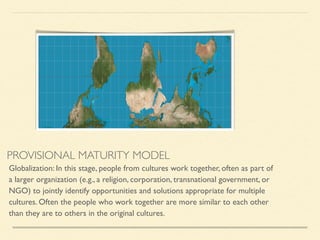
Globalization: In this stage, people from cultures work together, often as part of
a larger organization (e.g., a religion, corporation, transnational government, or
NGO) to jointly identify opportunities and solutions appropriate for multiple
cultures. Often the people who work together are more similar to each other
than they are to others in the original cultures.
PROVISIONAL MATURITY MODEL
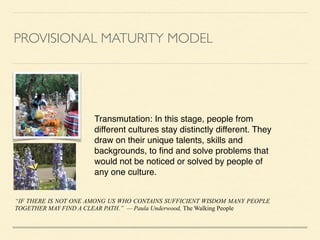
Transmutation: In this stage, people from
different cultures stay distinctly different. They
draw on their unique talents, skills and
backgrounds, to find and solve problems that
would not be noticed or solved by people of
any one culture.
“IF THERE IS NOT ONE AMONG US WHO CONTAINS SUFFICIENT WISDOM MANY PEOPLE
TOGETHER MAY FIND A CLEAR PATH.” — Paula Underwood, The Walking People
ASSUMPTIONS/PREMISES
Different cultures and background provide different default
assumptions and representational schemes.	

These differences lead to different ideas when faced with a
problem.	

A greater number of ideas is, other things being equal, more likely
to contain good ideas than a smaller number of ideas.	

People can evaluate with more than chance probability good vs.
bad ideas. 	

Additionally, the interplay of different ideas can result in the
production of ideas that no single background or culture is likely to
thus expanding the pool of possibly good ideas even further.	

Understanding the range and diversity of languages, customs, and
cultures allows the construction of a meta-cultural framework.This
framework can then allow us to construct new ways of working,
living and thinking that transcend those of any existing culture.
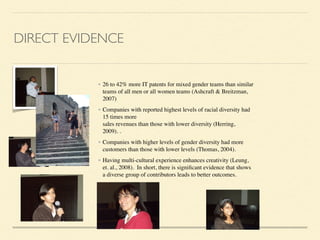
DIRECT EVIDENCE
• 26 to 42% more IT patents for mixed gender teams than similar
teams of all men or all women teams (Ashcraft & Breitzman,
2007) 	

• Companies with reported highest levels of racial diversity had
15 times more

sales revenues than those with lower diversity (Herring,
2009). . 	

• Companies with higher levels of gender diversity had more
customers than those with lower levels (Thomas, 2004).	

• Having multi-cultural experience enhances creativity (Leung,
et. al., 2008). In short, there is significant evidence that shows
a diverse group of contributors leads to better outcomes.
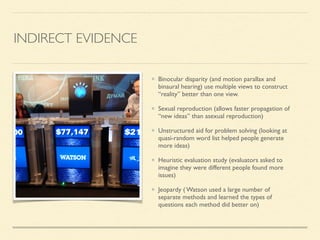
INDIRECT EVIDENCE
Binocular disparity (and motion parallax and
binaural hearing) use multiple views to construct
“reality” better than one view.	

Sexual reproduction (allows faster propagation of
“new ideas” than asexual reproduction)	

Unstructured aid for problem solving (looking at
quasi-random word list helped people generate
more ideas)	

Heuristic evaluation study (evaluators asked to
imagine they were different people found more
issues)	

Jeopardy ( Watson used a large number of
separate methods and learned the types of
questions each method did better on)
UNSTRUCTURED PROBLEM SOLVING AID
In a pilot study, college students were given a series of puzzle
problems to solve. A “structured aid” required them to be
explicit about goals, starting conditions and operations.An
“unstructured aid” was a quasi-random list of unrelated words.	

Structured Aid revealed issues to investigators but had no impact
on solution probability. 	

Unstructured Aid improved chances of solving “insight” problems
and judged creativity of a design problem (design a chair). 	

In a second study, 30 college students were given a design
problem: Design a restaurant from an abandoned church. 	

Designs were rated on originality (based on feature distance
from all designs) and practicality (based on number of features an
expert said were required).	

Half spent 1.5 hours designing. Half had time broken up with 15
minutes of looking at quasi-random word list. Latter group had
significantly higher practicality scores.
PAVE (PROGRAMMED AMPLIFICATION OF
VALUABLE EXPERTS)
Three in each of three groups: Human Factors Experts, Developers,
and Non-Experts	

Three conditions: Heuristic Evaluation, Cognitive Walkthrough, PAVE	

Given flow chart of proposed voice service.	

Asked to identify potential problems and suggest additional features. 	

PAVE perspectives: Self, Human Factors Expert, Cognitive
Psychologist, Behaviorist, Social Psychologist,Anthropologists,
Freudian Analyst, Health Advocate,Worried Mother, Spoiled Child. 	

Spent 2-3 hours on the problem. 	

HF Experts: Heuristic Evaluation>PAVE>>Cognitive Walkthrough.	

Developers and non-experts: PAVE >> Heuristic
Evaluation=Cognitive Walkthrough
PATTERN:WHO SPEAKS FOR WOLF?
• Abstract: 	

• A lot of effort and thought goes into decision making and design.
Nonetheless, it is often the case that bad decisions are made and
bad designs conceived and implemented primarily because some
critical and relevant perspective has not been brought to bear. This
is especially often true if the relevant perspective is that of a
stakeholder in the outcome. Make sure that every relevant
stakeholder’s perspective is brought to bear early.	

!
• The idea for this pattern comes from a Native American story
transcribed by Paula Underwood.	

!
• Underwood, Paula. Who speaks for Wolf: A Native American
Learning Story. Georgetown TX (now Bayfield, CO): A Tribe of
Two Press, 1983.
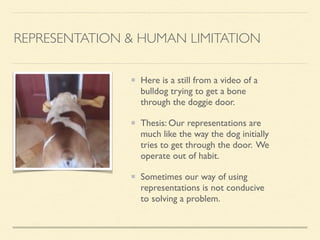
REPRESENTATION & HUMAN LIMITATION
Here is a still from a video of a
bulldog trying to get a bone
through the doggie door. 	

Thesis: Our representations are
much like the way the dog initially
tries to get through the door. We
operate out of habit.	

Sometimes our way of using
representations is not conducive
to solving a problem.
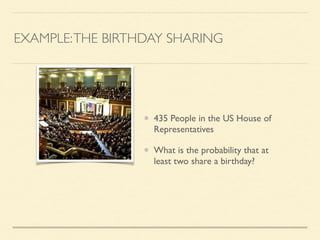
EXAMPLE:THE BIRTHDAY SHARING
435 People in the US House of
Representatives	

What is the probability that at
least two share a birthday?
PROBLEM: MAPPINGTO “THE BIRTHDAY PROBLEM"
People educated in mathematics
or statistics often run across “the
birthday problem” which basically
shows the counter-intuitive result
that even with only 30 people in a
room, there is about an even
chance that two will share a
birthday. People then conclude
that with 435 people, the
probability must be much higher;
e.g., .99
A GENERAL PROBLEM
It takes human beings a long time to learn
a complex system of representation; e.g.,
a natural language or a programming
language or a mathematical symbol
system.	

Therefore, we use the same symbol
system for many problems in a domain —
even if the system is not ideal for some.	

We use the same symbol system for
multiple stages of the problem — even if
the ideal symbol system would be
different for every step of the problem.
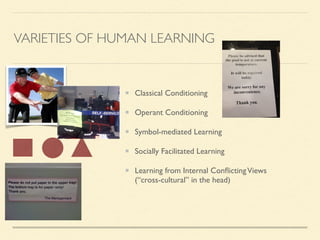
VARIETIES OF HUMAN LEARNING
Classical Conditioning	

Operant Conditioning	

Symbol-mediated Learning	

Socially Facilitated Learning	

Learning from Internal ConflictingViews
(“cross-cultural” in the head)
IMAGINE:
Another way to work that involved experts
from different cultures using different
representations for each stage of each
problem. 	

A system might be devised to select a subset
of people for each stage of a problem. 	

A system might be devised to translate
among steps/perspectives.	

Empathy and story can get us part-way
there.	

A system might be devised to synthesize
incompatible results.
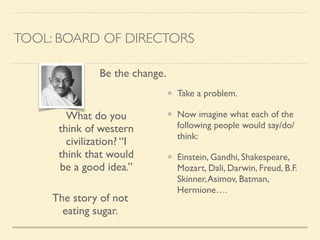
TOOL: BOARD OF DIRECTORS
Take a problem.	

Now imagine what each of the
following people would say/do/
think:	

Einstein, Gandhi, Shakespeare,
Mozart, Dali, Darwin, Freud, B.F.
Skinner,Asimov, Batman,
Hermione….
The story of not
eating sugar.
What do you
think of western
civilization? “I
think that would
be a good idea.”
Be the change.
USINGVARIETIES OF ACTUALTO DEVELOP
NOVEL REPRESENTATIONS
Date Notations:	

April 19, 2015 (American)	

19 April, 2015 (European)	

2015,April, 19 (Chinese)	

Change Order; Change Spatial Relations; Change specificity;	

Adjectives and Nouns	

“The red house.”	

“La Maison rouge”	

Simultaneous; put noun way before adjective; put noun way after adjective;“house”; kinetic typography
BASES FOR COUNTING
Number System A based on ten	

Number System B based on sixty	

!
Allows us, not only to use one or the other, but	

also to invent system C based on two, system D based on 16	

!
Multiply by 25: 	

In base ten, multiply by one hundred by shifting twice left	

In base two, divide twice by shifting twice right.	

Or, in base 25 shift once left … but this requires memorizing 	

large table.
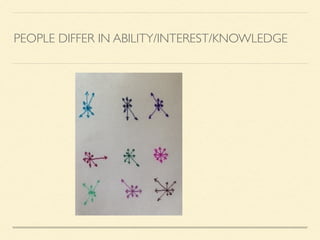
PEOPLE DIFFER IN ABILITY/INTEREST/KNOWLEDGE
ALIGNMENT:ALL MUST GO IN ONE DIRECTION
Fine for this
person
OK for
this person
Really a waste for
these three
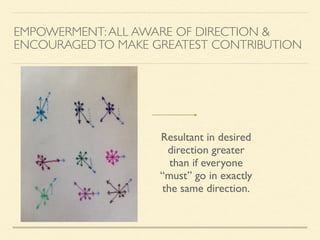
EMPOWERMENT:ALL AWARE OF DIRECTION &
ENCOURAGEDTO MAKE GREATEST CONTRIBUTION
Resultant in desired 	

direction greater
than if everyone
“must” go in exactly
the same direction.
POSSIBLE CONSEQUENCES
Not just: More productive,
effective, efficient problem solving	

Also: Finding and Formulating
problems we do not see	

And solving the insoluble: 	

Global Climate Change	

Unbridled Greed…
REFERENCES
!
Ashcraftand, C. & Breitzman, A. (2007) Who invents IT? An Analysis of Women’s Participation in Information Technology Patenting. Technical report, NCWIT, March 2007. 	

Best, M., Deardon, A., Dray, S., Light, A., Thomas, J.C., Buckhalter, C., Greenblatt, D., Krishnan, S., Sambasivan, N. (2007). Sharing perspectives on community centered design and international
development. Human-Computer Interaction, INTERACT 2007. New York: Springer.
Ceriejo-Roibas, A.,Dearden, A., Dray, S., Gray, P., Thomas, J.and Winters, N. (2009), Ethics, roles, and relationships in interaction design in developing regions, Lecture Notes in Computer Science,
Interact 2009. 5727, 963-964, Springer. DOI: 10.1007/978-3-642-03658-3_132.
Dearden, A., Dray, S., Light, A., & Thomas, J.C. (2007). Participatory design for international development, Workshop for CHI 2007, San Jose, CA, May 2007.
Desurvire, H. & Thomas, J.C. (1993). Enhancing performance of interface evaluators using non-empirical usability methods. In Proceedings of the Human Factors 37th Annual Meeting, 2,
1132-1136. Seattle, WA: October 11-15. Santa Monica, CA: Human Factors and Ergonomics Society.
!
Herring, C.. (2009) Does Diversity Pay? Race, Gender and the Business Case for Diversity. American Sociological Review, 74(2):208–224, 2009. 	

Kellogg, W. and Thomas, J. (1993) Cross-cultural perspectives on human-computer interaction: a report on the CHI'92 workshop, SIGCHI Bulletin, 25 (2), 40-45.
Leung, A.K.,Maddux, Galinsky, A.D.& Chiu, C-Y. (2008) Multicultural Experience Enhances Creativity: The When and How. American Psychologist, 63(3):169–181, 2008. 	

Sambasivan, N., Ho, M., Kam, M., Kodagoda, N., Dray, S., Thomas, J. C., Light, A., and Toyama, K. 2009. Human-centered computing in international development. In Proceedings of the 27th
international Conference Extended Abstracts on Human Factors in Computing Systems (Boston, MA, USA, April 04 - 09, 2009). CHI '09. ACM, New York, NY, 4745-4750. DOI= http://doi.acm.org/
10.1145/1520340.1520731
Schuler, D. (2008). Liberating Voices: A Pattern Language for Social Change. Cambridge MA: MIT Press.
Thomas, J. C. (2012). Patterns for emergent global intelligence. In Creativity and Rationale: Enhancing Human Experience By Design J. Carroll (Ed.), New York: Springer.
Thomas, J. (2012) Understanding and Harnessing Conflict. CHI Workshop Position Paper for HCI for Peace: Preventing, De-escalating and Recovering from Conflict. CHI 2012, Austin, Texas.
Thomas, J. (2012), Enhancing Collective Intelligence by Enhancing Social Roles and Diversity. CSCW Workshop Position Paper for Collective Intelligence and Community Discourse and Action.
CSCW 2012, Bellvue, WA.
Thomas, J. (2011). Toward a Socio-Technical Pattern Language for Social Systems in China and the World. Workshop position paper accepted for CSCW 2011 workshop: Designing social and
collaborative systems for China. Hangzhou, China, March 19-23.
Thomas, J. (2011). Toward a Socio-Technical Pattern Language for Social Media and International Development. Workshop position paper accepted for CSCW 2011 workshop: Social media for
development, Hangzhou, China, March 19-23.
Thomas, J.C. (2008). Using Story Templates as a Method to Cumulate Knowledge in HCI and International Development. Workshop paper for CSCW 2008.
Thomas, J.C. (2007). Panelist, Meta-design and social creativity: Making all voices heard. INTERACT 2007, Rio de Janeiro, BZ, Nov., 2007.
Thomas, J. C. (2007). The Walking People construed as a persistent conversation. IBM Research Report, RC 24187.
Thomas, J.C., Lyon, D. & Miller, L. (1977). Aids for problem solving. IBM Research Report. RC-6468. Yorktown Heights, NY: IBM Corporation.
Thomas, J.C. and Carroll, J. (1978). The psychological study of design. Design Studies, 1 (1), pp. 5-11.
!
REFERENCES (CONT).
!
Thomas, J.C. (2007). Search and sense-making strategies of the walking people. Presented at the Human Computer Interaction Consortium, Winter Park, CO, February 3, 2007.
Thomas, J.C. (2006). Calculating Culture. Invited discussant, Human Computer Interaction Consortium. Winter Park, CO, February, 2006.
D. A. Thomas. (2004) Diversity as strategy. Harvard Business Review, September 2004. reprint R0409G. 	

Thomas, J. C. (2003). Toward a socio-technical pattern language. Invited keynote presentation at the 10th ISPE international conference on concurrent engineering: Research and practice.
Madeira Island, Portugal, July 29, 2003.
Thomas, J. C., Lee, A., and Danis, C. (2002), “Who Speaks for Wolf?” IBM Research Report, RC-22644, Yorktown Heights, NY: IBM Corporation.
Thomas, J. C. (2001) Collaborative innovation tools. In T. Terano (Eds.) New Frontiers in Artificial Intelligence, JSAI 2001 Workshop, LNAI 2253, 27-34. Presented at Matsue City, May 25,
2001.
Thomas, J.C. (2001). Perspective modulation through interactive fiction. Workshop paper presented at CHI workshop: Interactive narrative and knowledge stewardship 2001; Seattle WA
Thomas, J.C. (1999). Facilitating global intelligence. Presented at Human-Centered Computing, Online Communities and Virtual Environments Report on the First Joint European Commission/
National Science Foundation Advanced Research Workshop, June 1-4, 1999, Chateau de Bonas, France"Human-Centered Computing, Online Communities and Virtual Environments", IEEE
Computer Graphics and Applications, Vol 19,No 6, pp 70-74, 1999.
Thomas, J.C. (1999). An HCI agenda for the next millennium: global intelligence. Presented at Human Computer Interaction Consortium, Winter Park, CO, February 1999.
Thomas, J.C. (1995). Biological metaphors for organizational learning. Presented at joint University of Colorado, University of Michigan, IRL, NYNEX symposium on organizational learning,
White Plains, NY.
Underwood, P. (1994). Three Native American Learning Stories. Georgetown, TX: A Tribe of Two Press.
Underwood, P. (1993). The Walking People. San Anselmo, CA: A Tribe of Two Press.

Asean

  • 1.
    Crossing HCI forDevelopment in Asia Pacific Chaos, Culture, Conflict and Creativity: Toward a Maturity Model for HCI4D! April 19, 2015 John C. Thomas, !Problem Solving International “IF THERE IS NOT ONE AMONG US WHO CONTAINS SUFFICIENT WISDOM, MANY PEOPLE TOGETHER MAY FIND A CLEAR PATH.” — Paula Underwood, The Walking People.
  • 2.
    OUTLINE Why HCI4D? Provisional MaturityModel Examples of Stage 8 Enhancing Creativity Representations The “singularity” & fluid representations
  • 3.
    WHY HCI4D? CHI ’89plenary talk by astronaut Cross-cultural HCI workshops at CHI ’92 and InterCHI ’93 Recommendations to SIGCHI EC to make SIGCHI and CHI more cross-cultural friendly Information and deadlines Sound friendly environments Development consortium Use “International English” in talks “Million Person Interface”1999; IBM World Jam 2001 HCI4D workshops at CHI 2007,8,9,10 Multiple workshops in Asia,Africa, and S.America; 2010+ Interact 2007 Rio; DIS 2008 Capetown; CSCW 2010 Hangzhou; CHI 2015 Seoul
  • 4.
  • 5.
    PROVISIONAL MATURITY MODEL Isolation:One culture has no real knowledge or contact with another Exploration: One culture begins to find out about another. Exploitation: One culture attempts to exploit, subjugate, enslave another. Exhortation: One culture tries to convince another to be more like the first. Exportation: (At least) one culture sees the advantages of trading.As applied to HCI, this might encompass trying to export PC’s from the US to Africa. Localization:An exporting culture realizes that unaltered goods and services are often not appropriate for another culture. E.g., different languages, icons, and, more deeply, service models are needed in different places.
  • 6.
    PROVISIONAL MATURITY MODEL Globalization:In this stage, people from cultures work together, often as part of a larger organization (e.g., a religion, corporation, transnational government, or NGO) to jointly identify opportunities and solutions appropriate for multiple cultures. Often the people who work together are more similar to each other than they are to others in the original cultures.
  • 7.
    PROVISIONAL MATURITY MODEL Transmutation:In this stage, people from different cultures stay distinctly different. They draw on their unique talents, skills and backgrounds, to find and solve problems that would not be noticed or solved by people of any one culture. “IF THERE IS NOT ONE AMONG US WHO CONTAINS SUFFICIENT WISDOM MANY PEOPLE TOGETHER MAY FIND A CLEAR PATH.” — Paula Underwood, The Walking People
  • 8.
    ASSUMPTIONS/PREMISES Different cultures andbackground provide different default assumptions and representational schemes. These differences lead to different ideas when faced with a problem. A greater number of ideas is, other things being equal, more likely to contain good ideas than a smaller number of ideas. People can evaluate with more than chance probability good vs. bad ideas. Additionally, the interplay of different ideas can result in the production of ideas that no single background or culture is likely to thus expanding the pool of possibly good ideas even further. Understanding the range and diversity of languages, customs, and cultures allows the construction of a meta-cultural framework.This framework can then allow us to construct new ways of working, living and thinking that transcend those of any existing culture.
  • 9.
    DIRECT EVIDENCE • 26to 42% more IT patents for mixed gender teams than similar teams of all men or all women teams (Ashcraft & Breitzman, 2007) • Companies with reported highest levels of racial diversity had 15 times more
 sales revenues than those with lower diversity (Herring, 2009). . • Companies with higher levels of gender diversity had more customers than those with lower levels (Thomas, 2004). • Having multi-cultural experience enhances creativity (Leung, et. al., 2008). In short, there is significant evidence that shows a diverse group of contributors leads to better outcomes.
  • 10.
    INDIRECT EVIDENCE Binocular disparity(and motion parallax and binaural hearing) use multiple views to construct “reality” better than one view. Sexual reproduction (allows faster propagation of “new ideas” than asexual reproduction) Unstructured aid for problem solving (looking at quasi-random word list helped people generate more ideas) Heuristic evaluation study (evaluators asked to imagine they were different people found more issues) Jeopardy ( Watson used a large number of separate methods and learned the types of questions each method did better on)
  • 11.
    UNSTRUCTURED PROBLEM SOLVINGAID In a pilot study, college students were given a series of puzzle problems to solve. A “structured aid” required them to be explicit about goals, starting conditions and operations.An “unstructured aid” was a quasi-random list of unrelated words. Structured Aid revealed issues to investigators but had no impact on solution probability. Unstructured Aid improved chances of solving “insight” problems and judged creativity of a design problem (design a chair). In a second study, 30 college students were given a design problem: Design a restaurant from an abandoned church. Designs were rated on originality (based on feature distance from all designs) and practicality (based on number of features an expert said were required). Half spent 1.5 hours designing. Half had time broken up with 15 minutes of looking at quasi-random word list. Latter group had significantly higher practicality scores.
  • 12.
    PAVE (PROGRAMMED AMPLIFICATIONOF VALUABLE EXPERTS) Three in each of three groups: Human Factors Experts, Developers, and Non-Experts Three conditions: Heuristic Evaluation, Cognitive Walkthrough, PAVE Given flow chart of proposed voice service. Asked to identify potential problems and suggest additional features. PAVE perspectives: Self, Human Factors Expert, Cognitive Psychologist, Behaviorist, Social Psychologist,Anthropologists, Freudian Analyst, Health Advocate,Worried Mother, Spoiled Child. Spent 2-3 hours on the problem. HF Experts: Heuristic Evaluation>PAVE>>Cognitive Walkthrough. Developers and non-experts: PAVE >> Heuristic Evaluation=Cognitive Walkthrough
  • 13.
    PATTERN:WHO SPEAKS FORWOLF? • Abstract: • A lot of effort and thought goes into decision making and design. Nonetheless, it is often the case that bad decisions are made and bad designs conceived and implemented primarily because some critical and relevant perspective has not been brought to bear. This is especially often true if the relevant perspective is that of a stakeholder in the outcome. Make sure that every relevant stakeholder’s perspective is brought to bear early. ! • The idea for this pattern comes from a Native American story transcribed by Paula Underwood. ! • Underwood, Paula. Who speaks for Wolf: A Native American Learning Story. Georgetown TX (now Bayfield, CO): A Tribe of Two Press, 1983.
  • 14.
    REPRESENTATION & HUMANLIMITATION Here is a still from a video of a bulldog trying to get a bone through the doggie door. Thesis: Our representations are much like the way the dog initially tries to get through the door. We operate out of habit. Sometimes our way of using representations is not conducive to solving a problem.
  • 15.
    EXAMPLE:THE BIRTHDAY SHARING 435People in the US House of Representatives What is the probability that at least two share a birthday?
  • 16.
    PROBLEM: MAPPINGTO “THEBIRTHDAY PROBLEM" People educated in mathematics or statistics often run across “the birthday problem” which basically shows the counter-intuitive result that even with only 30 people in a room, there is about an even chance that two will share a birthday. People then conclude that with 435 people, the probability must be much higher; e.g., .99
  • 17.
    A GENERAL PROBLEM Ittakes human beings a long time to learn a complex system of representation; e.g., a natural language or a programming language or a mathematical symbol system. Therefore, we use the same symbol system for many problems in a domain — even if the system is not ideal for some. We use the same symbol system for multiple stages of the problem — even if the ideal symbol system would be different for every step of the problem.
  • 18.
    VARIETIES OF HUMANLEARNING Classical Conditioning Operant Conditioning Symbol-mediated Learning Socially Facilitated Learning Learning from Internal ConflictingViews (“cross-cultural” in the head)
  • 19.
    IMAGINE: Another way towork that involved experts from different cultures using different representations for each stage of each problem. A system might be devised to select a subset of people for each stage of a problem. A system might be devised to translate among steps/perspectives. Empathy and story can get us part-way there. A system might be devised to synthesize incompatible results.
  • 20.
    TOOL: BOARD OFDIRECTORS Take a problem. Now imagine what each of the following people would say/do/ think: Einstein, Gandhi, Shakespeare, Mozart, Dali, Darwin, Freud, B.F. Skinner,Asimov, Batman, Hermione…. The story of not eating sugar. What do you think of western civilization? “I think that would be a good idea.” Be the change.
  • 21.
    USINGVARIETIES OF ACTUALTODEVELOP NOVEL REPRESENTATIONS Date Notations: April 19, 2015 (American) 19 April, 2015 (European) 2015,April, 19 (Chinese) Change Order; Change Spatial Relations; Change specificity; Adjectives and Nouns “The red house.” “La Maison rouge” Simultaneous; put noun way before adjective; put noun way after adjective;“house”; kinetic typography
  • 22.
    BASES FOR COUNTING NumberSystem A based on ten Number System B based on sixty ! Allows us, not only to use one or the other, but also to invent system C based on two, system D based on 16 ! Multiply by 25: In base ten, multiply by one hundred by shifting twice left In base two, divide twice by shifting twice right. Or, in base 25 shift once left … but this requires memorizing large table.
  • 23.
    PEOPLE DIFFER INABILITY/INTEREST/KNOWLEDGE
  • 24.
    ALIGNMENT:ALL MUST GOIN ONE DIRECTION Fine for this person OK for this person Really a waste for these three
  • 25.
    EMPOWERMENT:ALL AWARE OFDIRECTION & ENCOURAGEDTO MAKE GREATEST CONTRIBUTION Resultant in desired direction greater than if everyone “must” go in exactly the same direction.
  • 26.
    POSSIBLE CONSEQUENCES Not just:More productive, effective, efficient problem solving Also: Finding and Formulating problems we do not see And solving the insoluble: Global Climate Change Unbridled Greed…
  • 27.
    REFERENCES ! Ashcraftand, C. &Breitzman, A. (2007) Who invents IT? An Analysis of Women’s Participation in Information Technology Patenting. Technical report, NCWIT, March 2007. Best, M., Deardon, A., Dray, S., Light, A., Thomas, J.C., Buckhalter, C., Greenblatt, D., Krishnan, S., Sambasivan, N. (2007). Sharing perspectives on community centered design and international development. Human-Computer Interaction, INTERACT 2007. New York: Springer. Ceriejo-Roibas, A.,Dearden, A., Dray, S., Gray, P., Thomas, J.and Winters, N. (2009), Ethics, roles, and relationships in interaction design in developing regions, Lecture Notes in Computer Science, Interact 2009. 5727, 963-964, Springer. DOI: 10.1007/978-3-642-03658-3_132. Dearden, A., Dray, S., Light, A., & Thomas, J.C. (2007). Participatory design for international development, Workshop for CHI 2007, San Jose, CA, May 2007. Desurvire, H. & Thomas, J.C. (1993). Enhancing performance of interface evaluators using non-empirical usability methods. In Proceedings of the Human Factors 37th Annual Meeting, 2, 1132-1136. Seattle, WA: October 11-15. Santa Monica, CA: Human Factors and Ergonomics Society. ! Herring, C.. (2009) Does Diversity Pay? Race, Gender and the Business Case for Diversity. American Sociological Review, 74(2):208–224, 2009. Kellogg, W. and Thomas, J. (1993) Cross-cultural perspectives on human-computer interaction: a report on the CHI'92 workshop, SIGCHI Bulletin, 25 (2), 40-45. Leung, A.K.,Maddux, Galinsky, A.D.& Chiu, C-Y. (2008) Multicultural Experience Enhances Creativity: The When and How. American Psychologist, 63(3):169–181, 2008. Sambasivan, N., Ho, M., Kam, M., Kodagoda, N., Dray, S., Thomas, J. C., Light, A., and Toyama, K. 2009. Human-centered computing in international development. In Proceedings of the 27th international Conference Extended Abstracts on Human Factors in Computing Systems (Boston, MA, USA, April 04 - 09, 2009). CHI '09. ACM, New York, NY, 4745-4750. DOI= http://doi.acm.org/ 10.1145/1520340.1520731 Schuler, D. (2008). Liberating Voices: A Pattern Language for Social Change. Cambridge MA: MIT Press. Thomas, J. C. (2012). Patterns for emergent global intelligence. In Creativity and Rationale: Enhancing Human Experience By Design J. Carroll (Ed.), New York: Springer. Thomas, J. (2012) Understanding and Harnessing Conflict. CHI Workshop Position Paper for HCI for Peace: Preventing, De-escalating and Recovering from Conflict. CHI 2012, Austin, Texas. Thomas, J. (2012), Enhancing Collective Intelligence by Enhancing Social Roles and Diversity. CSCW Workshop Position Paper for Collective Intelligence and Community Discourse and Action. CSCW 2012, Bellvue, WA. Thomas, J. (2011). Toward a Socio-Technical Pattern Language for Social Systems in China and the World. Workshop position paper accepted for CSCW 2011 workshop: Designing social and collaborative systems for China. Hangzhou, China, March 19-23. Thomas, J. (2011). Toward a Socio-Technical Pattern Language for Social Media and International Development. Workshop position paper accepted for CSCW 2011 workshop: Social media for development, Hangzhou, China, March 19-23. Thomas, J.C. (2008). Using Story Templates as a Method to Cumulate Knowledge in HCI and International Development. Workshop paper for CSCW 2008. Thomas, J.C. (2007). Panelist, Meta-design and social creativity: Making all voices heard. INTERACT 2007, Rio de Janeiro, BZ, Nov., 2007. Thomas, J. C. (2007). The Walking People construed as a persistent conversation. IBM Research Report, RC 24187. Thomas, J.C., Lyon, D. & Miller, L. (1977). Aids for problem solving. IBM Research Report. RC-6468. Yorktown Heights, NY: IBM Corporation. Thomas, J.C. and Carroll, J. (1978). The psychological study of design. Design Studies, 1 (1), pp. 5-11. !
  • 28.
    REFERENCES (CONT). ! Thomas, J.C.(2007). Search and sense-making strategies of the walking people. Presented at the Human Computer Interaction Consortium, Winter Park, CO, February 3, 2007. Thomas, J.C. (2006). Calculating Culture. Invited discussant, Human Computer Interaction Consortium. Winter Park, CO, February, 2006. D. A. Thomas. (2004) Diversity as strategy. Harvard Business Review, September 2004. reprint R0409G. Thomas, J. C. (2003). Toward a socio-technical pattern language. Invited keynote presentation at the 10th ISPE international conference on concurrent engineering: Research and practice. Madeira Island, Portugal, July 29, 2003. Thomas, J. C., Lee, A., and Danis, C. (2002), “Who Speaks for Wolf?” IBM Research Report, RC-22644, Yorktown Heights, NY: IBM Corporation. Thomas, J. C. (2001) Collaborative innovation tools. In T. Terano (Eds.) New Frontiers in Artificial Intelligence, JSAI 2001 Workshop, LNAI 2253, 27-34. Presented at Matsue City, May 25, 2001. Thomas, J.C. (2001). Perspective modulation through interactive fiction. Workshop paper presented at CHI workshop: Interactive narrative and knowledge stewardship 2001; Seattle WA Thomas, J.C. (1999). Facilitating global intelligence. Presented at Human-Centered Computing, Online Communities and Virtual Environments Report on the First Joint European Commission/ National Science Foundation Advanced Research Workshop, June 1-4, 1999, Chateau de Bonas, France"Human-Centered Computing, Online Communities and Virtual Environments", IEEE Computer Graphics and Applications, Vol 19,No 6, pp 70-74, 1999. Thomas, J.C. (1999). An HCI agenda for the next millennium: global intelligence. Presented at Human Computer Interaction Consortium, Winter Park, CO, February 1999. Thomas, J.C. (1995). Biological metaphors for organizational learning. Presented at joint University of Colorado, University of Michigan, IRL, NYNEX symposium on organizational learning, White Plains, NY. Underwood, P. (1994). Three Native American Learning Stories. Georgetown, TX: A Tribe of Two Press. Underwood, P. (1993). The Walking People. San Anselmo, CA: A Tribe of Two Press.