CHAPTER 1
INTRODUCTION TO HUMAN
COMPUTER INTERACTION
SLIDES PREPARED BY Ts. DR. KOHILAH MIUNDY
DEFINITION OF HUMAN
COMPUTER INTERACTION
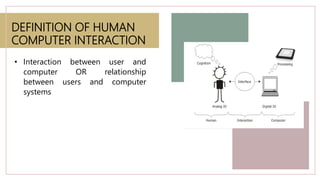
• Interaction between user and
computer OR relationship
between users and computer
systems
THREE (3) FUNDAMENTAL
COMPONENTS OF HCI
1. Human User
• People are diverse, unpredictable
messy, ill-understood. They have
different abilities.
2. Computer system
• Devices are much more complicated
and multi-functional then before
3. Interactive process
• Dialogue between human and
computer. The interface between
humans and the computer they use is
crucial to facilitating this interaction
HCI GOALS
• The goal of HCI is to improve the
interaction between users and
computers by making computers more
user-friendly and receptive to the user’s
needs.
• Improving the usability is the key factor
• To design systems that minimize the
barrier between the human’s cognitive
model of what they want to accomplish
and the computer’s understanding of
the user’s task
HCI AND USER INTERFACE
DESIGN
• HCI was largely about user interface
design.
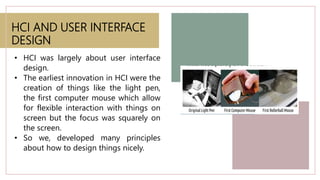
• The earliest innovation in HCI were the
creation of things like the light pen,
the first computer mouse which allow
for flexible interaction with things on
screen but the focus was squarely on
the screen.
• So we, developed many principles
about how to design things nicely.
USER INTERFACE
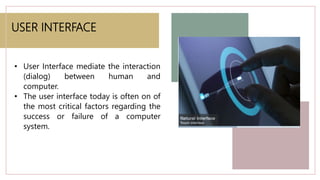
• User Interface mediate the interaction
(dialog) between human and
computer.
• The user interface today is often on of
the most critical factors regarding the
success or failure of a computer
system.
IMPORTANCE OF USER
INTERFACE DESIGN
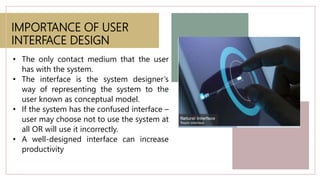
• The only contact medium that the user
has with the system.
• The interface is the system designer’s
way of representing the system to the
user known as conceptual model.
• If the system has the confused interface –
user may choose not to use the system at
all OR will use it incorrectly.
• A well-designed interface can increase
productivity
GOOD USER DESIGN
• Increase efficiency
• Improves productivity
• Reduces errors
• Reduces training
• Improves acceptance
GOOD USER DESIGN
1. USEFUL
• accomplish what is required
• functional, does things
2. USABLE
• easy to do things, does the right
things, enjoyable, user experience
3. USED
• make people want to use it
• attractive, available, acceptable to
organisation
COMPUTER TECHNOLOGY
INFLUENCES THE NATURE OF
INTERACTION AND STYLES
1. Input / output devices for
interactives users
2. Virtual reality systems and
3D visualization
3. Physical devices
4. Memory capacity
5. Processing speed
INPUT / OUTPUT DEVICES FOR
INTERACTIVE USERS
• Input devices - send information
to a computer system for
processing
• Output devices – reproduces or
displays the results of that
processing
• Most devices are only input
devices or output devices as they
can only accept data input from a
user or output data generated by a
computer.
Inputs
• Keyboard
• Microphone
• Mouse
• Motion sensor
• Heat sensor
• Digital camera
• Touch / Graphics Pad
• Bar code reader
Outputs
• Display
• Speakers
• Printer
• Projector
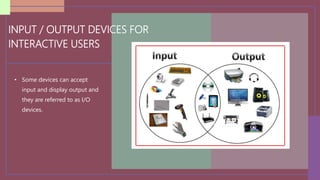
INPUT / OUTPUT DEVICES FOR
INTERACTIVE USERS
• Some devices can accept
input and display output and
they are referred to as I/O
devices.
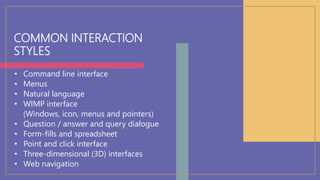
COMMON INTERACTION
STYLES
• Command line interface
• Menus
• Natural language
• WIMP interface
(Windows, icon, menus and pointers)
• Question / answer and query dialogue
• Form-fills and spreadsheet
• Point and click interface
• Three-dimensional (3D) interfaces
• Web navigation
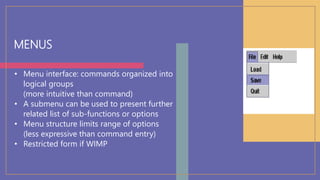
MENUS
• Menu interface: commands organized into
logical groups
(more intuitive than command)
• A submenu can be used to present further
related list of sub-functions or options
• Menu structure limits range of options
(less expressive than command entry)
• Restricted form if WIMP
FORM INTERFACE
• Form Interface: presents specific questions
to which user must respond in order to
perform some task.
• Intuitive, since users are led step by step
through interaction
• Not expensive, since form allows to only a
few specialized commands
WIMP
• WIMP stands for Windows, Icons, Menus,
Pointers
• WIMP interfaces are familiar as they are
the basis of most desktop computer
operating systems

Chapter 1.pdf

  • 1.
    CHAPTER 1 INTRODUCTION TOHUMAN COMPUTER INTERACTION SLIDES PREPARED BY Ts. DR. KOHILAH MIUNDY
  • 2.
    DEFINITION OF HUMAN COMPUTERINTERACTION • Interaction between user and computer OR relationship between users and computer systems
  • 3.
    THREE (3) FUNDAMENTAL COMPONENTSOF HCI 1. Human User • People are diverse, unpredictable messy, ill-understood. They have different abilities. 2. Computer system • Devices are much more complicated and multi-functional then before 3. Interactive process • Dialogue between human and computer. The interface between humans and the computer they use is crucial to facilitating this interaction
  • 4.
    HCI GOALS • Thegoal of HCI is to improve the interaction between users and computers by making computers more user-friendly and receptive to the user’s needs. • Improving the usability is the key factor • To design systems that minimize the barrier between the human’s cognitive model of what they want to accomplish and the computer’s understanding of the user’s task
  • 5.
    HCI AND USERINTERFACE DESIGN • HCI was largely about user interface design. • The earliest innovation in HCI were the creation of things like the light pen, the first computer mouse which allow for flexible interaction with things on screen but the focus was squarely on the screen. • So we, developed many principles about how to design things nicely.
  • 6.
    USER INTERFACE • UserInterface mediate the interaction (dialog) between human and computer. • The user interface today is often on of the most critical factors regarding the success or failure of a computer system.
  • 7.
    IMPORTANCE OF USER INTERFACEDESIGN • The only contact medium that the user has with the system. • The interface is the system designer’s way of representing the system to the user known as conceptual model. • If the system has the confused interface – user may choose not to use the system at all OR will use it incorrectly. • A well-designed interface can increase productivity
  • 8.
    GOOD USER DESIGN •Increase efficiency • Improves productivity • Reduces errors • Reduces training • Improves acceptance
  • 9.
    GOOD USER DESIGN 1.USEFUL • accomplish what is required • functional, does things 2. USABLE • easy to do things, does the right things, enjoyable, user experience 3. USED • make people want to use it • attractive, available, acceptable to organisation
  • 10.
    COMPUTER TECHNOLOGY INFLUENCES THENATURE OF INTERACTION AND STYLES 1. Input / output devices for interactives users 2. Virtual reality systems and 3D visualization 3. Physical devices 4. Memory capacity 5. Processing speed
  • 11.
    INPUT / OUTPUTDEVICES FOR INTERACTIVE USERS • Input devices - send information to a computer system for processing • Output devices – reproduces or displays the results of that processing • Most devices are only input devices or output devices as they can only accept data input from a user or output data generated by a computer. Inputs • Keyboard • Microphone • Mouse • Motion sensor • Heat sensor • Digital camera • Touch / Graphics Pad • Bar code reader Outputs • Display • Speakers • Printer • Projector
  • 12.
    INPUT / OUTPUTDEVICES FOR INTERACTIVE USERS • Some devices can accept input and display output and they are referred to as I/O devices.
  • 13.
    COMMON INTERACTION STYLES • Commandline interface • Menus • Natural language • WIMP interface (Windows, icon, menus and pointers) • Question / answer and query dialogue • Form-fills and spreadsheet • Point and click interface • Three-dimensional (3D) interfaces • Web navigation
  • 14.
    MENUS • Menu interface:commands organized into logical groups (more intuitive than command) • A submenu can be used to present further related list of sub-functions or options • Menu structure limits range of options (less expressive than command entry) • Restricted form if WIMP
  • 15.
    FORM INTERFACE • FormInterface: presents specific questions to which user must respond in order to perform some task. • Intuitive, since users are led step by step through interaction • Not expensive, since form allows to only a few specialized commands
  • 16.
    WIMP • WIMP standsfor Windows, Icons, Menus, Pointers • WIMP interfaces are familiar as they are the basis of most desktop computer operating systems