
HUMAN RESOURCE MANAGEMENT
Module 1 Lecture 2*
MUHAMMED NOWFAL S
Assistant Professor
Department of Management Studies
KMM College of Arts and Science
Kochi – Kerala
Email ID: Muhammednowfal.s@gmail.com
*Contents based on MG University Syllabus
LEARNING OUTCOMES
 Strategic Human Resource Management
 Human Capital Management
 International HRM
STRATEGIC HRM
STRATEGIC HRM
 Business objectives are accomplished when human resource practices, procedures
and systems are developed and implemented based on organizational needs, that is,
when a strategic perspective to human resource management is adopted
 Strategic HRM ‘is the interface between HRM and strategic management’
 SHRM is an approach that defines how the organization’s goals will be achieved
through people by means of HR strategies and integrated HR policies and practices
 SHRM involves the exercise of strategic choice and the establishment of strategic
priorities - implementation of strategy and the strategic behavior of HR specialists
AIM OF SHRM
 To generate organizational capability by ensuring that the organization has the skilled, engaged,
committed and well-motivated employees it needs to achieve sustained competitive advantage.
Integration:
The vertical alignment of HR strategies with
business strategies and the horizontal integration
of HR strategies
Provide a sense of direction
in an turbulent environment so that the business
needs of the organization and the individual and
collective needs of its employees can be met by
the development and implementation of practical
HR policies.
SHRM – Best practices model
 Employment security
 Selective hiring
 Self-managed teams
 High compensation contingent on performance
 Training to provide a skilled and motivated workforce
 Reduction of status differentials
 Sharing information
SHRM Practices - Delery and Doty (1996)
 The use of internal career ladders
 Formal training systems
 Results-oriented appraisal
 Performance-based compensation
 Employment security
 Employee voice
 Broadly defined jobs
SHRM – Guest 1999
 Selection and the careful use of selection tests to identify those with potential to
make a contribution.
 Training, and in particular a recognition that training is an ongoing activity.
 Job design to ensure flexibility, commitment and motivation, including steps to
ensure that employees have the responsibility and autonomy fully to use their
knowledge and skills.
 Communication to ensure that a two-way process keeps everyone fully informed.
 Employee share ownership programmes to increase employees’ awareness of the
implications of their actions on the financial performance of the firm
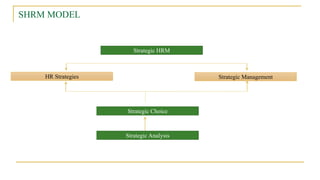
SHRM MODEL
Strategic HRM
Strategic ManagementHR Strategies
Strategic Choice
Strategic Analysis
HUMAN CAPITAL MANAGEMENT
HUMAN CAPITAL
 Knowledge, skills and abilities of the people employed in an organization
 The human factor in the organization; the combined intelligence, skills and expertise
that gives the organization its distinctive character
The human elements of the organization are those that are capable of learning, changing, innovating and
providing the creative thrust which if properly motivated can ensure the long-term survival of the organization
HUMAN CAPITAL – CONSTITUENTS
 Intellectual Capital : the stocks and flows of knowledge available to an
organization
 Social Capital : knowledge derived from networks of relationships
within and outside the organization
 Organizational Capital : Institutionalized knowledge possessed by an
organization that is stored in databases, manuals, etc
HUMAN CAPITAL MANAGEMENT
 A set of practices related to people resource management
 Workforce acquisition, workforce management and workforce optimization
 approach to employee staffing that perceives people as assets (human capital) whose
current value can be measured and whose future value can be enhanced through
investment.
 HCM recognizes people as investors of their personal human capital
 Main source of value to the organisation
 HCM is concerned with obtaining, analysing and reporting on data that informs the
direction of value-adding people management, strategic investment and operational
decisions at corporate level and at the level of front line management
 HCM defined as an approach to people management that treats it as a high level
strategic issue rather than an operational matter “to be left to the HR people
 The focus of HCM is more on the use of metrics (measurements of HR and people
performance) as a means of providing guidance on people management strategy and
practice
OBJECTIVES OF HCM
 To determine the impact of people on the business and their contribution to value;
 To demonstrate that HR practices produce value for money in terms (e.g. ROI).
 To provide guidance on future HR and business strategies.
 To provide data that will inform strategies and practices designed to improve the
effectiveness of HRM in the organization.
MAJOR CONTRIBUTIONS TO HCM
 1986 – The Know-How Company – Karl Erik Sveiby
 1997 – The New Wealth of Organizations – Thomas Stewart
 2000 – The ROI of Human Capital – JacFitz - Enz
 2001 – The Human Value of the Enterprise – Andrew Mayo
 2002 – Corporate Longitude – Leif Edvinsson
QUESTIONS ON PEOPLE MANAGEMENT RAISED BY HUMAN CAPITAL
THEORY
 What are the key performance drivers that create value?
 What skills do we have?
 What skills do we need now and in the future to meet our strategic aims?
 How are we going to attract, develop and retain these skills?
 How can we develop a culture and environment in which organizational and
individual learning takes place that meets both our needs and the needs of our
employees?
 How can we provide for both the explicit and tacit knowledge created in our
organization to be captured, recorded and used effectively
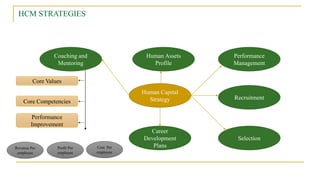
HCM STRATEGIES
Human Capital
Strategy
Human Assets
Profile
Performance
Management
Recruitment
Selection
Career
Development
Plans
Coaching and
Mentoring
Core Values
Core Competencies
Performance
Improvement
Revenue Per
employee
Cost Per
employee
Profit Per
employee
HUMAN CAPITAL DRIVEN BUSINESS MODEL
 Focus on tangible and intangible assets
 Valuation of physical, financial, human and structural assets
 Use decision criteria for knowledge and human capital investments
 Process and customer cost focus
 Focus on the future (value creation measurement)
 People are treated as expenses and investments
 Focus on present cash flow and future revenue streams
 Focus on dynamic budgets and revenue streams
 Focus on short-term and long-term profitability, added value and sustainability
HCM VS HRM
 In HCM ‘people are value adders, not overheads’ while in HRM ‘people are (treated as) a significant
cost and should be managed accordingly
 In HRM, the HR team is seen as a support service to the line’ while in HCM is clearly seen and
respected as an equal business partner at senior levels’ and is ‘holistic, organization-wide and systems-
based’ as well as being strategic and concerned with adding value
INTERNATIONAL HRM
IHRM
 Process of managing people across international boundaries by multinational
companies.
 Involves the worldwide management of people, not just the management of
expatriates
ISSUES IN IHRM
 The impact of globalization
 Globalization requires organizations to move people, ideas, products and information around the
world to meet local needs (Ulrich, 1998).
 International environmental differences
 Environmental differences between countries have to be taken into account in managing globally.
These include markets, institutions, regulations, collective bargaining and labour-force
characteristics.
 International cultural differences
 National cultural differences can be critical and insensitivity to
them can result in business failure (as well as failure and career
consequences for individual managers).
 Managing expatriates
 Expatriates can be difficult to manage because of the problems associated with adapting to and
working in unfamiliar environments, concerns about their development and careers, difficulties
encountered when they re-enter their parent company after an overseas assignment, and how they
should be remunerated.
 Global hr practices
 Talent management/employee branding
 International assignments management
 Managing an international workforce

Strategic HRM and HCM

  • 1.
    HUMAN RESOURCE MANAGEMENT Module1 Lecture 2* MUHAMMED NOWFAL S Assistant Professor Department of Management Studies KMM College of Arts and Science Kochi – Kerala Email ID: Muhammednowfal.s@gmail.com *Contents based on MG University Syllabus
  • 2.
    LEARNING OUTCOMES  StrategicHuman Resource Management  Human Capital Management  International HRM
  • 3.
  • 4.
    STRATEGIC HRM  Businessobjectives are accomplished when human resource practices, procedures and systems are developed and implemented based on organizational needs, that is, when a strategic perspective to human resource management is adopted  Strategic HRM ‘is the interface between HRM and strategic management’
  • 5.
     SHRM isan approach that defines how the organization’s goals will be achieved through people by means of HR strategies and integrated HR policies and practices  SHRM involves the exercise of strategic choice and the establishment of strategic priorities - implementation of strategy and the strategic behavior of HR specialists
  • 6.
    AIM OF SHRM To generate organizational capability by ensuring that the organization has the skilled, engaged, committed and well-motivated employees it needs to achieve sustained competitive advantage. Integration: The vertical alignment of HR strategies with business strategies and the horizontal integration of HR strategies Provide a sense of direction in an turbulent environment so that the business needs of the organization and the individual and collective needs of its employees can be met by the development and implementation of practical HR policies.
  • 7.
    SHRM – Bestpractices model  Employment security  Selective hiring  Self-managed teams  High compensation contingent on performance  Training to provide a skilled and motivated workforce  Reduction of status differentials  Sharing information
  • 8.
    SHRM Practices -Delery and Doty (1996)  The use of internal career ladders  Formal training systems  Results-oriented appraisal  Performance-based compensation  Employment security  Employee voice  Broadly defined jobs
  • 9.
    SHRM – Guest1999  Selection and the careful use of selection tests to identify those with potential to make a contribution.  Training, and in particular a recognition that training is an ongoing activity.  Job design to ensure flexibility, commitment and motivation, including steps to ensure that employees have the responsibility and autonomy fully to use their knowledge and skills.  Communication to ensure that a two-way process keeps everyone fully informed.  Employee share ownership programmes to increase employees’ awareness of the implications of their actions on the financial performance of the firm
  • 10.
    SHRM MODEL Strategic HRM StrategicManagementHR Strategies Strategic Choice Strategic Analysis
  • 11.
  • 12.
    HUMAN CAPITAL  Knowledge,skills and abilities of the people employed in an organization  The human factor in the organization; the combined intelligence, skills and expertise that gives the organization its distinctive character The human elements of the organization are those that are capable of learning, changing, innovating and providing the creative thrust which if properly motivated can ensure the long-term survival of the organization
  • 13.
    HUMAN CAPITAL –CONSTITUENTS  Intellectual Capital : the stocks and flows of knowledge available to an organization  Social Capital : knowledge derived from networks of relationships within and outside the organization  Organizational Capital : Institutionalized knowledge possessed by an organization that is stored in databases, manuals, etc
  • 14.
    HUMAN CAPITAL MANAGEMENT A set of practices related to people resource management  Workforce acquisition, workforce management and workforce optimization  approach to employee staffing that perceives people as assets (human capital) whose current value can be measured and whose future value can be enhanced through investment.  HCM recognizes people as investors of their personal human capital  Main source of value to the organisation
  • 15.
     HCM isconcerned with obtaining, analysing and reporting on data that informs the direction of value-adding people management, strategic investment and operational decisions at corporate level and at the level of front line management  HCM defined as an approach to people management that treats it as a high level strategic issue rather than an operational matter “to be left to the HR people  The focus of HCM is more on the use of metrics (measurements of HR and people performance) as a means of providing guidance on people management strategy and practice
  • 16.
    OBJECTIVES OF HCM To determine the impact of people on the business and their contribution to value;  To demonstrate that HR practices produce value for money in terms (e.g. ROI).  To provide guidance on future HR and business strategies.  To provide data that will inform strategies and practices designed to improve the effectiveness of HRM in the organization.
  • 17.
    MAJOR CONTRIBUTIONS TOHCM  1986 – The Know-How Company – Karl Erik Sveiby  1997 – The New Wealth of Organizations – Thomas Stewart  2000 – The ROI of Human Capital – JacFitz - Enz  2001 – The Human Value of the Enterprise – Andrew Mayo  2002 – Corporate Longitude – Leif Edvinsson
  • 18.
    QUESTIONS ON PEOPLEMANAGEMENT RAISED BY HUMAN CAPITAL THEORY  What are the key performance drivers that create value?  What skills do we have?  What skills do we need now and in the future to meet our strategic aims?  How are we going to attract, develop and retain these skills?  How can we develop a culture and environment in which organizational and individual learning takes place that meets both our needs and the needs of our employees?  How can we provide for both the explicit and tacit knowledge created in our organization to be captured, recorded and used effectively
  • 19.
    HCM STRATEGIES Human Capital Strategy HumanAssets Profile Performance Management Recruitment Selection Career Development Plans Coaching and Mentoring Core Values Core Competencies Performance Improvement Revenue Per employee Cost Per employee Profit Per employee
  • 20.
    HUMAN CAPITAL DRIVENBUSINESS MODEL  Focus on tangible and intangible assets  Valuation of physical, financial, human and structural assets  Use decision criteria for knowledge and human capital investments  Process and customer cost focus  Focus on the future (value creation measurement)  People are treated as expenses and investments  Focus on present cash flow and future revenue streams  Focus on dynamic budgets and revenue streams  Focus on short-term and long-term profitability, added value and sustainability
  • 21.
    HCM VS HRM In HCM ‘people are value adders, not overheads’ while in HRM ‘people are (treated as) a significant cost and should be managed accordingly  In HRM, the HR team is seen as a support service to the line’ while in HCM is clearly seen and respected as an equal business partner at senior levels’ and is ‘holistic, organization-wide and systems- based’ as well as being strategic and concerned with adding value
  • 22.
  • 23.
    IHRM  Process ofmanaging people across international boundaries by multinational companies.  Involves the worldwide management of people, not just the management of expatriates
  • 24.
    ISSUES IN IHRM The impact of globalization  Globalization requires organizations to move people, ideas, products and information around the world to meet local needs (Ulrich, 1998).  International environmental differences  Environmental differences between countries have to be taken into account in managing globally. These include markets, institutions, regulations, collective bargaining and labour-force characteristics.
  • 25.
     International culturaldifferences  National cultural differences can be critical and insensitivity to them can result in business failure (as well as failure and career consequences for individual managers).
  • 26.
     Managing expatriates Expatriates can be difficult to manage because of the problems associated with adapting to and working in unfamiliar environments, concerns about their development and careers, difficulties encountered when they re-enter their parent company after an overseas assignment, and how they should be remunerated.  Global hr practices  Talent management/employee branding  International assignments management  Managing an international workforce