Rural Development
The Concept of Rural Development
• Rural - Is an area, where the people are engaged in
primary industry in the sense that they produce
things directly for the first time in cooperation with
nature as stated by Srivastava (1961).
• A society or community can be classified as rural
based on the criteria of lower population density,
less social differentiation, less social and spatial
mobility, slow rate of social change, etc. Agriculture
would be the major occupation of rural area.
• Development:
• It refers to growth, evolution, stage of inducement or progress.
This progress or growth is gradual and had sequential phases.
Always there is increasing differentiation. It also refers to the
over all movement towards greater efficiency and complex
situations.
• Rural Development (RD): is a process which aims at
improving the well being and self realization of people living
outside the urbanized areas through collective process.
• According to Agarwal (1989) rural development is a strategy
designed to improve the economic and social life of rural poor.
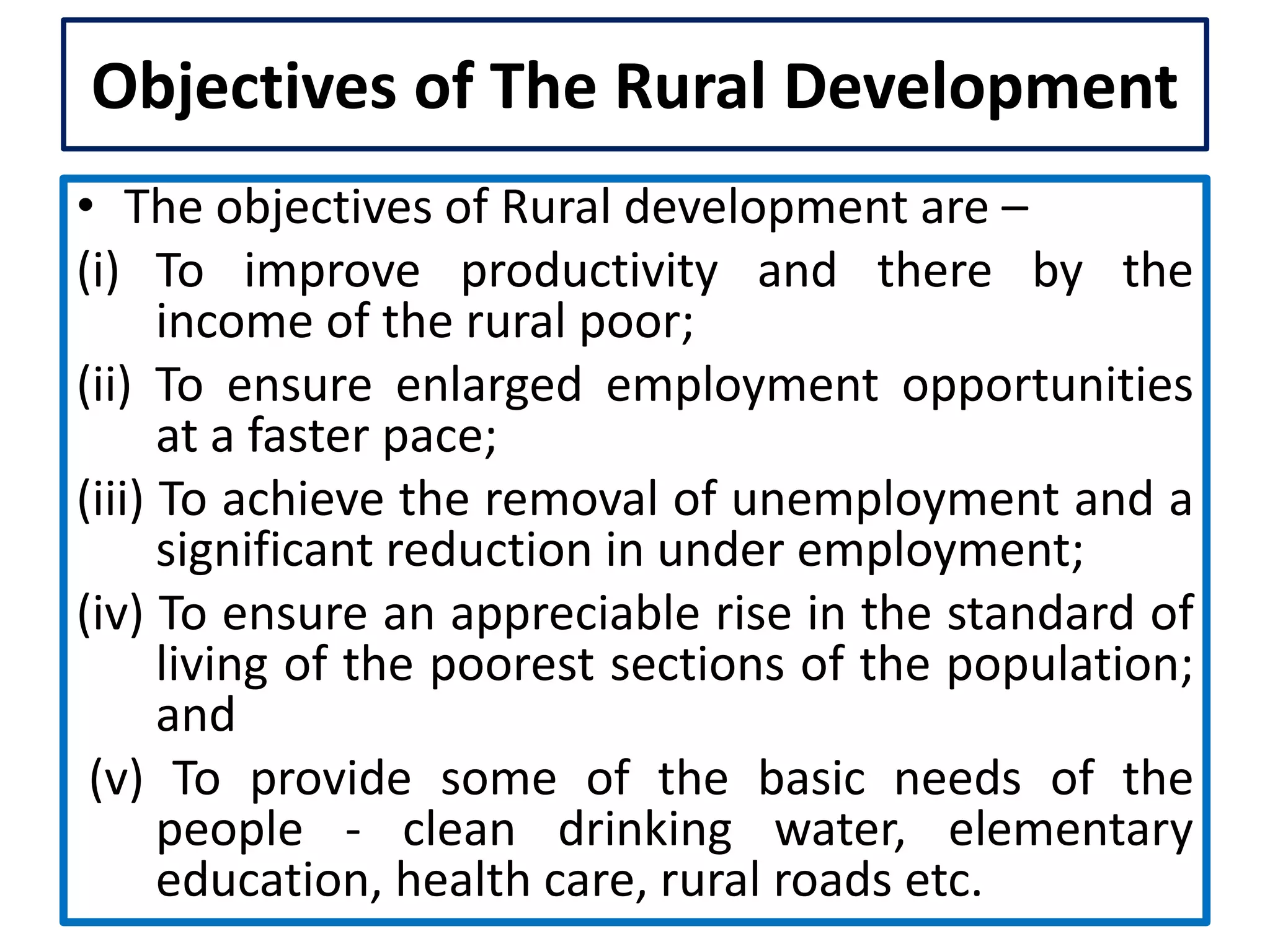
Objectives of The Rural Development
• The objectives of Rural development are –
(i) To improve productivity and there by the
income of the rural poor;
(ii) To ensure enlarged employment opportunities
at a faster pace;
(iii) To achieve the removal of unemployment and a
significant reduction in under employment;
(iv) To ensure an appreciable rise in the standard of
living of the poorest sections of the population;
and
(v) To provide some of the basic needs of the
people - clean drinking water, elementary
education, health care, rural roads etc.
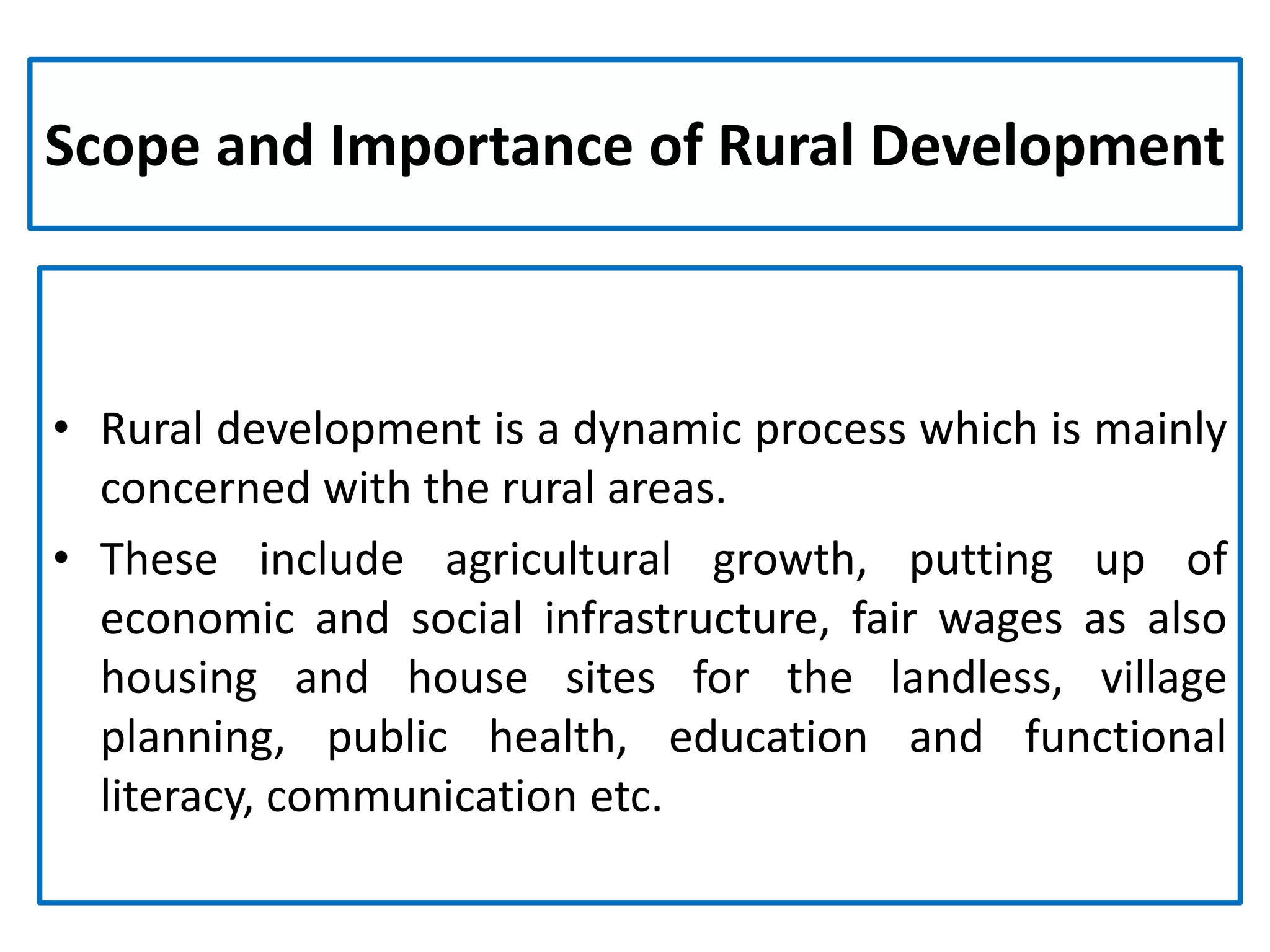
Scope and Importance of Rural Development
• Rural development is a dynamic process which is mainly
concerned with the rural areas.
• These include agricultural growth, putting up of
economic and social infrastructure, fair wages as also
housing and house sites for the landless, village
planning, public health, education and functional
literacy, communication etc.
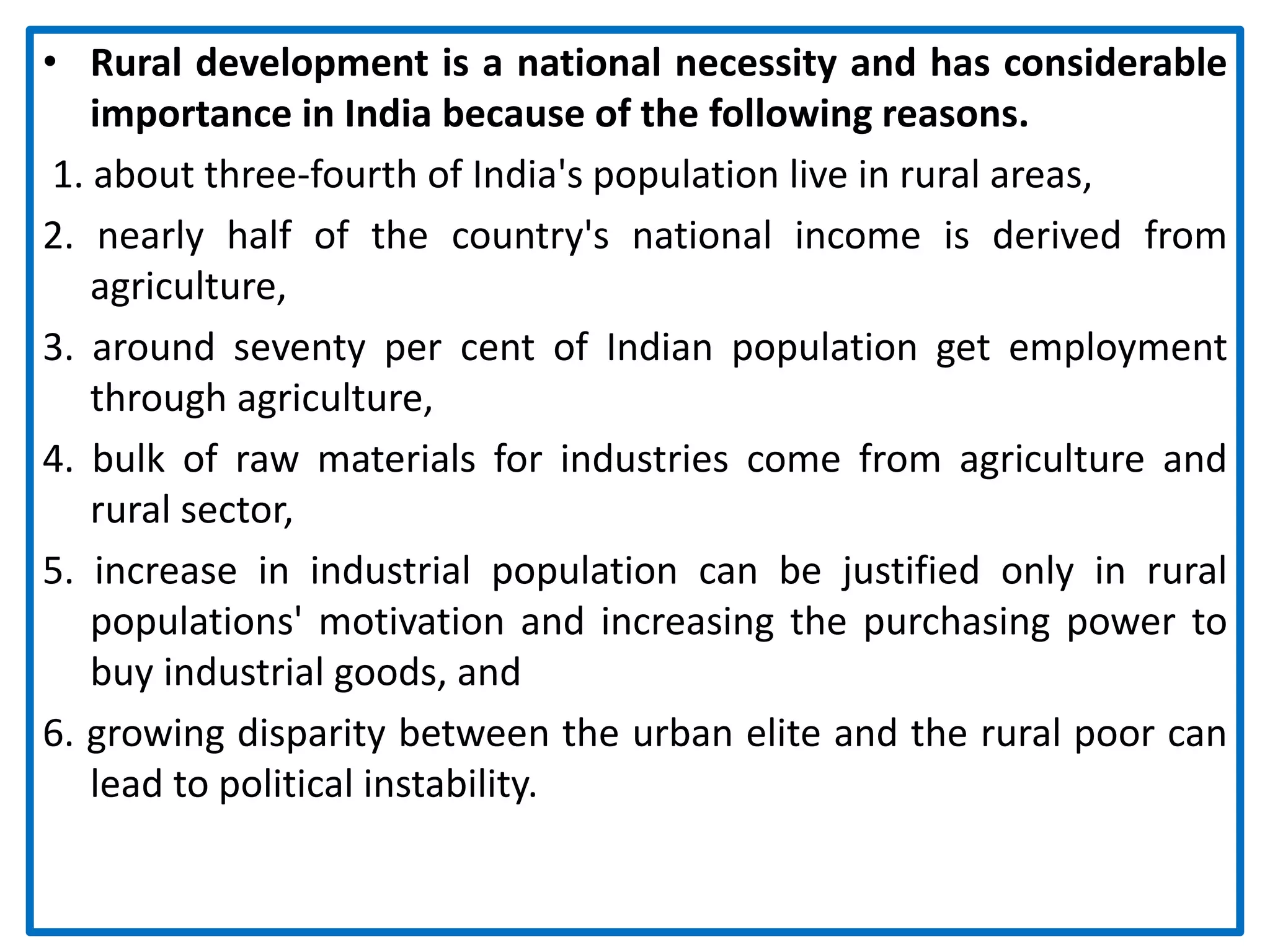
• Rural development is a national necessity and has considerable
importance in India because of the following reasons.
1. about three-fourth of India's population live in rural areas,
2. nearly half of the country's national income is derived from
agriculture,
3. around seventy per cent of Indian population get employment
through agriculture,
4. bulk of raw materials for industries come from agriculture and
rural sector,
5. increase in industrial population can be justified only in rural
populations' motivation and increasing the purchasing power to
buy industrial goods, and
6. growing disparity between the urban elite and the rural poor can
lead to political instability.

Rural Development.pptx

  • 1.
  • 2.
    The Concept ofRural Development • Rural - Is an area, where the people are engaged in primary industry in the sense that they produce things directly for the first time in cooperation with nature as stated by Srivastava (1961). • A society or community can be classified as rural based on the criteria of lower population density, less social differentiation, less social and spatial mobility, slow rate of social change, etc. Agriculture would be the major occupation of rural area.
  • 3.
    • Development: • Itrefers to growth, evolution, stage of inducement or progress. This progress or growth is gradual and had sequential phases. Always there is increasing differentiation. It also refers to the over all movement towards greater efficiency and complex situations. • Rural Development (RD): is a process which aims at improving the well being and self realization of people living outside the urbanized areas through collective process. • According to Agarwal (1989) rural development is a strategy designed to improve the economic and social life of rural poor.
  • 4.
    Objectives of TheRural Development • The objectives of Rural development are – (i) To improve productivity and there by the income of the rural poor; (ii) To ensure enlarged employment opportunities at a faster pace; (iii) To achieve the removal of unemployment and a significant reduction in under employment; (iv) To ensure an appreciable rise in the standard of living of the poorest sections of the population; and (v) To provide some of the basic needs of the people - clean drinking water, elementary education, health care, rural roads etc.
  • 5.
    Scope and Importanceof Rural Development • Rural development is a dynamic process which is mainly concerned with the rural areas. • These include agricultural growth, putting up of economic and social infrastructure, fair wages as also housing and house sites for the landless, village planning, public health, education and functional literacy, communication etc.
  • 6.
    • Rural developmentis a national necessity and has considerable importance in India because of the following reasons. 1. about three-fourth of India's population live in rural areas, 2. nearly half of the country's national income is derived from agriculture, 3. around seventy per cent of Indian population get employment through agriculture, 4. bulk of raw materials for industries come from agriculture and rural sector, 5. increase in industrial population can be justified only in rural populations' motivation and increasing the purchasing power to buy industrial goods, and 6. growing disparity between the urban elite and the rural poor can lead to political instability.