INTRODUCTION OF FMCG INDUSTRY

   FMCG industry, alternatively called as CPG (Consumer packaged goods) industry primarily
deals with the production, distribution and marketing of consumer packaged goods.
     The Fast Moving Consumer Goods (FMCG) are those consumables which are normally
consumed by the consumers at a regular interval. Some of the prime activities of FMCG
industry are selling, marketing, financing, purchasing, etc. The industry also engaged in
operations, supply chain, production and general management.

                             INTRODUCTON OF HUL

HUL good, look good and get more out of life with and services that are good for them and
good for others.

With over 35 brands spanning 20 distinct categories such as soap, detergent, shampoo,
skincare,
Toothpaste, deodorants, cosmetic, tea, coffee, packaged foods, ice cream and water purifiers,
The Company is a part of the everyday life of million customers across India. Its portfolio
includes leading house hold brands such as Lux, Lifeboouy, Usrfexcel, Rin, Wheel, Fire&Lovely,
Pond’s, Vaseline, Lakeme, Dove, Clinic Plus, Sunsilk, Pepsodent, Closeup, Axe, Brooke Bon, Bru,
Knorr, Kissa, Kwality Wall’s and pureit.

Works to create the better future every day and help people feel
The Company has over 16,000 employees and has an annual turnover of around RS. 19,401
crores (financial year 2010.2011). HUL good, look good and get more out of life with and
services that are good for them and good for others.

        HISTORY OF HUL
    In the summer of 1888, visitors to the Kolkata noticed full of sunlight soap bar , embossed
with the words “Made in England by Lever Brother’’ With it, began of era of marketing branded
fast moving Consumers Goods(FMCG).
    CEO of HUL is Nitin Paranjpe


                                                                                              1
PRODUCTS OF HUL


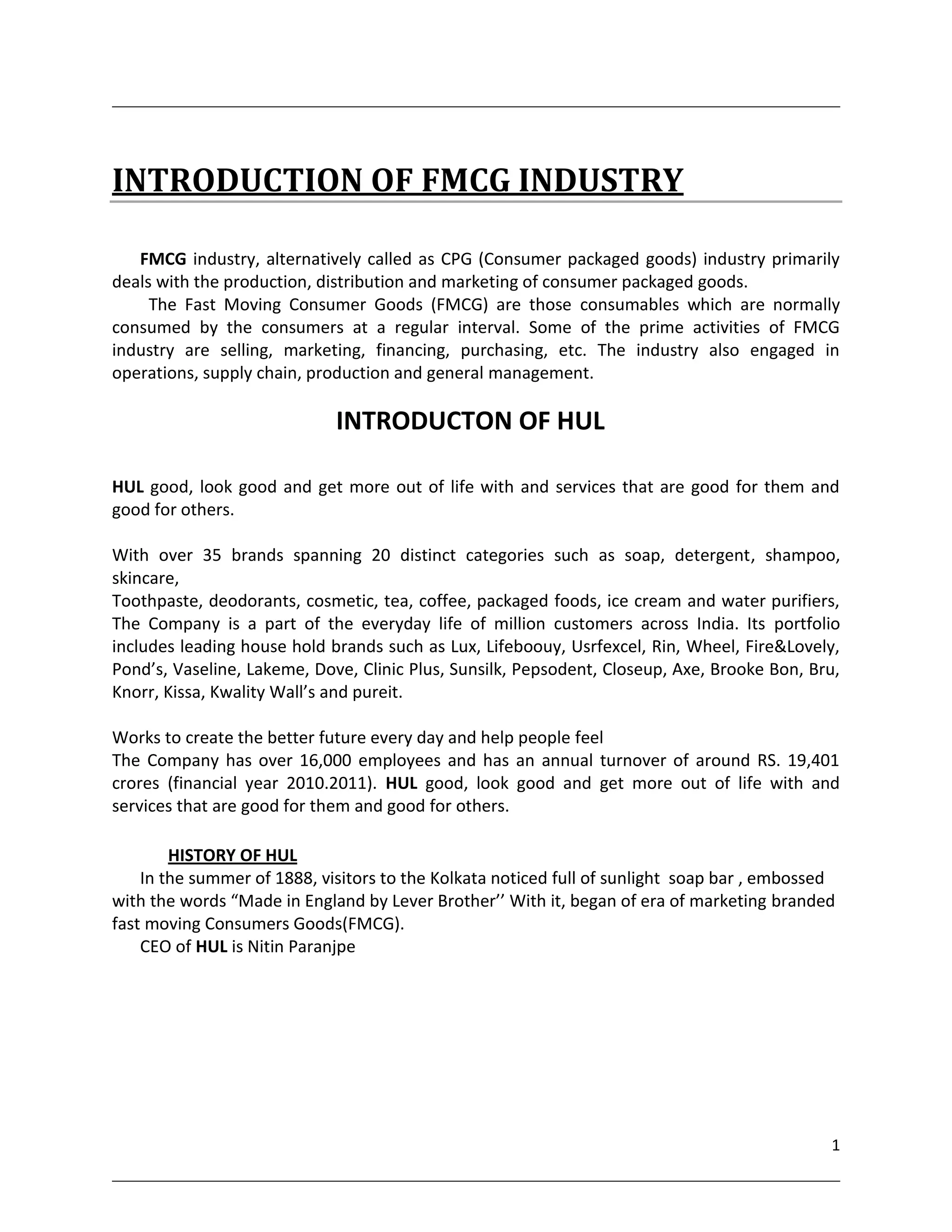
1. Personal use: Lux,
  Price Rs 10 to 18


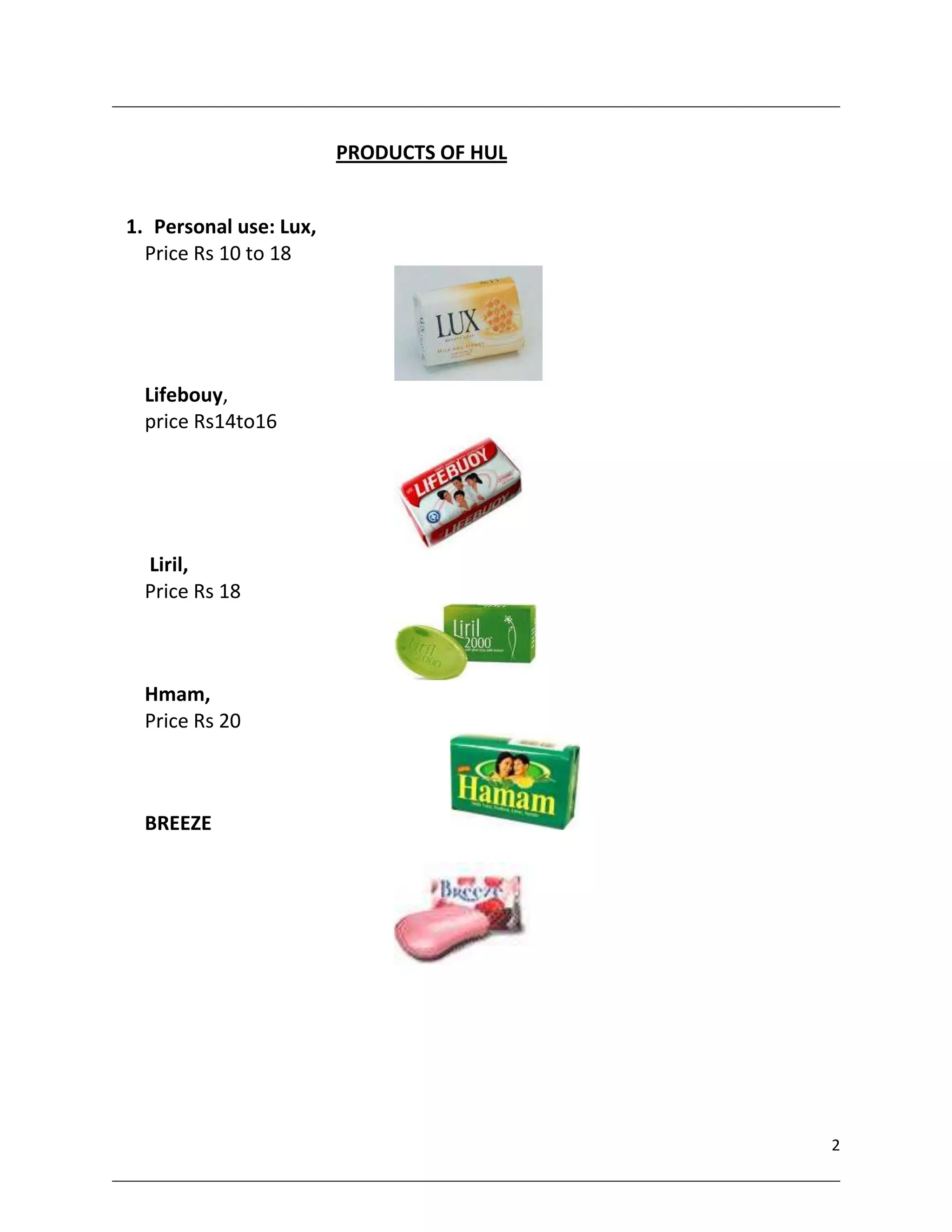
  Lifebouy,
  price Rs14to16


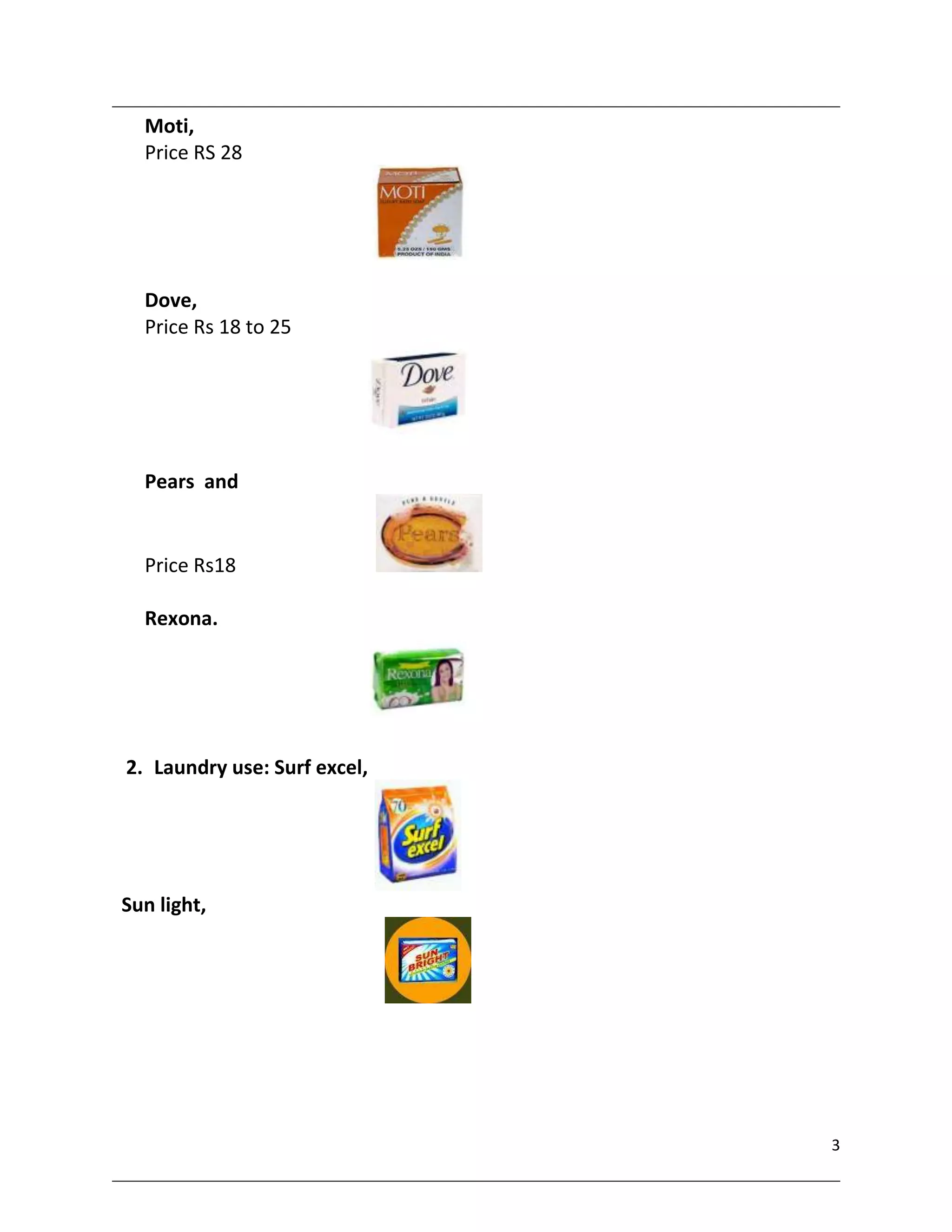
  Liril,
  Price Rs 18


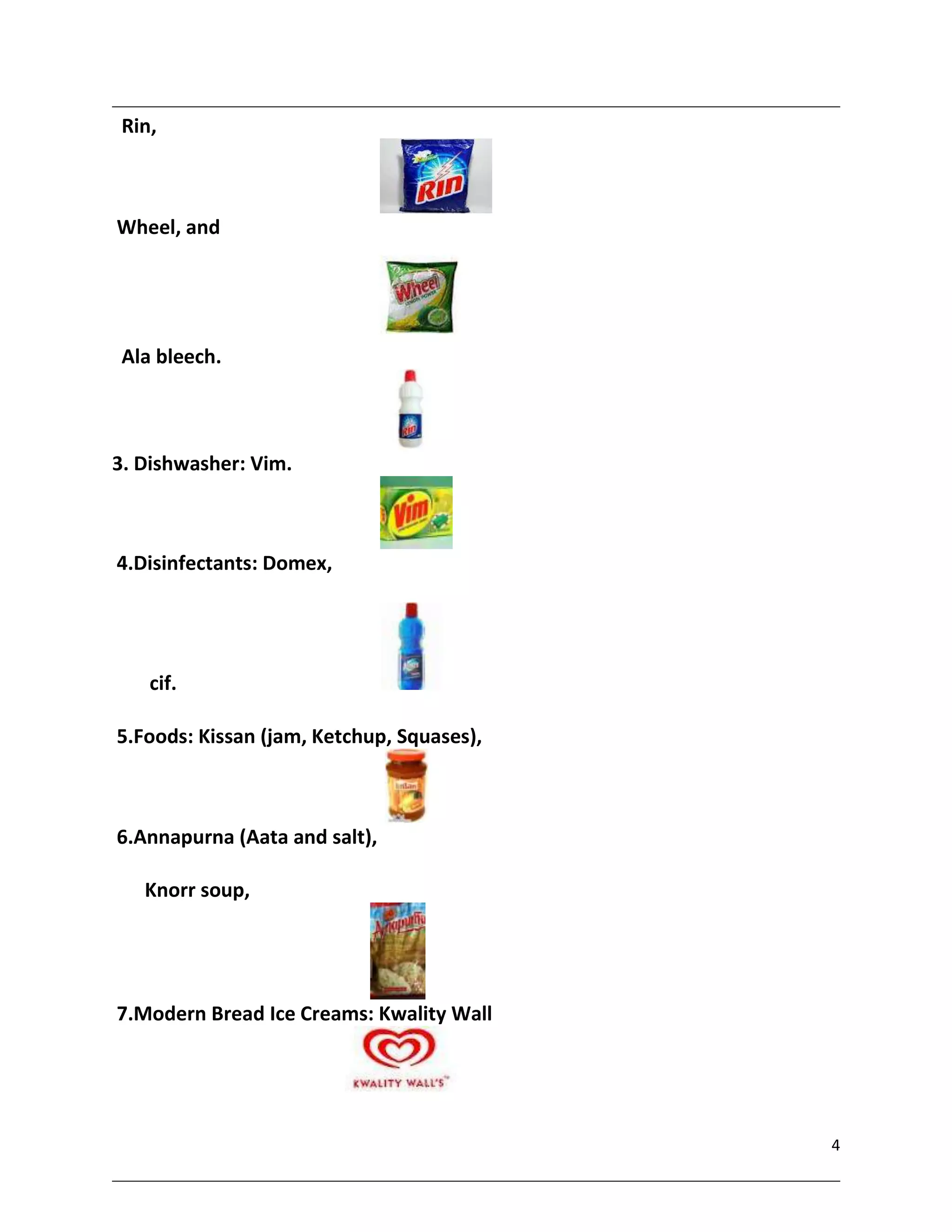
  Hmam,
  Price Rs 20


  BREEZE


                                          2
Moti,
  Price RS 28


  Dove,
  Price Rs 18 to 25


  Pears and


  Price Rs18

  Rexona.


2. Laundry use: Surf excel,


Sun light,


                              3
Rin,


Wheel, and


 Ala bleech.


3. Dishwasher: Vim.


4.Disinfectants: Domex,


    cif.

5.Foods: Kissan (jam, Ketchup, Squases),


6.Annapurna (Aata and salt),

   Knorr soup,


7.Modern Bread Ice Creams: Kwality Wall


                                           4
8.Tea: Brooke bond,


  Lipton, Taj mahal,


9.Coffee: Brooke bond,

  Bru.


10.Beauty Products: Fair & Lovely,

  lakeme, Pond’s,

  Vaseline and

  Aviance.


11.Hair care: Sunsilk Naturals,


  Dove.


12.Oral Care: Pepsodent and Close up


                                       5
12. Deo spray: Axe and Rexona
.
13. Water purifier: Pureist Star India Pvt Ltd has tied up with Hindustan Unilever Limited (HUL)
to advertise only (HUL) brands across all 10 star channels. Leading the pack will be Lifebuoy ads.
According to media Buyers, the deal is estimated to be Rs 52 crores. This is the biggest deal
after Vodafone took a similar step in 2007. When contracted, Kevin Vaz, executive V-P
(advertising and sales), STAR India, refused to comment on the deal.

The Star India channel includes Star plus, Star one, Star utsav, Star movies, Star worlds, channel
V, Star gold, Star pravah and Star vijay.
Speaking on this initiative, Vaz said, “At Star, we have always gone that extra mile to provide
our customers with exclusive campaigns that create a high impact for their brands, The first
time was done as a network roadblock was in 2007,when Hutch changed to Vodafone, We are
confident that this roadblock with HUL brands,
Primarily Lifebuoy, will create as huge an impression in the mind of the customer as it did for
Vodafone,”

HUL in 2008 spend close to Rs650 crore on TV and print advertisement.
The company posts a net profit of Rs543.19 crore for the quarter ended June 30, 2009, as
compared to Rs 558.18 crore same quarters last year. Total income stood at Rs453.61 crore for
the quarter as compare to Rs 431.75 crore same quarters last year. The company in the quarter
of 2009 increased its ad spend by 26%as part of its effort to drive up volume

COMPETITORS

    1. KRAFT

    2. P&G

    3. NESTLE

    4. LO’REAL

    5. DABUR


                                                                                                   6
6. ITC


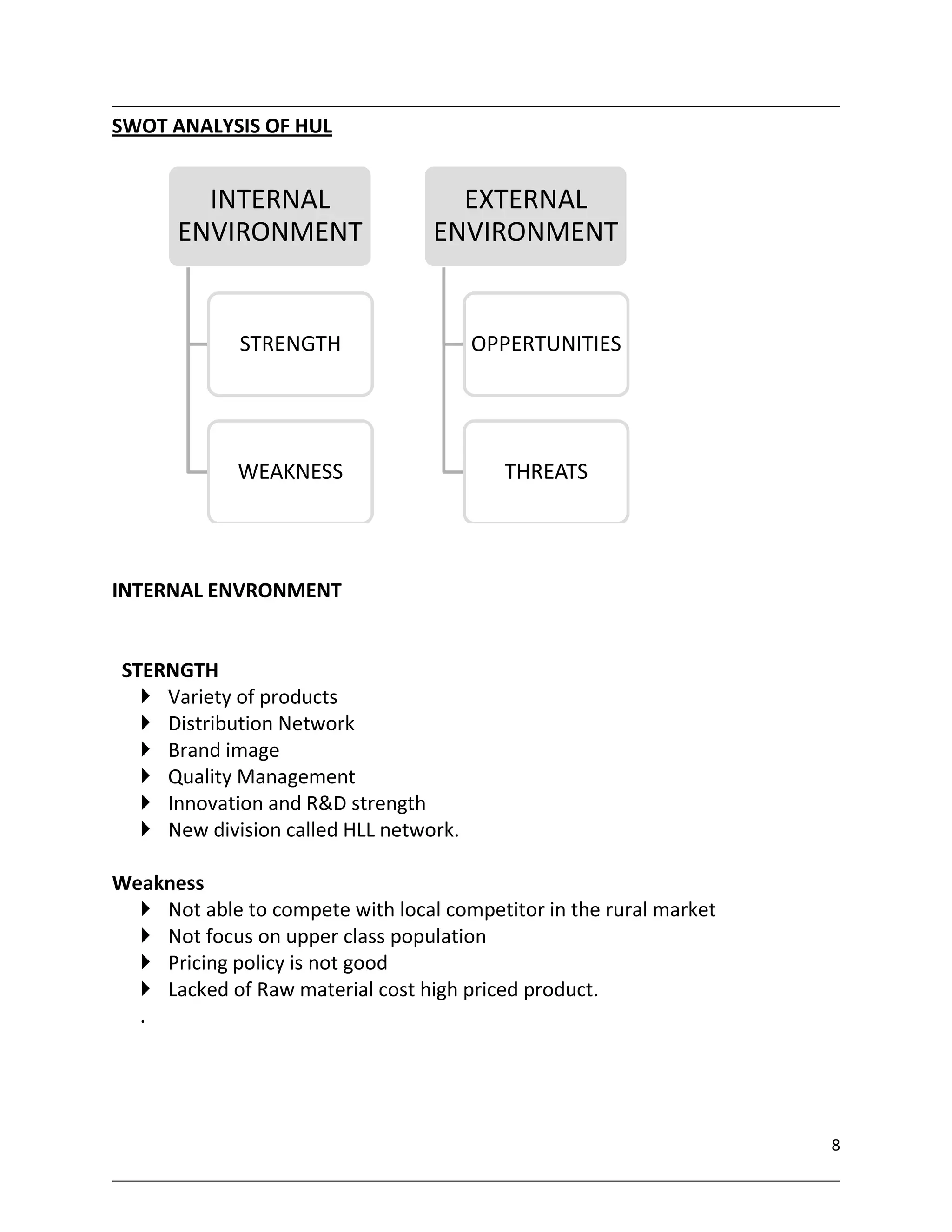
   Capital structure                                                                 (Rs crore)
                       Class Of   Authorized   Issued     Paid Up      Paid Up      Paid Up
From Year   To Year    Share      Capital      Capital    Shares       Face Value   Capital
                       Equity
2010        2011       Share      225.00       215.95     2159471968      1         215.95
                       Equity
2009        2010       Share      225.00       218.17     2181686781      1         218.17
                       Equity
2008        2009       Share      225.00       217.99     2179776077      1         217.98
                       Equity
2007        2008       Share      225.00       217.75     2177463355      1         217.75
                       Equity
2006        2007       Share      225.00       220.68     2206776097      1         220.68
                       Equity
2005        2006       Share      2,250.00     2,206.78   2206776097      10        2,206.78
                       Equity
2004        2005       Share      225.00       220.12     2201243793      1         220.12
                       Equity
2003        2004       Share      225.00       220.12     2201243793      1         220.12
                       Equity
2002        2003       Share      225.00       220.12     2201243793      1         220.12
                       Equity
2001        2002       Share      225.00       220.12     2201243793      1         220.12
                       Equity
2000        2001       Share      225.00       220.12     2201243793      1         220.12
                       Equity
1999        2000       Share      225.00       220.06     2200595070      1         220.06


                                                                                               7
SWOT ANALYSIS OF HUL


         INTERNAL                   EXTERNAL
       ENVIRONMENT                ENVIRONMENT


             STRENGTH                   OPPERTUNITIES


             WEAKNESS                     THREATS


INTERNAL ENVRONMENT


 STERNGTH
    Variety of products
    Distribution Network
    Brand image
    Quality Management
    Innovation and R&D strength
    New division called HLL network.

Weakness
   Not able to compete with local competitor in the rural market
   Not focus on upper class population
   Pricing policy is not good
   Lacked of Raw material cost high priced product.
  .


                                                                    8
EXTERNAL ENIVRONMENT

Opportunities
   Huge Market
   Increasing per capital income
   Increasing consumption pattern
   Potential for making more impact of brand image.


Threat
    Loosing Market Share due to new Entrants
    ITC Ltd one of the biggest threats
    Proctor & Gamble
    Dabur
    Dettol
    Colgate, Nirma
    Babool
      .


                                                       9
Procter and gamble (P&G).


                       Introduction
   In 2001, P&G was in a period of declining growth. A Company where the
solution is always innovation, P&G knew it needed to accelerate its innovation
development and increase its rate of innovation success. A leadership predicate,
   With the world continually getting smaller and moving faster, sustaining
solutions would be found in collaboration, not in solution. P&G Launched
connect+develop, a systematic, company-wide open innovation program charged
with bringing the outside in, and taking the inside out.


            History of Procter and Gamble (P&G).
   The CEO of P&G: Robert A Mcdonald.

   The Procter and Gamble Company (P&G) is a giant in the area of customer
goods. The leading maker of household product in the United States, P&G has
operation in nearly 80 countries, more than half of the company’s revenues and
derived overseas. Among its products, which fall in to the main categories of
fabric care, home care, beauty care, baby care, family care, health care, snakes
and beverages are 16 that generate more than $1 billion in annual revenues:
Actonel (osteoporosis treatment); Always (feminine protection); Ariel, Downy,
and tide (laundry care); bounty(paper towels); Charmin( bathroom tissue);crest
(tooth paste);Folgers (coffee); Head and shoulders,pantene and wella (hair care);
   Lams (pet food); Oley (skin care); pampers (diapers); and Pringles (snakes).
   Committed to remaining the leader in its markets, P&G is one of the most
aggressive marketers and is the largest advertiser in the world. Many innovations
that are now common practice in corporate America-including extensive market


                                                                               10
research, the brand-management system, and employee profit-sharing programs-
were first develop at Procter & Gamble.


                  List of products of P&G.
     1. Gellete


     2. Wilkisonsword


     3. 7’o’ clock


     4. Tide washing powder


     5. Oral-B tooth brush


     6. Ariel washing powder


                                                                          11
7. Head and Shoulder Shampoo


8. Pantine Shampoo


9. Whisper


10.Pampers baby napkins


11.Rejoice Shampoo


                               12
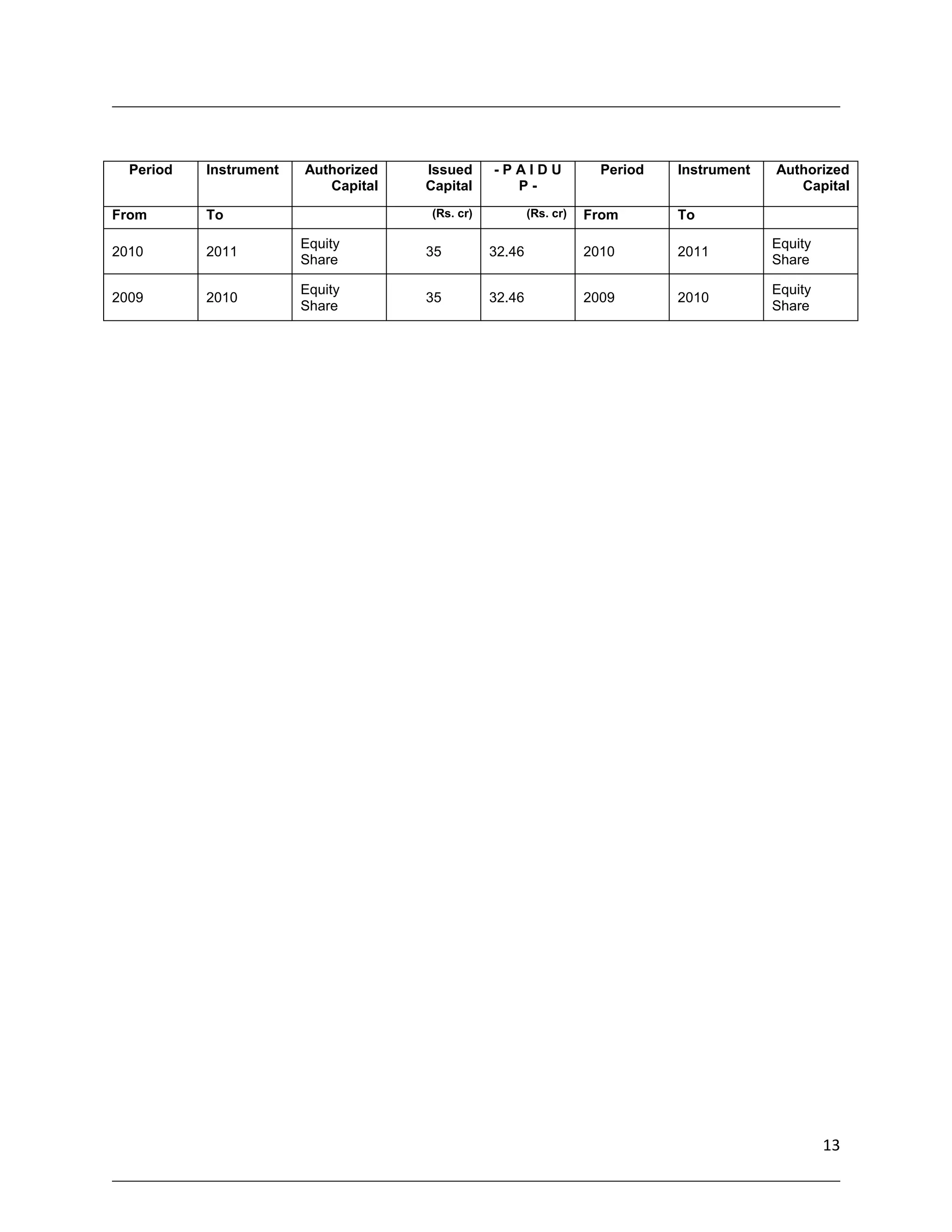
Period   Instrument   Authorized   Issued     -PAIDU               Period   Instrument   Authorized
                           Capital   Capital      P-                                          Capital

From       To                        (Rs. cr)           (Rs. cr)   From       To

                        Equity                                                             Equity
2010       2011                      35         32.46              2010       2011
                        Share                                                              Share

                        Equity                                                             Equity
2009       2010                      35         32.46              2009       2010
                        Share                                                              Share


                                                                                                    13
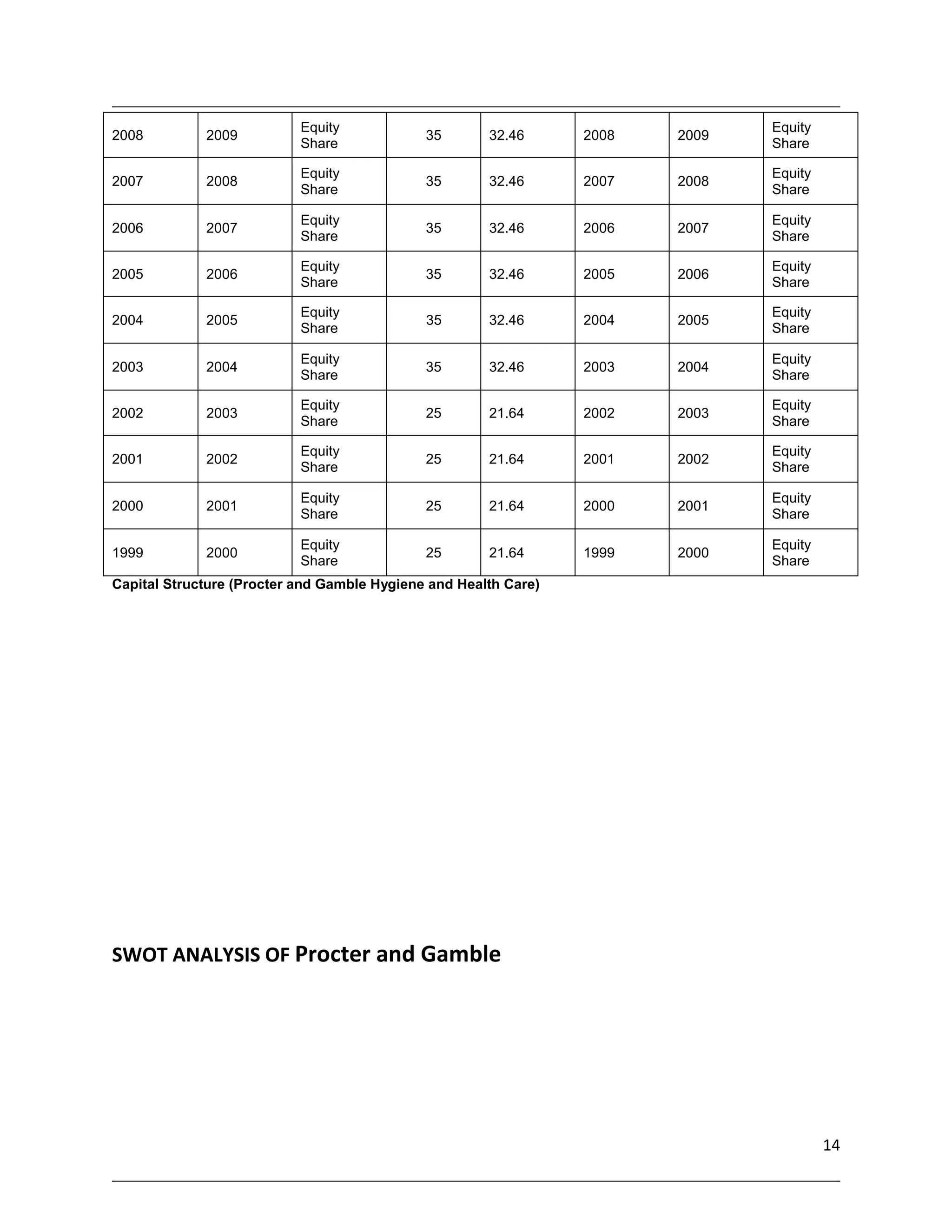
Equity                                              Equity
2008         2009                            35       32.46      2008   2009
                           Share                                               Share

                           Equity                                              Equity
2007         2008                            35       32.46      2007   2008
                           Share                                               Share

                           Equity                                              Equity
2006         2007                            35       32.46      2006   2007
                           Share                                               Share

                           Equity                                              Equity
2005         2006                            35       32.46      2005   2006
                           Share                                               Share

                           Equity                                              Equity
2004         2005                            35       32.46      2004   2005
                           Share                                               Share

                           Equity                                              Equity
2003         2004                            35       32.46      2003   2004
                           Share                                               Share

                           Equity                                              Equity
2002         2003                            25       21.64      2002   2003
                           Share                                               Share

                           Equity                                              Equity
2001         2002                            25       21.64      2001   2002
                           Share                                               Share

                           Equity                                              Equity
2000         2001                            25       21.64      2000   2001
                           Share                                               Share

                           Equity                                              Equity
1999         2000                            25       21.64      1999   2000
                           Share                                               Share
Capital Structure (Procter and Gamble Hygiene and Health Care)


SWOT ANALYSIS OF Procter and Gamble


                                                                                        14
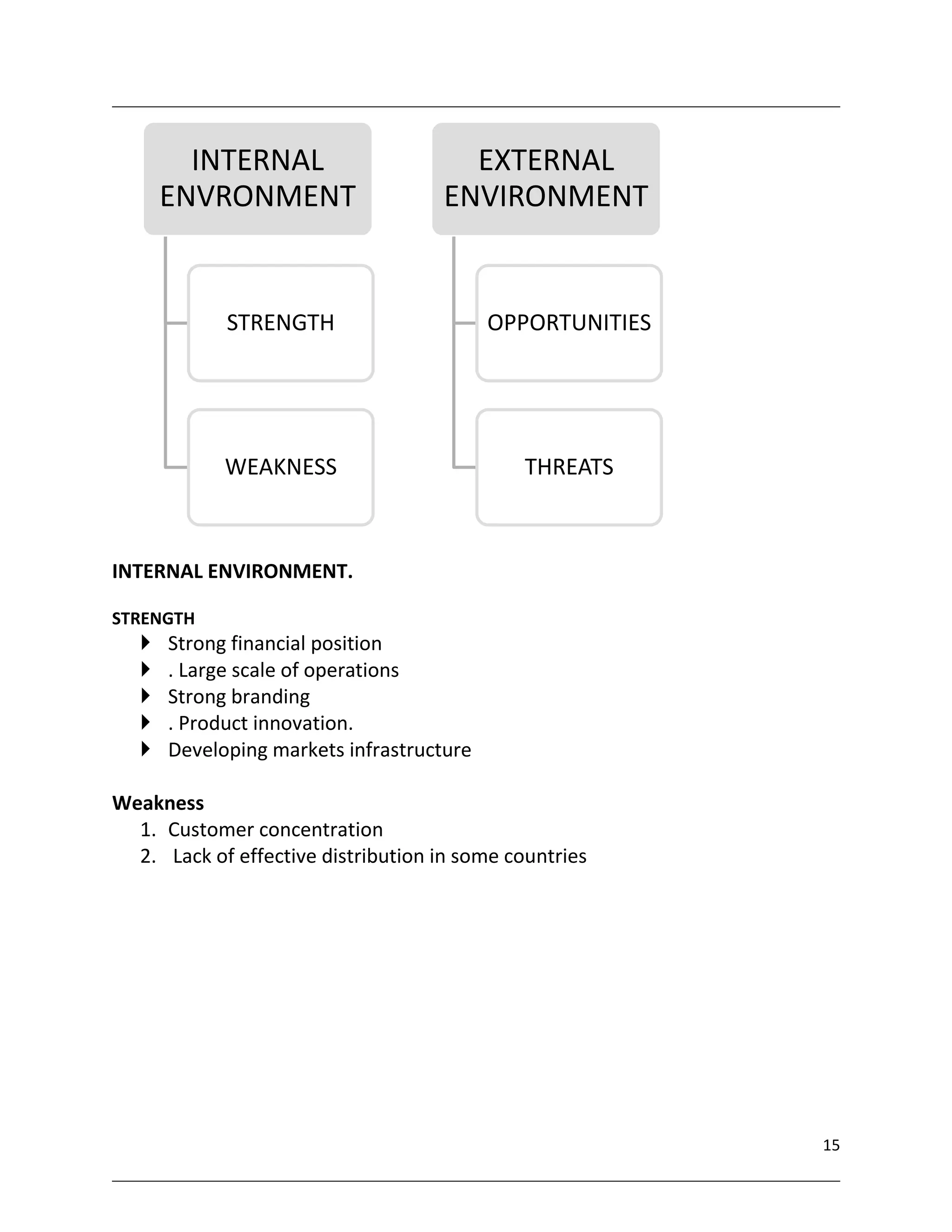
INTERNAL                      EXTERNAL
       ENVRONMENT                    ENVIRONMENT


             STRENGTH                      OPPORTUNITIES


             WEAKNESS                         THREATS


INTERNAL ENVIRONMENT.

STRENGTH
      Strong financial position
      . Large scale of operations
      Strong branding
      . Product innovation.
      Developing markets infrastructure

Weakness
  1. Customer concentration
  2. Lack of effective distribution in some countries


                                                           15
EXTERNAL ENVIRONMENT.

OPPORTUNITIES
    Expansion in developing markets.
    Future growth plans
    Growing India FMCG products

Threats
    Regulatory Environment
    Intense competition
    Increase in prices of raw materials


                 HUL vs. P&G Critical Evaluation.
   The recent war between HUL and P&G is over the advertisement featuring RIN
and TIDE Natural. HUL(through its latest advertisement launch in last week of
Feb.) openly challenges the superiority of its product RIN provide more brightness
in comparison to TIDE Natural, which is the new product the P&G launched a
couple of months ago in the mass segment positioning it against RIN as well as
Wheel.

    The rivalry between FMCG majors Hindustan Unilever and Proctor & Gamble
isn't a mystery. And for their new shampoo campaigns the writing is already on
the wall.

    While P&G is re-launching Pantene next week claiming to be the number one
brand, HUL has already taken a pre-emptive action by placing ads that say ‘Dove is
the No.1 shampoo.’

    “Comparative advertising is always fun even in the case of the earlier cola
wars. However, I personally don't expect this campaign to work as this campaign
is more to do with research and is self indulgent,” said Piyush Pandey, executive
chairman of Ogilvy & Mather, South Asia.

                                                                                16
The reason for the self indulgence is because the market worth Rs 2000 crore
is now increasingly getting competitive.

    In the last one year, Pantene's market share has gone down by 60 basis
points, and HUL's Dove has gained over 130 basis points during the same period.
So, P&G is now trying to regain the lost ground and market leader HUL is not in
the mood to give away any of their market share. Thus comes out an aggressive
marketing campaign.

    “To support our innovations to drive new categories for the future and to
make sure we are competitive in the share of voice, I mentioned earlier that the
competitive intensity has certainly gone up and now we are seeing it across
categories. Our strategy is that we don’t see it ground and we defend our
leadership,” said R Sridhar, CFO of HUL.

    The last two launches from P&G have seen very aggressive comparative
advertising from HUL especially during the Tide-Rin face off which even went to
the court.

    And now with P&G planning to launch and re-launch many more products in
the next two years, many of them in categories where HUL is the market leader,
we can expect both the companies to whip up some more lather.


   CONCLUSION

    There is wide competition in between HUL and P&G is over the
     advertisement featuring RIN and TIDE
    openly challenges the superiority of its product RIN provide more
     brightness in comparison to TIDE Natural,


                                                                              17

Hul vs p&g critical evaluation.

  • 1.
    INTRODUCTION OF FMCGINDUSTRY FMCG industry, alternatively called as CPG (Consumer packaged goods) industry primarily deals with the production, distribution and marketing of consumer packaged goods. The Fast Moving Consumer Goods (FMCG) are those consumables which are normally consumed by the consumers at a regular interval. Some of the prime activities of FMCG industry are selling, marketing, financing, purchasing, etc. The industry also engaged in operations, supply chain, production and general management. INTRODUCTON OF HUL HUL good, look good and get more out of life with and services that are good for them and good for others. With over 35 brands spanning 20 distinct categories such as soap, detergent, shampoo, skincare, Toothpaste, deodorants, cosmetic, tea, coffee, packaged foods, ice cream and water purifiers, The Company is a part of the everyday life of million customers across India. Its portfolio includes leading house hold brands such as Lux, Lifeboouy, Usrfexcel, Rin, Wheel, Fire&Lovely, Pond’s, Vaseline, Lakeme, Dove, Clinic Plus, Sunsilk, Pepsodent, Closeup, Axe, Brooke Bon, Bru, Knorr, Kissa, Kwality Wall’s and pureit. Works to create the better future every day and help people feel The Company has over 16,000 employees and has an annual turnover of around RS. 19,401 crores (financial year 2010.2011). HUL good, look good and get more out of life with and services that are good for them and good for others. HISTORY OF HUL In the summer of 1888, visitors to the Kolkata noticed full of sunlight soap bar , embossed with the words “Made in England by Lever Brother’’ With it, began of era of marketing branded fast moving Consumers Goods(FMCG). CEO of HUL is Nitin Paranjpe 1
  • 2.
    PRODUCTS OF HUL 1.Personal use: Lux, Price Rs 10 to 18 Lifebouy, price Rs14to16 Liril, Price Rs 18 Hmam, Price Rs 20 BREEZE 2
  • 3.
    Moti, PriceRS 28 Dove, Price Rs 18 to 25 Pears and Price Rs18 Rexona. 2. Laundry use: Surf excel, Sun light, 3
  • 4.
    Rin, Wheel, and Alableech. 3. Dishwasher: Vim. 4.Disinfectants: Domex, cif. 5.Foods: Kissan (jam, Ketchup, Squases), 6.Annapurna (Aata and salt), Knorr soup, 7.Modern Bread Ice Creams: Kwality Wall 4
  • 5.
    8.Tea: Brooke bond, Lipton, Taj mahal, 9.Coffee: Brooke bond, Bru. 10.Beauty Products: Fair & Lovely, lakeme, Pond’s, Vaseline and Aviance. 11.Hair care: Sunsilk Naturals, Dove. 12.Oral Care: Pepsodent and Close up 5
  • 6.
    12. Deo spray:Axe and Rexona . 13. Water purifier: Pureist Star India Pvt Ltd has tied up with Hindustan Unilever Limited (HUL) to advertise only (HUL) brands across all 10 star channels. Leading the pack will be Lifebuoy ads. According to media Buyers, the deal is estimated to be Rs 52 crores. This is the biggest deal after Vodafone took a similar step in 2007. When contracted, Kevin Vaz, executive V-P (advertising and sales), STAR India, refused to comment on the deal. The Star India channel includes Star plus, Star one, Star utsav, Star movies, Star worlds, channel V, Star gold, Star pravah and Star vijay. Speaking on this initiative, Vaz said, “At Star, we have always gone that extra mile to provide our customers with exclusive campaigns that create a high impact for their brands, The first time was done as a network roadblock was in 2007,when Hutch changed to Vodafone, We are confident that this roadblock with HUL brands, Primarily Lifebuoy, will create as huge an impression in the mind of the customer as it did for Vodafone,” HUL in 2008 spend close to Rs650 crore on TV and print advertisement. The company posts a net profit of Rs543.19 crore for the quarter ended June 30, 2009, as compared to Rs 558.18 crore same quarters last year. Total income stood at Rs453.61 crore for the quarter as compare to Rs 431.75 crore same quarters last year. The company in the quarter of 2009 increased its ad spend by 26%as part of its effort to drive up volume COMPETITORS 1. KRAFT 2. P&G 3. NESTLE 4. LO’REAL 5. DABUR 6
  • 7.
    6. ITC Capital structure (Rs crore) Class Of Authorized Issued Paid Up Paid Up Paid Up From Year To Year Share Capital Capital Shares Face Value Capital Equity 2010 2011 Share 225.00 215.95 2159471968 1 215.95 Equity 2009 2010 Share 225.00 218.17 2181686781 1 218.17 Equity 2008 2009 Share 225.00 217.99 2179776077 1 217.98 Equity 2007 2008 Share 225.00 217.75 2177463355 1 217.75 Equity 2006 2007 Share 225.00 220.68 2206776097 1 220.68 Equity 2005 2006 Share 2,250.00 2,206.78 2206776097 10 2,206.78 Equity 2004 2005 Share 225.00 220.12 2201243793 1 220.12 Equity 2003 2004 Share 225.00 220.12 2201243793 1 220.12 Equity 2002 2003 Share 225.00 220.12 2201243793 1 220.12 Equity 2001 2002 Share 225.00 220.12 2201243793 1 220.12 Equity 2000 2001 Share 225.00 220.12 2201243793 1 220.12 Equity 1999 2000 Share 225.00 220.06 2200595070 1 220.06 7
  • 8.
    SWOT ANALYSIS OFHUL INTERNAL EXTERNAL ENVIRONMENT ENVIRONMENT STRENGTH OPPERTUNITIES WEAKNESS THREATS INTERNAL ENVRONMENT STERNGTH  Variety of products  Distribution Network  Brand image  Quality Management  Innovation and R&D strength  New division called HLL network. Weakness  Not able to compete with local competitor in the rural market  Not focus on upper class population  Pricing policy is not good  Lacked of Raw material cost high priced product. . 8
  • 9.
    EXTERNAL ENIVRONMENT Opportunities  Huge Market  Increasing per capital income  Increasing consumption pattern  Potential for making more impact of brand image. Threat  Loosing Market Share due to new Entrants  ITC Ltd one of the biggest threats  Proctor & Gamble  Dabur  Dettol  Colgate, Nirma  Babool . 9
  • 10.
    Procter and gamble(P&G). Introduction In 2001, P&G was in a period of declining growth. A Company where the solution is always innovation, P&G knew it needed to accelerate its innovation development and increase its rate of innovation success. A leadership predicate, With the world continually getting smaller and moving faster, sustaining solutions would be found in collaboration, not in solution. P&G Launched connect+develop, a systematic, company-wide open innovation program charged with bringing the outside in, and taking the inside out. History of Procter and Gamble (P&G). The CEO of P&G: Robert A Mcdonald. The Procter and Gamble Company (P&G) is a giant in the area of customer goods. The leading maker of household product in the United States, P&G has operation in nearly 80 countries, more than half of the company’s revenues and derived overseas. Among its products, which fall in to the main categories of fabric care, home care, beauty care, baby care, family care, health care, snakes and beverages are 16 that generate more than $1 billion in annual revenues: Actonel (osteoporosis treatment); Always (feminine protection); Ariel, Downy, and tide (laundry care); bounty(paper towels); Charmin( bathroom tissue);crest (tooth paste);Folgers (coffee); Head and shoulders,pantene and wella (hair care); Lams (pet food); Oley (skin care); pampers (diapers); and Pringles (snakes). Committed to remaining the leader in its markets, P&G is one of the most aggressive marketers and is the largest advertiser in the world. Many innovations that are now common practice in corporate America-including extensive market 10
  • 11.
    research, the brand-managementsystem, and employee profit-sharing programs- were first develop at Procter & Gamble. List of products of P&G. 1. Gellete 2. Wilkisonsword 3. 7’o’ clock 4. Tide washing powder 5. Oral-B tooth brush 6. Ariel washing powder 11
  • 12.
    7. Head andShoulder Shampoo 8. Pantine Shampoo 9. Whisper 10.Pampers baby napkins 11.Rejoice Shampoo 12
  • 13.
    Period Instrument Authorized Issued -PAIDU Period Instrument Authorized Capital Capital P- Capital From To (Rs. cr) (Rs. cr) From To Equity Equity 2010 2011 35 32.46 2010 2011 Share Share Equity Equity 2009 2010 35 32.46 2009 2010 Share Share 13
  • 14.
    Equity Equity 2008 2009 35 32.46 2008 2009 Share Share Equity Equity 2007 2008 35 32.46 2007 2008 Share Share Equity Equity 2006 2007 35 32.46 2006 2007 Share Share Equity Equity 2005 2006 35 32.46 2005 2006 Share Share Equity Equity 2004 2005 35 32.46 2004 2005 Share Share Equity Equity 2003 2004 35 32.46 2003 2004 Share Share Equity Equity 2002 2003 25 21.64 2002 2003 Share Share Equity Equity 2001 2002 25 21.64 2001 2002 Share Share Equity Equity 2000 2001 25 21.64 2000 2001 Share Share Equity Equity 1999 2000 25 21.64 1999 2000 Share Share Capital Structure (Procter and Gamble Hygiene and Health Care) SWOT ANALYSIS OF Procter and Gamble 14
  • 15.
    INTERNAL EXTERNAL ENVRONMENT ENVIRONMENT STRENGTH OPPORTUNITIES WEAKNESS THREATS INTERNAL ENVIRONMENT. STRENGTH  Strong financial position  . Large scale of operations  Strong branding  . Product innovation.  Developing markets infrastructure Weakness 1. Customer concentration 2. Lack of effective distribution in some countries 15
  • 16.
    EXTERNAL ENVIRONMENT. OPPORTUNITIES  Expansion in developing markets.  Future growth plans  Growing India FMCG products Threats  Regulatory Environment  Intense competition  Increase in prices of raw materials HUL vs. P&G Critical Evaluation. The recent war between HUL and P&G is over the advertisement featuring RIN and TIDE Natural. HUL(through its latest advertisement launch in last week of Feb.) openly challenges the superiority of its product RIN provide more brightness in comparison to TIDE Natural, which is the new product the P&G launched a couple of months ago in the mass segment positioning it against RIN as well as Wheel. The rivalry between FMCG majors Hindustan Unilever and Proctor & Gamble isn't a mystery. And for their new shampoo campaigns the writing is already on the wall. While P&G is re-launching Pantene next week claiming to be the number one brand, HUL has already taken a pre-emptive action by placing ads that say ‘Dove is the No.1 shampoo.’ “Comparative advertising is always fun even in the case of the earlier cola wars. However, I personally don't expect this campaign to work as this campaign is more to do with research and is self indulgent,” said Piyush Pandey, executive chairman of Ogilvy & Mather, South Asia. 16
  • 17.
    The reason forthe self indulgence is because the market worth Rs 2000 crore is now increasingly getting competitive. In the last one year, Pantene's market share has gone down by 60 basis points, and HUL's Dove has gained over 130 basis points during the same period. So, P&G is now trying to regain the lost ground and market leader HUL is not in the mood to give away any of their market share. Thus comes out an aggressive marketing campaign. “To support our innovations to drive new categories for the future and to make sure we are competitive in the share of voice, I mentioned earlier that the competitive intensity has certainly gone up and now we are seeing it across categories. Our strategy is that we don’t see it ground and we defend our leadership,” said R Sridhar, CFO of HUL. The last two launches from P&G have seen very aggressive comparative advertising from HUL especially during the Tide-Rin face off which even went to the court. And now with P&G planning to launch and re-launch many more products in the next two years, many of them in categories where HUL is the market leader, we can expect both the companies to whip up some more lather. CONCLUSION  There is wide competition in between HUL and P&G is over the advertisement featuring RIN and TIDE  openly challenges the superiority of its product RIN provide more brightness in comparison to TIDE Natural, 17