HTTP/2
ISLAM GAMAL
topics
HTTP Today
Why HTTP/2
How it works
Working with HTTP2
Demo
HTTP Today
 Using HTTP 1.1 since 1997 / 1999
 Connection: keep-alive
 Head of Line Blocking
 But we still use N TCP Connections per origin
 And Many Hacks because requests are evil
 Spriting of Images
 Resource Inlining
 Concatenation of files
 Domain Sharding
 CDNs
 No Header Compression
HTTP Problems
 Negotiation mechanism that allows clients and servers to elect to use HTTP 1.1, 2.0, or
potentially other non-HTTP protocols.
 Maintain high-level compatibility with HTTP 1.1 (for example with methods, status
codes, and URIs, and most header fields)
 Decrease latency to improve page load speed in web browsers by considering:
 Data compression of HTTP headers
 HTTP/2 Server Push
 Pipelining of requests
 Fixing the head-of-line blocking problem in HTTP 1.x
 Multiplexing multiple requests over a single TCP connection
 Support common existing use cases of HTTP, such as desktop web browsers, mobile
web browsers, web APIs, web servers at various scales, proxy servers, reverse proxy
servers, firewalls, and content delivery networks
2009 .. SPDY
 It came in a beautiful package
 Header Compression
 Now cookieless domains are useless
 Multiplexing
 Now we can say that sharding is BAD PRACTICE
 Priority First (Ex. Bring my JS and CSS files first)
 Server Push
 With “Server Hint”, and “RST_STREAM” for HTTP/2
Why HTTP/2
 Performance matters
 HTTP/2 reduces the impact of latency on web applications
 TLS is becoming the default
 HTTP/2 amortizes TLS costs for the entire application
 Enabling new web development
 User perceivable improvement in web site performance
 Work with today’s internet
 Remain compatible with existing content
What is HTTP/2
 Used SPDY3 as its first draft
 Main Driven by Performance
 But also includes
 Security
 Reliability
HTTP/2 vs SPDY
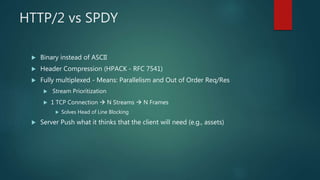
 Binary instead of ASCII
 Header Compression (HPACK - RFC 7541)
 Fully multiplexed - Means: Parallelism and Out of Order Req/Res
 Stream Prioritization
 1 TCP Connection  N Streams  N Frames
 Solves Head of Line Blocking
 Server Push what it thinks that the client will need (e.g., assets)
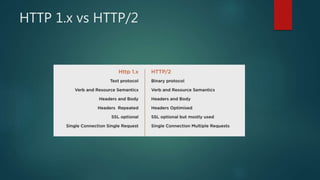
HTTP 1.x vs HTTP/2
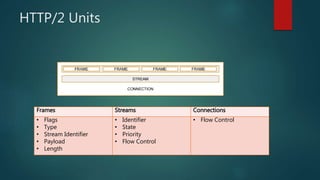
HTTP/2 Units
Frames Streams Connections
• Flags
• Type
• Stream Identifier
• Payload
• Length
• Identifier
• State
• Priority
• Flow Control
• Flow Control
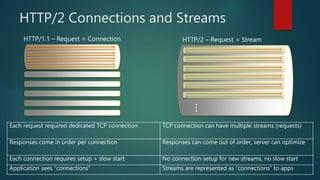
HTTP/1.1 – Request = Connection HTTP/2 – Request = Stream
…
Each request required dedicated TCP connection TCP connection can have multiple streams (requests)
Responses come in order per connection Responses can come out of order, server can optimize
Each connection requires setup + slow start No connection setup for new streams, no slow start
Application sees “connections” Streams are represented as “connections” to apps
HTTP/2 Connections and Streams
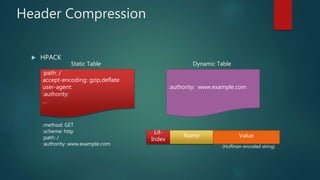
Header Compression
:path: /
accept-encoding: gzip,deflate
user-agent:
:authority:
…
Static Table
:authority: www.example.com
Dynamic Table
:method: GET
:scheme: http
:path: /
:authority: www.example.com
Lit-
Index
Name Value
(Huffman-encoded string)
 HPACK
Header Compression
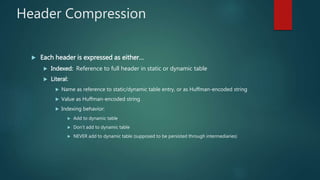
 Each header is expressed as either…
 Indexed: Reference to full header in static or dynamic table
 Literal:
 Name as reference to static/dynamic table entry, or as Huffman-encoded string
 Value as Huffman-encoded string
 Indexing behavior:
 Add to dynamic table
 Don’t add to dynamic table
 NEVER add to dynamic table (supposed to be persisted through intermediaries)
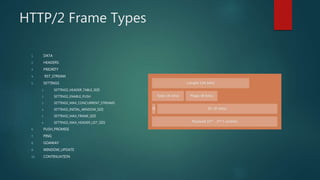
HTTP/2 Frame Types
1. DATA
2. HEADERS
3. PRIORITY
4. RST_STREAM
5. SETTINGS
1. SETTINGS_HEADER_TABLE_SIZE
2. SETTINGS_ENABLE_PUSH
3. SETTINGS_MAX_CONCURRENT_STREAMS
4. SETTINGS_INITIAL_WINDOW_SIZE
5. SETTINGS_MAX_FRAME_SIZE
6. SETTINGS_MAX_HEADER_LIST_SIZE
6. PUSH_PROMISE
7. PING
8. GOAWAY
9. WINDOW_UPDATE
10. CONTINUATION
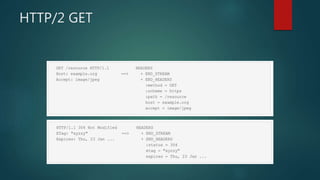
HTTP/2 GET
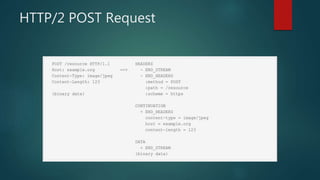
HTTP/2 POST Request
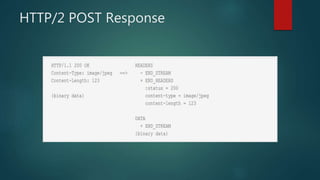
HTTP/2 POST Response
Request Reliability
 In HTTP no retry a request when an error occurs
 Re-Attempt: It is only possible to some server to do some processing prior to
the error which could result in undesired effects
 HTTP/2 Provides 2 mechanisms as guarantee to a client that a request has
not been processing
 GOAWAY: the highest stream number that has been processed
 REFUSED_STREAM: error code can be included in a RST_STREAM frame
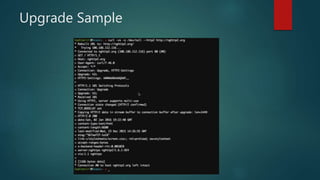
Upgrade Request Anatomy
 When you don’t know if it supports HTTP/2
GET / HTTP/1.1
Host: server.example.com
Connection: Upgrade, HTTP2-Settings
Upgrade: h2c
HTTP2-Settings:
Response
HTTP/1.1 101 Switching Protocols
Connection: Upgrade
Upgrade: h2c
• “h2c” means no TLS connection
• “h2” means TLS connection [TLS-ALPN]
• Implicit acknowledgement of HTTP2-Settings
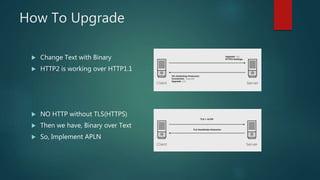
How To Upgrade
 Change Text with Binary
 HTTP2 is working over HTTP1.1
 NO HTTP without TLS(HTTPS)
 Then we have, Binary over Text
 So, Implement APLN
Upgrade Sample
HTTP/2 Adoption Rate
 Browsers: Chrome and Firefox latest versions support already
 Servers: Apache (mod_h2), jetty, Apache Traffic Server
 Services: Google, Twitter
 Proxy: Squid
 CDN
 Akamai said in the end of the 2015and
 CloudFlare when ‘nginx supports HTTP/2’
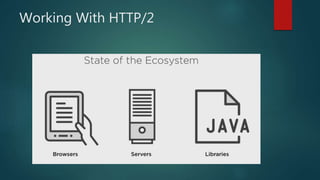
Working With HTTP/2
Working With HTTP/2
Hosting
 Hosting .NET Apps
 IIS 10 on Windows 10
 Windows Server 2016
 Ngnix
 Kestrel
 Hosting Java Apps
 Apache HTTP 2.4.17+
 Jetty 9.3+
 Tomcat 9 (still not fully supported)
 Hosting Node Apps
 Node-http2
 Node-spdy
 ExpressJS 5.0(Still has issues)
Working With HTTP/2
Server software
 Apache 2.4.12 Apache Traffic Server supports
HTTP/2.[58]
 Caddy supports HTTP/2.[59]
 Citrix NetScaler 11.x supports HTTP/2.[60]
 Sucuri Supports HTTP/2.[61]
 F5 BIG-IP Local Traffic Manager 11.6 supports
HTTP/2.[62]
 h2o was built from the ground up for HTTP/2
support.[63]
 Jetty 9.3 supports HTTP/2.[64]
 LiteSpeed Web Server 5.0 supports
HTTP/2.[65]
 Warp (Haskell web server, used by default in
Yesod) supports HTTP/2.
 Microsoft IIS supports HTTP/2 in Windows
10[66] and Windows Server 2016.
 Netty 4.1 supports HTTP/2.[67]
 nginx 1.9.5 supports HTTP/2.[68]
 node.js 5.0 supports HTTP/2.[69]
 OpenLiteSpeed 1.3.11 and 1.4.8 supports
HTTP/2.[70]
 Proxygen supports HTTP/2.
 Radware Alteon NG supports HTTP/2.[71]
 ShimmerCat was built from the ground up for
HTTP/2 support.[72]
 Vert.x 3.3 supports HTTP/2
 Wildfly 9 supports HTTP/2.
What About .NET
ASP.NET Core is an open source and cross-platform technology by Microsoft
for developing web-based applications. In .NET Framework 4.6.0 Microsoft
announced support for HTTP/2. So the .NET Framework 4.6.0 & 4.6.1 supports
HTTP/2.
Examples
 http://www.http2demo.io/
 https://http2.akamai.com/
 https://http2.golang.org/
 chrome://net-internals/
 http://caniuse.com/
Thank You!

Http2

  • 1.
  • 2.
    topics HTTP Today Why HTTP/2 Howit works Working with HTTP2 Demo
  • 3.
    HTTP Today  UsingHTTP 1.1 since 1997 / 1999  Connection: keep-alive  Head of Line Blocking  But we still use N TCP Connections per origin  And Many Hacks because requests are evil  Spriting of Images  Resource Inlining  Concatenation of files  Domain Sharding  CDNs  No Header Compression
  • 4.
    HTTP Problems  Negotiationmechanism that allows clients and servers to elect to use HTTP 1.1, 2.0, or potentially other non-HTTP protocols.  Maintain high-level compatibility with HTTP 1.1 (for example with methods, status codes, and URIs, and most header fields)  Decrease latency to improve page load speed in web browsers by considering:  Data compression of HTTP headers  HTTP/2 Server Push  Pipelining of requests  Fixing the head-of-line blocking problem in HTTP 1.x  Multiplexing multiple requests over a single TCP connection  Support common existing use cases of HTTP, such as desktop web browsers, mobile web browsers, web APIs, web servers at various scales, proxy servers, reverse proxy servers, firewalls, and content delivery networks
  • 5.
    2009 .. SPDY It came in a beautiful package  Header Compression  Now cookieless domains are useless  Multiplexing  Now we can say that sharding is BAD PRACTICE  Priority First (Ex. Bring my JS and CSS files first)  Server Push  With “Server Hint”, and “RST_STREAM” for HTTP/2
  • 6.
    Why HTTP/2  Performancematters  HTTP/2 reduces the impact of latency on web applications  TLS is becoming the default  HTTP/2 amortizes TLS costs for the entire application  Enabling new web development  User perceivable improvement in web site performance  Work with today’s internet  Remain compatible with existing content
  • 7.
    What is HTTP/2 Used SPDY3 as its first draft  Main Driven by Performance  But also includes  Security  Reliability
  • 8.
    HTTP/2 vs SPDY Binary instead of ASCII  Header Compression (HPACK - RFC 7541)  Fully multiplexed - Means: Parallelism and Out of Order Req/Res  Stream Prioritization  1 TCP Connection  N Streams  N Frames  Solves Head of Line Blocking  Server Push what it thinks that the client will need (e.g., assets)
  • 9.
  • 10.
    HTTP/2 Units Frames StreamsConnections • Flags • Type • Stream Identifier • Payload • Length • Identifier • State • Priority • Flow Control • Flow Control
  • 11.
    HTTP/1.1 – Request= Connection HTTP/2 – Request = Stream … Each request required dedicated TCP connection TCP connection can have multiple streams (requests) Responses come in order per connection Responses can come out of order, server can optimize Each connection requires setup + slow start No connection setup for new streams, no slow start Application sees “connections” Streams are represented as “connections” to apps HTTP/2 Connections and Streams
  • 12.
    Header Compression :path: / accept-encoding:gzip,deflate user-agent: :authority: … Static Table :authority: www.example.com Dynamic Table :method: GET :scheme: http :path: / :authority: www.example.com Lit- Index Name Value (Huffman-encoded string)  HPACK
  • 13.
    Header Compression  Eachheader is expressed as either…  Indexed: Reference to full header in static or dynamic table  Literal:  Name as reference to static/dynamic table entry, or as Huffman-encoded string  Value as Huffman-encoded string  Indexing behavior:  Add to dynamic table  Don’t add to dynamic table  NEVER add to dynamic table (supposed to be persisted through intermediaries)
  • 14.
    HTTP/2 Frame Types 1.DATA 2. HEADERS 3. PRIORITY 4. RST_STREAM 5. SETTINGS 1. SETTINGS_HEADER_TABLE_SIZE 2. SETTINGS_ENABLE_PUSH 3. SETTINGS_MAX_CONCURRENT_STREAMS 4. SETTINGS_INITIAL_WINDOW_SIZE 5. SETTINGS_MAX_FRAME_SIZE 6. SETTINGS_MAX_HEADER_LIST_SIZE 6. PUSH_PROMISE 7. PING 8. GOAWAY 9. WINDOW_UPDATE 10. CONTINUATION
  • 15.
  • 16.
  • 17.
  • 18.
    Request Reliability  InHTTP no retry a request when an error occurs  Re-Attempt: It is only possible to some server to do some processing prior to the error which could result in undesired effects  HTTP/2 Provides 2 mechanisms as guarantee to a client that a request has not been processing  GOAWAY: the highest stream number that has been processed  REFUSED_STREAM: error code can be included in a RST_STREAM frame
  • 19.
    Upgrade Request Anatomy When you don’t know if it supports HTTP/2 GET / HTTP/1.1 Host: server.example.com Connection: Upgrade, HTTP2-Settings Upgrade: h2c HTTP2-Settings: Response HTTP/1.1 101 Switching Protocols Connection: Upgrade Upgrade: h2c • “h2c” means no TLS connection • “h2” means TLS connection [TLS-ALPN] • Implicit acknowledgement of HTTP2-Settings
  • 20.
    How To Upgrade Change Text with Binary  HTTP2 is working over HTTP1.1  NO HTTP without TLS(HTTPS)  Then we have, Binary over Text  So, Implement APLN
  • 21.
  • 22.
    HTTP/2 Adoption Rate Browsers: Chrome and Firefox latest versions support already  Servers: Apache (mod_h2), jetty, Apache Traffic Server  Services: Google, Twitter  Proxy: Squid  CDN  Akamai said in the end of the 2015and  CloudFlare when ‘nginx supports HTTP/2’
  • 23.
  • 24.
    Working With HTTP/2 Hosting Hosting .NET Apps  IIS 10 on Windows 10  Windows Server 2016  Ngnix  Kestrel  Hosting Java Apps  Apache HTTP 2.4.17+  Jetty 9.3+  Tomcat 9 (still not fully supported)  Hosting Node Apps  Node-http2  Node-spdy  ExpressJS 5.0(Still has issues)
  • 25.
    Working With HTTP/2 Serversoftware  Apache 2.4.12 Apache Traffic Server supports HTTP/2.[58]  Caddy supports HTTP/2.[59]  Citrix NetScaler 11.x supports HTTP/2.[60]  Sucuri Supports HTTP/2.[61]  F5 BIG-IP Local Traffic Manager 11.6 supports HTTP/2.[62]  h2o was built from the ground up for HTTP/2 support.[63]  Jetty 9.3 supports HTTP/2.[64]  LiteSpeed Web Server 5.0 supports HTTP/2.[65]  Warp (Haskell web server, used by default in Yesod) supports HTTP/2.  Microsoft IIS supports HTTP/2 in Windows 10[66] and Windows Server 2016.  Netty 4.1 supports HTTP/2.[67]  nginx 1.9.5 supports HTTP/2.[68]  node.js 5.0 supports HTTP/2.[69]  OpenLiteSpeed 1.3.11 and 1.4.8 supports HTTP/2.[70]  Proxygen supports HTTP/2.  Radware Alteon NG supports HTTP/2.[71]  ShimmerCat was built from the ground up for HTTP/2 support.[72]  Vert.x 3.3 supports HTTP/2  Wildfly 9 supports HTTP/2.
  • 26.
    What About .NET ASP.NETCore is an open source and cross-platform technology by Microsoft for developing web-based applications. In .NET Framework 4.6.0 Microsoft announced support for HTTP/2. So the .NET Framework 4.6.0 & 4.6.1 supports HTTP/2.
  • 27.
    Examples  http://www.http2demo.io/  https://http2.akamai.com/ https://http2.golang.org/  chrome://net-internals/  http://caniuse.com/
  • 28.

Editor's Notes

  • #4 Head of Line Blocking HOL: occurs when a line of packets is held up by the first packet, for example in input buffered network switches, out-of-order delivery, and multiple requests in HTTP pipelining. N: usually 6 connections Reduce latency Reduce total number of TCP connections i.e., reduce number of open sockets Better web security. Maintain compatibility with HTTP/1.1 clients and server. Maintain same usability as HTTP/1.1 i.e., can be used wherever we use HTTP/1.1 Better web security.
  • #6 Multiplexing: Multiple asynchronous HTTP requests over a single TCP connection. Server Push: Multiple responses for single request Header Compression: Compress HTTP headers along with content. Request prioritization: While making multiple HTTP requests to a same domain they can be prioritized. Binary Protocol: HTTP/2 is binary protocol whereas HTTP/1.1 is text protocol.
  • #7 HTTP/2 was developed by the IETF’s HTTP Working Group, which maintains the HTTP protocol. It’s made up of a number of HTTP implementers, users, network operators and HTTP experts. Binary Instead of Text TLS: Transport Layer Security (TLS) and its predecessor, Secure Sockets Layer (SSL), both frequently referred to as "SSL", are cryptographic protocols that provide communications security over a computer network.
  • #9 Server Push: HTTP/2 Server Push is a modern, more efficient equivalent to the common practice of inlining assets in HTTP/1.1. Inlining is when you convert your external JavaScript and CSS resources into <script> and <style> elements in your HTML page. The goal is to minimize the number of HTTP requests between the browser and the server. Server Push accomplishes the same thing, but allows assets to be cached independently so that you’re not sending the same inline CSS styles with every single web page your visitors request. TCP/IP: TCP/IP (Transmission Control Protocol/Internet Protocol) is the basic communication language or protocol of the Internet. It can also be used as a communications protocol in a private network (either an intranet or an extranet). When you are set up with direct access to the Internet, your computer is provided with a copy of the TCP/IP program just as every other computer that you may send messages to or get information from also has a copy of TCP/IP.
  • #10 Why is HTTP/2 binary? Binary protocols are more efficient to parse, more compact “on the wire”, and most importantly, they are much less error-prone, compared to textual protocols like HTTP/1.x, because they often have a number of affordances to “help” with things like whitespace handling, capitalization, line endings, blank lines and so on.
  • #11 Inner Structure of Frames/Streams/Connections
  • #13 To remove the redundant headers, Huffman Coding with static and dynamic tables(Create index address space) Instead of send the all header we only send indexes to lookup the corresponding key and value
  • #14 HPack Behavior, How does it works
  • #16 again, followed by zero or more CONTINUATION frames
  • #19 RST_STREAM reset stream
  • #21 Application Layer Protocol Negotiation TLS: point to point connection and send encrypted information