A high performance, open-source, universal RPC framework
Mete Atamel
Developer Advocate for Google Cloud
@meteatamel
Confidential & ProprietaryGoogle Cloud Platform 2
Mete Atamel
Developer Advocate for Google Cloud
@meteatamel
atamel@google.com
meteatamel.wordpress.com
Please send talk feedback: bit.ly/atamel
@meteatamel
Google Cloud Platform
Agenda
Introduction
RPC, motivation for gRPC
gRPC Basics
What is gRPC? Design goals
Some me the code!
HelloWorld gRPC sample and demo
gRPC Benefits
HTTP/2, Protocol Buffers, multi-language support, connection options
Some me more code!
Streaming gRPC sample and demo
@meteatamel
Google Cloud Platform
Introduction
@meteatamel
Google Cloud Platform
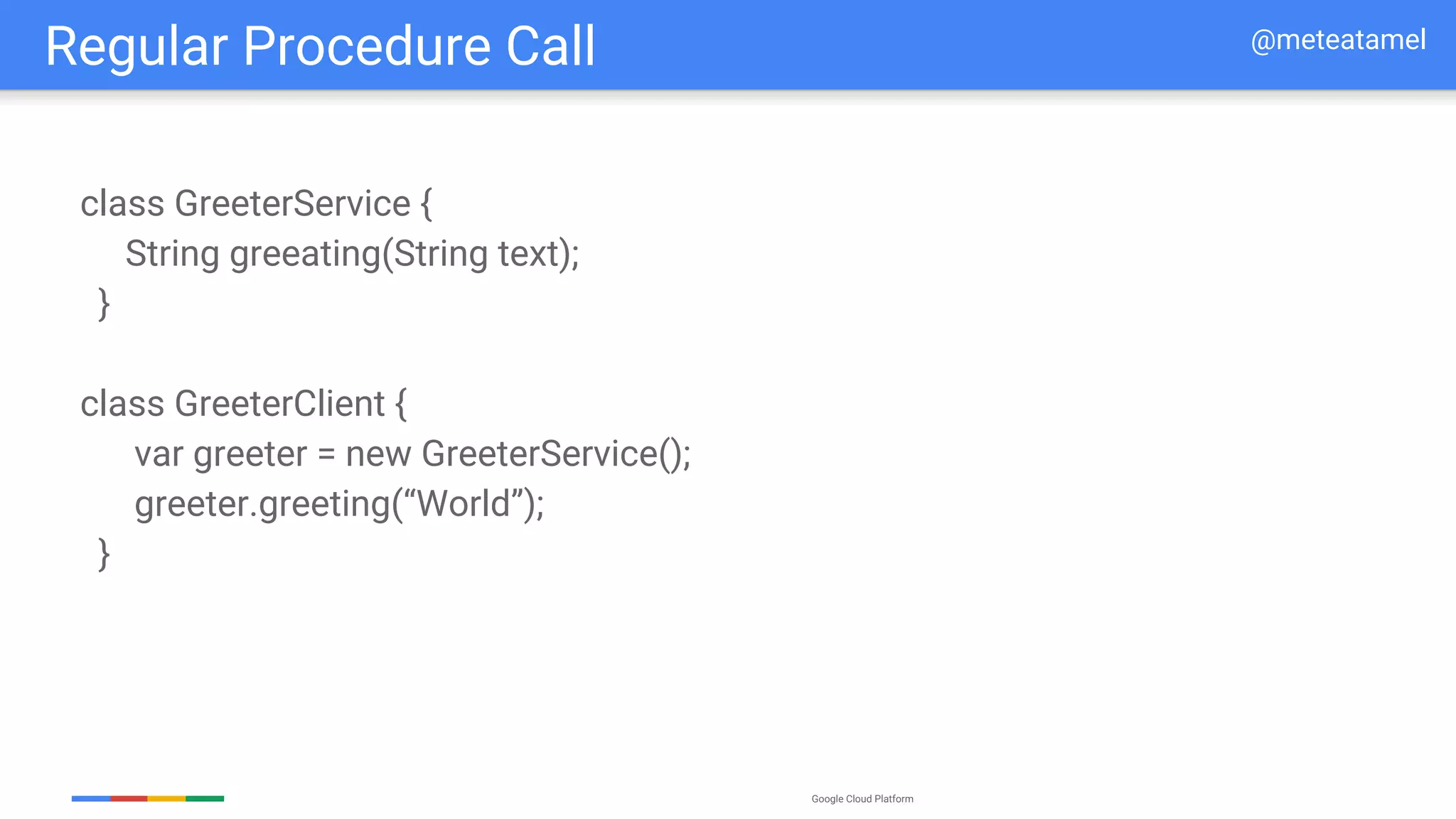
class GreeterService {
String greeating(String text);
}
class GreeterClient {
var greeter = new GreeterService();
greeter.greeting(“World”);
}
Regular Procedure Call @meteatamel
Google Cloud Platform
In distributed computing a remote procedure call (RPC) is when a computer
program causes a procedure (subroutine) to execute in another address space
(commonly on another computer on a shared network), which is coded as if it
were a normal (local) procedure call, without the programmer explicitly coding
the details for the remote interaction
That is, the programmer writes essentially the same code whether the subroutine
is local to the executing program, or remote*
Remote Procedure Call (RPC)
*Wikipedia
@meteatamel
Google Cloud Platform
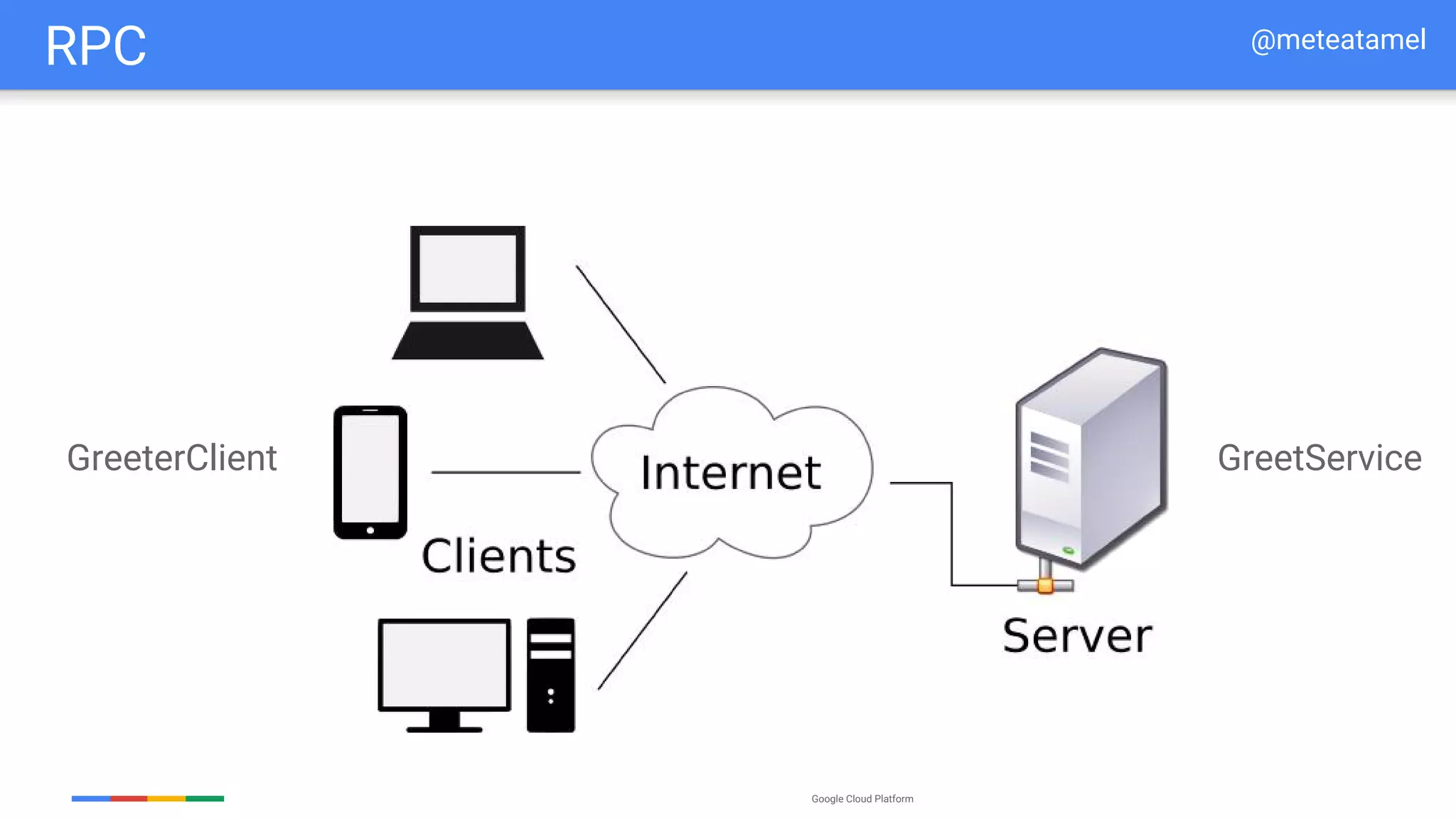
GreeterClient
RPC
GreetService
@meteatamel
Google Cloud Platform
How do clients call the service?
How does the server expose the service?
How does the data serialized/deserialized over the wire? XML, JSON, Binary?
What is the nature of the connection? Request/reply, streaming?
What about authentication?
RPC Questions @meteatamel
Google Cloud Platform
1. Build your own custom RPC framework
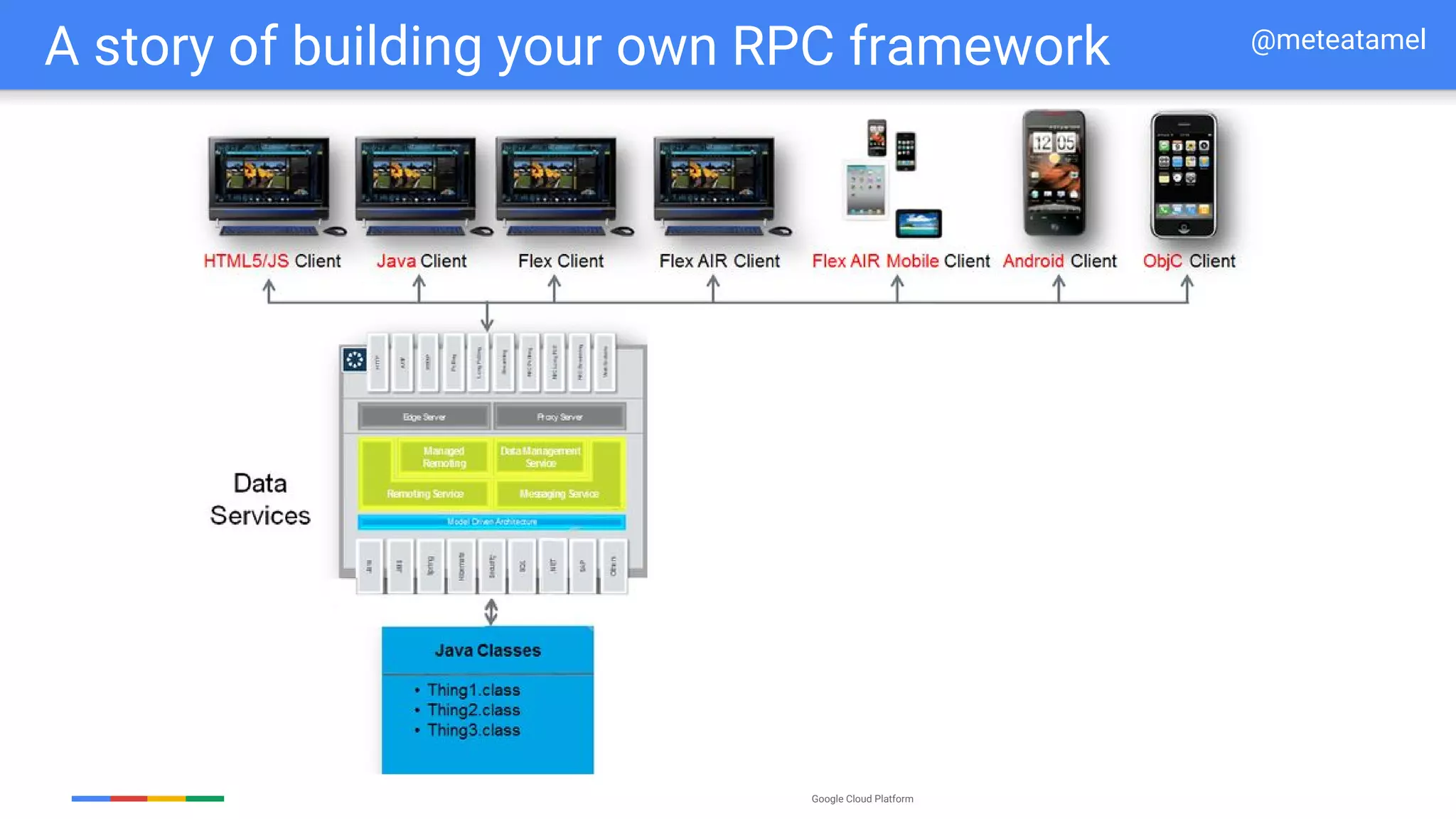
++ Exactly how you like it: I did this with Adobe Flex Data Services!
-- You need to answer the questions earlier & code
2. Use gRPC: A high performance, open-source universal RPC framework
++ Many of the questions already answered & implemented by community
-- You need to buy into gRPC style, gRPC generated code
Choices @meteatamel
Google Cloud Platform
A story of building your own RPC framework @meteatamel
Google Cloud Platform
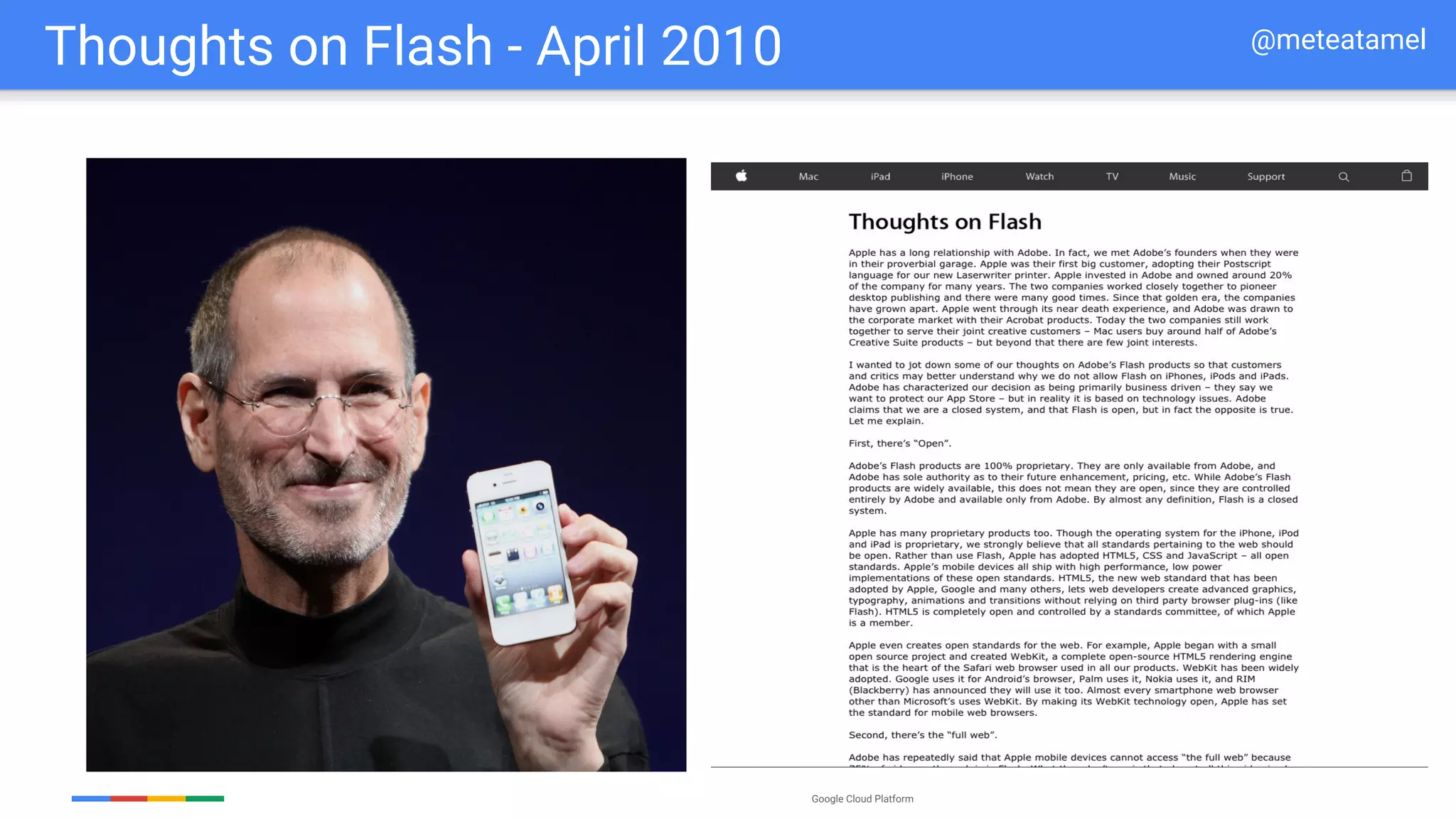
Thoughts on Flash - April 2010 @meteatamel
Google Cloud Platform
For simple services, HTTP REST is probably enough
→ HTTP verbs (GET, POST, PUT, DELETE etc.) are rich enough
→ REST semantics are well understood
For more complex services where efficiency is important, RPC can help
→ Domain specific: imagine a bank transfer scenario
→ More strongly typed experience via stubs
→ Efficiency with HTTP/2, Protocol Buffer
Why not REST? @meteatamel
Google Cloud Platform
Basics
@meteatamel
Google Cloud Platform
Stands for gRPC Remote Procedure Calls
A high performance, open source, general purpose standards-based, feature-rich
RPC framework
Open sourced version of Stubby RPC used in Google
Actively developed and production-ready, current version is 1.2.0
What is gRPC? @meteatamel
Google Cloud Platform
Services not Objects, Messages not References
Coverage & Simplicity
Free & Open
Interoperability & Reach
General Purpose & Performant
Layered
Payload Agnostic
Streaming
Blocking & Non-Blocking
Cancellation & Timeout
Motivation and Design Principles
grpc.io/blog/principles
@meteatamel
Google Cloud Platform
A high level service definition to describe the API using Protocol Buffers
Client and server code generated from the service definition in 10+ languages
Efficiency in serialization with Protocol Buffers and connection with HTTP/2
Connection options: Unary, server-side streaming, client-side streaming,
bi-directional streaming
Authentication options: SSL/TLS, token based authentication
How does it work? @meteatamel
Google Cloud Platform
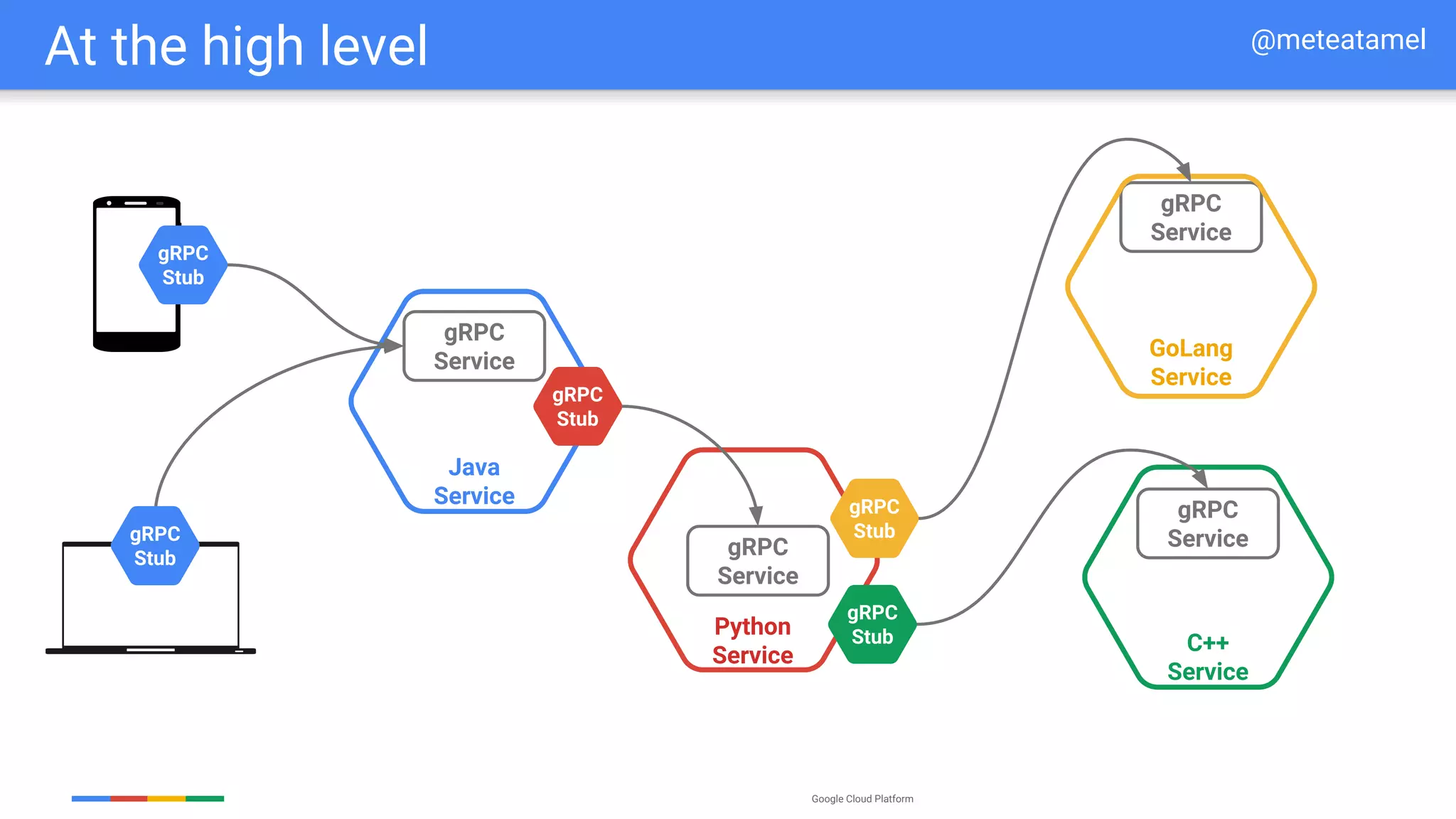
At the high level
Java
Service
gRPC
Service
Python
Service
gRPC
Stub
gRPC
Service
gRPC
Service
GoLang
Service
C++
Service
gRPC
Stub
gRPC
Stub
gRPC
ServicegRPC
Stub
gRPC
Stub
@meteatamel
Google Cloud Platform
Show me the code: 4 easy steps
@meteatamel
Google Cloud Platform
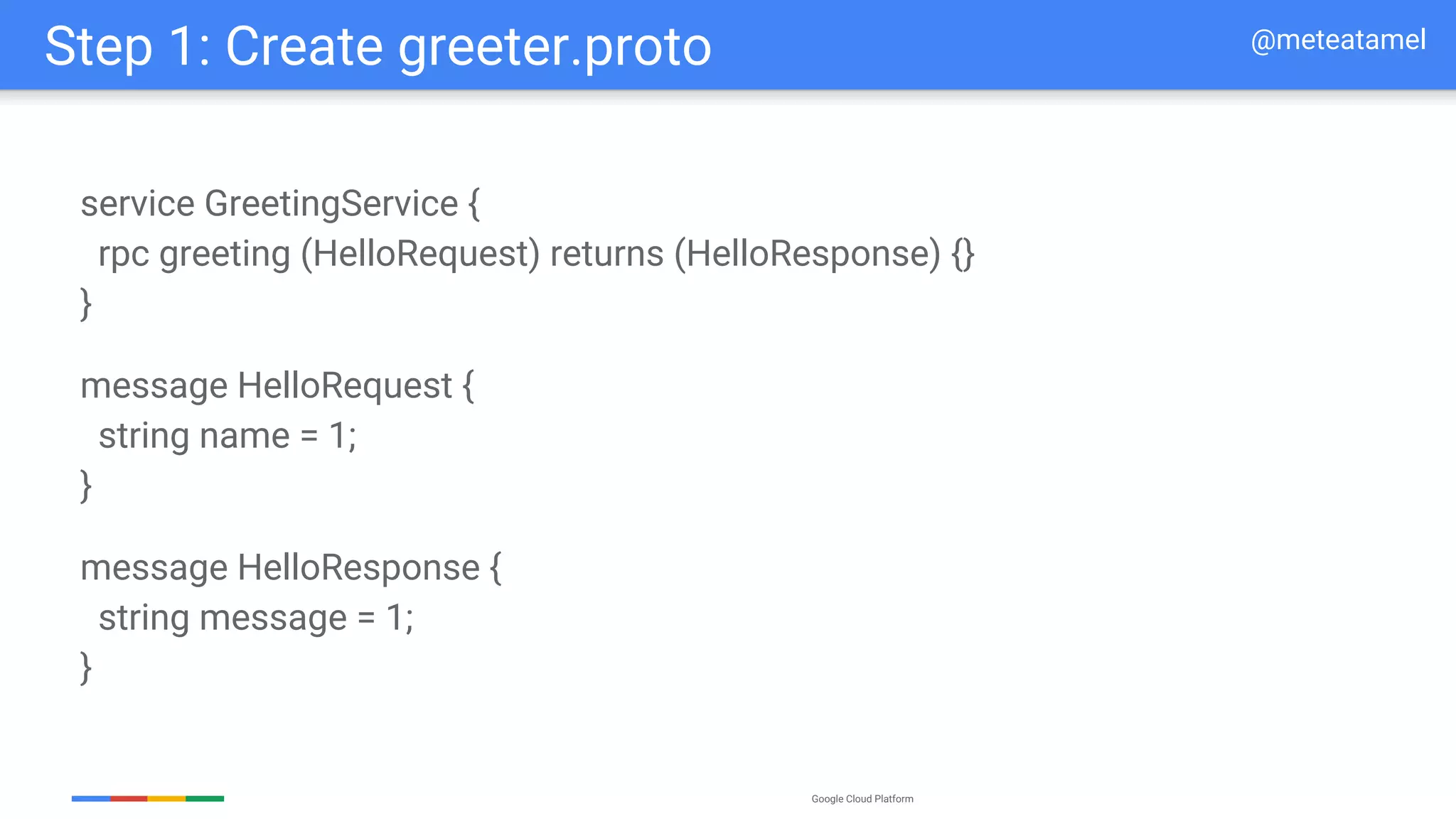
service GreetingService {
rpc greeting (HelloRequest) returns (HelloResponse) {}
}
Step 1: Create greeter.proto
message HelloRequest {
string name = 1;
}
message HelloResponse {
string message = 1;
}
@meteatamel
Google Cloud Platform
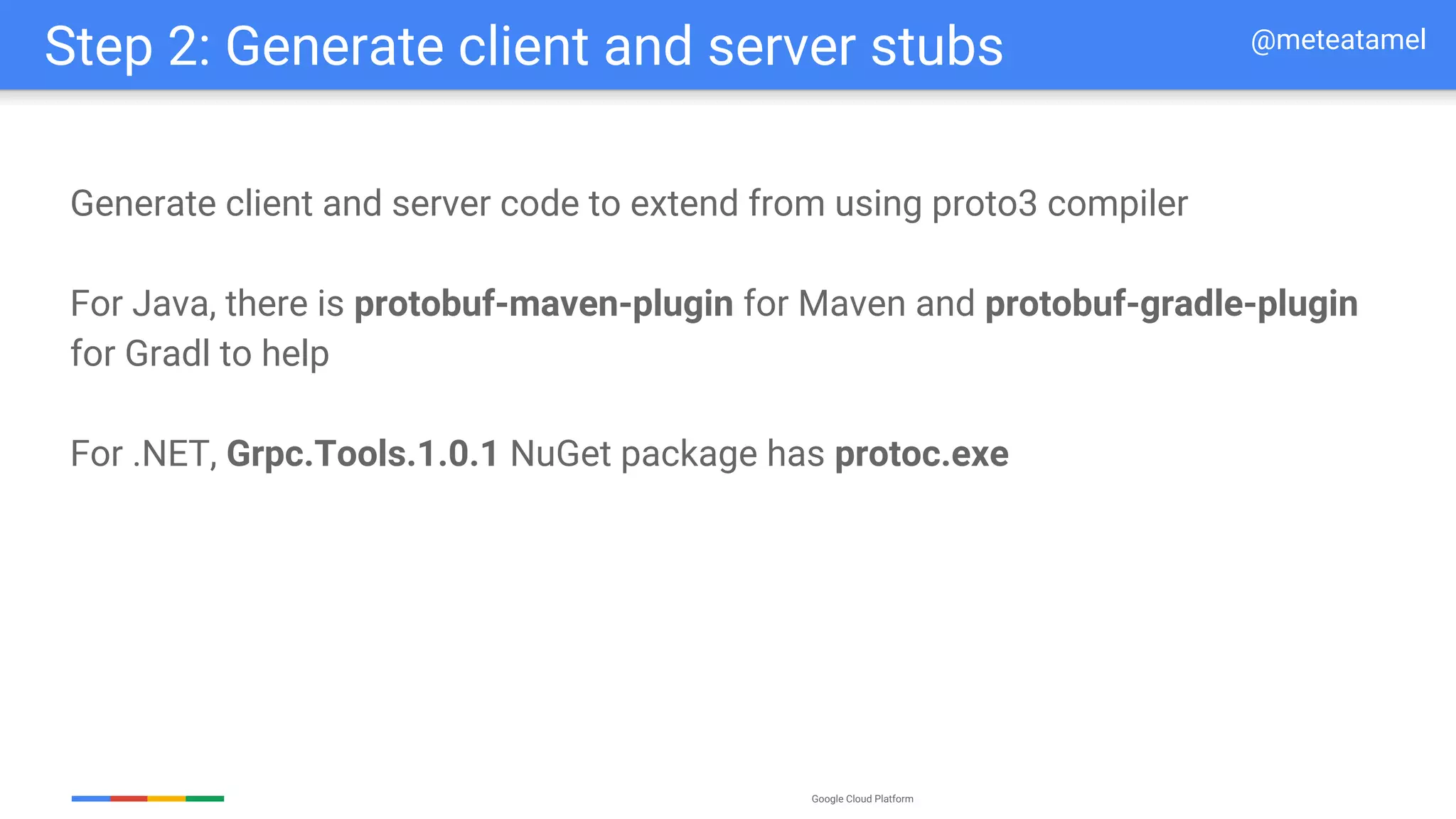
Generate client and server code to extend from using proto3 compiler
For Java, there is protobuf-maven-plugin for Maven and protobuf-gradle-plugin
for Gradl to help
For .NET, Grpc.Tools.1.0.1 NuGet package has protoc.exe
Step 2: Generate client and server stubs @meteatamel
Google Cloud Platform
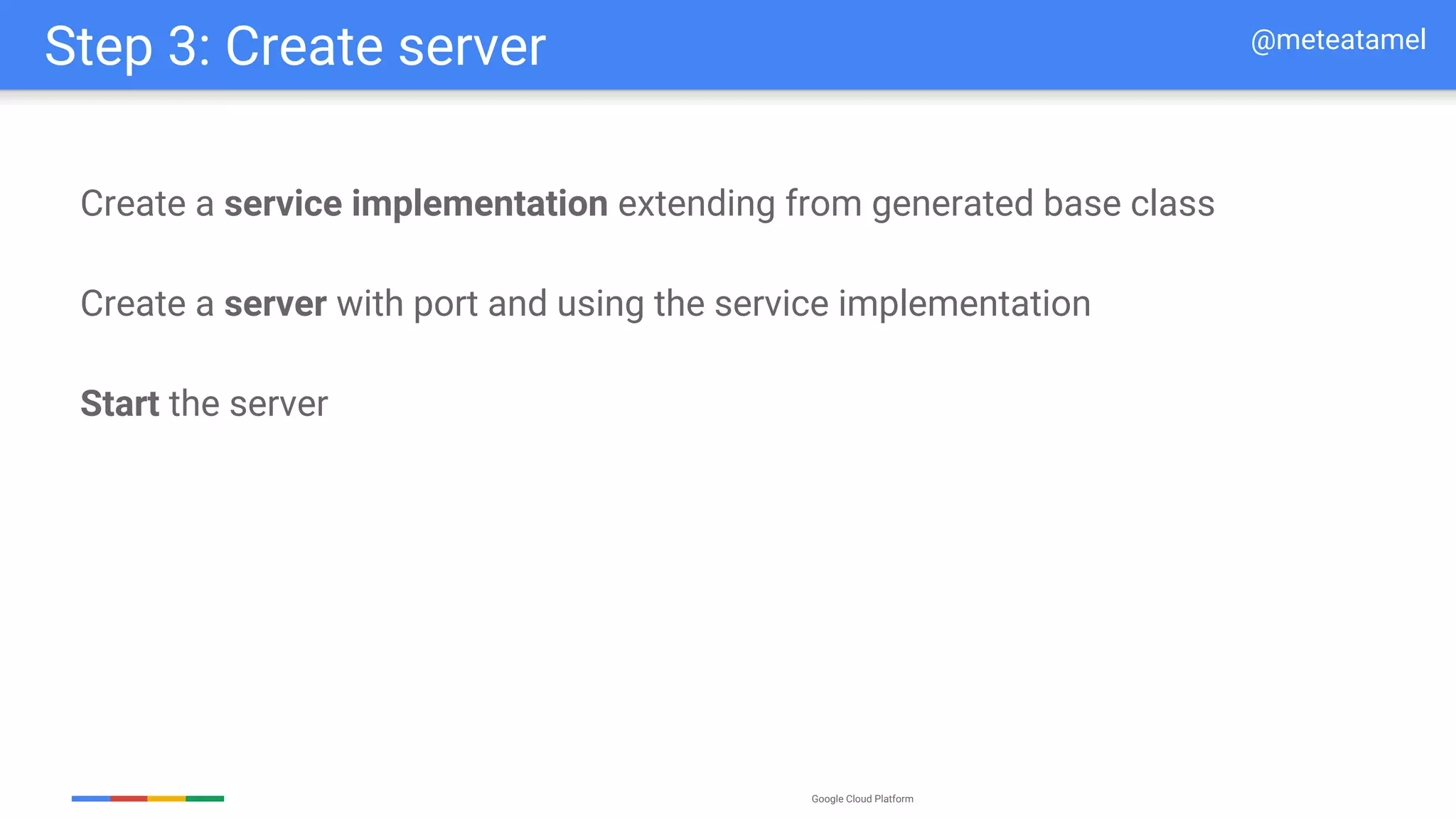
Create a service implementation extending from generated base class
Create a server with port and using the service implementation
Start the server
Step 3: Create server @meteatamel
Google Cloud Platform
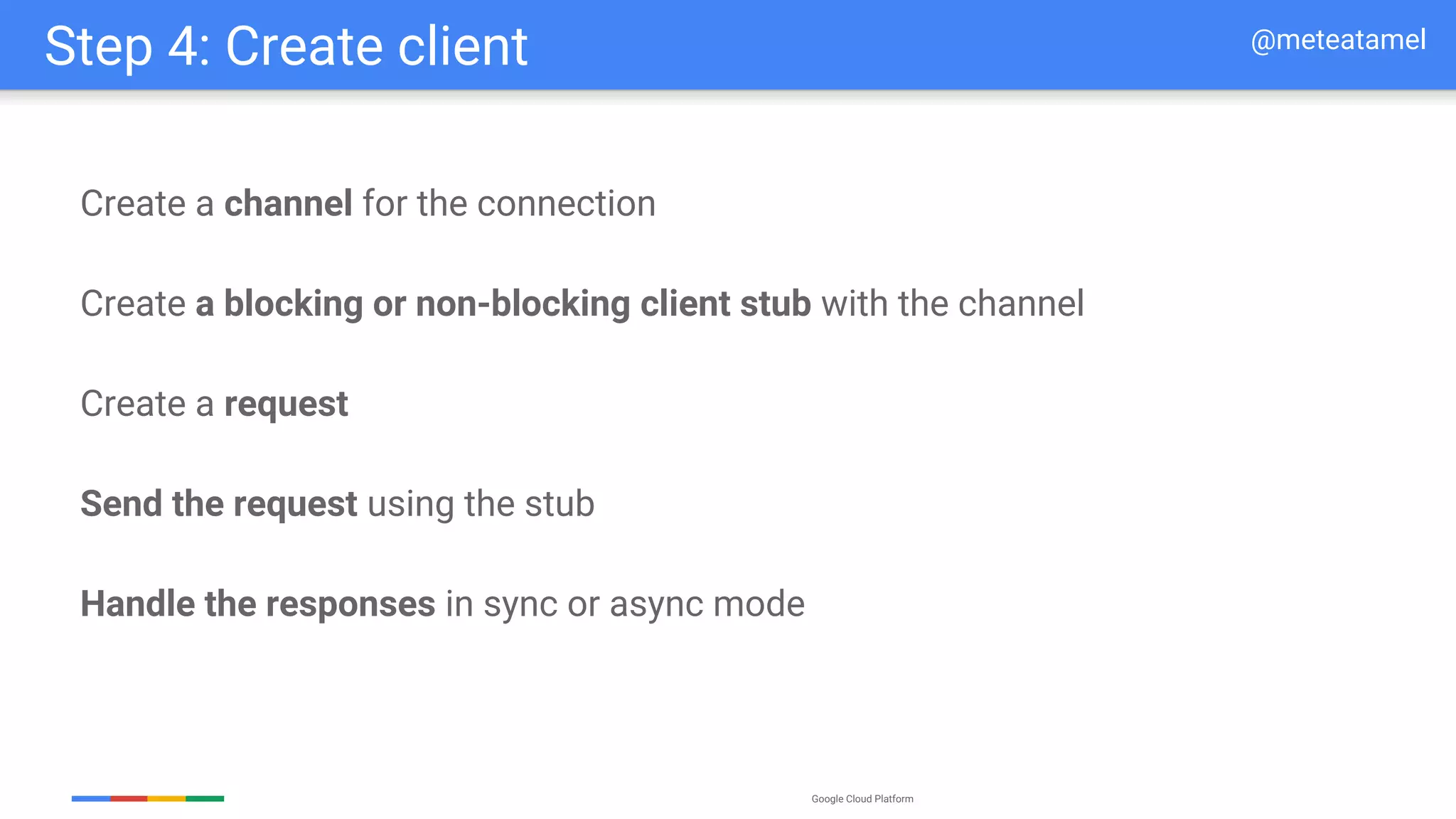
Create a channel for the connection
Create a blocking or non-blocking client stub with the channel
Create a request
Send the request using the stub
Handle the responses in sync or async mode
Step 4: Create client @meteatamel
Google Cloud Platform
Demo: Greeter Server & Client (Java)
@meteatamel
Google Cloud Platform
gRPC Benefits
@meteatamel
Google Cloud Platform
HTTP/2: low latency transport of content
Protocol Buffers (or Bond): efficient serialization
Multi-language Support
Connection Options: Unary, server, client, bi-directional streaming
Main benefits @meteatamel
Google Cloud Platform
Let’s talk about HTTP/2
@meteatamel
Google Cloud Platform
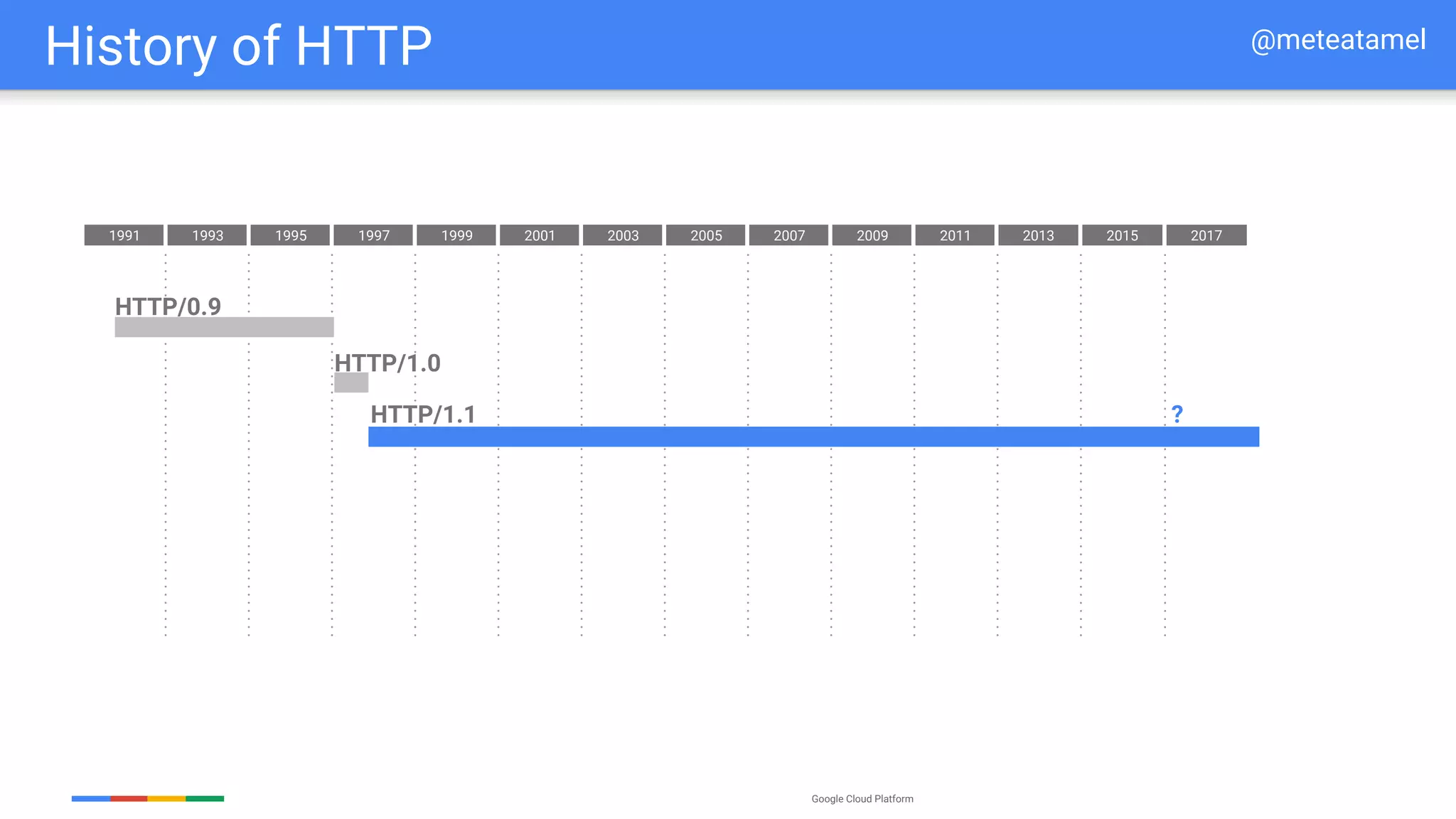
History of HTTP
1991 1993 1995 1997 1999
HTTP/0.9
2001 2003 2005 2007 2009 2011 2013
HTTP/1.0
2015 2017
HTTP/1.1 ?
@meteatamel
Google Cloud Platform
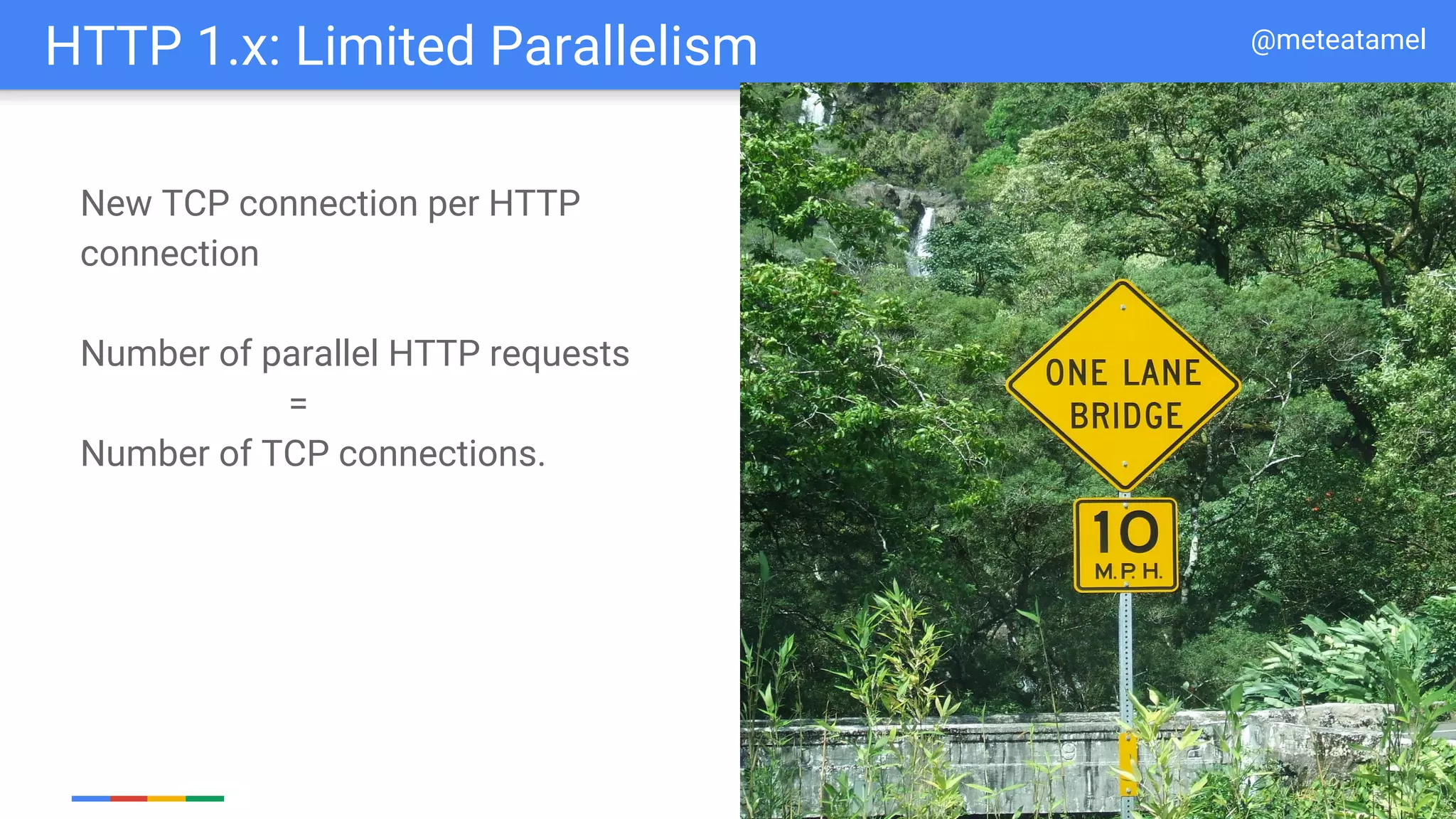
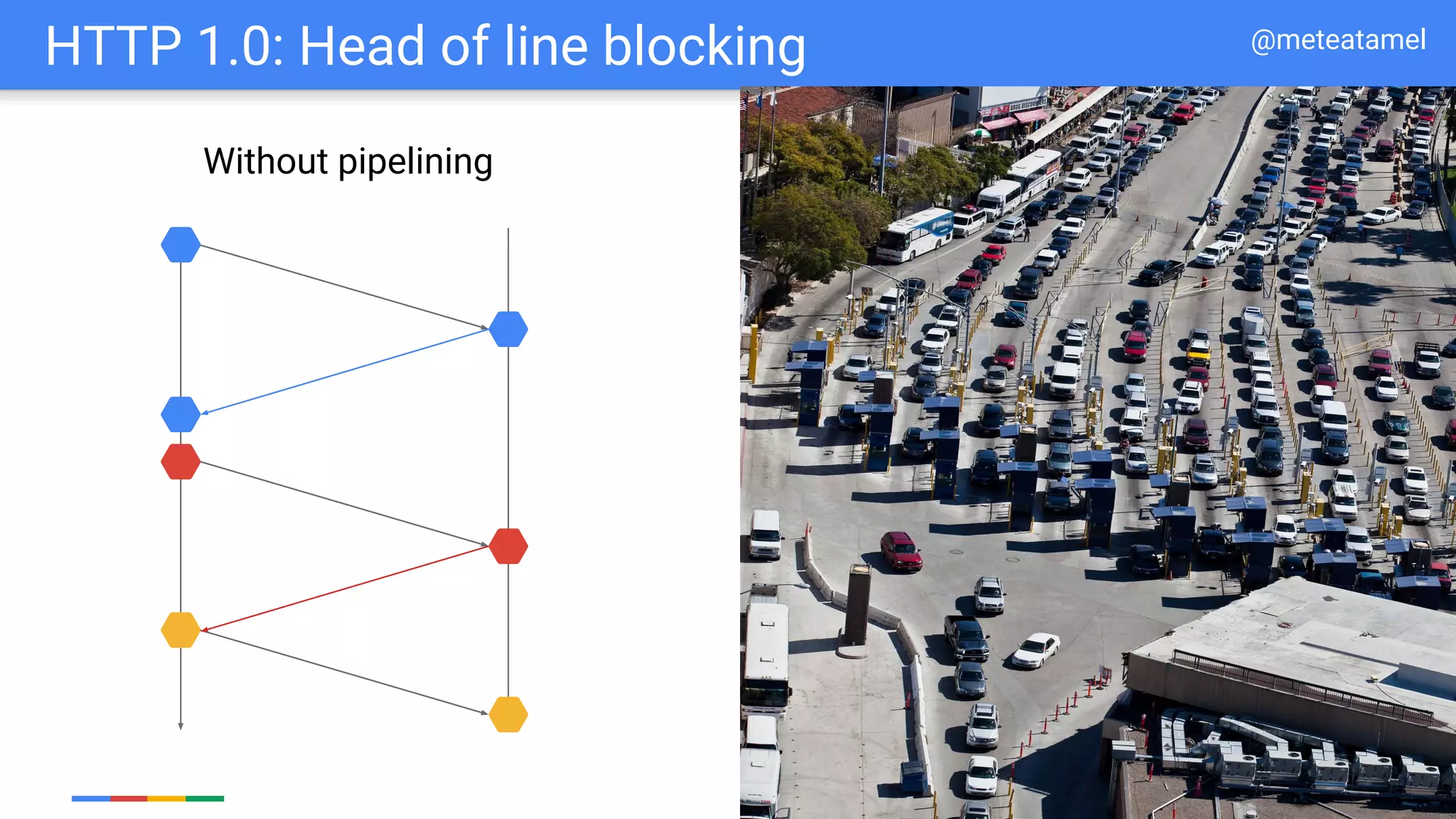
New TCP connection per HTTP
connection
Number of parallel HTTP requests
=
Number of TCP connections.
HTTP 1.x: Limited Parallelism @meteatamel
Google Cloud Platform
HTTP 1.0: Head of line blocking
Without pipelining
@meteatamel
Google Cloud Platform
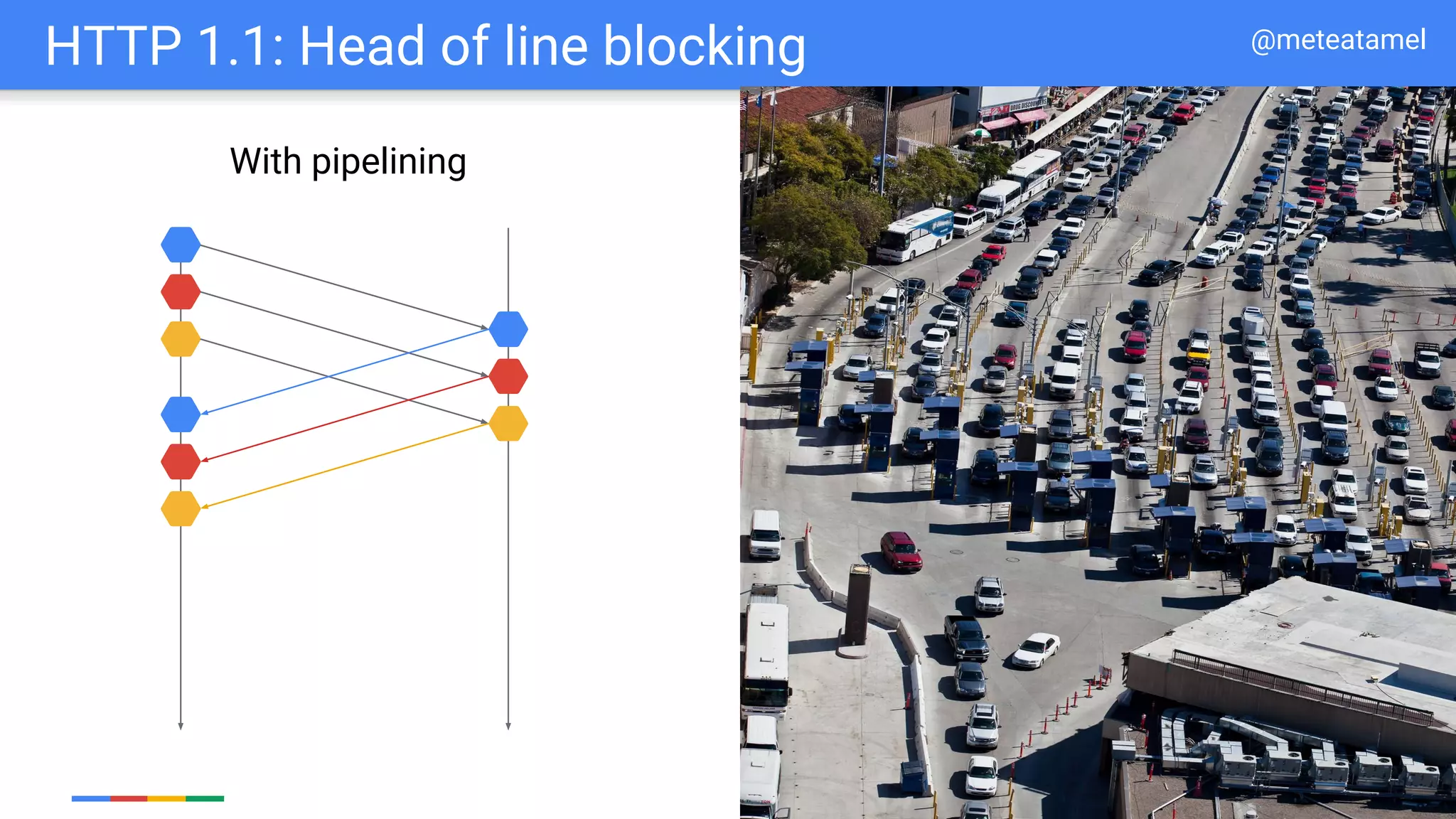
HTTP 1.1: Head of line blocking
With pipelining
@meteatamel
Google Cloud Platform
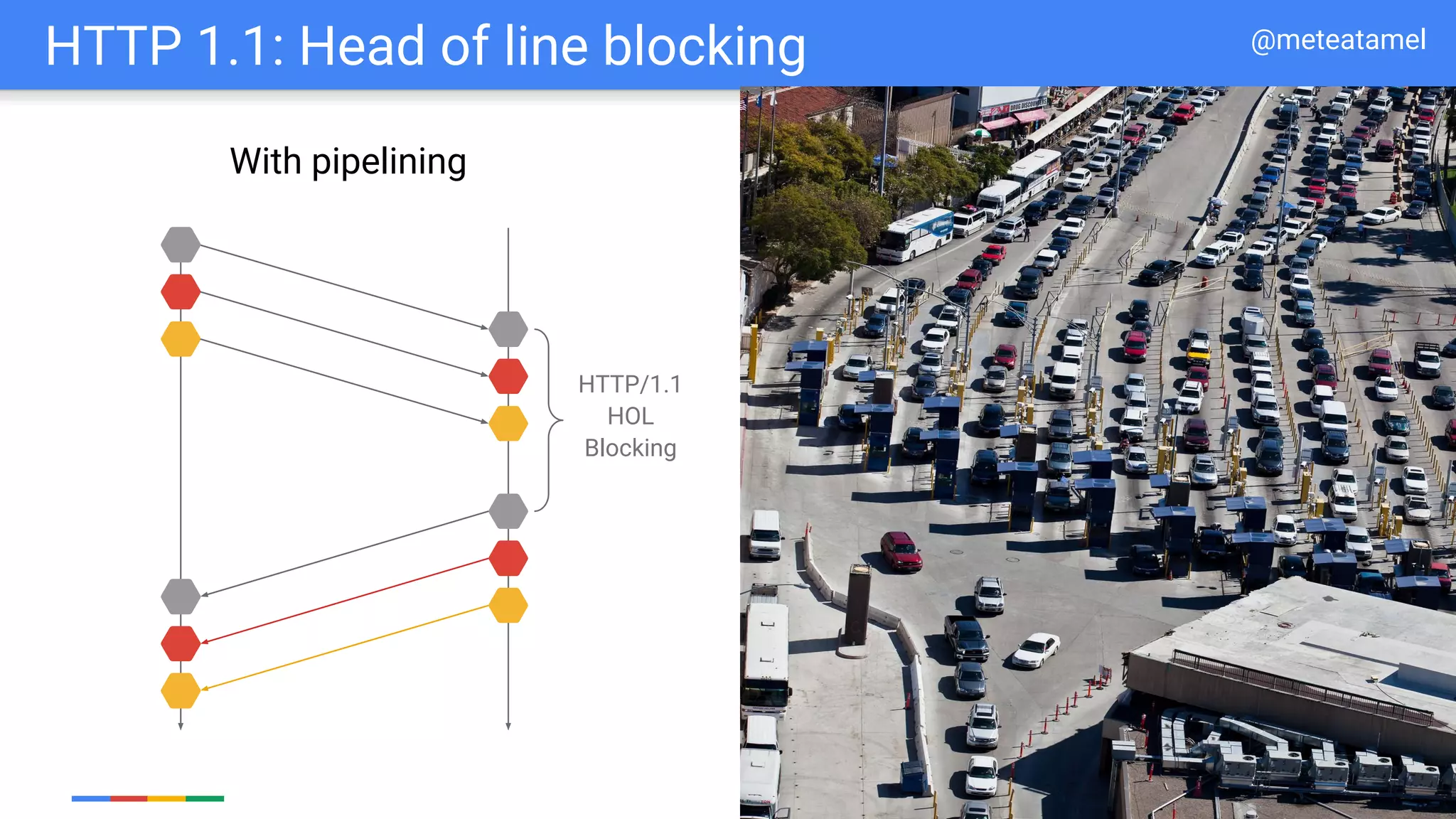
HTTP 1.1: Head of line blocking
HTTP/1.1
HOL
Blocking
With pipelining
@meteatamel
Google Cloud Platform
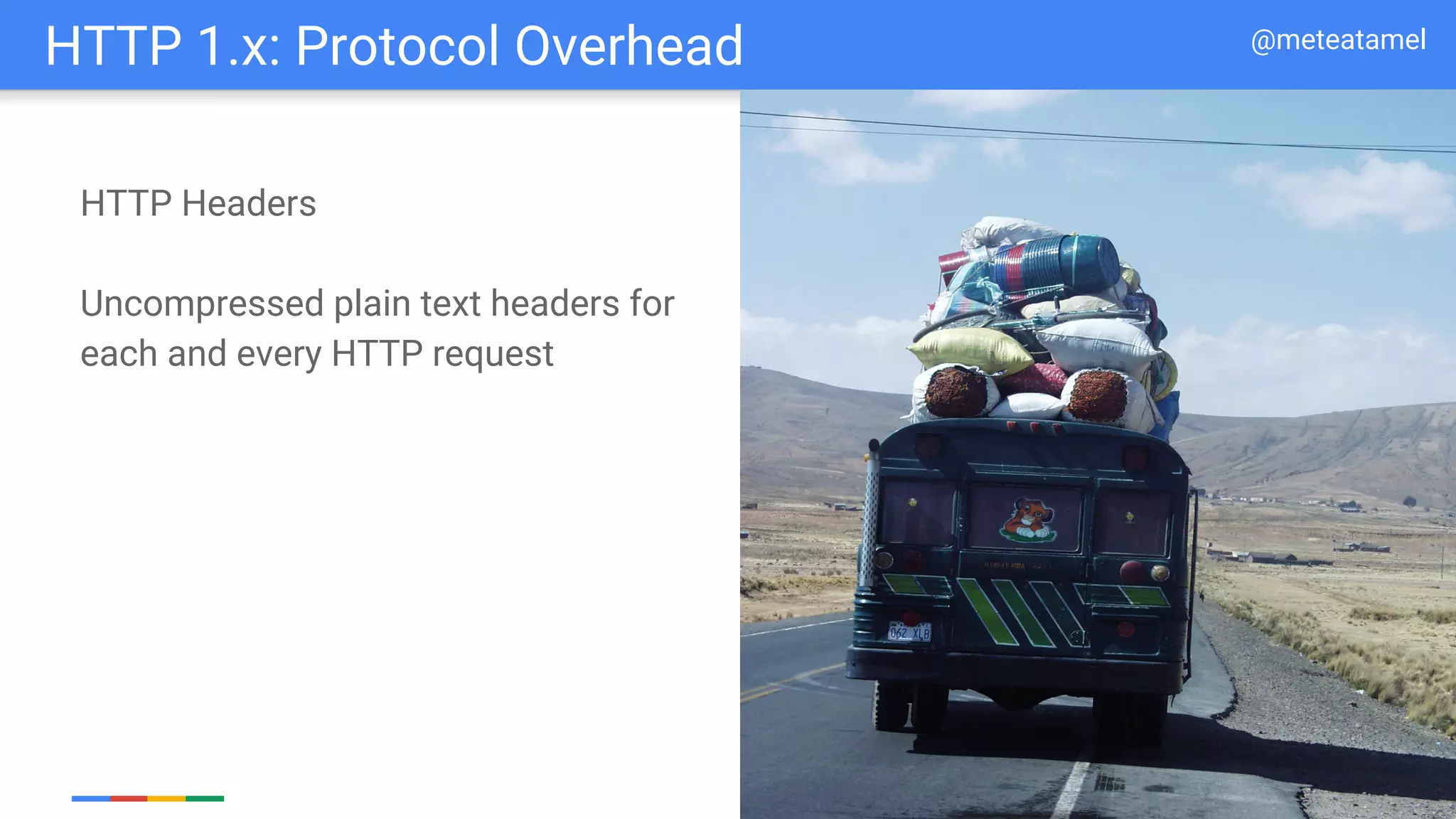
HTTP Headers
Uncompressed plain text headers for
each and every HTTP request
HTTP 1.x: Protocol Overhead @meteatamel
Google Cloud Platform
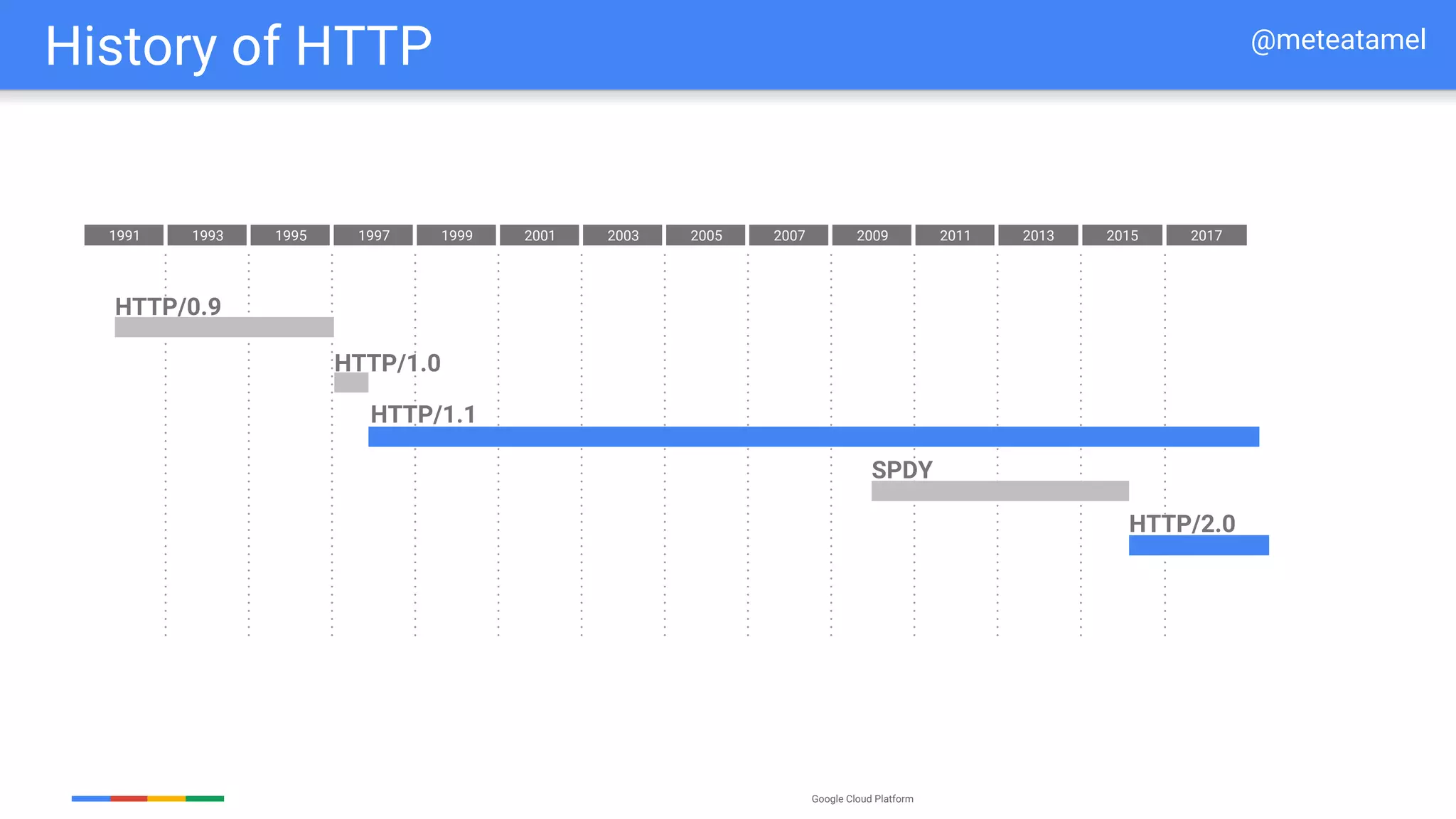
History of HTTP
1991 1993 1995 1997 1999
HTTP/0.9
2001 2003 2005 2007 2009 2011 2013
HTTP/1.0
2015 2017
HTTP/1.1
@meteatamel
SPDY
HTTP/2.0
Google Cloud Platform
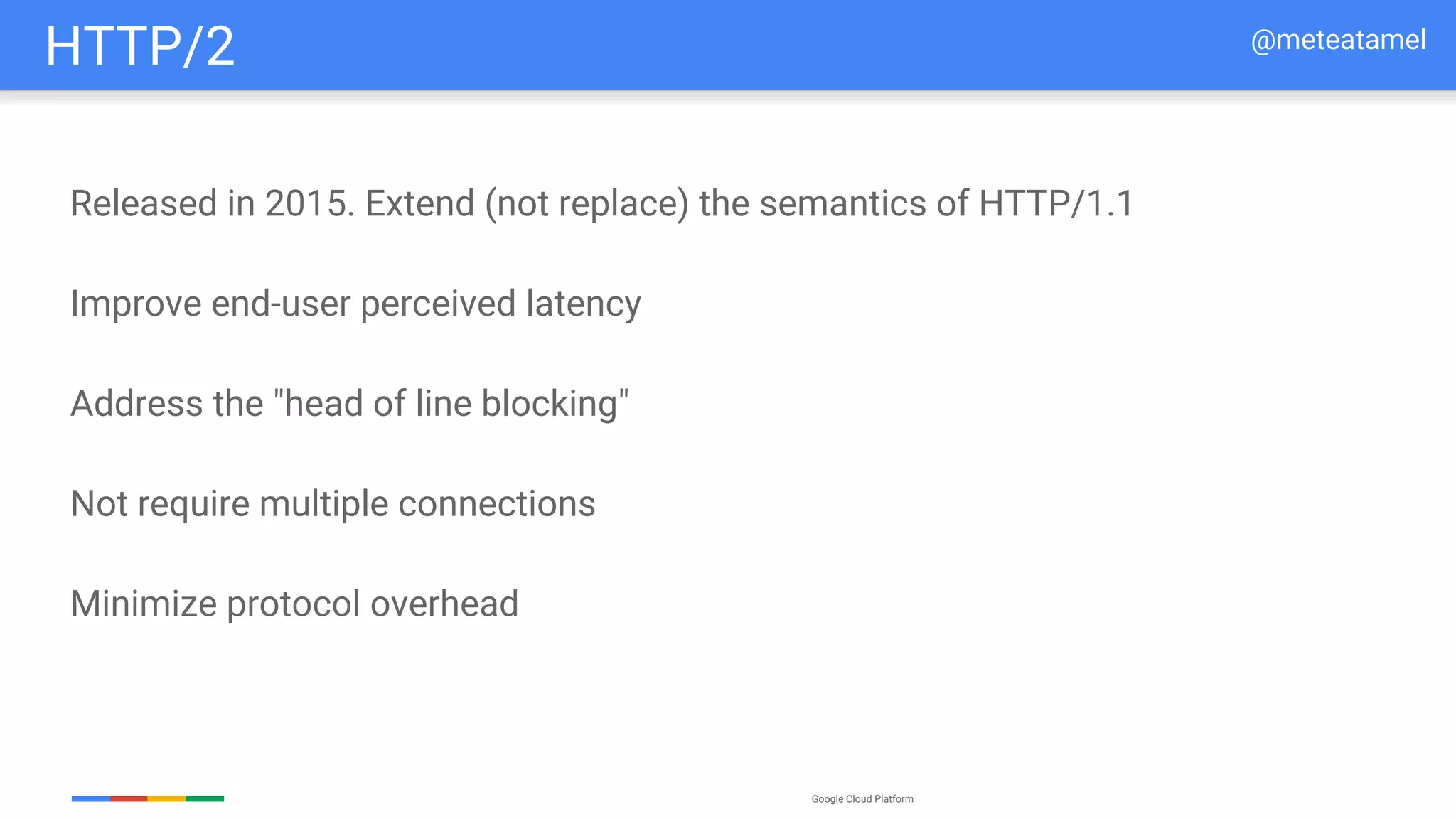
Released in 2015. Extend (not replace) the semantics of HTTP/1.1
Improve end-user perceived latency
Address the "head of line blocking"
Not require multiple connections
Minimize protocol overhead
HTTP/2 @meteatamel
Google Cloud Platform
HTTP/2
Single TCP connection
No Head-of-line blocking
Binary framing layer
Request –> Stream
Header Compression
Transport(TCP)
Application (HTTP/2)
Network (IP)
Session (TLS) [optional]
Binary Framing
HEADERS Frame
DATA Frame
HTTP/2
POST: /upload
HTTP/1.1
Host: www.javaday.org.ua
Content-Type: application/json
Content-Length: 27
HTTP/1.x
{“msg”: “Welcome to 2016!”}
@meteatamel
Google Cloud Platform
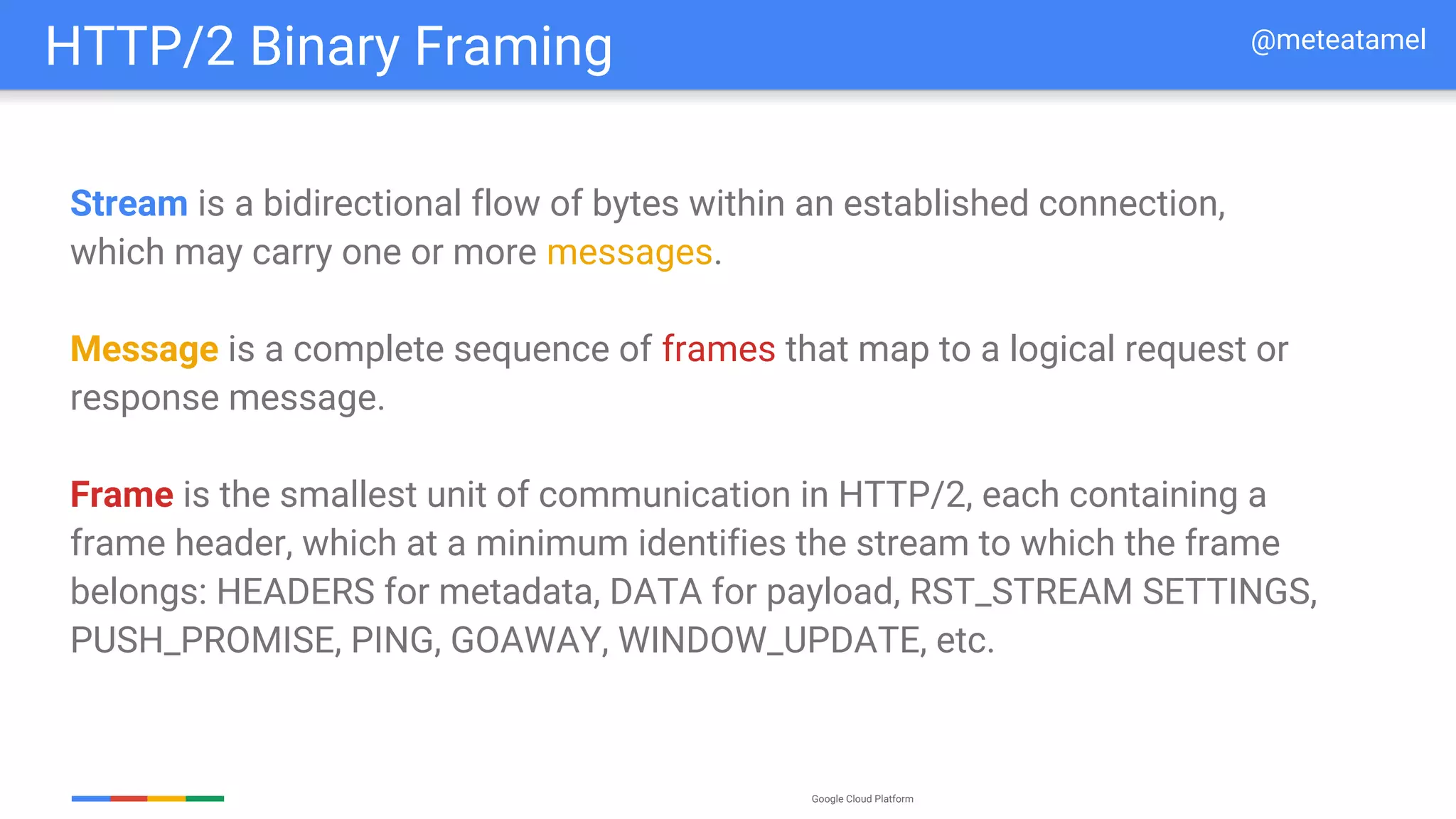
Stream is a bidirectional flow of bytes within an established connection,
which may carry one or more messages.
Message is a complete sequence of frames that map to a logical request or
response message.
Frame is the smallest unit of communication in HTTP/2, each containing a
frame header, which at a minimum identifies the stream to which the frame
belongs: HEADERS for metadata, DATA for payload, RST_STREAM SETTINGS,
PUSH_PROMISE, PING, GOAWAY, WINDOW_UPDATE, etc.
HTTP/2 Binary Framing @meteatamel
Google Cloud Platform
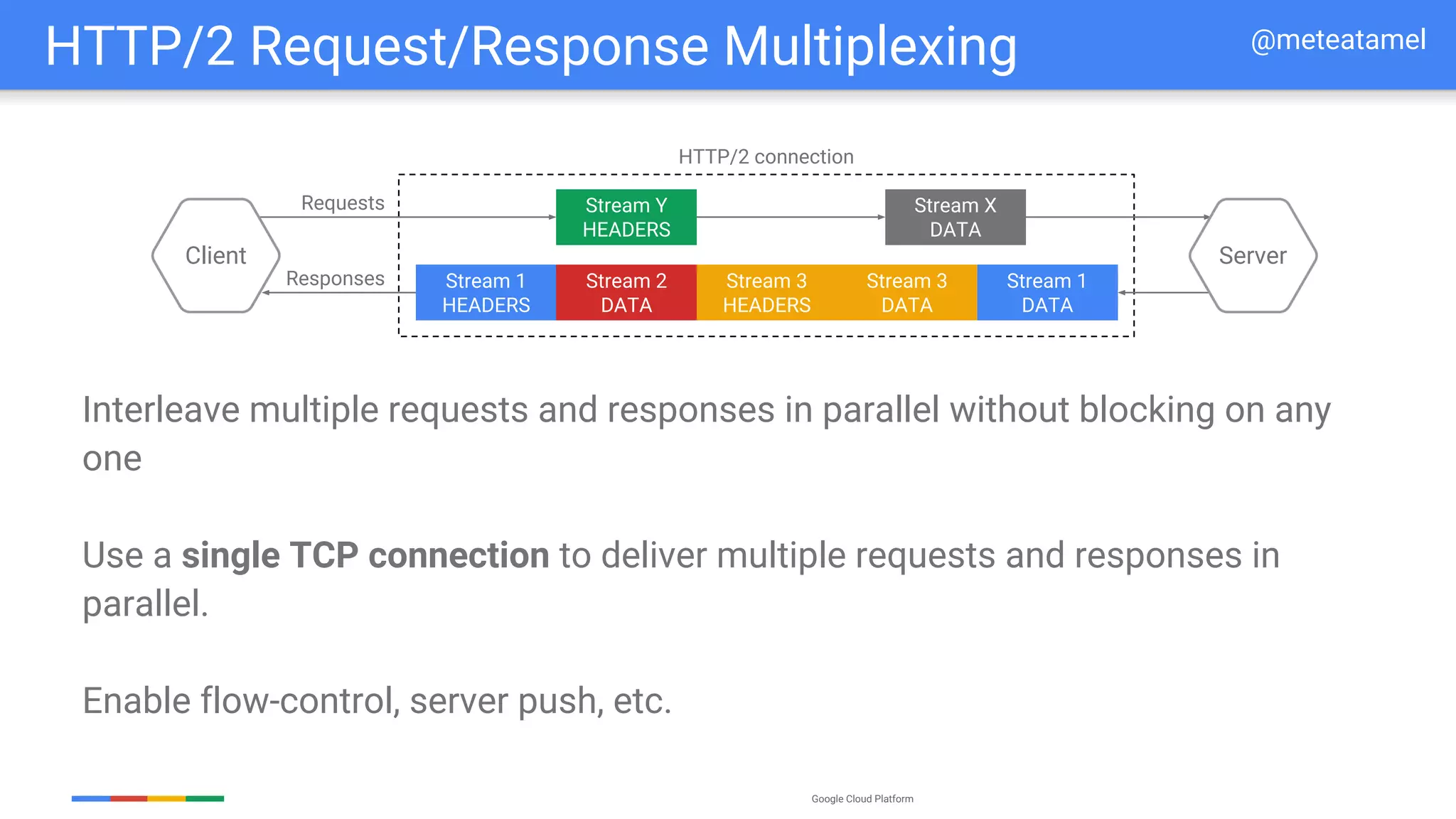
Interleave multiple requests and responses in parallel without blocking on any
one
Use a single TCP connection to deliver multiple requests and responses in
parallel.
Enable flow-control, server push, etc.
HTTP/2 Request/Response Multiplexing
Stream 1
HEADERS
Stream 2
DATA
Stream 3
HEADERS
Stream 3
DATA
Stream 1
DATA
Stream Y
HEADERS
Stream X
DATA
Requests
Responses
HTTP/2 connection
Client Server
@meteatamel
Google Cloud Platform
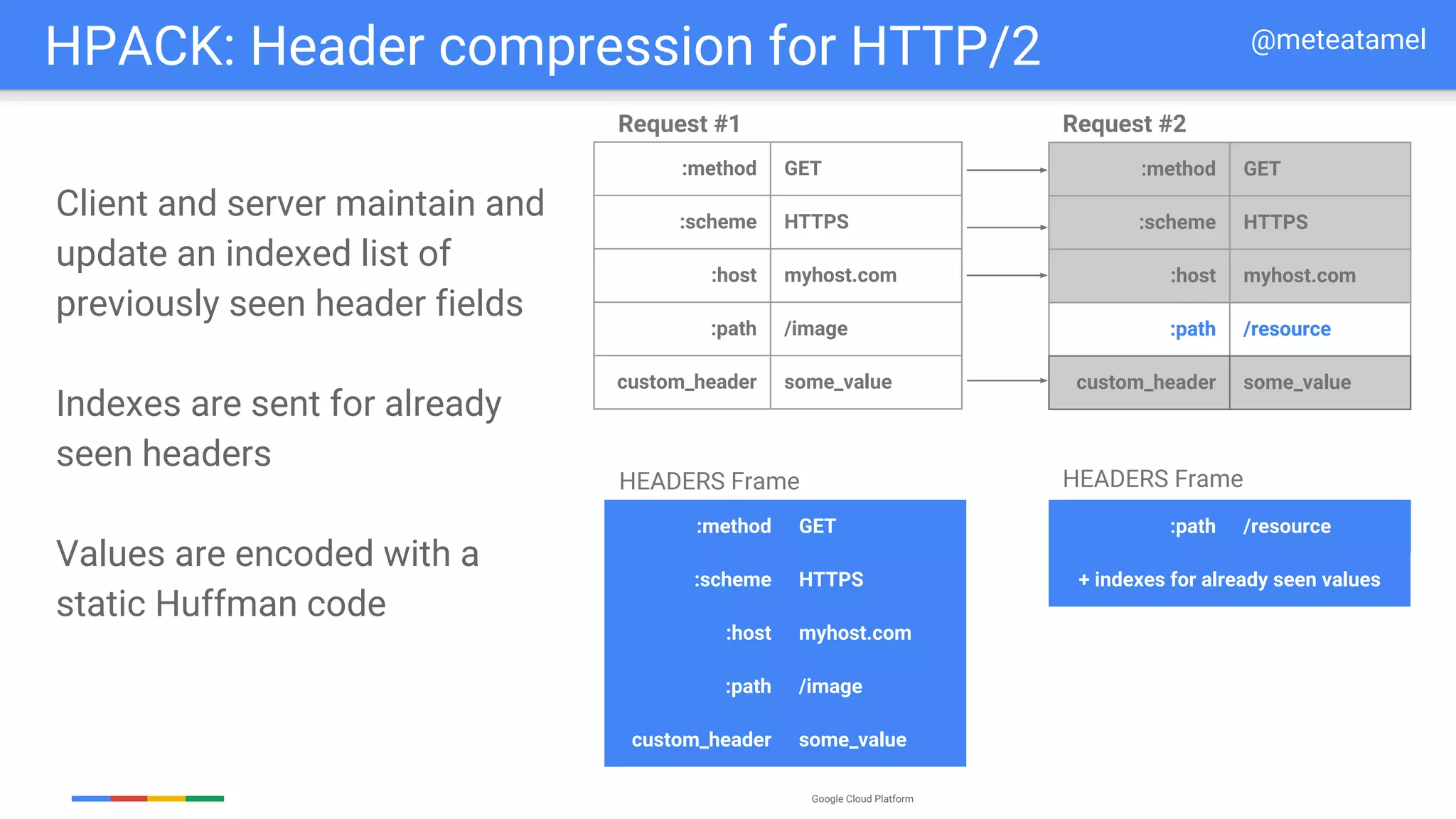
Client and server maintain and
update an indexed list of
previously seen header fields
Indexes are sent for already
seen headers
Values are encoded with a
static Huffman code
HPACK: Header compression for HTTP/2
:method GET
:scheme HTTPS
:host myhost.com
:path /image
custom_header some_value
:method GET
:scheme HTTPS
:host myhost.com
:path /image
custom_header some_value
HEADERS Frame
:method GET
:scheme HTTPS
:host myhost.com
:path /resource
custom_header some_value
Request #2Request #1
:method GET
:scheme HTTPS
:host myhost.com
:path /resource
custom_header some_value
:path /resource
+ indexes for already seen values
HEADERS Frame
@meteatamel
Google Cloud Platform
HTTP/2: What it means for you?
HTTP/2HTTP/1.1
http2demo.io/
@meteatamel
Google Cloud Platform
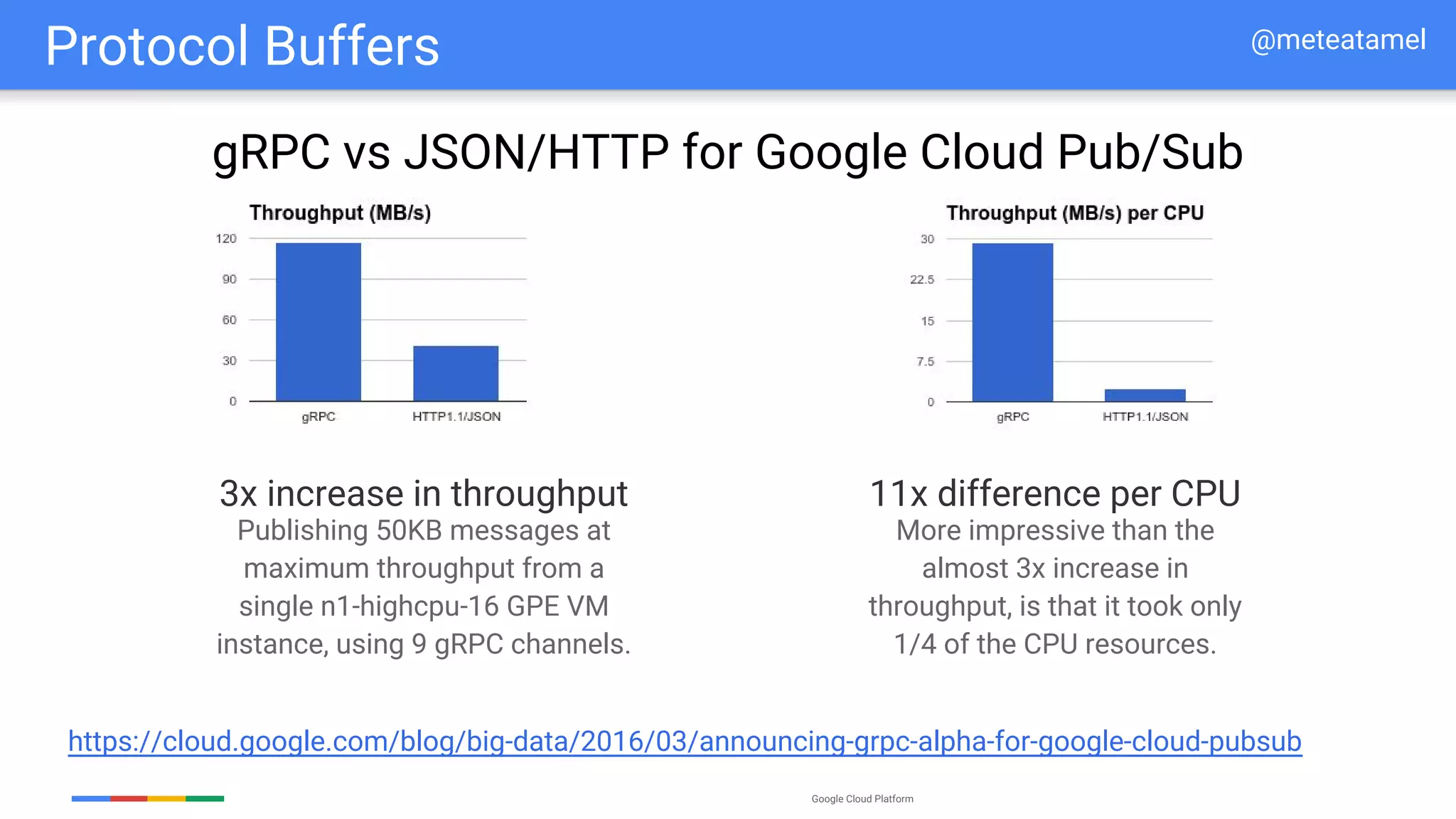
Protocol Buffers
Publishing 50KB messages at
maximum throughput from a
single n1-highcpu-16 GPE VM
instance, using 9 gRPC channels.
More impressive than the
almost 3x increase in
throughput, is that it took only
1/4 of the CPU resources.
11x difference per CPU3x increase in throughput
https://cloud.google.com/blog/big-data/2016/03/announcing-grpc-alpha-for-google-cloud-pubsub
gRPC vs JSON/HTTP for Google Cloud Pub/Sub
@meteatamel
Google Cloud Platform
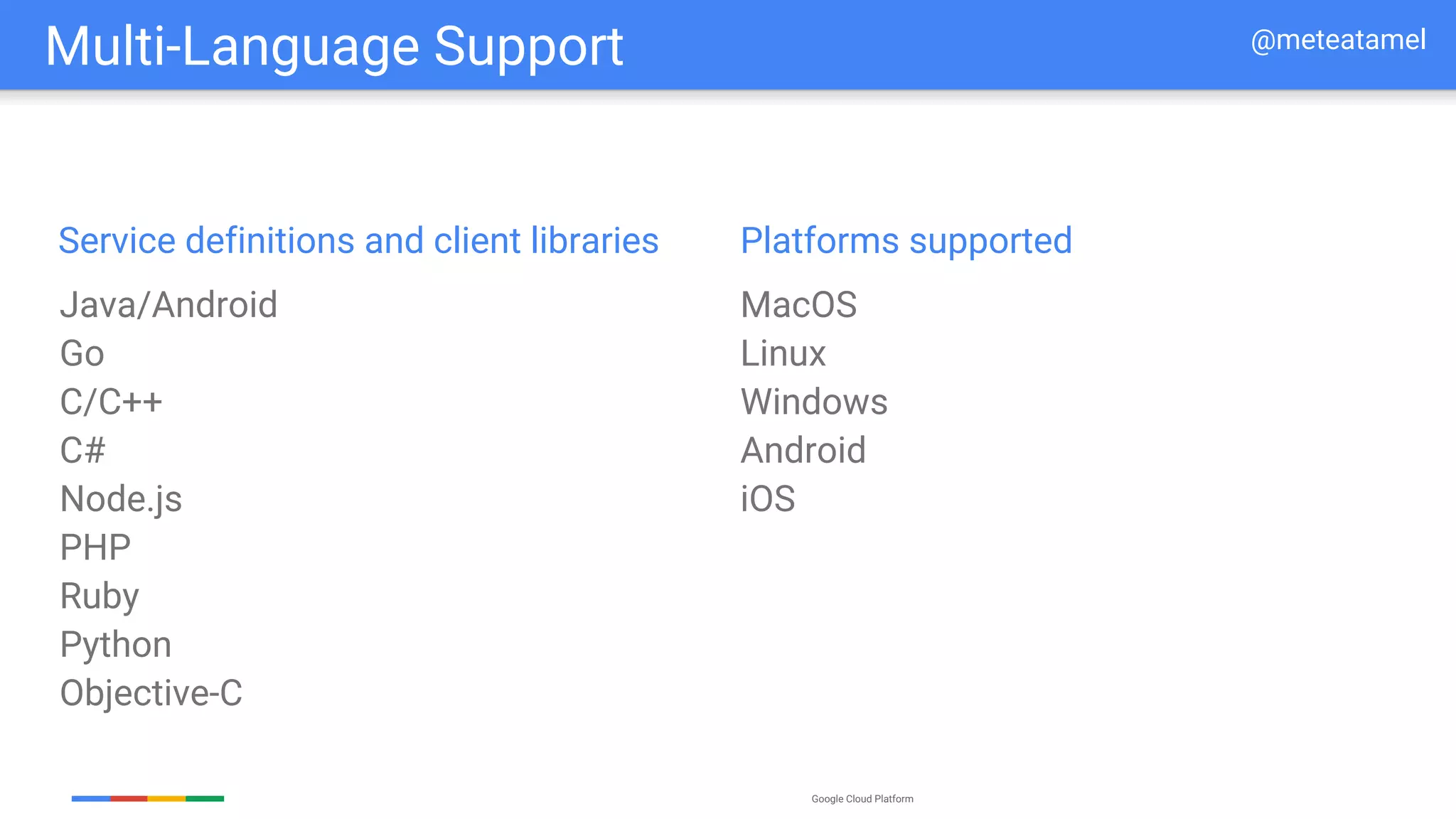
Multi-Language Support
Java/Android
Go
C/C++
C#
Node.js
PHP
Ruby
Python
Objective-C
Service definitions and client libraries
MacOS
Linux
Windows
Android
iOS
Platforms supported
@meteatamel
Google Cloud Platform
Demo: Greeter Server & Client (C#)
@meteatamel
Google Cloud Platform
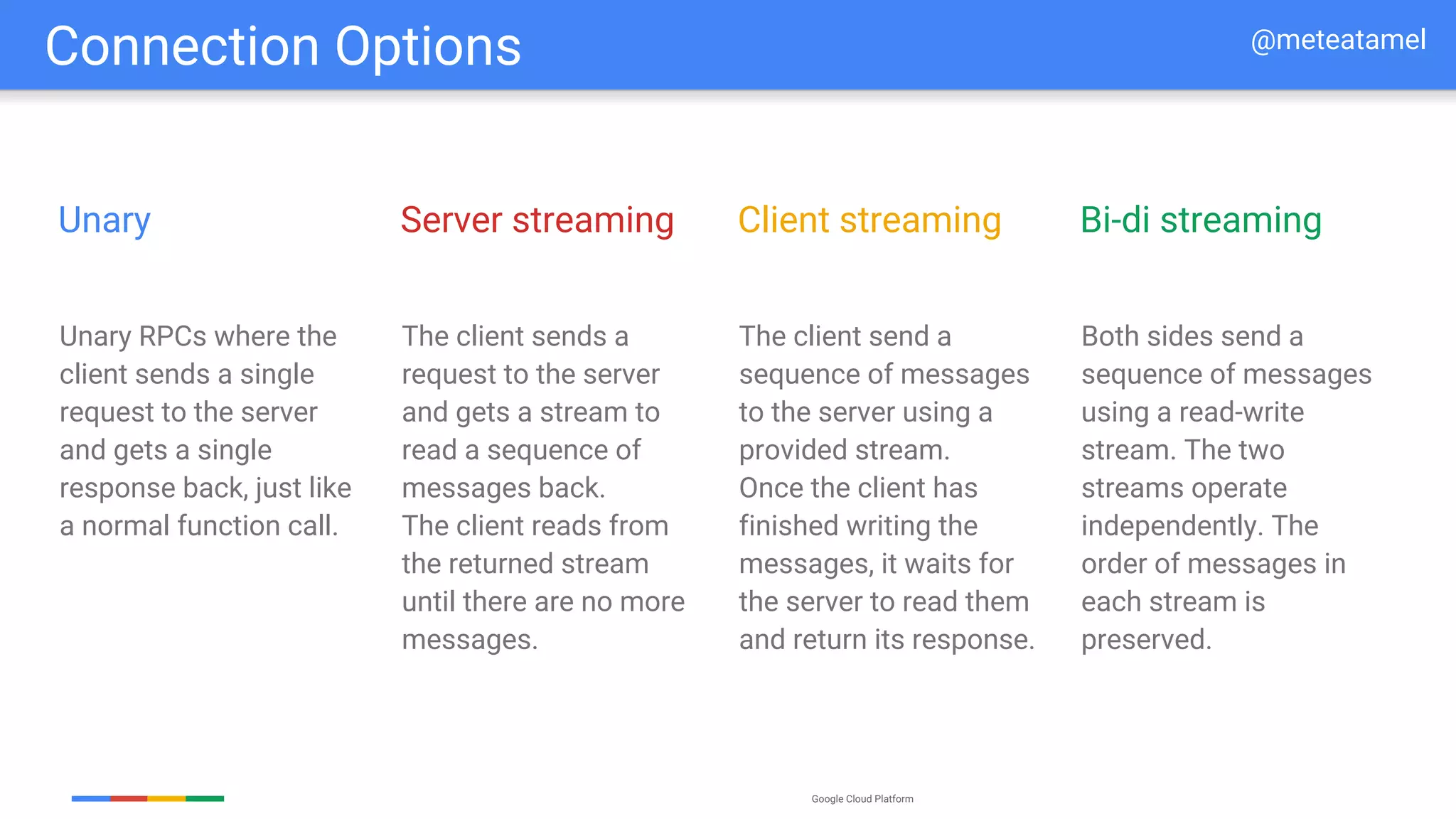
Connection Options
The client send a
sequence of messages
to the server using a
provided stream.
Once the client has
finished writing the
messages, it waits for
the server to read them
and return its response.
Client streaming
Both sides send a
sequence of messages
using a read-write
stream. The two
streams operate
independently. The
order of messages in
each stream is
preserved.
Bi-di streaming
Unary RPCs where the
client sends a single
request to the server
and gets a single
response back, just like
a normal function call.
Unary
The client sends a
request to the server
and gets a stream to
read a sequence of
messages back.
The client reads from
the returned stream
until there are no more
messages.
Server streaming
@meteatamel
Google Cloud Platform
Demo: Chat app using gRPC streaming
@meteatamel
Confidential & ProprietaryGoogle Cloud Platform 45
grpc.io Mete Atamel
@meteatamel
atamel@google.com
meteatamel.wordpress.com
Thank You
Send talk feedback
bit.ly/atamel

Introduction to gRPC: A general RPC framework that puts mobile and HTTP/2 first - Mete Atamel - Codemotion Amsterdam 2017

  • 1.
    A high performance,open-source, universal RPC framework Mete Atamel Developer Advocate for Google Cloud @meteatamel
  • 2.
    Confidential & ProprietaryGoogleCloud Platform 2 Mete Atamel Developer Advocate for Google Cloud @meteatamel atamel@google.com meteatamel.wordpress.com Please send talk feedback: bit.ly/atamel @meteatamel
  • 3.
    Google Cloud Platform Agenda Introduction RPC,motivation for gRPC gRPC Basics What is gRPC? Design goals Some me the code! HelloWorld gRPC sample and demo gRPC Benefits HTTP/2, Protocol Buffers, multi-language support, connection options Some me more code! Streaming gRPC sample and demo @meteatamel
  • 4.
  • 5.
    Google Cloud Platform classGreeterService { String greeating(String text); } class GreeterClient { var greeter = new GreeterService(); greeter.greeting(“World”); } Regular Procedure Call @meteatamel
  • 6.
    Google Cloud Platform Indistributed computing a remote procedure call (RPC) is when a computer program causes a procedure (subroutine) to execute in another address space (commonly on another computer on a shared network), which is coded as if it were a normal (local) procedure call, without the programmer explicitly coding the details for the remote interaction That is, the programmer writes essentially the same code whether the subroutine is local to the executing program, or remote* Remote Procedure Call (RPC) *Wikipedia @meteatamel
  • 7.
  • 8.
    Google Cloud Platform Howdo clients call the service? How does the server expose the service? How does the data serialized/deserialized over the wire? XML, JSON, Binary? What is the nature of the connection? Request/reply, streaming? What about authentication? RPC Questions @meteatamel
  • 9.
    Google Cloud Platform 1.Build your own custom RPC framework ++ Exactly how you like it: I did this with Adobe Flex Data Services! -- You need to answer the questions earlier & code 2. Use gRPC: A high performance, open-source universal RPC framework ++ Many of the questions already answered & implemented by community -- You need to buy into gRPC style, gRPC generated code Choices @meteatamel
  • 10.
    Google Cloud Platform Astory of building your own RPC framework @meteatamel
  • 11.
    Google Cloud Platform Thoughtson Flash - April 2010 @meteatamel
  • 12.
    Google Cloud Platform Forsimple services, HTTP REST is probably enough → HTTP verbs (GET, POST, PUT, DELETE etc.) are rich enough → REST semantics are well understood For more complex services where efficiency is important, RPC can help → Domain specific: imagine a bank transfer scenario → More strongly typed experience via stubs → Efficiency with HTTP/2, Protocol Buffer Why not REST? @meteatamel
  • 13.
  • 14.
    Google Cloud Platform Standsfor gRPC Remote Procedure Calls A high performance, open source, general purpose standards-based, feature-rich RPC framework Open sourced version of Stubby RPC used in Google Actively developed and production-ready, current version is 1.2.0 What is gRPC? @meteatamel
  • 15.
    Google Cloud Platform Servicesnot Objects, Messages not References Coverage & Simplicity Free & Open Interoperability & Reach General Purpose & Performant Layered Payload Agnostic Streaming Blocking & Non-Blocking Cancellation & Timeout Motivation and Design Principles grpc.io/blog/principles @meteatamel
  • 16.
    Google Cloud Platform Ahigh level service definition to describe the API using Protocol Buffers Client and server code generated from the service definition in 10+ languages Efficiency in serialization with Protocol Buffers and connection with HTTP/2 Connection options: Unary, server-side streaming, client-side streaming, bi-directional streaming Authentication options: SSL/TLS, token based authentication How does it work? @meteatamel
  • 17.
    Google Cloud Platform Atthe high level Java Service gRPC Service Python Service gRPC Stub gRPC Service gRPC Service GoLang Service C++ Service gRPC Stub gRPC Stub gRPC ServicegRPC Stub gRPC Stub @meteatamel
  • 18.
    Google Cloud Platform Showme the code: 4 easy steps @meteatamel
  • 19.
    Google Cloud Platform serviceGreetingService { rpc greeting (HelloRequest) returns (HelloResponse) {} } Step 1: Create greeter.proto message HelloRequest { string name = 1; } message HelloResponse { string message = 1; } @meteatamel
  • 20.
    Google Cloud Platform Generateclient and server code to extend from using proto3 compiler For Java, there is protobuf-maven-plugin for Maven and protobuf-gradle-plugin for Gradl to help For .NET, Grpc.Tools.1.0.1 NuGet package has protoc.exe Step 2: Generate client and server stubs @meteatamel
  • 21.
    Google Cloud Platform Createa service implementation extending from generated base class Create a server with port and using the service implementation Start the server Step 3: Create server @meteatamel
  • 22.
    Google Cloud Platform Createa channel for the connection Create a blocking or non-blocking client stub with the channel Create a request Send the request using the stub Handle the responses in sync or async mode Step 4: Create client @meteatamel
  • 23.
    Google Cloud Platform Demo:Greeter Server & Client (Java) @meteatamel
  • 24.
    Google Cloud Platform gRPCBenefits @meteatamel
  • 25.
    Google Cloud Platform HTTP/2:low latency transport of content Protocol Buffers (or Bond): efficient serialization Multi-language Support Connection Options: Unary, server, client, bi-directional streaming Main benefits @meteatamel
  • 26.
    Google Cloud Platform Let’stalk about HTTP/2 @meteatamel
  • 27.
    Google Cloud Platform Historyof HTTP 1991 1993 1995 1997 1999 HTTP/0.9 2001 2003 2005 2007 2009 2011 2013 HTTP/1.0 2015 2017 HTTP/1.1 ? @meteatamel
  • 28.
    Google Cloud Platform NewTCP connection per HTTP connection Number of parallel HTTP requests = Number of TCP connections. HTTP 1.x: Limited Parallelism @meteatamel
  • 29.
    Google Cloud Platform HTTP1.0: Head of line blocking Without pipelining @meteatamel
  • 30.
    Google Cloud Platform HTTP1.1: Head of line blocking With pipelining @meteatamel
  • 31.
    Google Cloud Platform HTTP1.1: Head of line blocking HTTP/1.1 HOL Blocking With pipelining @meteatamel
  • 32.
    Google Cloud Platform HTTPHeaders Uncompressed plain text headers for each and every HTTP request HTTP 1.x: Protocol Overhead @meteatamel
  • 33.
    Google Cloud Platform Historyof HTTP 1991 1993 1995 1997 1999 HTTP/0.9 2001 2003 2005 2007 2009 2011 2013 HTTP/1.0 2015 2017 HTTP/1.1 @meteatamel SPDY HTTP/2.0
  • 34.
    Google Cloud Platform Releasedin 2015. Extend (not replace) the semantics of HTTP/1.1 Improve end-user perceived latency Address the "head of line blocking" Not require multiple connections Minimize protocol overhead HTTP/2 @meteatamel
  • 35.
    Google Cloud Platform HTTP/2 SingleTCP connection No Head-of-line blocking Binary framing layer Request –> Stream Header Compression Transport(TCP) Application (HTTP/2) Network (IP) Session (TLS) [optional] Binary Framing HEADERS Frame DATA Frame HTTP/2 POST: /upload HTTP/1.1 Host: www.javaday.org.ua Content-Type: application/json Content-Length: 27 HTTP/1.x {“msg”: “Welcome to 2016!”} @meteatamel
  • 36.
    Google Cloud Platform Streamis a bidirectional flow of bytes within an established connection, which may carry one or more messages. Message is a complete sequence of frames that map to a logical request or response message. Frame is the smallest unit of communication in HTTP/2, each containing a frame header, which at a minimum identifies the stream to which the frame belongs: HEADERS for metadata, DATA for payload, RST_STREAM SETTINGS, PUSH_PROMISE, PING, GOAWAY, WINDOW_UPDATE, etc. HTTP/2 Binary Framing @meteatamel
  • 37.
    Google Cloud Platform Interleavemultiple requests and responses in parallel without blocking on any one Use a single TCP connection to deliver multiple requests and responses in parallel. Enable flow-control, server push, etc. HTTP/2 Request/Response Multiplexing Stream 1 HEADERS Stream 2 DATA Stream 3 HEADERS Stream 3 DATA Stream 1 DATA Stream Y HEADERS Stream X DATA Requests Responses HTTP/2 connection Client Server @meteatamel
  • 38.
    Google Cloud Platform Clientand server maintain and update an indexed list of previously seen header fields Indexes are sent for already seen headers Values are encoded with a static Huffman code HPACK: Header compression for HTTP/2 :method GET :scheme HTTPS :host myhost.com :path /image custom_header some_value :method GET :scheme HTTPS :host myhost.com :path /image custom_header some_value HEADERS Frame :method GET :scheme HTTPS :host myhost.com :path /resource custom_header some_value Request #2Request #1 :method GET :scheme HTTPS :host myhost.com :path /resource custom_header some_value :path /resource + indexes for already seen values HEADERS Frame @meteatamel
  • 39.
    Google Cloud Platform HTTP/2:What it means for you? HTTP/2HTTP/1.1 http2demo.io/ @meteatamel
  • 40.
    Google Cloud Platform ProtocolBuffers Publishing 50KB messages at maximum throughput from a single n1-highcpu-16 GPE VM instance, using 9 gRPC channels. More impressive than the almost 3x increase in throughput, is that it took only 1/4 of the CPU resources. 11x difference per CPU3x increase in throughput https://cloud.google.com/blog/big-data/2016/03/announcing-grpc-alpha-for-google-cloud-pubsub gRPC vs JSON/HTTP for Google Cloud Pub/Sub @meteatamel
  • 41.
    Google Cloud Platform Multi-LanguageSupport Java/Android Go C/C++ C# Node.js PHP Ruby Python Objective-C Service definitions and client libraries MacOS Linux Windows Android iOS Platforms supported @meteatamel
  • 42.
    Google Cloud Platform Demo:Greeter Server & Client (C#) @meteatamel
  • 43.
    Google Cloud Platform ConnectionOptions The client send a sequence of messages to the server using a provided stream. Once the client has finished writing the messages, it waits for the server to read them and return its response. Client streaming Both sides send a sequence of messages using a read-write stream. The two streams operate independently. The order of messages in each stream is preserved. Bi-di streaming Unary RPCs where the client sends a single request to the server and gets a single response back, just like a normal function call. Unary The client sends a request to the server and gets a stream to read a sequence of messages back. The client reads from the returned stream until there are no more messages. Server streaming @meteatamel
  • 44.
    Google Cloud Platform Demo:Chat app using gRPC streaming @meteatamel
  • 45.
    Confidential & ProprietaryGoogleCloud Platform 45 grpc.io Mete Atamel @meteatamel atamel@google.com meteatamel.wordpress.com Thank You Send talk feedback bit.ly/atamel