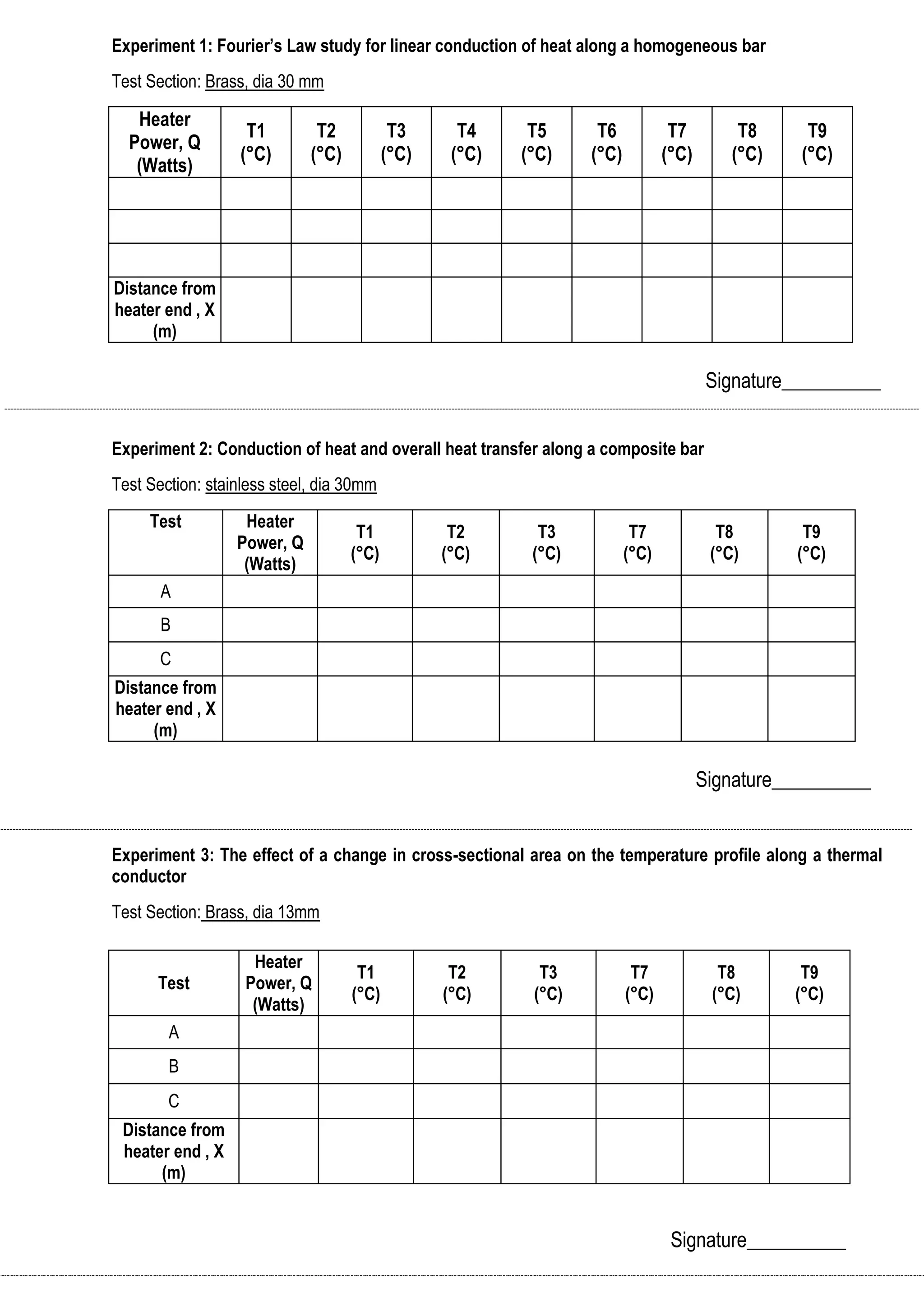
Experiment 1: Fourier’s Law study for linear conduction of heat along a homogeneous bar 
Test Section: Brass, dia 30 mm 
Signature__________ 
Experiment 2: Conduction of heat and overall heat transfer along a composite bar 
Test Section: stainless steel, dia 30mm 
Signature__________ 
Experiment 3: The effect of a change in cross-sectional area on the temperature profile along a thermal 
conductor 
Test Section: Brass, dia 13mm 
Signature__________ 
Heater 
Power, Q 
(Watts) 
T1 
(°C) 
T2 
(°C) 
T3 
(°C) 
T4 
(°C) 
T5 
(°C) 
T6 
(°C) 
T7 
(°C) 
T8 
(°C) 
T9 
(°C) 
Distance from 
heater end , X 
(m) 
Test Heater 
Power, Q 
(Watts) 
T1 
(°C) 
T2 
(°C) 
T3 
(°C) 
T7 
(°C) 
T8 
(°C) 
T9 
(°C) 
A 
B 
C 
Distance from 
heater end , X 
(m) 
Test 
Heater 
Power, Q 
(Watts) 
T1 
(°C) 
T2 
(°C) 
T3 
(°C) 
T7 
(°C) 
T8 
(°C) 
T9 
(°C) 
A 
B 
C 
Distance from 
heater end , X 
(m)
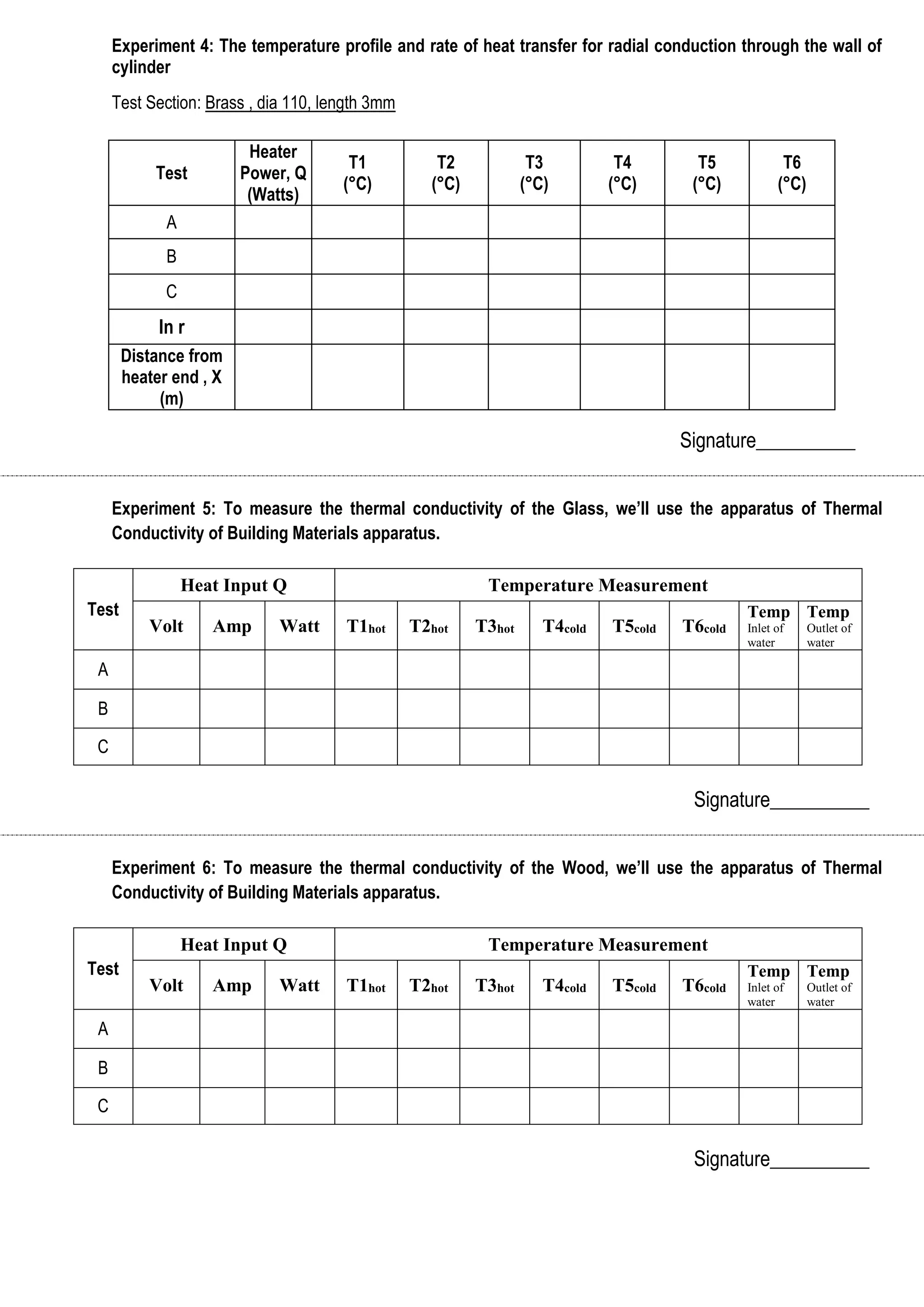
Experiment 4: The temperature profile and rate of heat transfer for radial conduction through the wall of 
cylinder 
Test Section: Brass , dia 110, length 3mm 
Signature__________ 
Experiment 5: To measure the thermal conductivity of the Glass, we’ll use the apparatus of Thermal 
Conductivity of Building Materials apparatus. 
Test 
Heat Input Q Temperature Measurement 
Volt Amp Watt T1hot T2hot T3hot T4cold T5cold T6cold 
Temp 
Inlet of 
water 
Temp 
Outlet of 
water 
A 
B 
C 
Signature__________ 
Experiment 6: To measure the thermal conductivity of the Wood, we’ll use the apparatus of Thermal 
Conductivity of Building Materials apparatus. 
Test 
Heat Input Q Temperature Measurement 
Volt Amp Watt T1hot T2hot T3hot T4cold T5cold T6cold 
Temp 
Inlet of 
water 
Temp 
Outlet of 
water 
A 
B 
C 
Signature__________ 
Test 
Heater 
Power, Q 
(Watts) 
T1 
(°C) 
T2 
(°C) 
T3 
(°C) 
T4 
(°C) 
T5 
(°C) 
T6 
(°C) 
A 
B 
C 
In r 
Distance from 
heater end , X 
(m)
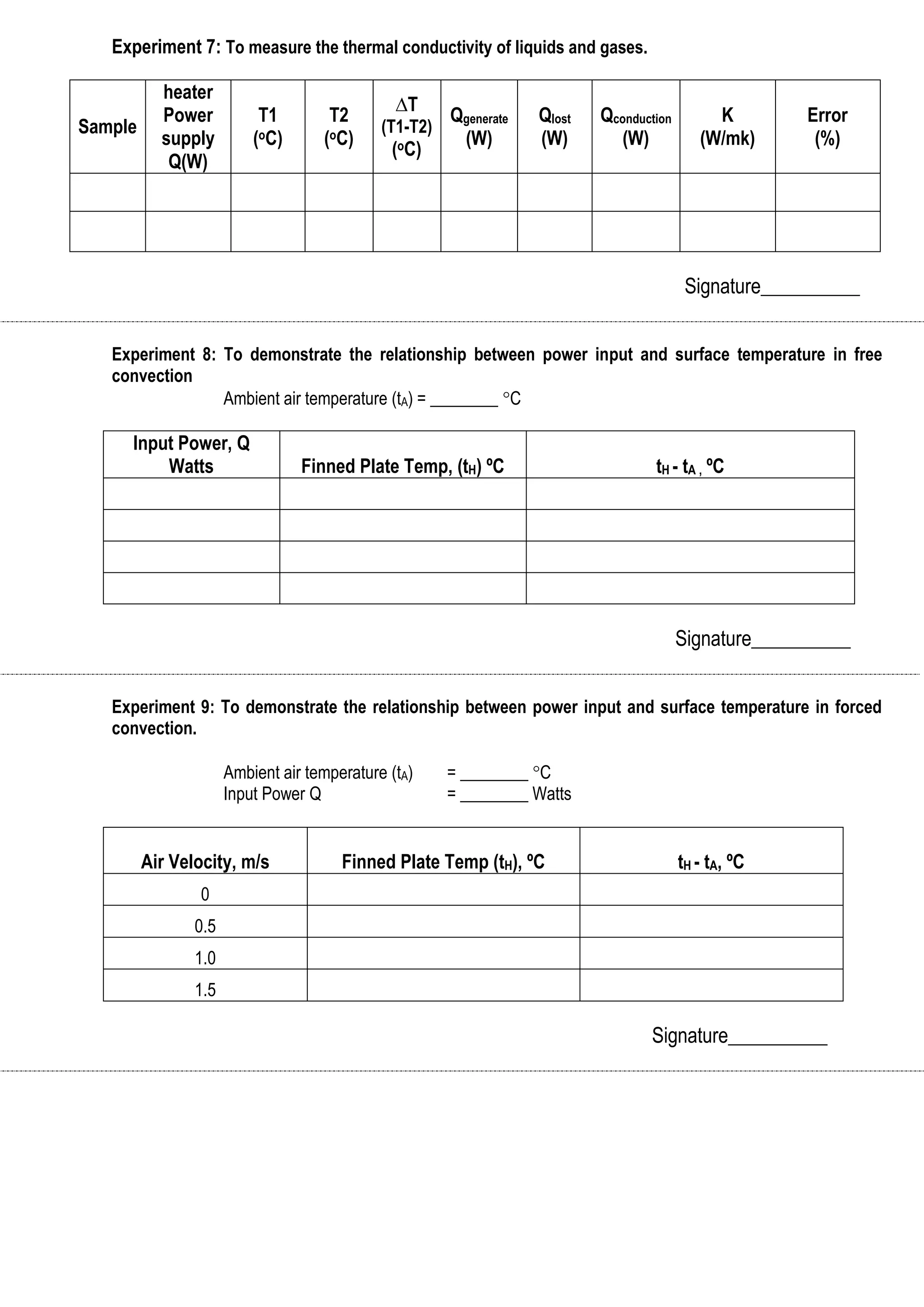
Experiment 7: To measure the thermal conductivity of liquids and gases. 
Sample 
heater 
Power 
supply 
Q(W) 
T1 
(oC) 
T2 
(oC) 
ΔT 
(T1-T2) 
(oC) 
Qgenerate 
(W) 
Qlost 
(W) 
Qconduction 
(W) 
K 
(W/mk) 
Error 
(%) 
Signature__________ 
Experiment 8: To demonstrate the relationship between power input and surface temperature in free 
convection 
Ambient air temperature (tA) = ________ C 
Input Power, Q 
Watts Finned Plate Temp, (tH) ºC tH - tA , ºC 
Signature__________ 
Experiment 9: To demonstrate the relationship between power input and surface temperature in forced 
convection. 
Ambient air temperature (tA) = ________ C 
Input Power Q = ________ Watts 
Air Velocity, m/s Finned Plate Temp (tH), ºC tH - tA, ºC 
Signature__________ 
0 
0.5 
1.0 
1.5
Experiment 10: To demonstrate the use of extended surface to improve heat transfer from the surface. 
Ambient air temperature (tA) = ________ C 
Input Power Q = ________ Watts 
Air Velocity, m/s Plate Temp (tH), ºC tH-tA, ºC 
Pinned Finned Flat Pinned Finned Flat 
0 
1.0 
2.0 
2.5 
Signature__________ 
Experiment 11: INVERSE SQUARE LAW FOR HEAT 
Observations: 
Signature__________ 
Experiment 12: STEFAN-BOLTZMANN LAW 
Observations: 
Heater 
Temperature 
(°C) 
Distance, 
x(mm) 
R(W/m2) 
Tb (BLACK) 
(°K) 
Ts(Source) 
(°K) 
 
 
X 
qb = σ [(Ts)4 – (Tb)4] C=qr / R 
(Constant) 
Rc = R x c 
F =qb / Rc 
150 300 
125 300 
100 300 
75 300 
Signature__________ 
Distance, 
x(mm) 
R 
(W/m2) 
Tb (BLACK) 
(°K) 
Ts(Source) 
(°K) 
qb = σ [(Ts)4 – (Tb)4] θ = tan-1  
 
 
 
50 
sin2 θ 
qr = qb x 
Sin2 θ 
C=qr / R 
(constant) 
Rc = Rxc 
800 
700 
600 
500 
400 
300
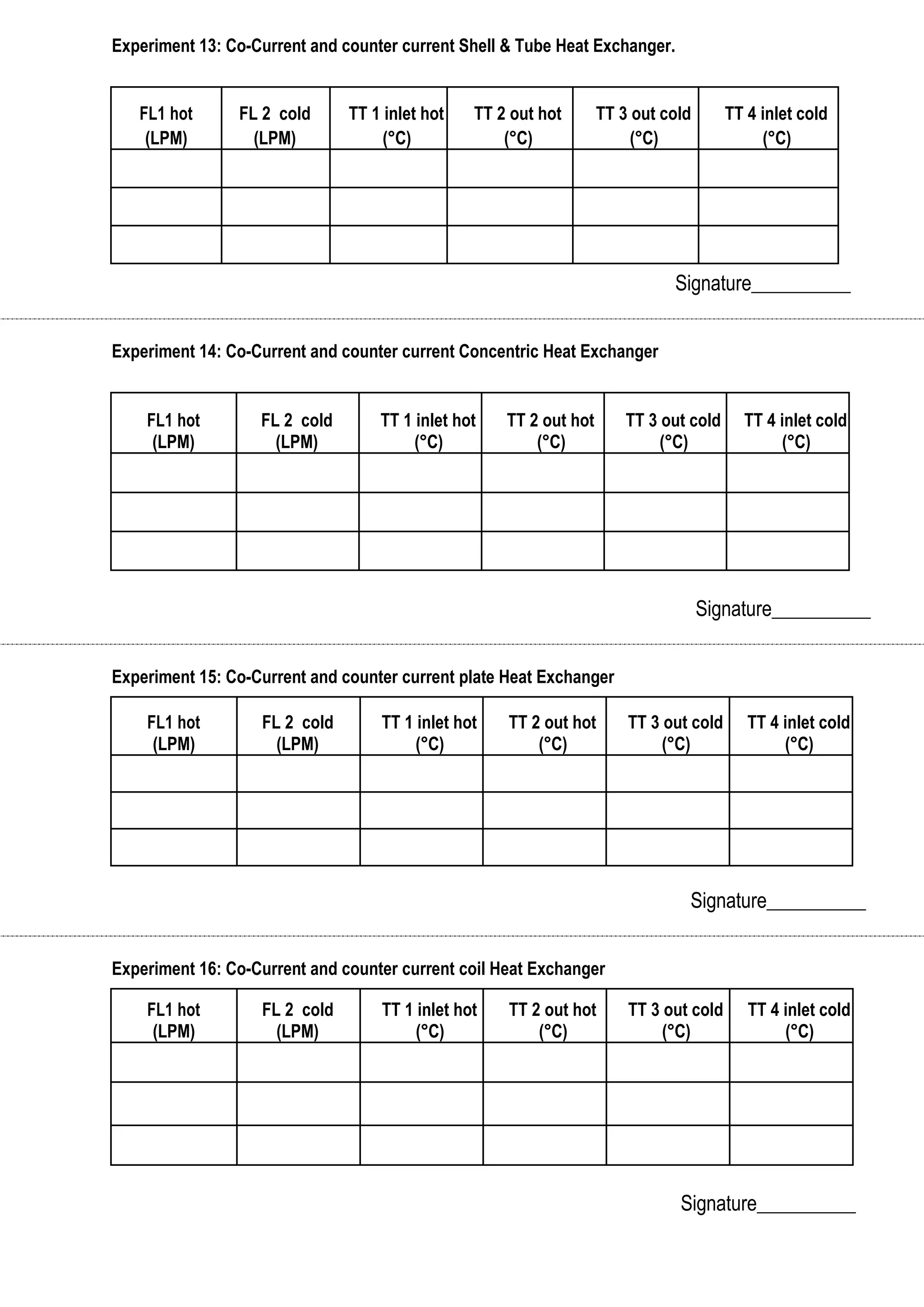
Experiment 13: Co-Current and counter current Shell & Tube Heat Exchanger. 
FL1 hot FL 2 cold TT 1 inlet hot TT 2 out hot TT 3 out cold TT 4 inlet cold 
(LPM) (LPM) (°C) (°C) (°C) (°C) 
Signature__________ 
Experiment 14: Co-Current and counter current Concentric Heat Exchanger 
FL1 hot FL 2 cold TT 1 inlet hot TT 2 out hot TT 3 out cold TT 4 inlet cold 
(LPM) (LPM) (°C) (°C) (°C) (°C) 
Signature__________ 
Experiment 15: Co-Current and counter current plate Heat Exchanger 
FL1 hot FL 2 cold TT 1 inlet hot TT 2 out hot TT 3 out cold TT 4 inlet cold 
(LPM) (LPM) (°C) (°C) (°C) (°C) 
Signature__________ 
Experiment 16: Co-Current and counter current coil Heat Exchanger 
FL1 hot FL 2 cold TT 1 inlet hot TT 2 out hot TT 3 out cold TT 4 inlet cold 
(LPM) (LPM) (°C) (°C) (°C) (°C) 
Signature__________

Manual tables all new

  • 1.
    Experiment 1: Fourier’sLaw study for linear conduction of heat along a homogeneous bar Test Section: Brass, dia 30 mm Signature__________ Experiment 2: Conduction of heat and overall heat transfer along a composite bar Test Section: stainless steel, dia 30mm Signature__________ Experiment 3: The effect of a change in cross-sectional area on the temperature profile along a thermal conductor Test Section: Brass, dia 13mm Signature__________ Heater Power, Q (Watts) T1 (°C) T2 (°C) T3 (°C) T4 (°C) T5 (°C) T6 (°C) T7 (°C) T8 (°C) T9 (°C) Distance from heater end , X (m) Test Heater Power, Q (Watts) T1 (°C) T2 (°C) T3 (°C) T7 (°C) T8 (°C) T9 (°C) A B C Distance from heater end , X (m) Test Heater Power, Q (Watts) T1 (°C) T2 (°C) T3 (°C) T7 (°C) T8 (°C) T9 (°C) A B C Distance from heater end , X (m)
  • 2.
    Experiment 4: Thetemperature profile and rate of heat transfer for radial conduction through the wall of cylinder Test Section: Brass , dia 110, length 3mm Signature__________ Experiment 5: To measure the thermal conductivity of the Glass, we’ll use the apparatus of Thermal Conductivity of Building Materials apparatus. Test Heat Input Q Temperature Measurement Volt Amp Watt T1hot T2hot T3hot T4cold T5cold T6cold Temp Inlet of water Temp Outlet of water A B C Signature__________ Experiment 6: To measure the thermal conductivity of the Wood, we’ll use the apparatus of Thermal Conductivity of Building Materials apparatus. Test Heat Input Q Temperature Measurement Volt Amp Watt T1hot T2hot T3hot T4cold T5cold T6cold Temp Inlet of water Temp Outlet of water A B C Signature__________ Test Heater Power, Q (Watts) T1 (°C) T2 (°C) T3 (°C) T4 (°C) T5 (°C) T6 (°C) A B C In r Distance from heater end , X (m)
  • 3.
    Experiment 7: Tomeasure the thermal conductivity of liquids and gases. Sample heater Power supply Q(W) T1 (oC) T2 (oC) ΔT (T1-T2) (oC) Qgenerate (W) Qlost (W) Qconduction (W) K (W/mk) Error (%) Signature__________ Experiment 8: To demonstrate the relationship between power input and surface temperature in free convection Ambient air temperature (tA) = ________ C Input Power, Q Watts Finned Plate Temp, (tH) ºC tH - tA , ºC Signature__________ Experiment 9: To demonstrate the relationship between power input and surface temperature in forced convection. Ambient air temperature (tA) = ________ C Input Power Q = ________ Watts Air Velocity, m/s Finned Plate Temp (tH), ºC tH - tA, ºC Signature__________ 0 0.5 1.0 1.5
  • 4.
    Experiment 10: Todemonstrate the use of extended surface to improve heat transfer from the surface. Ambient air temperature (tA) = ________ C Input Power Q = ________ Watts Air Velocity, m/s Plate Temp (tH), ºC tH-tA, ºC Pinned Finned Flat Pinned Finned Flat 0 1.0 2.0 2.5 Signature__________ Experiment 11: INVERSE SQUARE LAW FOR HEAT Observations: Signature__________ Experiment 12: STEFAN-BOLTZMANN LAW Observations: Heater Temperature (°C) Distance, x(mm) R(W/m2) Tb (BLACK) (°K) Ts(Source) (°K)   X qb = σ [(Ts)4 – (Tb)4] C=qr / R (Constant) Rc = R x c F =qb / Rc 150 300 125 300 100 300 75 300 Signature__________ Distance, x(mm) R (W/m2) Tb (BLACK) (°K) Ts(Source) (°K) qb = σ [(Ts)4 – (Tb)4] θ = tan-1     50 sin2 θ qr = qb x Sin2 θ C=qr / R (constant) Rc = Rxc 800 700 600 500 400 300
  • 5.
    Experiment 13: Co-Currentand counter current Shell & Tube Heat Exchanger. FL1 hot FL 2 cold TT 1 inlet hot TT 2 out hot TT 3 out cold TT 4 inlet cold (LPM) (LPM) (°C) (°C) (°C) (°C) Signature__________ Experiment 14: Co-Current and counter current Concentric Heat Exchanger FL1 hot FL 2 cold TT 1 inlet hot TT 2 out hot TT 3 out cold TT 4 inlet cold (LPM) (LPM) (°C) (°C) (°C) (°C) Signature__________ Experiment 15: Co-Current and counter current plate Heat Exchanger FL1 hot FL 2 cold TT 1 inlet hot TT 2 out hot TT 3 out cold TT 4 inlet cold (LPM) (LPM) (°C) (°C) (°C) (°C) Signature__________ Experiment 16: Co-Current and counter current coil Heat Exchanger FL1 hot FL 2 cold TT 1 inlet hot TT 2 out hot TT 3 out cold TT 4 inlet cold (LPM) (LPM) (°C) (°C) (°C) (°C) Signature__________