Html5 Media 1st Edition Kevin Martin Shelley Powers
Html5 Media 1st Edition Kevin Martin Shelley Powers
Html5 Media 1st Edition Kevin Martin Shelley Powers
Html5 Media 1st Edition Kevin Martin Shelley Powers
Html5 Media 1st Edition Kevin Martin Shelley Powers
1.
Html5 Media 1stEdition Kevin Martin Shelley
Powers download
https://ebookbell.com/product/html5-media-1st-edition-kevin-
martin-shelley-powers-2377198
Explore and download more ebooks at ebookbell.com
2.
Here are somerecommended products that we believe you will be
interested in. You can click the link to download.
Beginning Html5 Media Make The Most Of The New Video And Audio
Standards For The Web 2nd Edition Silvia Pfeiffer
https://ebookbell.com/product/beginning-html5-media-make-the-most-of-
the-new-video-and-audio-standards-for-the-web-2nd-edition-silvia-
pfeiffer-5131424
Html5 Rich Media Foundation David Matthew
https://ebookbell.com/product/html5-rich-media-foundation-david-
matthew-5743902
Responsive Media In Html5 Alex Libby
https://ebookbell.com/product/responsive-media-in-html5-alex-
libby-4984908
Html5 Canvas 1st Edition Steve Fulton Jeff Fulton
https://ebookbell.com/product/html5-canvas-1st-edition-steve-fulton-
jeff-fulton-2227062
3.
Html5 Geolocation AnthonyT Holdener Iii
https://ebookbell.com/product/html5-geolocation-anthony-t-holdener-
iii-2267278
Html5 For Publishers Sanders Kleinfeld
https://ebookbell.com/product/html5-for-publishers-sanders-
kleinfeld-2328684
Html5 Cookbook Oreilly Cookbooks Christopher Schmitt Kyle Simpson
https://ebookbell.com/product/html5-cookbook-oreilly-cookbooks-
christopher-schmitt-kyle-simpson-2437824
Html5 The Missing Manual Missing Manuals 1st Edition Matthew Macdonald
https://ebookbell.com/product/html5-the-missing-manual-missing-
manuals-1st-edition-matthew-macdonald-2439264
Html5 Architecture Early Release Wesley Hales
https://ebookbell.com/product/html5-architecture-early-release-wesley-
hales-2561354
Table of Contents
Preface. . . . . . . . . . . . . . . . . . . . . . . . . . . . . . . . . . . . . . . . . . . . . . . . . . . . . . . . . . . . . . . . . . . . . vii
1. HTML5 Audio and Video Elements: By-Default . . . . . . . . . . . . . . . . . . . . . . . . . . . . . . . 1
Adding a Media Element to a Web Page 2
Minimal Element Syntax 2
Disabled Scripting and the Magically Appearing Controls UI 3
Support for Multiple Media File Types 4
The Audio and Video File Babble and the Source Element in Detail 6
HTML5 Audio Codecs/Containers and Lossless versus Lossy
Compression 7
HTML5 Video Element Codecs/Containers 11
The Media Elements in More Detail 15
Media Elements and Global Attributes 16
Media-Specific Attributes 17
Video-Only Attributes and Video Resolutions 19
Audio and Video in Mobile Devices and Media Profiles 20
Challenges of a Mobile Environment 21
Media Profiles and Codec Parameters 22
Converting Audio and Video Content 24
The Free Mp3/Wma/Ogg Converter 24
Video Conversion with Miro Video Converter and Handbrake 26
Using a Frame Grabber 28
2. Customizing Media Elements . . . . . . . . . . . . . . . . . . . . . . . . . . . . . . . . . . . . . . . . . . . . 31
CSS Styling 32
Adding a Fancy Border 32
Using the CSS Pseudo Classes 34
Applying a CSS3 Transform to a Video Element 36
Animating the Transforms with CSS3 Transitions 40
Adding an Overlay 42
Custom Controls with JavaScript and CSS 44
v
12.
Creating a BasicControl 44
Adding CSS and Tracking Playback 53
Creating a Custom Progress Bar 58
The Custom Control and Seekability 65
Debugging and Discovering Browser Support 69
3. Media Elements, Multiple Tracks, and Accessibility . . . . . . . . . . . . . . . . . . . . . . . . . . 73
Media Controllers and the MediaController Interface 74
Multiple Tracks and the Track List Interfaces 76
Audio and Video Track Collections 77
Multiple Text Tracks 79
The Track Element 81
Track File Formats 82
JavaScript Support for Subtitles and Captions 88
Captionator 89
Playr 91
The Leanback Player 92
4. Advanced Media Element Scripting . . . . . . . . . . . . . . . . . . . . . . . . . . . . . . . . . . . . . . . 95
Media Elements and Canvas 95
Playing a Video in an Canvas Element 96
Creating a Video Visual Filter using the Canvas Element 100
Media Elements and SVG 106
Adding an HTML5 Video to an SVG Document 107
Applying SVG Filters to Video Files within HTML 110
The Audio Data APIs 113
Appendix: HTML Media Frameworks and Tools . . . . . . . . . . . . . . . . . . . . . . . . . . . . . . . . . . . 117
vi | Table of Contents
13.
Preface
Flash is dead.
Atleast, that’s what we’re told: thanks to the introduction of the HTML5 video and
audio elements, Flash is now dead.
Of course, we know this statement isn’t true: Flash will have its place in web pages for
many years to come. However, thanks to the new HTML5 media elements, we’re no
longer totally dependent on Flash in order to embed a playable audio or video file in
our web pages.
In years past, to play audio or video resources in a web page we had to use Flash (or
some other plug-in) that may, or may not, work correctly with all browsers. Many times
we’d have to use a combination of object elements, embeds, and links, just to ensure
that a video could be played. It wasn’t unusual to find the following in web pages:
<object width="425" height="350">
<param name="movie" value="http://www.youtube.com/v/7_6B6vwE83U">
</param>
<embed src="http://www.youtube.com/v/7_6B6vwE83U"
type="application/x-shockwave-flash" width="425" height="350">
</embed>
</object>
Though we could get a video or audio resource to play, we couldn’t really do anything
with it. We certainly couldn’t provide custom controls, ensure subtitle support, or use
something like SVG or the canvas element with it.
Beginning with HTML5, though, we now have two elements—audio and video—that
provide the long overdue functionality we’ve needed to really take advantage of audio
and video in web pages. Best of all, solid support for the media element’s basic func-
tionality is already available in all modern browsers and in most mobile environments.
So while Flash isn’t dead, it also isn’t the only option we have, and having more options
is a very good thing.
vii
14.
As I notein Chapter 1, Flash is still essential if you want your video or
audio file to play in older browsers.
About this Book
This book is tightly focused on two new HTML5 elements: the audio and video
elements.
In Chapter 1, I introduce both and discuss issues of embedding the elements in web
pages, how to mark up the elements based on quality and type of audio and video file,
as well as exploring all the options available by default with both elements.
In Chapter 2, I describe how to customize the appearance of the media elements using
CSS, as well as how to create your own applications that control and work with the
elements. I also provide an introduction into debugging your HTML5 media applica-
tions, as well as how to check out current browser support.
In Chapter 3, I discuss some of the upcoming media functionality, including support
for multiple audio and video tracks, and the new media controller that synchronizes
several different media elements. We’ll also explore the track element, the caption and
subtitle formats SRT and WebVTT, and how to enable support for both now using
JavaScript libraries.
In Chapter 4, I explore some of the more advanced and esoteric uses of the media
elements. This includes integrating the media elements with both SVG (Scalable Vector
Graphics) and the canvas element to create the rather amazing effects you may have
seen online. I’ll also introduce you to upcoming and potential API support for both
media elements, including generating audio as well as playing it.
Book Audience
You’ll get the most out of this book if you are a web developer, author, or designer who
wants to get up to speed on the HTML5audio and video elements. No actual experience
is necessary with either audio or video files, as there are numerous examples freely
available on the web you can use for the examples, and I provide enough information
to ensure you can work with those examples. However, you’ll get the most out of the
book if you have worked with CSS and JavaScript before.
Though Chapter 4 does get into the canvas element and SVG, you don’t need prior
experience with either of these technologies in order to work with the examples.
viii | Preface
15.
Examples
O’Reilly provides adownloadable file with examples from this book. To be able to use
the examples with a minimum of editing, most examples use generic names for audio
and video files. Thus, audio files are called audiofile, with whatever extension is ap-
propriate, and video files are called videofile with the appropriate extension. You can
just use whatever video and audio files you have, renamed to match the examples, or
change the examples to match your files.
I don’t include actual video and audio files in the example because doing so would
increase the size of the download file enormously. If you need example audio and video
files, you can find freely available versions of each on the Internet. One video file I used
with many of the examples is the short animated film Big Buck Bunny. This animated
movie is fast becoming the de facto HTML5 video primarily because the video is pro-
vided in different formats, and is freely usable via its generous Creative Commons
license.
You can read more about, and access Big Buck Bunny and other Blender Foundation
videos at http://www.blender.org/features-gallery/blender-open-projects/. Blender is an
open source and freely available tool for 3D content generation.
In fact, you can easily find many different tools and utilities for working
with audio and video files that are either freely available, shareware, or
available for a 30 day trial. I cover some of these in the Appendix.
Another source for media files is the Internet Archive. This site has sections for both
audio and video files that are either Creative Commons licensed for broad usage, or are
in the Public Domain and freely available. The Library of Congress is also another great
source for both video and audio files.
The Internet Archive Moving Picture archive can be found at http://www
.archive.org/details/movies, and the Audio archive is at http://www.ar
chive.org/details/audio. Audio and video files can be found at the Library
of Congress in the Digital Collections site at http://www.loc.gov/library/
libarch-digital.html.
Target Browsers
Throughout the book, you’ll find me referring to target browsers. Since the video and
audio elements are very new, the target browsers for this book are those that support
both elements. At a minimum, this means Internet Explorer 9+, Firefox 3.5+, Opera
10.5+, Chrome 6+, and Safari 3.1+. At the time this book was written, the latest full
release of each browser could work with the majority of examples in the book.
Preface | ix
16.
Some of theexamples use more cutting edge CSS and JavaScript, such as the CSS3
transitions and transforms, These examples required beta, and in some cases, alpha
software, to test. The alpha/beta software I used for these examples are IE 10, Firefox
6 (and 7), Opera Next, the Webkit Nightly build, and the Chrome Canary build. All
but IE 10 are available in multiple operating system versions.
I’ll make a point to note when alpha and beta software was required to ensure an
example worked, or if an example only works in some browsers.
The Polyglot Question: HTML or XHTML?
HTML5 supports two different serializations: HTML and XHTML. HTML5 docu-
ments are served with a text/html MIME type, while XHTML5 documents are served
with an application/xml or application/xhtml+xml MIME type. The majority of web
pages are served as HTML.
There are differences in syntax between the two. HTML allows uppercase element and
attribute names, unquoted attribute values, and you don’t have to use closing tags, or
the empty-tag syntax with void elements such as the img element:
<img src="somesource.jpg" alt="some desc" />
In addition, HTML allows you to use boolean attributes without values, while XHTML
requires an assignment:
<video src="somemovie.mp4" controls="controls"></video>
There are other differences, but these are the ones I wanted to highlight.
The example pages in this book work only with the HTML serialization, primarily
because I do make use of boolean attributes without assignment. I really dislike having
to assign a kludge value to a boolean attribute. However, I also use quotes with attrib-
utes, close tags, and never use uppercase letters for elements and attributes. If you want
to serve the example pages I provide as XHTML, you’ll need to modify the examples
accordingly.
The WHATWG organization provides a Wiki page on polyglot differ-
ences between HTML and XHTML serializations at http://wiki.whatwg
.org/wiki/HTML_vs._XHTML. There’s also a formal document on the
same at the W3C at http://dev.w3.org/html5/html-xhtml-author-guide/
html-xhtml-authoring-guide.html.
x | Preface
17.
Conventions Used inThis Book
The following typographical conventions are used in this book:
Italic
Indicates new terms, URLs, email addresses, filenames, and file extensions.
Constant width
Used for program listings, as well as within paragraphs to refer to program elements
such as variable or function names, databases, data types, environment variables,
statements, and keywords.
Constant width bold
Shows commands or other text that should be typed literally by the user.
Constant width italic
Shows text that should be replaced with user-supplied values or by values deter-
mined by context.
This icon signifies a tip, suggestion, or general note.
This icon indicates a warning or caution.
Using Code Examples
This book is here to help you get your job done. In general, you may use the code in
this book in your programs and documentation. You do not need to contact us for
permission unless you’re reproducing a significant portion of the code. For example,
writing a program that uses several chunks of code from this book does not require
permission. Selling or distributing a CD-ROM of examples from O’Reilly books does
require permission. Answering a question by citing this book and quoting example
code does not require permission. Incorporating a significant amount of example code
from this book into your product’s documentation does require permission.
We appreciate, but do not require, attribution. An attribution usually includes the title,
author, publisher, and ISBN. For example: “HTML5 Media by Shelley Powers (O’Re-
illy). Copyright 2011 Shelley Powers, 978-1-449-30445-4.”
If you feel your use of code examples falls outside fair use or the permission given above,
feel free to contact us at permissions@oreilly.com.
Preface | xi
18.
Safari® Books Online
SafariBooks Online is an on-demand digital library that lets you easily
search over 7,500 technology and creative reference books and videos to
find the answers you need quickly.
Withasubscription,youcanreadanypageandwatchanyvideofromourlibraryonline.
Read books on your cell phone and mobile devices. Access new titles before they are
available for print, and get exclusive access to manuscripts in development and post
feedback for the authors. Copy and paste code samples, organize your favorites, down-
load chapters, bookmark key sections, create notes, print out pages, and benefit from
tons of other time-saving features.
O’Reilly Media has uploaded this book to the Safari Books Online service. To have full
digital access to this book and others on similar topics from O’Reilly and other pub-
lishers, sign up for free at http://my.safaribooksonline.com.
How to Contact Us
Please address comments and questions concerning this book to the publisher:
O’Reilly Media, Inc.
1005 Gravenstein Highway North
Sebastopol, CA 95472
800-998-9938 (in the United States or Canada)
707-829-0515 (international or local)
707-829-0104 (fax)
We have a web page for this book, where we list errata, examples, and any additional
information. You can access this page at:
http://www.oreilly.com/catalog/9781449304454
To comment or ask technical questions about this book, send email to:
bookquestions@oreilly.com
For more information about our books, courses, conferences, and news, see our website
at http://www.oreilly.com.
Find us on Facebook: http://facebook.com/oreilly
Follow us on Twitter: http://twitter.com/oreillymedia
Watch us on YouTube: http://www.youtube.com/oreillymedia
xii | Preface
in the greatmajority of instances, be traced to contagion. It is
evident, however, that it must at one time have had an origin, and it
is reasonable to infer that what happened once may happen again.
Small-pox is known to attack many of the lower animals as well as
man, and there are grounds for believing that it originated among
the former, and by them was communicated to the human species. A
careful study of epizootics—our ignorance of which has been
disclosed by the present cattle plague —may ultimately reveal the
mode of origin of the poison of small-pox. The disease varies greatly
in its prevalence at different times. In other words, it is sometimes
epidemic, at others not. Some of these epidemics are local; others
are widely extended. All exhibit a gradual rise, culmination, and
decline, the decline being always less rapid than the advance. It is
difficult to account for the occurrence of these epidemics. They are
independent of hygienic defects, season, temperature, or any
meteorological conditions of which we are cognizant. They are
probably due to causes tending to depress the general health of the
population, and so to predispose it to the action of the poison. For
nearly two centuries it has been a common observation that
epidemics of small-pox have co-existed with epidemics of other
contagious diseases. The gradual accumulation also in a district of
unprotected persons, owing to the neglect of vaccination, will also
predispose to the occurrence of an epidemic, after the introduction
of the poison. In fact, to the neglect, or careless performance, of
vaccination, is entirely due the occurrence of epidemics of small-pox
at the present day.
2. Scarlet Fever. —The early history of scarlet fever is obscure, for
the disease was long confounded with measles and small-pox, but it
is generally supposed that, like small-pox, it came originally from
Africa, and was imported into Europe by the Saracens. It has been
known to prevail in Britain for the last two centuries; but although it
is only of late years, from the reports of the Registrar-General, that
we have been able to form an accurate idea of the extent of its
prevalence, there can be no doubt that it has increased greatly
during the present century, and that it now occupies that pre-
21.
eminence among thecauses of mortality in childhood which was
formerly held by small-pox. During twenty-four years (1838 to 1861
inclusive) 375,009 of the population of England and Wales, and
58,663 of the inhabitants of London, died of scarlet fever, or about
one in every twenty-four deaths that occurred in England during the
period in question {423} was due to this disease. The mortality from
scarlet fever, in fact, exceeds the mortality from small-pox and
measles taken together. Scarlet fever is known to prevail over the
whole of the continents of Europe and America, but it is nowhere so
common as in Britain. In France it is a rarer disease than either
measles or small-pox. In India it is said never to occur. In most
instances it is not difficult to trace the occurrence of scarlet fever to
contagion; and from the remarkable indestructibility of the poison
and its tendency to adhere to clothes, furniture, and even to the
walls of houses, there can be little doubt that the disease has a
similar origin in many instances, where the mode of transmission of
the poison cannot be traced. How the poison first originated is yet a
mystery; but there is some probability in the view, which has many
able advocates, that it originated in horses or cattle, and by them
was communicated to man. If this be so, it is reasonable to hope
that investigations as to the occurrence of the disease in the lower
animals may lead to a discovery productive of as great benefits to
the human race as vaccination. At intervals of a few years scarlet
fever spreads as an epidemic: but its ordinary prevalence, in this
country is greater than is generally imagined. The causes of these
epidemic outbursts are unknown. Many circumscribed outbreaks can
no doubt be traced to the importation of the poison into a population
of persons unprotected by a previous attack; but why the poison
should be introduced into numerous localities at one time, and not at
others, is difficult to determine. It is tolerably certain, however, that
at all times the prevalence of the disease is independent of
overcrowding, bad drainage, or of any appreciable hygienic or
meteorological conditions.
3. Measles was long confounded with scarlet fever, and, like it, is
supposed to have been originally imported from the East. During
22.
twenty-four years (1838-1861)this disease destroyed 31,595 of the
population of London, and 181,868 persons in England and Wales. It
is known to occur in all parts of the world, and is highly contagious.
There is no evidence that any hygienic defects or meteorological
conditions can generate the poison of measles. Hildenbrand, a great
authority, thought it might arise where numbers of men and cattle
were confined together in close, unventilated buildings; and in later
times American and Irish physicians have described a disease
corresponding in every respect with the measles, which appeared to
arise from sleeping on old musty straw, or from the inoculation of
the fungi of wheat straw. Measles in England is much less of an
epidemic disease than either small-pox or scarlet fever. The number
of deaths which it causes in years when it is most prevalent, is rarely
much more than double what it causes in years when it is at least
prevalent. Although often most fatal in winter, there is no proof that
its prevalence is influenced by season.
4. Typhus Fever has been well known for upward of three
centuries, and there are grounds for believing that from remote ages
it has prevailed in most parts of the world under favorable
conditions. It is impossible to estimate the precise extent of its
prevalence, inasmuch as many other diseases are included under the
designation "typhus," in the reports of the Registrar-General; but it is
the acknowledged scourge of the poor inhabitants of our large
towns. There is no evidence that typhus, such as we see it in this
country, has as yet been observed in Australia, New Zealand, Asia,
Africa, or the tropical parts of America. Even in Britain it is confined,
for the most part, to the large towns, and to the poorest and most
densely crowded parts of them. It is a disease almost unknown
among the better classes, except in the case of clergymen and
doctors who visit the infected poor. {424} It is undoubtedly
contagious; but in a spacious dwelling with a free ventilation, it
almost ceases to be so. There is also ample evidence that the poison
may be generated de novo; and the circumstances under which this
occurs are overcrowding, with defective ventilation and destitution.
Hence it is that the disease was formerly so apt to show itself in
23.
prisons and ships,and that, even at the present day, it is so common
an attendant on warfare and so prevalent in the wretched hovels of
the poor. This was the disease that before the days of Howard was
never absent from our prisons and hospitals, and that decimated the
armies of the first Napoleon and of the allies in the Crimea. "If," says
an able writer on fever in the last century, "any person will take the
trouble to stand in the sun, and look at his own shadow on a white
plastered wall, he will easily perceive that his whole body is a
smoking dunghill, with a vapor exhaling from every part of it. This
vapor is subtle, acrid, and offensive to the smell; if retained in the
body, it becomes morbid; but if re-absorbed, highly deleterious. If a
number of persons, therefore, are long confined in any close place
not properly ventilated, so as to inspire and swallow with their spittle
the vapors of each other, they must soon feel its bad effects. Bad
provisions and gloomy thoughts will add to their misery, and soon
breed the seminium of a pestilential fever, dangerous not only to
themselves, but also to every person who visits them or even
communicates with them at second-hand. Hence it is so frequently
bred in gaols, hospitals, ships, camps, and besieged towns. A
seminium once produced is easily spread by contagion." But if
overcrowding produces typhus, why is it that the disease prevails in
the epidemic form, and then in a great measure disappears? The
explanation is in this way. All the great epidemics of typhus have
occurred during seasons of famine or of unusual destitution. One of
the most common consequences of general destitution is the
congregation of several families in one house, in consequence of
their inability to pay their rents, and of the concentration in the large
towns of many of the inhabitants of country districts. Famine pre-
disposes to typhus by weakening the constitution; and it also tends
to produce it, in so far as it causes an unusual degree of
overcrowding. It has been the custom with many writers to refer
epidemics of typhus to some subtle "epidemic influence;" and thus,
where a failure of the crops has been followed by typhus, both of
these disasters have been ascribed to a common atmospheric cause.
But of such atmospheric influences, capable of producing typhus, we
know nothing; their very existence is doubtful, and the employment
24.
of the termhas too often had the effect of cloaking human
ignorance, or of stifling the search after truth. If typhus be due to
any "epidemic influence," why does this influence select large towns
and spare the country districts? why does it fall upon large towns in
exact proportion to the degree of privation and overcrowding among
the poor? in large towns, why does it indict the crowded dwellings of
the poor and spare the habitations of the rich? and why did the
varying prevalence of typhus among the French and English troops
in the Crimea correspond, exactly to the varying degree of
overcrowding in either army? Moreover, famine artificially induced
by warfare, by commercial failures, by strikes, or by any cause that
throws large bodies of men out of employment, is equally efficacious
in originating epidemics of typhus, as famine from failure of the
crops.
5. Relapsing Fever is so called from the fact that after a week's
illness there is an interval of good health for a week, followed by a
second attack. It is contagious, and is epidemic in a stricter sense
than even typhus. Although sometimes more prevalent in this
country than any other fever, it may disappear for so many years
that {425} on its return it has more than once been thought to be a
new malady. For upwards of ten years not a case of it has been
observed in Britain, but it has constitute the chief component of
many of the greatest epidemics of fever which has devastated this
country and Ireland, and it was one of the diseases composing the
"Russian Plague," which in the spring of the present year caused
such unnecessary alarm in this country. It usually prevails in the
epidemic form in conjunction with typhus, and it is connected in its
origin more directly with protracted starvation and the use of
unwholesome food than even the latter disease. Hence, in this
country, it is familiarly known as "Famine Fever," and in Germany as
"Hungerpest. "
6. Oriental Plague is still met with in Egypt and in other eastern
countries; but in the middle ages it frequently overran the whole of
Europe and invaded England, and, from the extent of its ravages, it
25.
was known asthe "Black Death," and the "Great Mortality. " The
Great Plague of London, of 1665, is a familiar fact in history. Since
then the disease has not been met with in this country. But British
typhus is merely a modified form of Oriental plague, or, in other
words, plague is merely typhus complicated with numerous
abscesses beneath the skin. Cases of typhus are occasionally met
with in this country, corresponding in every respect with true plague.
Both diseases appear under similar circumstances, but those which
generate plague are of a more aggravated character than those
which suffice to produce typhus. The disappearance of plague from
London, notwithstanding our vastly increased communications with
Egypt, has been chiefly due to the better construction of our
dwellings since the "Great Fire" of 1666. "It is probable," says an
able writer on the plague, "that if this country has been so long
forsaken by the plague as almost to have forgotten, or at least to be
unwilling to own, its natural offspring, it has been because the
parent has been disgusted with the circumstances under which that
hateful birth was brought to light, has removed the filth from her
doors in which it was matured, and has adopted a system of
cleanliness fatal to its nourishment at home. But if ever this favored
country, now grown wise by experience, should relapse into former
errors, and recur to her odious habits, as in past ages, it is not to be
doubted that a mutual recognition will take place, and she will again
be visited by her abandoned child, who has been wandering a
fugitive among kindred associates, sometimes in the mud cots of
Egypt, sometimes in the crowded tents of Barbary, and sometimes in
the filthy kaisarias of Aleppo."
7. Yellow Fever is a contagious fever with a limited geographical
range. Its geographical limits, as regards the new world, are from
about 43° N. lat. to 35° S. lat; and in the old world from 44° N. to
8° or 9° S. lat. It is a common disease on board our ships stationed
in the West Indies and off the west coast of Africa. As in the case of
typhus, overcrowded and defective ventilation are the main causes
which favor its origin and propagation, and, indeed, it is still a
subject for investigation whether yellow fever may not be typhus
26.
modified by climateand other circumstances. One of the most
recent and best authorities [Footnote 64] on the disease thus writes:
"Overcrowding in the between-decks of steamships seems to be the
principal cause of the extreme fatality of the disease in the navy.
What in this respect is true of typhus may with equal force be said of
yellow fever. There is no such powerful adjuvant to the virulence of
the poison, and to its power of propagation, as an unrenewed
atmosphere, loaded with human exhalations."
[Footnote 64: Dr. Gavin Milroy, President of the
Epidemiological Society.]
8. Diarrhoea is always more or less prevalent in this country during
the summer and autumn. There is no {426} reason to believe that
epidemic diarrhoea is contagious, but there is a direct ratio between
its prevalence and the temperature of the atmosphere and the
absence of ozone. As the temperature rises the cases increase in
number, and as it falls they diminish, and the disease is always most
prevalent in very hot seasons. Diarrhoea may be due to many
different causes, but its epidemic prevalence in autumn is chiefly
accounted for by the absorption into the system of the products of
putrefaction of organic matter, either in the form of gaseous effluvia
or through the vehicle of drinking-water.
9. Typhoid or Enteric Fever is very commonly confounded with
typhus, with which, however, so far as its origin is concerned, it has
nothing in common. It is not, like typhus, confined to the poor, but it
prevails among rich and poor alike; and, indeed, there are some
reasons for believing that the rich and well-fed are more prone to be
attacked by it than the destitute. It is the fever by which Count
Cavonr, several members of the royal family of Portugal, and our
own Prince Consort, came to their untimely end. It differs also from
typhus in the circumstances that its origin and propagation are quite
independent of overcrowding with defective ventilation, and are so
intimately connected with bad drainage that by some physicians the
fever is now designated pythogenic, or fever born of putridity. It is
27.
asserted by somewriters that the poison of enteric fever is never
generated in obstructed drains, but that the drains are merely the
vehicle of transmission of the poison from an infected person. But if
this were so, enteric fever must needs be a most contagious disease,
whereas all experience goes to show that it rarely spreads, even
under the most favorable circumstances. The disease, in fact, is so
slightly contagious that many excellent observers have doubted if it
be so at all. It is probable that certain meteorological conditions,
such as a high temperature, a defective supply of ozone, or a
peculiar electrical state, may be necessary for the production of the
poison of enteric fever; and thus, nuisances which are offensive to
the senses may exist for a long time without producing the disease.
The necessity of a high temperature is undoubted, and is itself a
strong alignment against the view which makes drains merely the
vehicle of transmission of the poison. It is well known that enteric
fever, like ordinary diarrhoea, becomes epidemic in this country
every autumn, and almost disappears in spring, while the autumnal
epidemics are always greatest in seasons remarkable for their high
temperature. Enteric fever is much later in commencing and in
attaining the acme of its autumnal prevalence than diarrhoea,
showing that a longer duration of hot weather is necessary for its
production; but, when once produced, a more protracted duration of
cold weather seems necessary for its destruction.
10. Cholera. —Epidemic cholera is generally described as having
originated at Jessore, in the delta of the Ganges, in the year 1817,
and as having spread thence over Hindostan, and ultimately to
Europe. Since 1817 Europe has been visited by three great
epidemics of cholera, viz.: in 1832, in 1848-9, and in 1854; and at
the present moment it is threatened with a fourth. During the past
autumn the disease has appeared at Ancona and Marseilles, and at
many other places in the basin of the Mediterranean. In England and
Wales cholera destroyed 53,273 lives in 1849, and 20,097 in 1854.
Although the great epidemics of cholera have appeared to take their
origin in India, and gradually to have spread to Europe, following
often the lines of human intercourse, the evidence in favor of its
28.
being a verycontagious malady is small. The attendants on the sick
are rarely attacked; and, on the other hand, the disease has often
appeared in isolated localities, where it was impossible to believe
that it was imported. It is a remarkable {427} circumstance, also,
that some of the greatest epidemics which have occurred in India, as
that of 1861, have shown no tendency to travel to Europe,
notwithstanding the constant communication that exists. Even on
the supposition, then, that cholera is of necessity imported from
India, there must be something as yet unknown to us that favors its
transmission at one time and not at another. But it is very doubtful if
the disease is imported in the manner generally believed.
Unequivocal cases of "Asiatic cholera" have been met with almost
every year in the intervals of the great epidemics; and, as Dr. Farr
has observed, it is highly probable that true cholera has always
existed in England. The researches of the late Dr. Snow render it
highly probable that the disease often arises from drinking water
impregnated with the fermenting excreta of persons suffering from
the disease; and if this be so, from what we know of other diseases,
it is not unreasonable to infer that, in certain conditions of the
atmosphere, the poison of cholera may be generated during the
fermentation of the excreta of healthy persons. It can readily be
conceived how the necessary meteorological conditions might
originate in the East and gradually extend to this country, and thus
lead to the supposition that the disease has been propagated by a
specific poison.
11. Dysentery. —Epidemics of dysentery are confined to tropical
countries, and need not occupy much attention at present.
Atmospheric states which unduly or suddenly depress the
temperature of the surface of the body are the most common
exciting causes. They are most apt to take effect in the case of
persons whose constitutions have been weakened by long exposure
to extreme heat, to malaria, or to other debilitating causes. There is
no positive evidence that dysentery is contagious.
29.
12. Agues andRemittent Fevers are now but little known, and
scarcely ever fatal, in this country. Many years ago, however, they
were among the most common and the most fatal diseases of
Britain. James I. and Oliver Cromwell both died of ague in London.
The disappearance of ague has been in direct relation to the
drainage and cultivation of the soil, and this remark applies not only
to England, but to all parts of the globe. The fens of Lincolnshire and
Cambridge are almost the only parts of England where agues arc
now known; but in many countries, and particularly in the tropics,
where the vegetation is very rank, they are still the most common of
all diseases. Agues are not contagious, but result from the malaria
given off during the evaporation from marshy uncultivated land.
These malaria may be wafted to a considerable distance by the
wind. A high temperature and rank vegetation seem to favor their
production and to increase their virulence.
13. Influenza. —Severe and widespread epidemics of influenza
have been observed in various parts of the world, from time
immemorial. In the present century the disease has been epidemic
in this country in 1803, 1831, 1833, 1837, and 1847. On each
occasion it has been particularly fatal in aged and debilitated
persons, and it has often been followed by an increased prevalence
of other epidemic diseases. Influenza is not contagious, but depends
on some unknown condition of the atmosphere. Sudden alternations
of temperature have been thought to favor its origin.
14. The Sweating Sickness. —This remarkable and very fatal
disease is happily now unknown in this country; but in the middle
ages many great epidemics of it were observed, and nowhere were
they more common than in England. Many of the epidemics were in
fact confined to England. There are records of five distinct visitations
of the disease during the fifteenth and sixteenth centuries, viz., in
1485, 1506, 1517, 1529, and 1551. The disease attacked all classes
alike, and {428} was often fatal within a few hours. From the
accounts handed down to us it is impossible to form any accurate
idea as to the causes of its origin and extension; but the prevalent
30.
opinion at thetime seems to have been that it was due in the first
instance to atmospheric influences.
15. The Dancing Mania. —The present brief summary of the
principal epidemic diseases would not be complete without alluding
to the dancing mania of the fourteenth and fifteenth centuries. The
effects of the Black Death of the fourteenth century had not yet
subsided, and the graves of millions of its victims were scarcely
closed, when we are told by Hecker a strange delusion arose in
Germany, which took possession of the minds of men, and, in spite
of the divinity of our nature, hurried away body and soul into the
magic circle of the wildest superstition. It was a convulsion which in
the most extraordinary manner infuriated the human frame, and
excited the astonishment of contemporaries for more than two
centuries, since which time it has never reappeared. It was called
the dance of St. John or of St. Vitus, on account of the Bacchantic
leaps by which it was characterized, and which gave to those
affected, whist performing their wild dance, and screaming and
foaming with fury, all the appearance of persons possessed. It was
propagated by the sight of the sufferers, like a demoniacal epidemic,
over the whole of Germany and the neighboring countries. While
dancing, the infected persons were insensible to external
impressions, but were haunted by visions, their fancies conjuring up
spirits whose names they shrieked out. Some asserted that they felt
as if immersed in a stream of blood, which obliged them to leap so
high; while others saw the heavens open, and the Saviour enthroned
with the Virgin Mary. The accounts of the dancing mania collected by
Hecker at first sight seem almost fabulous, but cease to be so when
we recollect the practices of certain modern religious sects and the
accounts of the so-called "revivals" in the middle of the nineteenth
century.
From the preceding summary, it is obvious that epidemic diseases
vary greatly in their nature.
31.
1. First wehave diseases, such as small-pox, scarlet fever, and
measles, which at the present day can only be traced to contagion,
and some of which probably took their origin in the lower animals.
2. There are diseases, such as typhus, relapsing fever, enteric fever,
and probably also plague, yellow fever, and cholera, which are
capable of propagation by contagion in varying degrees, but which
may also originate from the neglect of sanitary laws, aided by
certain meteorological conditions.
3. A third class, including agues, remittent fevers, and diarrhoea are
not at all contagious, but arise from malarious exhalations.
4. A fourth class, including influenza, dysentery, and, perhaps, the
sweating sickness, are also not contagious, and, arise from certain
atmospheric conditions.
5. The dancing mania differed from all other epidemic diseases in
being purely mental, and in depending on the mere sight of a
disagreeable nervous malady.
{429}
32.
Translated from EtudesReligieuses,
Historiques, et Littéraires, par des Pères de la
Compagnie de Jésus.
ANGLICANISM AND THE GREEK SCHISM.
In a previous number we made our readers acquainted with a
certain project of union between the Anglican and the Russo-Greek
Churches. [Footnote 65] The Russian as well as the English journals
have since spoken much of this project, and seemed to think that it
was on the eve of ending. There is one difference, however, to be
observed in the language held by the organs of the two countries.
The Russian journals gave us to understand that the Anglicans
would renounce the Protestant doctrines which form a prominent
portion of their belief, to adopt purely and simply the orthodox faith
such as it is expressed in the symbolical books of the Eastern
Church. The Anglicans did not place themselves in the same point of
view. They would not change belief; they admitted that both sides
should remain as they now are, but that there would be
intercommunion between the two Churches; that is to say, that
the Anglicans should be allowed to participate in the sacraments of
the Greek Church, and reciprocally.
[Footnote 65: "Etudes" May, 1865. Vide "CATHOLIC
WORLD," Vol. I., No. 7, October, 1865. ]
A certain Mr. Denton, rector of one of the largest Anglican parishes
in London, was especially animated by these thoughts. He went to
Servia and asked Mgr. Michael, metropolitan of Belgrave, to admit
him to communion in his quality of priest of the Church of England.
Mgr. Michael refused; but Mr. Denton, nowise discouraged, betook
33.
himself to travellingall over Servia, and at last found an
archimandrite who appeared to be more accommodating than the
metropolitan. After having communicated in this way in the Servian
Church, the Rev. Mr. Denton returns to England triumphantly
announcing that the intercommunion was an accomplished fact.
Great rejoicings there were, to be sure, in the little coterie. There
could be no doubt, whatever, that all was happily arranged.
But behold, Mgr. Michael, informed of what had taken place,
removed the archimandrite and struck him with ecclesiastical
censures. The joy that had prevailed in Mr. Denton's camp was
changed to mourning. On the other hand, the Anglicans who form
no part of the coterie, enjoy exceedingly the reverend gentleman's
discomfiture.
As for us, we are well pleased to see that Mgr. Michael does not
seem disposed to follow the footsteps of Cyril Lucar.
But another check was reserved for the famous project. The
archpriest Joseph Wassilief, chaplain to the Russian embassy in
Paris, after having shown himself rather favorable to the
contemplated union, has just laid down, with as much wisdom as
firmness, the conditions of the proposed treaty. "However much
explanations may be avoided, they will forcibly recur, sooner or
later," he justly observes in the Christian Union, 24th September,
1865. And, resting on this principle, he passes in review the three
questions of the procession of the Holy Ghost, the invocation of
saints, and prayer for the dead; he then shows that it is not possible
to establish intercommunion between the two Churches until they
have come to an agreement on all these points; Among other things,
he shows that the Church has always, been careful {430} to
preserve the entire deposit of doctrine, and that she has not
permitted herself to establish a difference between what is
fundamental and what is secondary. He concludes with these wise
words: "Charitable in our explanations, we are bound to be very
candid one with the other. If rigorous discussions on all points of
34.
divergence appear toretard the final agreement, they secure its
solidity and duration; whilst reservations, though accelerating the
agreement, would leave therein a germ of weakness and instability."
We attach the more importance to this declaration because the
authority of the archpriest Joseph Wassilief is enhanced by the
consideration shown him by the synod. Latterly there was a vacancy
in the ranks of that assembly, which forms the supreme council of
the Russian Church. There was question of replacing the chaplain-
general of the armies by land and sea. Three names were proposed
to the sovereign's choice: that of M. Wassilief was one of the three.
He has not been appointed; but, in proposing him, the synod
sufficiently testified that it would have wished to see him seated in
its midst, raised to the highest dignity to which, in Russia, a member
of the secular clergy can pretend.
After the energetic act of the metropolitan of Belgrade and the
words of the archpriest Wassilief, it remains for us to quote the
Levant Herald an English and Protestant journal published at
Constantinople. In its number of the 20th September, 1865, that
paper endeavors to make the Anglican clergy understand that they
flatter themselves with a delusive hope if they believe in the
possibility of a union, or even of an alliance, between the two
communions.
It results from all we have just said that if the Anglo-Americans have
entertained the project of Protestantizing the Greek Church, they
must perceive that the enterprise is more arduous than they had
supposed. The Russians, on their side, must see that it is not so
easy to make the Anglican Church enter into the bosom of theirs. As
to establishing the intercommunion between the two churches
without having come to an agreement on questions of faith, it is a
dream which the archpriest Wassilief must have dispelled once and
for ever.
36.
NEW PUBLICATIONS.
REASON INRELIGION.
By Frederic Henry Hedge. Boston: Walker, Fuller & Company, 245
Washington St. 1863. pp. 458.
The author of this work, who is a professor in Harvard University,
enjoys a deservedly high reputation as an accomplished scholar and
writer, and is looked upon by numbers of intelligent and thoughtful
persons, especially in Massachusetts, as their most revered and
trusted guide in religious matters. On that account whatever he
writes is worthy of consideration. In the work before us he has not
attempted a systematic treatise on the topic indicated in his title, but
has thrown together a series of essays touching on it and its kindred
topics, indicating difficulties more than aiming at solving them, and
suggesting a method by which anxious minds may separate a certain
modicum of belief which is practically certain and safe from that
which is doubtful, and wait patiently until they can get more truth by
the slow progress of science.
Any one who looks in this work for metaphysical solutions which are
satisfactory or plausible of the great theological problems will be
disappointed. The author sees too clearly the want of sufficient data,
and the want of a sufficient criterion in his system, to attempt to
dogmatize much. We think this {431} course more sensible and
honest than the opposite. At the same time, it lays open the defects
of his system; but so much the better, and so much the more hope
of getting at the truth. He cannot satisfy, however, either the
consistent rationalist or the consistent believer in revelation. On the
rationalistic side he has received a severe criticism from the
Christian Examiner. To a Catholic the positively theological part of
his work has but little interest. Some incidental topics are handled
with considerable acuteness and ability, as, for instance, the quality
of sin and evil, the relation between spirit and matter, the
37.
compensations of providence,etc. The impartial testimony of such a
bold and subtle critic as the author in favor of certain facts and
doctrines—e.g., miracles, the resurrection, future punishment, etc.,
is of value. There are half truths, incidental thoughts, scintillations of
light, through the book, which show how much the author's merits
are his own, and his defects those of the system he was trained in.
The style in which he writes has many most admirable and peculiar
qualities, fitting it to be the vehicle of the highest kind of thought.
Nevertheless, although we do not question the author's scholarship
in his own proper field of study, what he says of specially Catholic
questions and matters appears to us commonplace, superficial, and
sometimes quite gratuitously introduced. Through a want of care in
studying up the Catholic question, he has made one or two quite
remarkable mistakes. One of these is in speaking of the synod of
Valentia as if it were a general council. Another is the statement that
Pope Hildebrand (St. Gregory VII.) has not been canonized. These
remarks are by the way, for we are not attempting to follow Dr.
Hedge over the area covered by his essays for the purpose of
controverting his positions.
The real point of interest it a work like this is the author's thesis
respecting the source and criterion of religious truth. If we differ
here, there is very little use in discussing the particular conclusions
or inferences we draw respecting doctrine. While the difference
continues, it is better to keep the discussion upon it; if we ever come
to an agreement, it will be comparatively easy to proceed with the
discussion of specific doctrines.
Although Dr. Hedge does not proceed by a formal analytic method,
yet he has a thesis, and states it intelligibly in his chapter on "The
Cause of Reason the Cause of Faith." In philosophy he is a Kantian,
and in theology he adopts the system condemned in the late
encyclical of Pius IX. under the name of "moderate rationalism."
According to him, we cannot get the idea of God, or of spiritual
truths, from pure reason. All we know of these truths comes from
revelation, and the truths of revelation are subject to the critical
38.
judgment of reason,which cannot originate, but can approve or
reject, conceptions of spiritual truth.
There are two rather serious objections to this theory. The first is,
that it destroys reason by denying to it either the original intuition of
God, or the capacity of acquiring the idea of God by reflection;
without which it has no capacity of apprehending or judging of the
conception of God proposed to it by revelation. The second is, that it
destroys revelation, making it identical with the conscience or moral
sense; that is, individual and subjective. What is this revelation or
inspiration in the spiritual nature of an individual? Is it his reason or
intelligence elevated and illuminated? That cannot be; for then
reason and revelation are identical, and the proposition that we
know nothing of spiritual truths by reason would be subverted. What
then is it? We can conceive of nothing in the spiritual nature of man
which is not reducible to intelligence or will. It must be will, then.
But will is a blind faculty. It is a maxim of philosophy, "Nil volitum,
nisi prius cognitum." The will cannot choose the supreme good
unless the intelligence furnishes it the idea of the supreme good.
You cannot have a revelation without first establishing sound
rationalism as a basis. Reason may be indebted for distinct
conceptions even of those truths which it is able to demonstrate to
an exterior instruction given immediately by Almighty God through
inspiration. But it must have the original idea or intuition in itself
which is explicated by this instruction and is its ultimate criterion of
truth. If by revelation is understood merely the outward assistance
given to the mind to develop its own idea and attain the full
perfection of reason, there is no sense in distinguishing revelation
from {432} philosophy, science, or the light of reason itself, since all
alike come from God. A revelation, properly so called, is a
manifestation of truths above the sphere of reason—truths which
reason cannot demonstrate from their intrinsic contents. In this
case, reason can only apprehend the evidence of the fact that they
are revealed, that they are not contrary to any truths already known,
and that they have certain analogies with truths perceived by
reason. But they must be accepted as positively and absolutely true
39.
only on theauthority of revelation. You must therefore be a pure
rationalist, and maintain that we have no knowledge of any truth
beyond that which the educated intelligence of man evolves from its
own primitive and ultimate idea; or you must accept revelation in the
Catholic sense, as proposed by an extrinsic authority. Dr. Hedge
gives us no basis for either science or faith. There cannot be a basis
for faith without one for science; and give us a basis sufficient for
science, we will demonstrate from it the truth of revelation.
We conclude by quoting one or two remarkable passages, which
show that the author instinctively thinks more soundly and justly
than his theory will logically sustain him in doing:
"The mass of mankind must receive their religion at second-
hand, and receive it on historical authority, as they receive the
greater part of all their knowledge."
"We want a teacher conscious of God's inpresence, claiming
attention as a voice out of the heavens. We want a doctrine
which shall announce itself with divine authority; not a system of
moral philosophy, but the word and kingdom of God. Without this
stamp of divine legitimacy, without the witness and signature of
the Eternal, Christianity would want that which alone gives it-
weight with the mass of mankind, and the place it now holds in
human things." (pp. 64, 242.)
Well spoken! spoken like a philosopher, like a Christian, like a
Catholic! Apply now Kant's and Dr. Hedge's principle of practical
reason. They say, Mankind feel the need of a God, therefore there
is and has always been a God. So we say, Mankind feel and always
did feel the necessity of an infallible church, of a distinct, positive,
dogmatic faith. Therefore they exist, and always did exist. Only in
the Catholic Church are these wants realized; therefore the Catholic
Church is the true Church of God.
40.
THE COMPLETE WORKSOF ST. JOHN OF THE CROSS, ETC.
Edited by the Oblate Fathers of St. Charles. London: Longmans &
Company. 1864.
This is the most superb work on spiritual subjects in our English
Catholic literature. Mr. Lewis has made his translation in such a
manner as to merit the highest encomium from the late Cardinal
Wiseman, who has written the preface to the edition. The paper,
typography, and mechanical execution are in the highest style of
English typographical art. The fathers of St. Charles deserve the
thanks of the entire English-speaking Catholic and literary world for
this costly and noble enterprise which they have achieved.
It is needless to say that the works of St. John of the Cross are
among the highest specimens of genius and spiritual wisdom to be
found in the Spanish language or any other. St. John was a poet of
the first order, and an equally great philosopher. In this view alone
his works are worthy of profound study. The base of his doctrine is
the deepest philosophy, and its summit is ever varied and
enlightened by the glow of poetic fervor. It is philosophy and poetry,
however, elevated, purified, and hallowed by sacred inspiration, and
derived not merely from human but from divine contemplation. As a
book for spiritual reading and direction, it is most proper for a
certain class of minds only, who have difficulties and inward
necessities for which they cannot find the requisite aid in the
ordinary books of instruction. It is also the best guide for those who
have the direction of persons of this character.
We learn that the Messrs. Appleton have in press, and will soon
publish "The Temporal Mission of the Holy Ghost," by the Most Rev.
H. E. Manning, Archbishop of Westminster, which has just been
issued by the Longmans, of London.
Translated from LeCorrespondant
LEIBNITZ AND BOSSUET. [Footnote 66]
[Footnote 66: "Oeuvres de Leibnitz, publiées pour la
prémière fois d'après les Manuscrits's, avec des
notes et une introduction," par A. Foucher de Carcil.
Paris: Firmin-Didot. Tomes. I. et II.]
Every friend of letters must greet with sincere pleasure the literary
enterprise of M. de Careil in undertaking a complete edition of the
writings of Leibnitz, a large part of which has hitherto remained
unpublished and even unknown, and especially to make that great
genius live anew for us in all his fulness and integrity. No greater
literary undertaking ever seduced the imagination of a young
erudite, is better fitted to attract the sympathy of the European
republic, or more difficult of execution. For it was precisely the
peculiarity of Leibnitz that, while he labored to embrace with a
firmness of grasp never equalled the whole of moral and physical
nature, all things real, ideal, or possible, in one and the same
system, he uniformly abstained from giving, in his writings, to that
system its full and entire development. Possessing the amplest and
most complete mind that ever lived, he took no care to give to any
of his works the seal of completeness and perfection. The inventor
of so many methods, mathematical and metaphysical, he never
arranged his ideas in a methodical order. He leads his readers, with a
rapid and firm step, through a labyrinth of abstract conceptions and
boundless erudition, but he suffers no hand but his own to hold the
guiding thread. He has left us numerous tracts and fragments of
great value indeed, but no work that reveals the unity of his system,
and gives us a summary of his doctrines. There is no summa of the
43.
Leibnitzian science andphilosophy. We might say that, by a sort of
coquetry, while he sought to know and explain everything in nature,
he took care that the secret of his own heart should not for a
moment escape him.
Hence it becomes important to bring together and arrange in their
natural order his scattered members, so as to give them the
cohesion they lack, to combine his several personages, the
philosopher, the moralist, the geometrician, the naturalist, the
erudite, the diplomatist, and the courtier, in one living being, and
present the giant armed at all points as he came forth from the
hands of his Maker. Hence also the difficulty {434} of the task. It
requires to accomplish it the universality of tastes, if not of faculties,
possessed by the model to be reconstructed. It presents one of
those cases in which to reproduce nature it is almost necessary to
equal nature, and to resuscitate is hardly less difficult than to create.
Only a Cuvier is able to collect and put in their place the gigantic
bones and powerful fins of Leviathan.
Ab Jove principium. M. de Careil begins with theology. These two
volumes placed at the head of his edition are taken up with writings
some of which had already been printed, others had remained in
manuscript, but all subjected to a careful revision and enriched by
learned notes, which pertain exclusively to matters of religion. If the
ancient classification, which gave to theology the precedence of all
other matters, had not every claim to our respect, we might,
perhaps, permit ourselves to find fault with this arrangement of the
works of Leibnitz, which will cause, I am sure, some surprise to the
learned public. His theological writings were his first neither in the
order of time nor in the order of merit. He did not open his brilliant
career with religious discussions, nor was it by them that he was
chiefly distinguished, or left his deepest trace. He made in theology,
no discoveries as fruitful as the infinitesimal calculus, and gave it no
problems that have fetched so many and so distant echoes as his
theories of optimism and monadology. Why, then, open the series
with those writings which did not begin it, and which do not give us
44.
its summary, andgive the precedence to works, merely accessory
and of doubtful value, over so many others which earlier, more
constantly, and more gloriously occupied his laborious life?
There is still another objection to this distribution of matters which
M. de Careil has made. The theological writings of Leibnitz consist
almost exclusively in his correspondence, and are parts of the
negotiation for the reunion of the different Christian communions of
which, for a brief time, he was the medium. Correspondences are
admirable means of gaining an insight into the private and personal
character of men whose public life and works are already known, but
taken by themselves they are always obscure and difficult to be
understood. The reason is, that people who correspond are usually
mutual acquaintances, and understand each other by a hint or half a
word. They are familiar with contemporary events, and waste no
time in narrating them, or in explaining what each already knows.
Facts and ideas are treated by simple allusions, intelligible enough to
the correspondents, but unintelligible to a posterity that lacks their
information. The correspondence of Leibnitz, which M. de Careil
publishes, is far from being free from this grave inconvenience.
Leibnitz appears in it in the maturity of his age, and the full splendor
of his renown. He speaks with the authority of a philosopher in full
credit, and of a counsellor enjoying the confidence of an important
German court. His correspondents treat him with the respect due to
an acknowledged celebrity, and even a power. In the course of the
discussion he is carrying on he introduces many of his well known
metaphysical principles, but briefly, as ideas familiar to those whom
he addresses, and less for the purpose of teaching than of recalling
them to the memory.
His manner of writing, of rushing, so to speak, in medias res, takes
the inexperienced reader by surprise, and appears to conform to the
adventurous habits of dramatic art much more than to the sound
rules of erudition, which proceeds slowly, with measured step,
marking in advance the place where it is to plant its foot. Few
among us are sufficiently acquainted with the facts in detail of the
45.
life of Leibnitz,or know well enough the secret of his opinions, to be
able to render an account to {435} ourselves of the part we see him
—a lay-citizen—playing among emperors, kings, princes, and
prelates, or the relation that subsists between his system of monads
and scholastic theology. Hence it often happens that we neither
know who is speaking, nor of what he is speaking. This frequently
causes us an embarrassment to which M. de Careil is himself too
much a stranger to be able sufficiently to compassionate it. He has
lived ten years with Leibnitz in the Library of Hanover, his habitual
residence, and he knows every lineament of the face of his hero,
and—not the least of his merits—deciphers at a glance his formless
and most illegible scrawl. We are not, therefore, astonished that in
his learned introductions and his notes, full of matter, he makes no
account of difficulties which we in our ignorance are utterly unable
to overcome.
But we are convinced that the knowledge the editor has acquired by
his invaluable labors would have been far more available to his
readers if he had condensed it into a detailed biography, such as he
only could write, than as he gives it, scattered at the beginning of
each volume, or in a note at the foot of each page. An historical
notice, comprising the history of the intellect as well as of the life of
Leibnitz, an exposition of ideas as well as of facts, and the
arrangement of the didactic works according to the order of their
subjects and their importance, followed by the fragments and
correspondence, the order adopted by nearly all collectors of great
polygraphs, would, it seems to us, have been much better, and
simply the dictate of reason and experience. Introduced by M. de
Careil into the monument he erects not by the front, through the
peristyle, but by a low, side door, we run at least great risk of not
seizing the whole in its proportions.
I confess that I have also a personal reason for regretting the
arrangement adopted by M. de Careil. I had occasion formerly,
among the sins of my youth, to examine, with very little preparatory
study I admit, and in documents by no means so abundant and so
46.
exact as thosewhich are now placed within our reach, the
negotiations pursued by Leibnitz for the union of Christian
communions, which take up the whole of these two volumes. From
that examination, along with that of a small tract naturally attached
to it, I came, on the religious opinions of the great philosopher, to
certain conclusions which I set forth in the 32d number of the first
series of this periodical, which M. de Careil, even then deeply
engaged in this study of Leibnitz, has felt it his duty, in a discussion
marked by great urbanity, to combat. It is my misfortune to persist
in those conclusions, and more strenuously than ever in
consequence of the new light which seems to me to be furnished by
this publication, and to which I cannot dispense myself from briefly
recurring. In so doing I fear that I shall appear to some readers to
have sought or to have accepted too readily an occasion for
resuming a discussion of little importance, and which probably few
except myself remember. M. de Careil, I hope, will do me the justice
to acquit me of a thought so puerile. Nobody would have been more
eager than myself to admire, in the picture he presents us, the
figures which naturally occupy the foreground; but if the eye is
forced to pause at first on some insignificant detail, it perhaps is not
a defect of taste in the spectator; may it not be a defect of skill in
the artist?
47.
I.
These reserves made,we proceed to examine, with some care, the
changes rendered necessary, by this new and complete edition, in
the opinion previously adopted by the biographers of Leibnitz in
regard to the religious negotiation of which he was for a moment the
accredited medium, and in which we find mingled the great name of
Bossuet. Several important {436} points are much modified by the
documents now brought to light for the first time.
We learn, in the outset, that the negotiation for the union of the
Protestant communions with the Holy See was far more important
than is commonly thought, and was continued for a much longer
time. The earliest documents in relation to it published by M. de
Careil date from 1671, whilst the previous editors of Leibnitz and
Bossuet suppose that the first overtures were made only in the year
1690, a difference of twenty years; and it appears from these
documents, hitherto perfectly unknown, that it was precisely during
those twenty years that success came the nearest being obtained,
and that the highest influences were employed to obtain it.
During this period, from 1670 to 1690, the Catholic revival of the
seventeenth century was at its apogee, and nearly all the German
sovereigns were animated by a strong desire to effect the religious
pacification of their subjects. The wounds caused by the Thirty
Years' War were hardly closed by the peace of Westphalia, and every
one felt the mortal blow which religious dissension had struck to the
Germanic power by breaking the old unity of the empire. Beside, all
eyes were turned toward France, where religion and royalty seemed
to move on together in perfect harmony, and displayed an
unequalled splendor. France, under her young monarch, Louis XIV.,
was at once the object of envy and of dread; and the re-
establishment of religious unity in Germany, torn by mutually hostile
48.
Welcome to ourwebsite – the perfect destination for book lovers and
knowledge seekers. We believe that every book holds a new world,
offering opportunities for learning, discovery, and personal growth.
That’s why we are dedicated to bringing you a diverse collection of
books, ranging from classic literature and specialized publications to
self-development guides and children's books.
More than just a book-buying platform, we strive to be a bridge
connecting you with timeless cultural and intellectual values. With an
elegant, user-friendly interface and a smart search system, you can
quickly find the books that best suit your interests. Additionally,
our special promotions and home delivery services help you save time
and fully enjoy the joy of reading.
Join us on a journey of knowledge exploration, passion nurturing, and
personal growth every day!
ebookbell.com





![HTML5 Media
by Shelley Powers
Copyright © 2011 Shelley Powers. All rights reserved.
Printed in the United States of America.
Published by O’Reilly Media, Inc., 1005 Gravenstein Highway North, Sebastopol, CA 95472.
O’Reilly books may be purchased for educational, business, or sales promotional use. Online editions
are also available for most titles (http://my.safaribooksonline.com). For more information, contact our
corporate/institutional sales department: (800) 998-9938 or corporate@oreilly.com.
Editor: Simon St. Laurent
Production Editor: Kristen Borg
Proofreader: O’Reilly Production Services
Cover Designer: Karen Montgomery
Interior Designer: David Futato
Illustrator: Robert Romano
Nutshell Handbook, the Nutshell Handbook logo, and the O’Reilly logo are registered trademarks of
O’Reilly Media, Inc. HTML5 Media, the image of a brown-eared pheasant, and related trade dress are
trademarks of O’Reilly Media, Inc.
Many of the designations used by manufacturers and sellers to distinguish their products are claimed as
trademarks. Where those designations appear in this book, and O’Reilly Media, Inc., was aware of a
trademark claim, the designations have been printed in caps or initial caps.
While every precaution has been taken in the preparation of this book, the publisher and authors assume
no responsibility for errors or omissions, or for damages resulting from the use of the information con-
tained herein.
ISBN: 978-1-449-30445-4
[LSI]
1312548299](https://image.slidesharecdn.com/1188599-250522230609-ccf2de9c/75/Html5-Media-1st-Edition-Kevin-Martin-Shelley-Powers-10-2048.jpg)








![modified by climate and other circumstances. One of the most
recent and best authorities [Footnote 64] on the disease thus writes:
"Overcrowding in the between-decks of steamships seems to be the
principal cause of the extreme fatality of the disease in the navy.
What in this respect is true of typhus may with equal force be said of
yellow fever. There is no such powerful adjuvant to the virulence of
the poison, and to its power of propagation, as an unrenewed
atmosphere, loaded with human exhalations."
[Footnote 64: Dr. Gavin Milroy, President of the
Epidemiological Society.]
8. Diarrhoea is always more or less prevalent in this country during
the summer and autumn. There is no {426} reason to believe that
epidemic diarrhoea is contagious, but there is a direct ratio between
its prevalence and the temperature of the atmosphere and the
absence of ozone. As the temperature rises the cases increase in
number, and as it falls they diminish, and the disease is always most
prevalent in very hot seasons. Diarrhoea may be due to many
different causes, but its epidemic prevalence in autumn is chiefly
accounted for by the absorption into the system of the products of
putrefaction of organic matter, either in the form of gaseous effluvia
or through the vehicle of drinking-water.
9. Typhoid or Enteric Fever is very commonly confounded with
typhus, with which, however, so far as its origin is concerned, it has
nothing in common. It is not, like typhus, confined to the poor, but it
prevails among rich and poor alike; and, indeed, there are some
reasons for believing that the rich and well-fed are more prone to be
attacked by it than the destitute. It is the fever by which Count
Cavonr, several members of the royal family of Portugal, and our
own Prince Consort, came to their untimely end. It differs also from
typhus in the circumstances that its origin and propagation are quite
independent of overcrowding with defective ventilation, and are so
intimately connected with bad drainage that by some physicians the
fever is now designated pythogenic, or fever born of putridity. It is](https://image.slidesharecdn.com/1188599-250522230609-ccf2de9c/75/Html5-Media-1st-Edition-Kevin-Martin-Shelley-Powers-26-2048.jpg)


![Translated from Etudes Religieuses,
Historiques, et Littéraires, par des Pères de la
Compagnie de Jésus.
ANGLICANISM AND THE GREEK SCHISM.
In a previous number we made our readers acquainted with a
certain project of union between the Anglican and the Russo-Greek
Churches. [Footnote 65] The Russian as well as the English journals
have since spoken much of this project, and seemed to think that it
was on the eve of ending. There is one difference, however, to be
observed in the language held by the organs of the two countries.
The Russian journals gave us to understand that the Anglicans
would renounce the Protestant doctrines which form a prominent
portion of their belief, to adopt purely and simply the orthodox faith
such as it is expressed in the symbolical books of the Eastern
Church. The Anglicans did not place themselves in the same point of
view. They would not change belief; they admitted that both sides
should remain as they now are, but that there would be
intercommunion between the two Churches; that is to say, that
the Anglicans should be allowed to participate in the sacraments of
the Greek Church, and reciprocally.
[Footnote 65: "Etudes" May, 1865. Vide "CATHOLIC
WORLD," Vol. I., No. 7, October, 1865. ]
A certain Mr. Denton, rector of one of the largest Anglican parishes
in London, was especially animated by these thoughts. He went to
Servia and asked Mgr. Michael, metropolitan of Belgrave, to admit
him to communion in his quality of priest of the Church of England.
Mgr. Michael refused; but Mr. Denton, nowise discouraged, betook](https://image.slidesharecdn.com/1188599-250522230609-ccf2de9c/75/Html5-Media-1st-Edition-Kevin-Martin-Shelley-Powers-32-2048.jpg)


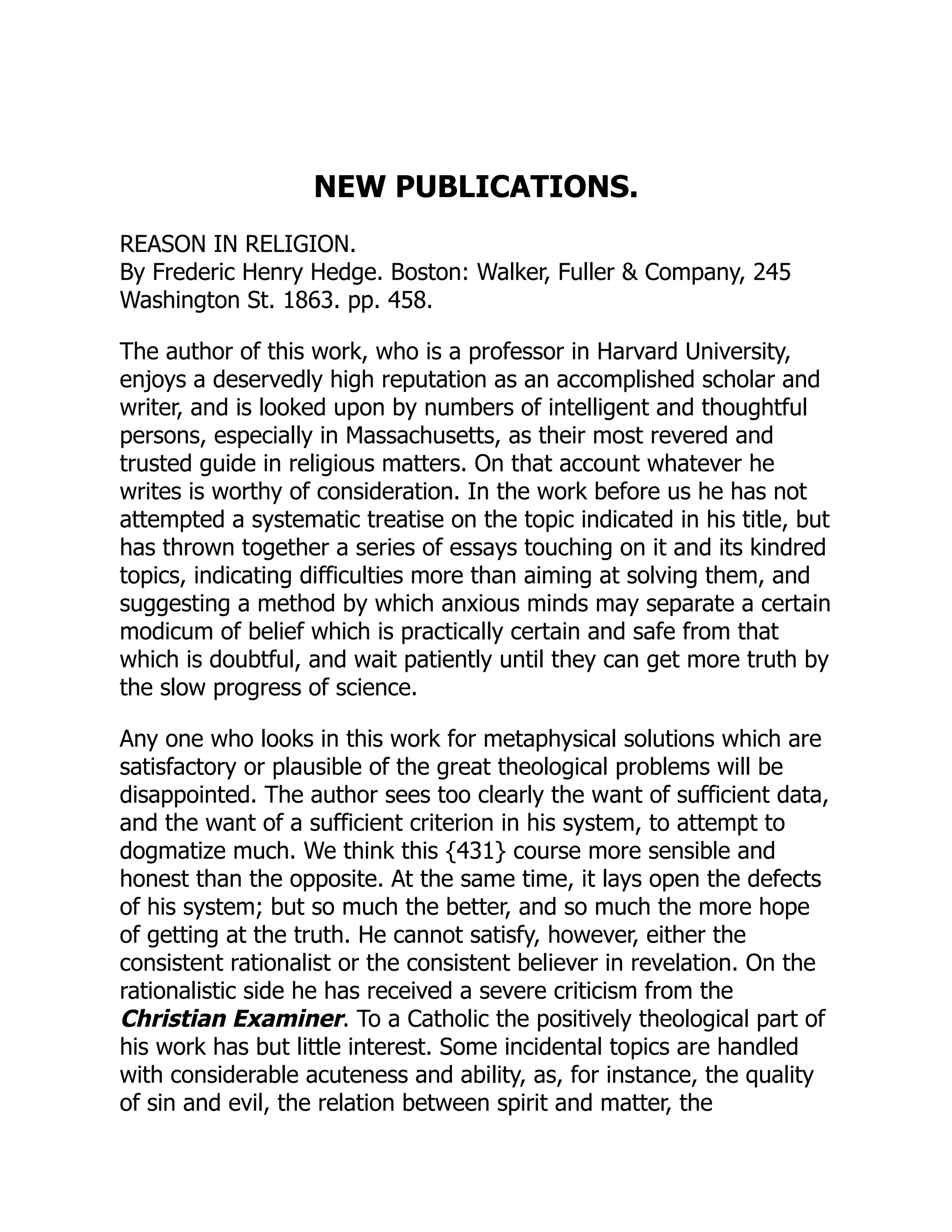


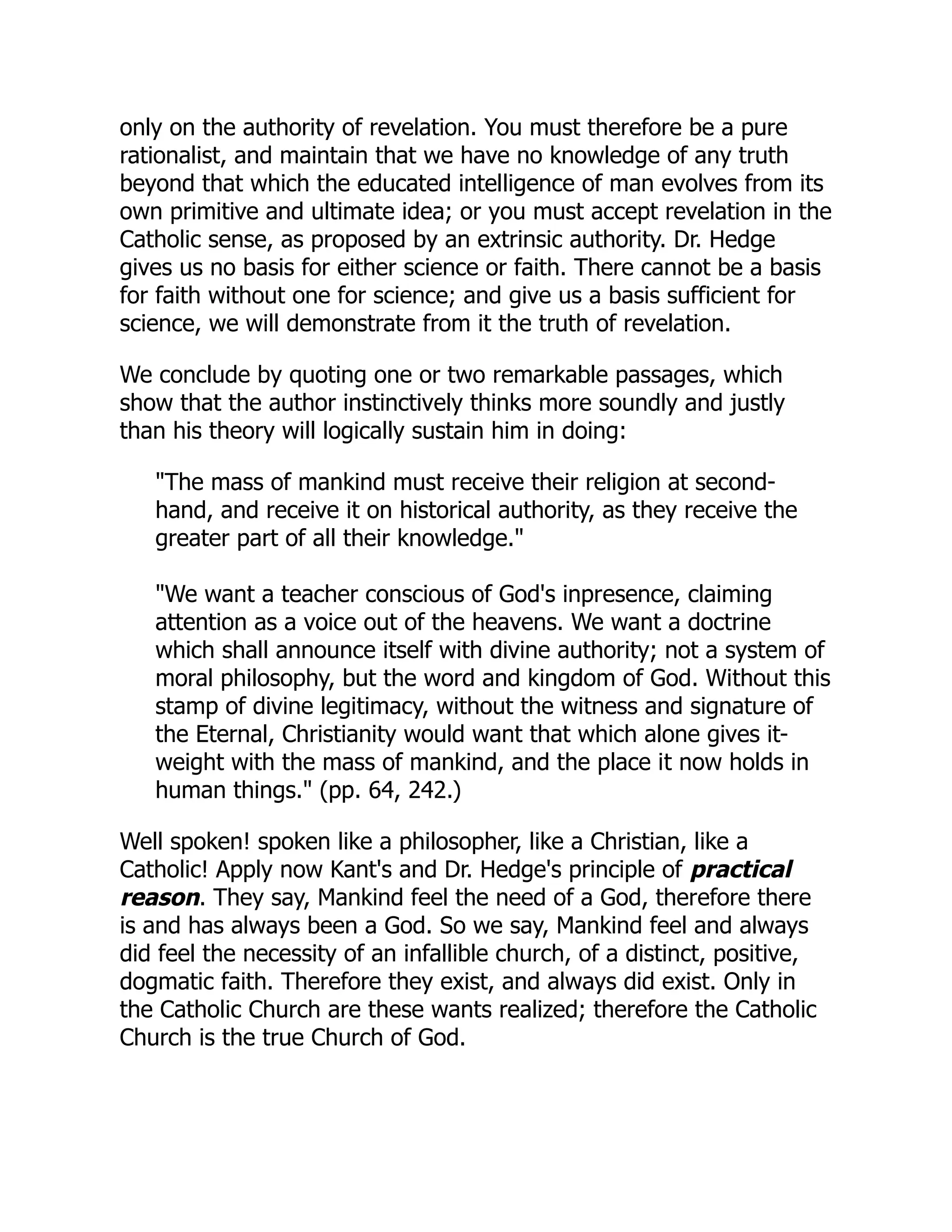

![Translated from Le Correspondant
LEIBNITZ AND BOSSUET. [Footnote 66]
[Footnote 66: "Oeuvres de Leibnitz, publiées pour la
prémière fois d'après les Manuscrits's, avec des
notes et une introduction," par A. Foucher de Carcil.
Paris: Firmin-Didot. Tomes. I. et II.]
Every friend of letters must greet with sincere pleasure the literary
enterprise of M. de Careil in undertaking a complete edition of the
writings of Leibnitz, a large part of which has hitherto remained
unpublished and even unknown, and especially to make that great
genius live anew for us in all his fulness and integrity. No greater
literary undertaking ever seduced the imagination of a young
erudite, is better fitted to attract the sympathy of the European
republic, or more difficult of execution. For it was precisely the
peculiarity of Leibnitz that, while he labored to embrace with a
firmness of grasp never equalled the whole of moral and physical
nature, all things real, ideal, or possible, in one and the same
system, he uniformly abstained from giving, in his writings, to that
system its full and entire development. Possessing the amplest and
most complete mind that ever lived, he took no care to give to any
of his works the seal of completeness and perfection. The inventor
of so many methods, mathematical and metaphysical, he never
arranged his ideas in a methodical order. He leads his readers, with a
rapid and firm step, through a labyrinth of abstract conceptions and
boundless erudition, but he suffers no hand but his own to hold the
guiding thread. He has left us numerous tracts and fragments of
great value indeed, but no work that reveals the unity of his system,
and gives us a summary of his doctrines. There is no summa of the](https://image.slidesharecdn.com/1188599-250522230609-ccf2de9c/75/Html5-Media-1st-Edition-Kevin-Martin-Shelley-Powers-42-2048.jpg)