© CONFIDENTIAL & PROPRIETARY
HSN codes for Goods and Service
Tax (GST) in India
© Avalara Technologies Private Limited
What are HSN codes?
© Avalara Technologies Private Limited
About HSN Codes
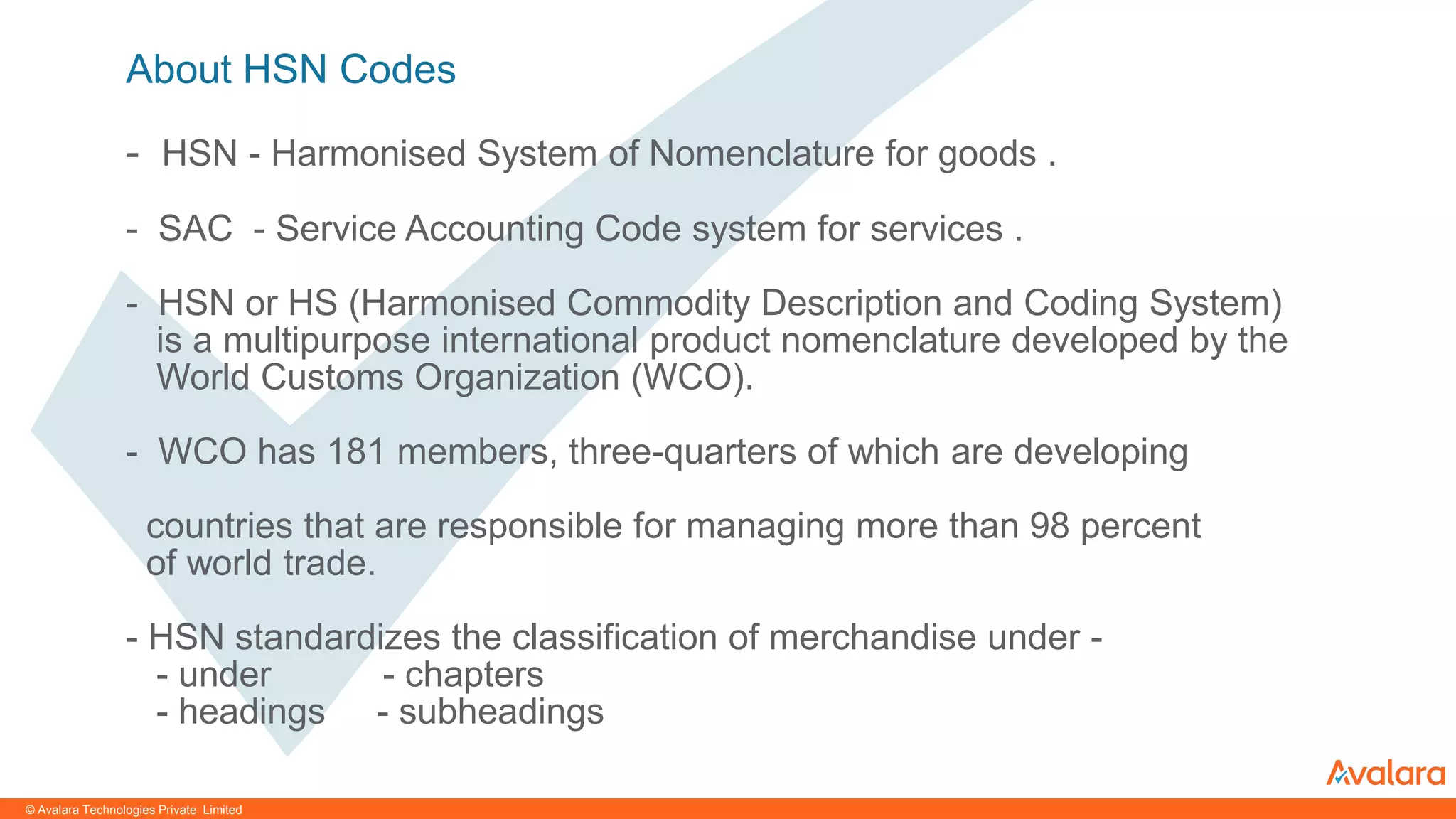
- HSN - Harmonised System of Nomenclature for goods .
- SAC - Service Accounting Code system for services .
- HSN or HS (Harmonised Commodity Description and Coding System)
is a multipurpose international product nomenclature developed by the
World Customs Organization (WCO).
- WCO has 181 members, three-quarters of which are developing
countries that are responsible for managing more than 98 percent
of world trade.
- HSN standardizes the classification of merchandise under -
- under - chapters
- headings - subheadings
© CONFIDENTIAL & PROPRIETARY© Avalara Technologies Private Limited
About HSN Codes
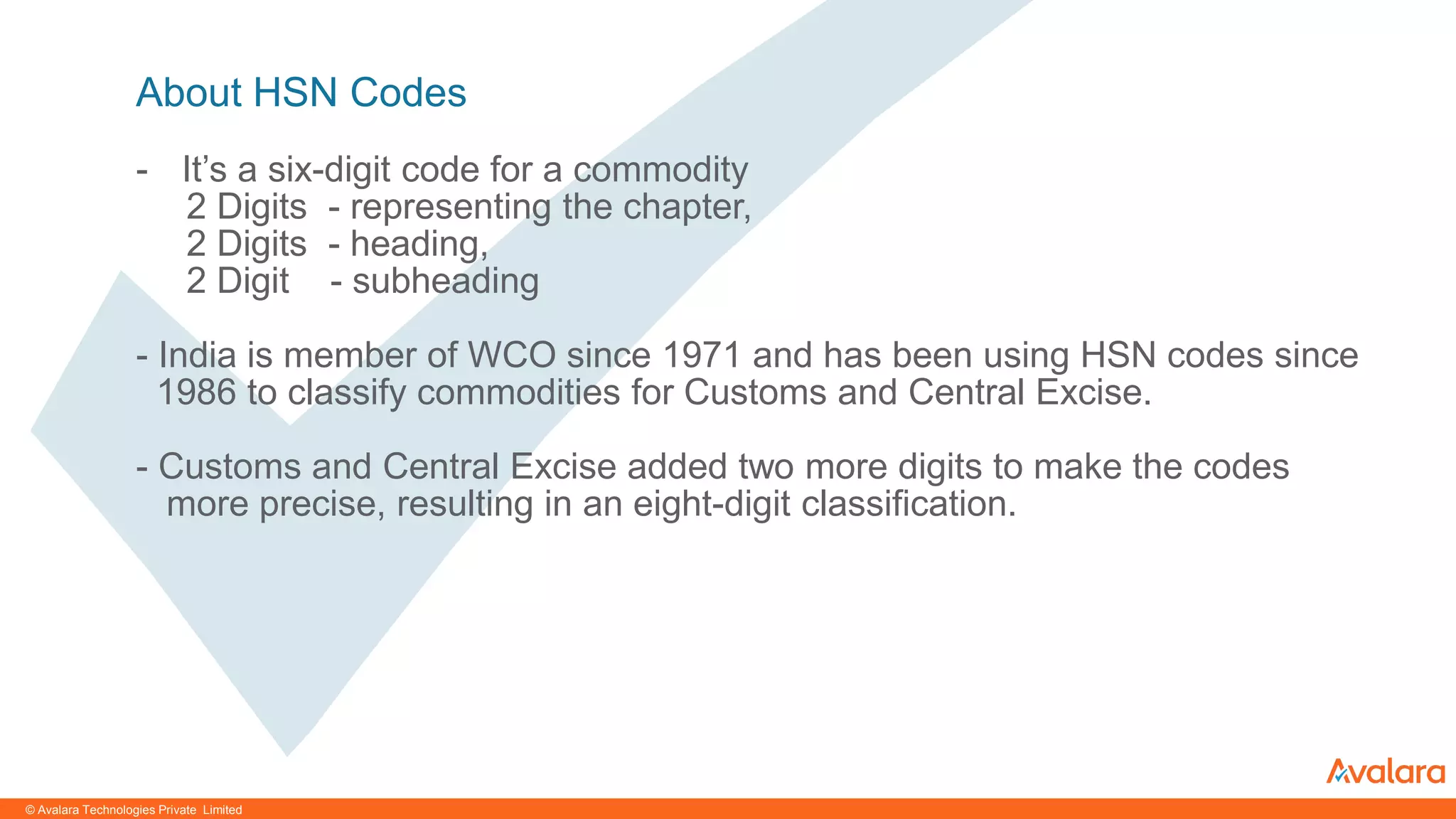
- It’s a six-digit code for a commodity
2 Digits - representing the chapter,
2 Digits - heading,
2 Digit - subheading
- India is member of WCO since 1971 and has been using HSN codes since
1986 to classify commodities for Customs and Central Excise.
- Customs and Central Excise added two more digits to make the codes
more precise, resulting in an eight-digit classification.
Use of HSN Codes
© Avalara Technologies Private Limited
© CONFIDENTIAL & PROPRIETARY
Under GST, the majority of dealers will need to adopt two-, four-, or
eight-digit HSN codes for their commodities, depending on their turnover
the year prior.
• Dealers with turnover of less than Rs1.5 crores will not be required to
adopt HSN codes for their commodities.
• Dealers with turnover between Rs1.5 crores and Rs5 crores shall be
required to use two-digit HSN codes for their commodities.
• Dealers with turnover equal to Rs 5 crores and above shall be required to
use four-digit HSN codes for their commodities.
• In the case of imports/exports, HSN codes of eight digits shall be
compulsory, as GST has to be compatible with international standards
and practices.
© Avalara Technologies Private Limited
Basics of HSN classification
© Avalara Technologies Private Limited
© CONFIDENTIAL & PROPRIETARY
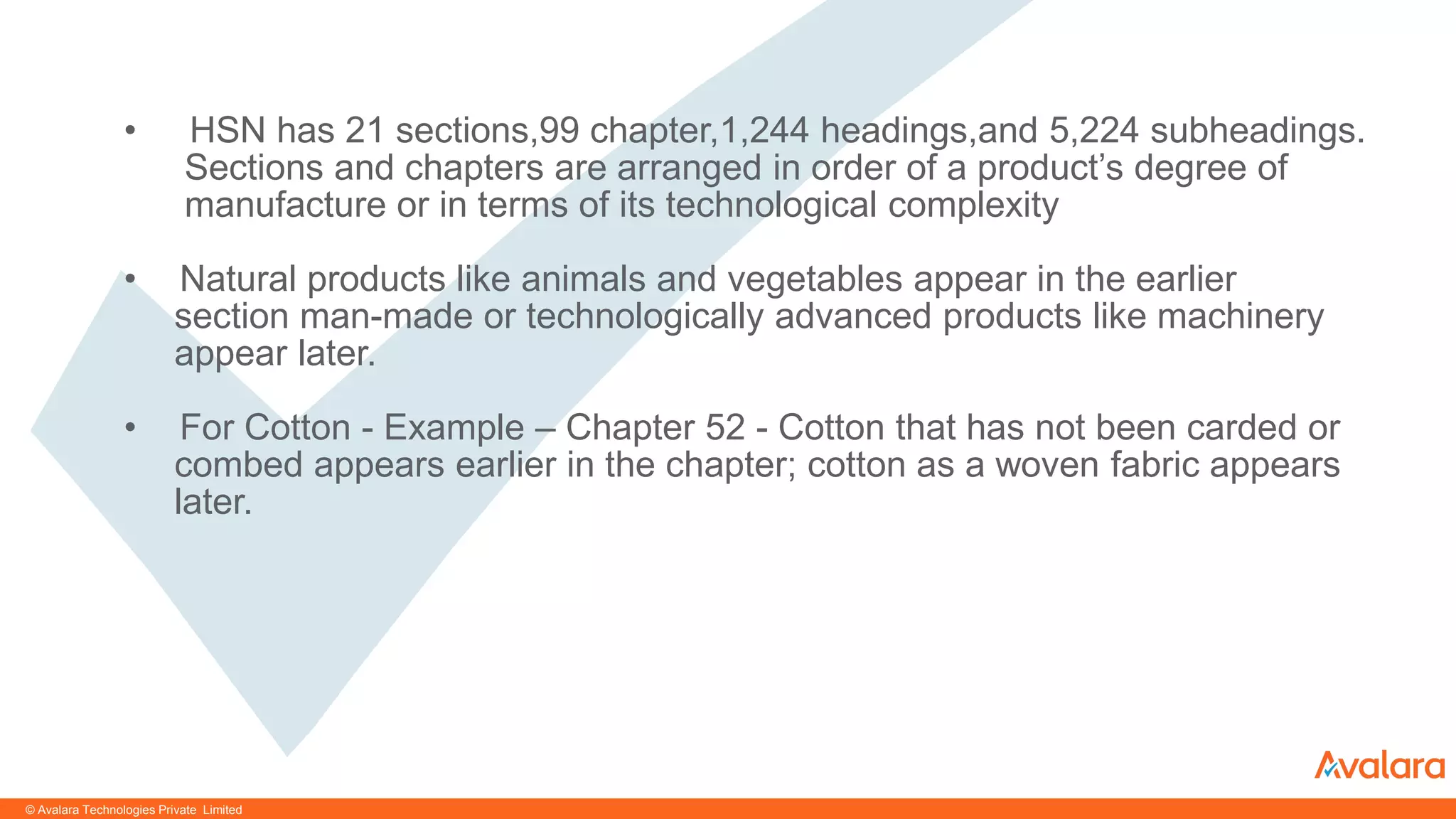
• HSN has 21 sections,99 chapter,1,244 headings,and 5,224 subheadings.
Sections and chapters are arranged in order of a product’s degree of
manufacture or in terms of its technological complexity
• Natural products like animals and vegetables appear in the earlier
section man-made or technologically advanced products like machinery
appear later.
• For Cotton - Example – Chapter 52 - Cotton that has not been carded or
combed appears earlier in the chapter; cotton as a woven fabric appears
later.
© Avalara Technologies Private Limited
More on HSN codes
© Avalara Technologies Private Limited
© CONFIDENTIAL & PROPRIETARY© CONFIDENTIAL & PROPRIETARY
• Each Section is a collection of various chapters.
• Sections represent a broader class of goods, and chapters represent
a particular class of goods.
o For example, Section XV relates to base metals and articles of
base metals, while Section XV, Chapter 72 is for iron and steel
specifically.
• Each chapter is further divided into various headings depending upon
different types of goods belonging to the same class.
o For example, Chapter 72, Heading 02 deals with ferro-alloys, and
Chapter 72, Heading 29 with wire of other alloys.
© Avalara Technologies Private Limited
• Each heading contains products, which are ultimately assigned an
HSN code. Ferro-manganese under ferro-alloys,
o For example, bears the HSN code 72.02.01 – 01 being the
product code under Heading 02 of Chapter 72. The HSN code
for other products under ferro-alloys is 72.02.99.
• For better identification of goods, India and a few other countries
use eight-digit codes for deeper classification.
o For example, 72.02.99.11 is the HSN code for ferro-phosphorus
under other ferro-alloy products.
© CONFIDENTIAL & PROPRIETARY© CONFIDENTIAL & PROPRIETARY© Avalara Technologies Private Limited
• Some HSN codes also use dashes:
o Single dash (-) at the beginning of a description denotes an article
that belongs to a group covered under a heading.
o Double dash (–) indicates that the article is a sub-classification of the
preceding article that has a single dash.
o Triple dash (—) or quadruple dash (—-) indicates the article is a sub-
classification of the preceding article that has a double dash or triple
dash.
© Avalara Technologies Private Limited
Classifying goods under HSN
© CONFIDENTIAL & PROPRIETARY© CONFIDENTIAL & PROPRIETARY
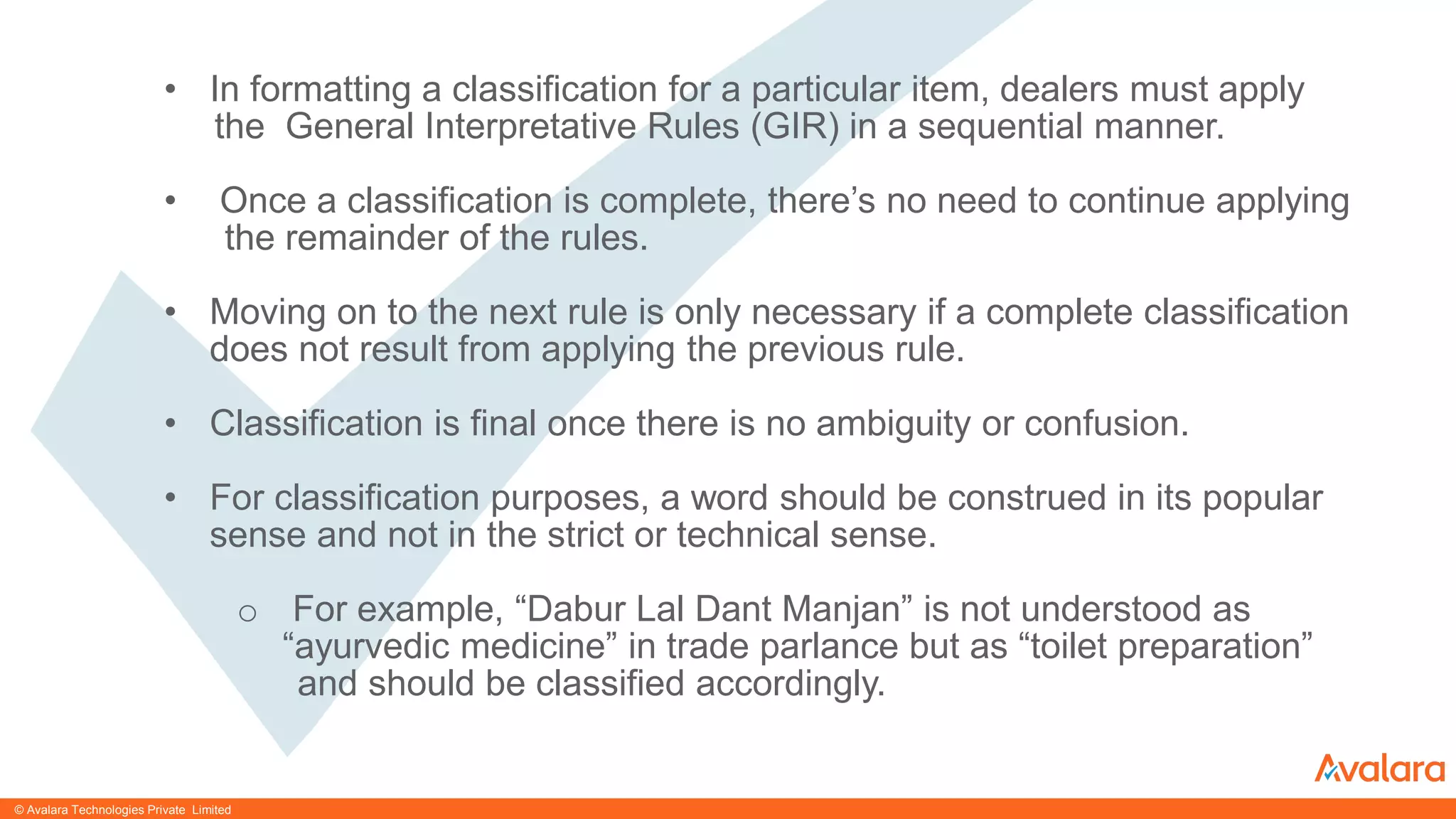
• In formatting a classification for a particular item, dealers must apply
the General Interpretative Rules (GIR) in a sequential manner.
• Once a classification is complete, there’s no need to continue applying
the remainder of the rules.
• Moving on to the next rule is only necessary if a complete classification
does not result from applying the previous rule.
• Classification is final once there is no ambiguity or confusion.
• For classification purposes, a word should be construed in its popular
sense and not in the strict or technical sense.
o For example, “Dabur Lal Dant Manjan” is not understood as
“ayurvedic medicine” in trade parlance but as “toilet preparation”
and should be classified accordingly.
© Avalara Technologies Private Limited
• Rule 1
- Titles of sections, chapters, and sub-chapters are provided for ease of
reference only.
- For legal purposes, refer to headings and sub-headings to drive
classification.
• Rule 2a
- If the goods are incomplete/unfinished and have the characteristics of the
finished product, classification is the same as that of the finished product
(if the classification is known).
- The heading shall also include removed/unassembled or disassembled
parts (i.e., SKD/CKD).
© CONFIDENTIAL & PROPRIETARY© CONFIDENTIAL & PROPRIETARY© Avalara Technologies Private Limited
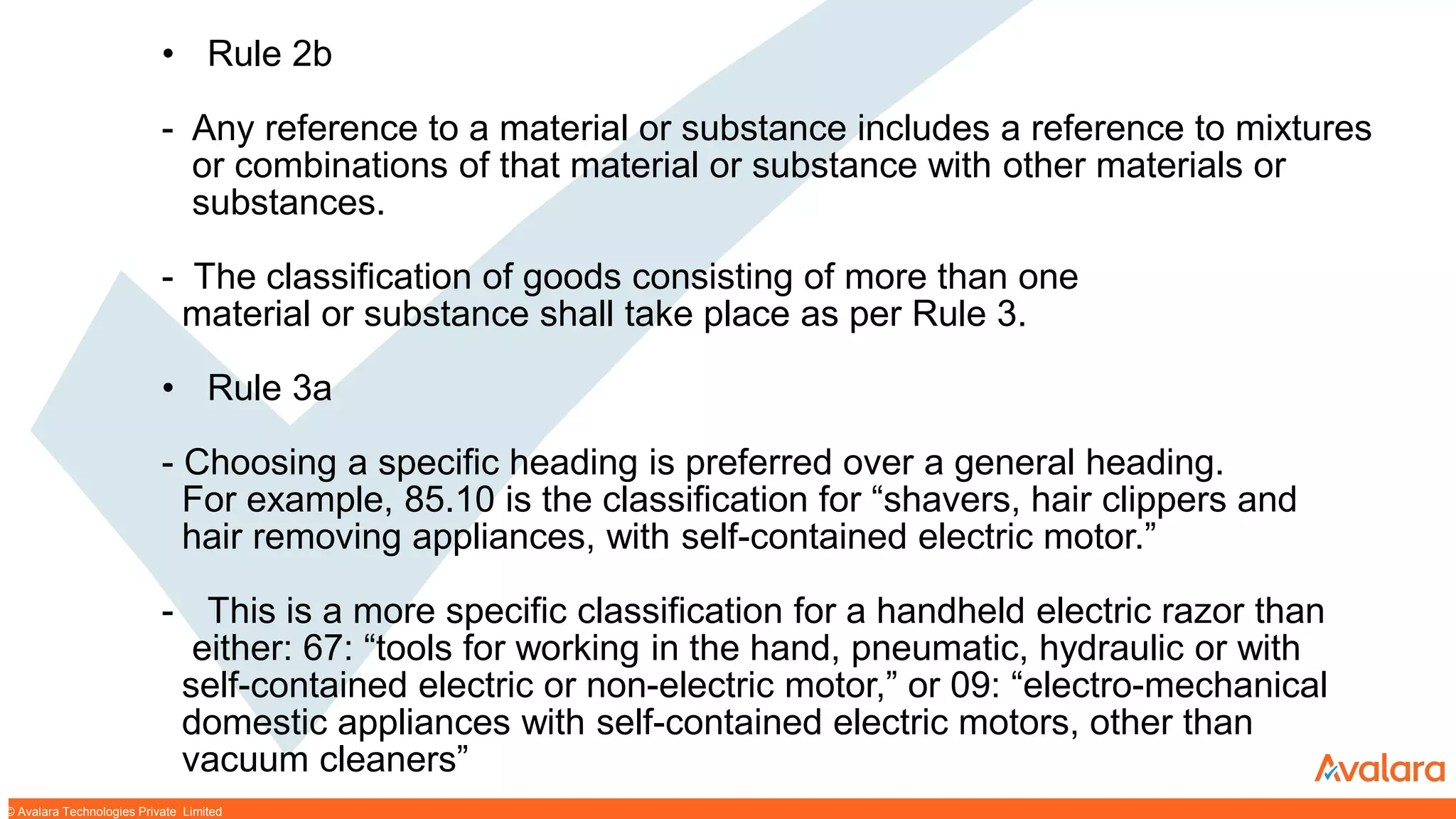
• Rule 2b
- Any reference to a material or substance includes a reference to mixtures
or combinations of that material or substance with other materials or
substances.
- The classification of goods consisting of more than one
material or substance shall take place as per Rule 3.
• Rule 3a
- Choosing a specific heading is preferred over a general heading.
For example, 85.10 is the classification for “shavers, hair clippers and
hair removing appliances, with self-contained electric motor.”
- This is a more specific classification for a handheld electric razor than
either: 67: “tools for working in the hand, pneumatic, hydraulic or with
self-contained electric or non-electric motor,” or 09: “electro-mechanical
domestic appliances with self-contained electric motors, other than
vacuum cleaners”
© Avalara Technologies Private Limited
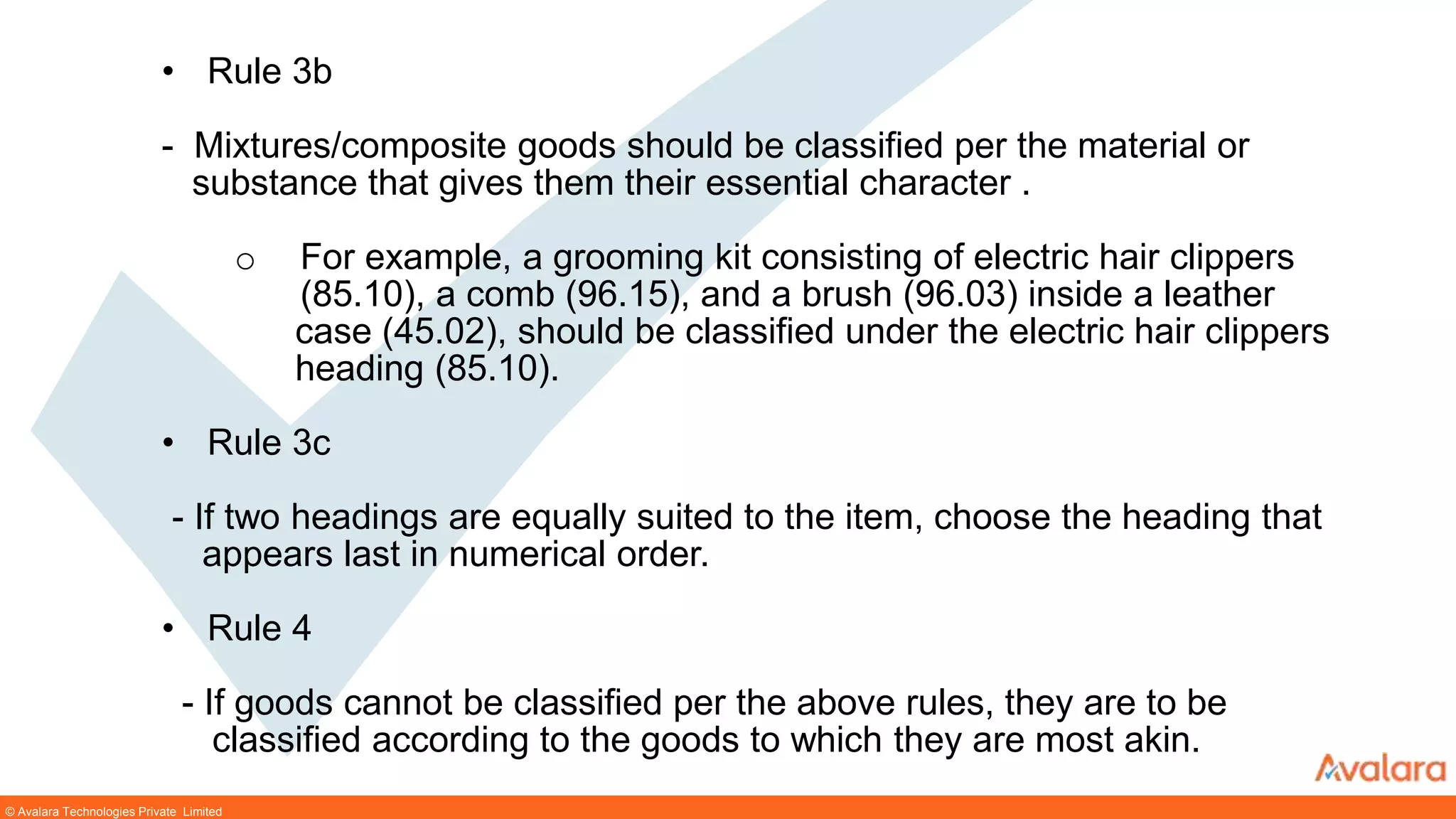
• Rule 3b
- Mixtures/composite goods should be classified per the material or
substance that gives them their essential character .
o For example, a grooming kit consisting of electric hair clippers
(85.10), a comb (96.15), and a brush (96.03) inside a leather
case (45.02), should be classified under the electric hair clippers
heading (85.10).
• Rule 3c
- If two headings are equally suited to the item, choose the heading that
appears last in numerical order.
• Rule 4
- If goods cannot be classified per the above rules, they are to be
classified according to the goods to which they are most akin.
© Avalara Technologies Private Limited
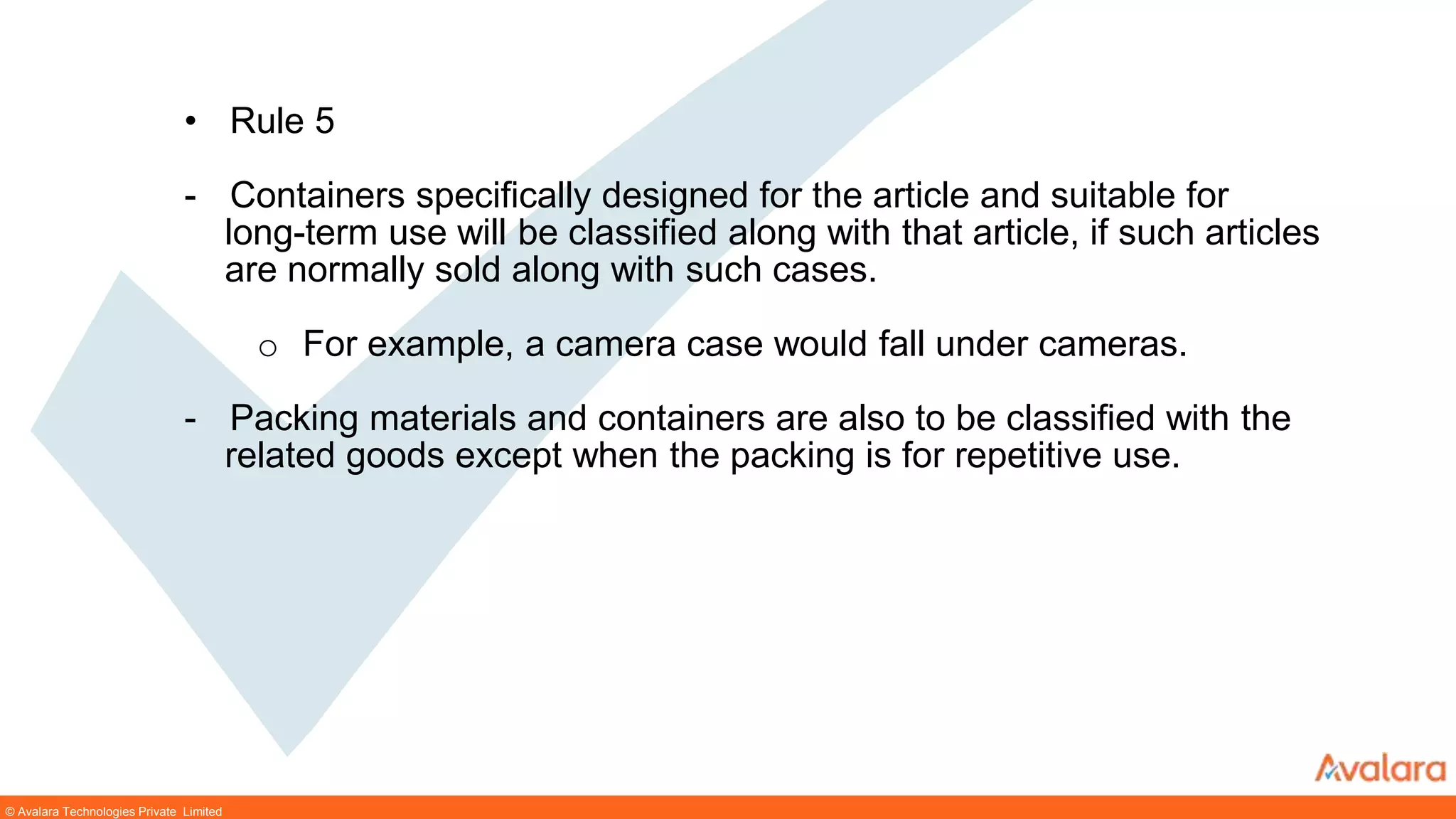
• Rule 5
- Containers specifically designed for the article and suitable for
long-term use will be classified along with that article, if such articles
are normally sold along with such cases.
o For example, a camera case would fall under cameras.
- Packing materials and containers are also to be classified with the
related goods except when the packing is for repetitive use.
Conclusion
© Avalara Technologies Private Limited
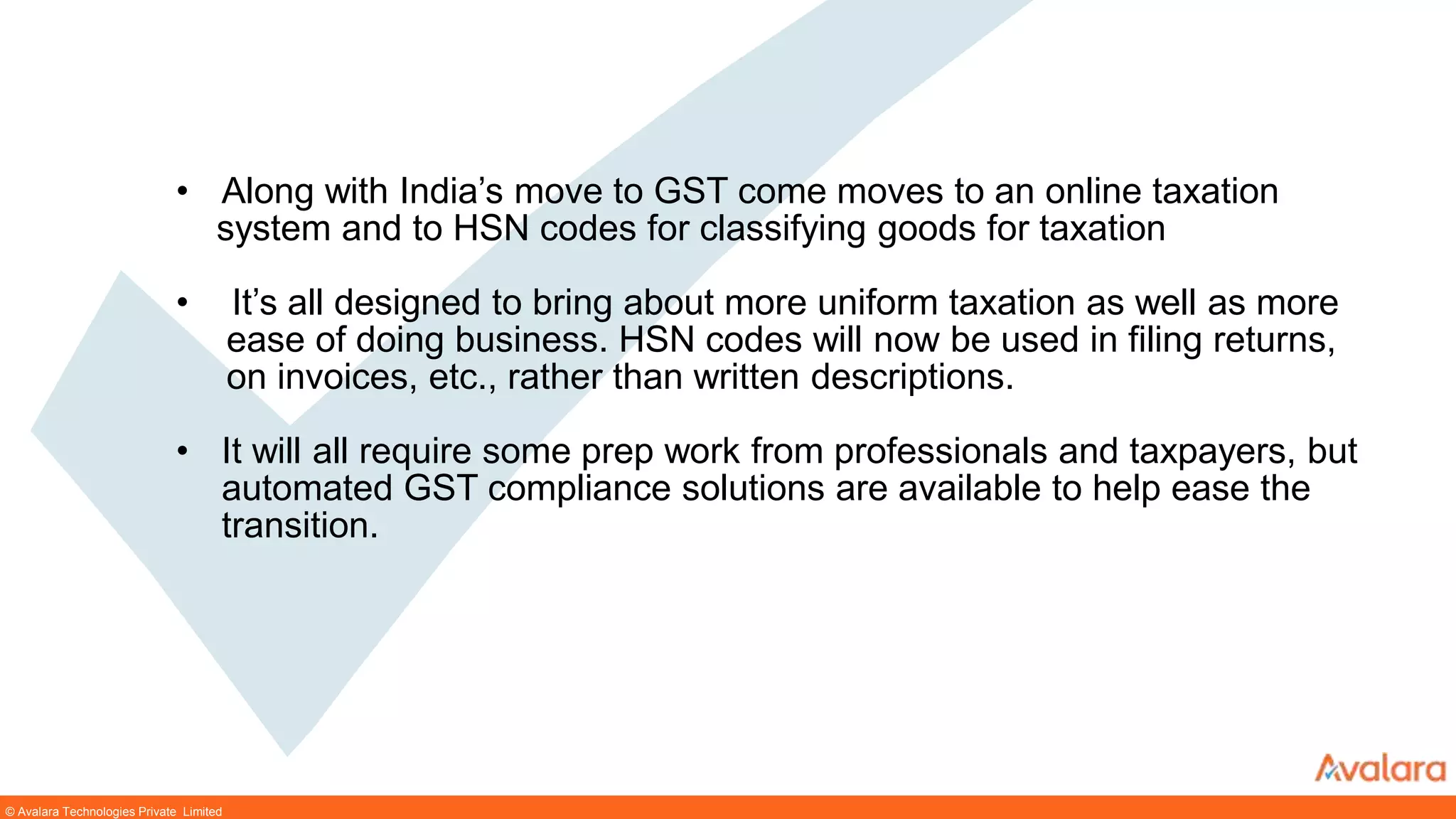
• Along with India’s move to GST come moves to an online taxation
system and to HSN codes for classifying goods for taxation
• It’s all designed to bring about more uniform taxation as well as more
ease of doing business. HSN codes will now be used in filing returns,
on invoices, etc., rather than written descriptions.
• It will all require some prep work from professionals and taxpayers, but
automated GST compliance solutions are available to help ease the
transition.
How to find HSN Code for
your Product ?
© Avalara Technologies Private Limited
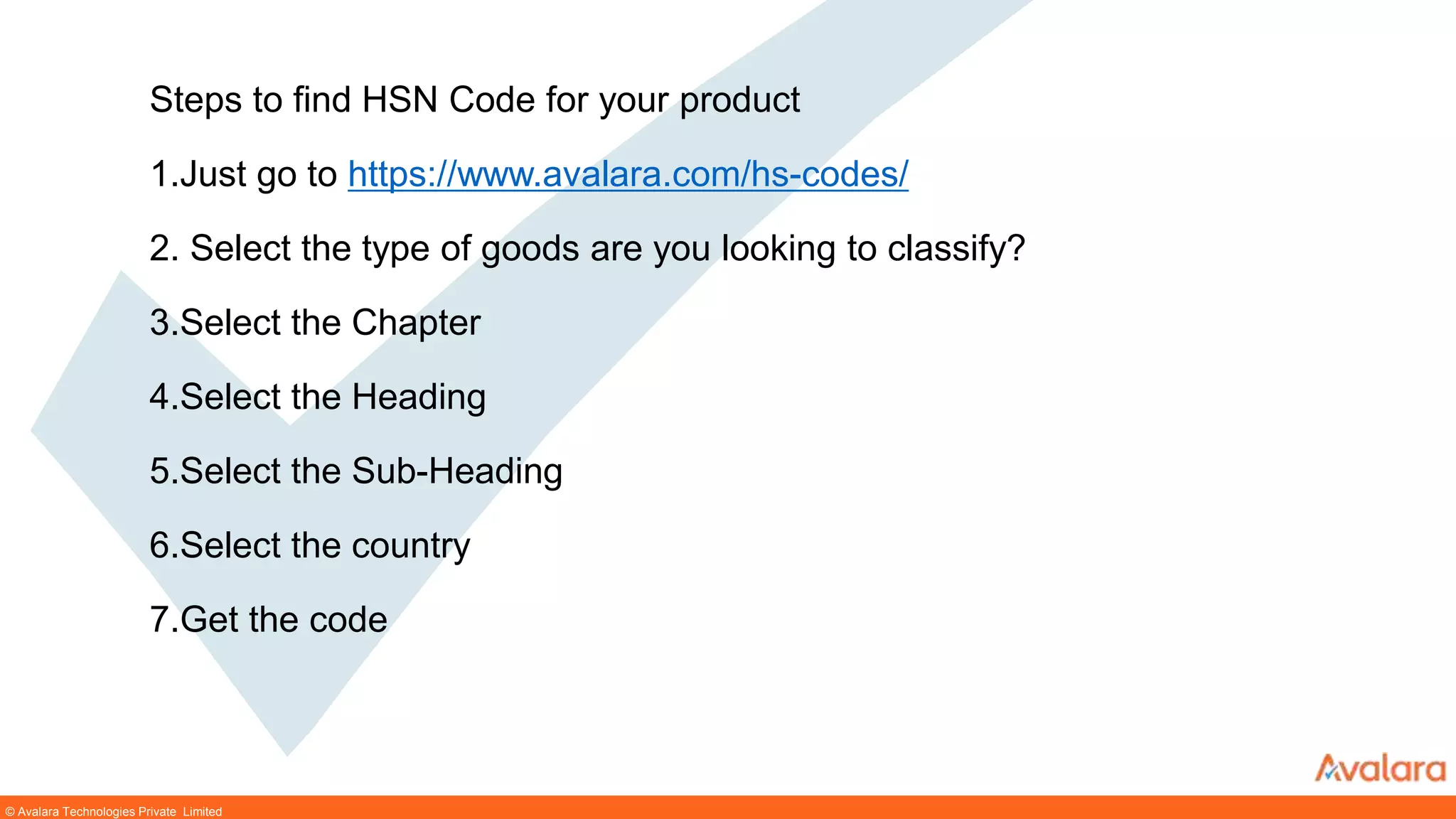
Steps to find HSN Code for your product
1.Just go to https://www.avalara.com/hs-codes/
2. Select the type of goods are you looking to classify?
3.Select the Chapter
4.Select the Heading
5.Select the Sub-Heading
6.Select the country
7.Get the code
Thank You
© Avalara Technologies Private Limited
For your GST Compliance automation needs,
Call us today at 1800-270-2875 or
Visit us at www.avalara.com/in/
Thank You

HSN codes for goods and service tax (GST) in india

  • 1.
    © CONFIDENTIAL &PROPRIETARY HSN codes for Goods and Service Tax (GST) in India © Avalara Technologies Private Limited
  • 2.
    What are HSNcodes? © Avalara Technologies Private Limited
  • 3.
    © Avalara TechnologiesPrivate Limited About HSN Codes - HSN - Harmonised System of Nomenclature for goods . - SAC - Service Accounting Code system for services . - HSN or HS (Harmonised Commodity Description and Coding System) is a multipurpose international product nomenclature developed by the World Customs Organization (WCO). - WCO has 181 members, three-quarters of which are developing countries that are responsible for managing more than 98 percent of world trade. - HSN standardizes the classification of merchandise under - - under - chapters - headings - subheadings
  • 4.
    © CONFIDENTIAL &PROPRIETARY© Avalara Technologies Private Limited About HSN Codes - It’s a six-digit code for a commodity 2 Digits - representing the chapter, 2 Digits - heading, 2 Digit - subheading - India is member of WCO since 1971 and has been using HSN codes since 1986 to classify commodities for Customs and Central Excise. - Customs and Central Excise added two more digits to make the codes more precise, resulting in an eight-digit classification.
  • 5.
    Use of HSNCodes © Avalara Technologies Private Limited
  • 6.
    © CONFIDENTIAL &PROPRIETARY Under GST, the majority of dealers will need to adopt two-, four-, or eight-digit HSN codes for their commodities, depending on their turnover the year prior. • Dealers with turnover of less than Rs1.5 crores will not be required to adopt HSN codes for their commodities. • Dealers with turnover between Rs1.5 crores and Rs5 crores shall be required to use two-digit HSN codes for their commodities. • Dealers with turnover equal to Rs 5 crores and above shall be required to use four-digit HSN codes for their commodities. • In the case of imports/exports, HSN codes of eight digits shall be compulsory, as GST has to be compatible with international standards and practices. © Avalara Technologies Private Limited
  • 7.
    Basics of HSNclassification © Avalara Technologies Private Limited
  • 8.
    © CONFIDENTIAL &PROPRIETARY • HSN has 21 sections,99 chapter,1,244 headings,and 5,224 subheadings. Sections and chapters are arranged in order of a product’s degree of manufacture or in terms of its technological complexity • Natural products like animals and vegetables appear in the earlier section man-made or technologically advanced products like machinery appear later. • For Cotton - Example – Chapter 52 - Cotton that has not been carded or combed appears earlier in the chapter; cotton as a woven fabric appears later. © Avalara Technologies Private Limited
  • 9.
    More on HSNcodes © Avalara Technologies Private Limited
  • 10.
    © CONFIDENTIAL &PROPRIETARY© CONFIDENTIAL & PROPRIETARY • Each Section is a collection of various chapters. • Sections represent a broader class of goods, and chapters represent a particular class of goods. o For example, Section XV relates to base metals and articles of base metals, while Section XV, Chapter 72 is for iron and steel specifically. • Each chapter is further divided into various headings depending upon different types of goods belonging to the same class. o For example, Chapter 72, Heading 02 deals with ferro-alloys, and Chapter 72, Heading 29 with wire of other alloys. © Avalara Technologies Private Limited
  • 11.
    • Each headingcontains products, which are ultimately assigned an HSN code. Ferro-manganese under ferro-alloys, o For example, bears the HSN code 72.02.01 – 01 being the product code under Heading 02 of Chapter 72. The HSN code for other products under ferro-alloys is 72.02.99. • For better identification of goods, India and a few other countries use eight-digit codes for deeper classification. o For example, 72.02.99.11 is the HSN code for ferro-phosphorus under other ferro-alloy products.
  • 12.
    © CONFIDENTIAL &PROPRIETARY© CONFIDENTIAL & PROPRIETARY© Avalara Technologies Private Limited • Some HSN codes also use dashes: o Single dash (-) at the beginning of a description denotes an article that belongs to a group covered under a heading. o Double dash (–) indicates that the article is a sub-classification of the preceding article that has a single dash. o Triple dash (—) or quadruple dash (—-) indicates the article is a sub- classification of the preceding article that has a double dash or triple dash.
  • 13.
    © Avalara TechnologiesPrivate Limited Classifying goods under HSN
  • 14.
    © CONFIDENTIAL &PROPRIETARY© CONFIDENTIAL & PROPRIETARY • In formatting a classification for a particular item, dealers must apply the General Interpretative Rules (GIR) in a sequential manner. • Once a classification is complete, there’s no need to continue applying the remainder of the rules. • Moving on to the next rule is only necessary if a complete classification does not result from applying the previous rule. • Classification is final once there is no ambiguity or confusion. • For classification purposes, a word should be construed in its popular sense and not in the strict or technical sense. o For example, “Dabur Lal Dant Manjan” is not understood as “ayurvedic medicine” in trade parlance but as “toilet preparation” and should be classified accordingly. © Avalara Technologies Private Limited
  • 15.
    © Avalara TechnologiesPrivate Limited • Rule 1 - Titles of sections, chapters, and sub-chapters are provided for ease of reference only. - For legal purposes, refer to headings and sub-headings to drive classification. • Rule 2a - If the goods are incomplete/unfinished and have the characteristics of the finished product, classification is the same as that of the finished product (if the classification is known). - The heading shall also include removed/unassembled or disassembled parts (i.e., SKD/CKD).
  • 16.
    © CONFIDENTIAL &PROPRIETARY© CONFIDENTIAL & PROPRIETARY© Avalara Technologies Private Limited • Rule 2b - Any reference to a material or substance includes a reference to mixtures or combinations of that material or substance with other materials or substances. - The classification of goods consisting of more than one material or substance shall take place as per Rule 3. • Rule 3a - Choosing a specific heading is preferred over a general heading. For example, 85.10 is the classification for “shavers, hair clippers and hair removing appliances, with self-contained electric motor.” - This is a more specific classification for a handheld electric razor than either: 67: “tools for working in the hand, pneumatic, hydraulic or with self-contained electric or non-electric motor,” or 09: “electro-mechanical domestic appliances with self-contained electric motors, other than vacuum cleaners”
  • 17.
    © Avalara TechnologiesPrivate Limited • Rule 3b - Mixtures/composite goods should be classified per the material or substance that gives them their essential character . o For example, a grooming kit consisting of electric hair clippers (85.10), a comb (96.15), and a brush (96.03) inside a leather case (45.02), should be classified under the electric hair clippers heading (85.10). • Rule 3c - If two headings are equally suited to the item, choose the heading that appears last in numerical order. • Rule 4 - If goods cannot be classified per the above rules, they are to be classified according to the goods to which they are most akin.
  • 18.
    © Avalara TechnologiesPrivate Limited • Rule 5 - Containers specifically designed for the article and suitable for long-term use will be classified along with that article, if such articles are normally sold along with such cases. o For example, a camera case would fall under cameras. - Packing materials and containers are also to be classified with the related goods except when the packing is for repetitive use.
  • 19.
  • 20.
    © Avalara TechnologiesPrivate Limited • Along with India’s move to GST come moves to an online taxation system and to HSN codes for classifying goods for taxation • It’s all designed to bring about more uniform taxation as well as more ease of doing business. HSN codes will now be used in filing returns, on invoices, etc., rather than written descriptions. • It will all require some prep work from professionals and taxpayers, but automated GST compliance solutions are available to help ease the transition.
  • 21.
    How to findHSN Code for your Product ? © Avalara Technologies Private Limited
  • 22.
    © Avalara TechnologiesPrivate Limited Steps to find HSN Code for your product 1.Just go to https://www.avalara.com/hs-codes/ 2. Select the type of goods are you looking to classify? 3.Select the Chapter 4.Select the Heading 5.Select the Sub-Heading 6.Select the country 7.Get the code
  • 23.
    Thank You © AvalaraTechnologies Private Limited For your GST Compliance automation needs, Call us today at 1800-270-2875 or Visit us at www.avalara.com/in/ Thank You

Editor's Notes

  • #2 Our goal – make good on our value prop Magical experience Cult of the customer
  • #3 Our goal – make good on our value prop Magical experience Cult of the customer
  • #5 Our goal – make good on our value prop Magical experience Cult of the customer
  • #6 Our goal – make good on our value prop Magical experience Cult of the customer
  • #7 Our goal – make good on our value prop Magical experience Cult of the customer
  • #8 Our goal – make good on our value prop Magical experience Cult of the customer
  • #9 Our goal – make good on our value prop Magical experience Cult of the customer
  • #10 Our goal – make good on our value prop Magical experience Cult of the customer
  • #11 Our goal – make good on our value prop Magical experience Cult of the customer
  • #13 Our goal – make good on our value prop Magical experience Cult of the customer
  • #14 Our goal – make good on our value prop Magical experience Cult of the customer
  • #15 Our goal – make good on our value prop Magical experience Cult of the customer
  • #17 Our goal – make good on our value prop Magical experience Cult of the customer
  • #20 Our goal – make good on our value prop Magical experience Cult of the customer
  • #22 Our goal – make good on our value prop Magical experience Cult of the customer
  • #24 Our goal – make good on our value prop Magical experience Cult of the customer