HS codes development for
bamboo and rattan commodities
Presenter: Ms. Gael Grooby, Deputy Director Tariff and Trade Affairs Directorate,
World Customs Organization
The World Customs Organization (WCO)
Who are we? An independent Intergovernmental Organization (IGO),
we were established in 1952 as the Customs Co-operation Council. Our
mission is to enhance the effectiveness and efficiency of Customs
administrations. We represent and support 182 Customs
Administrations around the globe.
The global centre for Customs
expertise, we provide a forum
for dialogue, learning and
development and administer a
range of Conventions and other
international instruments on
Customs matters.
Most importantly for us here,
the WCO is the creator and
custodian of the International
Convention on the Harmonized
Commodity Description and
Coding System
The Harmonized Commodity Description
and Coding System
Commonly called the Harmonized System
or simply “the HS”
A (very) brief introduction to the HS
Governments (and industry) want to know what is being
traded
… but the vast variety of goods traded today makes it
impossible to create, maintain and use a list of all goods.
So the HS creates named groups into which every traded
physical good (including electricity) can be categorised.
This then enables governments to make provisions for the
accounting, treatment and consideration of the groups of
goods rather than for the individual products.
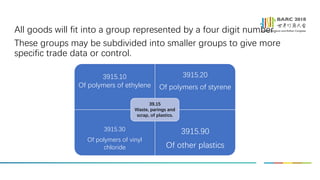
All goods will fit into a group represented by a four digit number.
These groups may be subdivided into smaller groups to give more
specific trade data or control.
39.15
Waste, parings and
scrap, of plastics.
3915.10
Of polymers of ethylene
3915.20
Of polymers of styrene
3915.30
Of polymers of vinyl
chloride
3915.90
Of other plastics
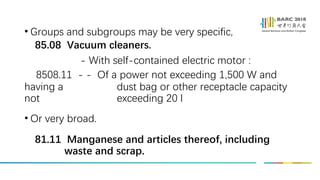
• Groups and subgroups may be very specific,
85.08 Vacuum cleaners.
    - With self-contained electric motor : 
8508.11 - - Of a power not exceeding 1,500 W and
having a dust bag or other receptacle capacity
not exceeding 20 l
• Or very broad.
81.11 Manganese and articles thereof, including
waste and scrap.
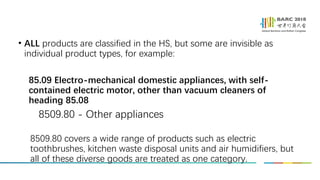
• ALL products are classified in the HS, but some are invisible as
individual product types, for example:
85.09 Electro-mechanical domestic appliances, with self-
contained electric motor, other than vacuum cleaners of
heading 85.08
       8509.80 - Other appliances
8509.80 covers a wide range of products such as electric
toothbrushes, kitchen waste disposal units and air humidifiers, but
all of these diverse goods are treated as one category.
We name and count what we value
(or what we are worried about)
When we give a particular type of product a specific HS
code,
we are saying:
This is important!
Usually, it is important because it is either:
• has a high trade value; or
• we want to control, restrict or monitor these goods.
The advantages of having your commodity specified
at the HS level
• Visibility
The HS is used by governments and international
organizations, as well as financial, trade and other private
sector bodies, for a variety of policy, legislative and
economic purposes. Visibility in the trade data is an
extremely strong tool for bringing attention to an industry
and raising its profile. It is recognized as an individual
product class that merits consideration in its own right.
The advantages of having your commodity specified at
the HS level (cont.)
• Statistical information
The extent, value, flows and evolution of the trade can be
captured and analyzed on a global basis.
In the case of products with environmental and economic
development credentials, this can also help to map their impact.
It also provides feedback on whether any support mechanisms
are sufficient to enhance trade.
The advantages of having your commodity specified at
the HS level (cont.)
• An agreed basis of identification for trade negotiations
The existence of classification for a specific commodity group
establishes it as a defined group that is understood
internationally. It allows the simple implementation of measures
and provides a way to track their application. This greatly
increases the likelihood of achieving a positive result for a
particular commodity, whether in a multilateral negotiation (for
example on environmental trade goods) or in a bilateral
negotiation.
Turning theory into reality
On behalf of the B&R industry, INBAR has already achieved multiple
changes to the HS to create B&R specific codes. However, realising the
full benefits of this requires intelligent trade use.
How do you make the most of the B&R specific codes?
• Ensure correct classification. The trade will only be visible if it is
correctly captured in the statistics.
• Use the trade data: global data (that is HS level data) is captured by
organisations like UN Comtrade and can be used for research and
analysis.
• Emphasis the ease of separate identification at the borders through the
HS codes when looking to negotiate trade policy positions.
Over to you ….
• HS codes are a positive step forward for the industry.
• They provide visibility and a clear place on the trade map.
• Their use gives data and a means to negotiate trade incentives
However, to gain the full value requires that the industry:
• ensures accurate data collection (correct classification);
• accesses and uses the data; and
• understands how the advantages of specific codes can aid
planning and negotiations.
Gael Grooby_HS Codes Development for Bamboo and Rattan Commodities

Gael Grooby_HS Codes Development for Bamboo and Rattan Commodities

  • 1.
    HS codes developmentfor bamboo and rattan commodities Presenter: Ms. Gael Grooby, Deputy Director Tariff and Trade Affairs Directorate, World Customs Organization
  • 2.
    The World CustomsOrganization (WCO) Who are we? An independent Intergovernmental Organization (IGO), we were established in 1952 as the Customs Co-operation Council. Our mission is to enhance the effectiveness and efficiency of Customs administrations. We represent and support 182 Customs Administrations around the globe. The global centre for Customs expertise, we provide a forum for dialogue, learning and development and administer a range of Conventions and other international instruments on Customs matters. Most importantly for us here, the WCO is the creator and custodian of the International Convention on the Harmonized Commodity Description and Coding System
  • 3.
    The Harmonized CommodityDescription and Coding System Commonly called the Harmonized System or simply “the HS”
  • 4.
    A (very) briefintroduction to the HS Governments (and industry) want to know what is being traded … but the vast variety of goods traded today makes it impossible to create, maintain and use a list of all goods. So the HS creates named groups into which every traded physical good (including electricity) can be categorised. This then enables governments to make provisions for the accounting, treatment and consideration of the groups of goods rather than for the individual products.
  • 5.
    All goods willfit into a group represented by a four digit number. These groups may be subdivided into smaller groups to give more specific trade data or control. 39.15 Waste, parings and scrap, of plastics. 3915.10 Of polymers of ethylene 3915.20 Of polymers of styrene 3915.30 Of polymers of vinyl chloride 3915.90 Of other plastics
  • 6.
    • Groups andsubgroups may be very specific, 85.08 Vacuum cleaners.     - With self-contained electric motor :  8508.11 - - Of a power not exceeding 1,500 W and having a dust bag or other receptacle capacity not exceeding 20 l • Or very broad. 81.11 Manganese and articles thereof, including waste and scrap.
  • 7.
    • ALL productsare classified in the HS, but some are invisible as individual product types, for example: 85.09 Electro-mechanical domestic appliances, with self- contained electric motor, other than vacuum cleaners of heading 85.08        8509.80 - Other appliances 8509.80 covers a wide range of products such as electric toothbrushes, kitchen waste disposal units and air humidifiers, but all of these diverse goods are treated as one category.
  • 8.
    We name andcount what we value (or what we are worried about)
  • 9.
    When we givea particular type of product a specific HS code, we are saying: This is important! Usually, it is important because it is either: • has a high trade value; or • we want to control, restrict or monitor these goods.
  • 10.
    The advantages ofhaving your commodity specified at the HS level • Visibility The HS is used by governments and international organizations, as well as financial, trade and other private sector bodies, for a variety of policy, legislative and economic purposes. Visibility in the trade data is an extremely strong tool for bringing attention to an industry and raising its profile. It is recognized as an individual product class that merits consideration in its own right.
  • 11.
    The advantages ofhaving your commodity specified at the HS level (cont.) • Statistical information The extent, value, flows and evolution of the trade can be captured and analyzed on a global basis. In the case of products with environmental and economic development credentials, this can also help to map their impact. It also provides feedback on whether any support mechanisms are sufficient to enhance trade.
  • 12.
    The advantages ofhaving your commodity specified at the HS level (cont.) • An agreed basis of identification for trade negotiations The existence of classification for a specific commodity group establishes it as a defined group that is understood internationally. It allows the simple implementation of measures and provides a way to track their application. This greatly increases the likelihood of achieving a positive result for a particular commodity, whether in a multilateral negotiation (for example on environmental trade goods) or in a bilateral negotiation.
  • 13.
    Turning theory intoreality On behalf of the B&R industry, INBAR has already achieved multiple changes to the HS to create B&R specific codes. However, realising the full benefits of this requires intelligent trade use. How do you make the most of the B&R specific codes? • Ensure correct classification. The trade will only be visible if it is correctly captured in the statistics. • Use the trade data: global data (that is HS level data) is captured by organisations like UN Comtrade and can be used for research and analysis. • Emphasis the ease of separate identification at the borders through the HS codes when looking to negotiate trade policy positions.
  • 14.
    Over to you…. • HS codes are a positive step forward for the industry. • They provide visibility and a clear place on the trade map. • Their use gives data and a means to negotiate trade incentives However, to gain the full value requires that the industry: • ensures accurate data collection (correct classification); • accesses and uses the data; and • understands how the advantages of specific codes can aid planning and negotiations.