




© CONFIDENTIAL & PROPRIETARY
E-way bill rules and
compliance under GST
© Avalara Technologies Private Limited
What is an e-way bill?
© Avalara Technologies Private Limited
- The Electronic Way (e-way) bill is the new procedure introduced by the
government to curb the tax evasion taking place under the current value added
tax (VAT) laws.
- The e-way bill shall unify all these with a standard documentation procedure
under the Goods and Services Tax (GST) regime.
- As per the draft rules issued recently, every registered person who causes
movement of goods, whether interstate or intrastate, is required to generate
an e-way bill when the consignment value of the goods is more than
Rs.50,000.
© CONFIDENTIAL & PROPRIETARY© Avalara Technologies Private Limited
• An e-way bill furnishes information relating to the goods being moved.
Movement of goods may be:
o In relation to a supply
o For reasons other than supply
o Due to inward supply from an unregistered person
How to generate an e-way bill
© Avalara Technologies Private Limited
© CONFIDENTIAL & PROPRIETARY
• A registered person shall furnish information relating to the transported goods
in Part A of Form GST-INS-01.
• The registered person may also upload the tax invoice he issues in Form
GST-INV-01 to auto populate Part A of the form.
• Thereafter, the consignor or the consignee shall furnish details in Part B of
Form GST-INS-01 and generate the e-way bill.
• Else the registered person shall furnish the transporter’s information in Part B,
and the transporter shall generate the e-way bill himself based on the
information furnished in Part A.
© Avalara Technologies Private Limited
© CONFIDENTIAL & PROPRIETARY
• Upon generation of an e-way bill, a unique e-way bill number (EBN) shall be
made available to the supplier, recipient, and transporter.
• The recipient must communicate his acceptance or rejection of the
consignment. If no communication is received within 72 hours, it will be
deemed accepted
© Avalara Technologies Private Limited
Responsibility of the
transporter
© Avalara Technologies Private Limited
© CONFIDENTIAL & PROPRIETARY© CONFIDENTIAL & PROPRIETARY
• If the e-way bill is not generated and the consignment value of goods is
more than Rs.50,000, the transporter may furnish the needed information
in Form GST-INS-01 himself.
• In the case of multiple consignments by the transporter in one
conveyance, the transporter shall generate a consolidated e-way bill by
furnishing all EBNs in Form GST-INS-02.
• In the case of multiple conveyances, the transporter shall generate a new
e-way bill for each change in transit specifying the mode of transport
before the transfer occurs.
© Avalara Technologies Private Limited
Validity of an e-way bill
© Avalara Technologies Private Limited
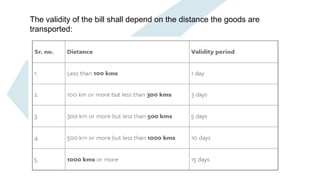
The validity of the bill shall depend on the distance the goods are
transported:
© Avalara Technologies Private Limited
Responsibility of the person
in charge of conveyance
© CONFIDENTIAL & PROPRIETARY© CONFIDENTIAL & PROPRIETARY© Avalara Technologies Private Limited
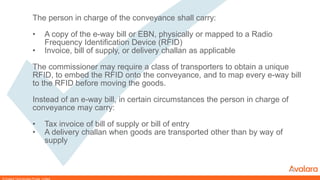
The person in charge of the conveyance shall carry:
• A copy of the e-way bill or EBN, physically or mapped to a Radio
Frequency Identification Device (RFID)
• Invoice, bill of supply, or delivery challan as applicable
The commissioner may require a class of transporters to obtain a unique
RFID, to embed the RFID onto the conveyance, and to map every e-way bill
to the RFID before moving the goods.
Instead of an e-way bill, in certain circumstances the person in charge of
conveyance may carry:
• Tax invoice of bill of supply or bill of entry
• A delivery challan when goods are transported other than by way of
supply
Verifying documents and
inspecting goods
© Avalara Technologies Private Limited
© CONFIDENTIAL & PROPRIETARY© CONFIDENTIAL & PROPRIETARY
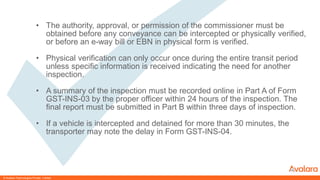
• The authority, approval, or permission of the commissioner must be
obtained before any conveyance can be intercepted or physically verified,
or before an e-way bill or EBN in physical form is verified.
• Physical verification can only occur once during the entire transit period
unless specific information is received indicating the need for another
inspection.
• A summary of the inspection must be recorded online in Part A of Form
GST-INS-03 by the proper officer within 24 hours of the inspection. The
final report must be submitted in Part B within three days of inspection.
• If a vehicle is intercepted and detained for more than 30 minutes, the
transporter may note the delay in Form GST-INS-04.
© Avalara Technologies Private Limited
Conclusion
© Avalara Technologies Private Limited
• The government has given serious thought to these rules, with the
motive to reduce human intervention and eliminate officer discretion.
• However, it remains to be seen how the small transporters and SMEs
cope with this scale of digitization.
• Revenue Secretary Hasmukh Adhia has promised that the government
won’t be overly harsh in the initial stages of e-way and shall only observe
the behavior of the transporters.
• Thus, penalties for non-compliance will not be part of the process from
day one but will eventually be instituted
Thank You
© Avalara Technologies Private Limited
For your GST Compliance automation needs,
Call us today at 1800-270-2875 or
Visit us at www.avalara.com/in/
Thank You

E-way bill rules and compliance under GST

  • 1.
    © CONFIDENTIAL &PROPRIETARY E-way bill rules and compliance under GST © Avalara Technologies Private Limited
  • 2.
    What is ane-way bill? © Avalara Technologies Private Limited
  • 3.
    © Avalara TechnologiesPrivate Limited - The Electronic Way (e-way) bill is the new procedure introduced by the government to curb the tax evasion taking place under the current value added tax (VAT) laws. - The e-way bill shall unify all these with a standard documentation procedure under the Goods and Services Tax (GST) regime. - As per the draft rules issued recently, every registered person who causes movement of goods, whether interstate or intrastate, is required to generate an e-way bill when the consignment value of the goods is more than Rs.50,000.
  • 4.
    © CONFIDENTIAL &PROPRIETARY© Avalara Technologies Private Limited • An e-way bill furnishes information relating to the goods being moved. Movement of goods may be: o In relation to a supply o For reasons other than supply o Due to inward supply from an unregistered person
  • 5.
    How to generatean e-way bill © Avalara Technologies Private Limited
  • 6.
    © CONFIDENTIAL &PROPRIETARY • A registered person shall furnish information relating to the transported goods in Part A of Form GST-INS-01. • The registered person may also upload the tax invoice he issues in Form GST-INV-01 to auto populate Part A of the form. • Thereafter, the consignor or the consignee shall furnish details in Part B of Form GST-INS-01 and generate the e-way bill. • Else the registered person shall furnish the transporter’s information in Part B, and the transporter shall generate the e-way bill himself based on the information furnished in Part A. © Avalara Technologies Private Limited
  • 7.
    © CONFIDENTIAL &PROPRIETARY • Upon generation of an e-way bill, a unique e-way bill number (EBN) shall be made available to the supplier, recipient, and transporter. • The recipient must communicate his acceptance or rejection of the consignment. If no communication is received within 72 hours, it will be deemed accepted © Avalara Technologies Private Limited
  • 8.
    Responsibility of the transporter ©Avalara Technologies Private Limited
  • 9.
    © CONFIDENTIAL &PROPRIETARY© CONFIDENTIAL & PROPRIETARY • If the e-way bill is not generated and the consignment value of goods is more than Rs.50,000, the transporter may furnish the needed information in Form GST-INS-01 himself. • In the case of multiple consignments by the transporter in one conveyance, the transporter shall generate a consolidated e-way bill by furnishing all EBNs in Form GST-INS-02. • In the case of multiple conveyances, the transporter shall generate a new e-way bill for each change in transit specifying the mode of transport before the transfer occurs. © Avalara Technologies Private Limited
  • 10.
    Validity of ane-way bill © Avalara Technologies Private Limited
  • 11.
    The validity ofthe bill shall depend on the distance the goods are transported:
  • 12.
    © Avalara TechnologiesPrivate Limited Responsibility of the person in charge of conveyance
  • 13.
    © CONFIDENTIAL &PROPRIETARY© CONFIDENTIAL & PROPRIETARY© Avalara Technologies Private Limited The person in charge of the conveyance shall carry: • A copy of the e-way bill or EBN, physically or mapped to a Radio Frequency Identification Device (RFID) • Invoice, bill of supply, or delivery challan as applicable The commissioner may require a class of transporters to obtain a unique RFID, to embed the RFID onto the conveyance, and to map every e-way bill to the RFID before moving the goods. Instead of an e-way bill, in certain circumstances the person in charge of conveyance may carry: • Tax invoice of bill of supply or bill of entry • A delivery challan when goods are transported other than by way of supply
  • 14.
    Verifying documents and inspectinggoods © Avalara Technologies Private Limited
  • 15.
    © CONFIDENTIAL &PROPRIETARY© CONFIDENTIAL & PROPRIETARY • The authority, approval, or permission of the commissioner must be obtained before any conveyance can be intercepted or physically verified, or before an e-way bill or EBN in physical form is verified. • Physical verification can only occur once during the entire transit period unless specific information is received indicating the need for another inspection. • A summary of the inspection must be recorded online in Part A of Form GST-INS-03 by the proper officer within 24 hours of the inspection. The final report must be submitted in Part B within three days of inspection. • If a vehicle is intercepted and detained for more than 30 minutes, the transporter may note the delay in Form GST-INS-04. © Avalara Technologies Private Limited
  • 16.
  • 17.
    © Avalara TechnologiesPrivate Limited • The government has given serious thought to these rules, with the motive to reduce human intervention and eliminate officer discretion. • However, it remains to be seen how the small transporters and SMEs cope with this scale of digitization. • Revenue Secretary Hasmukh Adhia has promised that the government won’t be overly harsh in the initial stages of e-way and shall only observe the behavior of the transporters. • Thus, penalties for non-compliance will not be part of the process from day one but will eventually be instituted
  • 18.
    Thank You © AvalaraTechnologies Private Limited For your GST Compliance automation needs, Call us today at 1800-270-2875 or Visit us at www.avalara.com/in/ Thank You

Editor's Notes

  • #2 Our goal – make good on our value prop Magical experience Cult of the customer
  • #3 Our goal – make good on our value prop Magical experience Cult of the customer
  • #5 Our goal – make good on our value prop Magical experience Cult of the customer
  • #6 Our goal – make good on our value prop Magical experience Cult of the customer
  • #7 Our goal – make good on our value prop Magical experience Cult of the customer
  • #8 Our goal – make good on our value prop Magical experience Cult of the customer
  • #9 Our goal – make good on our value prop Magical experience Cult of the customer
  • #10 Our goal – make good on our value prop Magical experience Cult of the customer
  • #11 Our goal – make good on our value prop Magical experience Cult of the customer
  • #13 Our goal – make good on our value prop Magical experience Cult of the customer
  • #14 Our goal – make good on our value prop Magical experience Cult of the customer
  • #15 Our goal – make good on our value prop Magical experience Cult of the customer
  • #16 Our goal – make good on our value prop Magical experience Cult of the customer
  • #17 Our goal – make good on our value prop Magical experience Cult of the customer
  • #19 Our goal – make good on our value prop Magical experience Cult of the customer